
JAIST Repository
https://dspace.jaist.ac.jp/
Title カプセル機能および形態制御によるポリプロピレン系
材料の長期安定化
Author(s) 片田, 一喜
Citation
Issue Date 2015‑03
Type Thesis or Dissertation Text version ETD
URL http://hdl.handle.net/10119/12767 Rights
Description Supervisor:寺野 稔, マテリアルサイエンス研究科,
博士
Doctoral Dissertation
Improvement of Long-term Stability of Polypropylene-based Materials through Encapsulation and Morphology Control
by
Ikki Katada
Supervisor: Professor Minoru Terano
School of Materials Science
Japan Advanced Institute of Science and Technology
March 2015
Preface
The present dissertation is the result of the studies under the direction of Professor Dr. Minoru Terano during 2012-2015. The purpose of this dissertation is a basis of the stabilization of polypropylene materials. The fundamentals in the polypropylene chemistry related to degradation and stabilization is presented as a general introduction in the first chapter. Chapter 2 shows the novel stabilization approach of polypropylene materials using hyperbranched polymer. Chapter 3 shows the development of this approach to polypropylene nanocomposites. Chapter 4 shows the effect of dendritic polymer on nano filler surface for stabilization of PP nanocomposites. Chapter 5 shows the control of crystalline unit cell for long-term stabilization on electrical breakdown property. The last chapter summarizes the conclusive items of this dissertation.
Ikki Katada Terano Laboratory,
School of Materials Science,
Japan Advanced Institute of Technology
Referee-in-chief: Professor Dr. Minoru Terano
Japan Advanced Institute of Science and Technology
Referees: Professor Dr. Masayuki Yamaguchi
Japan Advanced Institute of Science and Technology
Professor Dr. Noriyoshi Matsumi
Japan Advanced Institute of Science and Technology
Associate Professor Dr. Toshiaki Taniike
Japan Advanced Institute of Science and Technology
Professor Dr. Katsuhisa Tokumitsu The University of Shiga Prefecture
Contents
Chapter 1. General Introduction 1.1. Polypropylene
1.1.1. Background
1.1.2. Crystalline structures of Polypropylene 1.1.3. α form
1.2. Polypropylene Based Nanocomposites 1.2.1. Background
1.2.2. Polypropylene/SiO2 Nanocomposites 1.3. Degradation and Stabilization
1.3.1 Background 1.3.2. Degradation 1.3.2. Stabilization
1.3.3. Degradation of Composites 1.4. Hyperbranched Polymer
1.5. 1.5. Durability of PP in Capacitor Application 1.5.1 Background
1.5.2. Capacitor
1.5.2. Polypropylene Film for Capacitor 1.6. Objective
Chapter 2. Long-term Stability of Polypropylene materials by Hyperbranched Polymer
2.1. Introduction
2.2. Experimental Section 2.3. Results and Discussion 2.5. Conclusion
Chapter 3. Generation Effect of Hyperbranched Polymer and Preparation of Highly Stabilized Polypropylene Nanocomposites
2.1. Introduction
3.2. Experimental Section 3.3. Results and Discussion 3.4. Conclusion
Chapter 4. Stabilization of Polypropylene Nanocomposites by Dendritic Polyglycidol Modified Nano-Filler
4.1. Introduction
4.2 Experimental Section 4.3. Results and Discussion 4.4. Conclusion
Chapter 5. Long-term Stability for Capacitor Applications by Controlling Crystal Morphology
5.1. Introduction
5.2 Experimental Section 5.3. Results and Discussion 5.4. Conclusion
Chapter 6. General conclusion
6.1 General Summary 6.2 Conclusion
Chapter 1
General Introduction
1.1. Polypropylene
1.1.1. Background
High isotactic polypropylene (PP) is widely used plastics and one of the most important materials in the worlds because of its balanced properties. PP recognized that the discovery not only represented the first and most significant step in the synthesis of crystalline PP at the scientific and industrial level. In the years following its discovery, PP went through such a dynamic industrial development that it is one of the most widely used polymeric materials. Ziegler Natta (ZN) catalyst is most widely used for industrial production of 99% of PP and it has been used in numerous applications. As the development of catalyst chemistry has continued, the polymer morphology, properties and reactivity have been improved. Explosive growth of PP is due to the outstanding combination of cost performance, excellent physical properties, processability, and environmental friendly [1].
The application areas of PP also have been expanded with increasing its production amounts. Development of PP materials is still now desired in automobile fields especially because of its processability and so on. The researches of PP materials for accomplishments of its high performances are mainly classified to two classes. One is
“Control PP primary structure by catalyst technology”, and the other is “control high order structure by compounding technology”. Recent the most notable breakthrough achievement in the last couple of decades is “Nanocomposite”, which is classified to latter. Details of nanocomposites were indicated in chapter 1.2.
On the other hand, environment-conscious materials are also necessary for the coming century and PP will be expected as one of them. Polylactic acid is the most
desirable materials in environment-conscious materials because of its biodegradability [2]. However, PP materials, which is petrochemical raw materials, have been also tried to be gone as a carbon-neutrals [3,4].
With the rapid growth of PP industry have been needed the emergence of a new grade of general purpose plastics having higher performances. Therefore, the structure and morphology of PP are also introduced in this chapter. And also PP crystalline form is one of the important factors in chapter 4 especially. The explanation of PP structure was focused on.
1.1.2. Crystalline structures of Polypropylene
PP is a semi-crystalline polymer, which the crystalline architecture and crystallization of PP have been topics of interest. It is naturally expected that crystal structure and crystallization behavior are not only dependent upon molecular weight and molecular weight distribution, but also upon tacticities. Figure 1.1.2.1 shows PP chain molecule possesses a chain conformation with a 2 x 3/1 helix (tgtg).
:carbon
L
R
PP properties are strongly determined by its crystalline structure, and the relative amount of amorphous and crystalline phases, crystal modification, size and perfection of crystallites, dimensions of spherulites and the number of tie molecules all influence the performance of PP products [5]. Since the presence of the asymmetrically substituted methyl groups causes rotation around the backbone bonds to be direction-dependent, both right-handed and left-handed helices with stereo-isomer configurations of d and l result [6-10]. Combination of these possibilities leads to four distinguishable chain conformations.
The intramolecular interaction energies of all four types of helices are identical.
Their intermolecular interactions with each other in the crystal packing, however, depend upon packing geometry. Best packing is frequently achieved when the nearest neighbors of right-handed helices are the enantiomorphic left-handed helices and vice versa. Different packing geometries lead to four well-known crystal structures (polymorphs). The monoclinic (α) form [11], the hexagonal (β) form [12-14], the triclinic (γ) form [15-17] and the quenched form. Some reports have also proposed the existence of a δ form [18]. Among these crystal structures, the monoclinic (α) form is by far the most common, being formed in normal crystallized PP samples. The unoriented powder wide angle X-ray diffraction (WAXD) patterns for different forms in PP crystals are shown in Figure 1.1.3. Formation of these different forms is critically dependent on crystallization conditions and molecular characteristics. Because my work is especially relating to α form crystal in chapter 4, it was explained in chapter 1.1.3.
Figure 1.1.3. WAXD patterns for different forms in PP crystals
1.1.3. α form
The crystal unit cell of the α form was reported to be a = 0.666 nm, b = 2.078 nm, c
= 0.6495 nm, β = 99.62, and α = γ = 90˚C, with a crystallographic symmetry (space group) of P21/c [19]. The number of repeating unit cell involved in each unit cell is twelve and the crystallographic density is 0.946 g/cm3. Based on the unit cell reported by Natta and Corradini [20], a = 0.665 nm, b = 2.096 nm, c = 0.650 nm, β= 99.33, and α
= γ = 90˚C, the crystallographic density of the α form should be 0.936 g/cm3. It is particularly interesting that the three-fold screw axis of the PP molecule is not part of the crystal symmetry, as shown in Figure 1.1.4.
Figure 1.1.4. PP crystal unit cells of α form.
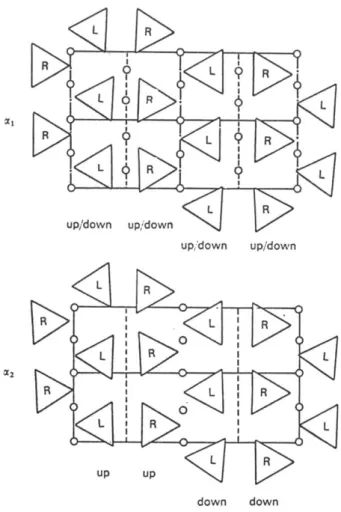
Although only isoclined helices (opposite handedness contacts) are evident here, the α form of PP also has two isomorphic (equal handedness contacts) helices. This leads to an increase in the coordination number without loss of packing by contacting helices of equal handedness. Another important feature lies in the positioning of the methyl groups within the polymer, isoclined (the methyl group is ‘up’ related to the left glide plane) and anticlined (the methyl group is ‘down’ related to the left glide plane) or vise versa. This introduces a high degree of disorder in PP crystals. It was reported that the α form in PP can be recrystallized and/or annealed from a less ordered α1 form with a random distribution of ‘up’ and ‘down’ chain packing of methyl groups to a more ordered α2 form with a well-defined deposition of ‘up’ and ‘down’ helices in the crystal unit cell. The packing energy difference between these two forms is only a few tenths of one kJ/mol. The space groups of these two forms are shown in Figure 1.1.5.
L
R
b c
a R
L R
L
Figure 1.1.5. Two monoclinic space groups, corresponding to α1 and α2 forms in PP
The α form is the most common and most extensively studied crystalline structure in PP. As for the lamellar scale, from transmission electron microscopy (TEM) observations, the crystalline morphology of PP is dominated by a highly characteristic lamellar branching (cross-hatch), which has no counterpart in other crystalline polymers [21]. Note that the cross-hatch structure is observed only for the α form, and not for the other forms. It has been recognized that this lamellar branching is formed by a constant angle between daughter (tangential direction in the spherulites) and parent (radial direction in the spherulites) lamellar of 80˚ or 100˚. The degree of the branching is depended on the Tc. and isotacticity. The branching decreases with
isotacticity of PP. In principle, the branching is an epitaxial growth phenomenon. It is explained by mainly three different aspects: molecular, crystallographic and morphological aspects [22]. The most general study was made by Lotz and Wittmann [23]. They suggested that structurally the daughter lamellae in PP grow epitaxially on the lateral (010) crystallographic plane of the parent lamellae by a satisfactory interdigitation of the methyl groups of facing planes. This condition arises from the near identity of the size of the a and c axes in the unit cell of the α form. From a molecular point of view, chains that deposit onto the (010) plane for the initiation of the epitaxy have the same helical handedness as chains in the (010) plane, but with a substantial angle of 80˚ or 100˚ in order to have favorable interactions of the methyl groups in the helices. In this study, 209 J/g was used based on the value from a literature, which seems to be one of the most reliable values [24].
1.2. Polypropylene Based Nanocomposites
1.2.1. Background
The Toyota researchers have developed a clay/nylon nanocomposite with excellent mechanical properties [25,26]. This success has aroused much attention for the use of polymer nanocomposites. The nanocomposite has been used to fabricate parts of automobiles, but this application was stopped because of the high cost. The high cost was caused by the time-intensive preparation process and the high price of nylon. This is why our group has aimed to develop nanocomposites using PP as a matrix.
In order to develop polymer nanocomposites as engineering plastics with high mechanical properties, at least two requirements must be satisfied. One is to separate
the stacked layer structure of clay, into monolayers if possible, in a polymer matrix.
The aspect ratio of the filler particle increases and as a result, the reinforcement effects are enhanced [27,28]. Another is to control the interfacial affinity between a clay particle surface and the matrix polymer [29,30]. We also thought that the type of filler would influence the mechanical properties of the resulting nanocomposites. So, spherical nano filler was chosen as filler for PP nanocomposites in our lab to subtract the factor of aspect ratio.
1.2.2. Polypropylene/SiO2 Nanocomposites
The mechanical properties of PP nanocomposites have been also improved [31] and PP/clay nanocomposite achieved to the application level as industrial fields [32,33].
Generally, non-polar nature of PP structure made PP more difficulty to improve their properties by using conventional techniques than other polar polymers. The developments of new techniques have been highly required for the preparation of PP nanocomposite. The preparation methods and processing work have been led to the development of the nanocomposites. Spherical SiO2 was also applied as a nano-filler for PP nanocomposites. Among PP-based nanocomposites, PP/SiO2 nanocomposite is one of the most reported systems from both academic and industrial fields. SiO2 has been widely used as a reinforcing agent for the rubbery materials. The use of SiO2 for other polymers like polyolefin is expected because of their price, properties and non-toxic aspects. In 1990, Osseoasare and Arrigada prepared nano-sized and mono-disperse SiO2 particles by controlled hydrolysis of tetraethoxysilane (TEOS) in an inverse micro emulsion. This micro emulsion method is also widely used to
synthesize SiO2 nanoparticles. SiO2 nanoparticles are now available from commercial sources, and they usually exist as powder or colloid.
In the case of PP/SiO2 nanocomposites, three general methods can be applied according to the starting materials and processing techniques: blending, sol-gel process and in-situ polymerization. Blending is just mixing of SiO2 nanoparticles into a polymer. For the preparation of SiO2 nanocomposites, fumed silica is commonly used and precipitated silica is seldom used since the precipitated one has more silanol groups (Si-OH) on the surface and consequently it is much easier to agglomerate than fumed one. As for commercial colloidal SiO2 spheres, they are usually in the form of a sol with water or alcohol as a dispersing medium. The surface of SiO2 is typically terminated with three silanol types: free or isolated silanols, hydrogen bonded or vicinal silanols and geminal silanols. Silanol groups residing on adjacent particles form hydrogen bonds and lead to formation of aggregates.
Our previous research got the highest mechanical property in the case of PP/SiO2
nanocomposites by grafting PP onto SiO2 surface [34]. Concept of our previous research was shown in Figure 1.2.1. This grafted PP acts as a rule of crystallization factor and this work suggested that co-crystallization between matrix PP and grafted PP might be existed. The highest improvement of PP/SiO2 nanocomposites may come from reinforcement of interface adhesion, which is weaker than polar nature polymers.
And the dispersion of SiO2 was also improved by grafted PP. Because of the availability of PP nanocomposite, SiO2 was chosen as nano filler in this research.
Figure 1.2.1. Results of our previous research
1.3. Degradation and Stabilization
1.3.1 Background
PP is easier to degradate than other polymers because of its tertiary hydrogen contained PP backbone. These tertiary hydrogens, which connect tertiary carbon, have higher radical reactivity and accelerate degradation reaction of PP [35]. However, it is not serious problem for PP application when we use PP as final products. It is known that the stability and lifetime of PP products were decided by the additives like antioxidants. Antioxidants can react with oxygen to substitute for PP itself. While antioxidants are working, PP degradation can be suppressed and PP can keep its good performances. In other words, the most important factor for the PP stability and lifetime is how to use antioxidants.
PP/SiO
2PP/PP-g-SiO
2agglomerates
Young’s modulus (MPa) Tensile strength (MPa) 800
600 650 700 750
25 26 27 28 29 30 31 32 33
physical cross-linkage
850
1.3.2. Degradation
Although PP is well known as a versatile plastic, its degradation is one of the most serious problems. After polymerization, PP is subjected to several processing steps involving extrusions. Even small degree of degradation reaction, it has an enormous effect on the physical properties. Generally it is well known that the degradation can be initiated by oxygen, shear, heat, light, catalyst residues and so on. It is widely accepted that the degradation follows so called ‘auto-oxidation mechanism’ as shown in Scheme 1.3.1 and Scheme 1.3.2.
Scheme 1.3.1. Degradation of PP [36]
PP(R-H)
ROO・ R・
O2 RO・
R-H ROOH
R-H ROH
∆or h
CH3 CH3 CH3 CH3
H H H
O2
CH3
CH3 CH3 CH3
H OO H H CH3 CH3 CH3 CH3
H OOH O2 H
Oxidative expansion
CH3
H O
CH3
CH3 CH3
OOH H CH2
CH3 CH3 CH3 CH3
H OOH OOH CH3
CH3 CH3 CH3
H OOH OO H
Chain scission
Scheme 1.3.2. Schematic of oxidation reactions [37]
The initiation reactions are still controversial and many factors can contribute to the formation of the first macro-alkyl radicals, e.g. heat, mechanical stress, light and transition metal impurities (catalyst residue. etc.,). Propagation reactions involve the very fast reaction of oxygen (a biradical) with polymer alkyl radicals leading to the formation of macro-alkylperoxyl radicals. This is followed by a slower (rate determining) reaction involving the abstraction of a hydrogen from another polymer molecule giving rise to the formation of macro-hydroperoxides, the first molecular product in the chain reaction; the rate of H-abstraction is a function of both the C-H bond dissociation energy and the stability of the final macro-alkyl radical.
Hydroperoxides formed in this reaction are associated with further initiation reactions, resulting in detrimental changes to molar mass and properties of the polymer, ultimately leading to catastrophic failure. The nature of the termination reaction is highly
For example, under normal oxygen pressure (oxygen saturation), conditions dominating in the course of end-product use, the Hydroperoxide (ROO•) radicals are the predominant reactive species, i.e. [ROO•] > [R•], and termination reactions predominate.
However, in the presence of limited amounts of oxygen (oxygen deficiency), conditions occurring mainly during polymer processing as well as in thick samples where oxidation rate is controlled by oxygen diffusion, alkyl radicals predominate, i.e.
[R•] > [ROO•], and bimolecular termination reactions involving R assume greater significance. This leads to polymer cross-linking and increased molar mass, and /or disproportionation without change to molar mass. However, it also accepted that the atmosphere, which contains about 20% of oxygen, with weak flow is enough to saturate reactive oxygen for PP degradation.
For better understanding of PP degradation, a lot of studies were reported relating to the effects of basic characters of PP, such as stereo-regularity, molecular weight, crystallinity (amorphous fraction) etc., on the degradation behavior. Moreover, other factors such as catalyst residue, presence of fillers also affect the degradation. On the other hand, from the point of macroscopic scale, PP degradation occurs heterogeneously from amorphous phase of PP, not from crystalline phase, and it also spatially heterogeneously spreads through the weaker area for the degradation. Degradation behavior of PP has been evaluated by a lot of methods. Spectroscopic measurements like Raman analyses are one of the most frequently used to detect carbonyl or ester compounds and/or carbon double bonds which are made during degradation.
1.3.2. Stabilization
Prevent of polymer degradation has been the most important topic when they were used as products. The additives which prevent polymer degradations and elongate their life-time are called “antioxidant”. These antioxidants can be classified mainly two categories. One is known as a radical scavenger, which traps radicals in polymer chain, and the other is peroxide decomposer, which suppresses to generate new peroxide.
The stabilization mechanism is shown in Scheme 1.3.3.
Scheme 1.3.3. Stabilization mechanism by antioxidants
Since PP is very weak for degradation due to the presence of tertiary hydrogen atoms in main chain, products must be stabilized by the addition of various antioxidants for real use.
How to use antioxidants is the most important for the long-term usage of PP.
There are two main factors to elongate the lifetime of antioxidants itself when the usage of antioxidants. One is “Chemical loss of antioxidants” and the other is “Physical loss of antioxidants” [38,39]. The former indicates the loss during radical reactions. It is
PP(R-H)
ROO・ R・
O2 RO・
R-H ROOH
R-H ROH
∆or h, etc.,
O P O
RO R
R’
Phosphate
O S
O
R’
R
Thioether
Peroxide decomposer
HN R Hindered amine
Hindered phenol
HO R
Radical scavenger
generally accepted that the one hindered phenol can react two radicals (peroxides).
And then antioxidant deactivated itself with suppressing PP degradation. This chemical loss can be controlled by changing the amounts of antioxidants. Otherwise, latter indicates volatilization and dissolution loss of antioxidants from PP matrix without working fully by dissolving and so on. This problem is difficult to be solved because it becomes prominent when we increase the amounts of antioxidants.
From the standpoint of the industrial, blending technics with PP and antioxidants have been mainly developed. For example, coexisting of lower molecular antioxidants and higher molecular one is one of the beneficial methods because it can suppress the volatilization of antioxidants, and keep its diffusion in matrix. In academicals fields, grafting reaction of antioxidants was applied to suppress volatilization and to elongate the life time [40].
UV-vis measurement is also effective to detect remaining antioxidants. Recently many techniques have been developed and extended to two dimensional evaluation coupled with microscopy techniques (as known IR or Raman microscopy analyses), and many reports have reported the heterogeneous degradation behavior.
For the commercial need, other requirements become necessary not only to
maintain properties of PP but also to extend its service life. Much more developments of high-performance of the PP materials are highly required, which addresses more stringent or new requirements such as more severe processing and use conditions and/or environmental concerns.
1.3.3. Degradation of Composites
Polymer or PP compounds with other materials, especially inorganic fillers, are one of the most promising technics for the developments as I mentioned. However, the most serious problem is its degradation which prevents their developments because of acceleration of degradation and rarely recyclable ability [41]. To break down the status quo, improvement of antioxidants efficiency in polymer matrix is necessary like in the case of homo PP.
The reason why PP composite is easier to degradate than homo is known as the absorption of antioxidants on filler surface and /or existence of metal ion, which is proceed degradation, and so on[42]. In addition, we reported the degradation behavior of antioxidants in PP/SiO2 composites. It was observed that the interface between filler and PP matrix got weaker and volatilization of antioxidant was accelerated from this interface [43]. That is to say, the volatilization is also a serious problem that needs to be solved to improve PP compounds properties. Cao et al, reported that grafting reaction of antioxidants on filler surface was useful to elongate polymer life time[44-46].
1.4. Hyperbranched Polymer
Hyperbranched polymers (HBPs) have specific architectures compared with linear polymers. It can also be attractive material for the functionalization of the materials.
HBPs are highly branched macromolecules with three-dimensional dendritic architecture. Polymer viscosity is generally increased with increasing its molecular
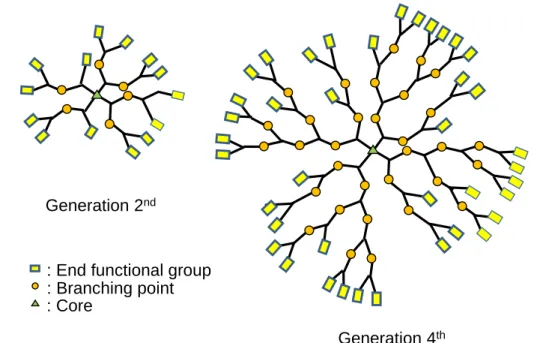
weight because its entanglements also increase each other. In the case of HBP, the viscosity tends to decrease with increasing their molecular weight. This phenomenon comes from specificity of HBPs. HBP has dendritic structure, which has less chain entanglements. Therefore, the potentials of HBPs expand their application area as not only processing but also medical materials. The architecture of HBP was shown in Figure 1.4.1. Their classification has been defined with their generations.
Due to their unique physical (e.g. low melt viscosity) and chemical (e.g. a large number of functional groups) properties different from linear polymers, they have expected as a new class of materials in various fields such as drug-deliverly, coatings, or additives [47-49].
Figure 1.4.1. Architectures of hyperbranched polymer (left) Generation 2nd (right) Generation 4th.
: End functional group : Branching point : Core
Generation 2nd
Generation 4th
The synthetic development in the field of hyperbranched polymers in the last two decades is based on the fact that these compounds possess new, particular characteristics that strongly influence material properties and open new application fields[50-54].
HBPs and their substitutes can be regarded as nanomaterials because of their molecular size. In particular, many researchers have intensively investigated the use of HBP for host-guest encapsulation and the fabrication of organic-inorganic hybrids.
1.5 Durability of PP in capacitor application
1.5.1 Background
Insulating materials have been used as electrical wiring, cable protectors and so on.
Recent developments of transistors and integrated circuits made insulating materials higher performance like plastic films. These developments have been contributed to properties improvements of polymer films which has very thin layer through processing ability.
1.5.2. Capacitor
Insulate materials can keep electrostatic energy. This is like a dam which can keep water. When electrical conductive materials have been directed parallel each other, the electrostatic energy can be kept between them. Capacitors are one of these applications. The principle shows in Figure 1.5.1
Figure 1.5.1. Principle of capacitor
Figure 1.5.2. Principle equations of electrostatic capacity
Capacitance (C) is the ability of a material to store an electrical energy. S is the area of conductive materials (electrodes) and L is the distance between electrodes.
Their relations can introduce the dielectric constant (εs) of the insulate material (ε0 is the dielectric constant under vacuum). From the capacitor principle, we can get that the one of the important factor is the thickness of insulate materials.
Insulate materials (L: distance) Conductive materials (S: area)
C = ε0εs L S Q = C ×E W = 2
1 C ×E2
C: electrostatic capacity
ε0: dielectric constant under vacuum 8.8554 ×10⁻¹²(F / m)
εs: dielectric constant of the insulate material S: effective electrode area (m2)
L: distance between electrodes (m) Q: electrification (C)
E: voltage (V) W: energy (J)
Recently, this capacitor expands their application for automobile are. Especially, the automobile will be developed to electrical automobile in the future. High performance capacitor is highly desired. Figure 1.5.3 shows the capacitor classification.
Figure 1.5.3. Classification of capacitor [Rubycon Corporation]
Film application will develop capacitor’s full potential. When deposit layer upon layer of capacitor, their performance will be improved to according to increasing number of layers and also miniaturization of capacitors is one of important factor to improve their ability. Why film capacitor is desirable materials comes from their process ability. Polymer processing had plastic capacitors developed in this field.
Paper capacitor Glass capacitor Mica capacitor
Dry-type electrolytic capacitor Wet tantalum capacitor Wet type electrolytic capacitor
Organic semiconductor electrolytic capacitor
Functional macromolecular aluminum electrolytic capacitor Solid tantalum capacitor
Solid-type electric double layer capacitor
PET film capacitor PP film capacitor PPS film capacitor PC film capacitor Other film capacitor PET / PP film capacitor PET / PC film capacitor PET / paper capacitor PP / PC film capacitor PP / paper capacitor PC / paper capacitor
ClassⅠceramics capacitor (TiO2) : temperature compensating (TC) ClassⅡceramics capacitor (BaTiO3, PbO) : high-dielectric constant ClassⅢceramics capacitor (SrTiO3, semiconductor) : high-dielectric constant
Capacitor
Electrolytic capacitor
Liquid electrolyte
Solid electrolyte
Ceramics capacitor
Plastic film capacitor (Metalized plastic
film capacitor)
Composite film capacitor Film capacitor
Others
1.5.2. Polypropylene Film for Capacitor
PP is the most desirable material in plastic film capacitors because of its balanced ability. The important factors for capacitor film are mentioned in Table 1.5.1.
Mainly 4 kinds of polymer have been applied for capacitor. In industrial field, this capacitor has been mainly developed in automobile fields. And this field will develop as electrical automobiles in the future.
Its desirable ability for PP is mainly the thickness and long-term stability.
Developments of processing ability have been contributed the preparation of polymer thin film for capacitor application. According to industry, the thickness of PP film became almost less than 3 μm in these last few years as I mentioned in Table 1.5.1.
When we make PP film thinner, it is harder to prepare without clarify the structure property relationship. And also the long-term stabilization of PP film is necessary for understanding of its performance and structure relationship.
Recently, some researchers found that the relationship between crystalline diameter of PP and its property of electrical breakdown voltage (BDV). In this finding, it was clarified the smaller diameter of crystalline gives stronger BDV properties. As mentioned in Figure 4.1. This finding indicates the importance of morphology control of PP materials.
Improvement of BDV properties for capacitor application of PP was aimed in this chapter. In addition, a molecular mass dependence of crystallization in PP is not yet well established. Therefore, crystalline structure was characterized by using various molecular weight of PP firstly.
Table 1.5.1
Characteristics of plastic films for capacitor application [Rubycon corporation]
Characteristic PP PET PPS*1 PEN*2
Thickness (μm) 3.0 – 25 1.0 – 25 1.5 – 25 1.0 – 25
Maximum working temperature (˚C)
80 – 105 120 – 130 130 – 140 120 – 140
Dielectric constant
(1kHz at 20˚C) 2.2 3.2 3.0 2.9
Dielectric loss tangent
(1kHz at 20˚C) 0.0002 0.003 0.0006 0.004
Volume resistivity (Ωcm) > 1017 > 1018 > 1017 > 1017 Water absorption
(% at 75 % humidity)
< 0.01 0.4 0.05 0.3
Glass transition temperature
(˚C) 0 69 92 121
Breakdown voltage (kV / mm) 200 - 400 120 - 280 180 300
*1Polyphenylenesulfide
*2Polyethylene naphthalate
1.6. Objective
The objective of this research is to improve the life-time of PP materials by encapsulation and morphology control. Chapter 2 shows the G4-HBP effectiveness in PP matrix and discussion of its stabilization mechanism. Chapter 3 shows the generation effect for stabilization and applicant for PP nanocomposites. Chapter 4 shows the preparation of dendritic polymer on filler surface to elongate the life time of PP nanocomposites. Chapter 5 shows the improvements and prediction of PP film durability for long term capacitor application.
Chapter 2
Long-term Stability of Polypropylene
materials by Hyperbranched Polymer
2.1. Introduction
As already mentioned, PP is one of the most widely used polyolefin because of its low cost, good processability, high chemical resistance, light weight, high melting point and well-balanced mechanical properties. In addition, because of the wide application and low environmental impact, further development of PP materials has been desired.
Basically, PP is easy to degradate due to heat and light originally, and the addition of various antioxidants is essential in order to obtain practical stability because PP has tertiary hydrogen which is easy to generate radicals compared with other carbons.
Although there have been researched for the development of various antioxidants, there are still remain a matter of research. When considering the long-term usage of PP, not only the efficiency of the antioxidants but also the reduction of the physical loss of antioxidants, such as volatilization and leaching from PP matrix is important. One of the main approaches to solve these problems is the usage of high molecular weight antioxidants. However, because high molecular weight antioxidants decrease the mobility of themselves in the matrix at the same time, the combination with low molecular weight antioxidant is necessary.
Specific structure of HBP, which has a lot of branched chain, shows unique properties. Generally, linear polymer is easy to entangle each other but HBP has no entanglement because of the structure [55]. When their molecular weight is almost same, difference of their viscosity arises from a difference in their nature. Linear polymer shows higher viscosity with increasing its molecular weight however HBP is opposite. Dendrimer is one kind of branched polymers which can be synthesized by a precision synthesis. On the other hand, HBPs can be produced by one-pot synthesize,
which deliver promising results for industrial applications [56]. They are also called
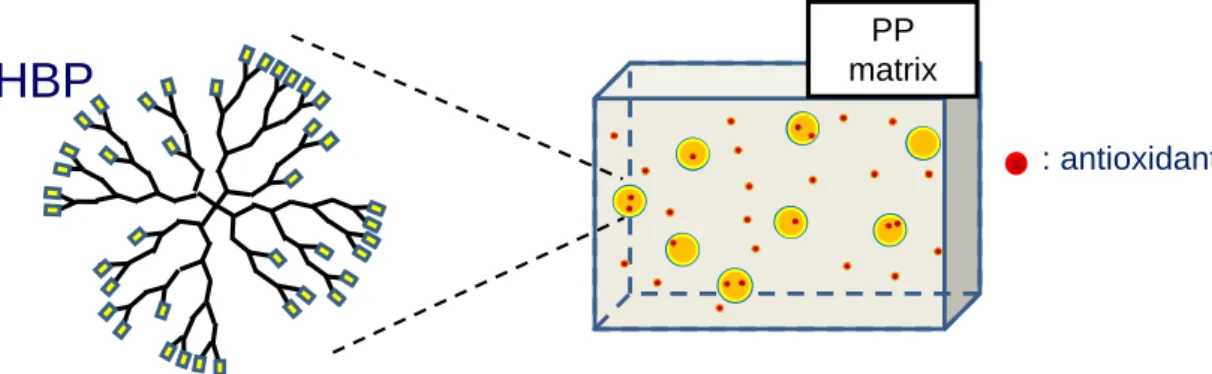
“dendritic polymer”. There is density difference, which has its roots in functional groups, between its inside and outside in dendritic polymer like these. These functions can be applied as drag delivery carriers because they can capsule other materials with molecular size [57]. In medical field, the application of dendritic polymers already has been started. By changing the point of view, it is possible for PP to apply dendritic polymer as carriers for functional molecules like antioxidants. This strategy suggests that the HBPs might not only prevent the volatilization of antioxidants and also keep their diffusion in PP matrix by acting as molecular carrier. Bergenudd et all. suggested that the immobilization of antioxidants on HBP was useful to elongate polymer life-time in previous report [58]. However, this strategy is still in faithful accordance with traditional method.
The purpose of this chapter is to elongate the life-time of PP materials by the addition of HBP. It is highly possible that this strategy improves the efficiency of antioxidants as a molecular carrier. As already mentioned, two important factors for PP stabilization have been considered “Suppressions of antioxidants volatilization” and
“Keeping diffusion of antioxidants”. This strategy can achieve the development of highly stabilized PP materials.
Figure 2.1 concept of this work
HBP
: antioxidant PP
matrix
2.2. Experimental Section
Materials
Unstabilized PP powder polymerized by Ziegler-Natta catalyst was used as the matrix polymer (mmmm = 95 mol%, Mn = 57,000, Mw = 290,000, MWD = 5.02).
n-octadecyl-3-(4’-hydroxy-3’,5’-di-t-butylphenyl)propionate (ADEKASTAB AO-50) and butylated hydroxytoluene (BHT) was donated by ADEKA Co. Generation 4 hyperbranched polymer (G4-HBP, molecular weight = 7323 g/mol, 64 hydroxyl end groups) was purchased from Aldrich Chemical Company. SiO2 nanoparticle (AEROSIL®90G, average diameter of 20nm, surface area of 90 m2/g) donated by Nippon Aerosil Co., Ltd. was dried in vacuum for 6 hour at 180°C before melt mixing.
Tetrahydrofuran (THF) without any antioxidants and o-dichlorobenzene (ODCB) purchased from Kanto Chemical Co., Inc. were used without further purification.
Figure 2. 2. Structure of the generation 4 hyperbranched polymer
O O
O O
O
O
O O
O OO
O O
O O
OH O
O O
O
O O
O
O O O O
O O O O O
OH
OH OH
OH OH OH OH OH OH OH
HO OH
HO
OH OH
≡
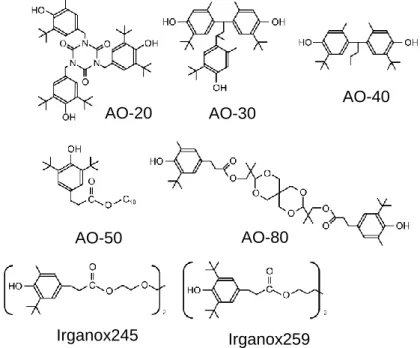
On the other hand, the relationship between antioxidants and G4-HBP was also evaluated by using 7 kinds of antioxidants. They were donated ADEKA Co. and Toyotsu Chemical Co. Figure 2.3 and Table 2.1 shows their structure and information.
Figure 2.3 Chemical structure of antioxidants
Table.2.1 Antioxidants information
Product name Molar weight (g/mol) Melting point (˚C)
AO-20 784 220-222
AO-30 545 183-185
AO-40 383 210-214
AO-50 530 50-52
AO-80 740 110-120
Irganox245 586 76-79
Irganox259 638 180
Irganox259
AO-50 AO-80
AO-20 AO-30
AO-40
Irganox245
Preparation
Blend Samples were prepared by melt mixing using two-roll (Imoto Machinery Co., Ltd.) mixer with a given amount of AO-50, and/or G4-HBP, respectively. The PP powder was blended in solid state with AO-50 at room temperature before melt mixing.
The blended PP powder was kneaded by two-roll mixer at 185°C for 15 min to prepare a master batch contained 1.0 wt% of AO-50. And then a given amount of the master batch was added into the kneaded PP powder by blending on two-roll mixer at 185°C for 5 min. The mixture was kneaded for another 10 min with/without G4-HBP. The samples thus prepared were collected and subsequently stored in refrigerator. All the final products contain 0.07 wt% of antioxidants.
Film preparations were performed after melt-mixing. The melt-mixed sample was melted at 230C for 5 min and then pressed at 10MPa for another 5 min. The pressed sample was immediately annealed at 100C for 5 min, trying to keep constant crystallinity. Film thickness was kept constant (100 μm).
Characterization s
Differential scanning calorimetry (DSC) was performed using Mettler Toledo DSC 822. The measurement was carried out under a nitrogen atmosphere with heating and cooling rate of 10°C/min. Heating was started from below room temperature and rate of 10°C/min. Crystallinity was determined by taking the peak value of scans, respectively.
Tensile tests were carried out at room temperature using dumbbell-shaped
specimen at a crosshead speed of 1.0 mm/min. Tensile specimens were cut from the films and the testing was done with a Abecks DAT-100 at room temperature.
The oxidation induction time (OIT) measured by CLA strongly offers an indirect measure of life time of the sample films. Not only that, but these observations lead to the conclusion that the CL method can be used to screen the stabilizer effectiveness in PP. The chemiluminescence (CL) emission of PP films stabilized with antioxidants was studied at 150 or 180°C under dry air (100 ml/min) by Chemiluminescence analyzer (CLA, CLA-ID-HS, Tohoku Electronic Industrial Co. Ltd.). CL signal was counted for a period of 60s. Samples pieces were located on aluminum pans which were placed on the heating stage and adjusted to the required temperature.
Figure 2.4. Typical CL spectra of stabilized PP
Volatilization tests were performed by Thermogravimetric (TG, Mettler Toledo TG50) analysis at 100°C under nitrogen atmosphere (50 ml/min). The data was collected on film samples contained 5.0 wt% of BHT.
Details of FT-IR emission measurements were shown in my minor research.
Table 2.2. Measurement conditions of FT-IR emission
Time (min) 180
Temperature (C) 150
Flow rate (air, l/min) 12.0
Number of scans 256
2.3. Results and Discussion
Firstly, total results of this work were shown in Table 2.3.
Table 2.3
Sample information
G4-HBP (wt%)
Xc (%)
Tensile strength (MPa)
Young’s modulus (MPa)
Elongation at break
(%)
OIT at 180˚C
(h)
OIT at 150˚C
(h)
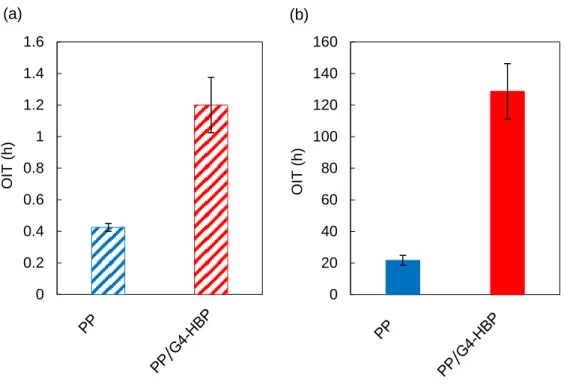
PP - 54.4 35.2 672 >300 0.4 21
PP/G4-HBP 1.0 52.7 35.0 670 >300 1.2 129
Table 2.3 shows the effects of G4-HBP added to PP. From this table, it was suggested that the addition of G4-HBP hardly affects to the crystallinity and the mechanical properties of PP materials, when it was 1.0 wt%.
According to these results, it was concluded that the other factors which related to PP morphology and its structure can be deleted. Therefore, we can focus on the
discussion about HBP effect.
CL analysis is also widely used for detect the initial stage of degradation with very high sensitivity. It is well known that degradation is accompanied by very weak emission. Figure 2.5 shows the results of CL measurements at 150˚C and 180˚C.
Figure 2.5. CL analysis of PP and PP/G4HBP in (a) molten state at 180˚C and (a) solid state at 150˚C
The addition of G4-HBP was re improvement of OIT on both measurements at 180˚C and 150˚C. On the measurement in molten state at 180˚C, PP/G4-HBP shows three times as long as PP. PP/G4-HBP at 150˚C elongates its OIT almost 6 times longer than PP. Great improvements of OIT were observed by adding G4-HBP. This suggests that the effect of G4-HBP in solid state much higher than that in molten state.
0 0.2 0.4 0.6 0.8 1 1.2 1.4 1.6
OIT (h)
0 20 40 60 80 100 120 140 160
OIT (h)
(a) (b)
The reason why solid state shows higher improvement of OIT may be related to PP crystallinity. When PP was crystalized, the amorphous region, which is easy to degradate compared with crystal region, decreases in contrast of its crystallinity.
Therefore, it is possible that there is an increase in the percentage of G4-HBP, which only can exist in amorphous region of PP. According to OIT measurements, these improvements might be come from the encapsulation of G4-HBP for antioxidants.
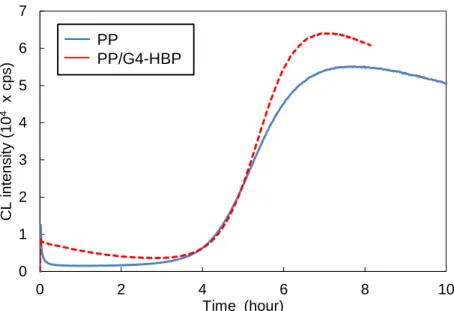
OIT measurements of PP and PP/G4-HBP after extraction of antioxidants by solvent were performed in order to confirm the effects of G4-HBP. AO-50 can dissolve in all proportions with hexane. Figure 2.6 shows the results of OIT measurements.
Figure 2.6. CL analysis of PP and PP/G4-HBP at 130˚C after extraction of AO-50 by hexane
Hexane was chosen as a solvent for antioxidants extraction because AO-50 can be
0 1 2 3 4 5 6 7
0 2 4 6 8 10
CL intensity (104x cps)
Time (hour) PP
PP/G4-HBP
dissolved easily. CL analysis showed almost all same OIT between PP and PP/G4-HBP. This result indicates that the OIT improvement came from not G4-HBP itself but the supplement the efficiency of antioxidants by G4-HBP. It was also strongly suggested that the encapsulation of G4-HBP might be exist.
On the other hand, we must consider about grafting reaction between G4-HBP and antioxidant by dehydration reaction of hydroxyl groups. However, it was suggested that there are no grafting reaction between G4-HBP and antioxidants. Why there are no grafting reaction is that the CL results showed same time OIT both PP and PP/G4-HBP after antioxidants extraction.
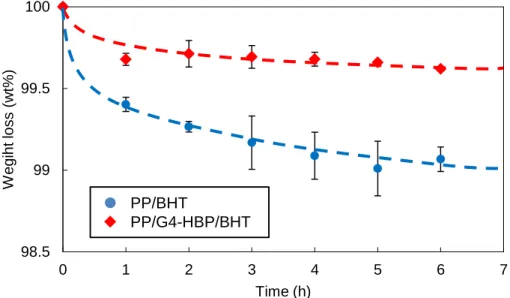
The reason why the addition of G4-HBP improved the OIT of PP is still not unclear. Therefore, volatilization of antioxidants was characterized by TG analysis.
Figure 2.7 shows the results of volatilization of PP/BHT and PP/G4-HBP/BHT.
Figure 2.7. Effect of G4-HBP as a volatilization of BHT in PP matrix
98.5 99 99.5 100
0 1 2 3 4 5 6 7
Wegiht loss (wt%)
Time (h) PP/BHT
PP/G4-HBP/BHT PP/BHT
PP/G4-HBP/BHT
BHT, which is the lowest molecular of antioxidants, was chosen in this work.
PP/G4-HBP/BHT was decreased at low rate compared with PP/BHT. It suggests that G4-HBP in PP matrix suppresses the volatilization of BHT. However, suppression of AO-50 was not observed by TG analysis.
FT-IR emission was performed to clarify the reason why suppression of AO-50 was not observed. The principle of FT-IR emission was shown in Figure 2.5. FT-IR emission is different from these measurements. It is much useful for real time quantitative analysis of samples. In the case of FT-IR emission, samples are needed in order to get infrared spectrum. The heated infrared spectrum corresponds to absorption spectrum. Thin films which are less than 2 μm are necessary for emission measurements.
Figure 2.8. Schematic diagram of the emission cell used with the FT-IR spectrometer [59]
Figure 2.9. FT-IR emission analysis (a) AO-50, (b)G4-HBP, (c) mixture of AO-50 and G4-HBP.
0.45 0.5 0.55 0.6 0.65 0.7 0.75 0.8
1000 1200
1400 1600
1800
Relative intensity
Wavenumber / cm1
0 15 30 45 60 75 90 105 120 135 150 165 180 (a)
0.45 0.5 0.55 0.6 0.65 0.7 0.75 0.8
1000 1200
1400 1600
1800
Relative intensity
Wavenumber / cm1
0 15 30 45 60 75 90 105 120 135 150 165 180 (b)
0.45 0.5 0.55 0.6 0.65 0.7 0.75 0.8
1000 1200
1400 1600
1800
Relative intensity
Wavenumber / cm1
0 15 30 45 60 75 90 105 120 135 150 165 180 (c)
Figure 2.9 shows the results of FT-IR emission. These results suggest that the AO-50 degrease its spectra with increasing measurement time (Figure 2.6 (a)). On the other hand, G4-HBP has remained its intensity of high during the measurement (Figure 2.6 (b)). The spectra of mixture of AO-50 and G4-HBP behaved like AO-50 (Figure 2.6 (c)). From these results, it was confirmed that the G4-HBP had no spectra change during the measurement. Therefore the G4-HBP contained mixture was also changed nothing. The peak intensity of AO-50 (a) is getting degrease with increasing the measurement time and it suggests the volatilization of AO-50.
However, it is difficult to discuss the comparison of samples because of their low data. It is necessary for characterization of G4-HBP effect to subtract itself as a background. Figure 2.10 shows the spectra of FT-IR emission after subtraction of spectra at 180 min as a background. And then we can discuss about the interaction between AO-50 and G4-HBP.
Figure 2.10. FT-IR emission spectra of (upper) AO-50 after subtraction of AO-50 spectra at 180 min as a background (under) mixture of AO-50 and G4-HBP after subtraction of the mixture at 180 min as a background
The change of time dependence of spectra was clearly observed from Figure 2.7.
Especially, the intensity at 1630 cm−1 became stronger and stronger with time. This intensity suggested that the structure change of AO-50 and the number of carbon double bonds was increased during the measurements.
0 0.05 0.1 0.15 0.2 0.25 0.3
1000 1200
1400 1600
1800
0 15 30 45 60 75 90 105 120 0
0.05 0.1 0.15 0.2 0.25
1000 1200
1400 1600
1800
0 15 30 45 60 75 90 105 120 C=O C=CH2 C-O
a b
Wavenumber (cm˗1)
Wavenumber (cm˗1)
(min)
(min) C=O C=CH2 C-O
Pospisil et al. reported the structure change of Irganox 1076 which is same chemical structure with AO-50[60]. Their report showed that the main products after the reaction of antioxidants were dimers. Otherwise, the structure which was shown in Figure 2.11 also can be generated on thermal degradation as a final product.
X = -O-C18H37 Figure 2.11. One of deactivated structure of AO-50
In this work, it may be possible to generate like a structure shown in Figure 2.8.
And also the peak intensity at 1050 and 1240 cm−1 origin form ester bonds of AO-50 is also getting weaker with increase measurement time. It is highly possible that the decomposition of ester bonds occur during the measurement (Figure 2.8: point X). In addition, the intensity at 1740 cm−1 origin from ester bonds (carbon oxygen double bonds) still remains, which assumes the existence of AO-50, when comparing with that at 1050 and 1240 cm−1. On the other words, the reason why the whole intensity decreased with increasing the time is that both volatilization and decomposition of AO-50 are occurred during thermal aging.
More discussions are necessary for clarification of the mechanism of HBP stabilization. The intensity at 1740 cm−1 and 1630 cm−1 was defined as a standard peak (a) and decomposition peak (b), respectively. Standard peak means the remaining AO-50 without any structural change and decomposition peak means the decomposition of AO-50. When we want to discuss the interaction, it is useful to estimate the ratio between remaining and decomposition. Figure 2.12 shows the deactivation rate by dividing the (b) and (a) with measurement time.
Figure 2.12. Deactivation rate (b/a) of AO-50 with/without G4-HBP
Compared with AO-50 only, deactivation rate of AO-50 was decreased by coexisting with G4-HBP in early stage of the measurements (0 – 60 min). It suggests that the G4-HBP can suppress the deactivation of antioxidants in early stage. It is well known that the preventing the early stage degradation is more important for long term usage of materials because degradation is expanded exponentially. Therefore, it is
0 5 10 15 20 25 30
0 20 40 60 80 100
Deactivation rate, b/a (%)
Aging time (min) AO-50
AO-50 with G4-HBP
highly possible that the G4-HBP prevents deactivation of antioxidant and then elongates the lifetime of PP materials.
This deactivation mechanism might be related to hydrogen bonds between G4-HBP and antioxidants. Both G4-HBP and AO-50 have hydroxyl groups and ester bond witch can form hydrogen bonds.
It might be related to antioxidants volatilization because coexisting with G4-HBP suppresses the early stage decomposition of antioxidant. One possibility is that G4-HBP can suppress low molecular antioxidants, which can be generated after decomposition of antioxidants. This explanation is reasonable for the understanding of stabilization mechanism.
Structure-performance relationship between antioxidants and G4-HBP were very important for understanding its stabilization mechanism.
Figure 2.13 shows the stabilization effect of G4-HBP by changing the antioxidants.
OIT results from CL analysis showed all the antioxidants were affected by G4-HBP.
Figure 2.13 CLA analysis by using 7 kinds of antioxidants.
All the stabilizers showed the elongation of OIT by adding G4-HBP. However, the relationship between antioxidants structure and OIT improvements is difficult to clarify from Figure 2.13. Molecular weight of antioxidants is one of the important factors to define antioxidants characteristics. Therefore, the summary of molecular weight and OIT improvements were shown in Figure 2.14
0 0.5 1 1.5 2 2.5 3 3.5
AO-20 AO-30 AO-40 AO-50 AO-80 Irganox245 Irganox259
OIT (hour)
PP
PP/G4-HBP
180˚C 50 ml/min
Dry air
Following equation was used for characterization of OIT improvement by G4-HBP.
Figure 2.14 Summary of relationship between molecular weight and OIT improvements
It was defined that lower stabilization effect by G4-HBP was the improvement of 0.4 or less in Figure 2.14. However, the relationship between chemical structure and ΔOIT was still unclear.
(OIT of PP/G4-HBP) – (OIT of PP) ΔOIT =
0 0 0 1 1 1
ΔOIT(h)
1.0 0.8 0.6 0.4 0.2 0
0 1 2 3 4
300 450 600 750 900
OIT (h)
Molecular weight of antioxidant (g/mol) AO-20 AO-40
Irganox245
AO-80
Irganox259
AO-50 AO-30 PP/G4-HBP PP
Irganox259 AO-20 AO-40
Lower HBP effect (ΔOIT < 0.4) OIT improvement by G4-HBP
Figure 2.15 was focused on melting point of antioxidants.
Figure 2.15 Relationship between the OIT improvements and melting point of antioxidants.
This result suggested that the antioxidants structure performance for OIT improvement by G4-HBP. It was confirmed that the stability (OIT) of PP was depends on the melting points of antioxidants. In addition, the presence or absence of ester bonds in antioxidants might be the key to decide the stabilization mechanisms by HBP.
AO-20 AO-30
AO-40
Irganox259 AO-50
AO-80 Irganox245
0 0.2 0.4 0.6 0.8
0 50 100 150 200 250
ΔOIT (h)
Tmof antioxidants (˚C) AO-50
Irganox245 AO-80
Irganox259
AO-30
AO-40 AO-20
Ester group No Ester group
![Figure 1.5.3. Classification of capacitor [Rubycon Corporation]](https://thumb-ap.123doks.com/thumbv2/123deta/6125517.1078875/28.892.134.741.351.717/figure-classification-capacitor-rubycon-corporation.webp)
![Figure 2.8. Schematic diagram of the emission cell used with the FT-IR spectrometer [59]](https://thumb-ap.123doks.com/thumbv2/123deta/6125517.1078875/43.892.230.646.683.976/figure-schematic-diagram-emission-cell-used-ft-spectrometer.webp)

