JAIST Repository
https://dspace.jaist.ac.jp/
Title 不完全な言語的情報を基に多属性による意思決定モデ
ルに関する研究
Author(s) 郭, 文涛
Citation
Issue Date 2015‑03
Type Thesis or Dissertation Text version ETD
URL http://hdl.handle.net/10119/12754 Rights
Description Supervisor:Huynh Nam Van, 知識科学研究科, 博士
Doctoral Dissertation
A Study on Evaluation Models for Multiple Attribute Decision Making with Incomplete Linguistic Information
Wentao Guo
Supervisor: Associate Professor Van Nam Huynh
School of Knowledge Science
Japan Advanced Institute of Science and Technology
March 2015
Abstract
In practice, most of the multiple attribute decision making (MADM) problems involve both kinds of qualitative and quantitative attributes, which may be represented by a hierarchy. While quantitative attributes can be measured by means of numeric scales in the form of numbers, intervals or fuzzy numbers, qualitative attributes which are often associated with imprecise, vagueness and uncertain information perhaps can only be assessed by linguistic information. In such situations, how to represent and aggregate linguistic information essentially plays an important role in decision analysis. In the literature, one of reasonable ways is the use of “fuzzy linguistic approach which provides tools to model and represent qualitative attributes by means of linguistic values of linguistic variables” (Zadeh, 1975). The use of linguistic information implies the necessity of operating with the mechanism for “computing with words (CW)” (Zadeh, 1996) so as to fusion linguistic information and then provide an evaluation for decision making.
In this research, we first briefly recall some key concepts of CW. Then, through a further study on CW and fuzzy linguistic approach, we analyze the relationship between MADM with linguistic information and CW, and the mechanism that how fuzzy linguistic approach is used to deal with linguistic information in the decision making process. Further, according to three categories of linguistic computational models based on fuzzy linguistic approach in the literature, we review the main features of several classic linguistic computational models in detail, including
“linguistic computational model based on membership functions”, “linguistic computational model based on ordinal scales”, “linguistic computational model based on 2-tuple representation” and “linguistic computational model based on proportional 2-tuple representation”. Meanwhile, the limitations and restrictions of these previous models have been found during the review process, such as loss of information during the evaluation process, with too much requirements when applied to MADM problems, without considering uncertain subjective judgments represented by linguistic distributions over the linguistic term set, without taking into account incomplete linguistic information and so on.
Inspired by providing more efficient measures to represent and aggregate linguistic information, three evaluation models, i.e., proportional 3-tuple fuzzy linguistic representation model, proportional fuzzy linguistic distribution model, interval fuzzy linguistic distribution model, are developed in this research aiming at overcoming the main limitations and restrictions of previous models, and meanwhile, providing some new ways to deal with more general cases of linguistic assessments. Some related concepts, such as preference-preserving proportional 3-tuple transformation, which is used for the transformation and unification of linguistic assessments represented by proportional 3-tuplse between two different linguistic term sets, expected utility in proportional or interval fuzzy linguistic distribution, which is employed for obtaining an ranking order among different alternatives provided to decision makers as a reference for their final decisions are proposed in this research. Further, some corresponding aggregation operators are developed for the three evaluation models respectively according to their own representation forms of linguistic information. Besides, three practical application examples taken from the literature as well as a simple illustration example are used respectively in order to compare the results with previous models, and also for the purpose of illuminating the features and capabilities of the proposed models.
After illustration by examples, it is shown that the proposed evaluation models in this research not only overcome
the limitations and restrictions of previous models, but are also inherent with some special features, such as no loss of information during the evaluation process, ease operation in the complicated linguistic context, flexible operation space for evaluators under uncertainty, taking the ignoring information into account and so forth. These features of the three evaluation models can help decision makers to easily deal with MADM problems with incomplete linguistic information, largely improve the precision, reasonability and reliability of final results, and finally, provide a more comprehensive guidance for decision makers.
Finally, four interesting aspects for future work are explored, which can be as the directions for continuing this research in order to extend the applicability of these three evaluation models proposed in this research. Meanwhile, the contributions of this research to Knowledge Science are summarized.
Keywords: Computing with words, decision making, incomplete assessments, linguistic modeling, multiple attribute.
Acknowledgments
First of all, I would like to express my great thanks to my supervisor Associate Professor Van Nam Huynh of Japan Advanced Institute of Science and Technology (JAIST) for his constant encouragement and kind guidance during this work. In the past three years of JAIST, Prof.
Huynh not only gave me so many good instructions on my research, but also helped me a lot on my life. The knowledge and experience that Prof. Huynh conveyed to me will accompany me for my whole life.
I also want to devote my sincere thanks and appreciation to Prof. Nakamori (JAIST), Prof.
Kosaka (JAIST), Prof. Yoshida (JAIST), and Prof. Tetsuya Murai (Hokkaido University), who gave me many important suggestions for improving my dissertation.
I also would like to give my thanks to my colleagues and friends in Nakamori Lab and Huynh lab dring the last three years. They helped me a lot on my research and life. I am very glad to study and play with you. They are Jin Jingzhong, Jin Guangzhong, Ju Hongli, Guo Wei, Sun Jing and Zhang Wei.
The last but not least, I would like to express my sincere gratitude to my parents and other relatives for their endless loves and everlasting supports. Without you, I cannot finish my research for the PH.D. smoothly.
Thanks very much for all of you. Wish you happy and healthy.
Contents
Abstract i
Acknowledgments iii
1 Introduction 1
1.1 Research Background and Research Purpose . . . 1
1.2 Research Motivation . . . 2
1.3 Research Objectives . . . 3
1.4 Related Knowledge . . . 3
1.4.1 Decision making . . . 3
1.4.2 Multiple attribute decision making problems . . . 4
1.4.3 Computing with words . . . 5
1.4.4 Fuzzy linguistic approach . . . 6
1.4.5 Linguistic decision making resolution scheme . . . 9
1.5 Organization of the Dissertation . . . 10
2 A Survey on Decision Making with Fuzzy Linguistic Models 12 2.1 Linguistic Computational Model Based on Membership Functions . . . 12
2.2 Linguistic Symbolic Computational Models Based on Ordinal Scales . . . 14
2.3 Linguistic Symbolic Computational Models Based on 2-Tuple Representation . . . . 15
2.3.1 Representation model . . . 16
2.3.2 Computational model . . . 17
2.3.3 The use of the 2-tuple linguistic representation model . . . 18
2.4 Linguistic Symbolic Computational Models Based on Proportional 2-Tuple Representation . . . 19
2.4.1 Representation model . . . 20
2.4.2 Computational model . . . 20
2.5 Conclusion . . . 23
3 A Proportional 3-Tuple Fuzzy Linguistic Representation Model 25 3.1 Proportional 3-Tuple . . . 26
3.2 Canonical Characteristic Values . . . 27
3.3 Computation Operator of Proportional 3-Tuple . . . 28
3.4 Preference-Preserving Proportional 3-Tuple Transformation . . . 30
3.5 The Procedure of Proportional 3-Tuple Fuzzy Linguistic Representation Model . . . 32
3.6 An Illustration Example . . . 35
3.6.1 The description of new product project screening problem . . . 35
3.6.2 Selecting evaluation criteria . . . 36
3.6.3 Selecting linguistic term sets and associated semantics . . . 36
3.6.4 Assessing merit/risk ratings and weights of criteria . . . 38
3.6.5 The unification of original linguistic assessments represented by proportional 3-tuples . . . 41
3.6.6 Computing the evaluation result via proportional 3-tuple fuzzy linguistic representation model . . . 43
3.6.7 Comparative study . . . 44
3.6.8 New product project screening problem with revised linguistic assessments . 44 3.6.9 The unification of the revised linguistic assessments represented by proportional 3-tuples . . . 46
3.6.10 The evaluation result of revised linguistic assessments . . . 47
3.7 Conclusion . . . 48
4 A Proportional Fuzzy Linguistic Distribution Model 49 4.1 Proportional Fuzzy Linguistic Distribution . . . 49
4.2 The Comparison of Proportional Fuzzy Linguistic Distributions . . . 52
4.3 Computation Operator of Proportional Fuzzy Linguistic Distribution . . . 54
4.4 Expected Utility in Proportional Fuzzy Linguistic Distribution . . . 55
4.5 Proportional Fuzzy Linguistic Distribution Aggregation Operator . . . 57
4.5.1 Arithmetic mean . . . 58
4.5.2 Weighted average operator . . . 59
4.5.3 Linguistic weighted average operator . . . 60
4.6 An Illustration Example . . . 63
4.6.1 Motorcycle evaluation problem . . . 63
4.6.2 Aggregating assessments by proportional fuzzy linguistic distribution model . 65 4.6.3 Computing the expected utilities of four types of motorcycles . . . 68
4.6.4 Motorcycle assessment problem with linguistic weights . . . 71
4.7 Conclusion . . . 75
5 An Interval Fuzzy Linguistic Distribution Model 77 5.1 Linguistic Assessments with Intervals . . . 78
5.1.1 Basic interval arithmetic . . . 78
5.1.2 Interval fuzzy linguistic distribution . . . 80
5.2 Comparison of Interval Fuzzy Linguistic Distributions . . . 83
5.3 Expected Utility in Interval Fuzzy Linguistic Distribution . . . 84
5.4 Interval Fuzzy Linguistic Distribution Aggregation Operators . . . 87
5.4.1 Arithmetic mean . . . 87
5.4.2 Weighted average operator . . . 88
5.4.3 Interval weighted average operator . . . 90
5.4.4 Interval ordered weighted average operator . . . 92
5.5 Illustration Examples . . . 93
5.5.1 The description of the first example . . . 93
5.5.2 Aggregating assessments of the first example via interval fuzzy linguistic distribution model . . . 94
5.5.3 Computing the expected utilities of the first example . . . 95
5.5.4 The description of a cargo ship selection problem . . . 95
5.5.5 Aggregating assessments of ship selection problem via interval fuzzy linguistic distribution model . . . 98
5.5.6 Computing the expected utilities of six cargo ships . . . 102
5.5.7 Ranking the expected utilities using the minimax regret approach . . . 103
5.6 Conclusion . . . 105
6 Conclusion 107 6.1 The Main Contributions . . . 107
6.2 Discussion and Future work . . . 110
Bibliography 111
Publications 119
List of Figures
1.1 Computing with words scheme [59] . . . 6
1.2 A set of seven terms with its semantics . . . 8
1.3 The scheme of a linguistic decision making problem . . . 10
2.1 Retranslation problem [23] . . . 13
2.2 Example of the third linguistic symbolic computational model [23] [79] . . . 15
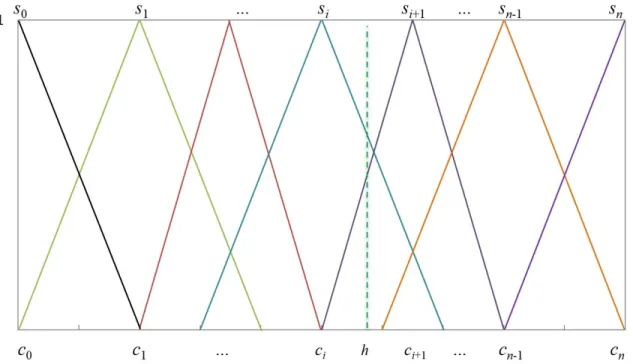
3.1 The representation of the information h of a proportional 3-tuple . . . 29
3.2 Linguistic merit rating values and associated fuzzy number semantic . . . 39
3.3 Linguistic risk rating values and their associated fuzzy number semantics . . . 39
3.4 Linguistic weights (success levels) and associated fuzzy number semantics . . . 40
3.5 Transition linguistic term set and associated fuzzy number semantics . . . 42
4.1 The relationship between a complete and an incomplete proportional fuzzy linguistic distribution . . . 53
4.2 The relationship between two incomplete proportional fuzzy linguistic distributions 53 4.3 Two level hierarchy . . . 56
4.4 Evaluation hierarchy for motorcycle performance assessment [87] . . . 64
4.5 The distributed assessments on the four types of motorcycles . . . 69
4.6 The expected utilities of four types of motorcycles . . . 70
4.7 Linguistic weights and associated fuzzy number semantics . . . 71 4.8 The distributed assessments on the four types of motorcycles by using linguistic
weights . . . 74 4.9 The expected utilities of four types of motorcycles by using linguistic weights . . . 75 5.1 Two level hierarchy . . . 86 5.2 The expected utilities of two alternatives . . . 96 5.3 The expected utilities of six cargo ships . . . 103
List of Tables
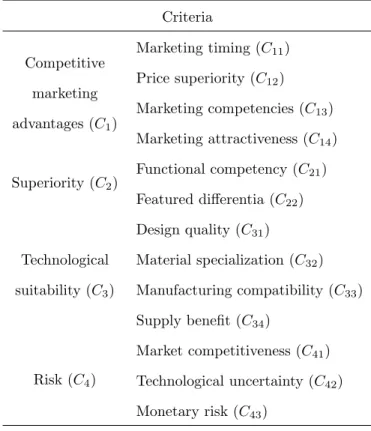
3.1 The evaluation criteria of new product project . . . 37 3.2 Original linguistic assessments of merit/risk ratings of criteria represented by
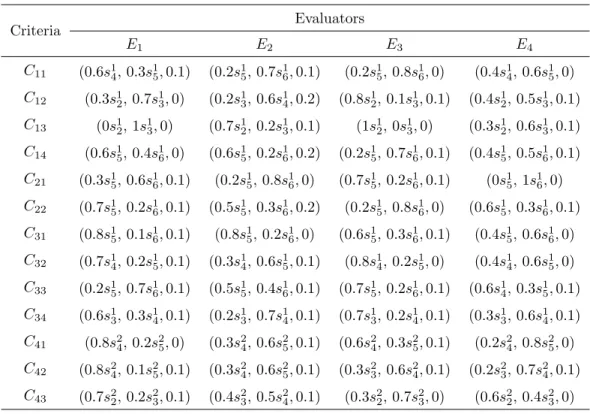
proportional 3-tuples . . . 40 3.3 Original linguistic assessments of weights of criteria represented by proportional
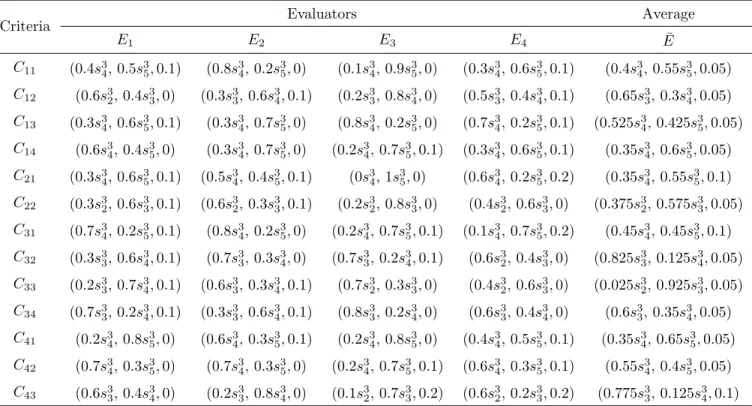
3-tuples . . . 41 3.4 Original linguistic assessments of risk ratings of criteria represented by proportional
3-tuples in transition linguistic term set . . . 42 3.5 Original linguistic preferences of criteria represented by proportional 3-tuples . . . . 43 3.6 Revised linguistic assessments of merit/risk ratings of criteria represented by
proportional 3-tuples . . . 45 3.7 Revised linguistic assessments of weights of criteria represented by proportional 3-
tuples . . . 46 3.8 Revised linguistic assessments of risk ratings of criteria represented by proportional
3-tuples in transition linguistic term set . . . 46 3.9 Revised linguistic preferences of criteria represented by proportional 3-tuples . . . . 47 4.1 Generalized decision matrix for motorcycle assessment [87] . . . 66 4.2 Generalized decision matrix for motorcycle assessment represented by proportional
fuzzy linguistic distributions . . . 67 4.3 The overall performances represented by proportional fuzzy linguistic distributions 68
4.4 Distributed assessments on four types of motorcycles . . . 68
4.5 The expected utilities of four types of motorcycles . . . 70
4.6 Linguistic weights represented by proportional fuzzy linguistic distributions . . . . 72
4.7 The overall performances represented by proportional fuzzy linguistic distributions by using linguistic weights . . . 73
4.8 Distributed assessments on four types of motorcycles by using linguistic weights . . 73
4.9 The expected utilities of four types of motorcycles by using linguistic weights . . . 74
5.1 Interval fuzzy linguistic distribution assessments for two alternatives . . . 94
5.2 The aggregation results of two alternatives . . . 94
5.3 The distributed assessments on two alternatives . . . 94
5.4 The expected utilities of two alternatives . . . 95
5.5 Original assessment data for six cargo ships [74] . . . 97
5.6 Distribution assessment matrix for the six cargo ships [74] . . . 99
5.7 Distribution assessment matrix for the six cargo ships represented by interval fuzzy linguistic distributions . . . 100
5.8 The overall belief degrees of six cargo ships represented by interval fuzzy linguistic distributions . . . 101
5.9 Distributed assessments on six cargo ships . . . 101
5.10 The expected utilities of six cargo ships . . . 102
Chapter 1 Introduction
1.1 Research Background and Research Purpose
Computing with words (CW) was proposed by Zadeh [93] aiming at capturing the concept of automated reasoning involving linguistic terms, of which the idea was actually rooted from his previous work on linguistic variables, fuzzy constraints and fuzzy if-then rules [90], [91], [92].
Since the conception of CW, it has already attracted great attentions from the fuzzy-set research community.
So far, numerous models have been developed for reasoning and CW in the literature.
Especially, CW approaches have also been applied to a wide range of decision making problems involving vague and imprecise information expressed linguistically. In decision making applications, the main problem for CW is how to represent and aggregate linguistic information for evaluation of alternatives. One of reasonable ways is the use of fuzzy linguistic approach.
However, most previously developed linguistic computational models based on fuzzy linguistic approach have various limitations and restrictions, such as loss of information, without involving ignoring information and so on. These limitations and restrictions seriously affect the precision, reasonability and reliability of final results, even leading to diametrically opposite evaluation conclusions. Consequently, these irrational results can make decision makers afford huge cost sometimes, which can be avoided originally. Therefore, it is critically important of finding some effective measures to deal with or avoid the limitations mentioned above during the evaluation process.
1.2 Research Motivation
Basically, most early work on decision making with linguistic information were making use of fuzzy sets as a tool for modeling linguistic information and aggregation methods were then developed based on “Zadeh’s extension principle”, e.g., [66]. Typically also, another approach aimed to develop the “linguistic symbolic computational model based on ordinal scales” [80].
Because of the inherent operation mechanism of these two linguistic computational models, the results of a computational process usually don’t exactly match any of the initial linguistic terms and, hence, a process of linguistic approximation must be applied to convert the computational results into linguistic terms of the initial linguistic domain. This linguistic approximation process causes a loss of information and consequently leads to the lack of precision in the final results [10]. As for overcoming this limitation in the computational stage for CW, Herrera and Mart´ınez developed a “2-tuple fuzzy linguistic representation model” based on the concept of symbolic translation so as to improve precision of the final results [28]. Although their approach has no loss of information when it was applied, they also pointed out that “it was only suitable for linguistic variables with equidistant labels” [28].
In order to overcome the limitation of “2-tuple fuzzy linguistic representation model” [28], Wang and Hao proposed “a proportional 2-tuple fuzzy linguistic representation model” for CW making use of the canonical characteristic values (CCV) of linguistic terms determined by their corresponding semantics [70]. Wang and Hao’s “proportional 2-tuple fuzzy linguistic representation model” interestingly provides a suitable and more flexible space in a computation stage for CW, which could allow evaluators to flexibly evaluate the performances of alternatives by not only one label but with the form of proportional 2-tuples (αA, βB), where A and B are two consecutive linguistic terms, and α, β ∈ [0,1], α+β = 1. However, as we can see from the definition, this model cannot deal with the decision situations where alternative performances are generally assessed by means of uncertain judgments represented by probability distributions over the linguistic term set. In addition, due to the premise that the summation of a pair of symbolic proportions must equal to 1, this model cannot handle ignoring information. In other words, it is only applicable under the context that all the linguistic assessments are complete. As a matter of fact, incomplete assessments emerge commonly when evaluators are lack of confidence, especially in the case of facing with uncertain, vague and imprecise information.
As such, it would be desirable that an appropriate extension of Wang and Hao’s “proportional 2-tuple fuzzy linguistic representation model” [70] could be developed. Therefore, modifying and
extending Wang and Hao’s “proportional 2-tuple fuzzy linguistic representation model” [70], and then developing new models for MADM problems motive our current research.
1.3 Research Objectives
According to the three categories of linguistic computational models in the literature, we will analyze and investigate the main features and limitations of these linguistic computational models in this research. Then, we will correspondingly develop three evaluation models for MADM problems, aiming at not only overcoming the limitations of the three categories of models, such as loss of information during the approximation process, without directly considering the underlying vagueness of linguistic terms, without involving the ignoring information and so on, but also being able to deal with more general cases of linguistic assessments possibly associated with uncertainty and incomplete information. Meanwhile, the three evaluation models developed in this research will also be associated with some other features, such as ease operation in the complicated linguistic context, flexible operation space for evaluators under uncertainty and so forth. These features can be regarded as some measures for evaluators to deal with MADM problems under uncertainty. Consequently, these linguistic computational models developed in this research can improve the precision, reasonability and reliability of the final results, and give decision makers a more comprehensive guidance.
1.4 Related Knowledge
The main work of this research is to develop linguistic computational models for MADM problems. Hence, it is necessary to introduce some basic knowledge regarding to decision making and CW.
1.4.1 Decision making
Decision making is a multi-discipline comprising philosophy, psychology, business, operations research, system engineering and management science. “It includes many procedures, methods, and tools for identifying, clearly representing, and formally assessing important aspects of a decision” [64]. Decision making is also a typical human mental process, resulting in the selection
of an alternative among several alternative possibilities. Because “decision making is an inherent human ability which is not necessarily rationally guided, it does not necessarily need precise and complete information about the set of feasible alternatives” [20]. Actually, we cannot acquire the exact information about each alternative that we are considering in most situation when we make a decision, and many respects of different objectives in the reality cannot be evaluated in a precise form but rather in an approximate way, which is often with vague, imprecise and uncertain knowledge. Traditionally, these decision situations are often defined under uncertain frameworks that could be managed by probabilistic models when assuming that any uncertainty can be represented by a probabilistic distribution. However, it is common that uncertainty does not always have a probabilistic nature. This fact has resulted in a reaction that many scholars and researchers apply “fuzzy sets theory” [89] to model the vagueness, imprecision and uncertainty in decision making processes [12], [21], [38], [46].
1.4.2 Multiple attribute decision making problems
In practice, most decision making problems involve multiple attribute of both quantitative and qualitative nature, “which may be represented by a hierarchy” [5], [61]. While quantitative attributes can be measured by means of numeric scales in the form of numbers, intervals or fuzzy numbers, qualitative attributes which are often associated with uncertain information cannot be assessed in the same way. In such case, we often prefer to use words in natural language instead of numerical values. These situations may appear due to different reasons [12]. For example, because of the inherent nature, some information cannot be quantified, but only by means of linguistic terms (e.g., when we look at a picture, the linguistic terms, such as “fair”, “beautiful”,
“excellent” can be used). In other cases, it is quite difficult to state precise quantitative information because sometimes we cannot obtain such kind of information or the cost of obtaining it is too high and an “approximate value” can be tolerated (e.g., we can use linguistic terms like “cold”, “warm”, “hot” to describe the temperature instead of numeric values). In these situations, it is reasonable and necessary to make use of fuzzy linguistic approach which provide tools to model and represent qualitative attributes by means of linguistic values of linguistic variables [90]. The use of linguistic information implies the necessity of operating with the mechanism for CW [93] so as to fusion linguistic information and then provide an evaluation for decision making.
1.4.3 Computing with words
Computing with words, that is, “the methodology that uses words and propositions from a natural language as its main objects of computation, was firstly introduced in the seminal paper by Zadeh” [93], aiming at capturing the concept of automated reasoning involving linguistic terms, rather than numerical quantities. In fact, the idea of CW, also known as granular computing, is rooted from Zadeh’s earlier work on fuzzy constraints and linguistic variables [90], [91], [92].
About granule, Zadeh explained that “a granule is a clump of objects (or points) which are drawn together by indistinguishability, similarity, proximity or functionality” [94]. Generally speaking, granules can be seen from two perspectives. On the one hand, the granules can be explained from the crisp perspective, i.e., they can be easily differentiated because the decomposition process is made into disjoint granules. This aspect is often used in various computational methods and techniques, such as rough set theory, divide and conquer, decision trees and so on. On the other hand, the granules are related to fuzzy rather than crisp especially when we deal with the aspects associated with human reasoning and concept formation [23], [94]. Thus, “a granule can be seen as a fuzzy set of points drawn together by similarity in a lot of situations” [23]. So far, a number of researchers have extensively studied the concept of fuzzy granulation in the literature, such as [4], [17], [30], [56], [57] and so on.
In CW, there is another basic assumption, i.e., “information is conveyed by constraining the value of variables, which take possible values as linguistic ones” [23]. “A linguistic variable is variable whose values are not numbers but words or sentences in a natural or artificial language” [90].
Generally speaking, although linguistic values are less specific than numerical values, they are much closer to human cognitive processes. Thus, humans can easily express and use their linguistic knowledge to successfully solve decision making problems with uncertainty.
Formally, “a linguistic variable is characterized by a quintuple (H, T(H), U, G, M) in which H is the name of the variable; T(H) (or simply T) denotes the term set of H, i.e., the set of names of linguistic values of H, with each value being a fuzzy variable that is denoted generically by X and ranging across a universe of discourse U, which is associated with the base variable u; G is a syntactic rule (which usually takes the form of a grammar) for the generation of the names of values of H; and M is a semantic rule for associating its meaning with each H, M(X), which is a fuzzy subset of U” [90]. Since its foundations [90], [91], [92], [93], lots of researchers have carried out a number of studies on linguistic variables and the CW methodology, such as [28], [37], [39], [40], [43], [45], [52], [68], [69], [70], [78], [88] and so on.
Figure 1.1. Computing with words scheme [59]
It is worth mentioning that CW has attracted great attention from the fuzzy-set research community not only since Zadeh [93] coined it, but also since the early 1980s, when different researchers such as [62], [66], [80] started to propose different computing schemes to operate with linguistic information. Such schemes are quite similar and keep a structure in which the input linguistic information should be mapped into fuzzy set models and the results should be expressed into linguistic information, which are easy to understand by human beings (see Figure 1.1) [59].
1.4.4 Fuzzy linguistic approach
CW has been and still is a key methodology in linguistic decision making problems, while fuzzy linguistic approach is a common approach to manage the uncertainty, model the linguistic information, and deal with linguistic variable. Generally speaking, it is necessary to choose appropriate linguistic term set and the associated semantics before dealing with linguistic variables. To do so, an important task is to determine the granularity of uncertainty, i.e., the level of discrimination among different counts of uncertainty, in the other words, the cardinality of the linguistic term set used to assess the linguistic variables. As mentioned in [8], “the cardinality of the term set must be small enough so as not to impose useless precision on the users, and it must be rich enough in order to allow a discrimination of the assessments in a limited number of degrees”. Usually, the values of cardinality are odd ones, such as 7 or 9.
Sometimes, we also use even cardinality in order to satisfy special requirements. If odd cardinality is used in the linguistic model, the middle linguistic term often represents an assessment of “approximately 0.5”, while the other terms are around it symmetrically [7]. “These classical cardinality values seem to satisfy the Miller’s observation regarding the fact that human beings can reasonably manage to bear in mind seven or so items” [54].
Syntactically, there are two main approaches to generate a linguistic term set.
(1) Context-free grammar approach: This approach uses a a context-free grammar G to define the linguistic term set. As a result, the linguistic terms are the sentences which are generated by
the grammar G [6], [9], [90], [91], [92]. “A grammarG is a 4-tuple (VN, VT, I, P), where VN is the set of nonterminal symbols, VT is the set of terminals’ symbols, I is the starting symbol, and P is the production rules that are defined in an extended BackusCNaur form” [9]. “Among the terminal symbols ofG, we can find primary terms (e.g., low, medium, high), hedges (e.g., not, much, very), relations (e.g., lower than, higher than), conjunctions (e.g., and, but), and disjunctions (e.g., or).
Thus, choosingIas any nonterminal symbol and usingP could be generated linguistic expressions, such as, {lower than medium, greater than high, . . .}”. It is worth mentioning that using this approach may yield an infinite term set.
(2) An ordered structure approach: The linguistic term set is defined with finite and ordered structure of terms. All terms are regarded as primary ones and are distributed on a scale on which a total order has been defined [25], [82]. For instance, a linguistic term set S which includes seven linguistic terms could be given as follows:
S ={s0 = Very Low, s1 = Low, s2 = Fairly Low, s3 = Medium, s4 = Fairly High, s5 = High, s6 = Very High}
in which the existence of the following is usually required.
1) A negation operator Neg(si) =sj so thatj =g−i(g+ 1 is the granularity of the term set).
2) A maximization operator: Max(si, sj) = si if si ≥sj. 3) A minimization operator: Min(si, sj) = si if si ≤sj.
After determining the mechanism of generating a linguistic term set, the procedure of defining its associated semantics should be carried out. We can find three main approaches for defining the semantics of linguistic term set in the literature.
(1) Semantics based on membership functions and a semantic rule: By the use of this approach, the meaning of each linguistic term is determined by a fuzzy subset defined in the interval [0, 1], which is described by membership functions [9]. Usually, this semantic approach is used when the linguistic descriptors are generated by means of a context-free grammar. “This approach consists of two elements: the primary fuzzy sets designed as associated semantics of the
Figure 1.2. A set of seven terms with its semantics
primary linguistic terms, and a semantic rule M that provides the fuzzy sets of the non-primary linguistic terms” [90], [91], [92]. “Often, while the primary terms are labels of primary fuzzy sets which are defined subjectively and context-dependently, the semantic rule M defines linguistic hedges and connectives as mathematical operations on fuzzy sets aimed at modifying the meaning of linguistic terms applied” [32].
(2) Semantics based on an ordered structure of a finite linguistic term set: The semantics is defined over linguistic term set with finite and ordered structure of terms. Therefore, the evaluators supply their linguistic assessments by the use of an ordered linguistic term set [67], [82]. The distribution of a linguistic term set in the interval [0, 1] can be distributed either symmetrically [82]
or non-symmetrically [26], [67] depending on a particular situation.
(3) Mixed semantics: This is a mixed approach which uses two semantic approaches mentioned above, that is, an ordered structure of the primary linguistic terms and a fuzzy set representation of linguistic terms (see, e.g., [24], [32], [60]) for more details).
After the linguistic term set and associated semantics have been elaborately defined and established, experts or evaluators can give their linguistic assessments according to the semantics of linguistic terms. Generally speaking, it is good enough if we use linear trapezoidal membership functions to capture the vagueness and uncertainty of linguistic assessments [16]. “The parametric representation is achieved by the 4-tuple (a, b, d, c), where b and d indicate the interval in which the membership value is 1, a and care the left and right limits of the definition
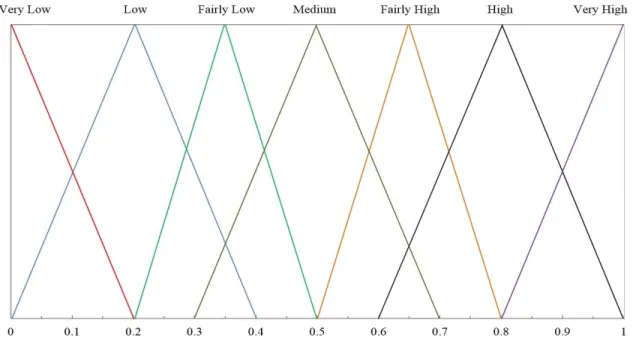
domain of the trapezoidal membership function respectively” [7]. A special case of fuzzy numbers are triangular membership functions denoted by a 3-tuple (a, b, c), i.e.,b=d. Figure 1.2 shows an example which is a linguistic term set, and the semantics of their terms could be represented as
Very High = (0.8,1,1),High = (0.6,0.8,1),Fairly High = (0.5,0.65,0.8), Medium = (0.3,0.5,0.7),Fairly Low = (0.2,0.35,0.5),Low = (0,0.2,0.4), Very Low = (0,0,0.2).
1.4.5 Linguistic decision making resolution scheme
It is necessary to analyze the phases of a linguistic decision scheme when the linguistic information is formally modelled. In linguistic decision analysis, a common decision resolution scheme, which is shown in Figure 1.3 must comply with the following three steps [24].
1) Defining the linguistic term set: This step requires us to establish the linguistic expression domain that is used to supply evaluators with an instrument by which they can assess the linguistic performance values about alternatives according to the different attributes.
Basically, one has to choose the granularity of the linguistic term set, its labels, and their associated semantics.
2) Developing the aggregation operator for linguistic information: According to different situations, develop appropriate aggregation operators for obtaining the aggregated values of the linguistic performance values provided by evaluators.
3) Selecting the best alternatives, including two phases:
• Aggregation phase: Obtain the aggregated linguistic preferences of alternatives by the use of developed aggregation operator.
• Exploitation phase: Make a ranking order among the alternatives according to the aggregated linguistic preferences and then choosing the best one(s).
Essentially, “the first two steps serve the aggregation phase in the third step, while the exploitation phase is determined depending on the choice of the semantic description of the linguistic term set” [32].
Figure 1.3. The scheme of a linguistic decision making problem
1.5 Organization of the Dissertation
This dissertation is composed of six chapters. The detailed explanation is shown as follow:
Chapter 1 first introduces research background, research purpose, research motivation, and research objective. Then, the related knowledge of this dissertation are briefly introduced for the purpose of conveniently carrying out subsequent chapters.
Chapter 2 recalls some main fuzzy linguistic approaches applied to the applications of multiple attribute decision making problems.
Chapter 3 proposes a proportional 3-tuple fuzzy linguistic representation model for multiple attribute decision making with incomplete linguistic information. Besides, an important notion, called preference-preserving proportional 3-tuple transformation, will be proposed serving for transforming linguistic assessments between two different linguistic term sets without loss of information. An illustration example taken from previous literature will be used in order to illustrate the proposed model.
Chapter 4 develops a proportional fuzzy linguistic distribution model for multiple attribute decision making with incomplete linguistic information. Several aggregation operators and expected utility in proportional fuzzy linguistic distribution will be proposed. An illustration example taken from previous literature will be employed so as to illustrate the proposed model.
Chapter 5 develops an interval fuzzy linguistic distribution model for multiple attribute decision making with incomplete linguistic information. Several interval aggregation operators and expected utility in interval fuzzy linguistic distribution will be proposed. Two illustration examples will
be used for the purpose of illustrating the proposed model from both a easily comprehensible perspective and a practical perspective.
Chapter 6 presents conclusions of this research. Meanwhile, the contributions of this research and future work will be discussed.
Chapter 2
A Survey on Decision Making with Fuzzy Linguistic Models
In decision making applications, the main problem for CW is how to represent and aggregate linguistic information for evaluation of alternatives. For this respect, lots of linguistic computational models have been proposed in the literature. In this chapter, we make a review of several main linguistic computational models based on fuzzy linguistic approach.
2.1 Linguistic Computational Model Based on Membership Functions
This kind of linguistic computational model is based on fuzzy linguistic approach and uses the extension principle to make the computations directly on the membership functions of the linguistic terms [7], [13]. “The use of extended arithmetic based on the extension principle increases the vagueness of the results. Therefore, the results obtained by the fuzzy linguistic operators based on the extension principle are fuzzy numbers that usually do not match with any linguistic term in the initial term set” [10]. According to different purposes, the results can be present either by means of the fuzzy numbers themselves (ranking purposes) [2], [22], or by means of linguistic labels which are computed from the fuzzy numbers that are obtained by the use of a linguistic approximation process (an interpretable and linguistic result purpose) [13], [51], [83].
Figure 2.1. Retranslation problem [23]
If latter purpose is required, then an approximation function app1(·) is applied to associate the fuzzy result F(R) with a label in S:
Sn−→F˜ F(R)−−→app1 (·)S,
where Sn symbolizes the n Cartesian product of S, ˜F is an aggregation function based on the extension principle, and F(R) is the set of fuzzy sets over the set of real numbers R [59].
It is worth noting that there is a loss of information when the approximation process is applied leading to the lack of accuracy of the results [10], which can be easily found in the following example of retranslation problem, shown in Figure 2.1. The obtained fuzzy number F(R) (highlighted in the figure) does not have an associated linguistic label on a particular term set S = {N, V L, L, M, H, V H, P}. Because we need to obtain a linguistic value in the end, an approximation function app1(·) that will assign one of the L or M labels to F(R) needs to be applied [23].
2.2 Linguistic Symbolic Computational Models Based on Ordinal Scales
This kind of linguistic computational models makes direct computations on labels and uses the ordered structure of the linguistic term set to accomplish symbolic computations. Basically, there are three kinds of linguistic symbolic computational models that are based on ordinal scales [23]
in the literature: “a linguistic symbolic computational model based on ordinal scales and max- min operators” [80], “a linguistic symbolic computational model based on indexes” [15], and “a linguistic symbolic computational model based on continuous term sets” [79].
In the first linguistic symbolic computational model, an ordered linguistic scaleS ={s0, . . . , sg} with a linear ordering is defined. The classical operators Max, Min and Neg which were introduced in Section 1.44 of Chapter 1 are used in order to be able to aggregate information expressed as linguistic labels in that ordered linguistic scale.
In the second linguistic symbolic computational model, a convex combination of linguistic labels is used during the aggregation process. “The convex combination of linguistic labels directly acts over the label indexes of the linguistic terms setS ={s0, . . . , sg}in a recursive way, and produces a real value on the granularity interval of the linguistic terms setS” [15]. Usually, this model assumes odd cardinality of the linguistic term set with linguistic labels symmetrically distributed around the middle linguistic term [23]. Because the aggregation results are numeric values, γ ∈ [0, g], which usually don’t match with any linguistic labels in the initial linguistic term set, they must be approximated in each step of the process by means of an approximation function app2 : [0, g] → {0, . . . , g}. By this way, a numeric value can be obtained which indicates the index of the associated linguistic term, sapp2(γ) ∈S [59]. Formally, it can be expressed as
Sn−→C [0, g]−−−−→ {app2(·) 0, . . . , g} →S,
where C is a symbolic linguistic aggregation operator, app2(·) is an approximation function used to obtain an index{0, . . . , g} associated with a term inS ={s0, . . . , sg} from a value in [0, g] [59].
In the third linguistic symbolic computational model, the linguistic term set S = {s0, . . . , sg} which is discrete is extended into a linguistic term set ¯S = {sα | s0 < sα ≤ sg, α ∈ [0, g]} which is continuous. In the continuous term set, if sα ∈S, then sα is called an original linguistic term, otherwise, sα is called a virtual linguistic term. Generally speaking, evaluators use original
Figure 2.2. Example of the third linguistic symbolic computational model [23] [79]
linguistic terms to assess the performances of alternatives, while the virtual linguistic terms only appear in the operation process [79].
Figure 2.2 is an example that a discrete term setS ={s−3, . . . , s3}(original linguistic terms) is extended into a continuous term set. From Figure 2.2 we can find that the virtual linguistic terms s−0.3 ∈ [−3,3] can be obtained after linguistic information aggregation in order to avoid loss of information [23], [79].
It is worth noting that since the virtual terms, which are quite different range than the original ones are created in the aggregation process, the interpretability of this computational model is limited. Therefore, as Herrera et al. points out [23], “this model also presents a retranslation problem if the results of the operations are virtual linguistic terms (and they will usually be virtual ones) and the final results must be expressed in the original linguistic term set. However, as the linguistic symbolic computational model based on linguistic terms is simple, as it avoids loss of information and as virtual linguistic terms can be used to rank alternatives and thus, to select the best of them, its use can be convenient in particular situations”. (For more information about linguistic symbolic computational models based on ordinal scales, interested readers can refer to, e.g., [23].)
2.3 Linguistic Symbolic Computational Models Based on 2-Tuple Representation
Generally speaking, when “linguistic computational models based on extension principle” [7], [13] and “linguistic symbolic computational models based on the ordered structure of linguistic term sets” [15], [80] (except “the linguistic symbolic computational model based on continuous term sets” [79]), are used in decision making for CW, the results of a computational process
usually don’t exactly match any of the initial linguistic terms and, hence, a process of linguistic approximation must be applied to convert the computational results into linguistic terms of the initial linguistic domain. This linguistic approximation process causes a loss of information and consequently leads to the lack of precision in the final results [10]. In order to avoid this limitation in the computational stage for CW and improve the precision of the final results, Herrera and Mart´ınez [28] developed the so-called “2-tuple fuzzy linguistic representation model based on the concept of symbolic translation”.
This symbolic model “extends the use of indexes modifying the fuzzy linguistic approach representation by adding a parameter to the basic linguistic representation in order to improve the accuracy of the linguistic computations after the retranslation step keeping in the CW scheme and the interpretability of the results” [49].
2.3.1 Representation model
Formally, let S = {s0, s1, . . . , sn} be a linguistic term set, and the term si with i = 0, . . . , n, represents a possible value for a linguistic variable. The total order on S is defined as: si ≤sj ⇔ i≤j. There is a negation operator: Neg (si) = sj such thatj =n−i, wheren+1 is the cardinality ofS. In general, using a symbolic method to aggregate linguistic information, we often get a value β ∈[0, n], and β /∈ {0, . . . , n}. Then, an approximation function is used in order to conveniently express the index of the result in S.
To avoid any approximation process which causes a loss of information in the process of computing with words, the 2-tuple (si, α) that expresses the equivalent information to β is obtained with the following function:
△ : [0, n]→S×[−0.5,0.5)
△ (β) = (si, α),with
si, i= round(β) α =β−i, α∈[−0.5,0.5)
where round (·) is the usual round operation,si has the closest index label toβ, and αis the value of the symbolic translation.
Inversely, a 2-tuple (si, α)∈S×[−0.5,0.5) can also be equivalently represented by a numerical value in [0, n] by means of the following transformation:
△−1 :S×[−0.5,0.5)→[0, n]
△−1 (si, α) = i+α =β.
2.3.2 Computational model
Based on the functions △ and △−1, 2-tuple fuzzy linguistic representation model is with the following operations:
(1) Comparison of 2-tuple
According to an ordinary lexicographic order, the comparison of linguistic information represented by 2-tuple is carried out as follows [23].
Let (sk, α1) and (sl, α2) be two 2-tuples with each one representing a counting of information, then
1) ifk < l then (sk, α1)<(sl, α2) 2) ifk =l then
• if α1 =α2 then (sk, α1), (sl, α2) represents the same information
• if α1 < α2 then (sk, α1)<(sl, α2)
• if α1 > α2 then (sk, α1)>(sl, α2).
(2) The negation operator of 2-tuple
The negation operator over 2-tuples is defined by
Neg((si, α)) =△(n−(△−1(si, α))) where n+ 1 is the cardinality of S, S ={s0, s1, . . . , sn}.
(3) 2-tuple aggregation operators
Because 2-tuples can be transformed into numerical values without loss of information, theoretically, conventional aggregation operators can be extended for 2-tuples.
Let x = {(s1, α1), . . . ,(sn, αn)} be a set of 2-tuples, and W = {ω1, . . . , ωn} be their associated weights. Then, the 2-tuple weighted average ¯x is computed by
¯
x=△(∑ni=1△−1(si, αi)·ωi
∑n
i=1ωi
)
=△(∑ni=1βi·ωi
∑n
i=1ωi
)
.
In the literature, many other 2-tuple aggregation operators have also been proposed, such as 2-tuple arithmetic mean, 2-tuple ordered weighted average operator. (For more details, see, e.g., [27], [28].)
2.3.3 The use of the 2-tuple linguistic representation model
Because the advantages of “2-tuple fuzzy linguistic representation model” [28], such as “its accuracy, its usefulness for improving linguistic solving processes in different applications, its interpretability, its ease managing of complex frameworks” [49] and so forth, it has been extensively and intensively researched and widely used as basis for different models employed in various decision making problems. Recently, several methodologies that are based on linguistic 2-tuples have been developed to deal with decision making problems under complex frameworks.
In [25], Herrera et al. proposed an approach to fusion multi-granular information in decision making, in which a basic linguistic term set is selected with maximum granularity, and a transformation function that represents each linguistic performance value as a fuzzy set is defined in this basic linguistic term set. Herrera and Mart´ınez [29] extend this methodology and using a linguistic hierarchies term sets to unify multi-granular hierarchical linguistic information using the 2-tuple linguistic model without loss of information. Huynh et al. also extended this model for MEDM in general multigranular linguistic contexts [35]. Herrera and Mart´ınez [26] presented a 2-tuple based methodology to deal with unbalanced linguistic information, which provided an algorithm to represent the linguistic terms and a computational model to accomplish processes of CW based on the 2-tuple linguistic model. Wang and Hao [70], [71] proposed “a proportional 2-tuple fuzzy linguistic representation model” to deal with linguistic term sets that are not uniformly and symmetrically distributed. By defining the concept of the numerical scale, Dong et al. [18] proposed an integration of Herrera and Mart´ınez’s model and Wang and Hao’s model.
Dong et al. [19] proposed “an interval version of the 2-tuple fuzzy linguistic representation
model”, which generalizes the numerical scale approach to set the interval numerical scale, by considering the context where semantics of linguistic terms are defined by interval type-2 fuzzy sets.
Although 2-tuple fuzzy linguistic representation model are inspired by the symbolic models used in decision making [15], [80], [81], [82], it and its extensions have been employed in numerous applications, such as supply chain management [72], screening new product projects [33], sensory evaluation [47], [48], engineering evaluation processes [50], intelligent agent system [14], research resources management [58], risk evaluation [11] and so on. A recent overview on the 2-tuple linguistic model, its extensions, specific methodologies, and applications can be found in [49].
2.4 Linguistic Symbolic Computational Models Based on Proportional 2-Tuple Representation
In last section, we recalled Herrera and Mart´ınez’s “2-tuple fuzzy linguistic representation model” [28], which aimed at avoiding loss of information caused by linguistic approximation process in the computational stage for CW. However, they also pointed out that “this model was only suitable for linguistic variables with equidistant labels”. In addition, as argued by Lawry [43], “although Herrera and Mart´ınez’s symbolic approach offered a computationally much more feasible method than those approaches using the extension principle in CW, it did not directly take into account the underlying vagueness of linguistic terms”. In an attempt to improve Herrera and Mart´ınez’s 2-tuple fuzzy linguistic representation model so as to be able to deal with unbalanced linguistic term sets while simultaneously taking the underlying semantics of terms into account, Wang and Hao [70] proposed a so-called “proportional 2-tuple fuzzy linguistic representation model for CW making use of the canonical characteristic values (CCV) of linguistic terms determined by their corresponding semantics”. Because our inspiration of developing a proportional 3-tuple fuzzy linguistic representation model for MADM problems comes from this symbolic linguistic computational model, we review it in this section on the one hand for appreciation, on the other hand for paving the way for next chapter.
2.4.1 Representation model
Formally, letS ={s0, s1, . . . , sn}be an ordinal term set with s0 < s1 <· · ·< sn(“<” represents order relation. si < sj if and only if i < j),I = [0,1] and
IS ≡I×S ={(α, si) :α∈[0,1] and i= 0,1, . . . , n}.
Given a pair (si, si+1) of two successive ordinal terms of S, any two elements (α, si), (β, si+1) of IS are called a symbolic proportion pair and α, β are called a pair of symbolic proportions of the pair (si, si+1) if α+β = 1. A symbolic proportion pair (α, si), (1−α, si+1) is denoted by (αsi,(1−α)si+1) and the set of all the symbolic proportion pairs is denoted by S∗, i.e., S∗ = {(αsi,(1−α)si+1) :α∈[0,1] andi= 0,1, . . . , n−1}. The set S∗ is called the ordinal proportional 2-tuple set generated by S and the members of S∗ are called ordinal proportional 2-tuples.
Remark: For i ={1, . . . , n−1}, ordinal term si can use either (0si−1,1si) or (1si,0si+1) as its representative in S∗, by abuse of notation.
Compared with 2-tuple representation, the presentation of proportional 2-tuple provides a suitable and more flexible space in a computation stage for CW. It could allow evaluators in various situations to flexibly evaluate performances of alternatives by not just one label but with the form of (αsi,(1−α)si+1).
2.4.2 Computational model
(1) Comparison of proportional 2-tuple
The comparison of linguistic information represented by proportional 2-tuple is carried out as follows:
Let S = {s0, s1, . . . , sn} be an ordinal term set and S∗ be the ordinal proportional 2-tuple set generated byS. For any (αsi,(1−α)si+1), (βsj,(1−β)sj+1)∈S∗, define
(αsi,(1−α)si+1) < (βsj,(1−β)sj+1)⇔αi+ (1−α)(i+ 1)
< βj+ (1−β)(j+ 1)⇔i+ (1−α)< j+ (1−β).
Thus, for any two proportional 2-tuple (αsi,(1−α)si+1) and (βsj,(1−β)sj+1), we obtain:
1) ifi < j, then
• (αsi,(1−α)si+1), (βsj,(1−β)sj+1) represent the same information when i=j−1 and α= 0, β = 1,
• (αsi,(1−α)si+1)<(βsj,(1−β)sj+1) otherwise.
2) ifi=j, then
• if α=β then (αsi,(1−α)si+1), (βsj,(1−β)sj+1) represents the same information,
• if α < β then (αsi,(1−α)si+1)>(βsj,(1−β)sj+1),
• if α > β then (αsi,(1−α)si+1)<(βsj,(1−β)sj+1).
(2) Negation operator of a proportional 2-tuple The negation over proportional 2-tuples is defined as
N eg(αsi,(1−α)si+1) = ((1−α)sn−i−1, αsn−i), where n+ 1 is the cardinality of S, S ={s0, s1, . . . , sn}.
(3) Canonical characteristic values of proportional 2-tuple
Wang and Hao introduced the so-called “canonical characteristic values (CCV)” to represent fuzzy number based semantics of linguistic terms and developed an efficient method for CW based on the proportional 2-tuple fuzzy linguistic representation. Specifically, “let F(R) be the set of fuzzy numbers defined onR (the real numbers set). Each fuzzy number,yi ∈F(R), has associated a membership function, uyi :R →[0,1]. For each fuzzy number, yi, there is a set of characteristic values, CVyi ={Ci1, Ci2, . . . , Ciz}, which are crisp values that summarize the information given by yi, i.e., they support its meaning” [70]. Wang and Hao have enumerated someCCV for representing the related information of proportional 2-tuples, such as expected value, center of gravity, mean of maxima. Particularly, if the semantics of linguistic terms is defined by symmetrical triangular fuzzy numbers in [0, 1], i.e, yi = [c−δ, c, c+δ], then the expected value (EV) of yi is defined by EV(yi) =c and used asCCV of yi.
With the notions of proportional 2-tuple and CCV, the computation operator used for transforming a proportional 2-tuple into a numerical value belonging to [0, 1] is defined as follows.
Letci ∈[0,1] withc0 < c1 <· · ·< cnbe the canonical characteristic values ofsi, i.e.,CCV(si) = ci for all i= 0,1, . . . , n. Then, define the function CCV on S∗ by
CCV :S∗ → [0,1]
CCV((αsi,(1−α)si+1)) = αCCV(si) + (1−α)CCV(si+1)
= αci+ (1−α)ci+1
= z ∈[0,1]
and call it the corresponding canonical characteristic value function on S∗ generated by CCV on S. It has been proved by Wang and Hao [70] that the CCV is a bijection from S∗ to [c0, cn].
Specifically, let us define f : [0, n]→[c0, cn] by
f(x) = ci+β(ci+1−ci)
where i=E(x), E is the integral part function andβ =x−i. Thenf is a bijection. Since,
CCV(((1−β)si, βsi+1)) = (1−β)ci+βci+1
=ci+β(ci+1−ci)
=f(i+β)
=f(π((1−β)si, βsi+1))
for all i = 0,1, . . . , n−1, β ∈[0,1], thus CCV =f ◦π. Here, “π is the position index function of ordinal 2-tuples” [70], i.e.,
π :S∗ → [0, n] by π((αsi,(1−α)si+1)) = i+ (1−α).
![Figure 2.2. Example of the third linguistic symbolic computational model [23] [79]](https://thumb-ap.123doks.com/thumbv2/123deta/6147512.1081351/29.918.155.766.102.280/figure-example-linguistic-symbolic-computational-model.webp)