Partnership in Psycho-Social Group Intervention for Cancer Patients: Factors to
Creating Group Dynamics
Masami Chujo* and Hitoshi Okamura†
*Department of Adult and Elderly Nursing, School of Health Science, Tottori University Faculty of Medicine, Yonago 683-8503, Japan and †Department of Psychosocial Rehabilitation, Faculty of Health and Science, Graduate School, Hiroshima University, Hiroshima 734-8553, Japan
ABSTRACT
Background The purpose of this study was to con-duct a psycho-social group intervention consisting of 3 parts, educate patients on methods to cope with stress and solve problems, hold group discussions and practice progressive muscle relaxation (PMR) for cancer patients, and investigate the way that group dynamics work in psycho-social group interventions in Japan.
Methods Three facilitators and 2 sub-facilitators who conducted the group intervention for breast cancer pa-tients were qualitatively and inductively analyzed using a phenomenological approach.
Results As a result, “hard effort,” “harmony of the whole group” and “collaboration between therapists” were extracted as the partnership functions of partici-pants that work on the creation of group dynamics in psycho-social group interventions. There was a structure in which “harmony of the whole group” and “collabora-tion between therapists” coexisted based on the basic attitude of “hard effort.”
Conclusion It was considered that these 3 intervention forms are involved in group dynamics in which partici-pants can easily hold discussions, and are techniques necessary for group intervention contributing to changes in the psychological distress and the coping of partici-pants.
Key words group dynamics; group intervention; facili-tator; nurse; partnership
Recent advances in cancer treatment have helped breast cancer patients live longer. However, breast cancer pa-tients also have psychological burdens and therefore live with psycho-social problems.1–3
Group therapy, which was developed in the United States and Europe as one of the psycho-social interven-tions for improving psychological distress and helping cancer patients cope,4–9 is a program consisting of
edu-Corresponding author: Masami Chujo, RN, PhD [email protected]
Received 2014 December 19 Accepted 2015 January 23
Abbreviation: PMR, progressive muscle relaxation
cation on methods for coping with stress and for solv-ing problems, group discussion and progressive muscle relaxation (PMR). This positive effects of this approach has also been verified in Japan.4, 5, 10
Group interventions are not considered susceptible to the skills of a therapist because a characteristic fea-ture of intervention is that participants can understand each others’ situations and support each other, i.e., they participate in group dynamics.11 On the other hand, it was reported that facilitators, who play a role in smooth and effective organization of group discussion in group interventions, provide their patients with intervention, but have difficulty in, for example, managing partici-pants with problems and feeling anxiety due to lack of knowledge.12 This is thought to be because these facili-tators and staff have more anxiety than necessary since the mechanism for creating group dynamics in group in-terventions for Japanese cancer patients has not yet been fully elucidated.
Based on the above background, we conducted a study of a psycho-social intervention which was proven to be useful for Japanese patients with primary and re-current breast cancer.4 10 In this study, we investigated in detail the factors that create group dynamics experi-enced by Japanese facilitators.
SUBJECTS AND METHODS Subjects
Facilitators and sub-facilitators: Eligible subjects were facilitators of group interventions in cancer center A or cancer center B who met the following criteria: i) experience as nurses for more than 5 years; ii) facilitator training received in advance and iii) willingness to play a role in facilitating discussion among participants. Group participants: Group participants were breast cancer patients followed in cancer center A or cancer center B who met the following eligibility criteria: i) adult women aged 20 years or older; ii) histological diag-nosis of breast cancer and presence of histologically and/ or clinically confirmed breast cancer; iii) no serious gen-eral condition; iv) no active double cancer; v) no clinical need for psychiatric treatment for depression, adjustment disorder, etc. and vi) no difficulty in understanding the essence of the study.
These patients were requested to participate in the study from June 2002 to April 2003 in cancer center A and from October 2006 to February 2008 in cancer cen-ter B.
Intervention methods
This study employed a short-term (6-week) psycho-social group intervention, which had been verified to be effective for Japanese patients with primary/recurrent breast cancer.4, 10
A total of 6 weekly 90-min sessions of group in-tervention were given to a group of 3 to 8 participants. Each session consisted of education on methods for cop-ing with stress and for solvcop-ing problems (20 min), dis-cussion on coping (50 min) and learning about PMR (20 min).
Evaluation
Intervention scenes were recorded with a digital video camera or IC recorder and later transcribed verbatim. The original records were discarded after verbatim tran-scripts were made.
Ethical considerations
After obtaining approval from the ethics committees of the two research institutions and Fukuoka Prefectural University, the outline of the study, voluntary nature of participation and preservation of anonymity were ex-plained verbally and in writing to the subjects and group intervention participants, and their consent to participate in the study was obtained.
Analysis methods
For the analysis, we used a method to qualitatively and inductively extract factors creating group dynamics from the verbatim transcript data according to the purpose of the study, based on the concept of a phenomenologi-cal method.13 First, we repeatedly read the interview descriptions to grasp the whole context, grouped similar expressions, compared and investigated the relationships among them, and named each group so that it represent-ed a distinct meaning. We further reviewrepresent-ed the verbatim transcripts many times to check whether the given group names reflected the true nature of the data. We further grouped similar expressions, compared and investigated the relationships among them. By repeating these proce-dures, we abstracted expressions gradually. Expressions, for which the true nature of meaning was captured, were extracted as methods of the interventions used by facili-tators.
In this process, we had discussions many times to improve the reliability and validity of the study and to investigate whether the results were reliable and
symbol-ized the “real” world of the subject (reliability), whether the study was conducted in the context considering the environment of the subject and all circumstances (mean-ing in the context), explanations and interpretations were adequately given, and whether the results found in this study could be applied to similar contexts or situations (transferability).
RESULTS
Characteristics of the subjects
An experienced facilitator: An experienced facilitator had experience as a nurse for more than 10 years, had experience of nursing breast cancer patients for more than 3 years, had received facilitator training and had experience as a facilitator of group interventions for more than 3 years.
New facilitators: Two new facilitators had experience as nurses for more than 10 years on average and had re-ceived facilitator training. These facilitators operated a 6-session course for the first time.
An experienced facilitator: An experienced sub-facilitator had experience as a nurse for more than 10 years, had experience of nursing breast cancer patients for more than 5 years, had received facilitator training and had experience as a facilitator and sub-facilitator of group interventions for more than 5 years.
A new sub-facilitator: A new sub-facilitator had expe-rience of medical care for psycho-oncology and breast cancer patients for 8 years and had received group facili-tator training.
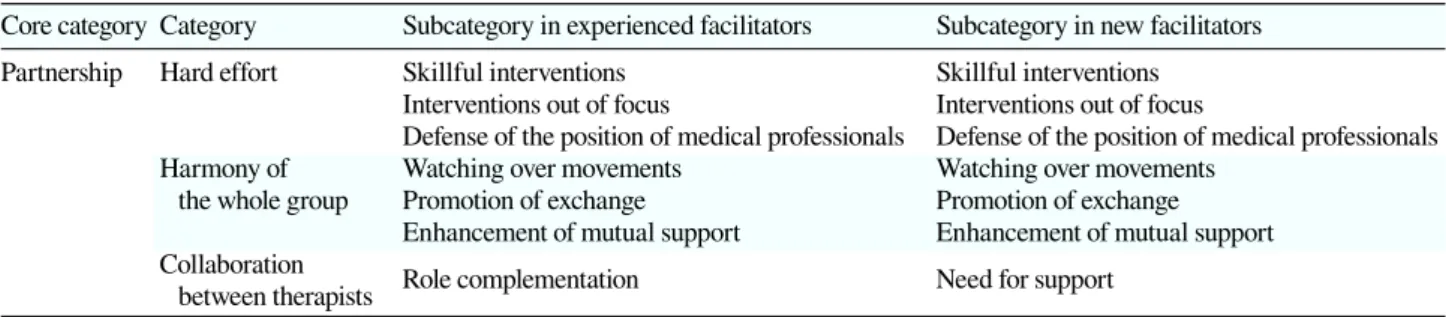
A factor creating group dynamics during the group intervention: As a result of the analysis, a core category “partnership” was extracted as a factor creating group dynamics during the group intervention (Table 1). In ad-dition, there were differences in subcategories between experienced and new facilitators. Hereinafter, categories are shown in “ ” and subcategories in < >, and inter-ventions used by facilitators on which these extractions were based in bold.
“Hard effort” This category means that facilitators worked exceedingly hard to interact therapeutically with partici-pants. Even when the facilitators could not make skillful interventions, their sincerity was expressed in emotions and conveyed to the participants. This category included 3 sub-categories.
<Skillful interventions> This subcategory means that in in-tervention facilitators speculated what a participant intended with his/her words and enhanced the feelings that he/she
Table 1. Comparison of partnership between experienced and new facilitators
Core category Category Subcategory in experienced facilitators Subcategory in new facilitators Partnership Hard effort Skillful interventions Skillful interventions
Interventions out of focus Interventions out of focus
Defense of the position of medical professionals Defense of the position of medical professionals Harmony of Watching over movements Watching over movements
the whole group Promotion of exchange Promotion of exchange Enhancement of mutual support Enhancement of mutual support Collaboration Role complementation Need for support
between therapists
wanted to convey so that the other participants could share his/her feelings.
Participant 15: “The doctor came to me to collect blood say-ing, ‘I want to check your blood oxygen content,’ and stuck a needle into my artery, like this. It was very pain-ful. The doctor said, ‘I am scared, too’ (laughing). ‘I am scared, too’ (laughing). It was like a near-death experi-ence.”
Participant 20: “I’m sorry to hear that. You really had a hard time.”
Facilitator A: “I see. Your story . . . it was like you came back alive.”
Participant 15: “When I thought about it later, it was . . .”
<Interventions out of focus> This subcategory means that facilitators dealt with the superficial meanings of words in discussion and failed to deal with the true meanings of the story behind the words, or improperly focused on a topic that a participant did not want the other participants to know.
Participant 4: “When someone tells me ’You’re doing well,’ I just think, huh. I’m a worth.”
Participant 2: “I cry, maybe because the tension I feel is re-leased all of a sudden.”
Participant 4: “I see.”
Facilitator A: “So . . . maybe you usually . . . make a strong effort.”
Participant 4: “I wouldn’t say I am making an effort like this (standing up firmly) . . . or maybe I do. I don’t know.”
<Defense of the position of medical professionals> This subcategory means that when medical services were criti-cized in the discussion, facilitators improperly explained the present state of, and/or defended, the medical services.
Participant 22: “When I saw a doctor at another hospital, a local hospital, I was told I had lung cancer and I was referred to this hospital. The doctor at the local hospital told me, ‘The amount of cancer is no problem, at least for a while, so let’s just leave things as they are.’ But I insisted on getting some treatment and visited a pulmo-nologist, complaining of severe symptoms, and it was finally found out that water had begun to accumulate in my lungs. So, if I think about my relationship with the
attending physician in this discussion, I start to feel like I can’t trust him or her because of that experience.” Facilitator A: “Other situations like this also often occur in
this hospital, and many patients go through something similar. So when the doctor told you, ‘Let’s wait and see,’ the doctor might not mean that he or she knew was their cancer but would leave it alone.”
“Harmony of the whole group” This category was also common to both experienced and new facilitators and is necessary for peaceful discussion among participants as the basis on which group dynamics work among participants. This category included 3 subcategories.
<Watching over movements> This subcategory means that when discussion was active in a group, facilitators wouldn’t dare to make active interventions.
Participant 26: “Well, I would like to take a trip, first of all. I will work harder for that and want to make an effort. Af-ter I began to come here, my anxiety went away a little bit, or considerably. My anxiety, anxiety in my feelings, has gone away completely.”
Participant 20: “(laughing) But you were anx. . .” Participant 26: “No! It was real . . . really!” Participant 21: “You’ll be OK.”
Participant 20: “Thanks, I appreciate that.”
Participant 21: “You’ll be OK, because you’re a cheerful person. A lot of patients tend to be emotionally unbal-anced . . . (omission).”
Participant 26: “So, feelings are important. People say worry is often the cause of illness.”
Participant 21: “In places like this . . .”
Participant 26: “We have to chase our gloomy feelings away.”
(The discussion continued as participants supported each other, and Facilitator A felt no need to take part in order to keep harmony in the group.)
<Promotion of exchange> This subcategory means that fa-cilitators took care so that all participants were able to take part in a discussion.
Facilitator A: “Everyone has various problems. I think everyone tries desperately to make an effort the first time . . . with various problems . . .”
Participant 15: “That’s right. I really think so, too. I did not think I would die of cancer the first time around.” (Par-ticipant 26 came in the room when Par(Par-ticipant 15 was speaking)
Participant 21: “Right! The first time around! But the sec-ond time . . . somehow . . . I don’t know yet. My point of view has changed.”
Participant 15: “Right, but the first time around, I thought it [the cancer] was all gone.”
Participant 26: “Me, too. I thought it was all gone . . .” Participant 21: “The bad part of mine was resected, and I
thought it was all gone, too.”
Facilitator A: “Welcome Ms. 26. Thank you for coming.” (Everyone agreed)
Participant 26: “I’m sorry for interrupting. I had to work late, but I thought I could finish work early today . . . (omission)”
<Enhancement of mutual support> This subcategory means that in interventions, facilitators suggest that partici-pants mutually express their feelings, share them and sup-port each other, thereby making them all feel that they are surviving together.
Participant 16: “She was told, ‘You can take a trip again and it is OK for you. If you undergo surgery soon, you will be fine.’”
Participant 8: “I see, but . . .”
Participant 16: “But, I myself couldn’t think and my mind went blank . . .”
Participant 8: I’m just a parent . . . It is only talk. If you are ill yourself like us, you would not to be sensitive.” Facilitator A: “Well, this place is where you can share
your feelings like this and consult with me or each other.”
Participant 8: “That’s right.”
“Collaboration between therapists” This category was also common to both experienced and new facilitators and means that therapists, i.e., a facilitator and a sub-facilitator in charge of education, collaborated so that group dynamics could work between them. Two therapists recognized the differences between them and complemented each other in their roles, which made the process of education and the discussion go smoothly in the group interventions. This cat-egory included 2 subcategories.
<Role complementation> This subcategory means that a sub-facilitator, whose main role was to provide education, and a facilitator, whose main role was to make interventions so that group dynamics would start to work in the discus-sion, understood each other’s roles and complemented each other’s weak points.
Participant 3: “I have always . . . thought positively, and I controlled myself as much as I can so that I would not be depressed. When recurrence occurred, I thought it was the same as death. But, thanks to this place, I can now expect my hair will grow again and expect other good
things. I now have something like a [progress] scale and it encourages me (omission). I already think I’ve gotten quite old, and I will not raise children any more (laugh-ing). But, I think it is enough for me if I can live day by day.”
Facilitator A: “I think Ms. 3 is great because she has been thinking positively from the beginning. It is important to have positive thinking, but it is also important to face the present situation . . .”
Sub-facilitator A: “I think positive thinking includes more than hard effort.”
Participant 2: “At first, I thought I had to control myself in that way and I had to be positive . . . which was like pres-sure. But I came to think I can sometimes be depressed, and I came to think I don’t necessarily have to work hard . . . (laughing)”
<Need for support> This subcategory means that when a new facilitator did not know how to talk to participants and how to intervene, a sub-facilitator skillfully makes an inter-vention instead of the facilitator.
Facilitator B: “Well, let’s start the discussion. In previous sessions, we talked about connections with people and support from people. Today’s theme is the relationship with attending physicians, families, friends and society. I think sometimes you’re supported by these people but sometimes you’re not. Everyone, please give your opinion on how to cope with problems when you are not supported, or what to do when you cannot cope with problems . . . or you can ask for advice . . .”
Sub-facilitator B: (looking at the clock)
Facilitator B: (Facilitator B became aware that he/she should ask the participants whether they had time to continue the session) “This session is originally scheduled to end at 16:30. But, I would like to extend the discussion for about 10 min. The session is scheduled to end at 16:30, but I would like to continue the session un-til about 16:40. Is that OK for you? (the facilitator looks at the sub-facilitator)
Sub-facilitator B: “Ms. 37 has to travel a long way.” Facilitator B: “I see. Ms. 37, are you OK with that?”
Participant 37: “It’s OK for me. But we can’t really discuss anything in only 10 min, can we?”
DISCUSSION
A qualitative inductive analysis revealed that 3 factors creating group dynamics, “hard effort,” “harmony of the whole group” and “collaboration between therapists,” all coexisted as [partnership]. In addition, these 3 categories were observed in both experienced and new facilitators. However, there were some differences in the content of these categories between new and experienced facilitators.
First, the category of “hard effort” included 3 sub-categories, <skillful interventions>, <defense of the posi-tion of medical professionals> and <intervenposi-tions out of focus>. <Skillful interventions> was extracted, because
facilitators had virtual experiences in facilitator train-ing as facilitators and patients in group interventions. In particular, experienced facilitators were considered to be able to make some interventions based on their past experiences, because they had encountered various sce-narios. On the other hand, not only new facilitators, but also experienced facilitators experienced <defense of the position of medical professionals> and <interventions out of focus>, suggesting that it is very difficult even for experienced facilitators to always make effective group interventions in a stream of group interventions. Howev-er, even if facilitators and sub-facilitators could not make skillful interventions, their feelings that they wanted to interact with and support the participants with all their might were conveyed to the participants as “hard effort”. Probably for this reason, the participants supported facilitators and continuously attended as many as 6 ses-sions. Concerning qualifications required for facilitators, this study suggested that it is necessary for facilitators to have an attitude of not being dependent on others only because they are new facilitators, or are not satisfied with their experiences, as well as an attitude of continu-ously and sericontinu-ously facing participants, as described by Spiegel et al.14 and Kiba et al.15 This indeed was consid-ered to be the basic attitude required for facilitators who handle group interventions.
The category of “harmony of the whole group” in-cluded 3 subcategories, <watching over movements>, <promotion of exchange> and <enhancement of mutual support>. These intervention forms, observed in both new and experienced facilitators, are required to con-struct and maintain group dynamics that improve the effectiveness of group interventions. These results may be attributable to facilitator training, as in the case of basic facilitator skills, and the fact that facilitators dis-cussed the condition of each participant and movements in each group before and after every group intervention and thereby obtained suggestions for better intervention methods. In addition, it was considered that <watching over movements> alone made group dynamics work in discussion, since the subjects were female patients which and were given an explanation about discussion sessions when recruited. There are female patients has resistance to talk each other less than male patients.
<Role complementation> and <need for support> were extracted in experienced and new facilitators, re-spectively, as subcategories of the category of “collabo-ration between therapists”. New facilitators have little empirical knowledge and sometimes do not know how to manage a group, which may influence the harmony of the whole group, and eventually influence whether or not group dynamics work well. Classen et al.7 pointed out
that if facilitators have little experience, group interven-tions are often less effective. From this, if a new facilita-tor makes interventions, it is recommended to assign an experienced facilitator as his/her partner or to deploy additional staff so that other staff can oversee the whole picture and support the new facilitator.
To improve the effectiveness of group interventions, it is important that facilitators adjust the environment so that group dynamics work, as described by Yalom and Vinogradov.11 The results of this study showed that there was a structure in which “harmony of the whole group” and “collaboration between therapists” coexisted based on the basic attitude of “hard effort”. In addition, these 3 subcategories created partnership among facilitators, sub-facilitators and participants. Yalom and Vinogra-dov11 reported that group interventions created group dynamics in which participants understood each other’s situation and supported each other. The present study also showed that group dynamics worked in group inter-ventions. A characteristic feature observed in the present study was that even when facilitators and sub-facilitators were beginners, group interventions allowed participants to understand each other’s situation and support each other. Classen7 stated that interventions by new facilita-tors could not contribute to the improvement of the qual-ity of life of participants, but this does not seem to be the case if the group dynamics of the participants.
In conlusion, A qualitative inductive analysis of the verbatim transcripts of group interventions extracted 3 categories, “hard effort,” “harmony of the whole group” and “collaboration between therapists,” as [partnership] which is a factor creating group dynamics. There was a structure in which “harmony of the whole group” and “collaboration between therapists” coexisted based on the basic attitude of “hard effort.” It is suggested that these 3 intervention forms are involved in group dynam-ics in which participants can have smooth discussions, and that these forms are techniques necessary for group interventions contributing to changes in the quality of life of the participants.
The authors declare no conflict of interest.
REFERENCES
1 Nukariya K. [A longitudinal prospective study of psychol-ogy in breast cancer]. Tokyo Jikeikai Ika Daigaku Zasshi. 1996;111:165-82. Japanese.
2 Pinder KL, Ramírez AJ, Black ME, Richards MA, Gregory WM, Rubens RD. Psychiatric disorder in patients with ad-vanced breast cancer: prevalence and associated factors. Eur J Cancer. 1993;29A:524-7. PMID: 8435204.
3 Takahashi M. Psychosocial problems of breast cancer: influ-ence of diagnosis and treatment. Terminal Care. 1997;7:141-5. Japanese.
4 Fukui S, Kugaya A, Okamura H, Kamiya M, Koike M, Nakanishi T, et al. A psychosocial group intervention for Japanese women with primary breast carcinoma. Cancer. 2000;89:1026-36. PMID: 10964333.
5 Hosaka T, Sugiyama Y, Tokuda Y, Okuyama T. Persistent ef-fects of a structured psychiatric intervention on breast cancer patients’ emotions. Psychiatry Clin Neurosci. 2000;54:559-63. PMID: 11043806.
6 Fawzy FI, Cousins N, Fawzy NW, Kemeny ME, Elashoff R, Morton D. A structured psychiatric intervention for cancer patients. I. Changes over time in methods of coping and affec-tive disturbance. Arch Gen Psychiatry. 1990;47:720-5. PMID: 2378543.
7 Classen C, Butler LD, Koopman C, Miller E, DiMiceli S, Giese-Davis J, et al. Supportive-expressive group therapy and distress in patients with metastatic breast cancer: a ran-domized clinical intervention trial. Arch Gen Psychiatry. 2001;58:494-501. PMID: 11343530.
8 Spiegel D, Boom JR, Yalom I. Group support for patients with metastatic cancer. A randomized outcome study. Arch Gen Psychiatry. 1981;38: 527-33. PMID: 7235853.
9 Goodwin PJ, Leszcz M, Ennis M, Koopmans J, Vincent L, Guther H, et al. The effect of group psychosocial support on survival in metastatic breast cancer. New Engl J Med. 2001;345:1719-26. PMID: 11742045.
10 Chujo M, Mikami I, Takashima S, Saeki T, Ohsumi S, Aogi K, et al. A feasibility study of psychosocial group intervention for breast cancer patients with first recurrence. Support Care Cancer. 2005;13:503-14. PMID: 15580362.
11 Yalom ID, Vinogradov S. The theory and practice of group psychotherapy. Kawamuro Y, translator. Tokyo: Kongo Shup-pan; 1991. Japanese.
12 Morita M, Yoshida M, Asakura T, Okuhara H, Fukui S, Endo K. Development and evaluation of a training program for support group facilitators for cancer patients. Palliative Care Research. 2006;1:114-20. Japanese with English abstract. 13 Munhall PL, Boyd CO, editors. Nursing research: a qualitative
perspective. 2nd edition. Washington, DC: Jones and Batlett Publishers and National League for Nursing; 2000. p. 106-14. 14 Spiegel D, Classen C. Group therapy for cancer patients: a
research-based handbook of psychosocial care. Asakura R, Tanaka S, translators and editors. Tokyo: Igaku-Shoin; 2003. 329 p.
15 Kiba S, Maruguchi M. Gan kanja to kazoku no sapoto pu-roguramu [Support program for cancer patients and family: basics and practice]. Hosupisu Kea Kenkyukai, editor. Tokyo: Seikaisha; 2005. Japanese. p. 71-72.