
OPEN ACCESS
First-principles band structure and FLEX approach
to the pressure effect on T
c
of the cuprate
superconductors
To cite this article: Hirofumi Sakakibara et al 2013 J. Phys.: Conf. Ser. 454 012021
View the article online for updates and enhancements.
Related content
Two-orbital view on the origin of the material dependence of Tc in the single-layer cuprates
Hirofumi Sakakibara, Hidetomo Usui, Kazuhiko Kuroki et al.
-Spin fluctuations and unconventional superconducting pairing in iron-based superconductors
Yu Shun-Li and Li Jian-Xin
-Spin, charge, and orbital orderings in iron-based superconductors
Jiang Qing, Kang Yao-Tai and Yao Dao-Xin
-Recent citations
Higher superconducting transition temperature by breaking the universal pressure relation
Liangzi Deng et al
-Effect of Pressure on the Pseudogap in Bi2223: Cuprates Are Not Strongly Coupled Superconductors
A.I. D’yachenko et al
First-principles band structure and FLEX approach
to the pressure effect on T
cof the cuprate
superconductors
Hirofumi Sakakibara1, Katsuhiro Suzuki1, Hidetomo Usui1, Kazuhiko
Kuroki1, Ryotaro Arita2,5, Douglas J Scalapino3 and Hideo Aoki4
1
Department of Engineering Science, The University of Electro-Communications, Chofu, Tokyo 182-8585, Japan
2
Department of Applied Physics, The University of Tokyo, Hongo, Tokyo 113-8656, Japan
3
Physics Department, University of California, Santa Barbara, California 93106-9530, USA
4
Department of Physics, The University of Tokyo, Hongo, Tokyo 113-0033, Japan
5
JST, PRESTO, Kawaguchi, Saitama 332-0012, Japan E-mail: hiro [email protected]
Abstract. High-temperature cuprate superconductors have been known to exhibit significant pressure effects. In order to fathom the origin of why and how Tc is affected by pressure, we
have recently studied the pressure effects on Tc adopting a model that contains two copper
d-orbitals derived from first-principles band calculations, where the d
z2 orbital is considered on
top of the usually considered dx2−y2 orbital. In that paper, we have identified two origins for
the Tc enhancement under hydrostatic pressure: (i) while at ambient pressure the smaller the
hybridization of other orbital components the higher the Tc, an application of pressure acts to
reduce the multiorbital mixing on the Fermi surface, which we call the orbital distillation effect, and (ii) the increase of the band width with pressure also contributes to the enhancement. In the present paper, we further elaborate the two points. As for point (i), while the reduction of the apical oxygen height under pressure tends to increase the dz2 mixture, hence to lower
T
c, here we show that this effect is strongly reduced in bi-layer materials due to the pyramidal
coordination of oxygen atoms. As for point (ii), we show that the enhancement of Tcdue to the
increase in the band width is caused by the effect that the many-body renormalization arising from the self-energy is reduced.
1. Introduction
Although many kinds of superconductors have been discovered, the superconducting transition temperature Tcof the cuprate superconductors still remains to be the highest, and the possibility of further enhancing Tc still attracts much attention. To achieve higher Tc, it is important to understand the key parameters that control Tc, and from this viewpoint, there have been studies that have focused on the correlation between Tc and the lattice parameters such as the in-plain bond length(l)[1, 2] or the apical oxygen height(hO) [3, 4, 5, 6, 7, 8, 9, 10, 11] measured from the CuO2 planes. Theoretically, we have studied the material dependence of Tc in [10, 11], and introduced a two-orbital model that takes into account the dx2
−y2 and dz2 Wannier orbitals. In most of the theories of the cuprates, only the dx2
−y2 (and the hybridized oxygen p) orbital is considered, but actually it has been noticed from the early days that in (La,Sr)2CuO4, which
Content from this work may be used under the terms of theCreative Commons Attribution 3.0 licence. Any further distribution of this work must maintain attribution to the author(s) and the title of the work, journal citation and DOI.
has small hO and relatively low Tc, there is a strong mixture of the dz2 orbital component near the Fermi level[12, 13, 14]. In fact, nowadays there have been more studies that focus on the dz2 orbital or the related apical oxygen [7, 8, 15, 16, 17, 18]. In [10, 11], we have shown that this mixture of the dz2 orbital component near the Fermi level works destructively against d−wave superconductivity, and hence this is the main reason of the material dependence of Tc.
Studying the pressure effect on Tc is an in situ way of attacking the problem of the correlation between Tc and the lattice structure. It is well known that in most of the cuprates, application of pressure enhances Tc[19, 20]. On the other hand, it has been revealed that the pressure effect exhibits strong anisotropy[21, 22, 23]. In our recent theoretical study on the pressure effect in the cuprates, it has been revealed that in addition to the dz2 effect, the roundness of the Fermi surface, which is controlled by Cu-4s-dx2
−y2 hybridization, and also the band width are important parameters that governs Tc under pressure[24].
In the present paper, after briefly reviewing the main results obtained in [24], we study more closely the effect of the band width by applying the fluctuation exchange
approximation(FLEX)[25, 26, 27] to the two-orbital model. Secondly, we will explain the
difference of the dz2 orbital effect between the multi-layer and single-layer systems under hydrostatic pressure.
2. Calculation Method
2.1. Determination of the Crystal Structure Under Pressure
We first obtain the crystal structure of the single-layer cuprates La2CuO4and Hg2BaCuO4under ambient pressure. Namely, we calculate the total energy by first principles calculation[28] varying the lattice constants, and fit the result by the standard Burch-Marnaghan formula[29] to obtain the structure at the most stable point. From such calculation, we can obtain the crystal structure within one percent discrepancy from the lattice constants determined experimentally[30, 31]. To obtain the lattice structure under hydrostatic pressure, we optimize the Poisson’s ratio and atomic position by first principles reducing the cell volume to 95% or 90% of the lattice structure under ambient pressure. Since the compressibility in the cuprates is known to be about ∼ 0.01 GPa−1[32], V = 0.9V
0 corresponds to a pressure of about 10 GPa. 2.2. Construction of the two-orbital model and FLEX approximation
Using the obtained crystal structure under ambient or hydrostatic pressure, we construct maximally localized Wannier orbitals[33, 34] to extract the hopping parameters of the dx2
−y2 -dz2 two-orbital model[10]. As for the electron-electron interactions, we consider the on-site intraorbital Coulomb repulsion U , interorbital repulsion U′, the Hund’s coupling J and the pair-hopping J′. Here we also keep the orbital SU(2) requirement, U − U′ = 2J. We set U = 3.0
eV, U′ = 2.4 eV and J = J′ = 0.3 eV unless mentioned otherwise. Estimates of U for the
cuprates is 7 − 10t, t ≃ 0.45eV (namely, U is about 3 ≃ 4.5 eV), and J(J′) ≃ 0.1U , so the values adopted here are within the widely accepted range.
We apply FLEX to this model to obtain the Green’s function renormalized by the many-body self-energy correction. In FLEX, we define the spin and charge susceptibilities as follows;
ˆ χs(q) = ˆ χ0(q) 1 − ˆS ˆχ0(q), (1) ˆ χc(q) = ˆ χ0(q) 1 + ˆC ˆχ0(q), (2)
where q ≡ (~q, iωn), the irreducible susceptibility is χ0l1,l2,l3,l4(q) =
X
q
Gl1l3(k + q)Gl4l2(k) (3)
with the interaction matrices Sl1l2,l3l4 = U, l1 = l2 = l3 = l4 U′, l1 = l3 6= l2 = l4 J, l1 = l2 6= l3 = l4 J′, l 1 = l4 6= l2= l3, (4) Cl1l2,l3l4 = U l1= l2 = l3 = l4 −U′+ J l 1= l3 6= l2 = l4 2U′− J, l1= l2 6= l3 = l4 J′ l 1 = l4 6= l2 = l3, (5)
here, l1, l2 are orbital indices. Considering the self-energy correction originating from these susceptibilities, we solve the Dyson equation in a self-consistent manner. Then the renormalized Green’s function is substituted to the linearized Eliashberg equation for superconductivity,
λ∆ll′(k) = − T N X q X l1l2l3l4 Vll1l2l′(q)Gl1l3(k − q)∆l3l4(k − q)Gl2l4(q − k). (6) The maximum eigenvalue λ in the above equation reaches unity at the superconducting transition temperature T = Tc, so that λ calculated at a fixed temperature can be used as a measure for Tc. Here, we calculate λ at T = 0.01 eV for La and T = 0.03 eV for Hg. The reason for this is because Tc∼ 100 K of Hg is about three times larger than for La with Tc ∼ 40 K[35]. 3. Results and Discussions: effect of band width
3.1. Orbital Distillation
In figure 3.1, λ is depicted as a function of the unit cell volume. λ increases in La and in Hg cuprates with hydrostatic pressure, and this agrees with the well-known experimental result that Tc goes up monotonically under pressure in the cuprates[19, 20]. To understand this result, we have introduced three important parameters, the level offset ∆E, the roundness of Fermi surface (rx2
−y2 defined below) and the band width W [24]. To decompose the pressure effect into the contribution from the variation of these parameters, we vary each parameter “by hand” from the original value at V = V0 to the value at V = 0.9V0 separately, and calculate the variation in λ. This result is also depicted in figure 3.1 as the length of arrows. ∆E is the on-site energy difference between dx2
−y2 and dz2 Wannier orbitals in the two-orbital model, so this is a measure of the dz2 orbital effect, which has been found to work destructively against d-wave superconductivity in our previous study[10]. The effect of ∆E is dominant in La compound because La originally has small ∆E thereby suppressing Tc, so its increase under pressure is effective for the Tc enhancement. Note that in La system, ∆E increases under pressure because the absolute magnitude of the crystal field increases in spite of the reduction of hO/l. On the other hand, in the Hg compound the pressure effect through ∆E is negligible because ∆E is intrinsically large. Instead, the other two parameters are effective. rx2
−y2 is defined as rx2
−y2 ≡ (|t2| + |t3|)/|t1|, where ti is the i-th neighbor hopping within the dx2
−y2 orbital. The roundness of Fermi surface is enhanced by the increase of this value, and t2 and t3 are mostly mediated by the Cu-4s orbital (which is effectively included in the two Wannier orbitals in the present model) with the path of dx2
−y2 → 4s → dx2
−y2[4]. It is known that the roundness of the Fermi surface works against the spin-fluctuation-mediated superconductivity[36], so the reduction of the 4s effect enhances Tc. The 4s orbital effect is reduced by hydrostatic pressure because the energy level offset between the dx2
−y2 and the 4s orbital is enhanced when the
oxygen ligands approach Cu. The effect of dz2 and 4s orbitals put together, we can say that Tc increases when the main band has more pure dx2
−y2 component, namely, when the “orbital distillation” takes place.
0.48 0.52 0.90 0.95 1.00 0.30 0.26 0.90 0.95 1.00
La
Hg
Figure 1. Eigenvalue λ of the Eliashberg equation plotted against the volume compression
V /V0. Arrows indicate the contribution to the λ variance from the parameters rx2
−y2(leftmost), W (center) and ∆E(rightmost)(see text).
3.2. The Effect of Band Width W
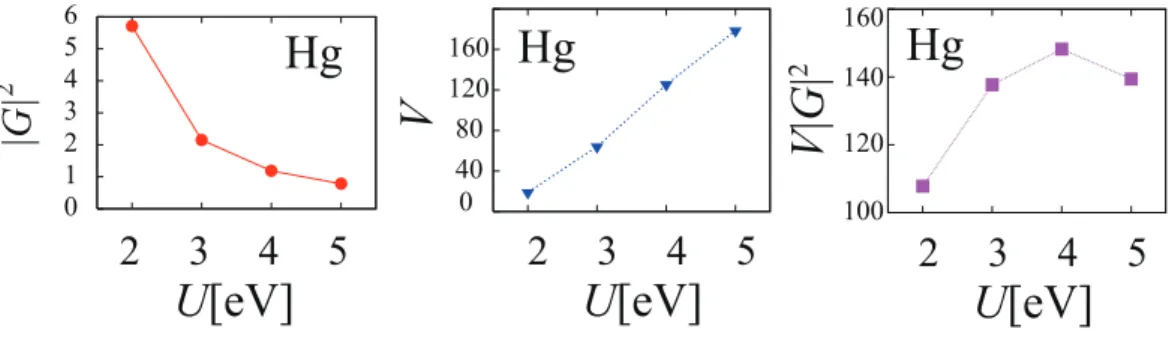
Now, we turn to the first main topic of this paper, i.e., the effect of the band width W . The band width W is defined as the energy range between the top and the bottom of the main band. It is evident that the band width is controlled by the in-plain bond length l, so that hydrostatic pressure enhances W . In figure 3.1, we can see that the increase in W results in an enhancement of λ in Hg, while the opposite occurs for La. The reason for this can be understood as follows. Let us first start with the U dependence of Tc for a fixed band width. In the top of figure 3.2, we show the absolute value of the renormalized Green’s function squared |G|2 in the Hg compound at (~k, iω) = (π, 0, iπkBT ) for several values of 2 < U < 5 eV. The value of |G|2 monotonically decreases with larger U because the self-energy, which increases with U , suppresses |G|2. On the other hand, the pairing interaction shown in the middle increases with U because the spin fluctuations develop monotonically. Consequently, V |G|2 shown on the right exhibits a maximum at a certain U . Since V |G|2 can be considered as a rough measure of the eigenvalue of the Eliashberg equation for d−wave superconductivity, λ (and thus Tc) is expected to be maximized around a certain Uoptim.
0 40 80 120 160
V
100 120 140 1602
3
4
5
V
|G
|
2U[eV]
0 1 2 3 4 5 6|G|
22
3
4
5
U[eV]
2
3
4
5
U[eV]
Hg
Hg
Hg
Figure 2. U dependence of the FLEX calculation result for the Hg compound. (left) the
absolute value of the renormalized Green’s function squared |G|2 at (~k, iω) = (π, 0, iπk BT ), (middle) the effective pairing interaction V at (~q, iω) = (π, π, 0) and (right) the product V |G|2.
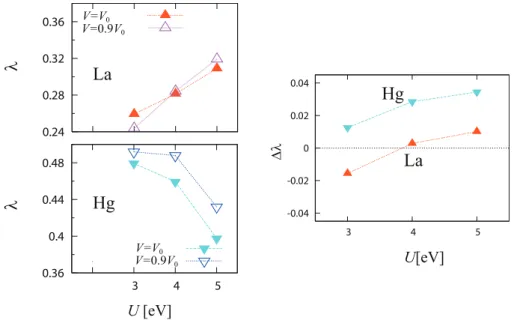
In the left panels of figure 3.2, we show the U dependence of λ for 3 < U < 5 eV for the two compounds with V = V0 and 0.9V0. We can see that U < 5 eV lies on the left side of Uoptim for La, while 3 eV< U is on the right side of Uoptim in Hg. This means that larger values of
U is necessary for La to be in the “strongly correlated regime”. This is because electrons can avoid the strong intraorbital repulsion within dx2
−y2 orbitals by using the dz2 orbital degrees of freedom in materials with small ∆E.
In the right panel of figure 3.2, we show the U dependence of the increment ∆λ of the eigenvalue λ induced by the increase of W under pressure. In this calculation, W is increased “by hand” up to its value at V = 0.9V0, while the other two parameters are fixed at their original values. From this figure, we can see that the increase in W always enhances Tc in the Hg cuprate within the realistic U range. For the La cuprate on the other hand, ∆λ is negative for small values of U , and this is the reason why W affects superconductivity in opposite ways between La and Hg in figure 3.1. For larger values of U , however, ∆λ becomes positive even for La.
-0.04 -0.02 0 0.02 0.04 3 4 5 U[eV]
La
Hg
∆λ 0.36 0.4 0.44 0.48 3 4 5λ
U [eV] 0.24 0.28 0.32 0.36λ
V=V0 V=0.9V0La
Hg
V=V0 V=0.9V0Figure 3. (Left) λ against U for La (top) and Hg (bottom). Filled (opened) symbols displays the result for V = V0(V = 0.9V0). (Right) ∆λ (increment in λ when W is increased up to its value at V = 0.9V0) against U .
To see the effect of the band width more clearly, we provide in figure 3.2 a schematic band width dependence of the U vs Tc plot. Namely, Tc should depend on U and W essentially in the form W f (U/W ), where f is a certain function that gives the overall dependence of Tc against the electron correlation strength. Therefore, as the pressure is applied, W increases so that Uoptim (peak position of the curve) also increases accordingly keeping Uoptim/W constant. At the same time, the absolute value of the maximized Tc is enhanced by the application of the pressure because the entire energy scale increases (i.e., both Uoptim and W are enhanced).
4. The dz2 Orbital Effect: Multi-layer vs Single-layer Systems
So far, we have concentrated on single-layer systems. In this section, we will discuss the difference of the pressure effect through ∆E between single and multi-layer systems. Here, we focus on the comparison between single- and bi-layer La, Hg, Tl, Bi, and Y cuprates. We consider ∆Ed, the energy difference between the dx2
−y2 and the dz2 orbital in the d-p model which considers all of the Cu 3d and O 2p orbitals explicitly. In the d-p model, the basis functions for the hopping part are close to the atomic orbitals, so ∆Edcan be considered as the energy difference between the dx2
−y2 and the dz2 atomic orbitals. ∆E is the energy difference between the dx2
T
cT
c pressure effect 3 4 5Hg
La
U [eV] 3 4 5 U [eV] pressure effectFigure 4. Schematic figure of Tc variation induced by applied pressure. Each line is a U vs. Tc plot for fixed W , and W is larger for solid green → dashed blue → dotted red.
dz2 Wannier orbitals which effectively take the O2p orbitals into account, so ∆Ed and ∆E are positively correlated[11].
In figure 4, we show the relationship between the apical oxygen height hO and ∆Ed. We can see that, while ∆Ed is positively correlated with the apical oxygen height in both single- and bi-layer systems as expected, ∆Ed is overall significantly greater in the bi-layer systems than in the single-layer systems. This is because bi-layer cuprates take pyramidal coordination of the oxygen ligands, while the single-layer cuprates take an octahedral one. Hence the effect of the apical oxygen should be weaker in the bi-layer systems, so that the “effective hO” is larger. As we have seen in the previous section, ∆E (and hence the dz2 orbital) plays minor role in the Tc enhancement under pressure in materials with large ∆E, so the effect of ∆E should become less relevant as the number of the layers increases. This can be considered as one reason why Tc increases in spite of somewhat larger reduction in hO in bi-layer system than in single-layer system under hydrostatic pressure[1].
0 0.1 0.2 0.3 0.4 0.5 0.6 2.3 2.4 2.5 2.6 2.7 2.8 2.9 ∆ Ed [eV]
h
O [A] La n=1 Hg n=1 Tl n=1 Bi n=1 Y n=2 La n=2 Hg n=2Figure 5. Relationship between the apical oxygen height hO[˚A] and the level difference
∆Ed [eV]. The squares(circles) show the value of ∆Ed in each bi-layer(single-layer) system(the materials are indicated by arrows). The dashed(solid) line presents the calculation result when hO is varied hypothetically in bi-layer (single-layer) La system by hand.
5. Conclusion
In conclusion, we have performed first-principle calculation+FLEX study to analyze the pressure effect on Tc of the cuprates. To explain the Tc enhancement induced by hydrostatic pressure, we introduce three important parameters, level offset ∆E, roundness of the Fermi surface rx2
−y2
and the band width W . ∆E and rx2
−y2 are the measure of ”orbital purity” in the main band, and Tc is enhanced by “orbital distillation”. We have shown that hydrostatic pressure enhances the distillation, thereby enhancing Tc. We have also analyzed the effect of the band width W in detail. It has been shown that λ (and hence Tc) is maximized around a certain U , which depends on the band width as well as ∆E. For materials with large ∆E such as the Hg compound, the increase of W under pressure leads to an enhancement of λ for realistic values of U .
We also discuss the difference between bi- or single-layer systems from the view point of ∆E. Even when hOis suppressed under pressure in bi-layer systems, the effect on Tc should be small because of the pyramidal coordination of the oxygen ligands.
6. Acknowledgments
The numerical calculations were performed at the Supercomputer Center, ISSP, University of Tokyo. This study has been supported by Grants-in-Aid for Scientific Research from JSPS (Grants No. 23340095, RA; No. 23009446, HS; No. 21008306, HU; and No. 22340093, KK and HA). RA acknowledges financial support from JST-PRESTO. DJS acknowledges support from the Center for Nanophase Material Science at Oak Ridge National Laboratory.
References
[1] Jorgensen J D, Hinks D G, Chmaissem O, Argyiou D N, Mitchell J F and Dabrowski B 1996 Lecture Notes in
Physicsvol 475, (Berlin: Springer) p 1; Jorgensen J D, Hinks D G, Chmaissem O, Argyiou D N, Mitchell J F and Dabrowski B 1995 Recent Developments in High Temperature Superconductivity, ed Klamut J et
al.(Berlin: Springer) pp 1-15
[2] Bianconi A, Bianconi G, Caprara S, Di Castro D, Oyanagi H and Saini N L 2000 J. Phys.: Condens. Matter 1210655; Bianconi A, Agrestini S, Bianconi G, Di Castro D, and Saini N L 2001 J. Alloys Compd. 317-318 537; Poccia N, Ricci A and Bianconi A 2010 Adv. Condens. Matter Phys. 2010 261849
[3] Maekawa S, Inoue J and Tohyama T 1992 The Physics and Chemistry of Oxide Superconductors vol 60, ed Iye Y and Yasuoka H (Berlin: Springer) pp 105-115
[4] Andersen O K, Liechtenstein A I, Jepsen O and Paulsen F 1995 J. Phys. Chem. Solids 56 1573 [5] Feiner L F, Jefferson J H and Raimondi R 1996 Phys. Rev. Lett. 76 4939
[6] Pavarini E, Dasgupta I, Saha-Dasgupta T, Jepsen O and Andersen O K 2001 Phys. Rev. Lett. 87 047003 [7] Weber C, Haule K and Kotliar G 2010 Phys. Rev. B 82 125107
[8] Weber C, Yee C -H, Haule K and Kotliar G 2012 Eur. Phys. Lett. 100 37001 [9] Takimoto T, Hotta T and Ueda K 2004 Phys. Rev. B 69 104504
[10] Sakakibara H, Usui H, Kuroki K, Arita R and Aoki H 2010 Phys. Rev. Lett. 105 057003 [11] Sakakibara H, Usui H, Kuroki K, Arita R and Aoki H 2012 Phys. Rev. B 85 064501
[12] Shiraishi K, Oshiyama A, Shima N, Nakayama T and Kamimura H, 1988 Solid State Commun. 66 629 [13] Kamimura H and Eto M 1990 J. Phys. Soc. Jpn. 59 3053; Eto M and Kamimura H 1991 J. Phys. Soc. Jpn.
602311
[14] Freeman A J and Yu J 1988 Physica B 150 50
[15] Wang X, Dang H T and Millis A J 2011 Phys. Rev. B 84 014530
[16] Hozoi L, Siurakshina L, Fulde P and van den Brink J 2011 Sci. Rep. 1 65 [17] Uebelacker S and Honerkamp C 2012 Phys. Rev. B 85 155122
[18] Mori M, Khaliullin G, Tohyama T and Maekawa S 2008 Phys. Rev. Lett. 101 247003
[19] Klehe A -K, Gangopadhyay A K, Diederichs J and Schilling J S 1993 Physica C 213 266; Klehe A -K, Schilling J S, Wagner J L and Hinks D G 1994 Physica C 223 313
[20] Gao L, Xue Y Y, Chen F, Xiong Q, Meng R L, Ramirez D, Chu C W, Eggert J H and Mao H K 1994 Phys.
Rev.B 50 4260
[21] Hardy F, Hillier N J, Meingast C, Colson D, Li Y, Barisic N, Yu G, Zhao X, Greven M and Schilling J S 2010 Phys. Rev. Lett. 105 167002
[22] Gugenberger F, Meingast C, Roth G, Grube K, Breit V, Weber T, Wuhl H, Uchida S and Nakamura Y 1994
[23] Meingast C, Junod A and Walker E 1996 Physica C 272 106
[24] Sakakibara H, Suzuki K, Usui H, Kuroki K, Arita R, Scalapino D J and Aoki H 2012 Phys. Rev. B 86 134520 [25] Bickers N E, Scalapino D J and White S R 1989 Phys. Rev. Lett. 62 961
[26] Dahm T and Tewordt L 1995 Phys. Rev. Lett. 74 793 [27] Yada K and Kontani H 2005 J. Phys. Soc. Jpn. 74 2161
[28] Blaha P, Schwarz K, Madsen G K H, Kvasnicka D and Luitz J 2001 Wien2k: An Augmented Plane Wave +
Local Orbitals Program for Calculating Crystal Properties(Wien: Vienna University of Technology) [29] Birch F 1947 Phys. Rev. B 71 809
[30] Jorgensen J D, Schuttler H -B, Hinks D G, Capone D W, Zhang K, Brodsky M B and Scalapino D J 1987
Phys. Rev. Lett. 581024
[31] Wagner J L, Radaelli P G, Hinks D G, Jorgensen J D, Mitchell J F, Dabrowski B, Knapp G S and Beno M A 1993 Physica C 210 447
[32] Balagurov A M, Sheptyakov D V, Aksenov V L, Antipov E V, Putilin S N, Radaelli P G and Marezio M 1999 Phys. Rev. B 59 7209
[33] Kunes J, Arita R, Wissgott P, Toschi A, Ikeda H and Held K 2010 Comp. Phys. Commun. 181 1888 [34] Marzari N and Vanderbilt D 1997 Phys. Rev. B 56 12847; Souza I, Marzari N and Vanderbilt D 2001 Phys.
Rev.B 65 035109 ; The Wannier functions are generated by the code developed by Mostofi A A, Yates J R, Marzari N, Souza I and Vanderbilt D http://www.wannier.org/
[35] Eisaki H, Kaneko N, Feng D L, Damascelli A, Mang P L, Shen K M, Shen Z -X and Greven M 2004 Phys.
Rev.B 69 064512
[36] Scalapino D J 2007 Handbook of High Temperature Superconductivity, ed Schrieffer J R and Brooks J S (New York: Springer) Chapter 13
![Figure 5. Relationship between the apical oxygen height h O [˚ A] and the level difference](https://thumb-ap.123doks.com/thumbv2/123deta/5779834.1027236/7.892.277.589.760.1000/figure-relationship-apical-oxygen-height-o-level-difference.webp)
