Abstract
This classroom-oriented research project examined the writing skills devel-oped during a 14-week writing course, in which genre-based writing instruction using an online platform had been implemented. Underpinning theories of the study include genre-based pedagogy and sociocultural theory. Genre today is considered, not a discrete text isolated from social events, but identified as a so-cial action that configures meaning in soso-cial contexts (Martin & Rose, 2008). Hence genre is inseparable from the culture and the community in which the communication takes place. To approximate the social situations which genre theorists describe, the study made use of an online platform to offer students a place for sharing their writing. The purpose of the research project was to inves-tigate the development of writing skills through genre-based writing instruction combined with participation in the online discussion forum. The participants were seven, 2nd-year, low intermediate English level university students. The re-searcher examined the performance of the participants in the class as well as their linguistic data: their posts (n=32) and survey responses (n=4). The results indicate that the participants gradually developed writing competence as they progressed through a series of writing assignments, forming critical opinions and trying out to arrange discourse elements according to a particular genre. The participants’ consideration of their audience appeared to emerge as they actually voiced their opinions across to the members on the online forum, i. e., communi-cating with those holding different attitudes and opinions. Two factors appeared to contribute to their improved writing skills: class genre-based writing in-struction and multiple postings on the online forum. Furthermore, the online plat-form offered the participants a sociorhetorical context that gave them exposure
Examining Writing Skills Through Genre-based
Pedagogy Combined with Posting on an Online
Discussion Forum
to different views on the issues and the linguistic behaviors of more advanced members on the forum.
Key words: writing skills, genre-based pedagogy, computer-mediated communication, readership considerations, scaffolding, sociocultural theory
Introduction
Historically, in academic settings, the term, genre, referred to different types of literature such as poetry, narrative, research papers, etc., so genre theorists have traditionally studied the conventions of paragraph organization, characteristics of overall structures, development of topics and plots, and other features distinguishing various genres. For the past few decades, however, researchers and practitioners of genre studies have considered the socially functioning nature of genre. Particular genres serve as communicative tools in particular social contexts. For example, the school of Systemic Functional Linguistics (SFL), known as the Sydney School, defines genre as a configuration of meaning making. Genre is a collection of recurrently used rhetorical structures that construct meaning effectively in a particular cultural context and it actualizes social processes of achieving communicative purposes (Martin & Rose, 2008). Researchers standing on SFL, distinguish three levels of language: field, the context of situation within a specific purposeful activity; tenor, interpersonal relationship between participants; and mode, the channel of communicaion (Martin & Rose, 2007).
Meanwhile, in the English for Specific Purposes (ESP), Swales (1990) researched the moves of introductions in research genre and argued particular moves of the texts effectively communicate with the audience in the community, for example the moves in articles in particular academic research communities. According to Swales, writers adopt the recurrent features of a genre to fulfill the expectations of the readership of the particular discourse community. The prominent genre features specific to a particular communicative event are an established means of communication. Swales delineates that genre is attached to a particular communicative event, and it is “communicative vehicles for achieving the goals” (p. 46). As noted above, in the ESP, genre is considered to be a recurrently used particular structural moves of the texts.
From a New Rhetoric perspective, however, Coe (2002) criticizes the view that overemphasizes linguistic features in particular discourse occasions, arguing that
discourse and situation are interconnected to each other in order to realize communication.
… I see myself as urging an understanding of genre as the motivated, functional relationship between text type and rhetorical situation. That is to say, a genre is neither a text type nor a situation, but rather the functional relationship between a type of text and a type of situation. (Coe, 2002, p. 197).
According to Coe, genre is one form of situated social action involving the construction of meaning between writers and readers in a particular social context so that such writing skills of genre features can be developed in the writer through actually engaging in the process of making meaning with the readers.
In the later half of the 20th century before the inception of genre theories,
process-oriented writing pedagogy prevailed in L2 writing theory and pedagogy, which is grounded on cognitive process writing theory (Flower & Hayes, 1981). According to the model, writers retrieve knowledge of content and audience from their cognitive resources construed through their experience, and they formulate texts by traversing across the stages of planning, reviewing, and evaluating.
The central feature of process-oriented writing is positioning the writers in the center of composing processes as it enables the writers exert rhetorical decision. Genre theorists, however, severely criticized the process pedagogy, claiming that it ignores the social aspects that writing realizes. Swales (1990) claims that effective writers communicate with readers, i. e. they effectively formulate texts responding to expectations of their readers. Hyland (2003) also argues that the process-oriented pedagogy does not adequately explain writers’ affective factors such as interacting with readers through texts, deciding rhetorical elements so that they could persuade readers and influence their convictions. Past research indicates that the writer’s assumptions on how their ideas and voices will be accepted, evaluated, or valued by their real readers could drive the writer’s choice of rhetorical organizations (Hyland, 2002; Hyland & Tse, 2004). With the rise of genre theories in the last couple of decades, genre-based pedagogy has drawn keen attention and developed, for example the Sydney School.
When it comes to teaching writing in traditional classroom settings, however, there seems to be a significant gap between the theoretical views of writing (making meaning with audience in social contexts) and, as teachers, ways we teach writing in a confined
context as a classroom. As genre researchers postulate, we need to acknowledge that writing should have a functional role to construct meaning in cooperation with the reader in a social context. However, the problem we have not yet solved is how we can help students be aware of the fact that the meaning making process must involve the readers and that the writer must respond to their expectations and concerns. In many cases, in the traditional classroom, students often assume their teachers are their only audience; however, the issues suggest us that we can help students increase their writing skills through having them experience the process of co-constructing meaning with their imagined audience and/or influence those with differed viewpoints, which is a very common social practice in communities.
In relation to writer-reader interactions, many researchers have reported the benefits of using the online platform, also known as Computer-Mediated Communication (CMC), for writing instruction for the past decades. The weblog, one example of CMC, offers an immediate social environment for voicing ones’ thoughts, thus encouraging the generation of meaningful language (Lee, 2010; Sun & Chang, 2012). An online discussion forum, another type of CMC, can serve as an effective platform for both supplying information and guiding topic-based discussions among members who share the same interests; hence, it can help the members shape multiple ideas collaboratively within their online community (Noytim, 2010; Sun & Chang, 2012). One common feature among all forms of CMC is to enable writers to connect to multiple readers who have broadly similar purposes and/or interests (Du & Wagner, 2007). Generally, the members have, to some extent, the motivation to communicate; thus CMC can be a forum for communicative exchange. In sum, the online platform can create a social context that instantaneously connects participating members with shared interests and similar goals for real communication.
I attempted to create such a social context, in which the writer interacts with readers and shares ideas on an online site, so in this study, I adopted the discussion forum as CMC support, and the participating students wrote exposition and argumentative genres. The purpose of the study was to investigate the development of writing skills through genre-based writing instruction combined with participation in the online discussion forum. According to Martin and Rose (2008), in exposition genre, writers propose some thesis and explain their reasons for supporting it, and they are motivated to argue for their positions.
researchers argue Japanese writers who did not receive any formal L2 writing instruction tend to formulate indirect and inductive ways of argument (Rinnert & Kobyashi, 2007); however, other researchers argue that those features are not static, which means, Japanese writers employ text features depending on the context (e.g., writing in higher education in a particular community either abroad or in Japan), and the writer’s experience of L1 and L2 writing instruction on the conventions of writing (Gilbert, 2004; Rinnert & Kobyashi, 2007;).
Writers’ writing processes have been researched in the past; however those studies drew upon the theory of process-oriented writing, namely writers’ cognitive processes during composition (e.g. De Larios, Marín, & Murphy, 2001); the researchers analyzed writers’ temporal processes of allocating their cognitive resources to planning, revising, or restructuring stages of formulating texts. In addition, they looked at the writers’ formulating processes in a lab situation―writers were given tasks, instructed to write, and videotaped during their writing. Obviously, in such circumstances we know little about writers’ strategies for their readers and/or affective factors such as motivation to write. Thus, I attempted to reveal such affective factors through the study. To date, few studies investigated writing outcomes by combining genre-based pedagogy with CMC. This study will reveal some aspects of writing in relation to students’ motivation and strategies for writing. In the sections below, I will first describe theories that this study draws upon and the course design, and in the later sections, I will present statistical data, linguistic analysis on the students’ posts, and survey responses collected after the course.
Background theories
The study draws upon two respected theories, genre-based pedagogy and sociocultural theory. Genre-based pedagogy is perhaps most clearly articulated by the school of SFL. It is beyond the scope of this paper to outline all the processes of genre-based pedagogy; however, I will instead concentrate on two distinctive instructional approaches referencing four repected studies (Swales, 1990; Hyland, 2007; Martin & Rose, 2008; Gibbons, 2015).
Genre, according to SFL, is a group of textual patterns recurrently used in the social practice of communities and inseparable from its cultural contexts because textual organizations “are realised as patterns of social interaction in each context of situation” (Martin & Rose, 2008, p. 11). We see such communicative contexts in scientific journals,
articles in newspapers, reports or school essays, etc. Hence, practitioners assume that genre-based pedagogy involves teaching not only linguistic elements like grammar, vocabulary or even formulaic structures of the texts but also ways to develop topics, to construct meaning using recurrent semantic structures, and to consider the cultural context in which communication takes place (Gibbon, 2015). Gibbon identifies four important elements of genre: It occurs recurrently within a social context in a specific culture; it has a specific purposes for writing, reccurently used overall structures; and it has particular linguistic features, for example connectives, tense structures, etc. Therefore, in genre-based pedagogy, the teacher’s foremost task is addressing these four elements― cultural context, specific purpose, moves of the structure, and linguistic features.
Swales (1990) suggests pedagogical tasks for genre-based instruction in research genre. Flowerdew (2015) summarizes the instructional stages as follows. The first step is to read and comprehend texts that have the established text features (authentic texts) in an intended discourse community. While reading, the students should pay attention to the rhetorical features of the text: organizational features, moves of the paragraphs and sections, etc. The next step is to compare target genre-specific texts of a discourse community with those written by novice writers such as students. Then, ask students to compare the distinguishing rhetorical features of each text. Finally, have students discuss the effects of differing rhetorical features of the texts on the reader. Swales emphasizes audience (discourse community) considerations, noting that established rhetorical features play a prominent role in effectively achieving communicative purposes.
Practitioners of genre-based writing instruction, for example the Sydney School, subscribe to sociocultural theory and the principle of scaffolding. Sociocultural theory (Vygotsky, 1978) claims “that the only ‘good learning’ is that which is in advance of development” (p. 89, quotation marks in original). In other words, learning first happens while interacting collaboratively with a more capable person, and that the learning moves inward, enabling the learner to independently solve the problem. Vygotsky terms the transformational processes as the zone of proximal development, and he proposes that the essential nature of learning is to create this zone of proximal development that awakens learning. Scaffolding, the term coined by Wood, Bruner, and Ross (1976), is another aspect integral to the pedagogy. They argue that “comprehension of the solution must precede production” (p. 90, italics in original). They suggest a tutor’s assistance in a problem-solving task is critical for the tutee’s successful performance of a target task. Examples of such assistance are limiting the task to a manageable set of tasks, and demonstrating the
process needed to perform it, thereby enabling the learner to imitate it.
To summarize, a critical part of genre-based pedagogy is having students recognize writing as a tool for communication. That is, genre is a meaning making process in social situations, and the core of the pedagogy involves having students: a) identify purposes for writing, b) adopt commonly used semantic structures and rhetorical organizations, and most importantly, c) recognize the cultural aspects of the communicative occasions (communities of practice). Instructional approaches to this pedagogy emphasize having students learn established genre features through scaffolding, that is teachers help learners move on to the independent production of writing. The approach is fundamentally student-centered; students determine what contents to write and do the necessary research, with “an awareness of the need to avoid an over-formulaic approach.” (Flowerdew, 2015, p. 4).
The study
The study was conducted during a 14-week writing course in a humanities department at university in the Kanto area. The university offered advanced English courses for students scoring over 400 on the TOEIC test in their first year of college with the aim of developing students’ English skills through a 56-week intensive set of courses focusing on speaking and writing skills. The research project was designed as a part of the writing course to help students achieve the following: a) gain a basic knowledge of the conventions of writing; b) nurture critical thinking skills; c) develop a sense of consideration for their readership; and lastly, d) produce opinion essays containing theses supported by facts and/or convincing, justifiable evidence. The participants were all sophomore students between the ages of 19 and 20 at the low intermediate level of English. Ten students out of the twelve students who had registered for the course had little experience with formal writing instruction.
The required writing assignment included: a) posting more than four times (five or six times were encouraged), b) writing more than 100 words per post in response to the prompt provided by the instructor. Writing for the assignments was done entirely outside of class and submitted exclusively through the online forum in the form of postings. At the end of the term, however, the students did in-class final presentations by using one of the topics from their posts and expanding their research on it. The posting task accounted for 25 percent of their grades. At the end of the course, four students had posted five
times, four had posted four times, one had posted twice, and three had posted only once. In order to examine the effects of multiple postings, the performances of those who completed four times or more were examined, with the exception of one student whose posts were difficult to understand. In total then, seven students’ performances, 32 posts in all, were carefully investigated. The following research questions were raised to be answered:
1. Through genre-based writing instruction combined with posting on the Internet forum, how did the students’ writing skills develop?
2. How did the students perceive their experience of posting on the forum? Method
The writing instruction consisted of two parts, genre-based writing instruction and guidance on posting on the online discussion forum.
Genre-based instruction
The course utilized topics from seven inspirational presentations from TED Talks (authentic texts). In the class, students studied the transcripts of the presentations and deepened their understanding of the main ideas in the content. In addition, the instructor held group discussion sessions on each topic studied to help students form clearer opinions.
The instructor provided the following prompts shown in Table 1. The purpose was to provide issues for further discussion and to facilitate reflective thinking.
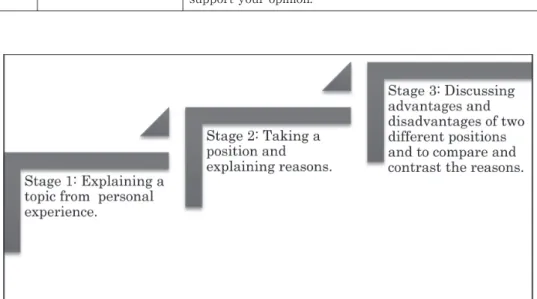
The first two prompts ask students to explain their ideas from personal experience, and the next two ask students to take a position and justify it. The last three prompts (Topic 5 through 7) increased the task demands ―asking students to discuss the advantages and disadvantages of two different positions on an issue and to compare and contrast the reasons for both.
It was assumed that completion of the first two tasks would provide the scaffoling needed to carry out the next two tasks―explaining justifiable reasons for the different positions. Likewise, propmts for Topic 3 and 4 can support students in writing for the last three prompts. This gradual increase in the number of task constituents was designed to help students complete the increased task demands in later stages. In other words, the
performance on the previous tasks would support the completion of the next task. The aim was to keep the task demands at a manageable level for the learner (Wood, Bruner, & Ross, 1976). A schematic structure is illustrated in Figure 1.
Overall organizaion and structural moves of each paragraph were explicitly taught in the class, as well as their linguistic features such as conjunctions and connectives for
Table 1. Themes from the TED Talks and Prompts
Topics Themes Prompts
1 Developing apps What do you think of tech nerds? Are they talented? Are they special people?
2 Starting a movement There are many ways to start a movement. What features have you seen in Japan for starting a movement?
3 Walking meeting Do you think that walking meetings help to generate creative ideas? Why or why not?
4 Tying shoes effectively Do you think that a small change in one place can have tremendous effects somewhere else? Why or why not?
5 Having strong passions In your opinion, which quality is more important for becoming a successful entrepreneur, passion or talent? Give specific reasons to support your opinion.
6 Sparking learning
In your opinion, which is more important for promoting students’ learning, curiosity of the students or very clear instructions from the teacher? Give specific reasons to support your opinion.
7 Opening your mind through books Which medium do you think is more effective for increasing knowledge, books or the Internet? Give specific reasons to support your opinion.
reasoning and comparing. In the class, the instructor modeled formulating processes using the think aloud method, and she also posted her own opinion paragraph at the top of each page to provide a model for the studetns to write.
Online discussion forum
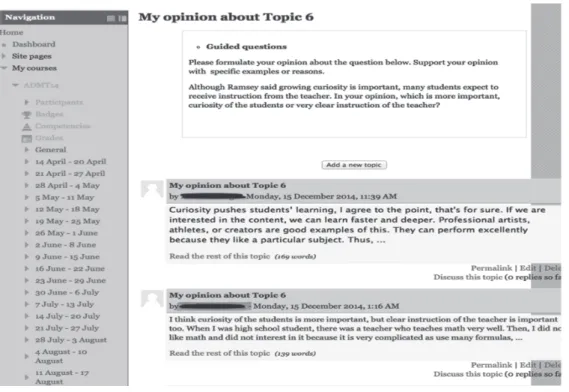
The discussion forum for a new topic was created every two weeks with the initial post of the instructor (modeling) at the top. The instructor put forward differential or oppositional views for students’ consideration so as to facilitate their reflective thinking. Students directly posted on the forum. No corrective feedback was directly given to the posts, but short comments responding to the content were posted by the instructor. The Moodle forum site appears in Figure 2, in which you can see the instructor’s post on top that initiates the discussion.
After the course, questionnaires were distributed via email, asking students’ perceptions about their writing experience. Four of the seven students returned the surveys, the answers to which are categorized and tallied below.
Results
In this section, I will present two linguistic data, students’ posts and survey responses.
Language outcome
Over the course of posting, the students progressively increased their paragraph lengths. Exceeding the demands of the task (to write more than 100 words), they increased their word counts more than 70 percent from their initial posting. Table 2 shows the word counts across the posting, and Table 3 shows the word counts and the number of sentences written across the topics.
As shown in Table 2, the first posts are not very long (mean: 90 words). Apparently, the students were not experienced at writing in English, so they did not explain fully and some of them appeared to articulate their opinions without any supports in detail. In later postings, however, most of the students incorporated linguistic features presented in class such as metadiscourse markers, adverbs, conjunctions, etc. As instruction moved progressively forward to genre of argumentation, students included more detailed information in their grounds. In Table 3, you can see that in spite of the significant increase in word counts, the total number of sentences per paragraph remained fairly stable. This indicates that in later postings students wrote longer sentences, incorporating discourse markers. Students’ skill in using metadiscourse markers increased as they posted more. In fact, they gradually began to employ such features not only for framing
Table 3. Word Counts and the Number of Sentences Across Topics Topic Topic 1M (SD) Topic 2M (SD) Topic 3M (SD) Topic 4M (SD) Topic 5M (SD) Topic 6M (SD) Topic 7M (SD) Word
counts (10.6)99.3 (13.5)83.3 (27.0)113.6 (49.2)139.5 (67.5)137.3 (34.1)147.2 (19.2)136.4
The number
of sentences (2.1)8.7 (1.0)7.8 (1.8)8.8 (3.8)10.0 (2.9)10.7 (1.8)10.3 (3.0)9.4
Table 2. Word Counts per Post
Posts M (SD)Post 1 M (SD)Post 2 M (SD)Post 3 M (SD)Post 4 M (SD)Post 5 Word
or making transitions between elements within the text (e.g., first, in conclusion, by contrast, but, etc.) but also those for directly interacting with the audience, examples of these include attitude markers (e.g., I believe), self mentions (e.g., I, we, our), and engagement markers (e.g., you can see, you).
Generally metadiscourse markers are used to frame the passage to make it easier for the readers to follow, so the researchers consider the use of these markers to be a manifestation of the writers’ intention to communicate with readers (Hyland, 2005). In the following excerpts (Topic 7) shown below, you can notice these linguistic features, in which the following metadiscourse markers are highlighted: a) attitude markers and explict references to the author (s) and audience (e.g., I agree, firstly I, we, you, us, your, etc.) ―bold and underlined; b) frame markers, transitions, and endophoric markers, (e.g., firstly, in conclusion, on the other hand, for example, etc.) ―underlined. No errors have been corrected. The students whose work appears hereafter are identified as S1(Student 1) through S7(Student 7).
I prefer to read a paper such as a newspaper or magazine rather than watch TV. I have two reasons to support my opinion.
Firstly, reading is useful for our brain. We can exercise to our brain by reading some documents. A newspaper, for example, we get the information by reading many words and understanding of its meaning. However, if you have some unknowing words or phrases, you may guess the meanings of that from the context, or may search the meanings of that. By contrast, watching TV has no time for doing which I exemplified above. … (S1)
I think if we attempt to get information, use the Internet is better than others for example TV, newspaper. We can always get new information and easy to get information which we want. But, there are wrong information and knowledge in Internet, so we need to check if information and knowledge are correct or not. Certainly, Internet is weaker than others in this point. Nevertheless, Internet has many good points, and they stand out than bad point. It is important to us for read a newspaper, think about news after watch it. However, Internet is useful, easy to get information and knowledge and used anywhere, so I think Internet is better than TV, newspaper, etc. (S4)
In the first excerpt, S1uses explicit references to the self and audience (e.g., I, we, and you), which might be modeled from the other posts on the forum. The instructor used self-mentions I and we in the model paragraph, but she never used direct reference to the audience, you in her model paragraphs. The reference to the audience, you, gradually began to appear on the forum from Topic 3 through Topic 7. This possibly indicates the writer’s direct intention to get the attention of the audience.
Also in S4’s writing, we see the word certainly in line 5. This word indicates S4’s partial agreement with the opposing view―books are more effective for getting information―which he encountered during in-class discussion or through reading other posts on the forum. He tactfully responded to the opposing view and acknowledged the point. These are some of the visible features that appeared on student posts as the course progressed.
Survey responses
Finally, I will tally the students’ responses to the end of course questionnaire. It asked three questions, and Table 4 summarizes the students’ responses.
1)Why did you write longer passages in later postings?
2)Were you nervous about posting your ideas on the online forum?
3) Which method do you prefer for submitting your papers, in person or via the online forum?
The responses reveal that the students sensed that they gradually increased their writing skills (longer words counts and sentences). They ascribed this first to familarity with the writing practice and separate in-class instruction regarding linguistic features such as connectives and conjunctions. Second, they acknowledged the demands of the prompts influenced their formulating processes. The more they needed to argue a particular position (e.g., Topic 5 and 6), the more detailed support and grounds they attempted to include. In terms of privacy and the posting experience, all four responding students answered that they were not concerned about revealing their true selves (identities) and attitudes, and all perceived posting as an exciting and stimulating experience because they could learn diverse ideas and various ways of expressing them from their classmates. Furthermore, the open forum motivated them to reflect on linguistic aspects because they hoped to convey their ideas accurately and effectively.
Two students preferred to submit their writing in person provided that they could get direct corrective feedback, which was not given directly on the forum. Next, I will return to the research questions.
Discussion
In this section, I will first discuss particular aspects of writing skills students have developed during the course of writing. The instructor observed the students’ marked improvement in their writing not only in terms of grammar, rhetorical organizations, and linguistic features (connectives and conjunction) but also in terms of communication skills (attitudinal markers and engagement markers). I will then discuss notable situational
effects (an online forum) that have likely contributed to this development.
RQ 1: Through genre-based writing instruction combined with posting on the In-ternet forum, how did the students’ writing skills develop?
As seen in the results, the students increased writing fluency in terms of the lengths
Table 4. Students’ Perceptions about Posting on the Forum
Category Statements (n=4)
Increased writing fluency “The more I posted on the forum, the easier it became to generate ideas.” (S2)
“I learned how to use conjunctions effectively in class, so the texts became longer.” (S2)
Complexity of the prompts “It was difficult to write my ideas in English, so I explained
a lot.” (S3)
“As a result of trying to incorporate relevant information
and details, the texts became longer.” (S7)
Stimulating experience “It was stimulating and interesting to learn what others
thought about the themes.” (S7)
“I learned different ways of viewing the issues and different
ways of phrasing and expressing ideas.” (S2)
Increased attention to linguistic
elements “Because my posting would be read openly by all classmates, I looked over my written texts carefully, not only in terms of the depth of the content but also the accuracy of the grammar.” (S2)
Desire for direct corrective
feedback “Although sharing ideas on the forum was exciting, I wanted to have my grammatical errors corrected directly and
receive comments on the content from the teacher.” (S6) Note. Remarks particularly significant to this study appear in bold type.
of the texts they submitted, gradually incorporating more metadiscourse markers and adverbial phrases.
One striking feature observed in the study was their increased sensitivity to their audience. The students’ excerpts indicate that they consciously recognized their audience’s presence on the forum and appeared to direct their remarks toward them. Such attempts can be seen in their use of connectives (linking the elements of the text), attitude markers, and engagement markers. Though some discourse features such as frame markers, (e.g., first, in conclusion), attitude markers, (e.g., I agree), and code glosses, (e.g., for example, such as) were explicitly taught in the class, explicit reference to the self, the inclusive self reference, we, engagement markers, you, and adverbs of attitude markers, certainly, surely, were not directly covered in the class. Thus, most students probably produced these markers, recognizing audience concerns, and they possibly modeled these features after observing the linguistic behaviors of other participating members. In other words, the members observed other members engaging in communication using the linguistic features, so they presumably modeled these behaviors. Critical instructional stages of emergent writing skills
Next I will briefly summarize critical instructional stages of emergent writing skills from my observation of the students’ in-class performance. Though the description is far from complete and definite, these may shed insights into L2 writing pedagogy.
1. Shaping ideas to write about:
Students may learn overall organizations and structural features; however, it may not help shape their voices. In the study students learned stimulating ideas through TED Talk speeches and engaged in-group discussion. After discussing multiple points on the issues, students were likely able to formulate coherent opinions―what they wanted to say (purpose for writing).
2. Engaging in writing practice several times before actually developing writing skills: Even after students learn to employ genre specific features and to form their individual ideas, they do not likely acquire these skills on the spot. After doing writing practice several times, just trying to arrange contents into a sequence of rhetorical features, they were likely able to figure out appropriate ways to deploy linguistic elements to express their ideas.
3. Adhering to representative genre features:
Students gradually become able to use the target genre features, but they may be still in the infant stage of writing development. Some effective ways to instruct genre features in this stage are demonstrating formulating processes using the think aloud method and offering templates for writing. In the study, the instructor actually participated in the discussion by posting on the forum that provided models for the genre specific texts. Through these steps, students are likely able to use genre features independently.
4. Growing audience considerations:
By receiving input from their readership, students gradually develop consideration for their audience, being more responsive to their expectations and critiques. Little by little, students can effectively use discourse markers (connectives, attitude markers, and engagement markers). At this stage, students are likely able to recognize their purpose for writing and make efforts to realize it. In sum, they can make the needed effort to get their audience to accept their voices.
How did the situational factor, the online platform, influence the development of the writing skills? The students’ responses and linguistic data from the posts suggest that learning was accelerated through actually participating in discussion on the forum, which absolutely had a pivotal role in creating the zone of proximal development, interacting collaboratively with people around the learner (Vygotsky, 1978). Participating in communication and reading the posts of more advanced learners produced (not only that of the instructor but also that of more adept students on the forum) offered an opportunity for novice writers to model the linguistic features (Lave & Wenger, 1991; Zhang, 2009). These benefits were possibly brought about by and enhanced by the one-to-many relationship of the online forum (one-to-many members participating in one forum) and instantaneous communication on the Internet. I argue the situational factor have provided the students with opportunities to nurture sensitivity toward their readership and contributed to their sincere efforts to get their message across. This kind of situational factor may have marked effects on students’ writing processes, and the relationship effects―writer-reader interactions―may be more powerful than those of one-on-one learning, such as the peer-peer review or student-instructor conferencing. These may be significant benefits of CMC for our students.
RQ 2: How did the students perceive their experience of posting on the online plat-form?
Posting on the forum was perceived as a stimulating experience by all four responding students. Taking part in any discussion might have been challenging; however, students were absolutely stimulated by learning from other members of the forum, who occasionally presented different perspectives from theirs and varied ways of framing sentences, so the students commented that the posting process was dynamic and interesting.
Some limitations of this study include the facts that first, no holistic assessment in terms of the quality of the writing was included. Second, this study included no comparative studies, for example looking at students’ writing through classroom instruction without posting on an online forum. Third, the number of participating students is small; therefore, in order to bring more definite conclusions, we need to replicate the study with a larger number of participants.
Finally, but not least, it seems that in-class writing instruction has an important role in developing L2 writing skills. An online forum can increase affective factors in writing (e.g., sensitivity to readership considerations, motivation to write, increased attention to linguistic features), students writing still contained a number of linguistic errors. In this regard, formal instruction on L2 knowledge, e.g., grammar, vocabulary, and the conventions of writing should be instructed systematically. I expect these issues should be examined in future studies.
Conclusion
This classroom-oriented research project focused on writing skills drawing on theories of genre-based pedagogy and sociocultural theory, and utilizing CMC. The instruction made use of an online discussion forum to provide students with a place for reaching others. Over the 14-week writing course, seven of the students’ posts were closely examined to investigate the development of writing skills. The results indicate that the more students participated in writing practice on the online forum, the more they progressively increased their writing skills in terms of writing fluency. Emergent writing skills were observed as students practice forming critical ideas and try aligning discourse elements in the target genre.
audience was markedly improved by actually being exposed to multiple forum members with different opinions and attitudes. As researchers (Noytim, 2010; Sun & Chang, 2012) argue, the Internet platform that realizes one-to-many communication has considerable benefits in creating meaningful writer-reader connections. The particularly beneficial features of the online forum would be difficult to duplicate in traditional classroom settings, but these allow students to interact with, learn from, and get input from other members who have common purposes and interests. This has noteworthy effects in accerelating learning, and importantly, these benefits cannot be brought about without actually participating in the communication (Lave & Wenger, 1991).
Research on CMC has risen fairly recently, so it has not yet proved various issues such as: a) to what extent the online platform can contribute to L2 proficiency; b) more specifically, which areas of writing skills the online platform has considerable effects, for example motivation to write, expertise with writing strategies, etc.; c) how we can integrate CMC with writing pedagogy; d) what types of CMC have different influence on writing, for example the blog, wiki, and forum. Researching these issues will shed profound insights into L2 writing pedagogies.
Acknowledgments
The author would like to express sincere thanks to Teruaki Tsushima for his valuable support in setting up a Moodle discussion site, and to Stella Yamazaki for helpful advice on an earlier version of this paper.
References
Coe, R. M. (2002). The new rhetoric of genre: Writing political briefs. In A. M. Johns (Ed.), Genre in the classroom: Multiple perspectives (pp. 197-210). Mahwah, NJ: Erlbaum.
De Larios, J. R., Marín, J., & Murphy, L. (2001). A Temporal Analysis of Formulation Processes in L1 and L2 Writing. Language Learning 51 (3), 497-538.
Du, H.S., & Wagner, C. (2007). Learning with weblogs: Enhancing cognitive and social knowl-edge construction. IEEE Transactions on Professional Communication, 50, 1-15.
Flower. L., & Hayes. J. R. (1981). A cognitive process theory of writing. College Composition and Communication. 32 (4), 365-387.
Flowerdew, J. (2015). John Swales’s approach to pedagogy in genre analysis: A perspective from 25 years on. Journal of English for Academic Purposes. Retrieved from http://dx.doi. org/10.1016/j.jeap.2015.02.003
Gibbons, P. (2015). Scaffolding language scaffolding learning: Teaching English language learners in the mainstream classroom. 2nd edition. Portsmouth, NH: Heinemann.
Asian Pacific Communication, 14, 55-75.
Hyland, K. (2002). Directives: Argument and engagement in academic writing. Applied Linguis-tics. 23 (2), 215-239
Hyland, K. (2003). Genre-based pedagogies: A social response to process. Journal of Second Lan-guage Writing, 12, 17-29.
Hyland, K. (2005). Metadiscourse. London: Continuum.
Hyland, K. (2007). Genre pedagogy: Language, literacy and L2 writing instruction. Journal of Second Language Writing 16, 148-164.
Hyland, K., & Tse, P. (2004). Metadiscourse in academic writing: A reappraisal. Applied Linguis-tics, 25, 156-177.
Lave, J., & Wenger, E. (1991). Situated learning: Legitimate peripheral participation. Cambridge: Cambridge University Press.
Lee, L. (2010). Fostering reflective writing and interactive exchange through blogging in an ad-vanced language course. ReCALL, 22, 212-227.
Martin, R., & Rose, D. (2007). Working with Discourse: Meaning beyond the clause. London: Con-tinuum.
Martin, R., & Rose, D. (2008). Genre relations: Mapping culture. London: Equinox.
Noytim, U. (2010). Weblogs enhancing EFL students’ English language learning. Procedia Social and Behavioral Sciences 2, 1127-1132.
Rinnert, C., & Kobayashi, H. (2007). L1 and L2 pre-university writing experience: What effects on novice Japanese EFL writers? Hiroshima Journal of International Studies (Faculty of In-ternational Studies Hiroshima City University), 13, 65-92.
Sun, Y., & Chang, Y. (2012). Blogging to learn: Becoming EFL academic writers through collab-orative dialogues. Language Learning & Technology, 16 (1), 43-61.
Swales, J. (1990). Genre analysis: English in academic and research settings. Cambridge: Cam-bridge University Press.
Vygotsky, L.S. (1978). Mind in society: The development of higher psychological processes. Cam-bridge, MA: Harvard University Press.
Wood, D., Bruner, J. S., & Ross, G. (1976). The role of tutoring in problem solving. Child Psychol-ogy, Vol. 17, 89-100.
Zhang, D. (2009). The application of blog in English writing. Journal of Cambridge Studies, 4 (1), 64-72.