NII-Electronic Library Service
【論 文〕 日本 建 築 学 会構 逓 系 論 文 報 告 集 第 439 号・1992 年9月
Journal of StrvcL. Constr. Engng, AIJ, ND,439, Sep.,.1992
1 . 『 ISIMULATION
OF
.ACCELERATION
GROUN
.D
MOTIONS
』
BY
HIERARC
且Y
FAULT
・MODEL
階層 断層モ デル による加速度 地震動の シ ミュ レーシ ョ ンDemin
FENG
* ,Tbkao
NISHIJKAWA
* * ,Masap
πki
KIKUCHI** * and ハ
4akoto
協4
TABE
* ** *馮
徳 民, 西 川 孝 夫, .菊 地 正 幸, 渡 部
舟
』’ ,
r ’
Ahi .elarchy 並odel is studied to simulate acceleration strong motions 「
quantitatively both in time histdries and frequency contents . The hierarchy model is
foimed
bY introducing hie[archy proper.ty into an earthquake source in addition to the heterogeneity.and discontinuity in the rupture やrQ・ cess . It i.s characterized by 1)average stress drop,2)fault
dimension
,3 )spatia 且.distribution of th・ di・c・et… u・ce・,4)hi
・f
・ ・chy ・ ・der「
a・d hi・ ・a・chy ・1・m ・nt・1・
99th
’
・ati。..Th… gh ・im・1・ti・n studies of acceleration ground motions recorded
during
the Izu・Hanto・Toho−Oki earthquake onJuly
9,. 1989, present method is found capable to explain 「the high・frequency component up to.ab . out 4.OHz . 、 、 .. . . .,K・9W ・mb ;ear・fiq・・ake ・・urc・, ruPture
er
・・邵 ・,ゐ枷 ・ゐツ 磁 ’, ま廨 伽 幗・加卿 覦 ・,岬 ’磁 !地 震 源,破 壊 過 程,階 層モデル,理論地震 動,断層モ デル
1
.. lntroduction ... . . .. . . Significant progresshas
been
made after Housner (1947)1)first
characterized strong motionaccelerograms
by
superposition of random pulses which are generated.by
a swarm ofdislocations
rahdomly
distributed
on a.fault
plane.For
the simplest and yet effective rep τesentat 玉on of a predicted ground motion , maximum values (accel6ration , velocity anddisplacement
), spectral properties, time ddfation ahd envelopefunction
are studiedby
regression allalyses related to the earthquake magnitude ,the
hypocentral
distance
or epicentraldistance
and the sitefactor
,This
method .is very effective to ageneral view of ground motions where the active fault or the underground structure i5 unknown .
Agreat
deal
of effortshas
been
made toward a more quantitative pr6diction of strong ground motion for a potential earthquake fault. Fault modelshave
heen
successfully applied to.generate seismogramsanalytically
,. in which ground motions are assumed as the result of the convolution of a source time
function accounting .for the rupture process, an(l a
Green
’s function accounting fol the wavepropagation .
Especlally
,Haskell
mode12 ),because
ofits
simplicity , haSbeen
widely used to analyze.
long
period surface wave recordsdue
tolalge
earthquakes andbody
wqvesdue
to moderate earthquakes ,High
frequency
motionsby
fault
model ,howevt
r, r6quire more detailed infoTmation about the ruptureprocess.
Several
source models , such as aspe4ty mode13 )andbafrier
model ‘)havebeen
proposed toexp14in the
heter6geneity
of the mechanical prqperties in the fault zpnes , a唄
止e discontinuity in thesource rupture process、 In practice, a stochastic mode15 )−T・)
Vould co マer our ignorance of thg details of
fault
zone and rupture process. 厂 . 1 ・Feng et al,(1gg1)8}・9}
propQsed the
hierarchy
fault
model to generafe broad−ba d seismograms ,based
on the concept
pr6sented
by Fukao &Furum δtb (1985)晝ol, The hierarφy model was proved useful to
「串 Research.
Eng重neer , Research Institute, Fujit4, Dr. Eng.
零 亭 Prof..,.Tokyo Metr6pohtan Univ,,Dr,.Eng. 寧榊 .Prof.,Yokohama
City・Univ,,Dr.Sc. 軸 榊 Shimizu Corpora吐ion, Dr. Eng.
(株 )フジタ技 術 研 究 所 研 究 員 ・博 士 (工 学 ) 東 京 都 立大 学 建 築 学 科 教 授・博 士 (工 学)
横浜市立 大学文 理学部 ’教授・博士 (理学 } (株 〉清 水建設 専 務 ・博士 (工学 )
一
1
一simulate the velocity records up to 2
Hz
in
theformer
studies.In
thispaper,webriefly
summarize theprocedure touse hierarchymodel and then, efforts are made toward the simulation of acceleration
records. '
The method isapplied tothe Izu-Hanto-Toho-Oki earthquake on
July
9,1989(
M,= 5.5) which wererecorded with epicentral
distances
smaller than 3km.Effects
ef parameterssuch ashierarchy
order,hierarchy
elementlength
ratio and rupture pattern, on the maximum values, timeduration
and spectralproperties of the synthetic seismograms are
discussed.
This
study issupposed to contribute to theapproaches tosimulate acceleration strong motions quantitativelybothintime histories and frequency
contents
by
thefault
model.2.
HierarchyFaultModel
An
earthquake source maybe
described
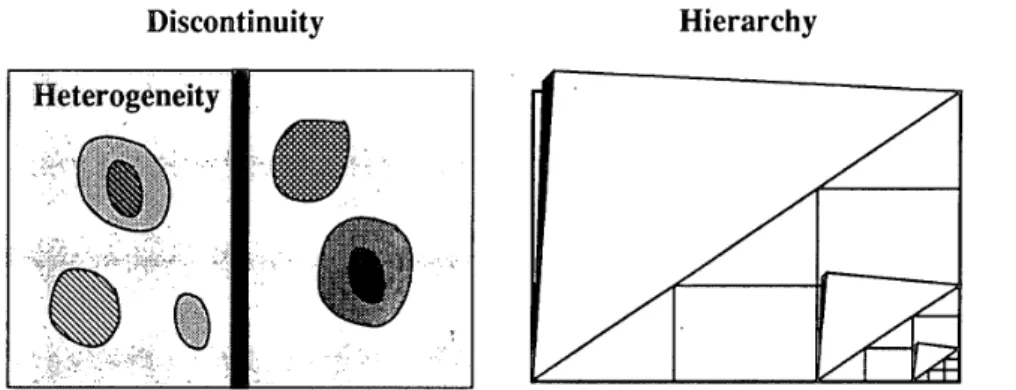
asFig,
1schematically,The
sketchin
theleft
side representsthe source
fault,
wherediscontinuity
is
indicated
by
the thickline
in
the central part,theheterogeneity
isindicatedby the shielded part.The sketch inthe right side represents the
hierarchy
propertyfora point souree. In additien to theheterogeneity
in mechanical propertiesof afault
plane and thediscontinuity
in
a rupture precess,hierarchy
in
earthquake sizedistribution
was reported toplay a very importantrole on the complexity of earthquake source processes.Phenomenadirectly
related tothe hierarchypropertyincludernagnitude-frequency relation and the magnitude gap.
The
frequencyof earthquake N isrelated to seismic magnitudeM
aslog
N--M.
Moreover,
the fault area S isrelated tothemagnitude M aslog
S-M.
Therefore,
wehave
a relation S・IV =constant, which means thatthe same scale sources cover all faultarea. Itisvery interestingthatthisrelation is suitablefor
all magnitudelevels.
Next
is
the magnitude gapfound
inan `earthquakefamily',
inwhichthe differenceinmagnitude
between
thelargest
event and the next largest event is about1-1.s.Same
phenomenon was also
found
in
a mainshock-aftershock sequence. The rnagnitude gap between the main shock and thelargest
aftersheckis
about1--1,2
or more.These phenomena could
be
explainedby
thehierarchy
model quantitatively.Rupture processdescribed
by ahierarchy
model isshown inFig.
2.
Ruptures
growby
repeating cycles shownin
thefigure.
Onefault
block
(shielded
partin
thefigure)
starts toruptureinto
1,2,-・-,If
thenumber ofblocksexceeds some number
(5
blocks
inthefigure),
abigger
fault
block
starts torupture,Eventually
the main rupture will start Length ratio
between
upper order element and lower order element andrupture patternare parameters
described
inthehierarchy model.
The
procedureto incorporatethe hierarchyproperty intothefault
model issummarized asfollows,
Ingereral,the seismic displacernentsobserved from an eafthquake source can
be
regarded as theresult
dlle
toadoublecoupleforce'i).
The totaldisplacement
atany observation pointdue
toan arbitr4ryDiscontinuity Hierarehy
Reterogeneity
,tw
i l.Yss
i,,g@
v .,・l・,.i'・,.-}eli・1. ;geee
Fig.1 Propertiesof discontinuity,heterogeneityand hierarchytocharacterize an earthquake source. The sketch in
theleftside represents the source fault,where discontinuityisindicatedbythe thicklineinthe central pait,
heterogeneityisindicatedbythe shielded part.The sketch intherightside represents thehierarchyproperty fora pointsource.
-2-NII-Electronic Library Service
) )
ts
>xix)
'Fig.2 A model of rupture expansion. Rupturegrows byrepeating the cycle shown inLhefigure.A shaded square
,represents afaultblockruptured. Therupture of alltheblocksinthebarrierstru,cture at the leftthree column
corresponds tothe'rupture of aunit blockforthe barrierstructure at the right two column. If,.forexample,
therupture happenstostop atsuch astage as inthemost right illustration,adoubletearthquake results. The stage shown inthe middle illustration
(five
bl6cksbroken)thencorresponds tothe initiation of the main rupture. The preceding stage isregarded as the precursoryrupture(after
Fukao & Furumoto,lgss).distribution
ofdisplacement
discontinuities
on a fault'isgiven as an integralef the momentclensity
tdnsors over the faultsurface convolved with Green'sfunctions.The displacement isgiven as
un(x, -t)=1:co dT
fl/l]
n{pa(e, t)・ G..,(x, t :e,
T)dF(e) ・・・・・・・・・・・-・・・・t・:・-・・・・・-・-・・・・・・・・・--・・+・・・・(
i)
e:general
positionon the faultsurface F;ca.:<p
q) component of th6 moment tensor; "'G..(t, t:
e,
T): x.-compon'ent of thedisplacement
atlocation
x and time tdue
to a unit impulsive
force
atlocation
e
and time r;G..,.(x,t:e,
T):thederivatiye
ofG..
with lespectto the source coordinatee,.
To calculate
Green's
functions,
we assume stratified structures and use wavenumber integrationmethod]Z), where the
dYnamic
displacements
on thefree
surface are given interms ofreflection-transmission matrix and
discrete
wavenumber methed.The
inversion'methodptoposedby
Kikuchi andKanamori
(1986)i3)
is
used todetermine
source parameters.A
rupture processisthendescribed
by
subevents which are characterized
by
source parameters,such as the seisMic moment, onset time,location,
focal
rnechanism and'timehistory
function.
The
iterative
least-squares
methodis
used togivespatial and temporal
distribution
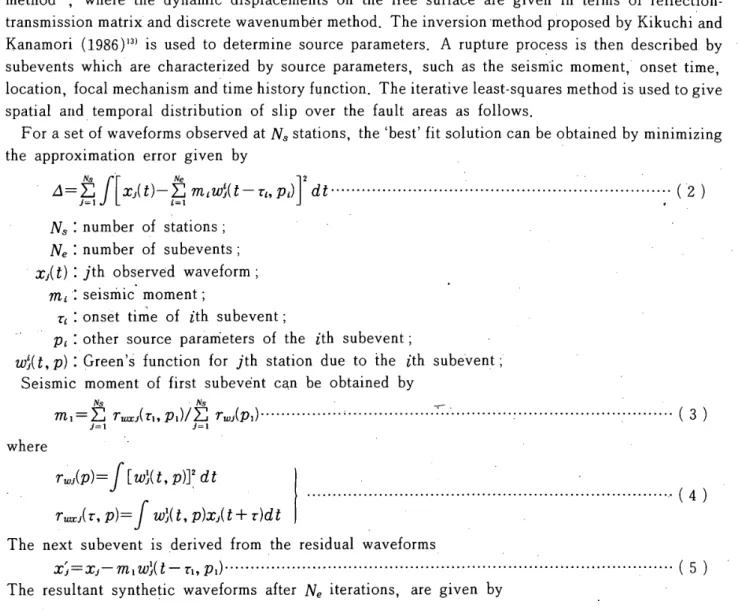
of slip over the faultareas as follows.For a set of waveforms obseTved atIVk stations, the
`best' fit
solution can be
gbtained
by minimizingthe approximation error given
by
'
A=tl!.iij,
f[
x,(t)-X.,
m,wS(t- ., p,)]2dt・・・・・・・・・・・・・・...H.,..,.,..,..,,.,.-.""l.
(
2)
N.:number
of stations; ・N.:number
of subevents; xj(t):J'th observed waveferm; - Emi: selsrmc moment;
.t
Tt:onset time of ithsubevent; '
pt:other source paThnieters of the
ith
subevent;2vS・(t,p) :
Green'S
functionfor
J'thstationdue
tothe
ith
sube'ven.t ;'Seismic rnoment of firstsubeve'nt can
be
obtainedby
mi==
ilil
rurj(Th pDlS rw.(pT)-・・・・・・-・-・-・'""---・---"・:"-H'H-'''''''・・・・・・-・・・・-・・・・・-・-・・--(3)
li-Ll j=1
where
r.,(p)=f[wl(t,p)]fdt
l
'ru[:,(T,p)=f wi<t,p)x,(t+odt
i
'''''"'-""'''''HHH-'-HH-'""''''"''''''''''H"'''''''''''-"
(
4)
The next subevent is
clerived
from
the residual waveformsX;==Xj-711iZVI・(t-ri,Pi)・・・・・・・・・・・・・-・・・・・・・・・・・・・・・・-・・・・・・・・・・・・・・・・・・・・・・・・・・・・・・'---・-・・・・・・・・-・・--T-・・・・・(5)
The resultant synthetic waveforms after
N.
iterations,
are givenby
yJ(t)=
sc
mtw;(t- e,pt)
---・--・---"-'----・---・-"'・''''''""''・・-・-・・---・・・・・・・---・・・・・(
6)
i=1
Hierarchy
rnodelis
thendetermined
asfollows.
Results
obtained from theanalysis oflong
periodmotion$ are used as
hierarchy
element of the firstorcler.Supposed
that a is,theiengthratio, then thenumber of second-ordeT hierarchyelements isa'! pereach upper order element, The rupture time and
moment
for
thelower
order element are respectively a and a-3 tirnesof thosefor
the upper erderelement.
Usually,
there are a"'th-i)h-th
order elements which have aduration
a{h-i), moment a-3(ic-i)times of those of the firstorder element. The onset time forthe elements isdeterminedbyrupture pattern
supposed, such as unilateral,
circular
or random.Moment rate inFig,3modified forthe hierarchymodel which will
be
discussed
insection 3 canbe
expressed as
hth
orderml(
t)==(1-a)
[m,(
t)+-+a3{h-" rizil'] m,(t-t,,)+・-]---・-・--・----・・・・-・・・・--・・・・・-・・-・・・・・-
(
7
)
wherem"t):seismic moment of
lah
order element which couldbe
obtained from Table1;tih:onset time of element
i
in
hth
order,The
factor
(1-a)
isused so that the totalseismic moment isequivalent to 1.
Finally,
the synthetic waveforms canbe
obtainedby
dey,(t)=
n.,
m:・tvS(t- Tt,pt)・・・・・・・--・・・・-・-・・・・・・・・・-・・・・・・-・・・・・--・・・・-・-・--・・・・・・・・--・--・・・・・・・・---・--(
s)
where ml :moderated seismic moment
by
hierarchy
model. The procedure to usehierarchy
model maybe
asfellows.
i
)
Fault
model isused tocalculated seismograms as Eq.6.Parameterssuch as 1)average stressdrop,
2)fault
dimensions,
3)spatial and temperal distributionof thediscrete
sources couldbe
determined
from
aninversion
technique.ii)
Hierarchy
propertyis
incorporated
into
thefault
model asEq.7,
wherehierarchy
oTder(1-s),
hierarchy
element lengthratio(1-s)
and rupture patternare needed. 3. Applicationtothelzu-Hanto-Toho-Oki
Earthquake on July 9, 1989For a pointsource, parametersusecl inthehierarchymodel could
be
determined
asfollows.
If
T,
isassurned as rupture time,
So(t)
is
assumed as source timefunctien,
thenparametersaredetermined
asTable1.
Mornent
rate, moment acceleration and thirddeviation
of moment aredepicted
in
Fig.3,
which are corresponding to
far-field
grounddisplacement,
far-field
ground velocity andfar-field
groundacceleration, respectively.
Here,
moment ratefunetion
isassumed as cosinefunction
with a timedurationof 6 second and the rupture patternisassumed as ranabm.
To simulate acceleration ground rnotions bythepresent method, itis
desirable
touse discretesourcesdetermined
from
velocity ground metions. Inorder that solutions of the inversionrnethod converge,long
peTiod motions are suitable since itisaffectedlittle
by
thedetailed
rupture process.To excludesite amplification and propagationpatheffects,
it
is
better
tousedata
recorded near source region.
The
Izu-Hanto-Toho-Oki
earthquake enJuly
9,
1989
providesabest
set of records.Ito
(ITO)
andShiofuki
(SOF)
are maintainedby
theStrong
Motion
Observation
Center
of theEarthquake
Research
Institutei4),
whose epicentraldistances
are within 3krn.
Area
map near Itowith thelocations
of strongmotion
instruments
andfocal
mechanism are shownin
Fig.4. AIIseismegraphs installedat thesestations are accelerographs.
Grouncl
velocity seismograms are obtainedby
integrating
from
accelerationrecords.
Acceleration
records arebaseline
corrected,filtered
using aband-pass
Chebyshev
filter
withlow-band.f}ofo.1Hz, high-band
.fi, of IO,OHz and stepband
A
of 15.0Hz.
Thelinear
accerlerationmethod isused forthe integrationscheme. To reduce theamplitude of thenoise, velocity seismograms
-4-NII-Electronic Library Service
Tablel Parametersdeterminedby the hierarchymodel
Tupturetimeseismicmoment- timefunction number
lstorderel'ement To
Cl-a)
So'(t) 1kthorderelementTo・ak-1/a3-i(1-a)So(tlcrk-l).a2h-iZ2k-1a O.30 o.oo -O.30O.3S o.oo -O.3SO.40 o.oo'-O.40 O.40 o,oo -e.4oO.40 o,oo -O.40 M'(t) O.30 o.oo -O/30O,35 M"(t) O.30 o.oo -O,35O.35 o.oo -O.35O.35 b.oo' o.oo -O,302.00 M'"(t) 2ndorder 3ndoTder 4thorder o.oo .-2.002,OO o.oo -2,OO2.00 O.5O,4O.3O,2O,1o.o'O.3 02 '・O.1 o.oO.5O.4O.3O.2O.1o.o '
l
patttttt
ttttttttt:.ttttttttttttttt, 't/tt /1 ttttI'ttttltttttttttttttiI-
i-l .+'.I o,oo Fig.3 -O.35 -2.00 O.35 2.00 ・ ・ . SthorderO・09
di
o.po o ,s io-O/35o s io'2'ooo s TLrne(see)Moment rate oc far-fieldgrounddisplacement
(left
column);(middle
column); thirddeviation o.f moment oc far・fieldground acce ingFourierspectra. Moment rate functionisassumed as cosinb rupture patternisassumed as rambm. ・10 M,"(t) 11ttt 'ttttttttt'tttttt ' 'Itttt tttt-.ttt'tttttttt' s.' /'/ /'' L.'ttttt tt'r''' /'' lt,t.''' 'ttttttts:t.. /. '/[lts:,,..ttt"
moment acceleration oc far-f
leration
(right
colfunction
with a timed"rationof 6second.O.1' 1
Frequency(Hz) ieldgrounclvelocity umn) and
The
are
filtered
using a.band-pass.Chebyshev
filter
withfl
of O,1Hi, .fL,of O.5Hz and.fk of 2.D'Hz,
The
'
'
minimum attenuation inthe stopband of all'filters is52dB. '
JMA
(Japan
MeteorologicalAgency) and NRCDP(now
known as the NationalResearchI4stituteforEarth
Science
and DisasterPrevention)propose'd slightlydifferent
locatidns,
depths
and mechanismsthatare compared
in
Table
2.In
thisstudy, them6del proposedby
JMA
withdiscrete
sources 5inthehorizontal
direction
and 4 indepth
direction
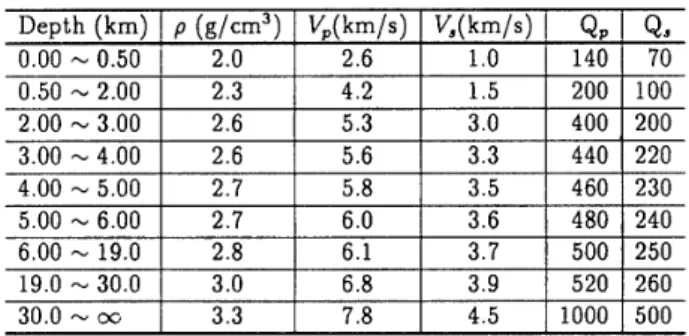
isused.Green's
fu.nctionsare calculated used, the earthstructute shown
in
Table
3iY.The
moment ratefunction
is
assumed as thatin
Fig.
3with a timeduration
' ' of l.5 second. '' ・・ tt ' '
The
inversion
results frornveloc'i' ty ground rnotions after 2iterationsare shgwn inFig.
5.The Pwavefirst'motion
of the sy.nthetic seismogramsdid
pothecessarily coincide with the observed ones, sincefault
parameters weredetermined
fre,m
the overall waveforms inthisinversionmethod.Synthetic
wbves 'inEW
dire6iion
have good agreement with the observed ones since theiramPlitdaes are largerthan'
othe'rs'.
Ge'nerally,
there isgood agreernent in Fourierspectra. .,t t
tt
Acceleration'Seismograms
or results byfirst
orderhierarchy
model4rg
deteripi.ned
onlyby
the inv6rsionresults as adifferential
result of thesynthetic velocity waves. Inorder toexamine effectsdue
toparaiheterssuch as hierarchyorder, hierarchy element length ratio and rupture patterri assurned,
Table2Source parameters given
by
JMA
andNRCDP forthe1989Izu-Hanto-Toho-Oki
earthquake ' JMANRCDP LatitudeN{O) 34.99234.994 LongitudeE{e) 139,112139.086 Depth(km) 3,4 6.3 Strike{") N86.0WN102,OE Dip(o) 79.0N79,OS SIip(o) .165,O155,O Length(kTn) 7.0 6,O IVidth(km) 4.0 5,O Dlsp.(cTn) 24.0 20.0
Stress-drop(bar) 31,O 26,O
B:se.ee
Fig.4 Area map near
strong motion
mechanism,
mse.7e Itowith the locationsof
instruments and focal
Table3 Velocitystructures used to calculate
Green'sfunctions
(after
Takeo, 1991} Depth(km)p(gfcrn3)V.(kmls)V,(kmfs)1QpQs O,OO・.O.502,O 2.6 1.e14070 O,50-.2.002,3 4.2 1.5200100 2.oo-J3.oo2.6 5.3 3,O400200 3.oo--4.oe2.6 5.6 3,3440220 4.oo-s.oe2.7 5.8 3,5460230 5.00-・6.002.7 6.0 3,6480240 6.DObe19,e2,8 6.1 3,7500250 19,O-j30.03.0 6.8 3.g520260 30.0-voo 3,3 7.8 4,5IOOO50Dresults
for
rupture patterncr'rctttarand randbm areshown in
Figs.6
and 7, respectively, where sourceparameters were
determined
from
velocitywave-forms.
Time
histories
are shownin
theorder oflength
ratio lf2,113,114and hierarchyorder 2 or 3 within
one
length
ratio,The
hierarchy
order wouldbe
determined
accorded totheNyquistfrequencyand thefrequency range of interestreferred to the time
duration
shownTable
1.As
frequency
contentsbecome
richer with theincrease
ofhierarchy
order, onlyFourier
spectra ofthelast
hierarchy
order(
=3)are shown.
Compared
with the observed accelerationseismograms, synthetic ones
have
smaller peakvalues and
have
good agreement up to only about1.0Hz
in
frequency
contents, Thus, thecomplexitywaveforms could not be found in the synthetic
selsmograrns.
qmeEemrv
chs.
sums
54 --,,
syn. ・---'xr:'L:tt'/:,i:-"t"-'zr,i・・・-・・-・・・-- ----・,,i . - :, i O 5 10 15 Time (sec} soFew :'l ÷i'l':/ttt:'iL..v"""'vL,.."""... v' omHMEeot n'oNs ,a,...-..,t: ,:"'
l/
:it"-.v:!i5v-...H".. :,:'IS'. . ffOEW//
'l"""'t/'i:
L,,.s"",.'J":L.ilv'--""""" :t li L v tsg
4.o s,o g,o ls.o
egE
g
s
ts
8
O'Oo.1 2S4Se1 20'Oon 2145e 1 2O':.1 2S4SS 1
2 O'Oo.1 2S.56
1 2
Frequency(Hi) Frequeney(Hl) FrequencyCHI) Frequency(H2) ' Fig.5
Comparison
of the observed velocity seismograms(solid
line)with synthetic ones(bToken
line)calculatedbythe inversionmethod after 2iterations.Thestart timeis11 :09 :10.The Earthmoclel used tocalculate Green'sfunctionsisshown inTable3.Themoment rate functionused isthesame one as inFig,3with a time
durationof 1,5second. The observed records are filteredusing a band-pass Chebyshev filterwith .flof O.1Hz,
A,
of 1.0Hz andfk
of 2,OHz.-6-NII-Electronic Library Service ' obs. soFNS SOFEW
-
-anv---ITONS ITOEW syn,1 p m syn・iII・,
,11,.syn.i-・-・・-rv'i,e/2/11illl/i''/Li'-:'・-・'--,-"'--・'---・・-・'""''・-・s'//,S,L,11'i//1'll/ii'i't・,,i':-'L-'"・-""""-'"'"""'"・:ivS"'・siilill.,i""-'""""'L"'""
t'
//
tl: ''' t syn・l syn.I 'syn.z--"vVVvJV'"hvv
d e
.sth
,syn.2 """"'ru:,'"tnsv'S:'・,i"'"""""""'"'' '"'="i't/,l,,/,///"Vtiii"-'"'"""""""""
a)"u["""",.・'・"-',.,i'i'7V'""'"'"" "''":"Ll,S/1///'Vi,,"v""""'""'"'"""'
syn.?}y.a.rcXY:kd・.er ,""tmb,.,{,.)s
"O
SO 70 ioo. o o o o
O.1 l O.1 1 o.1 1 O.1 t
Ftequency(Hz) Frequency{Hz) Freqilency(Hz) Frequency(Hz) Fig.6
Comparison
of the observecl acce!eratian seismograrns with synthetic ones and correspending FounerspectTacalculated bythehiera[chymodel. SourceparameteJsweJe determinedfrom the inversionmethod. The observed records are filteredusing. a band-passChebyshev filterwith .flof O,1Hz,
.fL of 4.
0
Hz and .fkof 4.5Hz. The rupture patternisassumed as circular.The start time is11:09i11.5..'
In
general, the maximurn valuein
timehistories
is
proportionaltothehiegarchy
elementlength
ratio,i,
e., thereis
thebiggest
valuein
the case wherelength
ratiois
112.Th'is
is
due
to thereason thatthemaximum amplitude of
lower
Qrder elementis
a of thatof theupper order element and at most two.small'
events occur simultaneously when a=113 or a=lf2
in
the2ndhierarchy
oider.Results
by
thehierarchy
model, where the rupture patternisassumed as circttlar would
be
first
discussed.
Resultswherehierarchy
order is3
andIength
ratio is113werefound
be{ter
torepresent the6omplexity
waveforrns andpeak values intheobserved ones.
For
Fourier
spectra, cases wherelength
ratio is112 or 113 werefouncl
'better
atSQF
and the.casewherelength
ratiois
114 wasfound
better
atITO.
This
would
be
affected,bythe inversionresUlts.
On
theother hand, rupture patternispreferredtoberandbm rather than circularto ・rep;esentthe averageprgperties.As seen from,Fig.7,
peak
values'in timehistories'
have
goodagreement inthe case where hierarchyorder is3and length
tatio
is113,For Fourierspectra, the casewhere lengthratio is112 was
found
tobe
better
one.Solutions
best
fitted
to the entire observedwaveforrns can
be
obtainedby
adjusting the hierarchymodel parameterssuch ashierarchy
order,hierarchy
elementlength
ratio and rupture pattern. ,LyvbeF ::・・ Ii :/"""""G,"a,,i
l/
ii
/1,v,tt・;・i・it/,,i-・・,i・..-...i'
g, ,,,11・1,...tt.tttttt:tt :itltI/titittlttt;: rlttt-ttCttttttttttttttttt"tt iit'/・.ii'/vt,S'e'.'" /v-7-ebs. syn.1 syn・
i
syn.g
syn,g syn.g sYTT,i syn・l soFNSp
m
'""/f/1,ill.
11'
/i,i
v"'- -"---- u.- T----twv---...v.-,S't/,:t:..,Y'・:':..tl'L.""""'""'""""'' hierurchyorder ltlenthratie SOFEW s f'1,"・-'.J l,,i・!i ':,1 ,1 "i tl ITONS --V-VV'VN.--L.--syn. ---・・---・'・--..i//i,,/'1:・ev:'l/i':'k.,i"'-・""""'"""" :i se se 70 s...・・---ivy'":.t///v・7L,/11'/,/1':V"・・・""・""""' .--wtte
S"''"""・・vx-・'・L,i'v,,,,・...
pt O Tim(sec) S ITO EW thiVWVV----..T-.-'"'""t't//://li::'S'11?/it/.iSv'v'..・・,.r... 1oo・o o o o
O.1 1 e.1 1 .1 1 O.1 1
Fiequency{Hz) Frequency(Hz) FTequency(Hz> Frequency(Hz)
Fig.7 Compari$onof the observed acceleration seismograms with synthetic ones and corresponding Fou[ierspectra calculated bythe hierarchymodel. The rupture patternisassumed as randum. See Fig.6fordetails.
4.
Conclusions
(1)
A
new approach isstudied tosimulate acceleration strong motions quantitativelybeth
intimehistoriesand frequencycontents,
The
hieTarchy
modelis
formed
by
introducing
hierarchy
propertyintothe earthquake source inaddition tothe
heterogeneity
anddiscontinuity
in
the rupture process.Thehierarchy
rnodelis
characterizedby
1)average stressdrop,
2)
fault
dimension,
3)
spatialdi$tribution
of thediscrete
sources, 4)hierarchy
order andhierarchy
elementlength
ratio.The
first
three aremacroscopic parametersto
be
estimatedby
aninversion
techniquefrom
long
period records.(2)
Acceleration
ground motions recordedduring
the Izu-Hanto-Toho-Okiearthquake onJuly
g,lgsg(MJ=5.5)
issirnulatedby
presentmethod.The
hierarchy
modelis
found effective to simulate themaximum values, time
duration
and spectral properties,Accelerationseismograms up toabout 4.oHz
are well simulated
based
on the inversionresults obtained from velocity waves up to 1.0Hz.(3>
For
abackward
study, one can determineparameters used inthehierarchy
model fromFourierspectra. The
hierarchy
element lengthratio couldbe
decided
from
the ratiobetween
thefrequency
atwhich the primarypeak value occurred and the
frequency
at which thesecond primarypeakyalue inhighfrequency
range occurred.The
rupture patterncanbe
determined
from the ratiobetween
the primary peak value and the second primary peak value above.(4)
Through simulation studies, ahierarchy
model isfound
useful tosynthesize ground motions over a wide frequency range.There
needfurther
studies of various scale eauthquakes forthepractical use.-8-NII-Electronic Library Service
Acknowledgments
'
The
authors wish tothankDr.
K, Kudo whokindly
proyidedthe records of the Izu-Hanto-Toho-Oki'
earthquake on
July
9, 1989.References.
0 Housner, G.W. :Cbaracteristicsof streng motion earthquakes, Bull, Selsm.Sbc.'Am.37,pp,19-31, 1947
z) Haskell,N.A, :TotaLenergy and energy spectTal densityofelastic vyave radiation frompropagating faultfi,
Bull.
Sleism.Soc. Am. 54,pp.1811-1841, 19643) Kanarno[i,H.and G.S.Stewart:Seimologicalaspects oftheGuatemalaearthquake of Feb:uary4,lb76,J.Geciphys.Res.
8'3,pp.3427-3434,1978
4) Aki,K.:Characterization of barriers on an earthquake fault,J. Gmphys,Res.84, pp.6140-61a8,]g7g '
s} Andrews. D.J. :A stochastic faultmodel, 2,Time-dependent case, Jl Ge[iphys.Res. 86,pp.10831-1083,4, 1981
6) Papageorgieu,S.A. and K.Aki:Aspeclfic baTrieTmodel forthequantitativedescriptionof inhomogeneous faulting,andthe
predictionof groundmotion. PartI,descnptlonef themodel, Butl.Seism.Sbc,Am. 73,pp.693-722, 1983
{See
alsoErrata,BssA 74, pp.794-795, 1984)
'
7) Koyarna,
J.
:Earthquake source time-function fremcoherent ancl inceherent rupture, 7lectchoph)cs.118,pp.Z27-242, 1985s) Feng,D.etal. :Astudy on synthesizatien ofbioad-bandseismogrames, Phroc.Archit.jhst.JapanCbnfl, pp.31g-32o, lggl (inJapanese) ・
g) Feng, D. e't al. :Broad・bandseismograms'by hierarchymodel, LL struct.,Eng. 38B. pp.71-84, 1992
lo) Fukao. Y. andM.・ Furumoto ;Hierarchy inearthquake size distributien,Phys, EarthFZanet,Inter.37,pp.I49-168, 1985
1]) Aki, K.andP. G,RichaTds:
CuantitativeSedsmoLqgy
71beor)iandMethacis,W,H. FreemapAnd,Company, SanIirancisco,pp,so-5Z l980
l2> Takeo, M. :Nea'r-fietdsynthetic seismograms taking intoaccount the effect ef anelasticity, Ripersin bdetevroLrgyand
Geopdysics36,pp. 245-257, 1985(inJapanese) . ,'
13) Kikuchi,M. and H. Kanamori:Inversion of cornprex bodywaves-], Rhys.EarthPlanet.inter.43,pp.205-222, lgs6 14) Kude,K., M.Sakaue and S.Higashi:Sou[cecharacteristics of earthquake sequence ocurred'at・the sea off Ite,
July
lgsg, as inferredfrom strong-motion records, Ptac. 8thJlaPanEarth. Eng S)7nP.I,pp.157-162, 1990 (inJapanese)15).Takeo,M. :Detailedrupture pTocessesofOffshoreItoearthquakesonJuly9, 1989,pTeceding,asu,brnarinevelcaniceruption,
subrnitted te J/ Geopltys,Res.,1991
'
' '
' '
{Manusciipt
receivecl December s, lggl;PaPer AcceptedJune
,lo,lgg2)'
'
'
'
-9-和 文要 約 1.序 Housner (1947 )1 }が 初めて加 速 度 波 形 をRandom 波 形の重ね合わ せ と し て記 述して以 来, 模 擬 地 震 動に関す る研 究 がか な り蓄 積 されて きた。よ り定 量 的に地 震動を 予測する ため, 断 層 震 源モ デル か ら直 接 波 動 計 算によっ て長 周 期 地 震 波 を再 現しよ う と する研 究が行わ れ る よう にな り, か な りの成 果 を 収 めて いる。これに対 し,大地 震で観 測され る実 体 波は Haskell model2 〕 か ら期 待さ れ る波 動よ りずっ と複 雑である。こ の地 震 動の複 雑 さ を説 明す るた めに, い くつ か改 良した震 源モ デルが提 唱さ れ
て き た。代 表 的 に は,Asperity modeli3 }と Barrier
mode14 〕が挙 げ られ る。 これ ら は基 本的に断 層 面 上の く い ち がい や強 度の不均一・性と破壊伝 播の不 連 続 性を規 定 す る もの といえ る。実際に, 確 率モ デル5ト ηを用い る こ とに よっ て, 微 細な破 壊 過 程 を考 慮する こと がで き る。 Feng et al. (1991)8,・9}は広 帯 域 模 擬 地 震 動 を作 成 する ため,階層モ デ ル を提 案し た。こ の方 法は地震 源の不 均 一性 ,不 連 続 性に加え て,階 層 性 も考 慮 し たもの であ る。 具 体 的に は,Inversion法 を 用い て,長 周 期 地 震波か ら 震 源 過 程 (Rupture process)の時空間 分布を決め た う え, こ れ を最上部 階 層とす る階 層モ デル に よっ て広帯 域地 震 動 を 合 成 する もの である。こ の モ デル を 用い て,1989 年 7月 9日伊 豆 半 島 東 方 沖 地 震 (M,=5.5)につ い て シ ミュ レーシ ョ ンを行っ た。 さ らに,最大値,継 続 時 間, ス ペ ク トル特 性な どにつ い て,階層モデル の パ ラメータ で ある階 層 階数 階層要 素長さ比と破 壊 伝 播パ ターン に よ る 影 響 を検 討し た。 2.階 層 断 層モ デル 図一1に示 し た ような地 震 源の不 均一性,不 連続 性に 加えて, 階 層 性 も導 入 することによっ て初 めて,微 小 破 壊か ら大き な破 壊へ の成 長や Magnitude と発生頻度の 関 係,短 周 期 地 震 動の励 起な ど が統一的に と ら え ら れ る。 こ の モ デル に直 接 関 連 する物 理 現 象は頻 度と Magni − tudeの 関 係 と, Magnitude gap な ど が挙 げら れ る。 頻
度 N と断層の面 積 S の 関 係は S・N = constant とさ れ て い る。こ の ことは, 同一規 模の地 震 源 を寄せ集めると, ちょうど断 層 面 全 体が埋めつ く さ れ ること を意 味し てい る。 この関係は特定の Magnitudeだ けで な く,色々 な Magnitude ご とに幾 重に も 成立す る。ま た, 一つ の ‘
earthquake family’において,最 大 イベ ン トの Magni −
tude と次に大きい イベ ン トの Magnitudeの間に は 1− 1.5の差が ある。同 様な現 象は一つの本 震 余 震 系 列 内に もみ られ, 本 震と最大余震の 間 Magnitudeの 差は 1〜 一
10
一 1.2と さ れ てい る。上 述の よ う な 現象は地 震 源の 階層性 によっ て 定量的に説明で き る。階層モ デルに おい て , 地 震 源の破 壊 過 程は図一2に示 し た よ うに段 階 的な もの か ら な ると仮 定 する1°) 。 まず,ある代 表 的な長 さ を持っ た 破 壊 要 素がある確 率で 1個,2個,…と拡 大 し停 止する。 こ れがある数 以 上に拡 大し合 体する と,1まわ り大き な スケール を持っ た破 壊へ 成 長 する 。 そして こ の繰 り返し によっ て, 震 源 全 体の破 壊まで達する。一般に, Double couple force震 源に よる地 表面の 応 答は式 (1)の よ うに地 震モーメ ン トとグリーン関 数の Convolutionと し て表せ る1]).震 源 過 程は時 間 的 空間的 に分 布 する小 イベ ン トか ら な る と す る。 Inversion法 を 用い,長 周 期地震 波か ら その時空間 分 布を決め る。 そ の 解を階層モ デルの 第一階 層 要素とす る。αが 下の 階層と 上の階層の要 素間長さ比と すると, h番目の 階層 は,パ ル ス幅が at’1 倍, 地 震モ ーメ ン トが α 3Ch−n倍の α 一2【ic”1 ) 個 要 素か ら なる。各 要 素の破 壊 開 始 時 刻は仮 定 し た破 壊 伝 播パ ターンか ら分か る。最 後に,合 成 波 形は式 (8) の ように求め られ る。 3.1989伊豆半 島 東 方 沖 地 震の シミュ レーション 点 震 源に対 し て, 階 層モデルの各 階 層のパ ラ メータ は 表一1の よ うに決 定できる。係 数 (1一α)は地 震モーメ ン トを 1にする ための もの である。モーメ ン ト速度, 加 速 度, 第3次 微 分の 時 刻 歴 とFourier spectra を図一3 に示 す。 そ れ ぞ れ は遠 地 地 動 変 位,速 度,加 速 度に対 応 するもの であ る。な お,モ ーメ ン ト速 度 関 数は継 続 時 間 6秒を有す る cosine 型 の もの と し, 破 壊伝播パ ターンは ランダムと し た。 1989伊 豆 半 島 東 方 沖 地 震の観 測 点 と 震 源メ カニ ズム は図一4に示す。解 析に は, 東 京 大 学 地 震 研究所Ulが所 有の SOF と ITO 二 観 測 点で記 録し た加 速 度 波 形 を使 用 し た。速 度 波 形は記 録 された加 速 度 波 形 を積 分して求 め た。 加速度波 形はゼロ線補 正 を行っ た後, チェ ビ シェ フ型 パ ン ドパ スフィ ル タをほどこ し た。そ の際, 用い た パ ラメ ータは
fi
= O. 1 Hz ,f
.= 10 Hz,fs
= 15Hz 。線形 加 速度法に よっ て得られ た速度波 形もf
,= 0.1Hz ,fh
=0.5Hz, ノ』=2Hz となる フ ィ ル タをか ・け た。い ずれ の フ ィ ルタに おい て も遮 断 帯で の パ ワーを52 dB とし た。 表一2に 気象庁と防 災 科 学技術 研 究 所が発 表 し た震 源 パ ラメータ を示す。表一3にグリーン関 数を計 算 する た め の地 盤 定 数を 示 す。モ ーメ ン ト速 度 関 数は図一3と同 じもの を用いた。 た だ し,継 続 時 間は1.5秒 とし た。NII-Electronic Library Service 図一
5
に,速度 波 形か ら,反 復 回 数 2回の Inverslon 結果を示 して あ る。 断 層の パラメータは波 形の主 要 動に よっ て決め ら れる の で,合 成 波 形と観 測 波 形の P 波 初 動は合わ ない場 合がある。結果 全体をみ る と, EW 方 向 成 分は大き な振 幅 を有して お り, よい対 応 を示し てい る とい え る。ま た Fourier spectra の場合は, 全 成分に おい て よい対 応がみ ら れ る。 加 速 度 波 形は,速 度 波 形から微 分し たもので,階 層モ デル の 第一階 層によ る もの で も ある の で,Inversionの 結果に よ る ところ が 大 きいと推 測で きる。 階 層モ デル の パ ラ メータ で あ る階層 階 数,階層 要 索 長さ比と破 壊 伝 播 パ ターンに よ る影 響を検 討し た結果は 図一6と図一7に 示し て ある。時 刻歴は長 さ 比 を 1/2,1/3,ユ/4,階層階 数 を2か 3とし た も の で あ る。階層階数はNyquist振 動 数 と 解 析 対 象 振 動 数に よっ て決め ら れ る。 ス ペク トル は階層階 数の増 加にっれ大 き く な るの で,図には階 層 階 数が 3のケースだ け示し て あ る。 記 録 波 形 と 比べ る と,合 成 波 形は全体 的に小さ く, Fourier spectra も1.5Hz まで再 現で き た もの の ,原波 形の複 雑さを再現 で き な か っ た。一・般に, 時刻歴 の振 幅 の大き さは要 素 間 長さ比 と比 例する の で,長さ比が1/2 の と き最 大振 幅とな っ た。長さ比が 1/4になると,ほぼ 第 ユ階 層の もの と同じレ ベ ル に なっ た。 破壊伝 播パ ターンが円 形と仮 定し た場 合,階 層 階 数が 3,長さ比が 1/3の と き,合成波形の時 刻歴は観 測 値と よく一致す る。 Fourier spectra の場 合は, SOF において長さ比が 1/2か1/3の と き, lTO に おい て長さ比が ユ/4の と き, 合 成 波 形は観 測 値と よ く一致する。 破壊 伝 播パ タニ ンが ランダム と仮定し た場 合,階 層 階 数が3, 長さ比 が1/3の と き, 合成 波形の時刻歴は観測値と よ く 一致す る。Fourler spectra の 場 合は,長 さ 比 が1/2の とき, 合 成 波 形は観測値と よ く一致す る。 全 体の最 適パ ラメータは階 層モ デルの パ ラ メータであ る階層 階 数,階 』 層 要 素 長さ比と破 壊伝播パ ターンを 調 整 す ることに よっ て得られ る で あ ろう。 4.結 論 (1) 時 間と振 動 数 領 域におい て断 層モデル を用い た広 帯 域地 震 動の作 成 法につ い て更に検 討し た。階 層モデル は 地 震 源の不均一性 ,’不連続 性に加 えて,階 層 性も考慮 し た もの で あ る。 階 層モ デル はユ)応力降 下量 2}断 層 面の大き さ3)サブ イベ ン トの 時 空間 分布4)階層階 数 と階層要 素間 長 さ 比 な どによっ て特 性づ け られ る。具体 的に は, Inversien法 を用い て, 長周期 地 震 波か ら震 源 過 程の時 空 間 分 布 を 決め た うえ, こ れ を最 上部階 層 とす る階層モ デル に よっ て広 帯 域 地 震 動を合 成す る。 (2) こ の ぞデル を 用い て, 1989 年 7月9日伊豆半島東 方 沖 地 震 (M,−5.5)につ い て シ ミュ レーションを行っ た。さ ら に,最 大 値,継 続 時間,ス ペ ク トル特 性な どに つ い て,階 層モ デル の パ ラ メータ である階 層 階数, 階 層 要 素 長 さ比と破 壊 伝 播パ ターン による影 響 を検 討 し た。 1,0Hz まで の速 度 波 形か ら の Inversion結 果を用い,加 速 度波形につ い て,4.OHz まで の Fourier spectra と最 大値, 継続 時間を よ く再現で き た。 (3) 一般 に,Backward 問題 に お い て は, Fourier spectTa か ら階層モデルの パ ラメータは決め られ る。そ の最 大ピークが 起こる振 動 数と2番目最 大ピーク が起こ る振 動 数の比に よっ て,階 層 要 素 間 長 さ比は決め られ る。 そ の ピーク比に よっ て,破 壊 伝 播パ ターン は推 定で き る。 今 後,階 層モ デル を実 用 化 する ために,各槿 規 模の地 震 につ い て階層 性 を検 討 する必 要がある。 一 11 一 N工 工一Eleotronio Library