◇論 文◇
Interlanguage Variation in Past Tense Marking
in Japanese EFL
Learners' Spoken and Written Production
NOMURA Mariko
1. Introduction
This study investigates the distribution of interlanguage past tense verb forms in Japanese EFL learners' spoken and written language from two perspectives; lexical aspect and discourse structure. Previous SLA studies have suggested that once second language learners begin to use past morphology, it is influenced by the inherent semantic aspect of verbs (i.e., aspect hypothesis) (Bardovi-Harlig & Reynolds, 1995; Bardovi-Harlig, 1998; Kumpf, 1984) and narrative structure (i.e., discourse hypothesis) (Bardovi-Harlig, 1995, 1998; Kumpf, 1984). There are only a few studies which have tested these hypotheses, using both oral and written data from the same learners (Bardovi-Harlig, 1998; Nomura, 2012). The present study attempts to examine how the distribution of simple past is influenced by lexical aspect and narrative structure using oral and written discourse pairs produced by Japanese secondary school students.
2. Background
Lexical, or inherent, aspect of verbs is most commonly divided into four categories proposed by Vendler (1967); states, activities, accomplishments, and achievements. This four-way classification, which is based on temporal properties of verbs, can be explained as follows, based on Vendler (1967, pp. 100-103):
1. States last for a period of time (e.g., know, believe, love, etc.).
2. Activities go on in time in a homogeneous way, but have no set terminal point. For example, in "He was running," any part of the process is of the same nature as the whole (e.g., run, push a cart, etc.).
3. Accomplishments also go on in time, but proceed toward a terminus and do have a "climax." For example, running a mile and drawing a circle have to be finished.
4. Achievements occur at a single moment (e.g., reach the top, win the race, etc.) Andersen (1991) and Andersen and Shirai (1996) use accomplishment and
achievement to refer to inherent aspectual categories, that is, telic and punctual. Telic denotes "having an inherent endpoint" (e.g., make a chair, build a house, etc.) and punctual denotes "having no duration" (e.g., recognize someone,find something, etc.). "Therefore, accomplishment and achievement are both telic, but only achievement is punctual" (Andersen and Shirai, 1996, p. 532). According to Andersen (1991), when L2 learners of English begin to use past inflections "the inflection is limited to punctual verbs," and the "next development is for telic verbs to also be inflected" (p. 318). Subsequently activity verbs and finally stative verbs are also inflected (ibid., p. 318). Thus, the predicted order of L2 past tense verb acquisition according to the aspect hypothesis could be shown as below:
Achievements → Accomplishments → Activities → States (telic/punctual)
As for narrative discourse, it is comprised of two parts: the foreground and the background. The foreground is the language of the actual story line; that is, "the parts of the narrative which relate events belonging to the skeletal structure of the discourse" (Hopper, 1979, p. 213). The background, on the other hand, is "the language of supportive material which does not itself narrate the main events" (ibid., p. 213). Thus, "background may provide orientation (scene setting), evaluation, or explanation/identification" (Bardovi-Harlig, 1995, p. 266). The discourse hypothesis for interlanguage development predicts that verbs in the foreground tend to be marked by simple past morphology whereas verbs in the background tend not to be marked (Bardovi-Harlig, 1998).
Many studies have supported either of the two hypotheses, based on oral interlanguage data alone. Bardovi-Harlig (1998) suggests that both hypotheses are necessary to account for the distribution of past morphology in interlanguage: "the results suggest that lexical aspect and narrative structure conspire to shape the distribution of tense-aspect morphology in interlanguage" (p. 501). This study attempts to examine the use of simple past morphology in both oral and written data from the perspectives of lexical aspect and discourse structure.
3. Research Question
The following two research questions are addressed in the present study RQ 1: Do the inherent meaning of verbs and narrative structure influence the
distribution of Japanese EFL learners' past tense use?
-116-RQ2: Do the aspect hypothesis and the discourse hypothesis interact with respect to learners' past tense reference?
4. Method
4.1. Data used in this study
The data used in this study was part of spoken and written discourse on three topics produced by 324 Japanese secondary school students ranging from Year 9 to Year 12 (see Nomura, 2010). Spoken and written discourse pairs on the topic "Impressive school events" were analyzed for the investigation of learners' past tense use. The students who spoke about the topic (e.g., a school festival, a school trip, etc.) wrote about the same topic as the one in their speeches. Although there were 75 discourse pairs on the topic, 3 pairs were excluded because Japanese words or phrases were used for the most part or all of the written discourse in those pairs. As a result, 72 pairs were analyzed. The tokens of spoken and written data totaled 4,023 and 5,360 English words, respectively.
In linguistic studies, a narrative discourse is defined as "one where the speaker relates a series of real or fictive events in the order they took place" (Dahi, 1995, p. 116). In the data used in this study, Japanese EFL learners at the secondary level did not always produce a series of events in the order they took place. However, their data were considered to have the quality of a narrative discourse since the narrative structure consisted of the foreground and the background. For this reason, it was decided to analyze all of the available discourse pairs on the topic "Impressive school events," though not all of them met Dahi's definition of a narrative discourse in a strict sense. Hereafter, the learners' discourse pairs will be called the spoken narratives and the written narratives.
4.2. Analysis
In order to answer RQ1, each verb used in past-time contexts was coded into one of the four aspectual classes proposed by Vendler (1967): states (STA), activities (ACT), accomplishments (ACC), and achievements (ACH). Subsequently, the distribution of the past tense use of these four classes was examined in each production mode. The distribution was investigated not only in the data as a whole but also in three groups divided according to the number of verbs used in past-time contexts in natural spoken data. The grouping was conducted based on Noda (2008) which assessed Japanese secondary school students' speaking levels. The results
showed that as assessed speaking level went up, the number of tokens and different types of words used (types) increased. See section 5.1 for details about the three groups.
As for narrative structure, after sentences or clauses in the discourse were classified into foreground (F) and background (B), the simple past use was examined in each grounding in the spoken and written narratives. Since the learners used base/present form instead of simple past form in past-time contexts, the distribution of base/present was also examined. In addition, the distribution of lexical verbs and be verbs was investigated separately to show different tendencies used in each grounding. Previous studies show that production of states is essentially limited to the background and states are dominated by be verbs (Bardovi-Harlig, 1998; Kumpf, 1984). Investigating be verbs separately could confirm such distribution.
In order to answer RQ2, the interaction of the aspect hypothesis and the discourse hypothesis was examined by combining the aspect and discourse analyses in RQI. The two analyses were compared in terms of which aspectual category showed higher use of past inflection between the foreground and the background and which grounding showed higher use of simple past morphology, compared across aspectual categories. The interaction was analyzed taking into account different production modes.
5. Results
5.1. The influence of lexical aspect on past tense use
Table I shows the distribution of simple past across aspectual classes in verbs used in past-time contexts in the spoken vs. written narratives. The figures in the columns "Simple past" and "Verbs used" indicate occurrences. The rightmost column in each mode shows the percentage of verbs in simple past tense, that is, the rates of target-like past tense use. Since the number of states includes a large number of tokens of be (Bardovi-Harlig, 1998), the number of be verbs is shown in parentheses to display their usage.
-118-Table 1
Distribution げSimple Past across Aspectual Classes (Spoken vs. Written Narrativeり
Aspectual class
Spoken Written
Simple past
Verbs
used % Simple past
Verbs used % STA 90 148 60.81 210 258 81.40 (beverbs) (63) (114) (55.26) (177) (213) (83.10) ACT 13 42 30.95 53 77 68.83 ACC 34 59 57.63 64 85 75.29 ACH 150 185 81.08 204 240 85.00 Total 287 434 66.13 531 660 80.5
Note. STA = states; ACT = activities; ACC = accomplishments; ACH = achievements
As can be seen from Table 1, both the spoken and written narratives support the prediction of the aspect hypothesis: achievements show the highest rate of simple past inflection. Overall, the rates of target-like simple past use in the written narratives are higher than those in the spoken narratives. It is noted that there is a striking difference in simple past with activities between different production modes: that is, a much higher use of simple past in the written narratives, with about a 38% difference. A rather big difference is also found with accomplishments. With respect to states, be verbs have a great influence on past tense marking. As Bardovi-Harlig (1998) states, "the tensing of the copula is not representative of the tense-aspect marking of other statives" (p. 484). However, as can be observed from the figures in parentheses in Table 1, be verbs account for a large percentage of states, suggesting that be verbs are an important means of expressing states by Japanese secondary school students.
Both the spoken and written narratives exhibit the same pattern in terms of the rates of simple past use. In both modes, the rate of simple past is high in the following order: achievements, states, accomplishments, activities. In order to observe the pattern of simple past use across aspectual classes, the learners were divided into three groups, relatively high (H ), middle (M ), or low (L) use of verbs in past-time contexts in the spoken narratives. The learners in group H (n = 17) used 18-9 verbs, group M (n = 28) 8-5 verbs, and group L (n = 27) 4-0 verbs. Figure 1 shows the rates of target-like simple past use by aspectual class in the spoken vs. written narratives across three learner groups.
100% 80% 60% 40% 20% 0% Spoken L M H -4-STA -u-ACT -*-ACC --ACH Written 100% 80% 60% -+-STA - -ACT 40% -*-ACC 20% ---ACH 0% L M H
Figure 1 Use of Simple Past by Aspectual Class (Spoken vs. Written Narratives)
As a whole, the rates of target-like use for the written narratives are somewhat higher in each group than those for the spoken narratives. The spoken narratives do not exhibit a stable pattern in each aspectual class across the three groups, while the written narratives exhibit increased rates of simple past from group L to H, except for a slightly decreased rate with achievements from M to H. In spoken mode, it is noted that the rates of simple past inflection with the three aspectual classes except for states decrease from group M to H. This indicates that the rate of misuse of base (present) forms in group H is higher than that in group M , despite the fact that group H learners use a larger number of verbs in past-time contexts.
5.2. The influence of narrative structure on past tense use
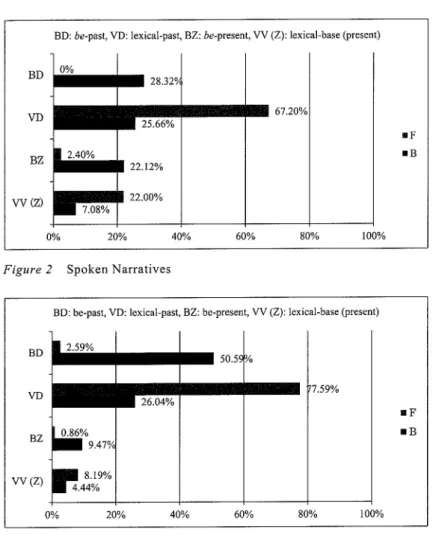
Figures 2 and 3 show the rates of the use of simple past and base (present) verb forms by grounding. The rates of be verbs and lexical verbs are indicated separately. This group of learners as a whole show lower use of past and greater use of present tense in spoken production, compared to written production.
The distribution of simple past in both the spoken and written narratives supports the prediction of the discourse hypothesis: both modes of narratives show greater use of simple past with lexical verbs in the foreground (F) than in the background (B). Be verbs in the past tense are used more dominantly in the background than in the foreground in both modes. The learners produced a lot more simple-past be verbs in the background in the written narratives than in the spoken narratives.
-120-BD: be-past, \TD: lexical-past, BZ: be-presen , VV (Z): lexical-base 印resent) BD BZ
vv(の
0% 2.40% 7.08% 28.320 25.66% 22. 12% 22.00% 67.20% 0% 20% 40% 60% 80% 100% ■F ■BFigure 2 Spoken Narratives
BD
BZ
VV (Z)
BD: be-past, VD: lexical-past, BZ: be-presen , VV (Z): lexical-base (present)
2.59% 0.86% 9.47 / 8.19% 4.44% 26.04% 50.5'/o 7.59% 0% 20% 40% 60% 80% 100% B
Figure 3 Written Narratives
Figure 4 shows the percentage of simple past use by grounding in the spoken vs. written narratives in the same three learner groups as mentioned above. The distribution of simple past morphology by grouping also exhibits support for the discourse hypothesis. It implies that the use of the simple past emerges first and more strongly in the foreground and becomes the dominant tense in the background later, as Bardovi-Harlig (1998) suggests.
The written narratives show higher use of simple past across learner groups than the spoken narratives, though the pattern of use is different between different
production modes. In written narratives, the gradual increase in the use of simple past can be seen in both grounding from group L (low) to H (high). In spoken narratives, on the other hand, the use of simple past in the foreground by group H decreases, compared to group M (middle). This means that though the learners in group H used more verbs in past-time contexts, they misused base or present forms in oral production, which resulted in the lower rate of target-like use of simple past than learners in group M .
100% 80% 60% 40% 20% 0% Spoken L M H -4-F +B 100% 80% 60% 40% 20% 0% Written L M H -4-F →-B
Figure 4 Use of Simple Past by Grounding (Spoken vs. Written Narratives)
5.3. The interaction of lexical aspect and narrative structure
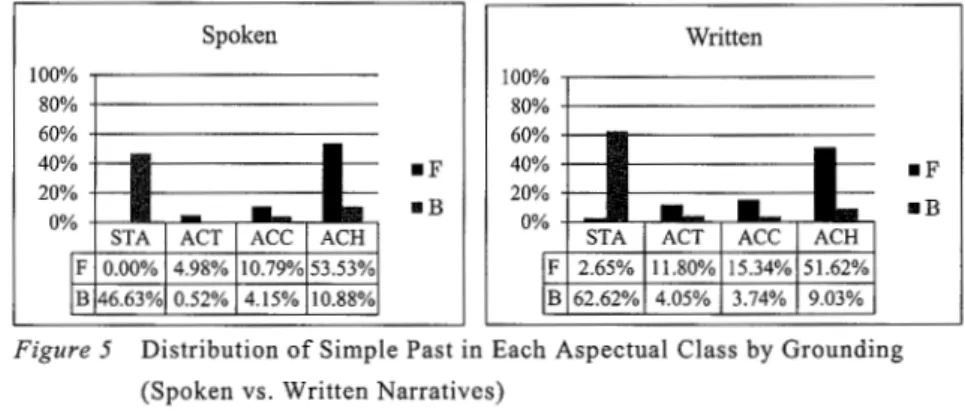
The use of simple past was examined with respect to lexical aspectual class and grounding by comparing the aspect and discourse analyses conducted in the previous sections. Figure 5 shows the distribution of simple past use in each lexical aspectual class by grounding in the spoken and written narratives.
100% 80% 60% 40% 20% 0% Spoken
STA ACT ACC ACH F 0.00% 4.98% 10.79% 53 .53% B 46.63% 0.52% 4.15% 10.88% ■F ■B 100% 80% 60% 40% 20% 0% F B Written ■ー ■ー ACT
STA ACC ACH
2.65% 62.62% 11.80% 4.05% 15 .34% 3.74% 5 1.62% 9.03% FaB
Figure 5 Distribution of Simple Past in Each Aspectual Class by Ground'ng (Spoken vs. Written Narratives)
Compared across aspectual categories, foreground predicates show increased
use of simple past morphology in both the spoken and written narratives, moving from the lowest occurrence with states (STA), to activities (ACT), to accomplishments (ACC), to the highest use with achievements (ACH). On the contrary, background predicates show a different pattern of simple past use: from the lowest rate with activities (in the spoken narratives) and accomplishments (in the written narratives), to achievements, to the highest rate with states. These results suggest that lexical aspect and discourse structure have an interacting effect on the variable use of past tense marking in learner interlanguage, such as a strong tendency for achievements to be marked by simple past in the foreground and for states to be marked by simple past in the background.
6. Discussion
The largest study to date that examined both the aspect hypothesis and the discourse hypothesis is Bardovi-Harlig (1998). Her study examined 74 narratives (37 oral and written pairs) produced by adult learners of English as a second language and the results supported both hypotheses. Compared to her study, there were about twice as many narrative pairs used in this study, that is, 144 narratives (72 oral and written pairs), which included stories of various lengths. In addition, the kind of data used was completely different: the data in Bardovi-Harlig (1998) were elicited by means of a film-retell task using an eight-minute excerpt from the silent film Modern Times, while the data in this study were elicited by means of a free narrative task about a personal experience, "Impressive school events." In spite of these differences, the results of this study also support both hypotheses. The findings obtained from this study verify Bardovi-Harlig's (1998) assumption: "Finding support for both hypotheses in a single corpus suggests that other corpora in the literature would also support both hypotheses-that is, a narrative corpus that provides evidence for the aspect hypothesis would also support the discourse hypothesis and vice versa" (p. 498).
By combining the aspect and discourse analyses, the interacting effect of lexical aspect and narrative structure was observed with respect to past tense marking. In general, the results demonstrated the strong association between aspectual class and discourse function described by Andersen and Shirai (1994):
Achievements and accomplishments typically fill the central role of laying out events in narration and are logical recipients for past/perfective marking. States and activities typically serve supporting roles, and if
they receive inflectional marking they tend to be inflected with progressive (for activities) and past imperfectives. (p. 152)
However, as in the results of Bardovi-Harlig (1998), there were also cases where achievements and accomplishments served supporting roles and activities filled the central role of laying out events. This means that aspectual class and grounding do not have a simple one to one relationship, yet there is a tendency for a certain lexical aspect to be used in expressing a particular grounding.
The findings of the present study suggest the following hierarchy of inflected verb use in learner narrative interlanguage, which is consistent with the hierarchy suggested by Bardovi-Harlig (1998, p. 498).
1. Achievements are most likely to be inflected for simple past.
2. Accomplishments are the next most likely to be marked by the simple past. 3. Activities are the least likely of all the dynamic verbs to be marked by the
simple past.
It would be reasonable to include be verbs in the analysis of states and make a comparison between different modes in the case of Japanese secondary school students. There was a rather big difference in the percentage of past tense use between spoken and written modes, nearly 20% higher in the written mode. In addition, 240 out of the 327 occurrences of be in both modes of data were tensed, but the other 87 occurrences were not marked by the past tense. On the contrary, in Bardovi-Harlig (1998), of the 324 occurrences of be in the combined oral and written data, all but one (323) were unambiguously tensed, which means that the past tense use of be verbs was stable regardless of production mode. In this way, variable use of be verbs is greatly different in her data and the present data. This difference might have resulted from such differences as adult ESL learners vs. Japanese secondary school learners' acquisition stage and their English proficiency levels.
By using both spoken and written data in the aspect and discourse analyses, the influence of production mode on simple past use was observed. In both analyses, overall, the rates of target-like past use for the written narratives were higher than those of the spoken narratives. This can be considered to be due to the effect of more monitoring in the written mode. Insightful findings were obtained by dividing learners into three groups by the number of verbs used in past-time contexts. Such grouping by the tokens of verbs would be supported by Noda's (2008) study, which suggested that vocabulary richness played an important role in deciding speaking levels. The increased use of simple past was rather stable in the
written narratives as the number of verbs used in past-time contexts increased, while the pattern of simple past use was unstable in the spoken narratives. For future studies, it would be necessary to examine what factors affect such performance in speaking.
7. Conclusion
In this study, variation in past tense use by Japanese EFL learners was investigated using spoken and written narrative pairs. First, the aspect hypothesis and the discourse hypothesis were tested, focusing on simple past tense forms. The results supported both hypotheses (RQ1): simple past marking was influenced by lexical aspect and narrative structure, respectively. Further analysis was conducted by combining the aspect and discourse analyses. The results suggested that lexical aspect and discourse structure had an interacting effect on past tense marking in learner interlanguage (RQ2). These analyses were also conducted taking into account different production modes (spoken vs. written). By comparing simple past use between the different modes with respect to each aspectual class and grounding, variable use was observed by production mode in each analysis. This study verified the hypotheses proposed in previous SLA studies and added some new insights on variation in past tense use by Japanese secondary school students.
Note
The present paper is an extended and revised version of a paper presented at the First Asia Pacific Corpus Linguistic Conference, Auckland, NZ, February 2012.
References
Andersen, R. W . (1991). Developmental sequences: The emergence of aspect marking in second language acquisition. In T. Huebner, & C. A. Ferguson (Eds.), Crosscurrents in second language acquisition and linguistic theories (pp. 305-324). Amsterdam: Benjamins.
Andersen, R. W ., & Shirai, Y. (1996). The primacy of aspect in first and second language acquisition: The pidgin-creole connection. In W . C. Ritchie, & T. K. Bhatia (Eds.), Handbook げ second language acquisition (pp. 527-570). San Diego, CA: Academic Press.
Bardovi-Harlig, K. (1995). A narrative perspectives on the development of the tense/aspect system in second language acquistion. Studies in Second Language Acqusition , 17, 263-291.
Bardovi-Harlig, K. (1998). Narrative structure and lexical aspect: Conspiring factors in second language acquisition of tense-aspect morphology. Studies in Second Language Acquisition , 20, 471-508.
Bardovi-Harlig, K ., & Reynolds, D . W . (1995). The role of lexical aspect in the acquisition of tense and aspect. TESOL Quarterly , 29, 107-131.
Dahl, 0 . (1983). Temporal distance: Remoteness distinctions in tense-aspect systems Linguistics , 21, 105-122.
Hopper, P. J. (1979). Aspect and foregrounding in discourse. In T. Givon (Ed.), みntax and semantics: Discourse and syntax (pp. 213-241). New York: Academic Press.
Kumpf, L. (1984). Temporal systems and universality in interlanguage: A case study. In F. Eckman, L . Bell, & D . Nelson (Eds.), Universals of second language
acquisition (pp. 132-143 ). Rowley, MA : Newbury House.
Noda, T . (2008). Niho可in eigogakushuusha no speaking nouryoku no jittaichousa narabini 如oukashi如ou kaihatsu: Chuugakusei koukousei wo taishou toshite [Investigation げJapanese EFL learners' speaking abiliケand development げ
evaluation indices: Focus ing on secondarフノ school student可.(Scienti五c Research Report No. 17652059).
Nomura, M . (2010). Nihonjin eigogakushuusha no speaking vs. writing performance no hikaku bunseki notameno shihyou: Gakushuusha corpus ni motozuku approach [Indices for a comparative analysis of Japanese EFL learners' speaking vs. writing performance: A learner corpus-based approach] . Step Bulletin , 22, 3 0-46.
Nomura, M . (2012, February). Interlanguage variation in past tense marking in Japanese EFL learners' spoken and written corpora. Paper presented at the First Asia Pacific Corpus Linguistic Conference, Auckland, NZ .
Vendler, Z. (1967). Verbs and times. In Z . Vendler (Ed.), Linguistics and philosophy (pp. 97-12 1). Ithaca, NY: Cornell University Press.