I
IntroductionMany years ago Australia was described by the poet Dorothea Mackellar as a "land of droughts and flooding rains".1) In response, the country has developed a vibrant irrigation in-dustry. One of the most commonly stated reasons for the vibrancy is the way that Austra-lia has allowed its water sharing agreements to evolve, reformed its entitlement and allocation regimes and allowed water users to trade water with one another. Australia's most cost-effec-tive water sharing and associated trading regime can be found in its Southern Connect-ed River Murray system.
Transition from a traditional regulatory wa-ter-abstraction regime2) to one that attempts to take full advantage of bottom-up market process has not been easy. Three parallel pro-cesses have been critical to the transformational policy changes that have occurred in Australia. The first was the development of a robust water sharing regime at the system level. The second has been the conversion licences to take water into entitlements and the separation of these li-cences from land titles. The third has been the development of water accounting, entitlement registration and administrative protocols that have made low transaction cost water trading possible.
The reform process began in the I 960s with a few cautious trades that tested the feasibility of moving the location of water use without harming third parties. Water trading expanded gradually during the 1970s and 1980s as irriga-tors and administrairriga-tors began to realize that there was an economic case for allowing users to trade water with one another. Trading took off in 1996 following development of the
Na-Trading Into Trouble?
Lessons from Australia's
Mistakes in Water Policy
Reform Sequencing
Mike Young
Gough Whitlam and Malcolm Fraser Chair in Australian Studies, Harvard University and Research Chair in Water and Environmental Policy, The University of Adelaide / Professor
Articles
1) See http://www.dorotheamackellar.com.au/archive/ mycountry.htm
2) Throughout the world the terms used to describe the regimes used to manage water vary considerably. In this paper, the term "abstraction regime" is used to describe the full suite of institutional arrangements used to
con-tional Competition Policy and introduction of a "cap" on surface water use in the Murray Dar-ling Basin (MDB). The so-called Murray Darling "cap" placed a limit on the maximum volume of surface water that could be diverted from any part of the system in any one year. The National Competition Policy required all Australian governments to make it possible for anyone to invest in water and in effect be able to buy and hold a water entitlement without having any intention to use it. This, it was ar-gued and subsequently demonstrated, would drive innovation and encourage the transfer of water to places where it would make the great-est contribution to the economy (Young 2012).
With the onset of a long dry spell at the start of this century and collective agreement to a National Water Initiative in 2004, water trad-ing in the Murray Darltrad-ing Basin became the norm. This was followed, in 2007, by the devel-opment of national legislation that enabled Australia's Federal Government to establish an independent Murray Darling Basin Authority and, in 2012, use a Basin Plan to set a suite of sustainable diversion limits (Australia 2007, 2012). Those interested in the detail should read "A short history" of the development of water trading in Australia (NWC 2012).3) Skinner and Langford (2013) provide a detailed description of the reform journey taken in the Murray Darling Basin.
At conferences throughout the world Aus-tralian officials tend to present water trading, especially in the Nation's Southern Connected River Murray System, as an "outstanding suc-cess!" (see Fig. 1). Economists too have been keen to present the advantages that trading has brought to Australia. For example, Grafton et al. (2012) have drawn attention to the fact that
water trading enabled the impact of the drought to be much less than it otherwise would have been. The late Jim McColl and I have made similar observations (see, for exam-ple, Young and McColl 2005). Peterson et al. (2004) have estimated that the gains from wa-ter trading in a dry year to be in the vicinity of $495 million. Water use per hectare has been halved and there has been much innovation (Young 2012). The internal rate of return on holding a water entitlement over the first de-cade after trading was opened up was well over 15% per annum (Bjornlund and Rossini 2007). In dry years, as much as 40% of the water allo-cated to irrigators is traded (NWC 2008, 2009, 2010, 2013).
II
The RealityThe argument presented in this chapter is different. Yes, the development of trading, per se, has been a success. This is particularly true when viewed from the perspective of water us-trol the amount of water that may be taken from a water
body and how it may be used.
3) Available at http://www.nwc.gov.au/_data/assets/
Fig. 1 National Water Commission slide presented to Australian Competition and Consumer Commission Con-ference, Brisbane, July 2011a)
a) Available at http://www.accc.gov.au/system/files/ Presentation%20by%20Chloe%20Munro.pdf
ers. There has been considerable innovation, water use efficiency has improved markedly and there has been considerable structural ad-justment. Considerable attention has been given to the development of the institutional arrangements that underpin the market. In its most recent review, the National Water Com-mission (2013) found that well over 90% of interstate water allocations trades were com-pleted within 10 days.
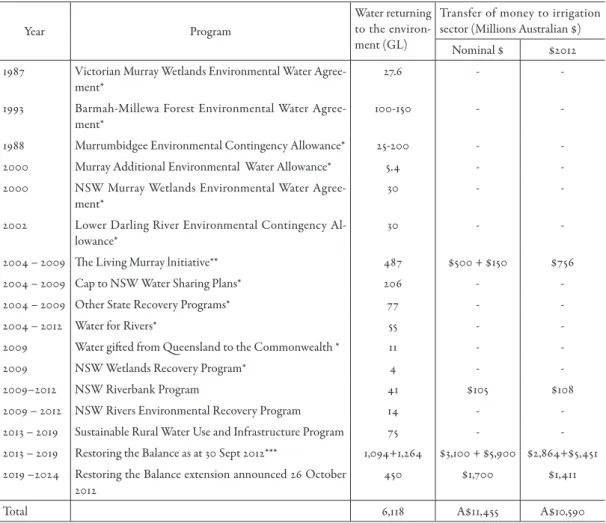
When viewed from a broader perspective, however, it is possible to conclude that Austra-l ia made some ma ssive "se quencing " miscalculations. When one looks back over the last 20 or so years of water reform experience, it is difficult to conclude that the net benefits of the introduction of trading have been posi-tive for the Nation as a whole. In total, the governments have invested billions of dollars in bringing about the reforms that have been her-alded by Australia's political leaders and senior officials as a social and environmental success. As shown in Table 1, the total transfer of mon-ey to the irrigation sector since 2012 amounts to around A$11 billion in both nominal and re-al terms or around A$3,500 per ML.
When distributed among the 14,340 surface and groundwater irrigators in the Murray Dar-ling Basin in 2012, the government investment required to restore health to the Murray Dar-ling Basin has required a transfer payment from taxpayers to the irrigation sector of around A$750,000 per irrigator for an asset which, at the time the reform process began in 1993/94 was issued only for a short period of time and definitely was not a perpetual right4) to a vol-ume of water.5) From this perspective, the picture looks a little different. Yes, the intro-duction of water trading has been to the
massive benefit of irrigators and irrigation communities but when one looks at the cost of the investment required to establish the ad-ministrative regime one must ask whether or not there was a better reform pathway and if that pathway could have been followed.
The argument put forward in this chapter is that those advocating water reform need to consider the benefits of first putting in place a robust abstraction regime. Robust abstraction regimes withstand the test of time. In particu-lar, they are designed to work elegantly when a system is under stress such as during a severe drought (Young and McColl, 2005). When the reform process began, irrigators held entitle-ments to the amount of water that could be taken sustainably from the river and the groundwater systems associated with it. They had no guarantee that the volumes of water they had become accustomed to taking would continue to be available and they had no enti-tlement to compensation if the amounts they were allowed to take was reduced (Fisher 2006).
A full cost benefit analysis of the celebrated Australian reforms has yet to be conducted. As indicated by the above observations, however, the result of a full cost-benefit analysis would most likely not be a positive one. Yes, the value of irrigation entitlements has risen and trading has brought significant increases in regional in-come but it required a massive transfer of capital from the rest of the nation. Examining the benefits to the nation of fixing the problem and including an estimate of the value of the resultant environmental improvement, Grafton et al. (2011) observe that "from 2001 to 2009 a water allocation that would have given less to irrigated agriculture and more to environmen-4) The long-term component of many water licences
where converted into perpetual shares after States agreed to the National Water Initiative in 2004 (COAG 2004). 5) Number of farmers irrigating in the MDB in 2011. At the time of writing, one Australian dollar is roughly equivalent to one US Dollar. Conversion from nominal
to 2012 dollars is approximate as details on actual expen-diture is only available for a range of years. Discounting for future years based on an assumption of 2% per an-num inflation. Entitlements were converted into entitle-ments in perpetuity following completion of the Na-tional Water Initiative in 2004 (COAG 2004).
Year Program
Water returning to the environ-ment (GL)
Transfer of money to irrigation sector (Millions Australian $)
Nominal $ $2012 1987 Victorian Murray Wetlands Environmental Water
Agree-ment* 27.6 -
-1993 Barmah-Millewa Forest Environmental Water
Agree-ment* 100-150 -
-1988 Murrumbidgee Environmental Contingency Allowance* 25-200 - -2000 Murray Additional Environmental Water Allowance* 5.4 - -2000 NSW Murray Wetlands Environmental Water
Agree-ment* 30 -
-2002 Lower Darling River Environmental Contingency
Al-lowance* 30 -
-2004 – 2009 The Living Murray lnitiative** 487 $500 + $150 $756 2004 – 2009 Cap to NSW Water Sharing Plans* 206 - -2004 – 2009 Other State Recovery Programs* 77 -
-2004 – 2012 Water for Rivers* 55 -
-2009 Water gifted from Queensland to the Commonwealth * 11 -
-2009 NSW Wetlands Recovery Program* 4 -
-2009–2012 NSW Riverbank Program 41 $105 $108
2009 – 2012 NSW Rivers Environmental Recovery Program 14 - -2013 – 2019 Sustainable Rural Water Use and Infrastructure Program 75 - -2013 – 2019 Restoring the Balance as at 30 Sept 2012*** 1,094+1,264 $3,100 + $5,900 $2,864+$5,451 2019 –2024 Restoring the Balance extension announced 26 October
2012 450 $1,700 $1,411
Total 6,118 A$11,455 A$10,590
* Agreement or change to an administrative arrangement. No direct transfer of money to the irrigation sector.
** A$500m for the core program plus an additional A$ 150m for a complementary environmental works and measures program.
*** A$3,100m for the purchase of entitlements and A$5,900m for investment in "savings" projects which through improvements in water use efficiency enable the transfer of water entitlements to the environment without any adverse effect on productivity.
Source: Volumetric data adapted from Skinner and Langford (2013). Program expenditure information from government statements.
Table 1 MDB programs designed to improve environmental outcomes in Murray Darling Basin (Nominal $ and $2012 assuming 2% per annum inflation after 2012)
tal flows would have generated between half a billion and over 3 billion U.S dollars in overall economic benefits".
One very important caveat needs to be made. The lessons that have emerged from the Aus-tralian experience in water reform are proving to be extremely valuable to other nations. Moreover, it is possible that no cheaper reform pathway may have been politically feasible. As Marshall et al. (2013) observe, Australia's Fed-eral Governments used the very large transfer payments to State Governments and to irriga-tors to keep them involved in the reform process.
III
Sequencingthe Reform Process
When trading in the Southern Connected Murray Darling Basin took off in the 1995/96 irrigation system (see Fig. 1) the cap was deemed to be an "interim" cap. Those responsi-ble for administration of water use in the Murray Darling Basin knew that the system was already over-allocated. Those advocating the expansion of trading were either not wor-ried about the declining environmental health of this internationally significant river system or not concerned about the adverse effects that the introduction of water trading would im-pose on it.
In retrospect, this failure to think through the implications of introducing a trading with-out simultaneously fixing flaws in the water allocation regime in place at the time is surpris-ing. The clues were there but economists and policy makers seemed to be blind to them. "In the Darling River in 1991, a toxic bloom of blue-green algae occurred over a distance of
1,000km and caused the New South Wales government to declare a state of emergency."6) Moreover, in July 1998, when governments agreed to finalize the Cap, they set it at the "volume that would have been diverted under 1993-94 levels of development."7) Once again, the language is clear. Administrators were wor-ried about the implications of allowing "further development."
Two other clues stood out (Young and Mc-Coll 2003). In fact, the situation was getting very serious. In November 2002 – before the long drought emerged – governments put first one and then two and then three dredges in the mouth of the River Murray! Despite all the agreements and plans being made the River Murray had stopped flowing to the sea. Murray Darling Basin Officials were warning that:
• by 2020, unless significant action is taken, it is expected that River Murray salinity at Morgan will fail to meet the World Health Organization's desirable drinking water standards over 50 per cent of the time (MDBC 1999); and
• between 20 and 40 per cent of irrigation water needs to be returned to the stem of the River Murray so that it can be restored to a healthy working river (Murray-Darling Basin Ministerial Council 2002).
Concerned ecologists were attempting to work out how to fix the problem and soon came to the conclusion that 1500 GL of water entitlements being used by irrigators had to be returned to the Southern Connected River Murray System. Officials, however, were unable to agree on this action and, in 2003, they agreed to a Living Murray program that would recover 500 GL of water as a first step to
restor-6) See http://www.mdba.gov.au/river-data/water-quality/bga
7) See http://www.mdba.gov.au/sites/default/files/ archived/cap/Striking _the_Balance_Report_97_ 98.pdf
ing this system to health (Skinner and Langford 2013).8)
IV
Water-Use Efficiency and Return FlowsWater trading is a pretty simple concept. Ev-ery irrigator is given a water allocation and told that if they don't want to use this allocation they can sell "their" allocation to someone else. With the introduction of trading, water soon became valuable and it did not take long for ir-rigators to decide to become more efficient and to seek new sources of water. As a result, in the five years following the opening up of the water market in 1995/6 water use went up by 25% (Bryan and Marvanek 2004). This increase was not due to a breach of the cap. It was due to the ways that the introduction of water trading changed land-use practice and investment in ir-rigation technology.
First and foremost, irrigators quickly began to invest in more efficient irrigation practices. The problem was that, as these irrigators be-came more efficient, less water flowed back to the river and, as a result, less water is available for others to use, for conveyance and for the environment. Return flows, as they are called went down and use went up.
This reduction in return flows would have had no adverse impact on river and aquifer health if the amount of water allocated to irri-gators was reduced as fast as the efficiency of water use increased. But, in the Murray Darling Basin no such policy regime existed. A double counting problem existed (Young and McColl 2003, 2008, Qureshi et al. 2010). In fact, to this day this flaw in the allocation regime remains. The current Murray Darling Basin Plan still
as-sumes that return flows will not decline as the technical efficiency of irrigated water use in-creases.
The new Murray-Darling Basin Plan (Austra-l ia 2013) do es, howe ver, re qu ire the management of the second source of flow re-duction. If you are a flood irrigator and you start investing in recycling systems, the first thing you do is to decide that none of "your" water should drain or flow back to the river. The next step is to make sure that none of the rain that falls onto your property runs into the river. This is achieved by building structures that divert as much water as possible into on-farm storages. Development of ways to account for the capture of overland flows in a robust manner is one of the frontiers in Australian wa-ter management.
To make matters worse for the river, irriga-tors also began looking for new cheaper sources of water. One of the obvious new cheaper sources was to begin using groundwater that they had a licence to access but had not yet de-cided to use. Those that could access groundwater began to do so and sell off the surface water that they had been using. The problem was that this groundwater used to flow into the river and it was not long before groundwater contributions to river flow started to decline.
V
Groundwater ConnectivityNot putting a cap on groundwater at the same time that surface water was capped is a policy failure that could have been averted. Es-pecially as groundwater trading was introduced at the same time as surface water trading. Giv-en the opportunity to sell surface water, a 8) The Murray Darling Basin Plan has since identified a
significant number of irrigators already li-censed to take groundwater began to develop this resource that they had been keeping in re-serve. From a system perspective, however, this meant that less groundwater flowed to the riv-er. Early estimates of the size of this impact were kept confidential but thought to be be-tween 4 and 7% of water use in the Southern Connected Murray Darling System (Young and McColl 2003).9) Subsequent estimates placed the Basin-wide estimate at 670 GL (Walker et al. 2009) which is very close to the upper 7% estimate that experts said was likely to be the size of the effect. Once again the problem could have been fixed but it wasn't and warnings from those advocating trade in the 1990s – including this author – were non-existent. A cap on groundwater was needed and, as with surface water, there was and still is need for an arrangement that ensures that as groundwater efficiency increases, the ground-water cap has to come down. The good news is that the new Murray Darling Basin Plan in-cludes a cap on groundwater as well as surface water use.10) Plans are being put in place to re-duce the extent of double accounting in the arrangements used to control how much water is used.
VI
Optimizing StorageOne would have thought that all these policy sequencing errors would have been sufficient for alarm bells to be going off everywhere but this is only part of the story. It took ten years for an economist – Donna Brennan – to point out that the way trading rules were specified meant that too much water was being used in dry times and not enough was being saved for
use at a later time. From 1995 until 2007 it was not possible to carry forward unused alloca-tions from one year to the next. The rule was "use it or sell it because you could not save it." All allocations had to be used within a season. With the exception of general-security irriga-tors in the Murrumbidgee System, carry-forward of water from one year to the next was not allowed. The late Donna Brennan (2007) renowned for her ability to see things first, esti-mated the cost of failing to optimize water use between years. This is basic economics. In sys-tems with large dams, optimizing storage is as important as optimizing water use.
Brennan found that when the benefits from trading were considered from a multi-seasonal perspective, the losses that resulted from stor-age mis-manstor-agement were greater than the benefits from trading! Brennan found that trading had increased water use in dry times so much so that it deepened the economic impact of the drought and that the cost to the Austra-lian economy of trading , without the opportunity to carry forward unused water from year to year was greater than the within-season benefits of trading. Almost as soon as Brennan's research results came out, all Gov-ernments involved in the allocation of water in the Southern Connected River Murray System changed allocation policies so that unused wa-ter could be carried forward. The damage to the economy of 11 years of market-based mis-allocation had been done! Optimization of storage management and water use for both commercial and environmental purposes is critical (Grafton et al. 2011).
Unfortunately, the story gets worse than this. Driven by the market and rising water prices, many irrigators sold water entitlements and 9) Now available at http://www.mdba.gov.au/sites/
default/f iles/archived/mdbc-GW-reports/2178_ Projections_of_GW_extraction_rates_and_the_CAP. pdf
10) The science around the limits that have been set re-main controversial.
used the money they received to install very ex-pensive and very efficient irrigation systems. These irrigators and the local town people who sold equipment to them liked all this new in-vestment. They thought that this new business opportunity would be sustainable. The prob-lem was that no-one told them that water trading systems and water allocation systems they were relying upon were seriously flawed. In fact, the majority of the growth was being achieved unsustainably by taking water needed to keep the river flowing and keep its ecosys-tems healthy. As a result, when the severity of all the above and other problems was revealed, communities became very angry – even though the government promised to fix this problem using tax revenues collected primarily from other people. As a result, Australian govern-ments have decided to restore balance to the Murray Darling Basin's abstraction regime by spending massive amount of money on invest-ments in infrastructure that enable the transfer of entitlements to the environment.
The final question that needs to be asked is one of whether or not the government was wise in deciding to fix the mistakes made. Cost-ben-efit analyses such as those undertaken by Grafton (2011), Morrison and Hatton Mac-Donald (2010) and the CIE (2011) suggest that the answer this question is yes as the value of the non-market benefits from the purchase of water for the environment and other non-con-sumptive uses like recreation appears to be greater than its value to irrigation. Grafton (2011) and the Productivity Commission (2010) have also been quick to point out that the approach taken to begin restoring health to the Murray Darling Basin ecosystems could have been much more cost-effective. In
partic-ular, much more emphasis could have been given to purchasing entitlements and much less emphasis given to the attainment of savings via investment in infrastructure.
VII
Learning from Australia's Sequencing MistakesWhen mistakes of the magnitude described above are made, developed country govern-ments need to act and fix the problems they create. The good news is that Australia is trying to do this and after a very difficult period has now put a suite of new administrative arrange-ments in place and they are much more robust. What can be learned from this experience?
The first and most important lesson for econ-omists is that they need to be careful when making recommendations designed to increase the efficiency of resource use and encourage in-novation. Markets have little respect for bio-physical conditions. They do, however, respond well to feedback loops. Robust abstraction re-gimes are needed. In particular, these need to signal increases in resource scarcity and the im-portance of changes in non-market conditions that lie outside the market.
When advocating a change in the way rights are specified and the opportunities associated with trading them, economists and policy mak-ers need to pay attention to the consequences of doing so. Naive, simplistic recommendations need to be replaced with ones that take ac-count of biophysical realities. Attention also needs to be given to the importance of se-quencing policy reforms. The pathway chosen should be one that results in continuous im-provement not one that allows environmental or any other form of decline.
With hindsight it is clear that Australian policy reformers got the reform sequence wrong. If it had fixed the Murray Darling Ba-sin's water allocation regime at the same time as it introduced trading or better still before trad-ing was introduced then it could have saved well over ten billion dollars. Looking forward, all water users can expect to benefit from the mistakes that Australia has made. Water trad-ing makes economic and social sense. It makes total sense when the entitlements and alloca-tions being traded derive from abstraction regimes that have hydrological integrity. References
⦿Australia (2007). Water Act 2007. Parliament of Aus-tralia, Canberra.
⦿Australia (2012). Water Act 2007: Basin Plan. Com-monwealth Parliament of Australia, Canberra.
⦿Bjornlund, H. and Rossini, P. (2007). An Analysis of the Returns from an Investment in Water Entitlements in Australia. Pacific Rim Property Research Journal 13(3):344-60.
⦿Bryan, B. and Marvanek, S. (2004). Quantifying and valuing land use change for Integrated Catchment Management evaluation in the Murray-Darling Basin 1996/97-2000/01. Stage 2 Report to the Murray-Darling Basin Commission. Available at www.clw.csiro.au/ research/society/peru/publ ications.html.
⦿CIE (Centre for International Economics) (2011). Eco-nomic benefits and costs of the proposed Basin Plan: Discussion and Issues. The Centre for International Economics, Canberra.
⦿COAG (Council of Australian Governments) (2004). Intergovernmental Agreement on a National Water Ini-tiative between the Commonwealth of Australia and the Governments of New South Wales, Victoria, Queensland, South Australia, the Australian Capital Territory and the Northern Territory.
⦿Fisher, D.E. (2006). Water law and policy in Australia: An overview. Environmental Law Reporter 36(4): 10264-76.
⦿Grafton, R.Q.; Chu, H.L.; Stewardson, M. and Kompas, T. (2011). Optimal dynamic water allocation. Water Re-sources Research 47(6):W00G08-13. Reprinted in Graf-ton, R.Q.; Pittock, J.; Tait, M. White, C. (eds) (2013) Water, security, economics and governance. Tilde Uni-versity Press, Prahran.
⦿Grafton, R.Q.; Libecap, G.; Edwards, E.C.; O'Brien R. and Landry, C. (2012). Comparative assessment of water markets: Insights from the Murray-Darling Basin, Aus-tralia and the western USA. Water Policy 14:175-193.
⦿Grafton, R.Q. (2011). Economic costs and benefits of the proposed Basin Plan. In Connell, D. and Grafton, R.Q. (eds) Basin futures: Water reform in the Murray Dar-ling Basin. ANU E Press, Canberra.
⦿Marshall, G.R.; Connell, D. and Taylor, B.M. (2013). Australia's Murray Darling Basin: A century of policy centric experiments in cross-border integration of water resources management. International Journal of Water Governance 1:197-218.
⦿Morrison, M. and Hatton MacDonald, D. (2010). Eco-nomic evaluation of environmental benefits in the Mur-ray-Darling Basin, Report prepared for the MDBA.
⦿NWC (National Water Commission) (2008). Austra-lian water markets report 2007-08. National Water Commission, Canberra.
⦿NWC (National Water Commission) (2009). Austra-lian water markets report 2008-09. National Water Commission, Canberra.
⦿NWC (National Water Commission) (2010). Australian water markets report 2009-1 0. National Water Com-mission, Canberra.
⦿NWC (National Water Commission) (2013). Australian water markets: trends and drivers 2007-08 to 2011-12. National Water Commission, Canberra.
⦿Productivity Commission (2010). Market Mechanisms for recovering water in the Murray-Darling Basin, Final Report, March.
⦿Qureshi, M.E.; Schwabe, K.; Connor, J. and Kirby, M. (2010). Environmental water incentive policy and return flows. Water Resources Research 46 (4):1-12.
⦿Skinner, D. and Langford, J. (2013). Legislating for sus-tainable basin management: The story of Australia's Water Act (2007). Water Policy, In Press.
⦿Walker, G.; Evans, R.; Barnett, B.; Daamen, C. and Parsons, S. (2009). The implications of surface water groundwater interaction on water resources of the Murray Darling Basin. CSIRO, Canberra. Available at http://irrigation.org.au/documents/publications-resources/conference_papers_2009/201009_Session 12_Richard Evans.pdf
⦿Young, M.D. (2012). Trading into and out of trouble. Australia's water allocation and trading experience. In Maestu, J. (ed.) Water trading and global water scarcity. Resources for the Future Press Water Policy Series, Washington DC.
⦿Young, M.D. and McColl, J.C. (2003). Robust reform. The case for a new water entitlement system for Austra-lia. Australian Economic Review 36(2):225-34.
⦿Young, M.D. and McColl, J.C. (2005). Defining trad-able water entitlements and allocations: A robust sys-tem. Canadian Water Resources Journal 30(1):65-72
⦿Young, M.D. and McColl, J.C (2008). Double trouble: the importance of accounting for and defining water entitlements consistent with hydrological realities. The Australian Journal of Agricultural and Resource Eco-nomics 53:19-35.
Trading Into Trouble? Lessons from Australia's Mistakes in
Water Policy Reform Sequencing
Mike Young
The changes in land-use practice and invest-ment that flow from the modification of an abstraction regime to allow water trading can bring significant economic gains. If these gains from trade are to be unequivocally beneficial to all members of society and to the environment simultaneous reform of the abstraction regime may be necessary. In particular, it is critical to understand how trading will affect return flows, the capture of overland flows and ab-straction from other water resources.
Failure to attend to the sequence of reforms needed to establish a robust abstraction regime capable of sustaining the pressures from trade can be very expensive. In retrospect, it can be argued that Australia got its water reform se-quence wrong. As a result and unnecessarily, she had to spend billions of dollars restoring balance to the Murray Darling Basin. The cost to society of restoring balance appears to be greater than the benefits that flowed from the rapid development of water trading. Those who recommend a transformational change to a policy regime have a responsibility to consider the system-wide consequences of adopting the change they recommend.
Keywords: Water Trading, Sequencing, Ab-straction Regime, Cost Benefit, Policy Reform