South Pacific newsletter : 16
著者
Kagoshima University Research Center for the
Pacific Islands
journal or
publication title
South Pacific newsletter
volume
16
page range
1-14
ISSN 1341-2418
OUTH PACIFIC NEWSLETTER
March 2005
J**f*r
:Vr, *
KAGOSHIMA UNIVERSITY
CONTENTS
Water Resource Situation in Metro Cebu, Philippines - 1
Symposium - - 9
Research Seminars - - - 9
Recent Publications - 13
Front Page Photo: Sorghum {Sorghum vuigare Pers.) fields in Kinmen Island, Taiwan. (Photo by Dr. T. Hidaka, Research Center for the Pacific Islands, Kagoshima University)
Water Resource Situation in Metro Cebu, Philippines
Concepcion S. MendozaResearch Center for the Pacific Islands, Kagoshima University
(Chemistry Department and Water Laboratory, University of San Carlos, Cebu City,
Philippines)
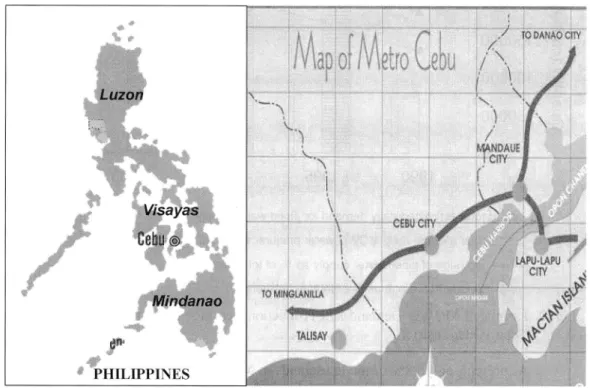
Cebu in Central Visayas is in the center of the Philippines archipelago. Metro Cebu is
composed of three cities (Cebu, Mandaue, and Lapu-lapu) and the six municipalities (Naga,
Minglanilla, Talisay, Cordova, Consolacion, and Lilo-an), Fig 1. There are about 1.5 million
people in Metro Cebu based on the 2000 Census of Population and Housing, within the 544 sq. km of land area. Metro Cebu is considered the second highly urbanized area in the country and the metropolitan center with the highest potential for further economic growth. Metro Cebu has been the commercial and service center of the Visayas and Northern
Mindanao. It has a well-developed linkage (i.e. transportation, communication, and services), making it a magnet for inter- and intra-regional migration.
In contrast to the progressive economic development of Metro Cebu, the state of its water resource management and quality of its water utility services are a serious threat to the various sectors.
Fig. 1. Map of the Philippines and Metro Cebu
Water Source
Cebu Province is supplied by Level III waterworks system with individual household connections and water service, which is extended to two or three adjacent barangays. Water
comes from springs and deep wells. Deep well extract groundwater and pump it directly to the reservoirs. It is distributed to the consumers through the force of gravity and is distributed
Metro Cebu's source of water is a coastal limestone aquifer with an estimated
available water of about 86 million m3 per year, although this is augmented by two small
water catchments or dams (Mananga and Buhisan). This aquifer is under a land surface of 180 square kilometers. As early as 1975, the Metro Cebu Water District (MCWD) was identified to develop and manage water supply and distribution, within the areas of Metro
Cebu. Previous studies1"2 have shown that water supply capacity of the MCWD is not
sufficient for the growing water number of urban population in the metropolis. Even now, with the expansion project (Mananga Phase I) of MCWD to supply easier access of safe water, not all are provided with potable water for individual household connections, as
presented in Fig. 2.3
The constraining factors identified by MCWD to justify its failure to provide water in certain areas of Metro Cebu include: no defined access roads where pipes can be laid out; low
water supply due to scarcity of sources; losses incurred in distribution, which in effect, result
in a low return of investment; and lack of funds for expansion, most especially in areas in elevations higher than the service reservoir.
300000
£
250000
a 200000 a> E 3 150000£
100000
*-> cS
50000
1990 1995 1998 2003^ S total estimated dally demand for piped water supply in Metro Cebu (cu m/day) rzzzi total average daily MCWD water production ( cu m/day)
—•—provision of piped water supply as % of total demand —A—reported coverage as % of total population
Fig. 2. Estimated MCWD Demand and Production, (cu m = cubic meter, MCWD = Metro
Cebu Water District).
At present, only 48% of the households in Metro Cebu is being serviced by MCWD.
Thus, a majority of the households, industrial and commercial firms have to rely on private
wells (either self-supplied or through private waterworks) and private water vendors, as presented in Table 1. Many of those with MCWD connections also have own wells, use vended water or even invest in booster pumps, cisterns and storage tanks to complement the rationed supply of piped water. Vended water may be picked up from any source, usually from a neighbour or maybe delivered by carts, jeeps or large trucks. There are about 447
water providers operating in Cebu City, all of which are classified as small-scale.4 The
presence of these informal water distributors in the city should not be considered a competitor of MCWD, but as providers that complement the services of MCWD.
Table 1. Estimate of urban water consumption by source of supply, 1996, (thousand m3/day)
Household Others
Metro Cebu Water District 47.6 19.5
(24.1)* (23)
Private wells and others 148.1 64.4
(76) (77) Total 195.7 83.9 [70]** [30] Total 67.1 (24) 212.5 (76) 279.6
* Figures in parenthesis are percentage shares of MCWD or other sources to water use
by households or other users
** Figures in brackets are percentage shares of households or other users to total water
use
Note: The total water use is derived based on a conservative assumption about the size of water demand for industrial, commercial and other users.
1000 900 H 800 700
$ 600
3 500 u 8 400 300 200 100 0 1995J Net MCWD supply with Lusaran Dam
•
1*Net MCWD supply without Lusaran Dam
PIDS_1 .
Compostella Wells Mananga Phase I PIDS.2 Mananga Phase H Lusaran- Darn Cebu-Bghol-Phase'l Cebu-Bohol Phase IISustainable private groundwater extraction: 51.8
2000 2005 2010 2015 2020
year
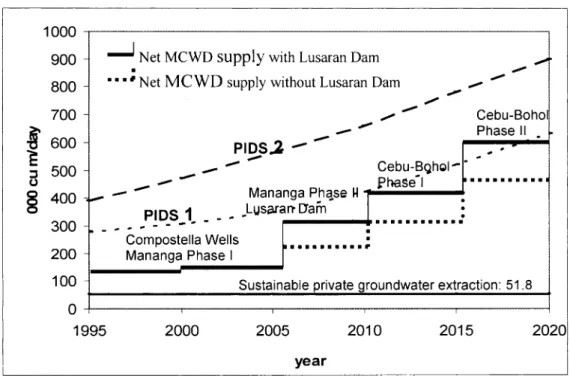
Fig. 3. Projections of water demand and net MCWD supply in Metro Cebu, Philippines
Projected Water Supply-Demand
Two alternative water demands projections (PIDS1 and PIDS2) are made.5 These
projections was estimated by adopting the ratio of industrial and commercial usage to totalwater consumption commonly observed internationally. Assuming a ratio of approximately 50% (PIDS2) for a high estimate is made, and a low estimate of 30% (PIDS1) is also
provided. Figure 3 shows the gap in the demand and supply of water. Through the years until
2020, MCWD will consider different expected water supply projects. The PIDS1 projection shows that groundwater depletion in Metro Cebu can only be controlled temporarily only through the development of all proposed water supply expansion. Based from the JICA
estimate of safe or sustainable ground extraction of 164,000 m3/day, a sustainable extraction
of 52,000 m3/day is allowed.6 Ifthe future demand for water is closer to the PIDS2 projection
and there are no efforts to conserve water, then the supply expansion strategies will fail to meet the water demand and there by control ground water mining.
Water Cost
Table 2. Average cost of water and its distribution in Metro Cebu.
Source % of households Average cost Monthly income
(Philippine Peso/m3)
(per capita)MCWD 33.9 12.0 2503.2 Private waterworks 4.1 12.6 7645.7 Self-supplied Deepwell 15.9 56.5 1370.8 Artesian well 2.4 0.0 1293.4 Public faucets 9.7 14.1 1427.2 Water vendors MCWD water Pick-up 9.2 76.3 1189.0 Hose (container) 1.1 59.8 1696.7 Hose (fixed) * 53.2 1200.0 Delivered * 106.4 750.0 Pick-up (fixed) * 66.5 4000.0 Deepwell Pick-up 2.1 76.3 1189.0 Hose (container) - - -Hose (fixed) - - -Delivered * 132.9 1025.0 Pick-up (fixed) 0 3.4 1100.0 Multi-Sources 21.6
The stumbling blocks faced by most households in urban poor communities of not availing the service from MCWD are the high cost of installing a connection and the requirement of MCWD for a title to the lot upon which the house is built. The second requirement is often the more difficult to secure for three reasons: 1) lot owners are often wary of allowing renters to use their land titles; 2) households are classified as squatters; 3)
lotownership is contested. The high price per m3 is an added constraint.
The tariff set by the informal water providers is comparatively higher than the
MCWD, as shown in Table 2.7 It appears, however, that clients do not see this an issue. The
residents appreciate the fact that theirs is not an economy of scale, and therefore, must necessarily be more costly than MCWD. What is important to the clients, is a safe and potable water which is available for 16-24 hours.
Water Depletion and Seawater Intrusion
MCWD is obtained mainly from groundwater sources. Those areas which are not
reached by the piped connection of MCWD and some manufacturing firms turn to alternative sources which are also primarily groundwater sources. Various estimates of groundwater
abstraction have fallen into the range of 235,000 to 243,000 m3/day. In 1995, the urban water
consumption indicated an estimate of groundwater abstraction of 280,000 to 390,000
m3/day. These estimates indicated that Metro Cebu's groundwater aquifer is rapidly
depleting. Considering the estimated natural recharge rate (a measure of safe or sustainable
groundwater yield) ranges from 130,000 to 160,000 m3/day, which is about half of the above
estimates of groundwater abstraction. The hydraulic balance between groundwater renewal and discharge is strongly disturbed. It is not surprising that saltwater has intruded into the coastal areas and pumping costs have increased as water table has fallen. Salinity profiles
have shown evidence of saltwater intrusion.8
The available data of the Water Resources Center at the University of San Carlos (USC-WRC) confirms the advancing over-salting of ground water in Cebu City region. A study of USC-WRC on the three-dimensional distribution of chloride (salinity) in the coastal aquifer, using the depth-depth measurement of electrical conductivity was conducted on observation wells in Metro Cebu.9 The results of the measurements showed that Mandaue
City has the highest level of chloride content. This effect could be due to saltwater intrusion or over-pumping (saltwater upcoming). This is an industrial city.
In Metro Cebu, groundwater depletion will continue at an accelerated pace as outputs of the more intensive industries increases on water usage, and that groundwater extraction is practically unregulated and unpriced.
Water Pollution Potential
A survey conducted by the PhilippineGerman Project Industrial Pollution Control -Cebu reveals that the electroplating industries in Metro -Cebu are producing toxic and
hazardous wastes.10 These plotters do not have treatment and storage facilities and are
discharging their wastes in nearby rivers and canals. This observation on the electroplating industry may well describe the situation for most industries in Metro Cebu which are without or improper wastewater treatment plants and are conveniently discharging to rivers. According to the Department of Environment and Natural Resources (DENR) classification, about 80% of the manufacturing firms are considered pollutive potentials. DENR data also show that generally the more water intensive industries are also the ones which are potentially pollutive.
Domestic wastes are also indiscriminately thrown into rivers. Health damages attributable to polluted water include incidence of water-related diseases like diarrhea, hepatitis, poliomyelitis and schistomiasis while non-health damages include decreases in fish yields due to siltation of coral reefs and increase nitrogen and phosphate on inland waters. It
is presumed that human health and non-health damages from water pollution11"12 are caused
by industrial and domestic pollution.Why Water Security?
Water security is defined as having adequate domestic water supplied so that
livelihood of rural people will not be unnecessarily burdened.13 Lack of water security results
in community losses in terms of productive time because of time spent and effort spent in water collection activities alone. The lack of water security imposes heavy burden on women and children who are the primary collectors of water. It contributes to the reproductive work burden of women and consumes a large portion of the playtime of children. It also limits the
alternative livelihood options of the communities affected thus contributing to the causes of poverty. It also imposed threat to community health. Low water security also affects the country's objective in maintaining food security and self-sufficiency because it is impossible to attain food security without water security. Therefore, increasing the water security of coastal communities would result not just in access to safe water but also in freed time for other activities. Available water would also expand the options for alternative livelihood and would improve the sanitation conditions in the communities.
Sustainability of Water Resources
There is enough water supply but mismanagement of resources is the real cause of the crises. Enough water supply is available in the neighbouring towns (in Naga, Danao, Asturias
and Pinamungajan) of Metro Cebu15, to meet the daily demand of the growing population in
Cebu province. But the resources are not fully tapped that there exists a deficit of daily water supply.In response to the feared future water crises, some of the river basins have been constructed with series of mini dams to retain water. DENR will also have community-based
reforestation projects for Cebu province. A foreign-assisted program jointly funded by the
governments of Australia and the Philippines is presently providing water to the unserved population. In municipalities with rapid growth in urban population, expansion of water facilities shall be provided.
Awareness, support and participation of public for nongovernmental organization
(NGO) participation in environmental matters are increasing. Some of the key NGOs in Metro Cebu of industrial and urban management, with programs in water sector campaigning
are Aboitiz Foundation, Cebu - Partners Committed to Environmental and Economic
Management, Inc., and Cebu Unitingfor Sustainable Water. Citizens must participate in
water policy and programs ... to get rid of all these associated problems ... water scarcity. El Nino warnings, spreading of pollution and emerging of new epidemic threats.
The sustainability of water for Metro Cebu is linked to the integrity of the Central Watershed areas and Coastal aquifers, which is the primary source of freshwater. There is seawater intrusion and water tables are declining due to over-extraction of water from underground and denudation of the forest canopy whose roots contribute much to the water
table levels. The local and national government must craft a water policy program. Such a
policy would price water at its economic value. Curb theft from illegal connections and weld fragmented agencies into a coordinated structure. There should also be an implementation of proper waste management and riverbank stabilization to maintain the freshwater supply in the
metropolis. Still, the basic and best way to manage water resources is to conserve and plant
trees that will restore these. Everyone has a watershed address. The sustainability of water
resources depends on proper governance, which can be achieved through integrated water
resources management.
Future Issues
Groundwater Depletion
The National Water Resources Board (NWRB) is vested the power to regulate water use. Technically, groundwater extraction has to have a water permit. This task is just too difficult for NWRB present capability's to implement properly. Groundwater extraction is practically unregulated and unpriced. It is high time for the government to empower this agency to enable it properly perform its functions especially the regulation on water usage.
With raw water from own wells being practically unpriced and pollution regulation
primarily based on the limits of concentration and in the absence of any restriction on the volume of wastewater, dilution will be practiced. This activity would put more pressure on
the groundwater resource by accelerating further groundwater mining and depletion. Thus, pricing of raw water should be done together with the charging of effluent fees.
Firms' wasteful use of water and uncontrolled discharge of untreated or partially
treated effluents will continue to result in industrial pollution and groundwater mining.
Experiences in other developing countries shows that regulatory policies and economic incentives can bring about reductions in withdrawal for industrial water, and can
consequently result in substantial reduction in water pollution.14 This points to the need to
explore more efficient and effective technologies for reusing and recycling water suited to Philippine industries.
Investments in environment-saving innovations, incentive to conserve the resource and adopt water saving technologies be made.
There is also a need for a massive information campaign to promote awareness and more informed decision-making among groundwater users and potential users.
Weak Government Policies
Existing regulations and policies are at present inadequate, have limited coverage and need to adjust to adopt to current developments as water resources become more scarce and deterioration of water quality is experienced.
The industrial pollution problem can be characterized by the absence of clear and legally binding rules, limited institutional capacity, lack of appropriate equipment and trained personnel, and inadequate information on the industries to be regulation, and appropriate quality standards. There is a need for realistic and feasible standards which take into account available technology and economic viability of industries.
Industrial Water Pollution
Available studies have shown that discharges responds to prices of water. There is a
scope of using prices in conjunction with direct effluent charges and standards in reducing
pollution from industries. In case of self-supplied firms, government may come up with a
price for the resource and a mechanism for collecting this revenue. David et al (1998)2
recommend a raw water discharge which is equal to the opportunity cost of water and/or environmental cost of water extraction from groundwater sources not only for the self-supplied water users but also for the water utilities in Metro Cebu to prevent further depletion of the aquifers. She further recommends that sewerage fees be collected from MCWD customers and self-supplied waters users in Metro Cebu to cover the cost of an effective regulatory and sewerage disposal system. Taxation of effluents from industrial firms should be pursued.
MCWD
For MCWD3, their key issues for the future are: The installation charges make it
difficult for the poor to access pipe water. The availability of an instalment payment scheme,
designed to reduce the immediate burden, has not been a sufficient incentive for the poor to obtain an individual connection. Perhaps, MCWD could consider bringing the meters closer to the houses in poor neighbourhoods, rather than passing on the cost of pipes to those
c o n s u m e r s .
Well fields are threatened by increased salinity and pollution by infiltration of untreated wastewater. Well fields could also be prone to high risk of groundwater contamination if proper care is not taken. With the high infiltration capacity of the riverbeds, the risk of contaminating the wells is also high. The need to regularly remove sediments will add to this risk of destroying the surface layer. Thus, proper protection of the water supply
and water quality monitoring need to be priorities for MCWD and the local government. It is
important to prepare a plan for maintaining the infiltration basin water quality.
Wastewater treatment has been inadequately explored by MCWD. Provisions of water supply services could aggravate poor sanitary conditions. Larger volumes of water discharged may cause stagnant water and increase health risks, especially in flat areas with poor drainage along the coast. Consequently, proper disposal of wastewater should be a priority of MCWD and the local government.
MCWD lists general monitoring requirements with respect to watershed management, drinking water standards, and mitigation of construction-related impacts. For long-term plans for pro-active watershed management, MCWD should seek cooperation from NWRB and NGOs. MCWD should get required attention and support of the various national government agencies in managing the watershed and developing future water sources.
Informal Water Providers
These water providers need to improve the quality of water distributed and increase capital investments to enable to reach out to more clients and operate the system effectively as well.
These small scale water providers need to be recognized positively by the Local Government, in that they are attuned to local needs and respond more readily to clients needs and motivated primarily to contribute to the well-being of the entire community.
References
1. Japan International Cooperation Agency (JICA)/Regional Development Council VII (1994). The Study on the Integrated Area Development Master Plan (CIADMP), July
1994.
2. David, CC, Inocencio AB, Largo FM, and Walag, EL (1998). The Case of Policy and
Institutional Reforms in Metro Cebu. PIDS-DENR, Paper presented at the Workshop on
Urban Water Issues in Metro Cebu, Cebu City, June 1998.
3. Asian Development Bank (2002). Project Performance Audit Report on the Metro Cebu
WaterSupply Project in the Philippines. December 2002.
4. Amadora-Nolasco, F (2003). Small-Scale Water Providers in Cebu City, The Philippines, A Report for Asian Development Bank (TA 6031), Draft Copy February 2003.
5. David, CC and Inocencio, A (1999). Policy and Institutional Reforms in Metro Cebu's
WaterResource Management, Development Research News, November-December 1999,
pp. 4-7,13-16.
6. Japan International Cooperation Agency (JICA) (1998). Masterplan Study on Water
Resources Management in the Republic of the Philippines. Progress Report (2). Manila:
JICA, National Water Resources Board (NWRB) and Department of Public Works and Highways (DPWH).
7. Largo, F, Inocencio A and David C (1998). UnderstandingHousehold Water Demand for
Metro Cebu. PIDS Discussion Paper 98-38. Makati City: Philippine Institute for
Development Studies.
8. World Bank (1993). Philippines Environmental Sector Study: Towards Improved Envoronmental Policies and Management. Industry and Energy Division, Country
Department I. East Asia and Pacific Region (December 8). 9. (http://www.tu-harburg.de/-wwvos/Fieldwork e.htm#top
10. Philippine-German Project Industrial Pollution Control-Cebu (1993). A Compilation of
Surveys on Waste Generators of Metro Cebu. Department of Environment and Natural
11. Bennagen EC, and Research staff (1996). ENRAP Sectoral and Regional Studies on
Pollution (Integrative Report), Vol. Ill: Sectoral Study 1, Philippine Environmental and
Natural Resources Accounting Project (ENRAP Phase III). 1996.
12. Mercado JL (2003). Philippines: Cebus lakes thirst with zero-sum water games.
ABS-CBN News, Cebu, Philippines (May 6).
13. Tambuyog Development Center (2003). Sustainable Water Area Management Project:
Preliminary Assessment of Water Resources in Selected Coastal Communities in the
Philippines. Philippines, or http://swamp.tambuyog.org
14. Bhatia, R (1997). Economics of Water Demand Management: Use of Water Prices and
Effluent Charges to Encourage Conservation and Improve Water Quality, Paper
presented at the Workshop on Water Demand Management organized by the Water Supply and Sanitation Collaborative Council at Oslo (April 28-30).
15. Calipayan MP (2003). Cebu's mismanaged water supply spawns water crises. The
Freeman, Cebu, Philippines (Aug. 21).
Symposium
Island of the World VIII; Changing Islands- Changing Worlds
The international symposium was held at Kinmen Island, Taiwan, R.O.C., during the
period of November 1-7, 2004. There were 250 participants from more than 20 countries. After the welcome address delivered by Mr. Chu-Feng Lee, Magistrate of Kinmen County followed by opening address given by Dr. Grant McCall, President of International Small Islands Studies Association, 150 reports were presented in five themes; Islands in a changing
world, Islands and environmental concerns, Islands and social concerns, Economic
perspectives for island societies, and Culture, history and literature on changing islands. All Japanese research staffs of Research Center for the Pacific Islands, Kagoshima University, attended the meeting. Mr. Nagashima, Dr. Kawai and Dr. Hidaka presented the papers entitled 'Governance for, of and by the islander toward lifenomic civilization - A comprehensive model for island sustainability and development under the trend of globalization', 'Beach litter in Amami Islands, Japan' and 'Tropical and subtropical fruits crops in Ryukyu Islands of Japan', respectively.
Symposium on Promotion of'Island Campus' in Kagoshima
The symposium was held at Nishino-omote, Tanegashima Island, Kagoshima Prefecture at 19 January 2005 for using islands as extension campuses of institutions of higher education. Activities including such as extension lectures and forums for people living in islands may contribute to the prosperity of island societies. The symposium was also
broadcasted through internet.
Research Seminars Research Seminar No.47 (1 March 2004)
Ecology of Tropical Rainforest: Stand Dynamics during the last 25 years Yoneda Tsuyoshi (Faculty of Agriculture, Kagoshima University)
Landscape in a forest area has largely changed under the Suharto regime. We could often see the scenario that selective logging area transferred to the oil palm plantation in
Sumatra. Depleted forest can be a target of the site of Aforestation/Reforestation CDM program under Kyoto Protocol through rough logging of remained trees. Hereby, we can say
that the last 25 years was so harmful period for a forest, though it would be only tiny time for an emergent tree with long-life cycle. It looks that unfairness in income tends to increase. Forest management system in Indonesia would retrograde under the new policy of decentralization system policy. Recent human and natural impacts on tropical rain forest was lectured.
Research Seminar No.48 (15 March 2004)
Biodiversity and its Conservation in the Galapagos Islands
Itow Syuzo (Professor Emeritus, Nagasaki University)
The biota of the Galapagos Islands is disharmonic and abounds with endemic taxa, due to geographically remote isolation from the continental source area. The southeast trade wind casts rain on vegetative zonation, bringing much more moisture to the windward side of islands than to the leeward side.
The concept of biodiversity comprises two aspects: systematic diversity and ecological diversity. The systematic diversity is conceived by inter-island speciation and speciation along the vegetation zones. The ecological diversity comprises two aspects: species diversity of biotic community (Alpha diversity in Whittaker's terminology) and species turnover between communities (Beta diversity). The alpha diversity is strikingly low due to disharmonic constitution of the flora. The beta diversity is higher in the windward side of island than in the leeward side.
A tree-like species of Scalesia (Compositae) has evolved in the humid mid-elevations, and its monospecific forest dies back synchronously in stand-level at its maturity and a new cohort starts again to built the next generation. Such a recruiting pattern is a self-cyclic, or buildup-and-collapse, succession, which is unique to remote oceanic islands. A part of ecosystems of the islands are threatened by intentionally introduced mammals like goats and donkeys and by accidentally introduced animal and plants. Since their inaugurations in 1964 and 1968, the Charles Darwin Research Station and the National Park Service have been cooperatively struggling for the conservation of indigenous biota and ecosystems.
Research Seminar No.49 (12 April 2004)
A Novel PrPSC-Protease Produced by Streptomyces sp.
Oka Tatsuzo (Faculty of Agriculture, Kagoshima University)
We have isolated and characterized a perchloric acid soluble protein (PSP) from the cytosolic fraction of rat liver (RL-PSP). The cDNA sequences of PSP from mammals show a high similarity to members of a new hypothetical family (YER057c/YJGF family) of small proteins whose function is presently unknown. The high degree of evolutionary conservation of these proteins may reflect an involvement in basic cellular regulation. Furthermore, we have crystallized a RL-PSP and determined the structure of PSP protein. A monomer structure of the PSP consist of 2 a-helices and 6 b-sheets. Interestingly the structure of the PSP looks like to the structure of PrPSC which consist of 2 a-helices and 4 b-sheets. Furthermore, the chemical characters of the PSP , which are the heat-stability and the proteinase-K resistance, were same to that of PrPSC. These results at least demonstrate that PSP can become a model protein of as a substrate of PrPSC-protease. In this study, we screened the microbial to obtain the PrPSC-protease. As a result, the streptomyces SP which excrete the PrPSC-protease was isolated and the PrPSC-protease was isolated and characterized.
Research Seminar No.50 (24 May 2004)
Modelling Poverty Dimensions of Fiji's Urban Informal Sector Operators
Mahendra Reddy (RCPI, Kagoshima University)
Growing poverty is a cause of concern for international, regional and local
organizations and policy makers. The growth of the urban informal sector resulting from the urbanization process has also contributed to the rise in urban poverty. The rise in urban informal economy has both beneficial and detrimental effects on the urban formal economy. It has been argued that the urban informal sector plays an important role in poverty alleviation though stark cases of poverty are evident in the urban informal sector. This duality
needs to be examined in light of the socio economic factors of the urban informal population. This study utilizes primary data from two cities and a town to examine the contribution of the
urban informal sector to employment creation and poverty alleviation. The findings reveal a significant positive contribution of the informal sector towards poverty alleviation and income generation. The data is further utilized to examine the household specific factors
affecting poverty in the informal sector.
Research Seminar No.51 (21 June 2004)
Seasonal Changes in Plankton Biomass, Production and Community Structure in
Kuroshio
Kobari Toru (Faculty of Fisheries, Kagoshima University)
It has been recognized that ecological efficiency is largely changed by structure of food web. Available resources decrease at higher trophic animals because consuming energies increase with a number of trophic levels. There are many previous studies on plankton food web in the productive marine ecosystems where large-sized plankton was predominated. However, we have little knowledge on plankton food web in the subtropical
waters where small-sized plankton is predominated. In this seminar, I would like to show
properties of plankton food web in subtropical waters, from the seasonal changes in plankton biomass, production and community structure in Kuroshio. In Kuroshio, bacteria, autotrophic nano-flagellate (ANF) and copepods are predominated among plankton biomass throughout the year, although no seasonal pattern was observed. ANF contributed to daily phytoplankton production with no clear seasonal patterns, and bacteria and heterotrophic nano-flagellate (HNF) to daily zooplankton production increasing during summer. Annual
phytoplankton and zooplankton production was estimated to be 177.0 and 244.3 gC m"2 year"1
(in 0-50 m), respectively. Considering with bacteria transforming from dissolved to particle
organic carbon, bacteria production (135.8 gC m"2 year"1) and phytoplankton production (i.e.
312.8 gC m" year"1) are available for zooplankton. In subtropical waters around Kuroshio,
energy flow mediated by nanoplankton might be important.
Research Seminar No. 52 (Islands Forum) (10 July 2004)
'Symbiosis' of Human Being and Nature in South Pacific
Traditional societies keep "symbiosis of nature and the human being". Natural products are consumed but remain in a sustainable state and the environment stays relatively
unaffected. However, modern societies have broken the balance between nature and mankind,
which has induced environmental pollution and decreased biodiversity in the natural
environment.
The South Pacific Islands are surrounded by sea; therefore, marine tourism is a very important industry for each country. For example, the Republic of Fiji Islands is one of the most famous sightseeing places. To make the marine tourism more attractive, many coastal sites were developed. This development may have decreased the biodiversity in the coastal
area. However, despite the increased development, many villages on the coast retain a
self-sufficient society and a common land sharing system in Fiji Islands. This means that they
keep their traditional social systems. Therefore, the "symbiosis of nature and the human
being" is retained. On the other hand, the South Pacific Island countries are characterized by
their small size, close proximity, and remoteness. These characteristics have kept industrial capitals from investing in the region. Furthermore, frequent natural disasters such as cyclones
lead to a relatively high transaction cost for the capitals. Hence, the region was not able to attract foreign capital fully which is opposite to the Southeast Asian countries whose economic structures were greatly influenced by direct foreign investment. The situation has
left the local people the opportunity to control their own economic and environmental
structure. We believe that one can study the coexistence of man and nature by examining the
way of life in the region from an interdisciplinary approach.
To better understand how to achieve sustainable development, we should look at
traditional society in the South Pacific Islands and its affects on the environment. 1. Agriculture and the Economies of Pacific Islands: Trends, Issues and Challenges.
Mahendra Reddy (Pacific Institute of Advanced Studies in Development and Governance, University of the South Pacific; Research Center for the Pacific Islands, Kagoshima University)
2. Deep-sea Mineral Potential in the South Pacific Region -Review of the Japan/SOPAC
Deep-sea Mineral Resources Study
Programme-Okamoto Nobuyuki (Japan Oil, Gas and Metals National Corporation, JOGMEC)
3. Palau: Reflections of a Volunteer Entomologist
Takahashi Keiichi (Ex-consultant of the Bureau of Agriculture, Palau)
Research Seminar No. 53 (27 September 2004)
Determination of Organohalogens in Water
Concepcion S. Mendoza (RCPI, Kagoshima University; University of San Carlos, Philippines) The halogen specific-parameters AOC1, AOBr and AOI in water can be determined by combining the standard AOX procedure (AOXDIN) with off-line ion chromatography (IC) or inductively coupled plasma spectrophotometry (ICP-MS) detection of the combustion products (C1-, Br-, and I-) recovered from the AOX analyzer. The IC and ICP-MS methods gave good results with model systems. With IC, the minimum detectable concentrations are near 0.1 mg/L for CI- and Br-, and 5.0 mg/L for I-, while the ICP-MS method, the minimum
detectable concentration is 0.0001 mg/L for C1-, Br- and I-. Quantitative recoveries of the
organic CI, Br, and I from different standard mixtures were obtained using the IC and ICP-MS methods. A good agreement between the conventional AOXDIN and the described AOXIC or ICP-MS was found. This new approach to the AOX classification gives useful information on the composition of the AOX pool and is a promising basis or further isolation and identification studies. Further improvement of the adsorption techniques and the ICP-MS
methods are needed to be able to classify the AOX from samples having low AOX concentrations.
Research Seminar No.54, 18 October 2004
Research on Polyphenols of Tea and its Future
Hashimoto Humio (Faculty of Agriculture, Kagoshima University)
Research Seminar No.55, 22 November 2004
Malaria Control Project in Vanuatu: From Cultural Anthropological Perspective
Shirakawa Chihiro (Faculty of Humanities, Niigata University)
Vanuatu is an island country with some 200,000 population, located approximately 2,500 kilometers north-east of Australian continent. The country is also located on the eastern
edge of the world's malaria distribution area, and the problem of the disease continues to be one of the major health issues among the people. Vanuatu consists of some 80 islands. Due to
this geographical condition, there are numbers of areas that are hard to access. It is therefore difficult to implement large-scale "top-down" malaria control activities. Instead of such activities, the government has been promoting the activities based on the community participation. Under this policy, the malaria control project using insecticide-impregnated mosquito nets has been conducted since 1991. My presentation will focus on the project, and discuss about its problems from cultural anthropological perspective.
Research Seminar No.56, 13 December 2004
Analyzing Actual State of Stress and Determining Affective Stressors in Agricultural Workers
Ueda Atsushi (Faculty of Medical and Pharmaceutical Sciences, Kumamoto University) The collaborative questionnaire survey for analyzing actual state of stress and determining affective stressors in agricultural workers (662 for male and 1084 for female) was carried out. Among those, 48% male and 59% female felt perceived stress, with higher prevalence rates in the younger age group than in elders. Affective stressors were found in factors related to the job demand category by Karasek's psychological work model and related to agricultural work elements and life-events from agricultural management and rural living. The multiple regression analysis using those items indicated the most affective factor for disturbance of Quality of life (QOL) was the perceived stress, and for improvement of QOL social support was essential. According to the results we proposed a comprehensive stress control model for agricultural workers focused on creating a network system to connect various resources of social support in the rural and urban communities.
Research Seminar No.57, 24 January 2005
The Autonomous-government of the Isle of Man, and the Peculiarity of Language Culture
Hara Kiyoshi (Joshibi University of Art and Design)
The Isle of Man located between Ireland and the British Island is a British Royal dependency and does not belong to the United Kingdom (UK). The autonomous government is functioning, having original currency, a mailing system, telephone and gas companies. The Manx language, one of Celtic languages is conserved, serving as a symbol of cultural identity. As a territory of tax haven, it became an active financial center. Although the population is only 71,000, it may be called an entire independent country. It also has cultural vitality. Jersey Island, located in the Channel Islands beside the Normandy Peninsula of France is in the situation similar to the Isle of Man. Probably Ishigaki Island and Miyako Island in Okinawa, are culturally in the similar situation, and an autonomous government like the Isle of Man or Jersey Island may be possible.
Recent Publications
South Pacific Studies Vol. 24 No. 2
Muhammad Ashfaq, Abida Nasreen and Ghulam Mustafa Cheema: Advances in Mass
Rearing of Chrysoperla (Stephen) (Neuroptera: Chrysopidae)
James P. Terry: Shoreline Erosion on a Low Coral Island in Fiji - Causes and Consequences
South Pacific Studies Vol. 25 No. 1
Iwagawa Tetsuo, Eguchi Satoshi, Okamura Hiroaki, Nakatani Munehiro and Hase Tsunao: New Phenylpropanoid Diglycosides from Viburnum furucatum
Tukirin Partomihardjo, Suzuki Eizi and Yukawa Junichi: Development and Distribution of Vascular Epiphytes Communities on the Krakatau Islands, Indonesia
Kinoshita Kisei, Kanagaki Chikara, Iwata Shino, Koyamada Megumi, Goto Kazuhiko, Hidaka Ko-ichi, Andrew Tupper and Iino Naoko: Ground Observation of Volcanic Plumes and High S02 Concentrations at Sakurajima Volcano
Mahendra Reddy: Economic Analysis of Artisanal Fisheries in Fiji: Issues of Profitability and Sustainability
Yukiko Inoue, John Sanchez and Olympia Terral: The Chamorro Adult Male Identity and Development
KAGOSHIMA UNIVERSITY
RESEARCH CENTER FOR THE PACIFIC ISLANDS
APPOINTMENT AVAILABLE
VISITING RESEARCHER
The Research Center for the Pacific Islands aims to promote interdisciplinary studies on islands and islands zones in Oceania and its surroundings. The Center will host one visiting researcher with a distinguished record of publications on some aspect of regional studies of above-stated areas. Once selected, the candidate will be appointed as a visiting professor or associate professor and take the position for three months to
one year.
The candidate should undertake, during the term of their appointment, collaborative research with the staff concerning one of the following themes;
Terrestrial environments,
Organisms and resources in marine environments, Conditions of health, and
History and/or culture studies
As a rule, the applicant should hold a Ph.D. or M.D. degree.
An appointee can be granted a salary and research expenses equivalent to a corresponding staff member of Kagoshima University and round-trip traveling expenses as well as the right to use an office, equipment, library, and other facilities and services.
Detailed inquiries are always welcome and should be addressed to following; Kagoshima University Research Center for the Pacific Islands 1-21-24 Korimoto, Kagoshima 890-8580 Japan
FAX:+81-99-285-6197
E-mail: [email protected] WWW: http://cpi.kagoshima-u.ac.jp/
KAGOSHIMA UNIVERSITY RESEARCH CENTER ejfc«*^*Bffl5Et!>^-FOR THE PACIFIC ISLANDS IMIS^ 890-8580
1-21-24, Korimoto, Kagoshima 890-8580, JAPAN • HE&USBtc 1
TB21#24-§-TEL: +81-99-285-7394 tt IS 099-285-7394 FAX: +81-99-285-6197 UlVV) 099-285-6197 E-mail: [email protected]