Distribution of Vitamin B_12 in Kagoshima Bay
著者
INOUE Akio
journal or
publication title
鹿児島大学水産学部紀要=Memoirs of Faculty of
Fisheries Kagoshima University
volume
28
page range
233-238
別言語のタイトル
鹿児島湾におけるビタミンB12の分布
Mem. Fac. Fish., Kagoshima Univ. Vol. 28 pp. 233-238 (1979)
Distribution of Vitamin B
in Kagoshima Bay
Akio Inoue*
Abstract
Vitamin B12 contents in sea water of Kagoshima Bay were investigated in August and October, 1977. Mean values of 7.52 ng//of vitamin B12 were found in summer samples and 6.53 ng// in autumn samples, respectively. These amounts are almost comparable to those reported in this bay previously. Vitamin B12 showed little change vertically at each station especially below 50 m. Significant differences were
not observed between the contents in samples from inner part of the bay and those
from its outer part.
Introduction
Water soluble vitamins such as vitamin B12, thiamine and biotin have been recognized as essential growth factors for most diatoms and dinoflagellates which dominantly concern with the primary production in the ocean. The po tential significance of these vitamins in nature are already suggested by seve ral investigators1""0. Laboratory cultures also indicated that these three vita mins were required by many phytoplankters alone or in combination. For ex ample, 45 of 58 species in dinoflagellates and 25 of 54 in diatoms have been re ported to require at least one of these vitamins5).
Thus vitamin B12 can not exist independently of the recurrences of red tides in coastal waters, and it might trigger the rapid and abundant propagation of some limited phytoplankton species. There are several reports on the vitamin B12 contents in sea water along the coasts of Japan6~10). The distribution of vi tamin B12 in Kagoshima Bay have also been reported in detail, and the diunal, vertical and horizontal changes were investigated previously. These investiga tions, however, were carried out about 20 years ago, and no surverys have been tried on vitamin Bj2 contents in this bay since this time. Red water by a dino-flagellate, tentatively assigned as Hornellia sp., appeared first time here in June, 1977. As can been seen in such peculiar occurrence, Kagoshima Bay is thought to have received some circumstantial changes during these years. Therefore the author tried again to assay the vitamin B12 contents in the water of Kago shima Bay in order to comprehend present situation and to obtain fundamental
* Laboratory of Marine Botany and Environmental Science, Faculty of Fisheries, Kago
234 Mem. Fac. Fish., Kagoshima Univ. Vol. 28 (1979) knowledge for coming changes.
Method
The collection of sea water samples were carried out in August 4-5 and Oc
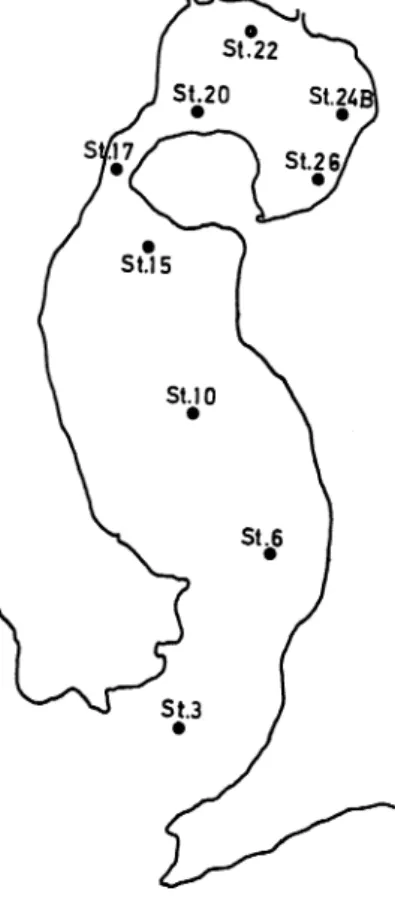
tober 6-7, 1977, at 9 stations in Kagoshima Bay (Fig. 1) during the cruises by Nansei Maru, a research vessel of Kagoshima University. Samples were col lected principally at 5 different depths, namely at surface, 50, 100, 150 and bot
tom at each station by Van Dorn water sampler. The collected samples were passed through Millipore filters (0. 45*) as soon as possible and stored at -20°C
until the time of subsequent analysis. Preceding to analysis, samples were
thawed and dialysed against water, two times each for 6 hrs, which were sub jected to microbiological assays on vitamin B12 by Lactobacillus leichmanii ATCC
7830.
Inoue: Vitamin BJ2 in Kagoshima Bay 235
Results
The results obtained in August, 1977 are given in Fig. 2. There were found a wide range of vitamin B12 contents, from 0 (not detected) to 28.73 ng// throughout the samples collected, but most of them fell between 5 and 10 ng//. The mean value of all samples analysed was 7. 52 ng//which was higher than
Q. Q
B12
ng/l 10 20 30 m 50\
Depth
V St.20
200-Q. Q m\
50->
100-V st.io
150-\
200-i >B12
ng/l 20 30B12
ng/l 10 20 30236 Mem. Fac. Fish., Kagoshima Univ. Vol. 28 (1979)
those of Seto Inland Sea7"" and practically the same with those reported in Kagoshima Bay before11'. Abundant contents more than 20 ng//were recognized
in the samples from 10 m at St. 15 and 24 B, and the lowest undetectable amount, to the contrary, was also found in the same depth at St. 10. These
two extremely different results at the same depth, where primary production by phytoplanktons were estimated to be active at the time of the year, were not
B12
ng/l
10 20 30 m 50-{
Depth
S
8
\
St. 20
200-B12
ng/l 10 20 30B12
ng/l
10 20 30Inoue: Vitamin Bi2 in Kagoshima Bay 237
yet elucidated.
The results in October are also shown in Fig. 3. Averaged value of all sam ples is 6.53 ng/l which is almost equivalent to the one obtained in August. The largest quantity of vitamin B12, 32.17 ng//, was observed at 10 m of St. 17, and except this abnormal value the contents at other stations were nearly the same with little differences with depth. Significant differences were not recog nized between the contents at each depth of inner part stations of the bay and those of the outer part.
Discussion
Many microorganisms have been adopted in the measurements of vitamin B12 in water. Each assay organism reacts with cyanocobalamin or its analogues in different way12). The values obtained in the present study may be regarded to
show the contents of vitamin Bu (cyanocobalamin) itself, because the employed
test organism (L. leichmanii) is specifically responsible to vitamin B12 and its li mited analogues. Therefore vitamin B12 concentrations in oceanic and coastal waters reported until now can not be compared and discussed without taking any considerations. Droop, however, reported that the concentrations of vita min B12 analogues are far lower than that of vitamin B12 itself in oceanic wa
ters1". If this is also the case with the sea water of Kagoshima Bay, it can be
said the vitamin B12 contents in this bay stayed almost constant during this 20 years.
As pointed out already, vitamin B12 contents in sea water fluctuate seasonally
and change even during a day. Menzel and Spaeth, for example, showed that
vitamin B12 concentrations in Sargasso Sea changed seasonally and auxotrophic
diatoms appeared in significant number when vitamin Bi2 was found rich14). As
far as two surverys carried out here concern, vitamin B12 in Kagoshima Bay
distributed rather evenly, and it is not probable that this vitamin should be a limiting factor to the fluctuations and occurrences of red waters. However, more frequent and detailed investigations are needed before obtaining some
conclusions.
According to Guillard15), marine diatoms could be propagated to 0.13-0.48 x 10s cells by 1 uug of vitamin B12. Droop also reported the same dose of vitamin B12 could sustain 2. 5xl05 cells of Skeletonema costatum or 8xl05 cells of Monochrysis
lutheri16). When l^g of vitamin B12 is postulated to have the ability to grow
10s cells of phytoplankters, the mean contents of 6-7 ng/l in Kagoshima Bay
correspond to the concentrations to grow them to population densities of near ly 107 cells/ml.Acknowledgements
238 Mem. Fac. Fish., Kagoshima Univ. Vol. 28 (1979)
collecting samples.
References
1) Parker, M. (1977) : Limnol. Oceanog., 22, 527-538. 2) Ohwada, K. (1972) : Mar. Chem., 1, 61-73.
3) Vishniac, H. S. and G. A. Riley (1961): Limnol. Oceanog., 6, 36-41.
4) Kashiwada, K., A. Kanazawa and S/Tachibanazono(1964) : Mem. Fac. Fish. Kago
shima Univ., 12, 153-157.
5) Iwasaki, H. (1968) : Aquaculture, 16, 171-177.
6) Kashiwada, K., A. Kanazawa and I. Sasaki (1964): Mem. Fac. Fish. Kagoshima Univ., 13, 52-57.
7) Inoue, A., H. Koyama and S. Asakawa (1973) : J. Fac. Fish. Anim. Husb., Hiroshima Univ., 12, 13-20.
8) Fujisawa, K. and Y. Miyake (1975): Bull. Fish. Exp. St. Okayama Pref., 31-36 9) Fujisawa, K., Y. Miyake and K. Ukida (1973): Ibid, 59-64.
10) Nishijima, T. and Y. Hata (1977) : Bull. Jap. Soc. Sci. Fish., 43, 1403-1410.
11) KXshiwada, K., D. Kakimoto and K. Kawagoe (1957): Ibid, 23, 450-453.
12) Kamikubo, T. (1956) : Vitamin, 11, 642-646.
13) Droop, M. R. (1955): J. Mar. Biol. Ass. U. K., 34, 229-231.
14) Menzel, D. W. and J. W. Spaeth (1962): Limnol. Oceanog., 7, 151-154.
15) Guillard, R. R. L. (1963): Limnol. Oceanog., 8, 161-165. 16) Droop, M. R. (1954): Nature, 520-521.