Delimitation of a QTL region controlling cold
tolerance at booting stage of a cultivar,
'Lijiangxintuanheigu', in rice, Oryza sativa
L.
著者
Shirasawa S., Endo T., Nakagomi K., Yamaguchi
M., Nishio T.
journal or
publication title
Theoretical and Applied Genetics
volume
124
number
5
page range
937-946
year
2012-03-01
URL
http://hdl.handle.net/10097/60999
doi: 10.1007/s00122-011-1758-6
- 1 -
Published in Theor Appl Genet (2012) 124: 937-946 Postprint; The final publication is available at Springer via
http://dx.doi.org/10.1007/s00122-011-1758-6
Delimitation of a QTL region controlling cold tolerance at booting
stage of a cultivar, ‘Lijiangxintuanheigu’, in rice, Oryza sativa L.
S. Shirasawa
1, T. Endo
2, K. Nakagomi
2, M. Yamaguchi
2, T. Nishio
1*1. Graduate School of Agricultural Science, Tohoku University, 1-1 Tsutsumidori-Amamiyamachi, Aoba-ku, Sendai 981-8555, Japan 2. Daisen Research Station, National Agricultural Research Center for Tohoku Region,
3 Shimo-furumichi, Yotsuya, Daisen, Akita 014-0102, Japan * Corresponding author
Abstract
Low temperature at the booting stage of rice causes male sterility resulting in severe yield loss. Cold tolerance has long been an important objective in rice breeding. We identified a QTL for cold tolerance on the long arm of chromosome 3 from the cold-tolerant breeding line ‘Ukei 840’ by using F2 and BC1F2 populations from crosses between ‘Ukei 840’ and ‘Hitomebore’.
The cold tolerance of ‘Ukei 840’ is derived from the Chinese cultivar ‘Lijiangxintuanheigu’. The effect of this QTL on cold tolerance was confirmed by developing ‘Hitomebore’ chromosome segment substitution lines having ‘Lijiangxintuanheigu’ alleles on chromosome 3. By producing recombinants in chromosome 3, the QTL region for cold tolerance was delimited to the region of about 1.2-Mb region between RM3719 and RM7000. All lines heterozygous for the QTL showed seed fertilities as low as that of ‘Hitomebore’, suggesting that the ‘Lijiangxintuanheigu’ allele for cold tolerance in the QTL region is recessive. Determination of a 1.2-Mb nucleotide sequence of ‘Ukei 840’ and comparison with the published genomic sequence of ‘Nipponbare’ showed 254 SNPs, of which 11 were in coding regions of genes, seven in five genes being non-synonymous. SNPs were detected in the 5-kb upstream regions of 89 genes, but no differences of gene expression levels were detected between alleles of these genes. Although further delimitation is required to identify the gene responsible for cold tolerance of ‘Lijiangxintuanheigu’, SNP markers developed here will be useful for marker-assisted selection in a breeding program using ‘Lijiangxintuanheigu’ as a donor of cold tolerance.
Keywords: SNP markers, marker assisted selection, seed fertility, rice breeding
Introduction
High temperature is required for normal development of pollen grains at the booting stage in rice. Low temperature, lower than 19˚C, during the period of microspore development causes male sterility, resulting in severe loss of yield (Satake and Hayase 1970). Such damage to gamete development by low temperature is observed only in male organs, while development of female organs is normal (Hayase et al. 1969). In the northern region of Japan and some countries in the temperate zone where the temperature is not consistently high enough for rice production, rice yield is reduced dramatically once every several years. Thus, rice cultivars with high tolerance to low-temperature stress at the booting stage are required for stable rice production in such regions.
In the development of pollen grains, the callose wall, which covers haploid cells of a tetrad, is digested by callase secreted by the tapetum. The haploid cells are released as microspores, and mitotic divisions occur twice in the microspores during development to mature pollen grains. Simultaneously, tapetal cells are degraded. Under low temperature, the tapetal cells expand abnormally, and anther locules are invaded (Nishiyama 1970). A decrease of inorganic phosphate, an increase of nonreducing sugar (Ito 1978), and a decrease of acid phosphatase activity (Nishiyama 1978) have been observed in anthers of rice under low temperature, suggesting that abnormal sugar metabolism causes expansion of the tapetal cells due to a change of osmotic pressure and results in abnormality of pollen development.
Rice breeding for cold tolerance has long been performed in
Japan. A deep-water irrigation system using cold water with controlled temperature has been developed as a reliable screening method for cold tolerance and is widely used for development of cold-tolerant cultivars (Matsunaga 2005). ‘Koshihikari’ has been identified as a highly cold-tolerant cultivar, but its flowering time is too late for cultivation in the northern region of Japan. Therefore, ‘Hitomebore’, which has high tolerance and an early flowering trait, has been developed by crossing ‘Koshihikari’ with ‘Hatsuboshi’ (Sasaki 2005). ‘Hitomebore’ shows high seed fertility, more than 70%, after cultivation in the deep-water irrigation system with cold water controlled at 19˚C. However, even these cold-tolerant cultivars exhibit low seed fertilities, less than 50%, under cold-deep-water irrigation of 18.5˚C. Thus, further improvement of cold tolerance is required.
Cold tolerance of rice at the booting stage is a quantitative trait controlled by multiple genes. Since it is difficult to combine many genes responsible for cold tolerance by investigating plant phenotypes, identifying each gene, and combining the genes by marker-assisted selection are considered to be effective means of developing cold-tolerant cultivars. Since there is a large variation of cold tolerance in rice cultivars (Toriyama and Futsuhara 1960), quantitative trait locus (QTL) analyses using various cultivars have been carried out. ‘Silewah’ and ‘Padi Labou Alumbis’, which have been identified as highly cold-tolerant cultivars by a Japan-China cooperative project for rice genetic resources in Yunnan Province of China (International Rice Research Institute 1977), have been used as parents for developing ‘Norin PL8’ and ‘Norin PL11’, respectively. QTLs for cold tolerance of ‘Norin PL8’ have been
on chromosome 3 and 4 (Saito et al. 1995, 2001, 2004), and that of ‘Norin PL11’ has been mapped on chromosome 8 (Kuroki et al. 2007). The QTL on chromosome 4 derived from ‘Silewah’ has been delimited to a 56-kb region, and a gene encoding F-box protein among seven genes in this region has been suggested to be the gene responsible for cold tolerance (Saito et al. 2004; 2010). QTLs for cold tolerance of the Japanese leading cultivar ‘Koshihikari’ have been found on chromosomes 1, 7, and 11 (Takeuchi et al. 2001), and those of ‘Kunmingxiaobaigu’ have been detected on chromosomes 3, 6, and 7 (Dai et al. 2004). The presence of many different QTLs in different rice cultivars suggests a complicated mechanism of cold tolerance controlled by many genes. ‘Lijiangxintuanheigu’ (‘LTH’ hereafter), a local variety of Yunnan province in China, has been reported to be one of the most cold-tolerant cultivars among 148 cultivars (Horisue et al. 1988). Recently, Ye et al. (2010) have detected one QTL for cold-tolerance at the booting stage of ‘Lijiangheigu’, which has a name similar to ‘LTH’, on the short arm of chromosome 10. Investigating the effects of low temperature at the booting stage on pollen development in a leading cultivar in Australia, ‘Doongara’, and the highly cold-tolerant cultivar ‘R31’, Oliver et al. (2005) have revealed that sucrose content increases in the anthers and that starch does not accumulate in the pollen grains of ‘Doongara’, while sucrose does not accumulate in anthers having fertile pollen grains in ‘R31’ and that expression of a gene encoding cell-wall-bound acid invertase, which has an important role in transport of sucrose to sink tissues, is suppressed in ‘Doongara’ but is high in ‘R31’. An increase in the level of abscisic acid (ABA) has been observed in ‘Doongara’ treated by low temperature, while not in similarly treated ‘R31’ (Oliver et al. 2007). Treatment of ‘Doongara’ with ABA has been found to result in a change of expression of an invertase gene and in male-sterility similar to that caused by low temperature. ABA has been suggested to function as a signaling molecule participating in male-sterility due to low-temperature stress by controlling the transport pathway of sugar (Oliver et al. 2007). ‘LTH’ is a useful breeding material for further improvement of cold tolerance in the present cold-tolerant cultivars such as ‘Hitomebore’. Analysis using progeny plants from a cross between ‘LTH’ and ‘Hitomebore’ may enable identification of genes for cold-tolerance. However, ‘LTH’ is tall, which makes it difficult to treat plants with cold water by the deep-water irrigation system. The height of ‘Ukei 840’, which is a cold-tolerant line selected from BC1F6
progeny plants between ‘LTH’ as a donor parent and ‘Hitomebore’ as a recurrent parent (Fig. 1), is as great as that of ‘Hitomebore’. In the present study, we analyzed QTLs for cold-tolerance using progeny from a cross between ‘Ukei 840’ and ‘Hitomebore’, and delimited the QTL region for identification of a candidate gene responsible for cold tolerance
.
Materials and methods
Plant materials and isolation of DNA
‘Lijiangxintuanheigu’ (‘LTH’), ‘Hitomebore’, and ‘Ukei 840’,
Fig.1 Lineage of ‘Ukei 840’ and progeny population used for
analysis of a QTL for cold tolerance
which was later renamed ‘Ouu PL4’, were used for developing DNA markers and evaluation of seed fertility after low temperature treatment. The F2 population of 192 individuals
between ‘Ukei 840’ and ‘Hitomebore’, which are BC2F2 plants
from a cross between ‘LTH’ as a donor parent and ‘Hitomebore’ as a recurrent parent (Fig. 1), were used for analysis of QTL for cold tolerance at the booting stage in 2005. For reevaluation of QTL for cold tolerance, 192 BC1F2 (BC3F2
between ‘LTH’ and ‘Hitomebore’) individuals were used in 2006. Genomic DNAs were extracted from leaves of ‘LTH’, ‘Ukei 840’ and ‘Hitomebore’ by the CTAB method (Murray and Thompson 1980) and leaves of populations for QTL analyses by the method of Edwards et al. (1991).
Examination of cold tolerance of plants
Populations for QTL analysis and parental lines were grown in a paddy field (Daisen Research Station, National Agricultural Research Center for Tohoku Region, Akita, Japan) and treated by the cold-deep-water irrigation method (Matsunaga 2005) for about two months from the panicle initiation stage to full heading. The cold-deep-water irrigation method was developed as a method for examining cold tolerance of rice about 30 years ago, and is widely used for selecting cold tolerant lines because of its high reliability (Matsunaga 2005, Suh et al. 2010). In the cold-deep-water irrigation method for low temperature treatment at the booting stage, the water temperature was controlled at 18.4 to 18.5˚C and its depth was 20 to 25 cm. Seed fertility, which is the percentage of the number of fertile seeds in the number of florets, of plants grown under low-temperature stress was used as an index of cold tolerance.
We used 684 DNA markers including 251 SSR (simple sequence repeat) (McCouch et al. 2002), 12 SCAR (sequence-characterized amplified region), 19 CAPS (cleaved amplified polymorphic region) (Shirasawa et al. 2004a), 306 PCR-RF-SSCP (PCR-restriction fragment-single strand conformation polymorphism) (Shirasawa et al. 2004b), and 96 dot-blot-SNP (single nucleotide polymorphism) markers (Shirasawa et al. 2006) for polymorphism analysis between ‘LTH’ and ‘Hitomebore’. The dot-blot-SNP markers were primer pairs for specific amplification of a single DNA fragment and allele-specific oligonucleotide probes, which are hybridized to dot-blotted PCR products on nylon membrane together with competitive oligonucleotides having sequences of the other alleles. Eighty SNP markers were also developed by genome-wide sequencing of ‘LTH’ using a 454 sequencer (Genome Sequencer FLX System, Roche, USA) and by comparison of sequence data with the published genome sequence of ‘Nippponbare’ (International Rice Genome Sequencing Project 2005). These 80 SNP markers were dot-blot-SNP markers using the bridge hybridization method (Shiokai et al. 2010). A total of 275 markers (Supplementary Table 1), which can detect polymorphisms between ‘LTH’ and ‘Hitomebore’, were used for graphical genotyping of ‘Ukei 840’.
QTL analysis
Forty-eight markers, which were mapped on chromosome segments derived from ‘LTH’ in ‘Ukei 840’, were used for genotyping of the 192 F2 (BC2F2 between ‘LTH’ and
‘Hitomebore’) plants (Fig. 1). A linkage map was constructed using Mapmaker 3.0 (http://www.broad.mit.edu/ftp/distribution/software/mapmake r3/). Analysis of QTL for cold tolerance was performed by composite interval mapping (CIM) (Jansen and Stam 1994; Zeng 1994) using Windows QTL cartographer 2.5 (http://statgen.ncsu.edu/qtlcart/WQTLCart.htm). For determining threshold value, a permutation test was carried out 1,000 times.
Delimitation of a region containing a QTL for cold tolerance Genotypes of 1,504 BC1F3 individuals (BC3F3 between ‘LTH’
and ‘Hitomebore’) were determined using seven makers within a QTL region (Fig. 1). For preparation of PCR templates for a large number of plants, the leaf-punch method (Shiokai et al. 2009) was used. Ten individuals having recombination in the QTL region were selected. Six types of recombinant lines were selfed, and genotypes of DNA markers in the QTL region of 64 BC1F4 progenies (BC3F4 for ‘LTH’)
of each recombinant line were determined. Eighteen individuals homozygous for the QTL region in each recombinant line were selected and seed fertility was evaluated for delimiting the QTL region.
Sequencing of the QTL region for cold tolerance
The QTL region for cold tolerance of ‘Ukei 840’ was
amplified by PCR using 152 pairs of primers, which were designed for amplifying each 5 kb of the candidate region using published sequence data of ‘Nipponbare’. A 20 µl PCR mixture consisting of 20 ng template genomic DNA, 20 pmol primers, 1 × PCR buffer, 0.4 mM dNTPs, and 0.4 units DNA polymerase (KOD-FX: TOYOBO, Japan) was used. PCR was carried out as follows: 2 min denaturation at 94˚C, 40 cycles of 10 sec denaturation at 98˚C and 6 min extension at 68˚C. After isolation by agarose gel electrophoresis, PCR products were purified using ULTRACLEAN 15 DNA PURIFICATION KIT (MO BIO, USA). All purified products were mixed and concentrated by ethanol precipitation. Nucleotide sequences of the PCR products were determined by Genome Analyzer IIx (Illumina, USA). Sequence data of ‘Ukei 840’ were compared with the published nucleotide sequence of ‘Nipponbare’ in the corresponding region. SNPs between ‘Ukei 840’ and ‘Nipponbare’ were detected.
Gene expression analysis
Total RNAs were extracted using the SV Total RNA Isolation System (Promega, USA) from 0.03 g spikelets of young panicles at the booting stage of ‘Hitomebore’ and ‘HCL3-homo’ grown in the cold-deep-water paddy field under normal growing conditions. First-strand cDNA was synthesized using First-Strand cDNA Synthesis Kit (GE Healthcare, USA). Genes having SNPs between ‘Ukei 840’ and ‘Nipponbare’ within 5 kb upstream regions of translation initiation sites were analyzed by RT-PCR using the first-strand cDNA as a template. Sequences of primer pairs are shown in Supplementary Table 2. The rice actin gene was used as a control. PCR was performed under the following conditions: 1 min denaturation at 94˚C, 30 cycles of 30-sec denaturation at 94˚C, 30-sec annealing at 58˚C, and 30-sec extension at 72˚C, and 1-min extension at 72˚C.
Results
Graphical genotyping of ‘Ukei 840’
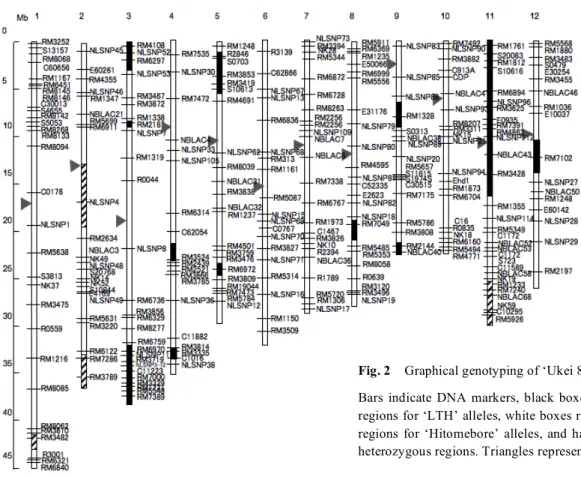
DNA polymorphism between ‘LTH’ and ‘Hitomebore’ was detected by analysis using 297 DNA markers including 144 SSR, 8 SCAR, 4 CAPS, 100 PCR-RF-SSCP, and 41 dot-blot-SNP markers from among 251 SSR, 12 SCAR, 19 CAPS, 306 PCR-RF-SSCP, and 96 dot-blot-SNP markers tested. To develop SNP markers for the regions in which the distances between markers exceed 3 Mb, nucleotide sequences of genomic DNA of ‘LTH’ were determined using a 454 nucleotide sequencer, and 80 SNPs between ‘LTH’ and ‘Nipponbare’ were selected. Removing closely linked DNA markers, 275 markers were used for genotyping of ‘Ukei 840’. ‘Ukei 840’ was homozygous for ‘LTH’ alleles in 42 markers (ca. 20%), homozygous for ‘Hitomebore’ alleles in 225 markers (ca. 75%), and heterozygous in 8 markers (ca. 5%) (Fig. 2). Regions homozygous for ‘LTH’ alleles were 12 regions in short and long arms of chromosomes 3, 5, and 11 and long arms of chromosomes 4, 8, 9, and 12. Heterozygous regions were in the long arms of chromosomes
1, 2, and 11. Genotypes of all the tested DNA markers on the short arm of chromosome 10 of ‘Ukei 840’, on which a QTL for cold-tolerance of ‘LTH’ has been mapped by Ye et al. (2010), were homozygous for ‘Hitomebore’ alleles.
QTL analysis of cold tolerance
Seed fertilities of 192 F2 plants derived from a cross between
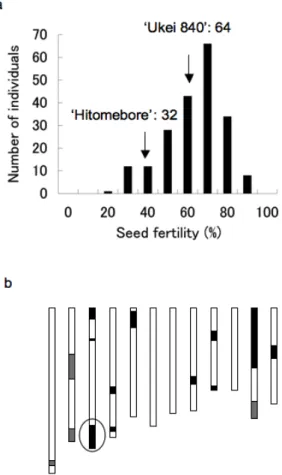
‘Ukei 840’ and ‘Hitomebore’ grown in a deep-water paddy field with water controlled at 18.5˚C showed continuous distribution from 17.4% to 84.2% (Fig. 3). Genotypes of the 192 F2 plants were analyzed using the 48 DNA markers in the
regions homozygous for ‘LTH’ alleles and the heterozygous region, and QTLs for the seed fertilities were investigated. One QTL with an LOD score of 7.1, higher than the threshold value of 5% significance represented as LOD score 2.5, was detected at marker C11223 on the long arm of chromosome 3. The phenotypic variance explained by this QTL was 24.4%. The additive effect was 7, indicating that substitution of this region from homozygous ‘Hitomebore’ alleles to homozygous ‘LTH’ alleles increases seed fertility by 14% (Table 1). This QTL was named qLTB3 (QTL for Low-temperature Tolerance at Booting stage on chromosome 3).
An F1 plant obtained from a cross between ‘LTH’ and
‘Hitomebore’ was backcrossed with ‘Hitomebore’ to obtain 192 BC1F2 plants, which are BC3F2 plants for ‘LTH’ and
‘Hitomebore’ (Fig. 1). These BC1F2 plants had ‘LTH’ alleles
of the DNA markers on the long arms of chromosomes 3 and 8 (Supplementary Fig. 1). Seed fertilities of these BC1F2
plants grown in the cold-deep-water paddy field were distributed continuously from 0% to 60.3% (Supplementary
Fig. 1). Analyzing genotypes of these plants using the DNA markers in these regions, QTLs were again investigated. A significant QTL was detected at marker RM7000 in qLTB 3. The LOD score of this QTL was 6.9, and the explained phenotypic variance was 18.1% (Table 1).
Development of chromosome segment substitution lines (CSSLs) and delimitation of the QTL region for cold tolerance A BC1F2 plant, which is heterozygous for DNA markers in
qLTB3 and homozygous for ‘Hitomebore’ alleles in the other genomic regions, named ‘HCL3-hetero’ (‘Hitomebore’ Chromosome segment substitution line with qLTB3-hetero), was selected, and ‘HCL3-homo’ was obtained from its selfed progeny. Six recombinants between RM6970 and RM7389 in qLTB3 were selected from 1,504 selfed progeny of ‘HCL3-hetero’. Determining genotypes of selfed progeny obtained from the six recombinant lines using seven DNA markers in qLTB3, we selected plants homozygous for ‘LTH’ alleles (Fig. 4). These lines, 18 plants for each line, were grown in the cold-deep-water paddy field together with ‘HCL3-homo’ and ‘Hitomebore’, and seed fertility of each plant was investigated in 2008. ‘HCL3-homo’ and ‘Hitomebore’ showed seed fertilities of 31% and 21%, respectively. The difference of seed fertility between the tested lines was significant at the 1% level by ANOVA. Lines with significantly higher seed fertility than that of ‘Hitomebore’ at the 1% level by the Dunnett test were ‘HCL3-3’, ‘HCL3-6’, ‘HCL3-7’, and ‘HCL3-homo’, while seed fertilities of ‘HCL3-5’, ‘HCL3-8’, and ‘HCL3-10’ were not significantly different from that of ‘Hitomebore’. Cold
Fig. 2 Graphical genotyping of ‘Ukei 840’.
Bars indicate DNA markers, black boxes show homozygous regions for ‘LTH’ alleles, white boxes represent homozygous regions for ‘Hitomebore’ alleles, and hatched boxes indicate heterozygous regions. Triangles represent centromeres.
tolerances of these lines were again examined using selfed progeny of these lines in 2009. ‘Hitomebore’ showed 18% seed fertility, while ‘HCL3-homo’ exhibited 32% seed fertility. Seed fertilities of ‘HCL3-3’, ‘HCL3-6’, ‘HCL3-7’, and ‘HCL3’ were significantly higher than that of ‘Hitomebore’ at the 1% level, while those of the other lines were comparable to that of ‘Hiromebore’ (Fig. 4). These results suggest that the QTL for cold tolerance can be delimited to the region from RM3719 to RM7000.
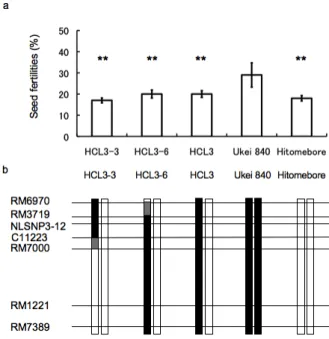
The dominance effect of the QTL was investigated using heterozygous plants of ‘HCL3-3’, ‘HCL3-6’, and ‘HCL3-hetero’. All these heterozygotes showed seed fertilities as low as that of ‘Hitomebore’, suggesting that the ‘LTH’ allele for cold tolerance in qLTB3 is recessive (Fig. 5). Identification of SNPs in qLTB3
The ‘Nipponbare’ genome sequence of the region between RM3719 and RM7000 is 1,161,293 bp. Genomic DNA of ‘Ukei 840’ in this region was amplified by long PCR for ca. 5 kb using 216 primer pairs. For amplification of the regions which could not be amplified by these primer pairs, 12 other primer pairs were designed. Genomic DNA fragments of ‘Ukei 840’ covering the whole region between RM3719 and RM7000 were obtained. Nucleotide sequences of these PCR products were determined using an Illumina genome analyzer, and 172 times coverage on average was obtained. The obtained 1,161,293-bp sequence of ‘Ukei 840’ was compared with the ‘Nipponbare’ genome sequence. In this nucleotide sequence analysis, many short sequences of ca. 30 nt were aligned with the published ‘Nipponbare’ genome sequence, and therefore insertions in ‘LTH’ genome could not be detected. However, all the DNA fragments amplified from ‘Ukei 840’ had the same sizes as those from ‘Nipponbare’, indicating that there is no large insertion in this genomic region of ‘Ukei 840’. Deletions of nucleotides in ‘Ukei 840’ were not detected. Detected SNPs were 254, of which 223 were present outside of the assigned gene regions. Among the 31 SNPs identified in the gene regions, seven SNPs detected in five genes were variations causing amino acid changes in encoded proteins. In Os03g0790700, Ile at 728 from the first Met, which is a conserved amino acid residue among genes for aldehyde oxidase-2, was replaced by Asn in ‘Ukei 840’. Leu at 59 and Glu at 439 in Os03g0793700 were replaced by Phe and Gly, respectively (Table 2).
SNPs were detected in the 5-kb upstream regions of 89 genes. In spikelets of young panicles at the booting stage, gene expression of 57 genes was detected, but no differences of gene expression levels were detected in these genes between ‘HCL3-homo’ and ‘Hitomebore’ nor between plants grown in the cold-water paddy field and those under the normal growing conditions.
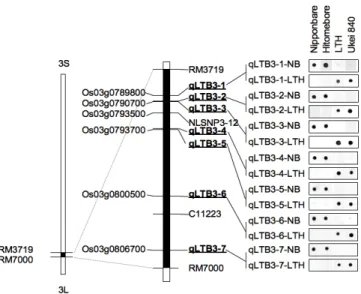
Seven dot-blot-SNP markers, i.e., qLTB3-1 to -7, were developed with SNPs identified in Os03g0789800, Os03g0790700, Os03g0793700, Os03g0800500, and Os03g0806700 (Table 3). All the markers showed clear dot-blot signals for each allele. In all the markers, ‘Ukei 840’ showed genotypes of ‘LTH’ type, and ‘Hitomebore’ did genotypes of ‘Nipponbare’ type (Fig. 6).
Fig. 3 QTL analysis using an F2 population.
(a) Distribution of seed fertilities of F2 plants between
‘Ukei 840’ and ‘Hitomebore’ cultivated in the cold-deep-water irrigation field at the booting stage. (b) Position of a QTL detected by analysis using an F2
population. Black boxes represent homozygous regions for ‘LTH’ alleles, white boxes indicate homozygous regions for ‘Hitomebore’ alleles and gray boxes show heterozygous regions. A circle indicates a QTL region.
Discussion
Repeated QTL analyses using ‘Hitomebore’ and ‘Ukei 840’, which is a cold-tolerant breeding line derived from a crossing
of ‘LTH’ with ‘Hitomebore’, revealed the presence of a QTL for cold tolerance at the booting stage on the long arm of chromosome 3. Although only one QTL with a significant effect was detected, phenotypic variance explained by this QTL was only 24.4%. A CSSL having a region of chromosome 3 derived from ‘LTH’ with a genetic background of ‘Hitomebore’ developed by backcrossing showed significantly higher cold tolerance than ‘Hitomebore’, but QTL analysis using a backcrossed population again showed this region to have a small explained phenotypic variance, 18.1%. The presence of many other QTLs with minor effects might be one of the reasons for this low explained phenotypic variance, but backcrossing to remove allelic variations at other QTLs did not increase the phenotypic variance explained by the QTL in chromosome 3, suggesting that most of the remaining phenotypic variance, ca. 80%, is due to environmental factors. Although further improvement
Fig. 4 Seed fertilities investigated in 2008 (a), in 2009
(b) and graphical genotypes of six CSSLs (HCL3-3, 5, 6, 7, 8 and 10), HCL3-homo (HCL3) and ‘Hitomebore’ in the QTL region (c).
Two asterisks indicate that lines showed significant differences in seed fertilities at 1% level against ‘Hitomebore’. Black boxes show homozygous regions for ‘LTH’ alleles and white boxes represent homozygous regions for ‘Hitomebore’ alleles. Gray boxes show regions containing recombination break points.
Fig. 5 Seed fertilities (a) and graphical genotypes of
heterozygous CSSLs of HCL3-3, HCL3-6 and HCL3, ‘Ukei 840’, and ‘Hitomebore’ in the QTL region (b).
Two asterisks indicate that lines showed significant differences in seed fertilities at 1% level against ‘Ukei 840’ and one asterisk indicates no significant difference at 5% level against ‘Hitomebore’. Black boxes show regions of ‘LTH’ alleles and white boxes represent regions of ‘Hitomebore’ alleles.
is required to develop a more reliable method for testing genetic effects on the cold tolerance of breeding lines in rice, detection of significant QTLs at the same region, i.e., qLTB3, by repeated analysis and significant differences of seed fertilities between the chromosome segment substitution lines having qLTB3, i.e., ‘HCL3’ lines, and ‘Hitomebore’ suggests the reliability of the effect of qLTB3.
Three, four, three, and one QTLs for cold tolerance at the booting stage have been observed by Takeuchi et al. (2001), Dai et al. (2004), Suh et al. (2010), and Ye et al. (2010), respectively, explained phenotypic variance of each QTL being less than 22% with summed explained phenotypic variances of 32%, 45%, 27%, and 20.5%, respectively. Since reevaluations of QTLs using chromosome segment substitution lines or progeny populations were not carried out
in these studies, it cannot be speculated whether these low values of summed explained phenotypic variances are due to large environmental effects. Only one QTL for cold tolerance at the booting stage of ‘Hokkai-PL9’ detected on chromosome 8 has explained the higher phenotypic variance, i.e., 26.6% (Kuroki et al., 2007), than the QTL in the present study. In the previous QTL studies, cold-tolerance QTLs have been detected on every chromosome from chromosome 1 to 12, and a few QTLs shared by different cold-tolerant cultivars have been found (Andaya and Mackill, 2003; Dai et al. 2004; Takeuchi et al. 2001, Ye et al., 2010). It can be inferred that many genes participate in cold tolerance at the booting stage of rice.
In the chromosomal region of about 1.2 Mb containing a gene for cold tolerance delimited by analysis using CSSLs, 143 genes have been annotated in the ‘Nipponbare’ genome (International Rice Genome Sequencing Project 2005) and full-length cDNA clones of them have been isolated. In the present study, SNPs were detected in 5-kb upstream regions of 89 genes. No difference of gene expression of these genes was detected between the CSSL having qLTB3 and ‘Hitomebore’ nor between plants grown in the cold-water paddy field and those under normal growing condition. Determining the nucleotide sequence in this region of ‘Ukei 840’, we revealed seven SNPs in five genes causing amino acid substitutions. Among them, one SNP in Os03g0790700 was found to be responsible for alteration of a conserved amino acid residue. Os03g0790700 is a possible candidate of the cold-tolerance gene of ‘LTH’. Os03g0790700 is similar to AAO2 in A. thaliana, which is considered to be a member of aldehyde oxydase functioning in ABA biosynthesis (Koiwai et al. 2004; Seo et al. 2004). Os03g0806700, which has been reported to be expressed in the anther (RiceXPro: Sato et al. 2011), encodes DUF family protein, the function of which is unknown. Proteins having an amino acid sequence similarity to Os03g0806700, e.g., SORBI_01g004400 of Sorghum bicolor, 100381620 of Zea
mays, and RCOM_0557310 of Ricinus communis, have serine
at 244 aa similar to a protein encoded by the ‘LTH’ allele, not leucine encoded by the ‘Nipponbare’ allele.
Fig. 6 A map of SNPs used for developing dot-blot-SNP
markers.
Dot-blot signals detected by the SNP markers are shown to the right. qLTB3-n-NP and qLTB3-n-LTH are probes for ‘Nipponbare’ alleles and ‘LTH’ alleles, respectively.
Although there is a possibility that the SNPs identified in Os03g0790700 and Os03g0806700 are variations responsible for cold tolerance in ‘Ukei 840’, further analysis is required to demonstrate participation of these SNPs in cold tolerance. Since Tos17 insertion lines of Os03g0790700 and Os03g0806700 are available (http://tos.nias.affrc.go.jp/), we are transforming these Tos17 insertion lines with ‘LTH’ alleles and ‘Hitomebore’ alleles of Os03g0790700 and Os03g0806700 to produce transgenic plants for testing their cold tolerance. However, such transgenic plants should be cultivated in an isolated greenhouse in line with requirements of the Biodiversity Convention. Although many plants per line should be examined for cold tolerance to minimize errors, it is not easy to test many transgenic plants in such an isolated greenhouse. Production of recombinants only in upstream and downstream intergenic regions by meiotic recombination may enable a large-scale evaluation of cold tolerance using a deep-water field with controlled water temperature for demonstrating the function of a candidate gene.
The only gene so far identified as a gene for cold tolerance at the booting stage in rice is the F-box protein gene from ‘Silewah’ (Saito et al. 2010). Although a 30% increase of seed fertility under low temperature has been shown in transgenic plants having the F-box protein gene from ‘Silewah’, there is neither a nucleotide sequence variation nor a difference of gene expression levels between ‘Silewah’ and a cold-sensitive cultivar. Since 687 genes have been reported as F-box protein genes in rice (Jain et al. 2007), it is not easy to elucidate the ‘LTH’ is required for elucidation of the cold-tolerance gene. However, the SNP markers developed in the present study would be useful for marker assisted selection of cold tolerant lines in rice breeding programs using ‘LTH’ as a gene source of cold tolerance.
Acknowledgment
This study was partly supported by a Grant-in-Aid for Scientific Research (Research Activity Start-up: 22880005).
Supplementary Data
Supplementary Table 1. Sequences of primers and probes used for QTL analysis
Supplementary Table 2. Sequences of primers used for RT-PCR analysis
Supplementary Fig. 1. QTL analysis using a backcrossed population. (a) Seed fertilities of backcross population after cultivation under low temperature conditions at the booting stage. (b) Position of a QTL detected using a backcrossed population. Black boxes indicate regions having segregated genotypes and white boxes show regions having a fixed genotype of homozygous ‘Hitomebore’ alleles. A circle represents a QTL region. A gray bar indicates candidate region of the QTL and a triangle shows the peak of the LOD score.
References
Andaya VC, Mackill DJ (2003) QTLs conferring cold tolerance at the booting stage of rice using recombinant inbred lines from a japonica x indica cross. Theor Appl
Genet 106:1084-1090
Dai L, Lin X, Ye C, Ise K, Saito K, Kato A, Xu F, Yu T, Zhang D (2004) Identification of quantitative trait loci controlling cold tolerance at the reproductive stage in Yunnan landrace of rice, Kunmingxiaobaigu. Breed Sci 54: 253-258
Edwards K, Johnstone C, Thompson C (1991) A simple and rapid method for the preparation of plant genomic DNA for PCR analysis. Nucleic Acids Res 19: 1349
Hayase H, Satake T, Nishiyama T, Ito N (1969) Male sterility caused by cooling treatment at the meiotic stage in rice plants. II. The most sensitive stage to cooling and the fertilizing ability of pistils. Proc Crop Sci Soc Japan 38: 706-711
Horisue N, Kunihiro Y, Higashi T, Oyamada Z, Huaiyi W, Jianhua X, Suchu Z, Zhiyong L, Yonghua W (1988) Screening for cold tolerance of Chinese and Japanese rice varieties and selection of standard varieties. Tropical Agriculture research series 21: 76-87 (In Japanese with English summary)
International Rice Research Institute (1977) Screening for cold tolerance. IRRI annual report for 1977: 142
International Rice Genome Sequencing Project (2005) The map-based sequence of the rice genome. Nature 436: 793-800
Ito N (1978) Male sterility caused by cooling treatment at the young microspore stage in rice plants. XVI. Changes in carbohydrates, nitrogenous and phosphorous compounds in rice anthers after cooling treatment. Jpn J Crop Sci 47: 318-323
Jain M, Nijhawan A, Arora R, Agarwal P, Ray S, Sharma P, Kapoor S, Tyagi AK, Khurana JP (2007) F-box proteins in rice. Genome-wide analysis, classification, temporal and spatial gene expression during panicle and seed development, and regulation by light and abiotic stress. Plant Physiol 143:1467-1483
Jansen RC, Stam P (1994) High resolution of quantitative traits into multiple loci via interval mapping. Genetics 136:1447-1455
Koiwai H, Nakaminami K,Seo M, Mitsuhashi W, Toyomasu T, Koshiba T (2004) Tissue-specific localization of an abscisic acid biosynthetic enzyme, AAO3, in Arabidopsis. Plant Physiol 134: 1697-1707
Kuroki M, Saito K, Matsuba S, Yokogami N, Shimizu H, Ando I, Sato Y (2007) A quantitative trait locus for cold tolerance at the booting stage on rice chromosome 8. Theor Appl Genet 115: 593-600
Matunaga K (2005) Establishment of an evaluation method for cold tolerance at the booting stage of rice using deep water irrigation system and development of highly cold-tolerant rice varieties by combining cold tolerance genes. Bull Miyagi Furukawa Agric Exp Sta 4:1-78 (In Japanese with English summary)
McCouch SR, Teytelman L, Xu Y, Lobos KB, Clare K, Walton M, Fu B, Maghirang R, Li Z, Xing Y, Zhang Q, Kono I, Yano M, Fjellstrom R, DeClerck G, Schneider D, Cartinhour S, Ware D, Stein L (2002) Development and mapping of 2240 new SSR markers for rice (Oryza sativa L.). DNA Res 9: 199-207
Murray MG, WF Thompson (1980) Rapid isolation of high molecular weight plant DNA. Nucleic Acids Res 8: 4321-4325
Nishiyama I (1970) Male sterility caused by cooling treatment at the young microspore stage in rice plants. VII. Electron microscopical observations on tapetal cells dilated by the cooling treatment. Proc Crop Sci Soc Japan 39: 480-486 Nishiyama I (1978) Male sterility caused by cooling treatment
at the young microspore stage in rice plants. XVIII. Some enzyme activities in anthers during and after the cooling. Jpn J Crop Sci 47: 551-556
Oliver SN, Van Dongen JT, Alfred SC, Mamun EA, Zhao X, Saini HS, Fernandes SF, Blanchard CL, Sutton BG, Geigenberger P, Dennis ES, Dolferus R (2005) Cold-induced repression of the rice anther-specific cell wall invertase gene OSINV4 is correlated with sucrose accumulation and pollen sterility. Plant Cell Environ 28: 1534-1551
Oliver SN, Dennis ES, Dolferus R (2007) ABA regulates apoplastic sugar transport and is a potential signal for cold-induced pollen sterility in rice. Plant Cell Physiol 48: 1319-1330
Saito K, Miura K, Nagano K, Hayano-Saito Y, Saito A, Araki H, Kato A (1995) Chromosomal location of quantitative trait loci for cool tolerance at the booting stage in rice variety ‘Norin-PL8’. Breed Sci 45:337-340
Saito K, Miura K, Nagano K, Hayano-Saito Y, Araki H, Kato A (2001) Identification of two closely linked quantitative trait loci for cold tolerance on chromosome 4 of rice and their association with anther length. Theor Appl Genet 103: 862-868
Saito K, Hayano-Saito Y, Maruyama-Funatsuki W, Sato Y, Kato A (2004) Physical mapping and putative candidate gene identification of a quantitative trait locus Ctb1 for cold tolerance at the booting stage of rice. Theor Appl Genet 109: 515–522.
Saito K, Hayano-Saito Y, Kuroki M, Sato Y(2010) Map-based cloning of the rice cold tolerance gene Ctb1. Plant Sci 179:97-102
Sasaki T (2005) Identification of rice germplasm for cold tolerance at the booting stage and breeding of Hitomebore, a cold-tolerant rice cultivar having excellent grain and eating quality. Bull Miyagi Furukawa Agric Exp Sta 4:79-128 (In Japanese with English summary)
Satake T, Hayase H (1970) Male sterility caused by cooling treatment at the young microspore stage in rice plants. V. Estimation of pollen developmental stage and the most sensitive stage to coolness. Proc Crop Sci Soc Japan 39: 468-473
Sato Y, Antonio B, Namiki N, Takehisa H, Minami H, Kamatsuki K, Sugimoto K, Shimizu Y, Hirochika H, Nagamura Y (2011) RiceXPro: a platform for monitoring gene expression in japonica rice grown under natural field conditions. Nucleic Acids Res 39:D1141-1148
Seo M, Aoki H, Koiwai H, Kamiya Y, Nambara E, Koshiba T (2004) Comparative studies on the Arabidopsis aldehyde oxidase (AAO) gene family revealed a major role of AAO3 in ABA biosynthesis in seeds. Plant Cell Physiol
45:1694-1703
Shiokai S, Kitashiba H, Shirasawa K, Nagano K, Nishio T (2009) Leaf-punch method to prepare a large number of PCR templates from plants for SNP analysis. Mol Breed 23: 329-336.
Shiokai S, Shirasawa K, Sato Y, Nishio T (2010) Improvement of the dot-blot-SNP technique for efficient and cost-effective genotyping. Mol Breed 25: 179-185 Shirasawa K, Kishitani S, Nishio T (2004a) Conversion of
AFLP markers to sequence-specific markers for closely related lines in rice by use of the rice genome sequence. Mol Breed 14: 283-292
Shirasawa K, Monna L, Kishitani S, Nishio T (2004b) Single nucleotide polymorphisms in randomly selected genes among japonica rice (Oryza sativa L.) varieties identified by PCR-RF-SSCP. DNA Res 11: 275-283
Shirasawa K, Shiokai S, Yamaguchi M, Kishitani S, Nishio T (2006) Dot-blot-SNP analysis for practical plant breeding and cultivar identification in rice. Theor Appl Genet 113: 147-155
Suh JP, Jeung JU, Lee JI, Choi YH, Yea JD, Virk PS, Mackill DJ, Jena KK (2010) Identification and analysis of QTLs controlling cold tolerance at the reproductive stage and validation of effective QTLs in cold-tolerant genotypes of rice (Oryza sativa L.). Theor Appl Genet 120: 985-995 Takeuchi Y, Hayasaka H, Chiba B, Tanaka I, Shimano T,
Yamagishi M, Nagano K, Sasaki T, Yano M (2001) Mapping quantitative trait loci controlling cool-temperature tolerance at booting stage in temperate Japonica rice. Breed Sci 51: 191-197
Toriyama K, Futsuhara Y (1960) Genetic studies on cool tolerance in rice. I. Inheritance of cool tolerance. Jpn J Breed 10: 7-16 (in Japanese)
Ye C, Fukai SI, Godwin D. Koh H, Reinke R, Zhou Y, Lambrides C, Jiang W, Snell P, Redona E (2010) A QTL controlling low temperature induced spikelet sterility at booting stage in rice. Euphytica 176: 291-301
Zeng ZB (1994) Precision mapping of quantitative trait loci. Genetics 136: 1457-1468
Supplymentary table 1 Sequences of primers and probes used for QTL analysis
Marker name Chr. positionSNP Markertype Reference Forward primer sequence (5'-3') Reverse primer sequence (5'-3') 'Nipponbare' type (5'-3')Probe sequence of Probe sequence of varianttype (5'-3') RM3252 1 302050 SSR 1 GGTAACTTTGTTCCCATGCC GGTCAATCATGCATGCAAGC
S13157 1 920089 dot - GCATGCATTCATACAGATGAAG CGAATGCGGAGAATTCAAGC GCATACtaTCCATCAC GCATACaTGACAAGAA RM8068 1 1659209 SSR 1 AAACCTCTCGCTGTAATTAG TGAACATTTATTGATATGGTA
C60656 1 2215405 dot 5 GTTCGACGAGCCAAGTTCTC GCTGCTACAAACACGCCATA TCGGGTAGtGGAATGTA TCGGGTAGcGGAATGTA RM1167 1 4239164 SSR 1 GAACATAAACCATGCGGGAG AGCTAGTGGCAAAAGTGTGC
RM6451 1 4796393 SSR 1 TATGACATTGACCGTGGGC TCTCCCCATGTTTGATCCTC RM8145 1 4885915 SSR 1 CGGCATGAGAGTCTGTGATG AAGCAAGCCCTGGGATTC RM8146 1 4908081 SSR 1 GACTCCTCCAAGTGCAACG GTAGCTTCCCCACAATGTCA
C30013 1 4912281 dot 5 ACGAACCCTAGCCACATGAC CTCCCCTCTCTCTCTTGTTCC CCATCCAAcACGCCAAA CCATCCAAtACGCCAAA S4655 1 7268206 dot 5 TATCCGGCACTTGTTTGTCAC GCCTCATAAAGCCCAAGATG GAGACATCaTGCAACTA GAGACATCgTGCAACTA RM8142 1 7457477 SSR 1 ATTCATATATATTGGCTAGAGTGGCTGT AAGCCAATATATGTAGAGATGAATGGAA S5053 1 7852785 PRS 4 CATTTATGGGCATGCAACAG TGTGCGTGATGTGTTAGCAA RM8268 1 9190446 SSR 1 AAATCGACATTCTCTGTTGC ATGGCTTACCTGCTGTCTC RM8133 1 9390236 SSR 1 AAAACTGACTGTTTGTTTAAATGAAAT GTTACTGCTGTAATGTGAATTGCT RM8094 1 11286841 SSR 1 AAGTTTGTACACATCGTATACA CGCGACCAGTACTACTACTA C0178 1 15849958 PRS 4 CACGCGTCATACAAAGCTAAGTC CCAGTTAACCTAGTGCAGGTTTG
TUSNP1 1 19714968 dot 2 GTACGTCATCCATAGTCCGATTC AAAAATGCGTGGACGTTAGC CGTGCATGtGTGAGGCG CGTGCATGcGTGAGGCG RM5638 1 22592885 SSR 1 GGCTTCCTCATCGCCATC CTGAGCAGCATTCCAGTCTG
S3813 1 24980344 dot 5 CCTCTTTAGTACCACCTCGACAG GCAGCAGCCTGTTATCCTTC CTCGCCTAcCCTGCCTC CTCGCCTAtCCTGCCTC NK37 1 25536345 CAPS 3 AATTTGTTGCATGTGGGTGTAG CACGCTCTTCGTCTTTATCACTT
RM3475 1 27797947 SSR 1 GTCGGTTTGCCTAGTTGAGC TTCCTCGGTGTATGGGTCTC R0559 1 30312642 PRS 4 AGTCTGGAGGTCTTCACCATTCT GTGCCAGACCTACTAATTGTTGC RM1216 1 33864286 SSR 1 TTCCCCAATGGAACAGTGAC AGGGTCTACCACCCGATCTC RM8085 1 36618931 SSR 1 TGCGTTTCGATTTCTTTTTA GGAAAGTTGTGTTCTTTGGC RM8062 1 40928887 SSR 1 CAAATTACTCCATCCATTATT GAGGAGATGCTAGTTAATTAC RM3810 1 41248012 SSR 1 ACGAAGGAACTACCCGTGTG CGCACATGTTACTCTAGCGG RM3482 1 41475886 SSR 1 TTGTTGTCAAGCTACGGTGG CTGCTTCGTGATGTTGTTGG R3001 1 44648503 PRS 4 ACGCAACTCTAGTATCAGGTGGA TGGGCGCTTACTCTTGTAGTAGT RM6321 1 44719165 SSR 1 GGCTCTACCTCGCTGTTGTC ACGAATATAACCTGCGGCAG RM6840 1 44967764 SSR 1 TACCAAGACTCCGCTATGGC GAAGAAGGGATCATGGATCG
TUSNP45 2 977553 dot 2 CTGGGACTGGATGAGACGTT CGGAGCTGGATCAGACCTAC TGCTGCCGgCGAACCGC TGCTGCCGaCGAACCGC E60261 2 2997852 PRS 4 CTTCTGAGTTGAGCTGCTTTCA GCACACTTTGTTTTGTGTGG
RM4355 2 4264267 SSR 1 GGGATGAGAGTAGAAGGCA TATATGGCAAGCCTAGCG SCSNP46 2 5253801 SSCP - GGGCTGATGCTGAATTTTCT CATCGAGGTACGAGGTAGCAG
RM1347 2 5314517 SSR 1 AACAAATTAAACTGCCAAG GTCTTATCATCAGAACTGGA
NBLAC21 2 7645937 dot - ATGGCGTGAGTAGCGACTTC CCACTGAAATGTCCCAGTTT AGTTGAGTcGAAAGATC AGTTGAGTtGAAAGATC RM5699 2 9010409 SSR 1 ATCGTTTCGCATATGTTT ATCGGTAAAAGATGAGCC
RM6911 2 9038132 SSR 1 GGTGATTGCTATTTAACTTC ACTTTTTCCAAATTATGCT
TUSNP4 2 17056398 dot 2 GTTACCGTGGGTACCAGCACTAT GGCTTGCAGAAGAGTGAAGAAT TCTTTGAAtGCTTGATT TCTTTGAAgGCTTGATT RM2634 2 21359015 SSR 1 GATTGAAAATTAGAGTTTGCA TGCCGAGATTTAGTCAACTA
P0812F 2 23257255 dot - TGGCAAGCCGAAGATCTCTC CTACCCTAATGCAAGGAAAA TGGGTGACcCATTTGCA TGGGTGACgCATTTGCA NK49 2 23935700 CAPS 3 TATGGTCACGCCTATCATACACA GGCTCAATACCTTTTTGCATCTA
SCSNP48 2 24279890 SSCP - CCCCAAGTATTGATGCCAAC CTCCAAAGGAAAGCCACAAC
S20768 2 25025944 dot 5 CCTGTGTACCTCGAAGAGTCAA TAGCTGATGTGCCACGTGAA TCTGTACCaTGGTAAAT TCTGTACCtTGGTAAAT NK14 2 25153369 SCAR 3 CGGTTTAGCACGATCTATCAAG TAGAGAGGAAGATTTCAAGTGG
NK52 2 25321909 SCAR 3 ATTTCATTCTCCCATTTCTCCTC CCCCTGTAGAGTGGCAAATAATA
R2559 2 25827732 dot 5 GCAATTGTGCCTTATACCGAG GAGCTTCTGTCTTTGGTAACACG ATATGTGGtTGGGTTAG ATATGTGGcTGGGTTGG E3295 2 25940259 dot 5 ACGTACGTCACACAACATCTGTC GCTGCAGTTCGTGATATGGA TGCAAGCGcCGTCGTGA TGCAAGCGaCGTCGTGA SCSNP49 2 26630912 SSCP - ATAAGCGCAATGGGCTAGAG GTGCATGGGAGCACATTACA RM5631 2 29160338 SSR 1 CGTCCAAGAAATATTGCAGT GTGAGACAGAATCCTTACGC RM3220 2 29350959 SSR 1 TTGAGTTTTCCTGGCCAGTC CTCGCTTTACAGGCCAGAAC RM6122 2 33081236 SSR 1 CCGCCCTCTTCTTCTTCTTC TAGACACCAACAATGGCGTC RM7286 2 33887388 SSR 1 CAGAACAATTCGACCGCTTC GGCTTGAGAGCGTTTGTAGG RM3789 2 35577595 SSR 1 ATTAAGGGCAGGGGCATATC CATTGACTGGTGTGGTCAGG RM4108 3 515005 SSR 1 GTCCCTCGCTTTATATCTAG CAACTCTGCTAAACGAATTA SCSNP52 3 1008965 SSCP - CCAGAAGCCAAATAAGTGGTG ACGATGTCTACGACGCGATA RM6297 3 1744274 SSR 1 TTCTTCTCTCCTCTCGCTCG CCAAAGCAACCCATCTCAAC SCSNP53 3 3577015 SSCP - GCCTGTCCCTCGTGAACTTA GTTCATCCCCGATAGCTCAA RM3467 3 6031935 SSR 1 ATAATGGCAGGGTTGTCTCG CTCGGTGAGCCTCCTACAAC RM3872 3 6902498 SSR 1 GGAAGAAAGGATCTATATCA TACGATTTGTTTAAGTTCAA RM1338 3 8444141 SSR 1 AGAGGGAATTAGATTGGATT GGTCCACTTCTTCCTTCTAT RM2187 3 8876841 SSR 1 GTCATTTGAAGTAAATCCGT GGTCTACTTGCGAAATAAGT
TUSNP7 3 9640009 dot 2 GCTGGGTGATAGAGCTACCTTC CTTGGCACACAGAACAAAGA ACTTGCTCcATCTATTT ACTTGCTCtATCTATTT RM1319 3 13078979 SSR 1 GTGCTAAGCTTCTTCTGTGC GCCAGTTAGCCCTTAAATC
R0044 3 14984339 PRS 4 GCCATCGTAGACAAAGAGTATGG ACCACAAGAACAGCTCTAACCAG
TUSNP8 3 21926296 dot 2 gaacggaggaagtaCATGAGAAAC AGGATGCATGAGGGGATATCTA TAGAGTCAcGTAGAGAT TAGAGTCAtGTAGAGAT RM6736 3 28084003 SSR 1 TGGAGGATGAAGATTAAGTA ATTTCGTGAAAAAAATTCTA RM3856 3 29542776 SSR 1 TTGCATAACAAGATGAACAA TTAATTGCGGATTTTTTATT RM6329 3 29572249 SSR 1 CCCTGGATGAAAAGCACAAG GAAGTTGTAGATGCCCCATC RM8277 3 29572261 SSR 1 AGCACAAGTAGGTGCATTTC ATTTGCCTGTGATGTAATAGC RM6759 3 33081236 SSR 1 TGGAAAATTTGATGACATAA TATGGGGTATCCATAATCTC RM6970 3 33342605 SSR 1 TCGCTTGTGTTTTCTGGGTC TGGAGAATTTGGAGGCTGC
TUSNP11 3 33369280 dot 2 CCAGATTTTGTCTTGGCCCTAA GGTGGATGCAAATAGGTACAAC ATCAGTACaTGCTAAGT ATCAGTACgTGCTAAGT RM3719 3 33540013 SSR 1 GTAGGTCAACTTACACGCAGTG GTACATACGACCAACGCTGC
NLSNP3-13 3 33900516 dot - CCACTATAAGGGTCGTTTGGGAGA GCAAGCAACCATATGGGCAGA AATAAATTATTTTATTC AATAAATTCTTTTATTC C11223 3 34347216 dot 5 ATTGTACCCTGACGATCGAA CTGTCTTTCCAGACAGAAGAACC CGCTTGACaGTGAATGG CGCTTGACgGTGAATGG RM1373 3 34567215 SSR 1 AGTTGGATATATAATGCAGG CATGCTATGTTTTCATGATA RM7000 3 34653353 SSR 1 CCCTTCTTTTCAACTGAATA TTGTAACAATGAACTCGTTC RM3329 3 36446341 SSR 1 GCACATACAGAAATGGTGAA GGCAAGGGACATGTAGTAAC RM1221 3 36527459 SSR 1 GAGTAGAGAGAGATGGCGGC AGGATTAGCAGCGTTAAGCG RM5548 3 36693701 SSR 1 GGTGCAGAGTGATGCAATTC AACATTAGGGATGAGGCTGG RM7389 3 37013036 SSR 1 AGCGACGGATGCATGATC TTGAGCCGGAGGTAGTCTTG RM7535 4 1159365 SSR 1 GACGAAAACCGGTCGAATTC TCCAACAAGAGTGAGCATGC SCSNP30 4 3413358 SSCP - CCTTGATCCGGTGTCAGAAC CTCACACCCTCTCGATCTCTGT RM7472 4 7087972 SSR 1 GCCACGTGACGGTTTAAGAG CAAGTGGCACGTATGAGTCC
P1255F 4 11851141 dot - TACATCACATCATAAAGCTA TGGGTTGCACTTACATTTAA ACAATAGGtTGTTTTCA ACAATAGGcTGTTTTCA SCSNP33 4 12292847 SSCP - CAGTTACTCAGTGGAGCTTGTGA TGAATACAGGTACCACCAAGAGG
NLSNP105 4 13477923 dot - AGCCTTGGCACCCCCGGCTG GCCATCACCAACCAATGGGC TCCTTGCAcGTGGCAAC TCCTTGCAgGTGGCAAC RM6314 4 18638026 SSR 1 GATTCGTGTCGGTTGTCAAG GGTTCAGGGACGAATTTCAG
C62054 4 20456093 dot 5 TGATGCACCGTCCTCAATTA TGTTGGAAGGGAACATGTCA AAACTTGTgACCAATGA AAACTTGTcACCAATGA RM3524 4 23292432 SSR 1 CGGAGCTGGTCTAGCCATC GTCTCCGTCTTCCTCACTCG
RM2439 4 23496189 SSR 1 ATGTTTAGATTCTTAGCACT GCTCATATCCATATAAATGT RM2521 4 23616994 SSR 1 TACGACTGCCTACATGATAT GTTGCCAGTTTTTTTATGTC RM3866 4 23757049 SSR 1 AGTTGGTCATCTACCAGAGC GATCTTCTTGCCTCAGAAAG RM3785 4 24646204 SSR 1 ACCTTTTCTTGGCTTGAGGG GCTTTTGCTACTTTTGGGGG
TUSNP36 4 28171432 dot 2 GGTACCTTGGTTACTTGGGCTA CTCCTCCTCTCTCTTGGGGTAT CTGGTacACTGGGCTAG CTtGGTtACTGGGCTAG C11882 4 32381472 dot 5 ATTGTGATGTCCCAGGAAGC CACAGTGCTACATGTGACATTCC TGACAAAAtTGAGAACT TGACAAAAcTGAGAACT RM3814 4 33083061 SSR 1 GCGTCTTTCGTCTCTGTGTG GTCCATCATCCCTATGGTCG
RM3335 4 33425009 SSR 1 TAATCCACTGTGTCATTTAA ACCATCATCTTGTACCTAGT C1016 4 33713844 PRS 4 TTCCTGTGGTGGTGGTTATAGAG GGGTAGGTTCAGTGAATCAGATG SCSNP38 4 34432656 SSCP - CTGATGATGAAGATGACGAGGA CGTCACAATAACGAAGATCGAG
RM1248 5 72127 SSR 1 ACAAGCAGCTAATGGTTGGG GTGATTTTGGCTCAGGTCAG
R2846 5 1991425 dot 5 CGTCAAACTTTTCACGGAACTAC GTAGGGAAACGAATTGAATCCTG ATCACAAAaCTACAGAT ATCACAAAgCTACAGAT S0703 5 2027570 dot 5 TGGATCATTCCTGCTTATCC CACCACCCATTCCAATTCA CTCAATTGgTTGCTGAT CTCAATTGtTTGCTGAT R2846 5 2027592 dot 5 CAGATTTAATGCACCATATCAC GTAGGGAAACGAATTGAATCCTG ATCACAAAaCTACAGAT ATCACAAAgCTACAGAT RM3853 5 4082433 SSR 1 AACATATGCTATGTGCCCTT GGAGTTATCAGCAAATGCTC RM3419 5 5267135 SSR 1 ATCTTGGTGAAACAGTGCTC CTGCTGCTATTCCTCAAGAC S10613 5 5454769 PRS 4 CATATTGGCCCATCAGTTCC AACATCATCGGGTGGAAGAC RM4691 5 7008395 SSR 1 GGTTTCCGTTATTTTTATCG CATCAAGAGATAGTGCTCCA SCSNP62 5 11952692 SSCP - CGAGAGTTCCAAGATGAGGAA AGGATCCAGTCAGCTGAGGA RM8039 5 13406414 SSR 1 CGTACGTACTTATATCTCAT AAATCTAATGTATCTGAGGT
NBLAC31 5 14208505 dot - TTAGCCAGCGTATGTGTT CGGTACTTAATTACCTTGT GAtCTTATGAGCCTaAC GAgCTTATGAGCCTcAC RM3838 5 16531553 SSR 1 AGATGTTGCCAGTTTGCCTG TAGTGTCTTTGTGCAAGCCG
NBLAC32 5 17833379 dot - CAATTCATTAAGGACTCCCAG ATAACCCTGAAATGCTCAAA ACAAAATGcCATTTTAA ACAAAATGtCATTTTAA RM1237 5 18023520 SSR 1 CTCCGCGAGCTTTAGAAGAG CACATACTCTGGCTCTCCCG RM4501 5 22159668 SSR 1 GCACAAATGTCTCTGTCTAA AGAGTACGAAACGGTACAAG RM3759 5 22437811 SSR 1 CGTGCACAAACGAATTGACAAGG CAGATGCTGGTGCGGATCTGG RM3476 5 23953842 SSR 1 GATTCTCGTCGTAATCAAGA ATCCACGGTTAAGATAAATG RM6972 5 25469993 SSR 1 GCTCTCCTGTGGGTTTTCAG CATGGTGCTCCTACTGGTTG RM3809 5 26712245 SSR 1 AAATATCTATCGGCCTCTCCAAGC GGAGGAATCGAACCAGAGAAGC RM19044 5 27038393 SSR 1 GGAACATCTATCCCTGTCCATGC CCATGGAAGATGAAACTGCAACC RM7473 5 27069221 SSR 1 CCGAGAATATCAAATCCCTACC TAGATAGACAGACGAACCGATGG RM5784 5 27939360 SSR 1 GAACGCACAAACGTCCATTC TTCACTCCAGTTCCTCCACC SCSNP12 5 28161272 SSCP - CTGCCTAAACTCCACTTCACATC CTGAAGCTAGAGCTCAACCAAAC R3139 6 1371037 PRS 4 ATGGAGGTCTGGGTAACACTGTA CAACAGCTTGGTTCAGGTCTC C62866 6 3358870 PRS 4 CTCGTCATGTCTAACTTCCCTTTC ACTTGTCCCCAATAGACACTTCC
TUSNP67 6 5476999 dot 2 GGCGGTAATAGTGGGACTGA CCGGTATGATGGATGGTTTC ATGCAAGGcCAACCTCT ATGCAAGGtCAACCTCT TUSNP13 6 6458563 dot 2 ACTCCACGAGGTAGTCCTCGAC GGCCCATCTACAGTATACACACC TTCGCTTGcTTCCAGAC TTCGCTTGtTTCCAGAC
RM6836 6 9309089 SSR 1 TTGTTGTATACCTCATCGAC AGGGTAAGACGTTTAACTTG
TUSNP68 6 12252705 dot 2 GGCGTAGATGTGGGTAGTGG GATCATGTCCGCGTATGTTG AACACACAcacacttgg AACACACAggcttggac RM3183 6 12516179 SSR 1 GCTCCACAGAAAAGCAAAGC TGCAACAGTAGCTGTAGCCG
RM1161 6 13821128 SSR 1 AAACTGTTTTACCCCTGGCC ATCCCCTTCTGCGGTAAAAC RM5087 6 17554814 SSR 1 AAGGAGTTAGTGGGGGATAA GAGATGAGATCCGAACCTCT
TUSNP15 6 18992003 dot 2 GAATGCTTACCGAGATTCCATC GACTACATGAGGTCCAGCTATGC CATCGGTAgAGCTAGAC CATCGGTAcAGCTAGAC TUSNP69 6 19354468 dot 2 CAAAAATTCTCCGGACCACA CCATCTTTGCAGGTTCATTG CTACCTCTgACAAATCC CTACCTCTaACAAATCC
C0767 6 20214495 PRS 4 CAGAAATTTGGCCACTGTTACC GTGTGTGTGGTTTTCTGCAACT
TUSNP70 6 21979144 dot 2 ACAAGCCTCTGGTGCTTTTT TGCAGGCCACTGACTTAACA GTTGAATTcAATTTTTA GTTGAATTtAATTTTTA RM3827 6 23175146 SSR 1 TAGTCCTCGAGGACGGATTG CTGGCCTTTCTTCAATCTGC SCSNP71 6 24708544 SSCP - GCTAAGTGTGGGGGCTAAGTC TGCGACCACTTAACAAACG RM5314 6 25720796 SSR 1 ATCCCACCAATAACCCTTGC TGGTTGAGAGGTTTGGATGG SCSNP16 6 27542447 SSCP - AGGCTGGTATGTACACCGAAAT GGAGACACACATTGGTCTGAGAT RM1150 6 31258391 SSR 1 ACAGTGGCCACAGTGTGTTG GGATTCGGGAGGTTGACG RM3509 6 31848997 SSR 1 GTGGTACATCCTCAAGGATCG GTTGAGGAAGGGGGCTAGAG SCSNP73 7 150574 SSCP - AGACCGGATCACCACATAGC GTTGCTTTTACAAGGGAGATGG RM3394 7 653262 SSR 1 CCCTTACGTGCAGTACATTG ATGCAGGCTACTTACTAGCG NK23 7 1531355 SCAR 3 AAACAACAGTGCCACCATGTAG CAAGTCGGTCATGTATCAAACAG NK28 7 1591816 SCAR 3 CCTGACAGCTTGTTTTCTTTGTC GGAGGCGTAATAGATTGACTTGA RM5344 7 1937749 SSR 1 ACGAACGGGAGCAAGGTC CTCTCAACCAAGACGCCTTC RM6872 7 4692642 SSR 1 GGATGAACACTGATGATGGC ACCTCCACCACGATATCCAC RM6728 7 5762308 SSR 1 GGGTATGTGTCGCTATTTTA GAAATCTGGAATTTTCCCTA RM8263 7 7718435 SSR 1 TTTGCTGTCCCTTTGTTC TGCAATTCAAAGTCTTAGGG RM2256 7 9184403 SSR 1 GTGCTTGCATATAACCTATA AGATCAACCTTCTTATTCAG RM8006 7 9290613 SSR 1 TGCCGGTTCTTAATTTTATC AATGGTCCACATTACTCCAC
NLSNP109 7 10777360 dot - ACACTAACCAATACCATTGC TACTTGTCTCGAAATAATTA TCTCCAGTtTGCTAGCT TCTCCAGTcTGCTAGCT NBLAC7 7 11072974 dot - TTCTTTTTTATCCCTTGTTC ACTATTGTTACGTTAGTACT GCTCTCACtAACAAGAA GCTCTCACaAACAAGAA NBLAC8 7 13205067 dot - ATACATCATGTGCCACGGTG CGAGCCTTAGCACGCTTCTG TGATTGAAaACAGAACT TGATTGAAgACAGAACT RM7338 7 16049090 SSR 1 CTTATCTCTCGGCAAGCAGC CTCACACGCATGGATCAATC
RM6767 7 18131297 SSR 1 ACATTCTTGATCTACGTGGC AATTATGGTTGCTAGGTTGG RM1973 7 20825003 SSR 1 GAGTTGCAAGGATATTTTAA TGGAGCCTAGAGAATACATA
C1467 7 21395095 dot 5 CAATCGTCTGGAGAGCTCTATG AAGCAAATCGGAAGAACAGG AATTCATGaAAACAGTT AATTCATGgAAACAGTT RM3826 7 21468510 SSR 1 TTAGCTTTCCTCCAGTCTCC ACGGGTATCTGAAACACAAC
NK10 7 23503072 SCAR 3 CGAGGTTCCCTAATGACCAA CTTGTACTTCGCCCCTCTTG R2394 7 23520106 dot 5 CTACTATTGAAAAGCCATAGTTAGG GCTTGAAAATGTGGTGGTTC
NBLAC36 7 24963340 dot - GCTGGCCTAATAGTCTGCAAT ACGGCTCATCACATGCGCACA AAGAATTCgGTAGGACG AAGAATTCaGTAGGACG R1789 7 27190213 PRS 4 GGCAATACAAAGAGCACATAG GCACAAATCATAAATACACTGG RM5720 7 29330369 SSR 1 CCTGATAAATTGACAGTTAC GAGAGTAGGAGTTGATAACA RM1306 7 29608200 SSR 1 TGCCAATTACCTTCCCGTAC TGCTCCGTATTGCTGCTATG SCSNP17 7 30269280 SSCP - GGAGATGACTCTCGATGTATTGC CACCTCCTGTCCTTTGCTATG RM5911 8 74440 SSR 1 CCCTCTTTTTAAGTCTGGGG GGTGCCTCCTTTCAAAGTTG RM6369 8 124747 SSR 1 CAAGCTAGGGCTGCATAAGC GCTTCACCTACCTACCTCACC RM1235 8 1208745 SSR 1 GAAAACTAAAAAGCAGAGGA AAGCTATCCATTTTGGATTA
E50066 8 3147604 dot 5 ATGCAGCAGTTTAGGCATGA CTGAAGACCAGGGGATAGGG AAGTTAGCgCTAAGCCT AAGTTAGCcCTAAGCCT RM6999 8 3984397 SSR 1 TTATCTGGGATCCATCGAGC GTGAATTTCCTTGGAGGGAC
RM5556 8 4588509 SSR 1 ATCTCCCTCCCTCTCCTCAC TCCACACCTTCACAGTTGAC E31176 8 8343288 PRS 4 CGCGAGCAATCAAATCGAAATC TCACATGACAATCTCAGGTTTC SCSNP79 8 9714494 SSCP - AATGACGAGCGTACGAGGAG GCAATAGCCCAATGGGTAGA
TUSNP80 8 12194374 dot 2 GCGATTTCGAAGGCAAGATA AACAACCATAGCCGAAGTGG TGTTACATaTTTTGTTC TGTTACATgTTTTGTTC RM4595 8 14424588 SSR 1 AATAGTTGTTGTTTTGGACA AAATTTAAGTGATTTTGTGC
TUSNP81 8 15829286 dot 5 CCCCACTGAGACCAAAAAGA ATCGTCGGTCGATCTGTGTT
C52335 8 16627858 dot 5 CCCATCATATCACCCATTCC AAGCCCTTGTTCCTTATCCAAC AAACAATAtATGCATGA AAACAATAgATGCATGA E2623 8 17608326 PRS 4 GTGGTCAAACCAACTCACCATAC GTGCCACTAACTGCTGAAGCTAT
SCSNP82 8 18365995 SSCP - AATGCAGGATTACCGACGAT GCTCGAGAGTACAGCCAAGG
TUSNP18 8 20864104 dot 2 CAGTTAACCACTTCGACAGAAGG GGGAGGGATTTGCAGATTAAC AATAGATAtCCACAAGC AATAGATAcCCACAAGC RM7049 8 20903095 SSR 1 AACCTAGATCTAATCCGTGG CATCTCTGAGTTGAGCAAAC RM5485 8 24160909 SSR 1 CTTCCACAAGCTTGGCTAGG AATGCCATCCCCTACTCATG RM5353 8 24209761 SSR 1 ACCCTCGATCTCCTAGGCTG TCTACTCCAAACCCATTGCC RM8058 8 24658119 SSR 1 ATATGATTTTCTCAAACAAC CCAAACTACTAAACAGTACA R0639 8 26999621 PRS 4 GAGCTAACCTCGCCTCTAAGTTC GACGTGGTCAGGAGGTACAAC RM3120 8 27908245 SSR 1 ATCGATGGAAGCTCTTTGCC GGATGTACAAGAGCTTAGGAG RM3496 8 27930203 SSR 1 CGCTGAAAATACTGAATTGA AGATGCATTTATTCCGAAAG SCSNP19 8 28049807 SSCP - CTAACGGGCTGCACTCATTATT TGCTAAGGTTCATCCTCATGCT SCSNP83 9 586242 SSCP - CTGGTCCCACCTGACATACA TGGGTTTCCGTGTCCAATTT SCSNP85 9 4331290 SSCP - GTTCAACAGCCCAAACCCTA GATCCCGCTTCAATCCCTCT
TUSNP88 9 8418691 dot 2 CAGGCTTCCTGTTCTTCGTC TTCGCTACTGGGTCCACTC CAACTACAaCAACTTGG CAACTACAgCAACTTGG RM1328 9 9772096 SSR 1 GAATGGGATTAGACGATTTG CCATGAGTGACATCAAAAGG
S0313 9 10196552 dot - GGTGAATTCATGGCACTGGT GGAACGATGTGACGGAAAAG AATTCTACaTGTATGCT AATTCTACgTGTATGCT NBLAC38 9 11062947 dot - TCAACCAACACGGTGATCAA AGGACTAAATCCAAAAAGGA TCTGTCATcGTTTATTT TCTGTCATtGTTTATTT TUSNP89 9 11464861 dot 2 CTCGCCATGTTCAAAGAAGC CTGGGTGTGAGAGACGAACA AAGAAGCTgAGCGACGC AAGAAGCTaAGCGACGC TUSNP20 9 13754905 dot 2 GATAAAGCAGAGAGGGGAAGATG cccTCATTTGCACATTCAGA TGGCACTCcGAGGCTCC TGGCACTCtGAGGCTCC
RM5657 9 15021542 SSR 1 TATGTGCATTTGTAAGGTGA GCTTTAGATTATTGAGCGAG
S11615 9 15789179 dot 5 CTGCAGCAAACTCACTCACTCTA ACAACTACTGCTGGGGCTTC AGCACGGTgGTGGCTCT AGCACGGTaGTGGCTCT S1974S 9 15814650 dot 5 TTGTTCGCCTCCGCTTCTTC AAAACCACTTCCCCCAATTC TTTGATTCcTCCAAGCT TTTGATTCaTCCAAGCT C30515 9 15818384 dot 5 CCTGCAAGAACAACCTGATG ACTATTACCTTGGTCCGAAGAGC TTGACAGCaACCATCAC TTGACAGCtACCATCAC RM7175 9 17526525 SSR 1 ACAGTAAACGTGGTGCCTCC AGAAGTAGCCTCGAGGACCC
RM5786 9 20442348 SSR 1 AAATCAGGAAAGTTTCTCAGC AGAGACACAGGCAAGTCATC RM3808 9 21379507 SSR 1 CGTTAGCGAAACGAACAGTG CAGTGGCTCGGTAATCGC RM2144 9 23041614 SSR 1 ACATTATGAAACGGAGGAAG GAAATGATGCATCAGCATTA
NBLAC40 9 23765863 dot - CGCCGGGAGCCCGATGAATA GCGCCACAGCTGGGTGTAGA CGGCAAGGtCTTCCGCA CGGCAAGGcCTTCCGCA RM7492 10 34023 SSR 1 AGATGGTTGCCAAGAGCATG GTCACGTGGCGATTTAGGAG
SCSNP90 10 543488 SSCP - TAGGGCCGATGTGGATAAAG ACTCCGAGAAGTCGAAGACG RM3882 10 2717552 SSR 1 GGTGCCCAATTTAGCAGAAC CGGTGGGTTCCGAAATTTC RM7217 10 4308039 SSR 1 TTTGTAGGATGACACGTGGC CGGGATTTCAGTACCTCACG
C913A 10 4320668 dot - GCTTCTTAGGATTGAGGAGGAG AGAACACGCAAGCTCAGAAC ATGCTGTcTTCACCAT GCATGATaTTCACCAT CDP 10 4347142 dot 5 GTCTTGCGAAATGTGACGTG CCTGCATTCGAAGAATTCCA GCTGGTGCgGCGCCTTG GCTGGTGCaGCGCCTTG NBLAC41 10 7942955 dot - AGAGCCGTTCAAAGCCACAG ATCACCCAAATGGTCAACCG GTTCCGTTtGCCTATTT GTTCCGTTcGCCTATTT TUSNP93 10 9665031 dot 2 CGTGTGGGAGGGAAAAATAA AGGACTTCCTCCGTCTCAAA CGACAAAAcCCTATAAT CGACAAAAgCCTATAAT
RM8207 10 10139191 SSR 1 TTCATCGACATCATCAACTG CAGTTTGGGATGAAGTGTTC RM3311 10 10950850 SSR 1 AAGTATCCCTGTCTCACGCC AGGTAGAGGGAGGGAGGGAG
NK15 10 11738209 CAPS 3 TGGTGGAGACAAAAGGTTCGAG TGGTGGGTGTGTTGATGATGG
TUSNP21 10 12100820 dot 2 ATATTTCAGCAGTGGGTTGTGG CGACTCTTTCTTCTCTCCATCTTC GGTGTCGAtGCTGTGCT GGTGTCGAgGCTGTGCT TUSNP94 10 16148652 dot 2 AAATTGGCAGCAGTGTCCTT TTGGACAGAGCCAACCTACA ACCAAGCAtGCATCTGC ACCAAGCAaGCATCTGC Ehd1 10 17535095 dot - GAGGATCGAAGAGCTGAGCA CTTCTTTGGAACTGCCTCTGC ACCACCTCgGAGAAGAC ACCACCTCaGAGAAGAC RM1873 10 18352141 SSR 1 CTGACAGGACATTAAAAAAC CCTCATCCTTAATCTCTTTA
RM6704 10 18462922 SSR 1 CACACATTGCATTACGAGGG CAGGGGCAGCTTGAATACTG
C16 10 21624964 dot 5 ACATCTTGAGGATTGGGAGC GAGCGTCTTCTTGGCAATCT TGTATGGAaAAGTTAAT TGTATGGAgAAGTTAAT R0835 10 22116792 dot 5 GTCCGTCCGGTATCAAGAGT ACCGGATAAAATCAGCCACA TAAACCTAcTATTAAAT TAAACCTAaTATTAAAT NK18 10 22845285 CAPS 3 GATGATAGACACAGCTTGACG AGCTGGTGGGGATTTAAACGG
RM6160 10 23023039 SSR 1 AATAGAATCCCGAACCGTCC CGCGAGAAAGACAGCGAC RM5494 10 23055210 SSR 1 CCAACAACATGCCACTTCTG TTGCTCCTGATTCTCGTGTG RM4771 10 23540814 SSR 1 ACGTTGATTTCATTCAGGTC ACGCTAACTGAGAAACATGG RM1761 11 305110 SSR 1 ACGCTTAAAGAACATTTGAT GCGATTAACTTTTAACCATT S20083 11 2107262 PRS 4 GCTGAGAACGACATGTGGAG GCAGCTTTCACCGACTTGAT RM1812 11 2391251 SSR 1 CAGCTAGTGAGCTCCTAGTG GCTAACCCACCAACTTATTC
S10616 11 3978112 dot 5 CACCCTTGTGGTCACACTTG CGGTGAACACCAGGTTCATT GATCCGCTgACGGAGGG GATCCGCTaACGGAGGG RM6894 11 5901535 SSR 1 AATCTCCACTGCAGCGATTC CGAATGGTCAAACGTAGGTG
TUSNP96 11 6180907 dot 2 CAGCGCGTGGTAACTATGAC ATCTCATCCCCTCCTTACCC CCAGTCCAtATCTGGAT CCAGTCCAgATCTGGAT RM3625 11 6652024 SSR 1 CTTGCAATTCAATTGCTTAC GGTGGCCTAGTGAAACTAAA
E0935 11 9119856 PRS 4 TTGCAAGAACTTCCCCTGAT GGTTCGTTTTCACTCCGTTTTC RM7391 11 9985225 SSR 1 GATGCCACATAGCGACTTAG GTCAATGAGTTCTTCAATTCC RM4862 11 10030624 SSR 1 CAACTTTCTGGCATAAACTA TGGTGAAAGATATTTCAGAC
NLSNP112 11 11446647 dot - CTATTGGCTGTGCAATACTG AAAGATCACAACATTTAGTA GTCGATTTcGACACATA GTCGATTTtGACACATA NBLAC43 11 14507234 dot - CGATATTGAGCGAAAGCCCT GTCCATTGATCGAGATCAGC TCGATCcCGTcCTGAAC TCGATCtCGTtCTGAAC
RM3428 11 15769270 SSR 1 ATTCATGCTTCCTTTCAGTG GATTACTGGTTTGCCATTTG RM1355 11 19497166 SSR 1 GTTGACGCCCAGAAGAGGTATCC TTTCCTCCACATAAGCGAAGAGC
NLSNP114 11 20111696 dot - CACAATAGTATTTGGTGTAT AGTATAGGATAACCTTTTTTAA ACTTCCCTaTCATCATT ACTTCCCTtTCATCATT RM5349 11 21478113 SSR 1 AGGGCATGCTTACATCCAAC CATTTGCTTCTATGCCCCAG
C1172 11 21900333 dot - CAGGAAGCTCTGGCATTGAG GTACAAGAAACCCGGCTGTG TATCTATAgTCAGCAAG TATCTATAaTCAGCAAG NBLAC52 11 23078628 dot - GGGCGATGAGGAGAGAGACAGA GCACAGCTCTGGCTCGAAGTAA TGAGCCATaGTTAGGGC TGAGCCATcGTTAGGGC NBLAC53 11 23740362 dot - TTTGGATGGTGTGTGGGTGTAGA GATATTCGGTGCGCAACTCTGA GTTCATGAtGATGTCTT GTTCATGAcGATGTCTT S723(Pb1) 11 24061028 dot 5 GTGGGATTTAGGAGGACAAG AGGCCTGTATGTGCCAATCG GTGTTCGCaAACAAGCA GTGTTCGCgAACAAGCA C11589 11 25737984 dot 5 TCTTGCAGGTCACTACAAGCAT GGTCAGCTATATGCATCAGGGTA GAATTCAAaCAACAGGC GAATTCAAgCAACAGGC
NK19 11 28063367 SCAR 3 CAAGAAACATAGGCGAGGTCG GTCGGTTTGATGAAAGATTCG RM1233 11 28848386 SSR 1 GTGTAAATCATGGGCACGTG AGATTGGCTCCTGAAGAAGG
NBLAC68 11 29270751 dot - TGGGTGGAGGAGGTGAGGAT ACCAGTAGCCGCACCGACAT TTGTGGATaATTACTTG TTGTGGATgATTACTTG RM7240 11 28872420 SSR 1 GCGACGACGAAGCTACCTAC ACGTTTCGGGTTCATGCC
NK59 11 30213450 CAPS 3 TCCTTGTTCTAGAGCACAATCAAT GGAGGTAGGAAAAGGACCAGTTA
C10295 11 30561744 dot 5 GGGTCAACCAGATCTTACGGTAG GGATTGTGAAATGCCTGACC CATGTATTgAAATCAGT CATGTATTcAAATCAGT RM5926 11 30766118 SSR 1 ATATACTGTAGGTCCATCCA AGATAGTATAGCGTAGCAGC
RM5568 12 711976 SSR 1 ATTATTGCTTGCGCCTTTAG AACGGAACAGATCCAAATG RM1880 12 747083 SSR 1 ACCACTAAATAAGCACATAC GGCATCATACATTAAAATAC RM3483 12 1611954 SSR 1 CCTAGCTTTCAGGAGCAAG CCCACAATGAGAAACAGTTG
S0479 12 3576638 dot - CGAGCAATTTGCCTCATTTC CGTTACATGGCTACAAGGTCA TGAGACCTgTAAGGCTG TGAGACCTaTAAGGCTG E30254 12 3983133 dot 5 TTCGTCTCGATGTCGATCTG CGATGGCCAGGTATCTACTCTC ACTTAAAAaGCTTAAGC ACTTAAAAgGCTTAAGC RM3455 12 4919688 SSR 1 TGAATCCACACTCGCAGATC GCCAGTCCACGATTGGTC
NBLAC46 12 6863682 dot - ATTTACCACTACTTTGAG TTTGCAATTTTCTAGTGG TCATTATTaCAAGACTG TCATTATTgCAAGACTG RM1036 12 8796300 SSR 1 CTCATTTGTCGATTGCCGTC ATGGGAGGAGTGATCAAACG
E10037 12 9396624 dot 5 GCATCCTATATCCGGGTTTT GTCAACAAACAAGAGGGGATGT GGGTTTTTtCGATACCA GGGTTTTTgCGATACCA RM7102 12 14868524 SSR 1 CGGCTTGAGAGCGTTTTTAG TACTTGGTTACTCGGGTCGG
SCSNP27 12 16153136 SSCP - ATGCATGCTGGATTTACCTG GGAGGCCCTCGTGTACTACT
NBLAC50 12 17443881 dot - CCGTTTAAGATGACTTCGT ATGCCCCTCACATGCCAG TGTGACGGcCCACAAAA TGTGACGGtCCACAAAA RM1246 12 19260113 SSR 1 AGCTCGATCCCCTAGCTCTC TTGGAGAAGGTCACCTGCC
E60142 12 19306962 dot 5 CGTATATCCTGCTCGGGTTC CTTATCATTCAGGTGAACTCC AAAGACCCaTTTGCAGA AAAGACCCgTTTGCAGA SC28 12 21022066 SSCP - TGGCAGGGATTTTAGAGAAG CTGGTCCAAGAAATTCTCCACT
TUSNP29 12 24186101 dot 2 ACTGATGACAGGTGAGACCAAGT TACGTGCTCCGTACGTATGCTAT GGTTCACTaTACTATTA GGTTCACTgTACTATTA RM2197 12 27610890 SSR 1 ACTGAGAACTTTAATCATCG GAACAACTTTGAAGAGAAAC
1) McCouch SR, Teytelman L, Xu Y, Lobos KB, Clare K, Walton M, Fu B, Maghirang R, Li Z, Xing Y, Zhang Q, Kono I, Yano M, Fjellstrom R, DeClerck G, Schneider D, Cartinhour S, Ware D, Stein L (2002) Development and mapping of 2240 new SSR markers for rice (Oryza sativa L.). DNA res 9: 199-207
3) Shirasawa K, Kishitani S, Nishio T (2004) Conversion of AFLP markers to sequence-specific markers for closely related lines in rice by use of the rice genome sequence. Mol Breed 14: 283-292 4) Shirasawa K, Monna L, Kishitani S, Nishio T (2004) Single nucleotide polymorphisms in randomly selected genes among japonica rice (Oryza sativa L.) varieties identified by PCR-RF-SSCP. DNA Res 11: 275-283
5) Shirasawa K, Shiokai S, Yamaguchi M, Kishitani S, Nishio T (2006) Dot-blot-SNP analysis for practical plant breeding and cultivar identification in rice. Theor Appl Genet 113: 147-155 2) Shiokai S, Shirasawa K, Sato Y, Nishio T (2010) Improvement of the dot-blot-SNP technique for efficient and cost-effective genotyping. Mol Breed 25: 179-185
㻶㼘㼓㼓㼏㼜㼐㼈㼑㼗㼄㼕㼜㻃㼗㼄㼅㼏㼈㻃㻕㻃㻃㻶㼈㼔㼘㼈㼑㼆㼈㼖㻃㼒㼉㻃㼓㼕㼌㼐㼈㼕㼖㻃㼘㼖㼈㼇㻃㼉㼒㼕㻃㻵㻷㻐㻳㻦㻵㻃㼄㼑㼄㼏㼜㼖㼌㼖 㻰㼄㼕㼎㼈㼕㻃㼑㼄㼐㼈 㻦㼋㼕㻑 㻩㼒㼕㼚㼄㼕㼇㻃㼓㼕㼌㼐㼈㼕㻃㼖㼈㼔㼘㼈㼑㼆㼈㻃㻋㻘㻊㻐㻖㻊㻌 㻵㼈㼙㼈㼕㼖㼈㻃㼓㼕㼌㼐㼈㼕㻃㼖㼈㼔㼘㼈㼑㼆㼈㻃㻋㻘㻊㻐㻖㻊㻌 㻲㼖㻓㻖㼊㻓㻚㻜㻖㻘㻓㻓 㻖 㻪㻤㻦㻷㻪㻦㻤㻪㻦㻤㻤㻦㻷㻦㻦㻷㻪㻤㻦㻦㻤㻤 㻤㻪㻤㻷㻷㻷㻪㻤㻷㻦㻪㻪㻷㻷㻪㻪㻦㻤㻪㻦㻷㻦 㻲㼖㻓㻖㼊㻓㻚㻜㻖㻚㻓㻓 㻖 㻦㻷㻷㻦㻷㻦㻦㻤㻤㻦㻤㻤㻦㻦㻤㻦㻪㻪㻦㻤㻤㻪 㻪㻷㻪㻪㻪㻦㻤㻦㻪㻦㻦㻤㻷㻦㻷㻦㻤㻤㻤㻪㻷㻤 㻲㼖㻓㻖㼊㻓㻚㻜㻗㻚㻓㻓 㻖 㻪㻪㻪㻤㻪㻪㻷㻷㻦㻷㻦㻦㻦㻤㻪㻪㻷㻷㻪㻷㻦㻷 㻪㻦㻷㻷㻦㻤㻷㻦㻤㻤㻪㻷㻦㻷㻦㻪㻪㻪㻷㻪㻪㻷 㻲㼖㻓㻖㼊㻓㻚㻜㻗㻛㻓㻓 㻖 㻤㻤㻷㻤㻪㻷㻦㻪㻪㻦㻪㻷㻦㻤㻪㻦㻦㻤㻤㻪㻤㻪 㻦㻤㻦㻦㻦㻦㻷㻪㻷㻤㻷㻪㻪㻦㻤㻷㻪㻷㻦㻤㻤㻪 㻲㼖㻓㻖㼊㻓㻚㻜㻗㻜㻓㻓 㻖 㻷㻪㻤㻪㻦㻷㻪㻤㻤㻷㻦㻪㻦㻷㻪㻤㻷㻪㻪㻷㻪 㻤㻦㻪㻤㻪㻪㻪㻷㻦㻦㻤㻪㻪㻪㻤㻦㻤㻤㻦㻤 㻲㼖㻓㻖㼊㻓㻚㻜㻘㻔㻓㻓 㻖 㻪㻪㻦㻷㻦㻦㻪㻦㻷㻪㻤㻤㻪㻤㻪㻷㻤㻤㻦㻦㻷㻪 㻤㻷㻷㻪㻪㻤㻷㻤㻪㻦㻪㻦㻤㻤㻤㻦㻪㻦㻤㻷㻷㻦 㻲㼖㻓㻖㼊㻓㻚㻜㻘㻕㻓㻓 㻖 㻷㻪㻪㻪㻷㻪㻤㻪㻪㻤㻪㻪㻤㻪㻤㻤㻤㻪㻦㻤㻤㻦 㻦㻦㻤㻦㻤㻤㻪㻤㻪㻦㻤㻪㻤㻦㻦㻦㻦㻤㻷㻦㻷㻷 㻲㼖㻓㻖㼊㻓㻚㻜㻙㻜㻓㻓 㻖 㻦㻷㻦㻪㻦㻷㻪㻷㻷㻤㻤㻪㻪㻦㻪㻷㻦㻷㻷㻪㻦㻷 㻪㻷㻷㻪㻦㻷㻷㻦㻤㻪㻤㻷㻪㻪㻪㻪㻤㻪㻦㻷㻪㻷 㻲㼖㻓㻖㼊㻓㻚㻜㻚㻔㻓㻓 㻖 㻦㻪㻦㻤㻦㻷㻦㻪㻤㻦㻦㻤㻤㻪㻪㻪㻤㻦㻷㻷 㻷㻪㻪㻦㻤㻦㻤㻪㻷㻷㻪㻦㻷㻪㻪㻪㻤㻪㻤㻤 㻲㼖㻓㻖㼊㻓㻚㻜㻚㻖㻓㻓 㻖 㻪㻪㻪㻷㻦㻦㻦㻦㻪㻷㻦㻦㻤㻤㻤㻤㻪㻷㻤㻤㻤㻦 㻷㻤㻪㻦㻷㻪㻦㻦㻷㻦㻤㻦㻦㻤㻷㻷㻪㻦㻤㻦㻷㻦 㻲㼖㻓㻖㼊㻓㻚㻜㻚㻗㻓㻓 㻖 㻪㻤㻪㻪㻦㻤㻷㻪㻦㻷㻦㻷㻷㻷㻦㻤㻪㻪㻤㻪㻷㻪㻤 㻦㻤㻦㻪㻷㻦㻷㻷㻪㻪㻦㻪㻤㻪㻤㻷㻦㻦㻷㻪㻷㻤 㻲㼖㻓㻖㼊㻓㻚㻜㻚㻘㻓㻓 㻖 㻷㻪㻦㻤㻷㻷㻦㻦㻦㻷㻤㻤㻪㻪㻷㻪㻪㻦㻷㻤㻦㻤 㻦㻦㻤㻪㻪㻦㻤㻦㻦㻤㻪㻦㻷㻪㻦㻷㻤㻤㻤㻤㻤 㻲㼖㻓㻖㼊㻓㻚㻜㻚㻛㻓㻓 㻖 㻤㻦㻷㻷㻦㻪㻦㻦㻪㻷㻦㻪㻦㻦㻷㻤㻷㻪㻤㻪 㻷㻷㻦㻷㻪㻷㻪㻤㻪㻤㻷㻪㻷㻦㻷㻤㻦㻷㻦㻦㻤㻷㻪㻦 㻲㼖㻓㻖㼊㻓㻚㻜㻛㻕㻓㻓 㻖 㻦㻦㻤㻤㻦㻷㻷㻷㻤㻦㻦㻤㻦㻤㻤㻦㻷㻤㻦㻦㻤㻪㻦㻤 㻦㻪㻪㻦㻷㻦㻷㻷㻷㻪㻪㻷㻦㻦㻷㻷㻷㻦㻷㻦㻤㻤 㻲㼖㻓㻖㼊㻓㻚㻜㻜㻔㻓㻓 㻖 㻷㻦㻦㻷㻷㻤㻪㻷㻦㻤㻷㻦㻤㻪㻪㻪㻦㻤㻤㻤㻪㻦 㻪㻷㻷㻦㻪㻦㻤㻤㻷㻪㻦㻷㻪㻷㻪㻤㻦㻪㻤㻷㻪㻷 㻲㼖㻓㻖㼊㻓㻚㻜㻜㻙㻓㻓 㻖 㻪㻦㻷㻪㻷㻤㻷㻷㻪㻦㻷㻪㻤㻤㻤㻤㻷㻪㻪㻤㻤㻤㻪㻪 㻤㻤㻪㻦㻤㻪㻦㻦㻷㻷㻪㻦㻤㻦㻤㻪㻪㻤㻤㻪㻤㻪 㻲㼖㻓㻖㼊㻓㻚㻜㻜㻚㻓㻓 㻖 㻤㻤㻤㻦㻪㻪㻤㻤㻤㻷㻤㻦㻤㻪㻪㻦㻪㻤㻤㻦㻤㻷 㻪㻦㻦㻷㻦㻷㻪㻪㻷㻤㻷㻪㻦㻷㻪㻪㻦㻷㻪㻤㻦㻷 㻲㼖㻓㻖㼊㻓㻚㻜㻜㻜㻓㻓 㻖 㻪㻪㻦㻤㻤㻷㻪㻦㻷㻪㻦㻤㻪㻤㻷㻷㻷㻷㻷㻪㻤㻤 㻷㻷㻦㻦㻤㻤㻤㻷㻪㻪㻤㻦㻦㻤㻦㻪㻷㻪㻷㻷㻷㻪 㻲㼖㻓㻖㼊㻓㻛㻓㻓㻓㻓㻓 㻖 㻤㻤㻪㻪㻪㻪㻪㻤㻦㻤㻷㻦㻷㻤㻦㻪㻦㻦㻤㻤㻪㻷 㻷㻤㻪㻦㻤㻪㻦㻤㻤㻪㻦㻦㻷㻤㻦㻦㻤㻷㻷㻷㻷㻷 㻲㼖㻓㻖㼊㻓㻛㻓㻔㻚㻓㻓 㻖 㻦㻦㻷㻦㻷㻷㻪㻪㻪㻦㻷㻦㻦㻤㻷㻤㻦㻷㻪㻷㻤㻤㻪㻤 㻷㻪㻷㻪㻷㻦㻦㻤㻷㻪㻤㻦㻷㻪㻤㻦㻦㻪㻷㻤㻦㻤㻤 㻲㼖㻓㻖㼊㻓㻛㻓㻔㻜㻓㻓 㻖 㻤㻪㻤㻪㻤㻦㻪㻪㻪㻦㻦㻷㻦㻦㻤㻷㻪㻤㻦㻤㻷㻤 㻷㻦㻤㻷㻷㻦㻦㻤㻦㻦㻦㻤㻤㻷㻷㻦㻪㻦㻷㻤㻦㻦 㻲㼖㻓㻖㼊㻓㻛㻓㻕㻙㻓㻓 㻖 㻷㻦㻦㻷㻤㻦㻦㻪㻦㻦㻷㻦㻪㻷㻦㻷㻷㻦㻦㻤 㻦㻦㻦㻷㻦㻷㻷㻦㻷㻷㻦㻷㻦㻦㻪㻪㻤㻷㻦㻦㻤㻷 㻲㼖㻓㻖㼊㻓㻛㻓㻕㻚㻓㻓 㻖 㻷㻦㻷㻷㻪㻪㻦㻤㻷㻤㻦㻪㻤㻦㻷㻦㻤㻦㻤㻦㻷㻦㻦 㻪㻷㻤㻪㻪㻪㻤㻷㻷㻷㻪㻦㻤㻪㻦㻪㻦㻷㻪㻤㻷㻪 㻲㼖㻓㻖㼊㻓㻛㻓㻖㻘㻓㻓 㻖 㻦㻪㻤㻪㻷㻦㻪㻦㻦㻤㻦㻷㻪㻷㻪㻦㻷㻷㻤㻷㻪㻷 㻪㻤㻤㻪㻤㻦㻷㻪㻪㻦㻷㻪㻪㻤㻷㻦㻦㻪㻷㻷㻪㻷 㻲㼖㻓㻖㼊㻓㻛㻓㻖㻙㻓㻓 㻖 㻷㻤㻷㻪㻦㻷㻤㻤㻷㻪㻪㻪㻦㻦㻤㻪㻪㻦㻷㻤㻦㻪 㻷㻤㻪㻦㻦㻤㻷㻦㻤㻤㻤㻪㻦㻤㻤㻦㻦㻪㻪㻤㻦㻷 㻲㼖㻓㻖㼊㻓㻛㻓㻘㻔㻓㻓 㻖 㻪㻷㻪㻪㻦㻷㻤㻷㻷㻪㻷㻷㻷㻷㻪㻪㻪㻦㻤㻷㻪㻤 㻪㻪㻷㻷㻷㻤㻪㻪㻪㻷㻪㻤㻤㻦㻤㻪㻤㻷㻤㻪㻪㻷㻪㻤 㻲㼖㻓㻖㼊㻓㻛㻓㻘㻕㻓㻓 㻖 㻷㻦㻷㻪㻪㻦㻦㻤㻪㻷㻤㻤㻷㻪㻦㻦㻷㻦㻪㻷㻦 㻤㻷㻦㻤㻪㻦㻦㻷㻪㻪㻷㻷㻪㻪㻦㻤㻷㻪㻪㻷 㻲㼖㻓㻖㼊㻓㻛㻓㻘㻖㻓㻓 㻖 㻪㻦㻷㻤㻷㻦㻪㻦㻷㻪㻷㻪㻪㻪㻤㻤㻦㻤㻷㻪㻪 㻷㻤㻷㻦㻷㻪㻦㻤㻤㻦㻦㻤㻪㻪㻪㻤㻤㻦㻷㻷㻦㻤 㻲㼖㻓㻖㼊㻓㻛㻓㻘㻘㻓㻓 㻖 㻤㻪㻦㻷㻪㻪㻦㻷㻤㻷㻦㻷㻷㻪㻪㻦㻷㻪㻷㻪㻦㻷 㻦㻤㻷㻤㻪㻦㻷㻷㻪㻦㻷㻪㻦㻪㻤㻷㻷㻦㻪㻤㻪㻤 㻲㼖㻓㻖㼊㻓㻛㻓㻙㻚㻓㻓 㻖 㻪㻦㻤㻤㻷㻷㻪㻦㻦㻷㻦㻦㻪㻷㻷㻷㻷㻤㻪㻷㻪㻦 㻷㻷㻷㻦㻷㻷㻪㻪㻤㻪㻦㻤㻷㻷㻪㻦㻦㻤㻦㻤㻪 㻲㼖㻓㻖㼊㻓㻛㻓㻚㻕㻓㻓 㻖 㻦㻦㻪㻤㻤㻪㻤㻤㻪㻤㻪㻪㻦㻦㻤㻤㻤㻪㻷㻷㻪㻤 㻪㻦㻦㻪㻦㻷㻦㻤㻪㻤㻷㻦㻷㻪㻷㻦㻷㻤㻪㻷㻷㻤㻤㻷㻪 㻲㼖㻓㻖㼊㻓㻛㻓㻚㻛㻓㻓 㻖 㻦㻪㻪㻦㻤㻷㻷㻪㻤㻪㻪㻤㻷㻪㻷㻦㻷㻷㻦㻤㻦㻦 㻪㻪㻷㻦㻪㻪㻷㻪㻷㻤㻦㻷㻦㻦㻷㻪㻪㻤㻤㻷㻪㻪 㻲㼖㻓㻖㼊㻓㻛㻓㻛㻖㻓㻓 㻖 㻤㻤㻪㻦㻤㻪㻦㻤㻪㻤㻪㻪㻪㻦㻤㻤㻦㻤㻪㻦 㻦㻤㻪㻦㻦㻤㻪㻦㻦㻷㻦㻷㻪㻦㻤㻤㻤㻦㻦㻷 㻵㼌㼆㼈㻃㻤㼆㼗㼌㼑㻃㻔 㻖 㻪㻪㻤㻦㻦㻦㻤㻤㻪㻤㻤㻷㻪㻦㻷㻤㻤㻪㻦㻦㻤㻤㻪 㻪㻪㻦㻦㻪㻪㻷㻷㻪㻤㻤㻤㻤㻦㻷㻷㻷㻪㻷㻦㻦