
System Design for Affordable and Accountable
Physically Assistive Robots with User State
Estimation Function
著者
MIZUKI TAKEDA
学位授与機関
Tohoku University
学位授与番号
11301甲第19221号
Doctoral Thesis
Thesis Title
System Design for Affordable and Accountable
Physically Assistive Robots with User State
Estimation Function
Department of Robotics
Graduate School of Engineering,
TOHOKU UNIVERSITY
MIZUKI TAKEDA
Advising Professor at
Tohoku Univ. Professor Yasuhisa Hirata Research Advisor at
Tohoku Univ. Assistant Professor Yueh-Hsuan Weng Dissertation Committee
Members Name marked with “○” is the Chair of the
Committee
○ Prof. Yasuhisa Hirata
1 Prof. Mami Tanaka 2 Prof. Yoichi Haga 3 Prof. Takayuki Okatani
TOHOKU UNIVERSITY
Graduate School of Engineering
System Design for Affordable and Accountable Physically
Assistive Robots with User State Estimation Function
A dissertation submitted for the degree of
Doctor of Philosophy (Engineering)
Department of Robotics
by
Mizuki TAKEDA
January 14, 2020
(使用者の状態推定機能を有する身体支援ロボットの
アフォーダブルかつアカウンタブルなシステム設計)
System
Design for Affordable and Accountable Physically
Assistive
Robots with User State Estimation Function
Mizuki
Takeda
Abstract
In this dissertation, we introduce affordable and accountable system design for care robots, especially focusing on physically assistive robots which are controlled based on user state estimation.
Population aging phenomenon have increasing the demands for care robots. How-ever, care robots have not been common yet in general households and welfare insti-tutions. There are several challenges for care robots in real environment. Care robots are expected to provide better support by their mechanical strength and sensing tech-nology. User state estimation is useful to provide appropriate support based on the user situation. However, it requires a lot of sensors, then cost and privacy challenges cause.
It is difficult for humans to understand the actions, plans, and behavior of au-tonomous robots and the reasons behind them, particularly when the robots include learning algorithms. Care robots which work closely with humans, however, should be trusted. Thus usability and ease of mind is important for care robots to use in real environment.
It is important that not to simply reduce sensors but to design considering how selecting and placing sensors influence robot functions. The design for accountable robots is also important hence there are various people who relate to the robots in each situation. However, most researches focused on specific systems, thus there is no general design. Therefore we propose a general design for affordable and accountable care robots. In this dissertation, we focus on physically assistive robots with user state estimation. Physical human-robot interaction and robot’s autonomous action increase the importance of accountability. However, accurate system often requires a lot of sensors. Hence physically assistive robots which is controlled based on user state estimation is one of most important for considering affordability and accountability of care robots in real environment.
First, we propose the concept of affordable and accountable system design. User state estimation should be accurate to reduce safety risks, however, it often requires a lot of sensors. It is important to reduce cost focusing on influence for robot function. Hence we focus on user state estimation using a small number of sensors. The CoG position is useful to estimate human state, however, accurate CoG position calculation requires a lot of sensors. Then we consider that candidates of CoG can be obtained using less sensors than required to calculate CoG position. The range of CoG can-didates changes by considering the selecting and placing sensors. Robots should be designed considering such relationship between cost and accuracy of robot’s function. Less sensors results less accurate system, and then the accountability become more important. Physical human-robot interaction comes with safety risks, and therefore
Abstract
humans become anxious when they do not understand them. Then we propose a design architecture which is composed of 2 step; describing whole system and tran-scribing the system information for each stakeholder. There are various stakeholders and their use cases are different depending on the situations. Hence knowledge repre-sentation method should be designed according to the relationships among required information, stakeholders’ expertise, and appropriate interfaces.
Subsequently, we propose concrete method to estimate user state using a small number of sensors. The new idea is presented that the user state can be estimated if candidates of CoG can be calculated and the ranges of them are narrow enough, even if the CoG position cannot be determined uniquely. Human link model in sagittal plane is used to calculate CoG candidates. By considering the unknown parameters’ ranges of value, the CoG candidates can be calculated. The selecting and placing sensors are classified as measurements sets using the number of unknown parameters. The proposed CoG candidates calculation methods are experimentally validated and the CoG candidates ranges of the measurements sets are compared.
The state estimation method using the CoG candidates is also proposed. We set 7 features of CoG candidates for Support Vector Machine (SVM) to estimate user state. Experiments using developed robot validated the state estimation method.
Accountable system design is detailed explained by using the robot. System Mod-eling Language (SysML) is adopted to describe whole system. Describing whole system also contribute to transparency of embodied AI systems. Most researches focused on transparency of learning algorithms, however, robot systems contain not only learning algorithms. Hence there are several parts which should be transparent other than learning algorithm including relationship between estimation result and robot action. The relationships among required information, stakeholders’ expertise, and appropriate interfaces are also discussed in detail. We should consider well about use cases as stakeholder-information relationship. The interface should be designed depending on the stakeholders’ expertise since there are various stakeholders and the appropriate way to represent information is different. Specialized interfaces are useful and efficient, however, it is generally difficult for ordinary people to use such special-ized tools. The relationship between information and interface is also important since the appropriate medium is different among information. Spatial information is easy to understand by using visual interface including a display, by contrast, temporal information is good to be transmitted by using auditory medium including a speaker.
We confirmed the importance of achieving accountability by the verbal guidance experiments. Verbal communication is important on nursing-care. And the temporal information including the timing of robot action is important, hence we analyze the importance of verbal guidance for physically assistive care robot. From the experiment results we confirm that the system without knowledge representation is not useful and users feel anxious and be scared. Appropriate verbal guidance is also determined and the effectiveness of the verbal guidance for the robot system which is controlled based on the imperfect but almost accurate estimation of user state.
User interface and investigation interface are developed based on the proposed accountable system design. Several experiments validated the interfaces and system
Abstract
accountability. First experiment is conducted to validate the accountability of user interface. Second experiment simulates the situation that caregiver want to check fail-ure by using user interface. Experiment for investigation interface is also conducted. In general, this dissertation proposes two major contributions to the field of robotics. First contribution is the design for affordable robots. We propose the state estimation method using a small number of sensors. The analysis of appropriate se-lecting and placing sensors contribute to the robot design. Second one is accountable robot design. We confirm the importance of accountability and clarify that there are necessary 2 steps for develop accountable robots; describing whole system and transcribing the described system for each stakeholder. Describing whole system also contribute to AI transparency. We propose a method to deal with various stakeholder and use cases by determining and designing interfaces and represented information based on the relationships among information, stakeholder, and interface.
Acknowledgments
I would like to express my sincerest thanks to Professor Yasuhisa Hirata for him support, guidance, and encouragement throughout this work.
I would like to thank the members of my dissertation committee; Professor Mami Tanaka, Professor Yoichi Haga, and Professor Takayuki Okatani, for their valuable advices which helped us to improve this dissertation.
I would like to deep thank my research advisor teacher; Professor Yueh-Hsuan Weng, for his support, especially in the fields of ethics and law.
I would like to thank Professor Kazuhiro Kosuge, Assistant Professor Jun Kinu-gawa, for their many advices. I would like to greatly thank Assistant Professor Jose Victorio Salazar Luces, for his advices, teaching, and supporting not only in research but also in daily life. I would like to thank Ms. Seiko Segawa, Ms. Yuko Maebashi, and Ms. Fumi Seto for their support in the laboratory.
I would like to thank all the laboratory members, especially, Tatsumi Kato, Yasu-fumi Takahashi, Yuto Tanaka, Antoine Chandy, Tsubasa Abe, Kengo Osaki, Keisuke Okabe, Shin Matsuzaki, Songyot Piriyakulkit, Liao Zhenyu, Yuta Imaizumi, Kentaro Kamakura, Shinpei Saito, Rikuto Sato, Takashi Shiomitsu, Kanako Ishida, Syunya Chihara, Yuhei Hazawa, Syuhei Yamaguchi, Hokuto Watarai, Promsutipong Kengkij, Hirokazu Kondo, Tomoki Takekawa, and Kohei Yamamoto, for their participation in my experiments and various comments from a perspective of experiment partici-pants. I would like to thank to my senior student at laboratory; Kengo Yamaguchi, Shotaro Ando, Yusuke Sugiyama, Hiroki Yamaya, Naruhiko Horikawa, Taiki Maki-moto, Takaaki Kondo, and Akira Seino, for their various advices. I would like to sincerely thank to my labmates; Ryo Shirai, Yoshiki Murao, Hiroki Adachi, Shoichi Itami, Takashi Okura, Akira Kanazawa, Akinari Kobayashi, Syuhei Kondo, Sirinda
Acknowledgments
Khurewattanakul, and Khawaja Fahad Iqbal.
Finally, I would like to express my deep gratitude to my family. To my parents, Mitsuo and Yayoi. Thanks for teaching, leading, supporting, encouraging, and ev-erything for me. Also to my grandmother and brothers for their encouragement and caring about me.
Contents
Title Page . . . i
Abstract . . . i
Acknowledgments . . . v
Table of Contents . . . vii
List of Figures . . . xi
List of Tables . . . xvii
1 Introduction 1 1.1 Background . . . 2 1.2 Related Researches . . . 4 1.2.1 Care Robot . . . 4 1.2.2 State Estimation . . . 16 1.2.3 Transparency . . . 19 1.3 Objectives . . . 21 1.4 Outline . . . 23
2 Affordable and Accountable System Design Architecture 27 2.1 Introduction . . . 27
2.2 Affordable System Design . . . 28
2.3 Accountable System Design . . . 30
2.4 Conclusions . . . 35
3 CoG Candidate Calculation 37 3.1 Introduction . . . 37
3.2 Method to Estimate CoG Candidates Using Link Model . . . 38
3.2.1 Planar Link Model and CoG Calculation . . . 38
3.2.2 Unknown Parameters of Link Model . . . 40
3.2.3 Support Systems and Usable Sensors . . . 41
3.2.4 Measurement Sets and Candidates of CoG . . . 45
3.3 CoG Candidates Estimation Using Motion Capture System . . . 45
3.4 CoG Candidates Estimation Using a Few Simple Sensors . . . 47
3.5 Discussion . . . 50
Contents
4 State Estimation 59
4.1 Introduction . . . 59
4.2 Development of the Support System . . . 60
4.3 The CoG Candidates Calculation and State Estimation . . . 62
4.3.1 CoG Candidates Calculation Method Using the Ranges of An-kles Positions . . . 63
4.3.2 Validation Experiments of the Proposed CoG Candidates Cal-culation Method . . . 65
4.3.3 State Estimation Method . . . 66
4.4 State Estimation Experiments Using Simple Sensors Which Are Set on the Assistive Machine . . . 70
4.5 Conclusions . . . 76
5 Accountable System Design 79 5.1 Introduction . . . 79
5.2 System Design Concept . . . 81
5.2.1 AI Transparency . . . 83
5.2.2 Information Ontology . . . 84
5.3 Describing Whole System . . . 86
5.3.1 SysML . . . 87
5.3.2 Describing Systems That Include Learning Algorithms . . . . 89
5.4 Representation of Information . . . 91
5.4.1 Use Case: Stakeholder-Information Relationship . . . 92
5.4.2 Professional Standard: Stakeholder-Interface Relationship . . . 93
5.4.3 Media: Information-Interface Relationship . . . 93
5.5 Conclusions . . . 94
6 Verbal Guidance 97 6.1 Introduction . . . 97
6.2 Verbal Guidance Concept . . . 98
6.2.1 Knowledge Representation . . . 98
6.3 Validation Experiment of Verbal Guidance for the System with Accu-rate Estimation . . . 99
6.4 Experiment for Imperfect Estimation System . . . 105
6.5 Discussion . . . 110
6.6 Conclusions . . . 113
7 Interface Implementation and Validation Experiments 115 7.1 Introduction . . . 115
7.2 Interface Implementation . . . 116
7.2.1 Describing in SysML . . . 116
7.2.2 Interface for Investigation . . . 118
7.2.3 Interface for Users in Use . . . 120
Contents
7.4 Failure Investigation with User Interface . . . 125
7.5 Investigation Interface Validation Experiment . . . 129
7.6 Conclusions . . . 131
8 Conclusions 133 8.1 General Conclusions . . . 133
8.2 Future Works . . . 136
Bibliography 139 A CoG Candidates Calculation Procedures and Results for Each Mea-surements Set 153 A.1 CoG Calculation Procedure . . . 153
A.2 CoG Candidate Calculation Procedure for Each Measurements Set . . 155
A.2.1 Measurements Set 1b . . . 156
A.2.2 Measurements Set 1c . . . 156
A.2.3 Measurement Set 2a . . . 157
A.2.4 Measurements Set 2b . . . 159
A.2.5 Measurements Set 2c . . . 160
A.2.6 Measurements Set 2d . . . 161
A.3 CoG Candidate Calculation Results for Each Measurements Set . . . 163
A.3.1 Calculated CoG Candidates of the Motion Capture Experiment 163 A.3.2 Calculated CoG Candidates of the Experiment Using Simple Sensors . . . 164
B List of Published Papers 173
List of Figures
1.1 Changes of Aging and Population Projection [1]. . . 3
1.2 Important Point for Adopting a Care Robot. (The graph is made base on the data of the special poll about care robots [2].) . . . 4
1.3 The Number of Elderly Patients Urgently Transported by Ambulance. (The graph is made base on the data provided by Tokyo Fire Depart-ment [3].) . . . 5
1.4 Accident Type. (The graph is made base on the data provided by Tokyo Fire Department [3].) . . . 5
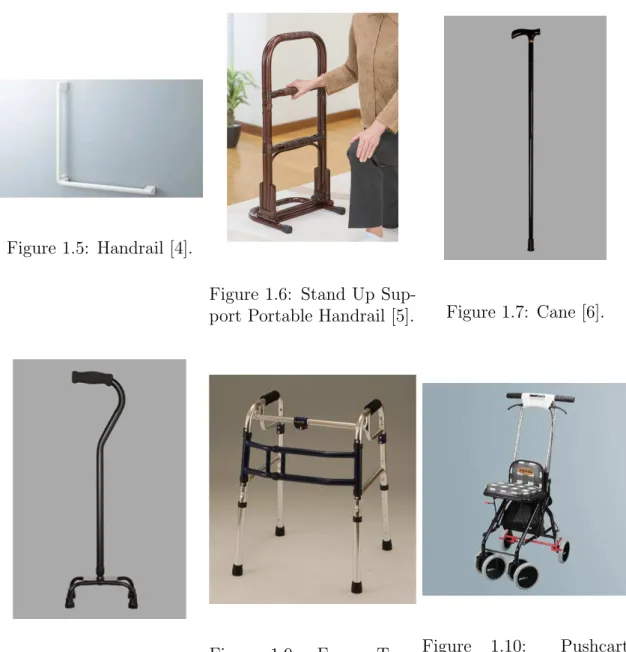
1.5 Handrail [4]. . . 6
1.6 Stand Up Support Portable Handrail [5]. . . 6
1.7 Cane [6]. . . 6
1.8 Multi-legged Cane [7]. . . 6
1.9 Frame Type Walker [8]. . . 6
1.10 Pushcart Type Walker [9]. . . 6
1.11 Wheelchair [10]. . . 7
1.12 Uplift Seat [11]. . . 7
1.13 Electric Actuation Type Uplift Chair [12]. . . 7
1.14 Secom Lift [13]. . . 8
1.15 Power-assisting Device for Independent Transfer [14]. . . 8
1.16 ROBEAR [15]. . . 8
1.17 Self-help Standing-up Device [16]. . . 8
1.18 Self-help Standing-up Device [17]. . . 8
1.19 Electrical Wheelchair [18]. . . 10 1.20 Cycling Wheelchair [19]. . . 10 1.21 Walking Helper [20]. . . 10 1.22 RT Walker [21]. . . 10 1.23 SmartWalker [22]. . . 11 1.24 SmartCane [22]. . . 11
1.25 Walking Support System [23]. . . 11
1.26 Care-O-bot [24]. . . 11
1.27 Walking-aid Robot [25]. . . 12
List of Figures
1.29 RT.1 [27]. . . 12
1.30 RT.2 [28]. . . 12
1.31 Unweighg System NxStep [29]. . . 13
1.32 Lokomat®[30]. . . 13
1.33 Andago®[31]. . . 13
1.34 NILTWAMOR [32]. . . 13
1.35 FLORA TENDER [33]. . . 13
1.36 HAL [34]. . . 14
1.37 Wearable Walking Helper (WWH) and Intelligent Passive Cane (IP Cane) [35]. . . 14
1.38 Lumbar Assistive Orthosis [36]. . . 14
1.39 Self-reliance Support Robot [37]. . . 14
1.40 Rehabilitation Robotic Walker [38]. . . 14
1.41 NAO [39]. . . 15
1.42 Pepper [40]. . . 15
1.43 RoBoHoN [41]. . . 16
1.44 PARO [42]. . . 16
1.45 Communication Robot for the Watching System [43]. . . 16
1.46 Wearable Ground Reaction Force Sensor [44]. . . 17
1.47 Intelligent Cane Using Camera [45]. . . 17
1.48 RT Walker and Human Link Model [46]. . . 18
1.49 Posture Estimation of Walking-aid Robot Using Wearable Sensors [25]. 18 1.50 Evidence for Answers [47]. . . 21
1.51 LED Light Gaze of Robot [48]. . . 21
1.52 Outline of the Dissertation. . . 25
2.1 CoG Calculation Using Human Link Model . . . 30
2.2 CoG Candidates . . . 30
2.3 Accountable System Design Concept . . . 34
3.1 Human Link Model . . . 39
3.2 CoG of a Link . . . 39
3.3 CoG of Human Body . . . 40
3.4 Measurement Sets . . . 40
3.5 3 + 1 Link Closed Chain. . . 41
3.6 Measurement Sets (CoG Can Be Calculated.) . . . 41
3.7 Calculation of CoG Candidates (1a) . . . 44
3.8 CoG Candidates (Sitting, 1a) . . . 46
3.9 CoG Candidates (Sitting, 2b) . . . 46
3.10 Maximum Error of Candidates . . . 47
3.11 PSD (GP2Y0E03) . . . 49
3.12 LRF (UBG-04LX-F01) . . . 49
3.13 IMU (LSM9DS0) . . . 49
List of Figures
3.15 CoG Candidates of Sitting (1a) . . . 51
3.16 CoG Candidates of Sitting (2b) . . . 51
3.17 CoG Candidates of Standing (1a) . . . 52
3.18 CoG Candidates of Standing (2b) . . . 52
3.19 Time Variation of Maximum Error of CoG Candidates . . . 53
3.20 Time Variation of Maximum Error of CoG Candidates of Y and Z Direction (Sitting) . . . 54
3.21 Time Variation of Maximum Error of CoG Candidates of Y and Z Direction (Standing) . . . 54
3.22 Hausdorff Distance . . . 55
3.23 Area Ratio and Hausdorff Distance (Sitting) . . . 56
3.24 Area Ratio and Hausdorff Distance (Standing) . . . 57
4.1 Developed Assistive Robot (Left: Lowest Armrest, Right: Highest Armrest) . . . 61
4.2 Human Link Model and Assistive Robot with Coordinate Frame . . . 61
4.3 Users’ Data Which Can Be Calculated by Using the Developed As-sistive Robot (Black Points: Position Measured Points, Black Lines: Position Determined Links, and Grey Dash Circles: Candidate Posi-tions of Joints, Grey Dash Lines: Representative Candidate Links) . . 64
4.4 Calculation Procedure of CoG Candidates . . . 65
4.5 8 Groups of CoG Candidates with Human Link Model . . . 67
4.6 Enlarged Views of 8 Groups of CoG Candidates (Y-Coordinate of An-kle Joint Is Assumed 0∼−350 mm) . . . . 67
4.7 Parts of the CoG Candidates (Representative Candidates Are Empha-sized by Symbols) . . . 68
4.8 Utilized Features on the State Estimation . . . 69
4.9 Pixels for Calculation of Integral Value of the CoG Candidates . . . . 69
4.10 Sit-to-Stand Motion (Participant B) . . . 70
4.11 Time Variation of the Quantities of Groups Which Show Each State as the Estimation Result . . . 71
4.12 Time Variation of Estimated State (Participants A and B) . . . 72
4.13 Time Variation of Estimated State (Participants E and I) . . . 75
5.1 Example of System and Stakeholders. . . 81
5.2 AI Robot System. . . 81
5.3 Stakeholder-Interface Relationship. . . 86
5.4 Example of State Machine Diagram. . . 86
5.5 Examples of Activity Diagram. . . 90
5.6 Example of Sequence Diagram. . . 90
List of Figures
6.1 Overview of the first experiment. The experimenter determines the user’s leaning motion and sends a command to start the stand support
function of the robot. . . 100
6.2 Guidance and support procedure (pattern 2.) (a) User is sitting; (b) armrest start uprising at beginning of leaning. . . 101
6.3 Guidance and support procedure (pattern 14.) (a) Verbal guidance “let’s stand up” when user is sitting; (b) beginning of leaning; (c) verbal guidance “3, 2, 1” at end of leaning; (d) armrest start uprising after verbal guidance. . . 103
6.4 SUS score for each guidance pattern. The blue lines are the average of SUS scores for each guidance patterns. The black bars indicate the standard deviations. . . 104
6.5 Time variation of estimated state (participant J.) Background colors represent the actual state. Blue: sitting; yellow: leaning; green: leaned. The purple points indicate the estimated state. . . 107
6.6 Overview of the last experiment. Chairs and a bed are put on the experimental area. . . 108
6.7 Pictures of chairs and a bed. (a) Chair 1; (b) chair 2; (c) chair 3; (d) chair 4; (e) chair 5; (f) bed. . . 109
6.8 Experimental setup. Participants sit and stand from all chairs and bed using the robot. . . 110
6.9 SUS scores. Blue, orange, grey, yellow, aqua, and green lines are aver-age SUS scores for chair 1, 2, 3, 4, 5, and bed, respectively. The black bars show the standard deviations. . . 111
7.1 Activity Diagrams. . . 117
7.2 Sequence Diagram. . . 118
7.3 Use Case Diagram. . . 118
7.4 Investigation Interface. . . 121
7.5 Overall View of User Interface. . . 121
7.6 Upper Part of User Interface. . . 122
7.7 Lower Part of User Interface. The animation consist of four figures which appear in order of (a) to (d). . . 122
7.8 Questionnaire of Failure Detection Experiment Using the User Interface.128 7.9 Overview of Failure Detection Experiment Using the User Interface. . 128
7.10 Overview of the Investigation Interface for the Validation Experiment. 130 A.1 Calculation of CoG (A) . . . 155
A.2 Calculation of CoG Candidates (1b) . . . 157
A.3 Calculation of CoG Candidates (1c) . . . 158
A.4 Calculation of CoG Candidates (2a) . . . 159
A.5 Calculation of CoG Candidates (2b) . . . 160
A.6 Calculation of CoG Candidates (2c) . . . 161
List of Figures
A.8 CoG Candidates (Sitting, Pattern 1a) . . . 163
A.9 CoG Candidates (Sitting, Pattern 1b) . . . 163
A.10 CoG Candidates (Sitting, Pattern 1c) . . . 164
A.11 CoG Candidates (Sitting, Pattern 2a) . . . 164
A.12 CoG Candidates (Sitting, Pattern 2b) . . . 164
A.13 CoG Candidates (Sitting, Pattern 2c) . . . 165
A.14 CoG Candidates (Sitting, Pattern 2d) . . . 165
A.15 CoG Candidates (Standing, Pattern 1a) . . . 165
A.16 CoG Candidates (Standing, Pattern 1b) . . . 165
A.17 CoG Candidates (Standing, Pattern 1c) . . . 166
A.18 CoG Candidates (Standing, Pattern 2a) . . . 166
A.19 CoG Candidates (Standing, Pattern 2b) . . . 166
A.20 CoG Candidates (Standing, Pattern 2c) . . . 166
A.21 CoG Candidates (Standing, Pattern 2d) . . . 167
A.22 CoG Candidates (Walking, Pattern 1a) . . . 167
A.23 CoG Candidates (Walking, Pattern 1b) . . . 167
A.24 CoG Candidates (Walking, Pattern 1c) . . . 167
A.25 CoG Candidates (Walking, Pattern 2a) . . . 168
A.26 CoG Candidates (Walking, Pattern 2b) . . . 168
A.27 CoG Candidates (Walking, Pattern 2c) . . . 168
A.28 CoG Candidates (Walking, Pattern 2d) . . . 168
A.29 Maximum Error of CoG Candidates. . . 169
A.30 CoG Candidates of Sitting (1a) . . . 169
A.31 CoG Candidates of Sitting (1b) . . . 169
A.32 CoG Candidates of Sitting (1c) . . . 170
A.33 CoG Candidates of Sitting (2a) . . . 170
A.34 CoG Candidates of Sitting (2b) . . . 170
A.35 CoG Candidates of Sitting (2c) . . . 170
A.36 CoG Candidates of Standing (1a) . . . 171
A.37 CoG Candidates of Standing (1b) . . . 171
A.38 CoG Candidates of Standing (1c) . . . 171
A.39 CoG Candidates of Standing (2a) . . . 171
A.40 CoG Candidates of Standing (2b) . . . 172
List of Tables
3.1 List of Sensor and User Information . . . 42 3.2 Range of Joints . . . 44 3.3 Specifications of Distance Sensor . . . 49 3.4 Specifications of Laser Range Finder . . . 49 3.5 Specifications of IMU . . . 49 4.1 Specifications of Developed Assistive Robot . . . 62 4.2 State Estimation Accuracy (Participant A) . . . 73 4.3 State Estimation Accuracy (Participant B) . . . 73 4.4 State Transition Time Error . . . 74 6.1 Guidance and support patterns. . . 102 6.2 Basic information of the participants. . . 103 6.3 State transition time. . . 106 7.1 Selecting Media for Each Information . . . 121 7.2 User Interface Patterns of Validation Experiment . . . 123 7.3 Frequency Distribution of the Questionnaires (UI Pattern O) . . . . 1241
7.4 Frequency Distribution of the Questionnaires (UI Pattern O) . . . . 1242
7.5 Frequency Distribution of the Questionnaires (UI Pattern O) . . . . 1243
7.6 Frequency Distribution of the Questionnaires (UI Pattern O) . . . . 1254
7.7 Frequency Distribution of the UI Patterns Ranking . . . 125 7.8 Failure Detection Result (UI). . . 129 7.9 Failure Detection Result (Investigation Interface). . . 131
Chapter 1
Introduction
Recent aging population increases the demand for support systems, and various robotic systems have been developed to meet this demand. Care robots are required to provide better support using their machine power and sensing technology, for example, supporting in appropriate way depending on the user situations. User state estimation is also useful to detect anomaly for preventing accidents. However, accurate state estimation requires a lot of expensive sensors and it is difficult to use the system in real environment. Autonomous robots in elderly care raise additional problems. Autonomous systems are opaque for humans and humans become anxious and scared if such systems work closely with them. It is also difficult to investigate and fix system failures in such systems.
In this dissertation, we propose the system design for care robots. To realize the care robots in real environment, there are several challenges including cost and ease of mind. These challenges should be solved in designing step. Not only hardware and software but also people who relate to the robot and use cases should be considered.
Chapter 1: Introduction
1.1
Background
In recent years, the populations are aging all over the world, especially in developed nations. There are same tendencies in developing nations and the world’s population aging will continue. Japan is the world’s fastest aging country. According to 2018 annual report [1] on the aging society of Cabinet Office, Government of Japan, whole population of Japan is 126.44 million people at the date of 1th of October, 2018 as shown in Figure 1.1. The number of aged 65 and older are 35.58 million and the rate is 28.1%. Decreasing of age-adjusted mortality rate and total fertility rate is the main reason of the rapid aging of population. Male and female age-adjusted mortality rate of Japan were 23.6 and 18.3 in 1947, whereas they become 4.7 and 2.5 in 2017. Japanese total fertility rate is 1.43 in 2019, which is much smaller than the replacement-level fertility (2.07 in 2017). Living environment and diet habit improvement and advance in medical and healthcare technology are considered the reason of aging population.
The number of households with persons aged 65 and over is 23.787 million in 2017 in Japan, and it is 47.2% of all households. The rate of households consisting only of elderly (one-person households and married-couple households) is more than half of them. It causes a problem that elderly have to look after another elderly. It is hard to care elderly person for one young person, even more so for elderly one since they often have not enough power. It goes without saying that it is much harder for elderly person who have physical weakening to live alone. Aging population means that there are not enough young people to care elderly, thus it causes staff shortage in the elderly care sector. Therefore, the demands for machines and robots for caring
Chapter 1: Introduction
Figure 1.1: Changes of Aging and Population Projection [1].
has been increasing.
However, care robots have not become common in general households and welfare facilities. Cabinet Office, Government of Japan reported the special poll about care robots in 2013 [2]. The respondents answered several questionnaires including impor-tant point for adopting a care robot. According to the report, 74.4% of respondents answered “simplicity of use” as an important point for adopting a care robot as shown in Figure 1.2. And second most important point is “low price”, which is considered important by 68.6% of respondents. The report suggest that usability, price, safety, size, and reputation are import point of care robots for caregivers and care recipients. Therefore, care robots should be affordable while they are high functional at the same time to be used in real environment. And many caregivers and care recipients are
Chapter 1: Introduction 0.0 10.0 20.0 30.0 40.0 50.0 60.0 70.0 80.0 Simplicity of Use Low Price Safety Certification Care Insurance Insurance for Injured User Simplicity of Maintenance Size Recommendation by Goverment Reputation Record of Sales of Company Fame of Sales Company Design Seen on Commercial Others None Don't Understand
Percentage of Answer [%] (multiple answers allowed)
Figure 1.2: Important Point for Adopting a Care Robot. (The graph is made base on the data of the special poll about care robots [2].)
worried whether they can use robots. Hence the robot should be useful and comfort for users and caregivers.
1.2
Related Researches
1.2.1
Care Robot
With aging population, the accident of elderly also increases. According to Tokyo Fire Department [3], the number of elderly patients urgently transported by ambulance is 81, 952 people in 2018, increased by 15, 930 from 2014 as shown in Figure 1.3. Over 80% accident is tumbling as shown in Figure 1.4, and over 50% of the falling
Chapter 1: Introduction 66,022 68,122 72,198 76,889 81,952 0 10,000 20,000 30,000 40,000 50,000 60,000 70,000 80,000 90,000 2014 2015 2016 2017 2018 N um be r of P at ie nt s [p eo pl e] Year [year]
Figure 1.3: The Number of Elderly Pa-tients Urgently Transported by Ambu-lance. (The graph is made base on the data provided by Tokyo Fire Department [3].) Tumbling 260,433 81.7% Falling 33,987 10.7% Chocking 8,436 2.6% Clashing 6,285 2.0% Drowning 2,809 0.9% Cutting 2,735 0.9% Being Sandwiched 1,674 0.5% Being Bited1,197 0.4% Burn 1,046 0.3%
Figure 1.4: Accident Type. (The graph is made base on the data provided by Tokyo Fire Department [3].)
accident are happened indoor. For those reasons, the demands for physically assistive machines have increased.
Various types of physically assistive tools and machines have developed for el-derly. Handrails are the most popular equipment for standing and walking, thus not only welfare facilities but also general house adopt them in recent years as shown in Figure 1.5. Portable type handrails are also developed for traditional house holds as shown in Figure 1.6. One of the most famous walking care tool is cane as shown in Figure 1.7, and multi-legged type is developed for stability as shown in Figure 1.8. As more stable walking assist tools, several types of walkers are developed including frame type walker and push type walker as shown in Figure 1.9 and Figure 1.10, re-spectively. Wheelchair (Figure 1.11) is also popular for elderly and people who have disabilities in lower limbs. Those machines consist of simple frames, casters, and wheels, thus there are some risks including unintended acceleration and tumbling of the machines. To pretend accidents and provide better support, care robots have
Chapter 1: Introduction
Figure 1.5: Handrail [4].
Figure 1.6: Stand Up
Sup-port Portable Handrail [5]. Figure 1.7: Cane [6].
Figure 1.8: Multi-legged Cane [7].
Figure 1.9: Frame Type Walker [8].
Figure 1.10: Pushcart Type Walker [9].
been developed.
Standing up is one of the most difficult motion for elderly. Elderly have disability not only in their lower limbs but also upper body. Then it is difficult for them to stand up using assistive tools including handrails. Assisting lifting power by using a kind of actuators is effective for standing support. Uplift seat (Figure 1.12) is a simple standing support tool which utilize springs and dumpers. Electric actuation
Chapter 1: Introduction
Figure 1.11: Wheelchair [10].
Figure 1.12: Uplift Seat [11].
Figure 1.13: Electric Ac-tuation Type Uplift Chair [12].
type uplift chairs are also developed as shown in Figure 1.13. SECOM co., ltd. developed “Secom Lift” (Figure 1.14) based on robot technology [13]. It have sensors on lifting part to keep user posture and detect anomaly. Standing support system which can use by elderly oneself without caregiver has been studied. Nagai et al. developed wire-driven standing assisting device [14] as shown in Figure 1.15. It has not only power assist function and also motion guidance for self-reliant motion and keeping posture. RIKEN developed the nursing care robot “ROBEAR” [15] which can lift patient with two arms as shown in Figure 1.16. Robots have advantages in massive power and sensing systems. Analyzing sit-to-stand motion is also important for standing support and robot technology contribute the analysis. Hatsukari et al. developed relatively compact system [16, 17] to analyze the motion and proposed method to select standing way considering physical loads.
Walking assist is another main concern of physical assistive robots. Electrical wheelchair (Figure 1.19) is one solution of elderly mobility problems. Although it is effective as a mobility, the users lower limbs decay since don’t move them. Thus cycling wheelchairs (Figure 1.20) are studied [19, 49, 50]. It is particularly effective
Chapter 1: Introduction
Figure 1.14: Secom Lift [13].
Figure 1.15: Power-assisting Device for Independent Transfer [14].
Figure 1.16: ROBEAR [15].
Figure 1.17: Self-help Standing-up Device [16].
Figure 1.18: Self-help Standing-up Device [17].
for hemiplegia patients. And there are many researches which focus on robotic walk-ers. Hirata et al. developed human adaptive walking support system called “Walking Helper” [20, 51] which is shown in Figure 1.21. It has omni-directional moving mech-anism and force sensors. “RT Walker (Robot Technology Walker)” is passive type walking assist robot which is shown in Figure 1.22, and it is developed by Hirata et al [21, 46, 52]. It adopted servo brakes and there are no motor thus basically it
Chapter 1: Introduction
moves only by human force. Dubowsky et al. developed walker type and cane type walking support systems named “PAMM (Personal Aid for Mobility and Monitor-ing)” [22, 53, 54] as shown in Figure 1.23, Figure 1.24. The systems are developed for using indoor space in general household and welfare facilities. They measure user’s force data and environmental information by using 6-axis torque sensor and CCD camera, respectively. Hitachi, ltd. also developed walking support system as shown in Figure 1.25 which have two independent wheels [23,55]. The wheels move based on force sensor data. “Care-O-bot” (Figure 1.26) is intelligent walking support system developed by Feaunhofer IPA [24, 56, 57]. It can not only support walking but also elementary cleaning, table setting, and bring objects which is requested by humans. Huang et al. developed “Walking-aid Robot” [25] and “Intelligent Cane” [26] for walking assist which are shown in Figure 1.27 and Figure 1.28, respectively. Intelli-gent Cane has Laser Range Finder (LRF) to measure user’s lower limbs. It also has force senor, and by using wearable sensors on shoes, it can detect user falling and estimate user intend. Assistive robot walker “RT.1” [27] and “RT.2” [28] which are shown in Figure 1.29 and Figure 1.30, respectively, are developed by RT.WORKS co., ltd. They can control speed and automatically stop on slope when user unhand the system. The robots have network system for healthcare and watching by family, doctors, and caregivers.
Body weight support using harness and wires is another focused way to support standing and walking. Body weight-Support Treadmill Training (BWSTT) is fa-mous as an effective rehabilitation method[58, 59]. SAKAI Medical Co., Ltd. has developed Unweighg System NxStep [29]. It can automatically adjust the amount of body-weight support. Lokomat®is a body weight-support gait training system
Chapter 1: Introduction
Figure 1.19: Electrical Wheelchair [18]. Figure 1.20: Cycling Wheelchair [19].
Figure 1.21: Walking Helper [20]. Figure 1.22: RT Walker [21].
developed by Hocoma [30, 60]. Hocoma also developed body weight support walker named Andago®[31]. Ochi et al. developed NILTWAMOR, a body weight support walker which can keep wire tension [32]. Osaki et al. adopted Support Vector Ma-chine (SVM) for user state estimation of body weight support walker named FLORA TENDER [33].
Chapter 1: Introduction
Figure 1.23: SmartWalker [22]. Figure 1.24: SmartCane [22].
Figure 1.25: Walking Support System
[23]. Figure 1.26: Care-O-bot [24].
Wearable robots are also studied extensively for walking support. HAL®(Hybrid Assistive Limb®) is one of the most famous robot suit which is developed by CY-BERDYNE, INC. [34, 61, 62]. It is controlled based on the muscle potential of the user. Suzuki et al. also studied wearable walking assist robot [63]. They also use cane-type walking support robot and proposed cooperation method of them [35, 64]
Chapter 1: Introduction
Figure 1.27: Walking-aid Robot [25].
Figure 1.28: Intelligent Cane [26].
Figure 1.29: RT.1 [27]. Figure 1.30: RT.2 [28].
as shown in . Piriyakulkit et al. developed Lumbar Assistive Orthosis as a standing and walking support wearable robot [36].
Many support systems focus on either sit-to-stand motion or walking. However, systems which can support both standing and walking are effective especially for indoor use. Hence multi-legged canes which are equipped with handle on low have
Chapter 1: Introduction
Figure 1.31: Unweighg System NxStep [29].
Figure 1.32: Lokomat®[30]. Figure 1.33: Andago®[31].
Figure 1.34: NILTWAMOR [32]. Figure 1.35: FLORA TENDER [33].
developed. Figure 1.39 shows self-reliance support robot developed by Panasonic Corporation, and it is one of those which can support both standing and walking [37, 65]. Chugo et al. also study standing and walking support system for rehabilitation [38] as shown in Figure 1.40.
Physical disability is not only issue for elderly care. There are various tasks for care including physical assist of walking, standing, and bathing, excretion assistance, meal assistance, cooking, serving, changing linens, and holding recreations. Thus
Chapter 1: Introduction
Figure 1.36: HAL [34].
Figure 1.37: Wearable Walking Helper (WWH) and Intelligent Passive
Cane (IP Cane) [35]. Figure 1.38: Lumbar Assis-tive Orthosis [36].
Figure 1.39: Self-reliance Support Robot [37]. FigureRobotic Walker [38].1.40: Rehabilitation
communication, office works, and watching are important as well as physical elderly assistance. Socially assistive robotics (SAR) is an important area of elderly care.
Communication is one of main topics of SAR. “NAO” is one of the most famous communication robots which is developed by Aldebaran Robotics SAS [39]. It is small humanoid robot which can dance and talking. It is also used for teaching radio exercise to kids and elderly. SoftBank Robotics Corp. (formerly Aldebaran Robotics) developed semi-humanoid robot “Pepper” [40]. It has a display on its
Chapter 1: Introduction
Figure 1.41: NAO [39].
Figure 1.42: Pepper [40].
breast and people can select applications. It behave as it has a kind of emotion, thus it can relatively naturally communicate with humans. Sharp Corporation developed humanoid robot RoBoHoN, which also can talk and dance [41, 66]. The robot can look after the house instead of humans. The therapeutic medical robot, “PARO”, is a seal type animal robot which is developed by National Institute of Advanced Industrial Science and Technology (AIST) [42, 67]. It is developed based on the idea of animal-assisted therapy. It has several types of sensors including tactile, light, and audio sensors. Effectiveness for autism and dementia of PARO have gotten a lot of attention.
Healthcare and watching is important for elderly care since caregivers cannot always stay together. There are some watching system using indoor mounted sensors [68, 69]. Yoshino et al. developed watching system using a conversational robot [70]. Takahashi et al. also developed elderly watching robot as shown in Figure 1.45 and validate the appropriate functions for the robot [43]. The robot can detect anomaly from daily conversations. The network system of RT.1 and RT.2 let not only users but also family and caregivers to check user walking [27,28] using the walking support
Chapter 1: Introduction
Figure 1.43: RoBoHoN
[41]. Figure 1.44: PARO [42].
Figure 1.45:
Communication Robot for the Watching System [43].
robot. It also can alert user anomaly to family and caregivers.
1.2.2
State Estimation
It is important for both physically assistive robots and communication robots to obtain information of user. If robots can recognize user situation, action, state, emo-tion, and so on, the robots can select appropriate action for them. It is important for physically assistive robots to provide appropriate support depending on the situa-tion. Real-time user state estimation is also effective to detect user anomaly including falling for preventing accidents.
There are various way to measure or estimate human information. Motion capture systems are famous human motion measurement systems which often use optical information. Ground reaction force is useful information of humans especially for walking analysis. Generally, ground reaction force is measured by using force plates. Center of Pressure (CoP) can be also calculated by using force information [71– 73]. Force plate is huge and expensive, thus there is a limitation for installation location. Then more small and inexpensive sensors are including shoe-type reaction force sensors have been developed. Liu et al. made shoe sole type reaction force
Chapter 1: Introduction
Figure 1.46: Wearable Ground Reaction Force Sensor [44].
Figure 1.47: Intelligent Cane Us-ing Camera [45].
sensor [44] as shown in Figure 1.46, and Woodburn developed wearable sensors which is set in shoes [74]. For gait analysis, acceleration is also important, thus Morita et al. install accelerometer on wearable ground reaction sensing system [75]. Muscle potential is useful for human motion analysis including gait [76], and some researchers also use visual information by using cameras [45] as shown in Figure 1.47. Center of Gravity (CoG) and Center of Mass (CoM) are also useful to estimate human state. Moe-Nilssen et al. analyzed human gait by using Inertial Measurement Unit (IMU) [77]. They set IMUs on the third lumber vertebra (L3) and second sacral vertebra (S2) where are strongly sensitive to CoG.
These measurement and estimation methods are adopted to care robots. Many communication robots use light and auditory information to estimate user words and intention. Force information is also useful to estimate user posture, state, and intention. Some walking support robots use force information as user intention and determine the direction to walk. It is also used to detect anomaly. Human CoG
Chapter 1: Introduction
Figure 1.48: RT Walker and Hu-man Link Model [46].
Figure 1.49: Posture Estimation of Walking-aid Robot Using Wearable Sensors [25].
position is useful to estimate human state, for example, user is going to fall if the projected point of CoG is out of base of support. There are several ways to estimate human CoG position. By using human link model, complicated human body can be considered as simplified model. The human CoG position can be calculated by measuring all link positions. Link positions can be measured by using motion capture system, a kind of distance sensors including Laser Range Finder (LRF) and Position Sensitive Detector (PSD), and IMUs [46,78,79]. RT Walker use two LRFs to calculate human link model [46] and Walking-aid Robot use five IMUs as wearable sensors in addition to the robot [25] as shown in Figure 1.48 and Figure 1.49, respectively.
There has been interest in machine learning and deep learning algorithms for state estimation. On-body sensors such as accelerometers are frequently used for human activity estimation [80, 81]. Vision-based estimation has received a lot of attention. Convolutional Neural Network is one of the most famous methods for human pose estimation [82, 83]. The user state is generally evaluated for anomaly detection or robot function changes [84, 85]. User state, action, and intent can be used for motion
Chapter 1: Introduction
control [86–88]. Anomaly detection can be used for accident prevention. Thus state estimation is also useful for improving safety. Accumulation of estimated data can be used for care monitoring and deep learning.
1.2.3
Transparency
Not only high functionality and safety but also usability and ease of mind are impor-tant issues of machines and robots, especially care robots. It is difficult for humans to understand the actions, plans, and behavior of autonomous robots and the reasons be-hind them, particularly when the robots include learning algorithms. Learning-based autonomous systems which are called Autonomous Intelligence (AI) are treated as an inherently untrustworthy “black box”, because machine learning or deep learning algorithms are difficult for humans to understand. Robot systems such as assis-tive robots, which work closely with humans, however, should be trusted. Physical human-robot interaction comes with safety risks, and therefore humans become anx-ious when they do not understand them. It is difficult for humans to cooperate with or rely on such robots to support human actions. When a person is carrying out a task that involves cooperation with other people, the task cannot be completed well if they cannot communicate with each other. Communicating is much more diffi-cult in human-robot interactions than in human-human interaction. Humans become anxious if they cannot understand the actions of robots. People feel uncomfortable consigning health care tasks to robots that are perceived as unpredictable. Learning-based robots that interact with humans need to clearly present their safety-critical actions, states, plans, and reasons for acting.
Chapter 1: Introduction
making AI transparent by representing the reasons for decisions [47, 93] can provide some understanding of learning algorithms, however, these methods cannot make all algorithms transparent for ordinary people. Hosseini et al. made original modeling language to achieve transparency for information systems [94]. Transparency of sys-tem is often studied in the computer vision and AI fields, and autonomous robot also should deal with this ethical issue.
If robots detect an anomaly, they usually stop their operations and alert users. Such alerts are useful to draw attention to the anomaly, and are effective for letting users know why robots have stopped operating. Representation of a robot’s actions or plans is effective under both normal and abnormal operating conditions. If a robot has many functions, humans are unable to understand the robot’s action and plan without representation, even if the system does not include learning algorithms. Song et al. set LED to represent robot state to the surrounded humans [48]. Novikova et al. study representation of artificial emotions in human-robot interaction [95]. Teaching robots also enables users to learn which actions are required of them [96]. If robot systems include learning algorithms, the system is more opaque for humans. Representation of recognition or estimation results, as well as asking humans for confirmation, facilitate the robot’s tasks [97]. Confirmation of tasks which are ordered by humans can reduce the number of mistakes [98, 99].
Adopting robots that use learning algorithms raises additional problems. It is dif-ficult to investigate and fix system failures in systems with “black boxes”. It is also difficult to decide who is responsible in such cases. Complicated autonomous systems should also clarify the boundaries of responsibility. Learning-based robot systems should therefore be designed based on ethical principles. Ethical design has been
Chapter 1: Introduction
Figure 1.50: Evidence for Answers [47].
Figure 1.51: LED Light Gaze of Robot [48].
discussed in various fields such as telehealth [100] and the Internet of Things (IoT) [101]. The IEEE Global Initiative on Ethics of Autonomous and Intelligent Systems has published Ethically Aligned Design, First Edition [102], which discusses gen-eral principles for autonomous and intelligent systems, including human rights, data agency, transparency, and accountability. Ethically aligned design for autonomous and intelligent systems has been discussed elsewhere [103], and its importance for assistive robots is also suggested [104].
1.3
Objectives
Systems in real environment is required to reduce costs, however, robot systems are also required to be high functional. User state estimation is important for care robots, however, accurate estimation requires a lot of expensive sensors. To obtain informa-tion from less sensor than required makes robots affordable. Autonomous robots should be transparent for humans from the perspective of usability and ease of mind. Autonomous robots raise another problem that it is difficult to investigate and fix
Chapter 1: Introduction
system failures in systems with black boxes. Hence care robots should achieve ac-countability for various types of people who relate to the robot.
There are some researches focusing on state estimation using a small number of sensors or transparency of robots. However, the researches focused on specific situations for specific robots, aiming to improve system efficiency. It is important to consider system affordability and accountability at design step. It is not effective simply reducing sensors to cut cost. It should be designed by considering how selecting and placing sensors influence robot functions. Various types of people including the user and engineers relate to a robot by each reason. Those people who relate to system are called stakeholders and how to achieve accountability differs for each stakeholder. We should design as the whole system including how to relate as well as hardware and software. In the fields of medical technology, the importance of needs finding considering use cases and stakeholders is pointed [105]. The design procedure including repetition of inventing and screening is discussed. However, it is not concrete method, and detailed methods of sensor choosing and consideration of use cases and stakeholders are not well discussed. Therefore we propose a new general design method for affordable and accountable robots.
The general objective goal of this research is to propose a system design method considering affordability and accountability for care robots which provide physical support based on user state estimation. Specific objectives are as follows:
• Construct a user state estimation method by using a small number of sensors. • Evaluate measurements set and determine the appropriate selecting and placing
sensors.
• Develop a physically assistive robot with user state estimation function.
Chapter 1: Introduction
• Propose a method to achieve transparency for embodied AI.
• Propose a new concept that accurate human state estimations are not
neces-sary for robots and that appropriate guidance make robots useful even if the estimation is not strictly accurate.
• Evaluate the system which is developed according to the proposed design.
1.4
Outline
This dissertation is organized in 8 chapters as follows:
In chapter 2, we propose the concept of system design for affordable and account-able care robots focusing on physically assistive robot with user state estimation.
In chapter 3, we propose CoG candidate calculation method by using a small number of sensors. We classify patterns of selecting and placing sensors and evalu-ate the range of CoG candidevalu-ates. Through experiment we confirmed that the CoG candidates range can be narrow enough. The appropriate measurements set is also determined.
In chapter 4, we propose a user state estimation method using the CoG candi-dates. In this chapter the new calculation method of CoG candidates is proposed and evaluated. The proposed state estimation method which uses SVM is proposed and evaluated by experiments.
In chapter 5, detailed design architecture for accountable robot is explained. Con-tribution to transparency of embodied AI is also explained in this chapter.
In chapter 6, we introduce verbal guidance to sit-to-stand support system to vali-date the effectiveness of robot’s accountability. We confirm that appropriate guidance
Chapter 1: Introduction
make robots useful even if the estimation is not strictly accurate.
In chapter 7, the physically assistive robot developed according to the proposed design is validated by experiment focusing on its accountability of interface. Sev-eral experiments are conducted for simulating a situation for each stakeholder. The experiments validate the system usability and accountability.
Chapter 8 concludes this dissertation with a general discussion about the pro-posed design, state estimation method, and developed system. Future works are also presented based on the conclusions. The dissertation outline is shown in Figure 1.52.
Chapter 1: Introduction
Accountable System Affordable System
Unknown Parameter of Link Model and Measurements Set
CoG Candidate Calculation Method Calculation Experiment
Using Motion Capture System Calculation Experiment
Using a Few Simple Sensors Chapter 3: CoG Candidate Calculation
State Estimation Using CoG Candidates State Estimation Experiment Using a Robot
Chapter 4: User State Estimation
Describing Whole System Representation of Information
Chapter 5:
Detailed Accountable System Design
Concept
Experiment for Accurate System Experiment for Imperfect System
Chapter 6: Verbal Guidance
Interface Implementation
User Interface Accountability Experiment Failure Detection with User Interface Investigation Interface Validation Experiment
Chapter 7: Interface Implementation and
Validation Experiment Background Related Researches Objectives Chapter 1: Introduction
Affordable System Design Accountable System Design
Chapter 2: Affordable and Accountable
System Design Concept
General Conclusions Future Works
Chapter 8: Conclusion
Chapter 2
Affordable and Accountable
System Design Architecture
2.1
Introduction
Affordability and accountability are required to use robot in real environment, es-pecially in the case of care robots which interact physically with humans. Systems utilizing a lot of expensive and sophisticated sensors are difficult to use in general households or institutions. And there are also privacy problems for using a lot of sensors. Therefore, systems should decrease sensors while keeping high functionality at the same time. To realize it, the method is required to obtain information from small number of sensors.
Robot systems which work closely with humans should achieve accountability. It is difficult for humans to understand the actions, plans, and behavior of autonomous robots and the reasons behind them, particularly when the robots include learning algorithms. Physical human-robot interaction comes with safety risks, and therefore
Chapter 2: Affordable and Accountable System Design Architecture
humans become anxious when they do not understand them.
In this dissertation, we propose a new design architecture care robot systems which include physical human-robot interaction. Following sections explain the design architecture focusing on affordability and accountability, respectively.
2.2
Affordable System Design
Care robots are required to provide better support with their mechanical strength and sensing technology. Compensating for lack of power of elderly is effective, however, there is a safety risk if the robot do not figure out user situation. Therefore user state estimation is important for care robots. User state estimation should be accurate to reduce safety risks, however, it is difficult to realize strictly accurate estimation. More accurate estimation required more expensive and more huge number of sensors. However, systems utilizing a lot of expensive and sophisticated sensors are difficult to use in general households or facilities. And there are also privacy problems for using a lot of sensors. Therefore, systems should decrease sensors while keeping high functionality at the same time.
Affordable robots have been studied for several use including education [106], treatment intervention [107], robot hand [108]. Underactuated robot hand is a famous way to achieve affordability [108, 109]. Elderly care is one of the most familiar use of robots for general people, therefore various affordable care robots are studied [110]. Passive robotics has advantages on affordability as well as safety and simplicity of control [21,46,52]. Robot suit HAL is focused for assisting bathing care [111]. Bathing care by using fixed equipments requires rebuilding, hence robot suit has advantage. Care-O-bot has few like features including an arm, since unnecessary
Chapter 2: Affordable and Accountable System Design Architecture
like robot become expensive [112]. Mayer et al. developed a care robot named HOBBIT considering affordability [113, 114]. For map building and self-localization, it uses a depth camera instead of 2D laser range finder since laser range finders are expensive.
It is important to reduce cost focusing on influence for robot function. Robot parts for unnecessary function are cause of expensiveness, moreover, we cannot reduce them if the robot cannot perform required function without them. Hence state estimation by using small number of sensors is important.
CoG is useful to estimate human state, hence there are several method to measure or estimate CoG position. Motion capture system is famous system to measure human state, and CoG position can also be measured by using it. However, motion capture system is very expensive and usable place is limited. Therefore several method to measure CoG position is studied. Human link model is a way to consider a human body as a simplified model, and human CoG position can be calculated using the link model as shown in Figure 2.1. Hirata et al. adopted LRFs on RT Walker to calculate human link model [46], and Huang et al. use wearable 5 IMUs [25] as shown in Figure 1.48 and Figure 1.49, respectively. Although a LRF is expensive, it can be replaced with several inexpensive distance sensors. These methods are effective, however, accurate CoG position calculation still requires a lot of sensors. And these methods do not consider sensor selection and placement design, hence it is difficult to be applied to other systems.
Accurate CoG position calculation requires a lot of sensors, however, if there are less sensors than required to calculate the link model, we cannot determine the position of CoG uniquely. Then we focused on the range of value of link model’s
Chapter 2: Affordable and Accountable System Design Architecture
CoG of Each Links CoG of Human
Figure 2.1: CoG Calculation Using Human Link Model
CoG Candidates
Figure 2.2: CoG Candidates
unknown parameters. And we propose the CoG candidate calculation method using the range of value of unknown parameters. If the ranges of CoG candidates become narrow enough as shown in Figure 2.2, we can estimate user state. By selecting and placing sensors, the CoG candidates ranges can be reduced. If we can find the appropriate combination of sensors to reduce the ranges of CoG candidates, this knowledge can be used not only for real-time estimation of user state but also for determining where and which sensors to set when designing robots. The detail method is explained in chapter 3.
2.3
Accountable System Design
An aging population increases the demand for support systems, and various robotic systems have been developed to meet this demand. Robotic support systems are ex-pected to not only become alternatives to human caregivers, but also to provide better support, owing to features including mechanical strength, estimation algorithms, and AI technology.
Chapter 2: Affordable and Accountable System Design Architecture
It is possible to comfortably use home electronics or machines without knowing the internal processes of the systems. These machines have limited operations and are controlled by humans. The machines function by following simple conditional decision-making logic, which humans can easily understand. Learning-based systems that include character recognition and recommendation systems also do not require transparency in the sight of trustworthy since there is no safety risk. There are some machines which are not transparent for humans and have safety risks, including vehicles and airplanes. They are generally developed following a kind of system design methods. Such methods mainly focus on performance and safety. The operation interfaces are well designed to decrease mistakes. However, such design methods do not focus on ease of mind. Drivers can control those systems, thus they do not become anxious. Those systems are not transparent for the passengers. They trust the systems since the systems have a good record in safety. And most important point is that such systems do not interact with humans.
AI systems, including autonomous robots that use learning algorithms, however, are difficult for humans to use because they are difficult to understand. Physical human-robot interaction comes with safety risks, and therefore humans become anx-ious when they do not understand them. It is difficult for humans to cooperate with or rely on such robots to support human actions. When a person is carrying out a task that involves cooperation with other people, the task cannot be completed well if they cannot communicate with each other. Communicating is much more diffi-cult in human-robot interactions than in human-human interaction. Humans become anxious if they cannot understand the actions of robots. People feel uncomfortable consigning health care tasks to robots that are perceived as unpredictable.
Learning-Chapter 2: Affordable and Accountable System Design Architecture
based robots that interact with humans need to clearly present their safety-critical actions, states, plans, and reasons for acting.
Adopting robots that use learning algorithms raises additional problems. It is difficult to investigate and fix system failures in systems with “black boxes.” It is also difficult to decide who is responsible in such cases.
Manual brake is a frequently used method to achieve reliability and accountability. Humans can control and stop autonomous machines by using manual brakes when there are safety risks. It can make user feel at ease, and distribution of responsibility become clearer in the case of general machines. In the case of autonomous robots, however, if humans do not understand system, they cannot determine anomaly and cannot feel at ease even if the system works normally. Anxiety and user-unfriendliness of autonomous robot come from lack of knowledge of the robot. Hence transparency is important for accountability of robots.
Knowledge representation is adopted to make systems transparent. If robots de-tect an anomaly, they usually stop their operations and alert users. Such alerts are useful to draw attention to the anomaly, and are effective for letting users know why robots have stopped operating. Representation of a robot’s actions or plans is ef-fective under both normal and abnormal operating conditions. If a robot has many functions, humans are unable to understand the robot’s action and plan without rep-resentation, even if the system does not include learning algorithms. Displaying the robot’s plan helps humans understand the robot’s future actions [115]. Sound is one effective means of knowledge representation [116] and simple LED lights can also rep-resent the robot’s state [48]. These methods are considered useful for learning-based robot systems.
Chapter 2: Affordable and Accountable System Design Architecture
The ability of robots to correctly recognize visual and auditory inputs is not always reliable. Some studies in the computer vision field have addressed the reasoning behind learning-based classifications [47,93]. For robots, both the input-classification relationship as well as the relationship between the classification result and the robot’s action are important. Representation of recognition or estimation results, as well as asking humans for confirmation, facilitate the robot’s tasks [97]. Confirmation of tasks which are ordered by humans can reduce the number of mistakes [98, 99].
When robots interact with humans, both the robot and the user actions are im-portant. If human and robot are cooperating on a task, the robot will work more effectively if there is an understanding of what the human should do. Teaching robots also enables users to learn which actions are required of them [96]. Some researchers also study representation of artificial emotions in human-robot interaction [95].
These studies show that real-time knowledge representation is effective for us-ing robot-based systems, as humans can understand and predict robots’ actions via knowledge representations. Describing the systems in this way has advantages for designing and investigating the systems. Some researchers create original modeling languages to describe their specific systems [94, 117].
Some studies evaluated the construction of accountable robot systems by making their systems transparent; however, almost all studies have focused on the stakehold-ers for their specific systems. Systems design should follow some sort of guideline.
Transparency of learning-based robot system is less frequently discussed, although AI transparency has been discussed in the computer vision and machine learning fields. For physical systems such as robots with AI, the surrounding AI transparency poses other issues as well as those related to the learning algorithm. However, the
Chapter 2: Affordable and Accountable System Design Architecture
Describing Whole System Embodied AI Transparency
Stakeholder
Information Interface
Relationships
List of System Information
Investigation Interface User Interface
Figure 2.3: Accountable System Design Concept
general design architecture for assistive AI robot systems has not been widely dis-cussed.
This paper proposes a design architecture to achieve accountability for learning-based support robot systems. First, the entire system should be described, then the described system should be transcribed for each stakeholder based on several principles to effectively achieve accountability as shown in Figure 2.3. Because each stakeholder requires different information, the entire system should be described to clarify the internal information of robot systems. In this study, we adopt the Systems Modeling Language (SysML) to describe the entire system; the language was created to describe systems and is popular in the systems engineering field.
Describing the system as a whole also contributes to AI transparency. It is dif-ficult to achieve transparency in machine learning or deep learning algorithms and models. However, general systems consist of more than learning algorithms used for recognition or estimation in robot systems. Thus, the input-estimation relationship is opaque for humans. By contrast, the relationship between the decided action of
![Figure 1.1: Changes of Aging and Population Projection [1].](https://thumb-ap.123doks.com/thumbv2/123deta/5897719.1048979/26.892.168.804.172.598/figure-changes-aging-population-projection.webp)
![Figure 1.11: Wheelchair [10].](https://thumb-ap.123doks.com/thumbv2/123deta/5897719.1048979/30.892.156.804.169.478/figure-wheelchair.webp)


![Figure 3.20: Time Variation of Maximum Error of CoG Candidates of Y and Z Direction (Sitting) 0 100 200 300 400 500 0 0.5 1 1.5 2 2.5 3 3.5Maximum Error ofCoG Candidates (y) [mm]](https://thumb-ap.123doks.com/thumbv2/123deta/5897719.1048979/77.892.115.733.199.497/figure-variation-maximum-candidates-direction-sitting-maximum-candidates.webp)

