Relationship between
results
on
degree
sum
conditions for
cycles, paths and
trees
Tomoki
Yamashita*\daggerDepartment
of Mathematics, Kinki University
3-4-1
Kowakae,
Higashi-Osaka, Osaka 577-8502,
Japan.
1
Introduction
In this paper, we consider finite simple graphs, which have neither loops nor multiple
edges. Let $G=(V, E)$ be
a
graph with vertex set $V(G)$ and edge set $E(G)$.
We write$|G|$ for the order of $G$, that is, $|G|=|V(G)|$. We denote by $\deg_{G}(v)$ the degree of
a
vertex $v$ in $G$. We define $\sigma_{2}(G)=\min\{\deg_{G}(u)+\deg_{G}(v):uv\not\in E(G)\}$ if $G$ is notcomplete; otherwise $\sigma_{2}(G)=\infty.$
In 1960, Ore obtained
a
$\sigma_{2}(G)$ condition for Hamiltonicity.Theorem 1 (Ore [10]). Let$G$ be
a
connectedgraphof
orderat least three.If
$\sigma_{2}(G)\geq$ $|G|$, then $G$ is Hamiltonian.After thistheorem, many researchershavegiven $\sigma_{2}(G)$ conditions fortheexistence
of cycles, paths and trees. The purpose of this paper is to investigate the relationship
between such results. In this section, we show well-known results on Hamiltonian
cycles. In Section 2 and Section 3, by using the results,
we
prove the resultson a
spanning treewith
a
constrainton
leaves, and the resultson a
partitioninto vertex-disjoint paths, respectively. The degreesum
conditions in this paperare
sharp ina
sense.
In 1969, Kronk showed that
a
stronger condition than Ore’s condition guaranteesthe existence of a Hamiltonian cycle passing through specified linear forest. A linear
forest
is a graph in which every component is a path.Theorem 2 (Kronk [8]). Let $G$ be
a
graph and let $F$ bea
linearforest
in G.If
$\sigma_{2}(G)\geq|G|+|E(F)|$, then $G$ has
a
Hamiltonian cycle passing through $F.$In 1976, Bermond and Linial, independently, obtained
a
$\sigma_{2}(G)$ condition for thecircumference.
*Email address: yamashitaQmath.kindai.ac.jp
Theorem 3 (Bermond [1], Linial [9]). Let $G$ be
a
2-connected graph. Then $G$ hasa
cycle
of
order at least $\min\{a_{2}(G), |G|\}.$In 1997, Brandt, Chen, Faudree, Gould and Lesniak showed that the
same
con-dition
as
Ore’s condition yieldsa
partition into prescribed number ofvertex disjoint cycles.Theorem 4 (Brandt et al. [2]). Let $k$ be
a
positive integer, and let $G$ be a graphof
order at
teast
$4k$.If
$\sigma_{2}(G)\geq|G|$, then $G$can
be partitioned into $k$ vertex-disjointcycles.
In 2004, Enomoto andLi showed that if$K_{1}$ and $K_{2}$
are
regardedas
cycles, whichare
called degenerated cycles, then the $\sigma_{2}(G)$ condition can be weakened.Theorem 5 (Enomoto and Li [5]). Let$k$ be
a
positive integer, and let $G$ be a graph.If
$\sigma_{2}(G)\geq|G|-k+1$, then $G$can
be parhtioned into $k$ vertex-disjoint cyclesor
degenerated cycles, except $G=C_{5}$ and $k=2.$
In2000, Egawa, Faudree, Gy\"ori, Ishigami, Schelp and Wanggave
a
$a_{2}(G)$ conditionfor each vertex-disjoint cycle of the partition to pass
one
of specified edges.Theorem 6 (Egawa et al. [4]). Let $k$ be
a
positive integer, and let $G$ bea
graphof
order
at least $4k-1$.
If
$\sigma_{2}(G)\geq|G|+2k-2$, thenfor
each $k$ independent edges$e_{1},$$e_{2}$,
. .
.
,$e_{k},$ $G$ can be partitioned into $k$ vertex-disjoint cycles $C_{1},$$C_{2}$,.
.
.
,$C_{k}$ suchthat $e_{i}\in E(C_{i})$
.
Theorem 7 (Egawa et al. [4]). Let $k$ be a positive integer, and let $G$ be
a
graphof
order at least$3k$
. If
$\sigma_{2}(G)\geq|G|+k$, thenfor
each $k$ independent edges $e_{1},$$e_{2}$,.
.
.
,$e_{k_{f}}$ $G$can
be partitioned into $k$ vertex-disjointcyclesor
degenerated cycles$D_{1},$ $D_{2}$,,. .
,$D_{k_{f}}$such that $e_{i}\in E(D_{i})$
.
Finally, we show
a
degreesum condition for Hamiltonicityin directed graphs. Let$D=(V, A)$ be
a
directed graph (digraph) with vertex set $V(D)$ andarc
set $A(D)$.
We denote by $\deg_{D}(v)^{+}$ and $\deg_{D}(v)^{-}$ the out-degree and in-degree of
a
vertex $v$ in$D$, respectively. In 1972, Woodall gave
a
in-degree and out-degreesum
condition forHamiltonicityof digraphs.
Theorem 8 (Woodall [12]). Let$D$ be
a
digraphof
order at least three.If
$\deg_{D}(u)^{+}+$ $\deg_{D}(v)^{-}\geq|D|$for
$uv\not\in A く D$), then $D$ hasa
directed Hamiltonian cycle.2
Spanning trees
with
a
constraint on
leaves
In this section,
we
show that the results in the previous section imply the results onA Hamiltonian path
can
beviewed
as
a
spanning tree with two leaves.As
a
gener-alization ofit,we
can
considera
spanning tree with few leaves. For $k\geq 2$,a
$k$-endedtree is a tree with at most $k$ leaves. On the other hand,
a
concept ofHamiltonian-connectedcanbeviewed
as a
spanningtree whose two specified verticesare
theleaves.For $k\geq 2$,
a
graph $G$ is $k$-leaf
connected if for each subset $S$ of$V(G)$ with $|S|=k,$ $G$has aspanning tree such that $S$ is the set ofthe leaves.
Theorem 9 $($Broersma $and$ Tuinstra $[3|, Ore [10, 11],$ Gurgel $and$ Wakabayashi $[7])$
.
Let $k$ be
an
integer with$k\geq 2$, and let $G$ be a connected graph.(1)
If
$\sigma_{2}(G)\geq|G|-k+1$, then $G$ hasa
spanning $k$-endedtree.
(2)
If
$\sigma_{2}(G)\geq|G|-1$, then $G$ hasa
Hamiltonian path.(3)
If
$\sigma_{2}(G)\geq|G|+1$, then $G$ is Hamiltonian-connected.(4)
If
$\sigma_{2}(G)\geq|G|+k-1$, then $G$ isk-leaf-connected.
We prove Theorem
9
(1) by using Theorem3
or
Theorem5.
First proof of Theorem 9 (1). Let $H$ be
a
graph obtained from $G$ by addinga
vertex $v$ and by joining $v$ and all vertices of$G$
.
Then $H$ is 2-connected and $\sigma_{2}(H)\geq$$|G|-k+1+2=|G|-k+3$
. By Theorem 3, $H$ hasa
cycleoforder at least $|G|-k+3.$ Hence $G$can
be partitionedintoa
path of order at least $|G|-k+2$ and at most $k-2$isolated vertices (see Fig. 1).
–
$arrow$ $o\circ$ $\cdots$ $\circ 0$
Figure 1: A spanning $k$-ended tree in the first proof
Since
$G$ is connected,we
can
obtaina
spanning $k$-ended tree from the partitionby adding edges connecting the components. $\square$
Second proof of Theorem 9 (1). ByTheorem5, $G$
can
be partitioned into$k$vertex-disjoint cycles
or
degenerated cycles (see Fig. 2).$OO\cdots O$
$arrow$
$arrow 0$
. .
. .
$arrow 0$$\circ$ $\circ$ $\cdots$ $\circ$ $0$
Figure 2: A spanning $k$-ended tree in the second proof
Since $G$ is connected,
we
can
obtaina
spanning $k$-ended tree from the partitionWe
prove Theorem9
(4) by using Theorem 2or
Theorem7.
First proofof Therorem 9 (4). Let $S$ be
a
subset of $V(G)$ of order $k$.
We showthat$G$has
a
spanningtreesuch that $S$istheset oftheleaves. We constructa
graph$H$ obtained from$G$by adding edgesbetweenverticesof$S$so
that $H[S]$hasa
Hamiltonianpath $P$, where $H[S]$ istheinduced subgraph of$H$by$S$
.
Let $u$and$v$ beendvertices of$P$
.
Bythedegreesum
condition,we
have$\sigma_{2}(H)\geq\sigma_{2}(G)\geq|G|-k+1=|H|+|E(P)|.$By Theorem 2, $H$ has
a
Hamiltonian cycle passing through $P$ (see Fig. 3).$arrow$
Figure 3: A spanning tree with specified leaves in the first proof
Therefore $G$ has $a(u,v)$-path $Q$ such that $V(Q)\backslash \{u, v\}=V(G)\backslash S$ and $V(G)\backslash$
$V(Q)=S\backslash \{u, v\}$
.
Since
$\sigma_{2}(G)\geq|G|+|S|-1,$ $G$ is $(|S|+1)$-connected. Therefore,each vertex in $S\backslash \{u, v\}$ is adjacent to
a vertex
of$V(G)\backslash S$, that is, each vertex in$V(G)\backslash V(Q)$ is adjacent to a vertex of $V(Q)\backslash \{u, v\}$
.
Hence $G$ has a spanning treesuchthat $S$ isthe set of end vertices. $\square$
Second proofofTherorem 9 (4). Let $S$be
a
subset of$V(G)$ of order $k$.
We showthat $G$ has
a
spanning tree such that $S$ is the set of the leaves.Case 1. $k$ is
even.
We construct
a
graph $H$ from $G$ by adding edges between vertices of $S$so
that$H[S]$ hasaperfect matching $\{e_{1}, e_{2}, . . . , e_{k/2}\}$
.
Since$k\geq 2$, wehave$\sigma_{2}(H)\geq\sigma_{2}(G)\geq$$|G|+k-1\geq|H|+k/2$
.
By Theorem 7, $H$can
be partitioned into$k/2$ vertex-disjointcycles
or
degenerated cycles $D_{1},$$D_{2_{\rangle}}\ldots,$$D_{k/2}$ such that $e_{i}\in E(D_{i})$. Therefore $G$can
bepartitioned into vertex-disjoint paths such that $S$ is the set ofends.
Since
$\sigma_{2}(G)\geq|G|+|S|-1,$ $G^{\cdot}i9(|S|+1)$-connected. Therefore,each
vertex of$S$is adjacent
to
a
vertex of$V(G)\backslash S$.
Hence $G$ hasa
spanning tree such that $S$ is theset of leaves.
$\bullet-\cdot-e$ $\bullet$
.
. .
Case 2.
$k$ isodd.
Let $v$ be
a
vertex in$S$. We constructa
graph $H$ from $G$by deletinga
vertex$v$ andby adding edges betweenvertices of$S\backslash \{v\}$
so
that $H[S\backslash \{v\}]$ hasa
perfect matching $\{e_{1}, e_{2}, . . . , e_{(k-1)/2}\}$. Since $k\geq 3$,we
have $\sigma_{2}(H)\geq\sigma_{2}(G)-2\geq|G|+k-1-2\geq$$|H|+(k-1)/2$. By Theorem 7, $H$
can
be partitioned into $(k-1)/2$ vertex-disjointcycles
or
degenerated cycles $D_{1},$ $D_{2}$,. .
.
,$D_{(k-1)/2}$ such that $e_{i}\in E(D_{i})$.
Thus,we
can
prove in the
same
wayas
Case
1. $\square$3
Partition into
vertex-disjoint paths
In this section,
we
show that the results inSection 1
implies resultson
a
partition into vertex-disjoint paths.A $k$-path system is
a
linear forest with at most $k$ components. Wecan
prove thefollowing theorem in the
same
wayas
the first proofof Theorem 9 (1).Theorem 10. Let$k$ be
a
positive integer and let $G$ bea
connectedgraph.If
$\sigma_{2}(G)\geq$$|G|-k+1$, then $G$ has
a
k-path-system.Let $G$ be
a
graph and let $X\subseteq V(G)$.
An $X$-path isa
path such that the end vertices belong to $X$ and the inner vertices do not belong to $X$.
An X-path-system isa
graph in which every component isan
$X$-path.Theorem 11. Let $k$ be
a
positive integer, and let $G$ bea
graph and let $X\subseteq V(G)$with $|X|=2k$
.
If
$\sigma_{2}(G)\geq|G|+k$, then $G$ hasa
spanning X-path-system.Proof.
We construct a graph $H$ from $G$ by adding edgesso
that $H[X]$ has a perfectmatching $M$
.
Note that $\sigma_{2}(H)\geq\sigma_{2}(G)\geq|G|+k\geq|H|+|M|$.
By Theorem 2, $H$ has a Hamiltonian cycle $C$ passing through $M$ (see Fig. 5).$\bullet$ $x$
. $M$
Figure 5: A spanning X-path-system
For
a
graph $G$and$X,$$Y\subseteq V(G)$,an
$(X, Y)$-path isa
path suchthatone
endvertexbelongsto$X$, another end vertexbelongsto$Y$ and the inner vertices do not belong to
$X\cup Y$
.
An $(X, Y)$-path-system is agraph in which everycomponentisan $(X, Y)$-path. Theorem 12 (Gould and Whalen [6]). Let $k$ be a positive integer, and let $G$ bea
graph
of
order at least$3k$.
Let $X,$$Y\underline{\subseteq}V(G)$ with$X\cap Y\neq\emptyset$ and $|X|=|Y|=k$.
If
$\sigma_{2}(G)\geq|G|+k_{f}$ then $G$ has
a
spanning $(X, Y)$-path-system.Note that Theorem 11 is
a
corollary of Theorem 12. Wecan
prove this theoremby using Theorem 8, and
moreover
we can
omit the order condition.Proof
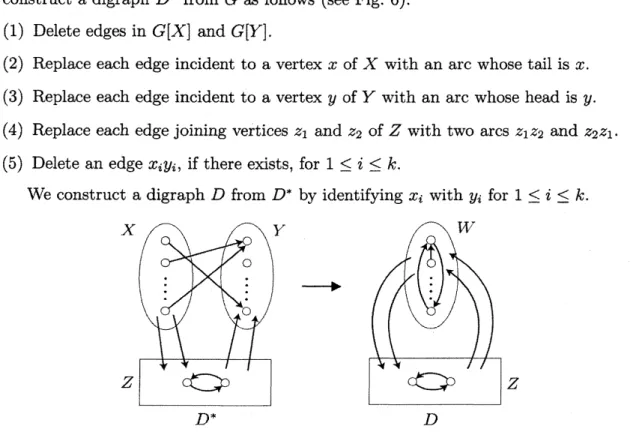
Let $X=\{x_{1}, x_{2}, . . . , x_{k}\},$ $Y=\{y_{1}, y_{2}, . . . , y_{k}\}$ and$Z=V(G)-X-Y$ .
We
construct
a
digraph $D^{*}$ from $G$as
follows (see Fig. 6).(1) Delete edges in $G[X]$ and $G[Y].$
(2) Replace each edge incident to a vertex $x$ of$X$ with an arc whosetail is $x.$
(3) Replace each edge incident to
a
vertex $y$ of $Y$ withan arc
whose head is $y.$(4) Replaceeach edge joining vertices $z_{1}$ and $z_{2}$ of$Z$ with two
arcs
$z_{1}z_{2}$ and $z_{2}z_{1}.$(5) $Ds\ddagger ete$
an
edge$x_{i}y_{i}$, if there exists, for $1\leq i\leq k.$
We construct
a
digraph$D$ from $D^{*}$ by identifying $x_{i}$ with $y_{i}$ for $1\leq i\leq k.$$arrow$
$D^{*} D$
Figure 6: The construction of
a
digraph $D$ from $D^{*}$Let $w_{i}$ be the vertex obtained by identifying $x_{i}$ with $y_{i}$ for $1\leq i\leq k$
.
Let $W=\{w_{1}, w_{2}, . . . , w_{k}\}$.
Wenow
check the out-degree and in-degree of each vertex in$D$
.
For $z\in Z,$ $\deg_{D}(z)^{+}=\deg_{G}(z)-\deg_{X}(z)\geq\deg_{G}(z)-k$ and $(teg_{D}(z)^{-}=\deg_{G}(z)-cteg_{Y}(z)\geq\deg_{G}(z)-k.$ For $w_{i}\in W,$ $\deg_{D}(w_{i})^{+}=\deg_{G}(x_{i})-\deg_{X\cup\{y_{i}\}}(x_{i})\geq\deg_{G}(x_{i})-k$and
$\deg_{D}(w_{1})^{-}=\deg_{G}(y_{i})-\deg_{Y\cup\{x\}}:(y_{1})\geq\deg_{G}(y_{i})-k.$
We next check the out-degree and in-degree
sum
condition in $D$.
If $z_{1}z_{2}\not\in A(D)$for $z_{1},$$z_{2}\in Z$, then $z_{1}z_{2}\not\in E(G)$, and hence it follows fromthe degree
sum
conditionthat
$\deg_{D}(z_{1})^{+}+\deg_{D}(z_{2})^{-}$ $\geq$ $\deg_{G}(z_{1})-k+\deg_{G}(z_{2})-k$
$\geq |G|+k-2k=|D|.$
If$zw_{i}\not\in A(D)$ for $z\in Z$ and $w_{i}\in W$, then $zy_{i}\not\in E(G)$, and hence
$\deg_{D}(z)^{+}+\deg_{D}(w_{1})^{-}$ $\geq$ $\deg_{G}(z)-k+\deg_{G}(y_{i})-k$
$\geq |G|+k-2k=|D|.$
If$w_{i}z\not\in A(D)$ for $w_{i}\in W$ and $z\in Z$, then$x_{i}z\not\in E(G)$
,
andso
$\deg_{D}(w_{i})^{+}+\deg_{D}(z)^{-}$ $\geq$ $\deg_{G}(x_{i})-k+\deg_{G}(z)-k$$\geq |G|+k-2k=|D|.$
If$w_{\dot{t}}w_{j}\not\in A(D)$ for $w_{i}\in W$ and $w_{j}\in W$, then$x_{i}y_{i}\not\in E(G)$, and
$\deg_{D}(w_{i})^{+}+\deg_{D}(w_{j})^{-}$ $\geq$ $\deg_{G}(x_{i})-k+\deg_{G}(y_{j})-k$
$\geq |G|+k-2k=|D|.$
Thus, $D$ satisfies the degree
sum
condition of Theorem 8, andso
$D$ hasa
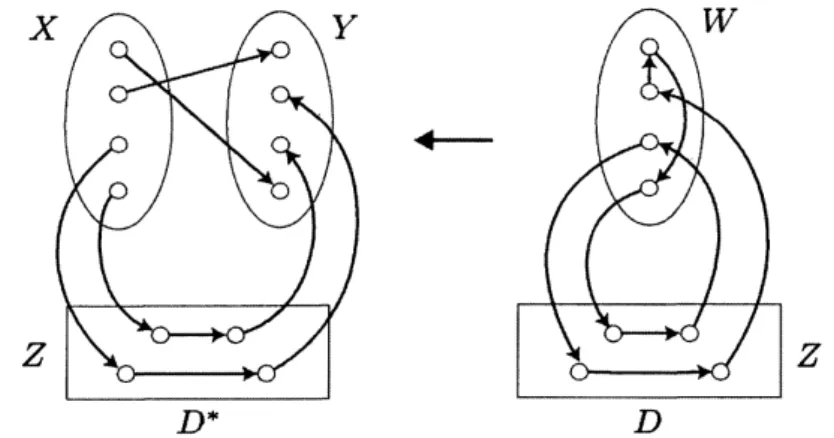
directedHamiltonian cycle. By putting$w_{i}$ backto$x_{i}$ and$y_{i}$,
we
can
obtain spanning$k$ directedvertex-disjoint paths from vertices of$X$ to vertices of$Y$ in $D^{*}$ (see Fig. 7).
$D^{*} D$
Figure
7:
Thetransform froma
directed Hamiltonian cycle in$D$tospanning$k$directedvertex-disjoint paths in $D^{*}$
Furthermore, by putting the
arcs
of directed paths back to edges,we
can
obtain4
Conclusion
remarks
In this paper,
we
proved known resultson
spanning trees and vertex-disjoint pathsby using known results
on
Hamiltonian cycles. As faras
I know,these
factswere
not written anywhere. It is interesting to investigate whether there exist any other
resultswhich
can
beprovedby usingotherresults. Also, it isinterestingto determinea
maximal subgraph which is guaranteed bya
degreesum
condition.References
[1]
J.C.
Bermond,On
hamiltonian walks, Congr. Numer. 15 (1976)41-51.
[2] S. Brandt, G. Chen, R.J. Faudree, R.J. Gould and L. Lesniak, Degree conditions
for $2arrow$factors, J. Graph Theory 24 (1997)
165-173.
[3] H. Broersmaand H. Tuinstra, Independencetrees and Hamilton cycles, J. Graph
Theory 29 (1998)
227-237.
[4] Y. Egawa, R.J. Faudree, E. Gy\"ori,Y. Ishigami, R.H. SchelpandH. Wang,
Vertex-disjoint cycles containing specified edges, Graphs and
Combin. 16
(2000)81-92.
[5] H. Enomoto and H. Li, Partition of a graph into cycles and degenerated cycles,
Discrete Math. 276 (2004)
177-181.
[6] R.J. Gould and T.C. Whalen, Distance between two $k$-sets and path-systems
extendibility, Ars Combin.
79
(2006)211-228.
[7] M.A. Gurgeland Y. Wakabayashi, On k-leaf-connected graphs, J. Combin. The-ory Ser. B41 (1986)
1-16.
[8] H. Kronk, A generalization of
a
Theorem of P6sa, Proc. Amer. Math. Soc. 21(1969)
77-78.
[9] N. Linial, A lower bound for the circumference of
a
graph, Discrete Math.15
(1976)
297-300.
[10] O. Ore, Note
on
Hamilton circuits, Amer. Math. Monthly67 (1960)55.
[11] O. Ore, Hamilton connected graphs, J. Math. Pures Appl. 42 (1963)
21-27.
[12] D.R. Woodall, Sufficient conditions for circuits in graphs, Proc. London Math.