
Characterization of Perfect Ulam Permutation Codes via Spheres and Young Tableaux (Combinatorics of Lie Type)
19
0
0
全文
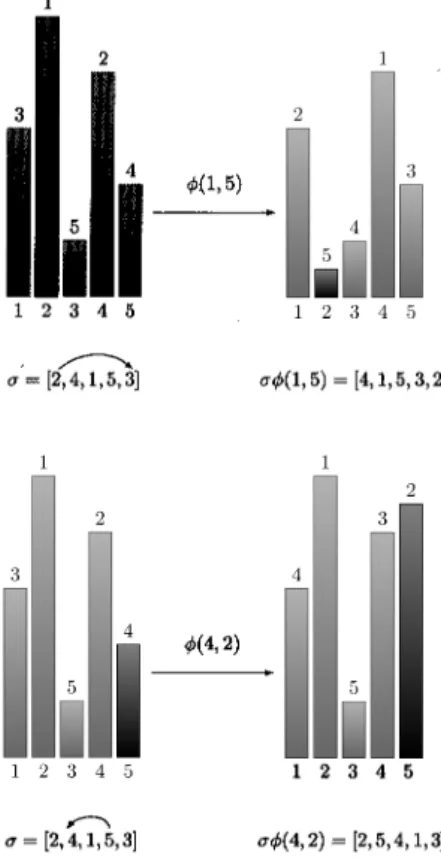
(2) 175. Preliminaries and Notation. 2. In this paper we utilize the following notation and definitions, in [3]. The symbol [n] denotes the set of integers \{ 1, 2, .,. generally following conventions established n\} The symbol \mathrm{S}_{n} stands for the set of permutations (automorphisms) on [n] i.e., the symmetric group of order n! For a permutation $\sigma$\in \mathrm{S}_{n}, we use the notation $\sigma$=[ $\sigma$(1), $\sigma$(2), . . . , $\sigma$(n)] where for all i\in[n], $\sigma$(i) is the image of i under $\sigma$ Under this notation, we may also view ( $\sigma$(1), $\sigma$(2), \ldots , $\sigma$(n)) as the sequence of $\sigma$ which we reference later in one of the equivalent definitions of the Ulam distance. Given two permutations $\sigma$, $\pi$\in \mathrm{S}_{n} the product $\sigma \pi$ is defined by ( $\sigma \pi$)(i)= $\sigma$( $\pi$(i)) In other words, we define multiplication of permutations by composition, e.g., [2, 1, 5, 4, 3] [ 5, 1, 4, 2, 3]=[3 2, 4, 1, 5 ] The identity permutation [ 1, 2, n]\in \mathrm{S}_{n} is denoted by e. .. .. .. .. ,. ,. .. ,. ,. .. .. ,. Definition. If. i=j. ( $\phi$(i,j) translocation). ,. ... i,j\in[n]. Given distinct. the. ,. .. ,. symbol $\phi$(i,j)\in \mathrm{S}_{n}. is defined. $\phi$(i,j):=\left\{\begin{ar ay}{l} [1, 2, . i-1, i+1, i+2, . , j i,j+1, . , n] \mathrm{i}\mathrm{f} i<j\ {[}1, 2, . j-1, ij, +1, . . , i-1, i+1, . . , n] \mathrm{i}\mathrm{f} i>j \end{ar ay}\right. $\phi$(i,j). then define. ,. indexes i and j. :=e. may denote. we. a. .. $\phi$(i,j). We refer to. translocation. as a. and if. translocation,. we. do not. follows:. as. specify. the. simply by $\phi$.. Intuitively, a translocation is the permutation that results in a delete/insertion operation. More specifically, given $\sigma$ \in \mathrm{S}_{n} and the translocation $\phi$(i,j) \in \mathrm{S}_{n} the product $\sigma \phi$(i,j) is tbe result of first removing $\sigma$(i) from $\sigma$ then shifting all positions between i and j including j by one (left if i<j and right if i>j ), and finally reinserting $\sigma$(i) into the new jth position. Figure 1 illustrates the permutation $\sigma$= [2 4, 1, 5, 3 ] represented physically by relative cell charge levels and the effect of multiplying $\sigma$ by the translocation $\phi$(1,5) (top half of figure) or $\phi$(4,2) (bottom half of figure) on the right. Notice that multiplying by $\phi$(1,5) corresponds to the error that occurs when the highest (1st) ranked cell suffers charge leakage that results in it being the lowest (5th) ranked cell. Multiplying by $\phi$(4,2) corresponds to the error that occurs when the 4th bighest cell is overfilled so that it is the 2nd highest cell. We next define the Ulam distance. For the definition, it is first necessary to define \ell( $\sigma$, $\pi$) Given permutations $\sigma$, $\pi$\in \mathrm{S}_{n} then \ell( $\sigma$, $\pi$) denotes the length of the longest common subsequence of $\sigma$ and $\pi$. More precisely, P( $\sigma$, $\pi$) is the largest integer m\in \mathbb{Z}>0 such that there exists a sequence ( a_{1} a2, a_{m} ) ,. ,. ,. ,. ,. .. ,. .. ,. where for all. [m]. \mathrm{E}. r. have a_{r} $\sigma$(i_{r}) The length of the longest we. ,. j_{2} <\cdots<j_{m}\leq n denoted simply by \ell( $\sigma$) .. (\mathrm{d}_{\mathrm{o} ( $\sigma$, $\pi$). Definition. ,. =. $\pi$(j_{r}). with 1 \leq i_{1} < i_{2} <. < i_{m} \leq increasing subsequence of a permutation. =. .. \mathrm{d}_{\mathrm{o} ( $\sigma$, $\pi$). Note that. Ulam. distance).. =. n-P( $\sigma$). We. now. ,. and. $\sigma$. into. $\pi$[3. ,. 7]. define the notions of. ((n, M, d) code).. Definition. 1) |C|=M 2). .. $\sigma$. .. $\pi$.. \mathrm{d}_{\mathrm{o} ( $\sigma$, $\pi$) equals the minimum \displaystyle \mathrm{d}_{\mathrm{O} ( $\sigma$, $\pi$)=\min\{k\in \mathbb{Z}_{\geq 0} |\exists$\phi$_{1}, $\phi$_{2} (n, M, d) code and an Ulam sphere.. It is also well‐known that. .. translocations needed to transform. $\sigma \phi$_{1}$\phi$_{2}\cdots$\phi$_{k}= $\pi$\}. ,. Given ơ, $\pi$\in \mathrm{S}_{n} , then. the Ulam distance between. \mathrm{d}_{\mathrm{o} ( $\sigma$, e). ... and 1 \leq j_{1} < $\sigma$\in \mathrm{S}_{n} is \ell( $\sigma$, e) , n. .. \mathrm{d}_{\mathrm{O} ( $\sigma$, $\pi$):=n-\ell( $\sigma$, $\pi$) We call. .. A subset. That. .. an. C\subseteq \mathrm{S}_{n} is. a. is,. called. an. (n, M, d). code if and. number of ,. .. .. .. ,. $\phi$_{k}. s.t.. only if. and. \displaystyle \min_{\mathrm{c}_{1},c_{2}\in C,\mathrm{c}_{1}\neq c_{2} \mathrm{d}_{\mathrm{o} (c_{1}, c_{2})=d.. Definition. (S( $\sigma$, r). ,. Ulam. sphere).. Given $\sigma$\in \mathrm{S}_{n} and. t\in\{0, 1, . . . , n-1\}. ,. we. define. S( $\sigma$, t) :=\{ $\pi$\in \mathrm{S}_{n}|\mathrm{d}_{\mathrm{o}}(c, $\pi$)\leq t\}, and call. S( $\sigma$, t). the Ulam. sphere. centered at. $\sigma$. of radius t ,. or. simply the sphere centered. at. $\sigma$. of. radius t. we use t for the radius instead of r because r is reserved for the repetition number ‐regular multipermutations discussed later. It is known that an (n, M, d) code is t‐error correcting if and only if d\geq 2t+1 [3] This is because if the distance between two codewords is greater or equal to 2t+1 then after t or fewer errors (multiplication by t or fewer translocations), the resulting permutation remains closer to the original permutation than any other permutation. Finally, we define perfect codes.. In the definition. in. r. .. ,.
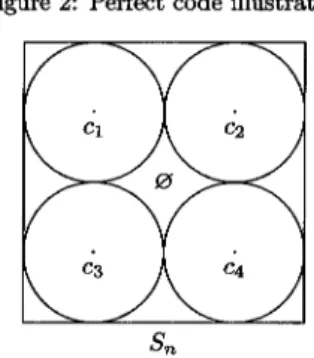
(3) 176. Figure. (perfect code). (or simply a perfect. 1: Translocation illustration. Deflnition. a. code. code if the context is. codeword c\in C such that A. perfect. subset C\subseteq \mathrm{S}_{n} is called. $\sigma$\in S(c, t). a. perfect t‐error correcting Ulam permutation if and only if for any $\sigma$\in \mathrm{S}_{n} there exists a unique. clear). .. code. partitions S_{n} as illustrated in Figure 2. In the figure four codewords c_{1}, c_{2}, c_{3} and c_{4} spheres combining to fill S_{n} The area outside of these spheres is empty so that any member of S_{n} is within one of the spheres. A perfect code C\subseteq \mathrm{S}_{n} is said to be trivial if either (1) C=\mathrm{S}_{n} (occurring when t=0 ); or (2) |C|=1 (occurring when t=n-1 ). are. 3. ,. shown with their. Ulam. .. Size. Sphere. Perfect codes and. sphere sizes are related as follows: a perfect t‐error correcting code C\subseteq S_{n} if it exists, cardinality |C|=\displaystyle \frac{n!}{S(c,t)} where c\in C Hence one of the first questions that may be considered in exploring the possibility of a perfect code is the feasibility of a code of such size. Toward that end, the calculation of the size of the sphere S(c, t) will prove to be useful. As noted in [3], for any $\sigma$\in \mathrm{S}_{n}, we have |S( $\sigma$, t)|=|S(e, t)| Hence calculation of Ulam sphere sizes can be reduced to the case when the identity is the center. One way to calculate Ulam sphere sizes centered at e is to use Young tableaux and the RSK‐ Correspondence. It is first necessary to introduce some basic notation and definitions regarding Young tableaux. Additional information on the subject can be found in [6] and [12]. ,. will have. ,. .. ..
(4) 177. Figure. 2: Perfect code illustration. young diagram is a left‐justified collection of cells with \mathrm{a} (weakly) decreasing number of cells in Listing the number of cells in each row gives a partition $\lambda$=($\lambda$_{1}, $\lambda$_{2}, \ldots, $\lambda$_{k}) of n where n is the total number of cells in the Young diagram. The notation $\lambda$\vdash n is used to mean $\lambda$ is a partition of n Because the partition $\lambda$\vdash n defines a unique Young diagram and vice versa, a Young diagram may be referred to by its associated partition $\lambda$\vdash n For example, the partition $\lambda$ :=(4,3,3,1)\vdash 11 has the corresponding Young diagram pictured on the left side of Figure 3. First,. each. row. a. below.. ,. .. .. Figure 3: Young diagram and SYT. SYT. $\lambda$:=(4,3,8,1). on. $\lambda$. A standard Young tableau, abbreviated by SYT, is a filling of a Young diagram $\lambda$ \vdash n with the following three qualities: (1) cell values are strictly increasing across each row; (2) cell values are strictly increasing down each column; and (3) each of the integers 1 through n appears exactly once. One possible SYT on $\lambda$ :=(4,3,3,1) is pictured in the right side of Figure 3. Following conventional notation ([6, 12 f^{ $\lambda$} denotes the number of SYT on $\lambda$\vdash n The next lemma, a stronger form of which appears in [6], is an application of the famous RSK‐correspondence. .. Lemma 3.1. Let. $\sigma$\in S_{n} and let RSK‐correspondence.. P and. Q both ,. Then. on. $\lambda$\vdash n , be the. $\lambda$_{1}=l( $\sigma$). pair of SYT associated with. $\sigma$. by the. .. (equivalently Q ) associated with $\sigma$ by the equal to the length of the longest increasing subsequence of $\sigma$ Applying this calculate Ulam sphere sizes, we are able to relate Ulam sphere sizes to f^{ $\lambda$}.. The above lemma states that the number of columns of P. RSK‐correspondence lemma to. Lemma 3.2. Let. is. .. t\in\{0, 1, . .. , n-1\}. and $\Lambda$ Then. Proof. Assume that t sphere, |S(e, t)|. :=\{ $\lambda$\vdash n|$\lambda$_{1} \geq n-t\}.. |S(e,t)|=\displaystyle \sum_{$\lambda$\in$\Lambda$}(f^{$\lambda$})^{2}.. \{ $\lambda$ \vdash n | $\lambda$_{1} \geq n-t\} By definition of an equal to |\{ $\pi$ \in \mathrm{S}_{n} | n-P( $\pi$) \leq\cdot t\}| by the definition of Ulam distance. This in turn is trivially equal to |\{ $\pi$ \in \mathrm{S} | \ell( $\pi$) \geq n-t which by Lemma 3.1 equals the number of ordered pairs (P, Q) of SYT on $\lambda$\vdash n where $\lambda$\in $\Lambda$ In other words, |\{(P, Q) on $\lambda$\vdash n | $\lambda$ \in $\Lambda$ Finally, the conclusion holds by definition of |\{ $\pi$ \in \mathrm{S} | l( $\pi$) \geq n-t\}| \square f^{ $\lambda$}. Ulam. \in. =. \{0, 1, . . ., n- 1\} and let |\{ $\pi$ \in \mathrm{S}_{n} | \mathrm{d}_{\mathrm{o} (e, $\pi$) \leq t ,. $\Lambda$. :=. .. which is. .. =.
(5) 178. below, known as the hook length formula, is due to Frame, Robinson, and Thrall [5, 6]. formula, the notation (i,j) \in $\lambda$ is used to refer to the cell in the ith row and jth column of à Young diagram $\lambda$\vdash n The notation h(i,j) denotes the hook length of (i,j)\in $\lambda$ i.e., the number of boxes below or to the right of (i,j) including the box (i,j) itself. More formally, h(i,j) :=|\{(i,j^{*})\in $\lambda$|j^{*}\geq The formula. In the. .. ,. ,. j\}\cup\{(i^{*},j)\in $\lambda$|i^{*}\geq i. The formula is. as. follows:. f^{$\lambda$}=\displaystyle\frac{n!}{(i,j)\in$\lambda\Pi$h(i,j)}. Applying Lemma 3.2 and the hook length formula provides an answer to the first main question of calculating Ulam sphere sizes. Sizes can be explicitly calculated as demonstrated in the following lemmas. These lemmas will be useful later to show the nonexistence of nontrivial t‐error correcting perfect codes for t\in\{1 2, 3 \} In the calculations we implicitly use the fact mentioned earlier that sphere sizes can be .. ,. reduced to the. case. when. is the center.. e. $\sigma$\in \mathrm{S}_{n} Then |S( $\sigma$, 0)|=1.. Lemma 3.3. Let. .. Proof. Although this. is. an. 3.2. Note first that there is. Young diagram below.. It is clear that there is. obvious. fact, we wish to consider why it is true from the perspective of Lemma only one partition $\lambda$\vdash n such that $\lambda$_{1}=n namely $\lambda$ :=(n) with the associated ,. only. one. possible Young tableau. on. $\lambda$. so. that. |S( $\sigma$, 0)|=1. Lemma 3.4. Let. $\sigma$\in \mathrm{S}_{n}. Then. .. Therefore. formula,. one. by Lemma. we. obtain. 3.2 and the. (f^{ $\lambda$})^{2}=. ,. and thus. by Lemma 3.2 \square. |S( $\sigma$, 1)|=1+(n-1)^{2}.. Proof. only possible partition $\lambda$\vdash n such Young diagram pictured below. There is. (f^{ $\lambda$})=1. that. $\lambda$_{1}. =n-1 ,. namely. $\lambda$. :=(n-1,1). ,. with its. previous example, |S( $\sigma$, 1)| 1+(f^{ $\lambda$})^{2} Applying the hook length which implies that |S( $\sigma$, 1)|=1+(n-1)^{2}. \square =. (\displaystyle \frac{n!}{(n)(n-2)!})^{2}=(n-1)^{2}. .. ,. proof of Lemma 3.4 may be applied to spheres of larger radii. As 3.2, the cardinality of the set \{ $\pi$\in \mathrm{S}_{n} |l( $\pi$) =n-t\} is exactly the sum of the squares of the number of standard tableaux on distinct Young diagrams with n-r columns. Moreover, the size of a sphere of radius t is equal to the size of a sphere of radius t-1 plus |\{ $\pi$\in \mathrm{S}_{n}|\ell( $\pi$)=n-t\}|. The. same. method used in the. alluded to in Theorem. Lemma 3.5. Let. $\sigma$\in \mathrm{S}_{n} and n>3 Then .. |S( $\sigma$, 2)|=1+(n-1)^{2}+(\displaystyle \frac{(n)(n-3)}{2})^{2}+(\frac{(n-1)(n-2)}{2})^{2} Proof.. Note first that. $\lambda$_{1}=n-2. are. |S( $\sigma$, 2)|=|S( $\sigma$, 1)|+|\{ $\pi$\in \mathrm{S}_{n}|P( $\pi$)=n-2\}| The only partitions $\lambda$\vdash n such that and $\lambda$^{(2)} :=(n-2,2) with their respective Young diagrams pictured .. $\lambda$^{(1)} :=(n-2,1,1). ,. below.. Using. the hook. \displaystyle \frac{(n-1)(n-2)}{2}. .. length formula,. Following. the. same. f^{$\lambda$^{(1)}. and. reasoning. f^{$\lambda$^{(2)} as. may be calculated to. in Lemma 3.4. yields. yield:. f^{$\lambda$^{(1\rangle} =\displaystyle \frac{nn-3}{2}. the desired result.. and. f^{$\lambda$^{(2)}. =. \square.
(6) 179. Such individual. cases could be considered indefinitely. significance in this paper as its result will be nontrivial perfect codes in the Ulam metric do not exist.. instance of. Lemma 3.6. Let. However,. the. following sphere is the last theorem, that. necessary to prove the main. $\sigma$\in \mathrm{S}_{n} and n>5 Then .. |S( $\sigma$, 3)| = 1+(n-1)^{2}+(\displaystyle \frac{(n)(n-3)}{2})^{2}+(\frac{(n-1)(n-2)}{2})^{2} + (\displaystyle \frac{(n)(n-1)(n-5)}{6})^{2}+(\frac{(n)(n-2)(n-4)}{3})^{2}+(\frac{(n-1)(n-2)(n-3)}{6})^{2} Proof. The proof. the. essentially. is. \mathrm{S}_{n}|\ell( $\pi$)=n-3\}| can be and $\lambda$^{(3)} := (n-3,1,1,1). same. the. as. for Lemmas 3.4 and 3.5.. proofs. In this. case. |\{ $\pi$. \in. calculated by considering the partitions $\lambda$^{(1)} :=(n-3,3) , $\lambda$^{(2)} :=(n-3,2,1) , These Young diagrams are , the only Young diagrams having n-3 columns.. pictured below.. Applying. the hook. length formula. to. $\lambda$^{(1)}, $\lambda$^{(2)}. ,. and. $\lambda$^{(3)}. and. adding the value from Lemma. 3.5. yields the. result. \square. Nonexistence of Nontrivial Perfect Ulam Codes. 4 In. 2013, Farnoud. et. al. ([3]). proved the following upper. bound. the size of. on. an. (n, M, d). code C :. M\leq(n-d+1)! Hence. (1). perfect codes is to show that the size of a perfect larger than the upper‐bound given above. Note that for equation (1) to make This is always true since the maximum Ulam distance sense, d must be less than or equal to n-1 between any two permutations in \mathrm{S}_{n} is n-1 achieved when permutations are in reverse order of each one. code must. strategy. necessarily. to prove the non‐existence of. be. .. ,. other. (e.g., \mathrm{d}_{\mathrm{O} (e, [n, n-1, 1])=n-1 ).. Lemma 4.1. There do not exist any. Proof. Assume that C\subset \mathrm{S}_{n} is 1 If n\leq C=\mathrm{S}_{n} or if |C|. a. (nontrivial) single‐error correcting perfect. perfect single‐error correcting. code. Recall that C is trivial code if either. 2 , then for all $\sigma$, $\pi$\in \mathrm{S}_{n} , we have trivial code. Thus we may assume that n>2. We proceed by contradiction. Since C is a perfect single‐error =. .. code with 3\leq d\leq n-1 and. M=\displaystyle \frac{n1}{|S( $\sigma$,1)|} =\displaystyle \frac{n!}{1+(n-1)^{2}. M\leq (n-2)! Hence, it suffices. that the code size. .. codes.. $\pi$. \in. S( $\sigma$, 1). ,. which. implies that C is. a. correcting code, then C is an (n, M, d) by Lemma 3.4. However, inequality (1) implies. to show that. if and only if n>2.. M=\displaystyle \frac{n!}{1+(n-1)^{2}}>(n-2)!. ,. which is true \square. Similar arguments may also be applied to show that no nontrivial perfect t‐error correcting codes t\in\{2 3 \} The remaining cases are treated toward the end of this section.. exist for. ,. .. Lemma 4.2. There do not exist any. Proof. Assume that C then C is. a. is. trivial code. (nontrivial) perfect. 2‐error correcting codes.. a perfect 2‐error correcting code. Similarly to the proof of Lemma 4.1, if n\leq 3, consisting of a single element, so we may assume n>3 Again we proceed by .. contradiction.. Since C\subseteq \mathrm{S}_{n} is. a. perfect. 2‐error. correcting code, then C is. M=\displaystyle \frac{n!}{|S( $\sigma$,2)|}=n!/[1+(n-1)^{2}+(\frac{(n)(n-3)}{2})^{2}+(\frac{(7 $\iota$-1)(n-2)}{2})^{2}] that. M\leq(n-4)!. ,. so. it suffices to prove that. f(n). an. (n, M, d). code with 5\leq d\leq n-1 and. by Proposition. 3.5.. Inequality (1) implies. :=n!/[1+(n-1)^{2}+(\displaystyle \frac{(n)(n-3)}{2})^{2}+(\frac{(n-1)(n-2)}{2})^{2}]. -.
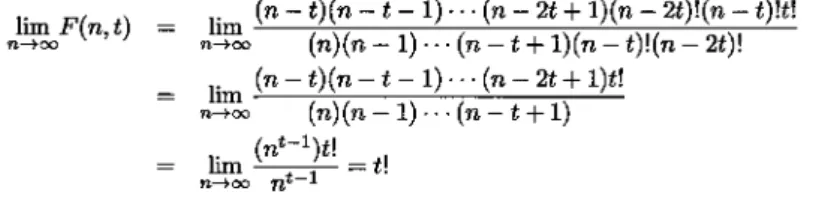
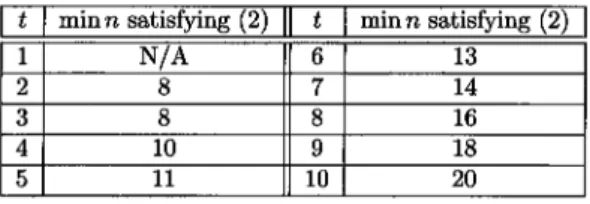
(7) 180. (n-4)! n. > 0. \displaystyle\frac{3+\sqrt{3} {2}. >. Here. .. f'(n). 2.37 Both. \approx. .. integer values of n>3 it ,. =. 2n^{3}-9n^{2}+9n-1. f'(4). f(4). and. must be true that. Lemma 4.3. There do not. e. cist any. and f''(n) 6n^{2}-18n+9 strictly greater than 0 which in. are. =. ,. ,. positive for implies that for. which is turn. ,. f(n)>0.. all all. \square. (nontrivial) perfect. correcting codes.. 3‐error. Proof outline. Assume that C\subseteq \mathrm{S}_{n} is a perfect ‐error correcting code. Similarly to the proof of Lemmas 4.2, if n\leq 7 then C is a trivial code, so we may assume that n>7 The remainder of the proof follows the same reasoning as the proof for Lemma 4.2, utilizing the sphere size calculated in Lemma 3.6.. 4.1 and. ,. .. For small values of t. explicit sphere calculations work well for showing the non‐existence of nontrivial correcting codes. However, for each radius t the size of the sphere S(e, t) is equal to This means each sphere size calculation of radius t requires |S(e, t-1)|+|\{ $\pi$ \in \mathrm{S}_{n} | \ell( $\pi$) =n-t calculation of sphere sizes for radii from 0 through t-1 Hence such explicit calculations are impractical for large values of t For values of t >6 mother method can be used to show that nontrivial perfect codes do not exist. The next lemma provides a sufficient condition to conclude that perfect codes do not exist. In the proof of the lemma, the notation \left( begin{ar y}{l n\ t \end{ar y}\right) denotes the usual combinatorial choice function, \left( begin{ar y}{l n\ r \end{ar y}\right) perfect. ,. t‐error. ,. .. .. ,. :=\displaystyle \frac{n!}{(n-t)1t1}.. Lemma 4.4. Let. t, n \in \mathbb{Z}_{>0} and correcting codes entst in \mathrm{S}_{n} :. t \leq. ,. n/2 If .. the. following inequality holds, then. F(n, t):=\displaystyle \frac{( n-t)!)^{2}t!}{n!(n-2t)!}>1. We call the above. inequality the overlapping. perfect. no. t ‐error. (2). .. condition.. Proof We proceed by contrapositive. Suppose C. \mathrm{S}_{n} is a perfect t‐error correcting code. Then C by inequality (1), M \leq (n-2r)! At the same time, |S(e, t)| which is less than or equal to \displaystyle \left(\begin{ar ay}{l n\ n-t \end{ar ay}\right)\frac{n!}{(n-t)!} since any permutation $\pi$\in S(e, t) can be obtained by first choosing n-r elements of e to be in increasing order, and then arranging the remaining t elements into $\pi$ Of course this method will generally result in double counting some permutations in S(e, t) hence the inequality. Now |S( $\sigma$, t)| \leq \displaystyle \left(\begin{ar ay}{l n\ n-t \end{ar ay}\right)\frac{n!}{(n-t)!} implies that is. [n, M d). code with 2t+1 \leq d \leq for any $\sigma$\in \mathrm{S}_{n} we have |S( $\sigma$,t)|. an. ,. =. ,. \subset. n-1 and. .. ,. ,. .. ,. \displaystyle\frac{(n-t)!}{(_t}^{n}) \leq \displaystyle \frac{n!}{|S( $\sigma$,t)|}=M\leq(n-2t)!. .. Moreover,. \displaystyle \frac{(n-t)!}{(_{\mathrm{t} ^{n})}\leq(n-2t)!. if and. Proposition Proof.. as. 4.5. Let. Assume. if. F(n, t)\leq 1. \square. overlapping condition is never satisfied for t=1 However, the following proposition long as t>1 then the overlapping condition may be satisfied for sufficiently large n.. Notice that the. will imply that. only. .. ,. t\in \mathbb{Z}_{>0}. and. t\in \mathbb{Z}_{>0} and t\leq n/2. t\leq n/2 .. .. Then. \displaystyle \lim_{n\rightar ow\infty}F(n,t)=t!.. Then. \displaystyle \lim_{n\rightar ow\infty}F(n, t) = \lim_{n\rightar ow\infty}\frac{(n-t)(n-t-1).\cdots(n-2t+1)(n-2t)!(n-t)!t!}{(n)(n-1)\cdot\cdot(n-t+1\rangle(n-t)!(n-2t)!} = \displaystyle \lim_{n\rightar ow\infty}\frac{(n-t)(n-t-1).\cdots(n-2t+1)t!}{(n)(n-1)\cdot\cdot(n-t+1)} = \displaystyle \lim_{n\rightar ow\infty}\frac{(n^{t-1})t!}{n^{t-1} =t!. \square. of. The proposition above means that for any integer t>1 , there is some value k such that for all values larger than k , there does not exist a perfect t‐error correcting code. The question remains of how. n. large. the value of k must be before it is. guaranteed. that. perfect. t‐error. correcting codes do. not exist.. Table 1 compares positive integer values t versus \displaystyle \min\{n\in \mathbb{Z}>0|F(n, t)>1\} Values were determined via numerical computer calculation. The table suggests that for t>6 , the minimum value of n satisfying ..
(8) 181. Table 1:. Non‐feasibility. the. of. perfect. correcting codes. t‐error. overlapping condition is n=2t If what the table appears to suggest is true, then in view of Proposition we may rule out perfect t‐correcting codes for any t>6 The next lemma formalizes what is implied in the table by providing parameters for which the overlapping condition is always satisfied. In combination with Lemma 4.4, the implication is that nontrivial perfect codes do not exist for these parameters. The remaining cases are also easily dealt with. .. 4.5,. .. Lemma 4.6. Let t\in \mathbb{Z} and t>6. .. Then n\geq 2t. implies that. the. overlapping condition. satisfied.. is. Proof. Assume t\in \mathbb{Z} and that t>6 We begin the proof of‐the lemma by showing that inequality holds. We assume that n=2t and proceed by induction on t. .. if n=2t , then. the desired. For the base case, let t=7 Then n=14 , and .. suppose it is true that. F(2t, t). =. \displayst le\frac{(t!)^{3}{(tk)!}. > 1. $\zeta$ \mathrm{L}^{t+}!\mathrm{L}^{3}(2(t+1) !>1 holds. Here \displaystyle\frac{( t+1)! ^{3} {(2 t+1) !} (\displaystyle \frac{(t!)^{3} {(2t)!})(\frac{(t+1)^{3} {(2t+1)(2t+2)}) =. side is greater than. 1,. .. F(n, t)=\displaystyle \frac{(7!)^{3} {14!}\approx 1.46>1. We wish to show that the. .. By. our. induction. it suffices to show that. so. \displaystyle \frac{(t+1)^{3} {(2t+2)(2t+2)}=\frac{(t+1)^{s} {4(t+1)^{2} =\frac{t+1}{4} we. As the induction. \displaystyle\frac{(t+1)^{3} {(2\mathrm{t}+1)(2\mathrm{t}+2)}. 1. \geq .. .. hypothesis,. inequality F(2(t+1), t+1). hypothesis, the first. is greater than 1 whenever t>3 Of , which the desired conclusion follows.. Thus far. .. term of the. Note here that t>6. course. =. right hand. \displaystyle \frac{(t+1)^{3} {(2t+1)(2\mathrm{t}+2)}. by assumption,. > so. have technically only proven that F(n,t) >1 whenever n=2t However, it is a simple same is true whenever n> 2t as well. We begin by supposing that F(n,t) > .. matter to show that the. 1. .. Then. F(n+1, t). \displaystyle \frac{(n+1-t)^{2} {(n+1)(n+1-2t)}\geq 1. ,. =. \displaystyle \frac{( n+1-t)! ^{2}t!}{(n+1)!(n+1-2t)!}. Lemma 4.6 t‐error. =. F(n, t)\displaystyle \cdot\frac{(n+1-t)^{2} {(n+1)(n+1-2t)}. which is true for all values of. n. is. necessarily greater. \square. required that n \geq 2t However, if n < 2t then it is impossible correcting code to exist. In fact, we may say something even stronger. .. Remark 4.7. If. ,. n,t\in \mathbb{Z}_{>0} and n\leq 2t+1 then ,. than 1 whenever. and t.. it is. impossible for. a. nontrivial. for. a. perfect. nontrivial. t‐error. perfect. correcting. code to exist. To understand. apart.. why Remark 4.7 is true, consider two permutations within \mathrm{S}_{n} of maximal Ulam distance example of which would be the identity element e and the only‐decreasing. The most obvious. permutation $\omega$ := [n, n-1, 1] Notice that S(e, t) \{ $\pi$ \in \mathrm{S}_{n} | l( $\pi$) \geq n-t\} which means that every permutation whose longest increasing subsequence is at least n-t is in the sphere centered at e. Meanwhile, there is at least one permutation $\sigma$\in \mathrm{S} such that \ell( $\sigma$)=1+t and $\sigma$\in S( $\omega$, t) since we may apply successive translocations to $\omega$ in such a way that the longest increasing subsequence is increased with each translocation. As long as n\leq 2t+1 then n-t\leq t+1=1+t implying that P( $\sigma$)=1+t\geq n-t, which implies that $\sigma$\in S(e, t)\cap S( $\omega$, t) Therefore the only perfect code possible when n\leq 2t+1 is a single element code, i.e. a trivial code. Consolidating all previous results, we are now able to state the following generalized theorem. This is a main contribution of this paper. =. .. ,. ,. ,. ,. .. Theorem 4.1. There do not exist any nontrivial. Proof. First, by codes for t \in. (see. Table. 1),. Lemmas. \{1 2, 3 \} ,. .. 4.1, 4.2, and 4.3, there do. Next note that. for all t\in. perfect codes. \{4 5,6 \} ,. F(n, r). in the Ulam metric.. not exist any nontrivial. increases. as n. the overlapping condition is. perfect t‐error correcting increases, and thus by numerical results satisfied whenever n\geq 2t+2 Therefore ..
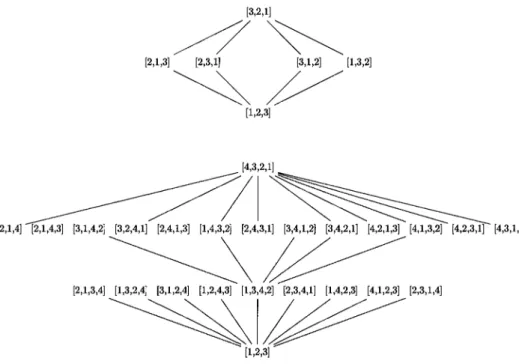
(9) 182. by Lemma 4.4, and Remark 4.7, there are no nontrivial perfect t‐error correcting codes for t\in\{4 5, 6 \}. Finally, by Lemmas 4.4, 4.6, and Remark 4.7, there are no nontrivial perfect r‐error correcting codes for ,. \square. r>6.. Partial. 5. Ordering. The symmetric group, \mathrm{S}_{n} may be viewed in terms of a partial ordering based on the Ulam metric. This partial ordering enables one to visualize \mathrm{S}_{n} as a Hasse diagram where each row consists of permutations with a particular length of longest increasing subsequence. Such a diagram also gives a visual represen‐ tation of the spheres centered at e since each row corresponds to a set of permutations of a particular Ulam distance from e Such visualization may help to choose a code as close to perfect as possible. The partial ordering is defined below. ,. ,. .. Definition. (\leq_{0}). Let $\sigma$,. .. \in. $\pi$. \mathrm{S}_{n} Then .. say. we. $\sigma$. $\phi$ if and only if the following. <_{\circ}. two conditions. are. satisfied:. (1) (2). There exists. m\in \mathbb{Z}_{>0} such. that. P( $\sigma$)=\ell( $\pi$)+m. ,. and. There exist translocations $\phi$_{1}, $\phi$_{2} , such that $\pi$= $\sigma \phi$_{1}$\phi$_{2}\cdots$\phi$_{m} , $\phi$_{m} and for i=1 , , m , we have P ( $\sigma \phi$_{1} $\phi$_{i-1})=\ell( $\sigma \phi$_{1}\cdots$\phi$_{i})+1. .. .. A. permutation. .. .. .. .. $\sigma$. is \leq_{\circ} another. permutation. $\pi$. if and. only. if $\sigma$<_{\circ} $\pi$. or $\sigma$= $\pi$.. Intuitively, the above definition simply means that $\sigma$<_{\circ} $\pi$ if $\pi$ can be obtained from $\sigma$ by applying translocations, with the length of the longest increasing subsequence decreasing with each application of a translocation. The definition is defined in this way so that for all $\sigma$\in \mathrm{S}_{n} if $\sigma$\neq e then e<_{\circ} $\sigma$ It is easily verified that \leq_{0} is indeed a partial ordering. Reflexivity and antisymmetry both follow trivially from the definition. Transitivity is also a simple matter. If a, b, c\in \mathrm{S}_{n} with a\leq b\leq c and either a=b or b=c then transitivity follows immediately. Otherwise, if a < b and b < c then there exist integers m and k such that \ell(a) \ell(b)+m and $\phi$_{m}=b and \ell(b)=P(\mathrm{c})+k with sets of translocations \{$\phi$_{1}, . . . , $\phi$_{m}\} and \{$\phi$_{1}', . . . , $\phi$_{k}'\} such that a$\phi$_{1} if i \in [m] then \ell (a$\phi$_{1}. . .$\phi$_{\dot{*}-1}) c and if i \in [k] then \ell(a$\phi$_{1}. . . $\phi$_{i})+1 and similarly b $\phi$ í. $\phi$_{k}' a. series of. ,. ,. .. ,. ,. =. ,. ,. =. ,. .. .. The. partial ordering \leq_{0}. =. .. ,. P(b$\phi$_{1}'\cdots$\phi$_{i-1}')=\ell(a$\phi$_{1}\cdots$\phi$_{i})+1 Then a<_{\circ}c since \ell(a)=\ell(c)+(m+k) \{$\phi$_{1}, . . . $\phi$_{m}, $\phi$\'{i}, . . . , $\phi$_{k}'\} satisfies the second condition of the definition. ,. may be visualized in the. ,. and the set of translocations. form of a Hasse diagram. This allows, for example,. the sphere |S(e, r)| to be viewed simply as the bottom r+1 rows of the Hasse diagram for \mathrm{S}_{n} Figure 4 shows the Hasse diagram for S3 under \leq_{\circ} and part of the Hasse diagram for \mathrm{S}_{4} under \leq_{\circ} In the latter .. .. case, all connections to [1, 2, 3, 4], [1, 3, connections are omitted for simplicity.. If there. $\sigma$. \leq_{0}. are. true for. $\pi$ ,. then. we. permutations. call $\sigma$. $\pi$ a. \in. $\omega$=[n, n-1, . . . , 1]. ,. 4, 2. and. superior of. $\sigma$. .. [4, 3, 2, 1]. in the. partial ordering. An interesting fact about the. are. depicted, but other. partial ordering. is that. \mathrm{S} for which there do not exist any superiors. This is of course trivially since this is always the permutation having the shortest longest increasing. subsequence. However, there are also permutations having non‐minimal longest increasing subsequences but without superiors. For example, the permutations [2, 1, 4, 3], [3, 1, 4, 2], [2, 4, 1, 3], and [3,4, 1, 2] have no superiors, as can be clearly seen in the bottom half of Figure 4. This is generalized in the next proposition.. Proposition 5.1. Let k\in \mathbb{Z}_{>0} and k\displaystyle \leq\frac{n}{2} Then there estst any $\pi$\in \mathrm{S}_{n} such that $\sigma$<_{\mathrm{o} $\pi$. .. Proof. Assume k. \ell( $\sigma$). =. \mathbb{Z}_{>0} and k \leq \displaystle\frac{n}2 Let .. or. the odd k ‐length. $\sigma$. ,. not. Then. :=. $\phi$ we have P( $\sigma \phi$) increasing subsequence. k , but for all translocations. subsequence The. \in. $\sigma$\in \mathrm{S}_{n} such that P( $\sigma$)=k and there do. exist. n-2k\geq k. ,. since. eitherkthe. is retained in. $\sigma \phi$.. even. ‐lekngth increasing. k. \square. proposition above for the case when k>\displaystyle \frac{n}{2} is the following conjecture yet to be k>\displaystyle \frac{n}{2} then for all $\sigma$\in \mathrm{S}_{n} such that P( $\sigma$)=k there exists $\pi$\in \mathrm{S}_{n} such that $\sigma$<_{\mathrm{o}} $\pi$. This would mean that there are always members in the upper half of the diagram without successors, but never such members in the lower half. The partial ordering and associated Hasse diagrams may provide a. analogue. to the. proven: If k\in \mathbb{Z} and. ,. ,.
(10) 183. Figure 4: Hasse diagram for S3 (top) and partial Hasse diagram for \mathrm{S}_{4} (bottom). useful tool for future code elements. so. analyzing of permutation codes in the Ulam metric, and perhaps as large as possible.. Extension to. 6 We. now. [4]. First,. based. are. on. choosing. Multipermutations. extend the discussion from. in.the Ulam metric.. studied in. assist in. that the chosen code is. Specifically,. some. permutation codes. we. in the Ulam metric to. multipermutation codes ‐regular multipermutations defined and necessary. Unless otherwise stated, definitions. extend the discussion to. basic notation and definitions. conventions established in. are. r. [4].. ‐regular multiset is a multiset such that each of its element appears exactly r times (\mathrm{i}.\mathrm{e}. each repeated r times). Given positive integers r and n such that r divides n we write \mathrm{M}(n,r) to denote the r ‐regular multiset whose elements are precisely the set [n/r] For example, \mathrm{M}(6,2) \{1 1, 2, 2, 3, 3 \} A multipermutation is a permutation of a multiset, and in the instance of an r‐regular multiset, we call the multipermutation an r‐regular multipermutation. For example, (3, 2, 2, 1, 3, 1) is a 2‐regular multipermutation of \mathrm{M} $\zeta$ 6 2). An. r. ,. element is. ,. =. .. .. ,. ,. r\in \mathbb{Z}>0 (mớ). r|n Given an r‐regular multiset \mathrm{M}(n, r) for each $\sigma$\in \mathrm{s}_{n} corresponding r‐regular multipermutation mớ as follows:. Definition a. for all. Let n,. i\in[n]. and. and. mớ. :=. ,. we. define. j\in[n/r],. \mathrm{m}_{$\sigma$}^{r} (i) :=j and. .. (mớ(1), mớ(2),. .. ... ,. if and. only. if. (j-1)r+1\leq $\sigma$(i)\leq jr,. mớ (n) ).. n=6, r=2 and $\sigma$=[1 5, 2, 4, 3, 6 ] Then \mathrm{m}_{ $\sigma$}^{r}=[1 3, 1, 2, 2, 3 ] Note that slightly from the correspondence defined in [4], which was defined in terms of the inverse permutation. This is so that certain properties (discussed later) of the Ulam metric for permu‐ tations will‐also hold in the case of the Ulam metric for multipermutations. With the correspondence As. an. example. of. this definition differs. mớ,. let. ,. ,. .. ,. ..
(11) 184. above, we may define an equivalence relation between elements of \mathrm{S}_{n} For permutations $\sigma$, $\pi$\in \mathrm{S}_{n} and r dividing n we say that $\sigma$\equiv_{r} $\pi$ if and only if \mathrm{m}_{ $\sigma$}^{r}=\mathrm{m}_{ $\pi$}^{r} The equivalence class R_{r}( $\sigma$) of $\sigma$\in \mathrm{S}_{n} is defined by R_{r}( $\sigma$) :=\{ $\pi$\in \mathrm{S}_{n} | $\pi$\equiv_{r} $\sigma$\} For a subset S\subseteq \mathrm{S}_{n} the notation $\lambda$ 4_{r}(S) := {mớ | $\sigma$\in S}, i.e. the set of r ‐regular multipermutations corresponding to elements of S. The following definition is our own. We define the product \mathrm{m}_{ $\sigma$}^{r}\cdot $\pi$ as \mathrm{m}_{ $\sigma$}^{r}\cdot $\pi$ := \mathrm{m}_{ $\sigma \pi$}^{r} Since it is possible for different permutations to correspond to the same multipermutation, we should clarify that mớ \mathrm{m}_{ $\tau$}^{r} implies \mathrm{m}_{ $\sigma \pi$}^{r} \mathrm{m}_{ $\tau \pi$}^{r} Indeed this is true because if mớ \mathrm{m}_{ $\tau$}^{r} then for all i \in [n] we have mớ(i) =\mathrm{m}_{ $\tau$}^{r}(i) which implies for j : mớ(i) that (j-1)r+1\leq $\sigma$(i)\leq jr and (j-1)r+1\leq $\tau$(i)\leq jr. This in turn implies that (j-1)r+1 \leq $\sigma \pi$( $\pi$(i))\leq jr and (j-1)r+1 \leq $\tau \pi$( $\pi$(i)) \leq jr which means \mathrm{m}_{ $\sigma \pi$}( $\pi$(i) =\mathrm{m}_{ $\tau \pi$}( $\pi$(i)) Intuitively speaking, the same corresponding elements of the sequences $\sigma$ and $\tau$ still correspond (with a different index) after being multiplied on the right by $\pi$ Hence \mathrm{m}_{ $\sigma \pi$}^{r} =\mathrm{m}_{ $\tau \pi$}^{r}, or by our notation \mathrm{m}_{ $\sigma$}^{r}\cdot $\pi$=\mathrm{m}_{ $\tau$}^{r}\cdot $\pi$. A quick example makes the explanation above clearer: if n 2 with permutations 6 and r $\sigma$ := [1 2, 3, 4, 5, 6] and $\pi$ := [2 1, 4, 3, 5, 6] then mớ \mathrm{m}_{ $\pi$}^{r} [1 1, 2, 2, 3, 3] Here, if we take any permutation $\tau$\in \mathrm{S}_{6} and multiply both $\sigma$ and $\pi$ on the right side by $\tau$ then in the resulting permutations $\sigma \pi$ and $\tau \pi$ we will still have the same corresponding values. In flash memory devices, both permutations or multipermutations may be modeled physically by relative rankings of cell charges as depicted in Figure 1 of Section 2. The number of possible messages is limited by the number of distinguishable relative rankings. However, multipermutations may significantly increase the total possible messages compared to ordinary permutations. For example, if only k different charge levels are utilized at a given time, then permutations of length k can be stored. Hence, in r blocks of length k one may store (k!)^{r} potential messages. On there other hand, if one uses r‐regular multipermutations in the same set of blocks, then (kr)!/(r!)^{k} potential messages are possible. Recall that the Ulam metric \mathrm{d}_{\mathrm{o} ( $\sigma$, $\pi$) between permutations $\sigma$, $\pi$\in \mathrm{S}_{n} was defined in terms of longest common subsequences: \mathrm{d}_{\mathrm{O} ( $\sigma$, $\pi$) := n-\ell( $\sigma$, $\pi$) Recall also that the Ulam distance \mathrm{d}_{\mathrm{o} ( $\sigma$, $\pi$) between $\sigma$, $\pi$ \in \mathrm{S}_{n} is equivalent to the minimum number of translocations needed to transform $\sigma$ into $\pi$ The r‐regular Ulam distance for multipermutations is defined in terms of the Ulam distance for permutations. ,. .. .. ,. .. ,. .. =. =. =. .. =. ,. ,. .. .. =. ,. ,. =. ,. =. =. .. ,. ,. ,. ,. .. .. Definition. (dó( $\sigma$. ,. $\pi$. ), r‐regular. Ulam. distance).. Let n,. r\in \mathbb{Z}>0. and. r|n. \displaystyle \mathrm{d}_{\mathrm{o} ^{r}( $\sigma$, $\pi$):= \min \mathrm{d}_{\mathrm{o} ($\sigma$', $\pi$'). .. Also let $\sigma$, $\pi$\in \mathrm{S}_{n}. .. Define. .. $\sigma$'\in R_{\mathrm{r}}( $\sigma$),$\pi$'\in R_{r}( $\pi$). We call. dó ( $\sigma$, $\pi$). the. Notice that the. r. ‐regular. ‐regular. r. Ulam distance between. Ulam distance is defined. $\sigma$. over. and. $\pi$.. equivalence classes. That is, the definition. is. the minimum Ulam distance among all members of R_{r}( $\sigma$) and R_{ $\eta$}( $\pi$) We will discuss this distance in more detail in the following section. We finish this section by defining what a multipermutation code is. .. ( r‐regular multipermutation code, \mathrm{M}\mathrm{P}\mathrm{C}(n, r) ). Given r, n\in \mathbb{Z}_{>0} with r|n then C\subseteq \mathrm{S}_{n} is ‐regular multipermutation code if and only if for all $\sigma$ \in C we also have R_{r}( $\sigma$) \subseteq C Such a code is denoted by \mathrm{M}\mathrm{P}\mathrm{C}(n, r) and we say that C is an \mathrm{M}\mathrm{P}\mathrm{C}(n, r) code. Definition. ,. an r. .. ,. ,. Because any time. a. permutation is. a. member of. \mathrm{M}\mathrm{P}\mathrm{C}(n, r). an. code C its entire. equivalence class. is. contained within C , then any \mathrm{M}\mathrm{P}\mathrm{C}(n, r) code C can be represented by the set of r‐regular multipermuta‐ tions associated with elements of C , i.e. the set \mathcal{M}_{r}(C) Moreover, the cardinality |C|_{r} of an \mathrm{M}\mathrm{P}\mathrm{C}(n, r) .. code C is defined. \mathrm{M}\mathrm{P}\mathrm{C}_{\mathrm{o} (n,r, d) 7. as. code. |C|_{r} :=|\mathcal{M}_{r}(C)| (this notation and C is an \mathrm{M}\mathrm{P}\mathrm{C}(n, r) code C such that. Multipermutation. In this section. we. discuss. the Ulam metric for. some. definition differs. \displaystyle\min_{$\sigma,\ pi$\inC,$\sigma$\neq$\pi$}. slightly from [4]). Finally,. an. \mathrm{d}_{\mathrm{O} ^{r}( $\sigma$, $\pi$)=d.. Ulam Metric. similarities and differences between the Ulam metric for. permutations and. multipermutations. The r‐regular Ulam distance, defined in the previous section, is a distance between equivalence classes. However, it is often convenient to think of the r‐regular Ulam distance as a distance between multipermutations. Viewed this way, the property of the Ulam metric for permutations, that it can be defined in terms of longest common subsequences or equivalently in terms of translocations, carries over to the r‐regular Ulam distance. The next lemma shows that the r‐regular Ulam distance between permutations $\sigma$ and $\pi$ is equal to n minus the length of the longest common subsequence of their corresponding r‐regular multipermutations..
(12) 185. Lemma 7.1. Let r,. n\in \mathbb{Z}_{>0}. ,. r|n. and. .. Also let $\sigma$, $\pi$\in \mathrm{S}_{n}. Then. .. \mathrm{d}_{\mathrm{o} ^{r}( $\sigma$, $\pi$)=n-\el (\mathrm{m}_{ $\sigma$}^{\prime \mathrm{r} , \mathrm{m}_{ $\pi$}^{r}). .. Proof. Assume r, n \in \mathbb{Z}_{>0}, r|n , and $\sigma$, $\pi$ \in \mathrm{S}_{n} We will first show that dó ( $\sigma$, $\pi$) \geq n —P(mớ, \mathrm{m}_{ $\pi$}^{r} ). By definition of dó ( $\sigma$, $\pi$) , there exist $\sigma$'\in R_{7}( $\sigma$) and $\pi$'\in R_{ $\eta$}( $\pi$) such that dó ( $\sigma$, $\pi$)=\mathrm{d}_{\mathrm{o}}($\sigma$', $\pi$')=n-P($\sigma$', $\pi$') Hence if for all $\sigma$'\in R_{r}( $\sigma$) and $\pi$'\in R_{r}( $\pi$) we have l($\sigma$', $\pi$')\leq l(\mathrm{m}_{ $\sigma$}^{r}, \mathrm{m}_{ $\pi$}^{r}) , then dó ( $\sigma$, $\pi$)\geq n-\ell(\mathrm{m}_{ $\sigma$}^{r}, \mathrm{m}_{ $\pi$}^{r}) .. .. (subtracting. larger value from. a. that for all $\sigma$' \in if two. R_{r}( $\sigma$). and $\pi$'. permutations have. results in. n. \in. R_{ $\eta$}( $\pi$). a. that. ,. smaller overall. P($\sigma$', $\pi$'). value).. Therefore it suffices to show that. \leq \ell (mớ, \mathrm{m}_{ $\pi$}^{r} ). This is simple. to prove because. subsequence, then their corresponding r ‐regular multipermutations will have related common subsequence. Let $\sigma$' \in R_{7}( $\sigma$) $\pi$' \in R_{r}( $\pi$) and l($\sigma$', $\pi$') k Then there exist indexes 1 \leq i_{1} < i_{2} <. < i_{k} \leq n and 1 \leq j_{1} <j_{2} <. ..<j_{k} \leq n such that for all p \in [k], a common. ,. .. $\sigma$'(i_{p}) =$\pi$'(j_{p}) Of course, l(\mathrm{m}_{ $\sigma$}^{r}, \mathrm{m}_{ $\pi$}^{r},)=l(\mathrm{m}_{ $\sigma$}^{r}, \mathrm{m}_{ $\pi$}^{r}). $\sigma$'(i) =$\pi$'(j). whenever. .. =. ,. .. .. ,. then. \mathrm{m}_{ $\sigma$}^{r},(i)= \mathrm{m}_{ $\pi$}^{r},(j). Therefore. .. \ell($\sigma$', $\pi$'). =. k \leq. .. Next,. we. will show that. \mathrm{d}_{\mathrm{o} ^{r}( $\sigma$, $\pi$)\leq n ‐P(mớ, \mathrm{m}_{ $\pi$}^{r} ).. Note that. \displaystyle \mathrm{d}_{\mathrm{o} ^{r}( $\sigma$, $\pi$) = \min_{$\sigma$'\in R_{r}( $\sigma$), $\pi$\in R_{r}( $\pi$)}\mathrm{d}_{\mathrm{o} ($\sigma$', $\pi$') $\sigma$'\in R_{\ma\dithrsplma{ystr}yl(e$\mi\snigma$),$\pi$'\in R_{\mathrm{r} ( $\pi$)^{(n-\el ($\sigma$',$\pi$') } = n-\displaystyle \max_{$\sigma$'\in R_{r}( $\sigma$), $\pi$\in R_{f}( $\pi$)}l($\sigma$', $\pi$') =. .. Here. from. \displaystyle \mathrm{i}\mathrm{f}_{ $\sigma$\in R_{r} \max_{( $\sigma$), $\pi$\in R_{r}( $\pi$)}\el ($\sigma$', $\pi$') \geq\ell (mớ, \mathrm{m}_{$\pi$}^{r} ),. then. dó. n‐ \ell. (mớ, $\pi$*^{r} ) (subtracting a smaller value. a larger overall value). It is enough to show that there exist $\sigma$'\in R_{r}( $\sigma$) and $\pi$'\in R_{ $\eta$}( $\pi$) l($\sigma$', $\pi$') \geq\ell (mớ, \mathrm{m}_{ $\pi$}^{r} ). To prove this fact, we take a longest common subsequence of mớ and then carefully choose $\sigma$'\in R_{r}( $\sigma$) and $\pi$'\in R_{r}( $\pi$) to have an equally long common subsequence.. results in. n. ( $\sigma$, $\pi$) \leq. such that and. \mathrm{m}_{ $\pi$}^{r}. The next. paragraph describes how this can be done. \mathrm{m}_{ $\pi$}^{r} ) =k and let (1\leq i_{1} <i_{2}<\cdots<i_{k}\leq n). Let \ell (mớ,. and. (1\leq j_{1}<j_{2}<\cdots<j_{k}\leq n). be. integer. sequences such that for all p\in [k], \mathrm{m}_{ $\sigma$}^{r}(i_{p})=\mathrm{m}_{ $\pi$}^{r} (jp). The existence of such sequences is guaranteed by the definition of \ell (mớ, \mathrm{m}_{ $\pi$}^{r} ). Now for all p\in[k] , define $\sigma$'(i_{p}) to be the smallest integer t\in[n] such that mŨ. (l)=\mathrm{n}4(i_{\mathrm{p}}) and if q\in [k] with q<p [k] define $\pi$(j_{p}) similarly. Then for all. ,. p\in. may. ,. easily be chosen. $\pi$'\in R_{r}( $\pi$) The. such that. in such. a manner. that. P($\sigma$', $\pi$') \geq\ell (mớ, \mathrm{m}_{ $\pi$}^{r} ).. following example helps. \mathrm{m}_{ $\sigma$}^{r}(i_{q}) =\mathrm{m}_{ $\pi$}^{r}(i_{p}) implies $\sigma$'(i_{q}) <$\sigma$'(i_{p}) =l For all [k], $\sigma$'(i_{p}) =$\pi$'(j_{p}) The remaining terms of $\sigma$' and $\pi$' $\sigma$'\in R_{r}( $\sigma$) and $\pi$'\in R_{r}( $\pi$) Thus there exist $\sigma$'\in R_{r}( $\sigma$) and then. .. p\in. .. .. \square. to illuminate the choice of $\sigma$' and $\pi$' in the. proof. If. above.. mớ. =. [2, 1, 2, 1, 3, 3], and \mathrm{m}_{ $\pi$}^{r} [3 2, 2, 1, 3, 1 ] then we have \el (\mathrm{m}_{ $\sigma$}^{r}, \mathrm{m}_{ $\pi$}^{r}) =4 with the common subsequence (2, 2, 1, 3) of maximal length. Here (1, 3, 4, 6) and (2, 3, 4, 5) are sequences with mớ(l) =\mathrm{m}_{ $\pi$}^{r}(2) mớ(3) \mathrm{m}_{ $\pi$}^{r}(3) mỚ(4) =\mathrm{m}_{ $\pi$}^{r}(4) and mớ(6) =\mathrm{m}_{ $\pi$}^{r}(5) Then following the convention outlined in the proof above, $\sigma$'(1)=$\pi$'(2)=3, $\sigma$'(3)=$\pi$'(3)=4, $\sigma$'(4)=$\pi$'(4)=1 and $\sigma$'(6)=$\pi$'(5)=5 so that \ell($\sigma$', $\pi$')\geq 4. \mathrm{T}\mathrm{h}_{\mathrm{r}\mathrm{e} other elements of $\sigma$' and $\pi$' can be chosen as follows so that $\sigma$'\in R_{ $\eta$}( $\sigma$) and $\pi$'\in R_{r}( $\pi$) : set $\sigma$'(2)=1, $\sigma$'(5)=6, $\pi$'(1)=1 and $\pi$'(6)=6. If two multipermutations mớ and \mathrm{m}_{ $\pi$}^{r} have a common subsequence of length k then mớ can be trans‐ formed into mń with n-k (but no fewer) delete / insert operations. Delete/insert operations correspond to applying (multiplying on the right) a translocation. Hence by the previous lemma we can state the =. ,. ,. ,. =. ,. ,. .. ,. ,. ,. ,. ,. following. lemma about the. Lemma 7.2. Let r,. ‐regular Ulam distance.. r. n\in \mathbb{Z}_{>0}. ,. and. r|n. .. Also let $\sigma$, $\pi$\in \mathrm{S}_{n}. .. Then. \displaystyle \mathrm{d}_{\mathrm{o} ^{r}( $\sigma$, $\pi$)=\min\{k\in \mathbb{Z}_{\geq 0}|\exists($\phi$_{1}, $\phi$_{2}, \ldots , $\phi$_{k}) s.t. \mathrm{m}_{ $\sigma$}^{r}\cdot$\phi$_{1}$\phi$_{2}\cdots$\phi$_{k}=\mathrm{m}_{ $\pi$}^{r}\}. Proof.. There exists. a. translocation. $\phi$. \in. \mathrm{S}_{n} such that \ell (mớ. $\phi$, \mathrm{m}_{ $\pi$}^{r} ). ways possible to arrange one element with a single translocation. \mathb {Z} | \exists($\phi$_{1}, \ldots, $\phi$_{k}) s.t. mớ $\phi$_{1}\cdots$\phi$_{k} = \mathrm{m}_{ $\pi$}^{r}\} \leq n— \ell (mớ, \mathrm{m}_{ $\pi$}^{r} ) =. .. l(\mathrm{m}_{ $\sigma$}^{r}, \mathrm{m}_{ $\pi$}^{r})\leq n. =. \ell (mỚ,. \mathrm{m}_{ $\pi$}^{r} ) +1 implies. This then. \mathrm{d}_{\mathrm{o} ^{r}( $\sigma$, $\pi$). .. At the. ,. since it is al‐ that. same. \displaystyle \min\{k. then for all translocations $\phi$\in \mathrm{S}_{n} we have that \ell (mớ. $\phi$, \mathrm{m}_{ $\pi$}^{r} ) \leq l(\mathrm{m}_{ $\sigma$}^{r}, \mathrm{m}_{ $\pi$}^{r})+1 single translocation can only arrange one element at a time. Therefore \displaystyle \min\{k\in \mathbb{Z}|\exists ($\phi$_{1}, \ldots , $\phi$_{k}) mớ. $\phi$_{1}\cdots$\phi$_{k}=\mathrm{m}_{ $\pi$}^{r}\}\geq n —P(mớ, \mathrm{m}_{ $\pi$}^{r} ) =\mathrm{d}_{\mathrm{o} ^{r}( $\sigma$, $\pi$) by Lemma 7.1. ,. ,. ,. \in. time, given ,. since. a. s.t. \square.
(13) 186. answer the third question of relating the Ulam metric for permutations to the multipermutations by allowing us to view the Ulam metric for r‐regular multipermu‐ tations similarly to the way we view the Ulam metric for permutations; in terms of longest common subsequences or in terms of the minimum number of translocations. Another known property of the Ulam metric for permutations is left invariance, i.e. given $\sigma$, $\pi$, $\tau$ \in \mathrm{S}_{n} we have \mathrm{d}_{\mathrm{O} ( $\sigma$, $\pi$) =\mathrm{d}_{\mathrm{o} ( $\tau \sigma$, $\tau \pi$) However, left invariance does not hold in general for multipermutations, as stated in the next lemma.. Lemmas 7.1 and 7.2. Ulam metric for. .. ,. Lemma 7.3. Let r,. n\in \mathbb{Z}_{>0}, r|n, n/r\geq 2 and r\geq 2 Then there exist .. \mathrm{d}_{\mathrm{o} ^{r}(e, $\pi$)\neq \mathrm{d}_{\mathrm{O} ^{r}( $\tau$ e, $\tau \pi$) Proof. Let. n, r,. \in \mathbb{Z}_{>0}, r|n, n/r\geq 2 and r\geq 2 ,. .. Define $\pi$,. $\pi$,. $\tau$\in \mathrm{S}_{n} such that. .. $\tau$\in \mathrm{S}_{n} by \mathrm{d}. $\pi$:=. $\tau$:=. First, consider \mathrm{d}_{\mathrm{o} ^{r}(e, $\pi$) Note that for mé and \mathrm{m}_{ $\pi$}^{r} for any integer i such that 2r < i \leq n we e(i) $\pi$(i) which implies mé(i) \mathrm{m}_{ $\pi$}^{r}(i) Meanwhile, the first 2r elements of mé and \mathrm{m}_{ $\pi$}^{r} are and respectively, so that the longest common subsequence .. have. =. \ldots. .. (2,2, \ldots, 21,1, \ldots, 1)\vee'\vee. \rightarrow 2,2,. r. ,. =. ,. ,. \mathrm{r}. \mathrm{r}. of the first 2r elements of mé and. r. ;. \mathrm{m}. is. comprised of \mathrm{r}1 s or r2' \mathrm{s} Hence \ell (mé, \mathrm{m}_{ $\pi$}^{r} ) =(n-2r)+r=n-r, .. by lemma 7.1 implies that dó(e, $\pi$ ) =r\geq 2. Next, consider \mathrm{d}_{\mathrm{O} ^{r}( $\tau$ e, $\tau \pi$) We have. which. .. $\tau \pi$=. For all. integers. i such that 2r<i\leq n ,. the first 2r elements of. and ni. $\pi$. $\tau$ e(i)= $\tau$(i)= $\tau \pi$(i) \Rightarrow \mathrm{m}_{ $\tau$ e}^{r}(i)=\mathrm{m}_{\mathrm{v} $\pi$}^{r}(i) Meanwhile, 1, 2) and ( 2, 1, 2, 1, (1, 2, 1, 2, 2,1) respectively. Thus. have. we. are. .. \ldots. ,. \ldots,. longest common subsequence of the first 2r elements of \mathrm{n}\mathrm{k}_{e}^{r} and \mathrm{m}_{ $\tau \pi$}^{r} is any length 2r-1 sequence alternating 1 s and 2' \mathrm{s} Hence l(\mathrm{m}_{ $\tau$ \mathrm{e}}^{r}, \mathrm{m}_{ $\tau \pi$}^{r})=(n-2r)+(2r-1)=n-1 which by lemma 7.1 implies. the. of. \mathrm{m}_{ $\tau$ e}^{r} .. that. ,. \mathrm{d}_{\mathrm{o} ^{r}( $\tau$ e, $\tau \pi$)=1.. \square. r ‐regular Ulam metric has implications on r‐regular sphere sizes, defined and discussed in the next section. When left invariance does hold, as in the permutation case, sphere sizes do not depend upon the choice of center. On the other hand, when left invariance does not hold, as in the multipermutation case, then it is possible that sphere sizes differ depending upon the choice of center.. The fact that left invariance does not hold for the. Ulam. 8. r. ‐Regular. Ulam. Spheres. In this section. we begin to analyze r‐regular Ulam sphere sizes. The r ‐regular Ulam sphere sizes important role in understanding the potential code size for \mathrm{M}\mathrm{P}\mathrm{C}_{\mathrm{o} (n, r, d) codes (recall that an \mathrm{M}\mathrm{P}\mathrm{C}_{\mathrm{o} (n, r, d) code is a \mathrm{M}\mathrm{P}\mathrm{C}(n, d) code with minimum r‐regular Ulam distance d ). For example, the well‐known sphere‐packing bounds and Gilbert‐Varshamov type bounds rely on calculating, or at least bounding sphere sizes. In the case of permutations, recall that the the Ulam sphere S( $\sigma$, t) centered at $\sigma$ of radius t was defined as S( $\sigma$, t) :=\{ $\pi$\in \mathrm{S}_{n} |\mathrm{d}_{\mathrm{o} ( $\sigma$, $\pi$)\leq i\} which is equivalent by definition to the set \{ $\pi$\in \mathrm{S}_{n} |n-\ell( $\sigma$, $\pi$) \leq t\} In the case of r‐regular multipermutations, for r, n, t\in \mathbb{Z}_{>0} with r|n and a given $\sigma$\in \mathrm{S}_{n} we introduce the following analogous definition of a sphere.. play. an. ,. .. ,. Definition. Let r,. n\in \mathbb{Z}_{>0} and r|n Also .. let ơ,. $\pi$\in \mathrm{S}_{n} Define .. S(\mathrm{m}_{ $\sigma$}^{r}, t) :=\{\mathrm{m}_{ $\pi$}^{r}\in \mathcal{M}_{r}(\mathrm{S}_{n})|\mathrm{d}_{\mathrm{o} ^{r}( $\sigma$, $\pi$)\leq t\} We call. S(mớ, t). the. r. ‐regular Ulam sphere centered. at. mớ. of radius t..
(14) 187. By Lemma 7.1, S(\mathrm{m}_{ $\pi$}^{r}, t)= { \mathrm{m}_{ $\pi$}^{r} \in \mathcal{M}_{r}(\mathrm{S}_{n}) | n— \ell (mớ, \mathrm{m}_{ $\pi$}^{r})\leq t}. It should be noted, however, that \mathrm{m}_{ $\pi$}^{r} is a bit misleading because given \mathrm{m}_{ $\pi$}^{r}\in \mathcal{M}(\mathrm{S}_{n}) we cannot uniquely determine $\pi$ The r‐regular Ulam sphere definition can also be viewed in terms of translocations. Lemma 7.2 implies that S(mớ, t) is equivalent to {\mathrm{m}_{ $\pi$}^{r}\in \mathcal{M}_{r}(\mathrm{S}_{n})|\exists k\in[t] and ($\phi$_{1}, $\phi$_{k}) s.t. mớ $\phi$_{1}\cdots$\phi$_{k}=\mathrm{m}_{ $\pi$}^{r} }. Recall that the number of standard tableaux on a particular $\lambda$\vdash n is denoted by f^{ $\lambda$} We denote by K_{r}^{ $\lambda$} (our own notation) the number of (not necessarily standard) Young tableaux on $\lambda$ \vdash n such that each i \in [n/r] appears exactly r times. The following remark is a straight‐forward application of the RSK‐correspondence, and states the relationship \mathrm{b}\mathrm{e}\mathrm{t}\mathrm{w}\mathrm{e}\mathrm{e}\mathrm{n}|S(\mathrm{m}_{\mathrm{e} ^{r}, t)|, f^{ $\lambda$} and K_{r}^{ $\lambda$}. the notation. .. ,. \ldots. ,. .. ,. n\in \mathbb{Z}_{>0}, r|n, t\in\{0, . .. , n-1\}. Remark 8.1. Let r,. and. ,. $\Lambda$:=\{ $\lambda$\vdash n|$\lambda$_{1}\geq n-t\}. |\displaystyle\mathrm{S}(\mathrm{m}_{e}^{r},t)|=\sum_{$\lambda$\in$\Lambda$}(f^{$\lambda$})(K_{r}^{$\lambda$}). .. Then. .. Thus. we have an explicit way of calculating sphere sizes centered at \mathrm{ }_{e}^{$\gam a$\backsla h} In the permutation case, it enough to consider sphere sizes centered at e because sphere sizes did not depend on the choice of center. Unfortunately, in the case of multipermutations the choice of center has an impact on the size of the sphere, as is easily confirmed by an explicit calculation using Remark 8.1 and comparing the result to Proposition 8.9 at the end of this section. Therefore the applicability of the above formula is limited. We begin to address the issue of sphere sizes depending on choice of center by considering the radius t=1 case. To aid with calculating such sphere sizes, we first find it convenient to introduce (as our own definition) the following subset of the set of translocations. .. was. Definition. Let. n\in \mathbb{Z}_{>0} unique .. We call T_{n} the. Define. T_{n}:=\{ $\phi$(i,j)\in \mathrm{S}_{n}|i-j\neq 1\}.. set of translocations.. translocations, except translocations of the form $\phi$(i, i-1) We they can be modeled by translocations of the form $\phi$(i-1,i) and are therefore redundant. We claim that the set T_{n} is precisely the set of translocations needed to obtain all unique permutations within the Ulam sphere of radius 1 via multiplication. Moreover, there is no redundancy in the set, that is, there is no smaller set of translocations yielding the entire Ulam sphere of radius 1 when multiplied with a given center permutation. These facts are stated in the next In other. words, T_{n} is the. set of all. .. exclude translocations of this form because. ,. two lemmas.. Lemma 8.2. Given. n\in \mathbb{Z}_{>0}. and $\sigma$,. \in \mathrm{S}_{n} then S( $\sigma$, 1)=\{ $\sigma \phi$\in \mathrm{S}_{n}| $\phi$\in T_{n}\}. ,. Proof. First note that S( $\sigma$, 1) =\{ $\pi$\in \mathrm{S}_{n} |\mathrm{d}_{\mathrm{O} ( $\sigma$, $\pi$) \leq 1\} =\{ $\sigma \phi$(i,j) \in \mathrm{S}_{n} | i,j \in [n]\} It is trivial that T_{n}=\{ $\phi$(i,j)\in \mathrm{S}_{n}|i-j\neq 1\}\subseteq\{ $\phi$(i,j)\in \mathrm{S}_{n}|i,j\in[n]\} so \{ $\sigma \phi$\in \mathrm{S}_{n}| $\phi$\in T_{n}\}\subseteq S( $\sigma$, 1) To see why S( $\sigma$, 1)\subseteq\{ $\sigma \phi$\in \mathrm{S}_{n}| $\phi$\in T_{n}\} consider any $\sigma \phi$(i,j)\in\{ $\sigma \phi$(i, j)\in \mathrm{S}_{n} |i,j\in[n]\}=S( $\sigma$, 1) If i-j \neq 1 then $\phi$(i,j) \in T_{n} and thus $\sigma \phi$(i,j) \in \{ $\sigma \phi$ \in \mathrm{S}_{n} | $\phi$\in T_{n}\} Otherwise, if i-j 1 then $\sigma \phi$(i,j)= $\sigma \phi$(j, i) and i-j=1 \Rightarrow j-i=-1\neq 1 so $\phi$(j, i)\in T_{n} Hence $\sigma$ ¢ (i,j)= $\sigma \phi$(j, i)\in\{ $\sigma \phi$\in \square \mathrm{S}_{n}| $\phi$\in T_{n}\}. .. .. ,. .. ,. ,. ,. n\in \mathbb{Z}_{>0} and. $\sigma$,. \in \mathrm{S}_{n} then |T_{n}|=|S( $\sigma$, 1)| ,. Proof. By Lemma 3.4, |S( $\sigma$, 1)| =1+(n-1)^{2} On the other hand, |T_{n}|= Now if i=1 , then there are n values j\in[n] such that i-j\neq 1 Otherwise, if .. |\{ $\phi$(i,j) \in \mathrm{S}_{n} |i-j\neq 1 i\in[n] but i\neq 1 then there i,j\in [n], $\phi$(i, i)= $\phi$(j,j)=e so that there .. j\in[n]. i-j\neq 1 However,. such that. are. n-1 values. are. n-1 redundancies. Therefore. ,. .. ,. Lemma 8.3. Given. =. .. ,. .. for all. ,. |T_{n}|=n+(n-1)(n-1)-(n-1)=(n-1)^{2}+1=1+(n-1)^{2}.. Although the Ulam sphere centered at $\sigma$\in \mathrm{S}_{n} by applying (multiplying on the right). by all permutations previous two lemmas show that some translocations are redundant. That is, there are translocations $\phi$_{1}\neq$\phi$_{2} such that $\sigma \phi$_{1}= $\sigma \phi$_{2}. In the case of permutations, the set T_{n} however, has no such redundancies. If $\phi$_{1}, $\phi$_{2} \in T_{n} then $\sigma \phi$_{1} = $\sigma \phi$_{2} \Rightarrow $\phi$_{1} =$\phi$_{2} Alternatively, in the case of multipermutations, the set T_{n} can generally be obtainable. of radius 1. \square. a. can. be characterized. translocation to. $\sigma$ ,. the. ,. ,. .. shrunken further to exclude redundancies. Notice that for r, n\in \mathbb{Z}_{>0}^{\backslash }, r|n and $\sigma$\in \mathrm{S}_{n} that the sphere S(\mathrm{m}_{ $\sigma$}^{r}, 1)=\{\mathrm{m}_{ $\pi$}^{r}\in \mathcal{M}_{r}(\mathrm{S}_{n})|\exists $\phi$ s.t. \mathrm{m}_{ $\sigma$}^{r}. $\phi$=\mathrm{m}_{ $\pi$}\}=\{\mathrm{m}_{ $\sigma$}^{r}\cdot $\phi$\in \mathcal{M}_{r}(\mathrm{S}_{n}) | $\phi$\in T_{n}\} However, it is possible that there exist $\phi$_{1}, $\phi$_{2} \in T_{n} such that ,. .. $\phi$_{1} \neq$\phi$_{2} but mớ ,. $\phi$_{1}. =. mớ $\phi$_{2}. .. In such. an. instance. we. may refer to either. $\phi$_{1}. or. $\phi$_{2}. as a. duplicate.
(15) 188. translocation for set will have the. definition. (our. own. (D(\mathrm{m}). Definition. \mathrm{m}_{ $\sigma$}^{r}. ,. If. .. duplicate translocations for mớ from T_{n} then the resulting ‐regular Ulam sphere of radius 1 centered at \mathrm{m}_{ $\sigma$}^{r} The next standard set of duplicate translocations. all. we remove. cardinality. same. definition). is. a. set of standard. the. as. ,. r. .. duplicate translocations). Given n\in \mathbb{Z}_{>0}. and. a. tuple \mathrm{m}\in \mathbb{Z}^{n} define ,. D(\mathrm{m}) :=\{ $\phi$(i,j)\in T_{n}\backslash \{e\}|\mathrm{m}(i)=\mathrm{m}(j)\vee \mathrm{m}(i)=\mathrm{m}(i-1)\} We call If. D(\mathrm{m}). the set of standard. duplicate translocations for. \mathrm{m}.. take. an r‐regular multipermutation mỚ, then removing the general set of duplications from T_{n} removing a set of duplicate translocations. These duplications come in two varieties. The first variety corresponds to the first condition of the D(\mathrm{m}) definition, when \mathrm{m}(i) =\mathrm{m}(j) For example, if $\sigma$\in \mathrm{S}_{6} such that \mathrm{m}_{ $\sigma$}^{2}=[1 3, 2, 2, 3, 1 ] then we have \mathrm{m}_{ $\sigma$}^{2} $\phi$(1,5)=[3 2, 2, 3, 1, 1]=\mathrm{m}_{ $\sigma$}^{2} $\phi$(1,6) since \mathrm{m}_{ $\sigma$}^{2}(2) 3 =\mathrm{m}_{ $\sigma$}^{2}(4) This is because moving the first 1 to the left or to the right of the last 1 results in the same tuple. The second variety corresponds to the second condition of the of D(\mathrm{m}) definition above, when \mathrm{m}(i)= \mathrm{m}(i-1) For example, if \mathrm{m}_{$\sigma$}^{2} [1 3, 2, 2, 3, 1 ] as before, then for all j \in [6] we have \mathrm{m}_{ $\sigma$}^{2}\cdot $\phi$(3,j) \mathrm{m}_{ $\sigma$}^{2}\cdot $\phi$(4,j) This is because any translocation that deletes and inserts the second of the two adjacent 2 s does not result in a different tuple when compared to deleting and inserting the first of the two adjacent we. equates. to. .. ,. =. ,. ,. ,. .. =. .. ,. =. ,. .. 2' \mathrm{s}. Lemma 8.4. Let r,. n\in \mathbb{Z}_{>0}, r|n and $\sigma$\in \mathrm{S}_{n} ,. n\in \mathbb{Z}_{>0}, r|n. .. Then. S(\mathrm{m}_{ $\sigma$}^{r}, 1)=\{\mathrm{m}_{ $\sigma$}^{r}\cdot $\phi$\in \mathcal{M}_{r}(\mathrm{S}_{n}) | $\phi$\in T_{n}\backslash D(\mathrm{m}_{ $\sigma$}^{r})\}.. $\sigma$\in \mathrm{S}_{n} First note that S(mớ, 1 ) =\{\mathrm{m}_{ $\sigma$}^{r} $\phi$\in \mathcal{M}_{r}(\mathrm{S}_{n})| $\phi$\in T_{n}\} Hence it $\phi$ (i, j) \in D(mớ), there exists some i',j'\in [n] such that $\phi$(i',j') \in T_{n}\backslash D(\mathrm{m}_{ $\sigma$}^{r}) and mớ $\phi$ (i, j) =\mathrm{m}_{ $\sigma$}^{r} $\phi$(i',j') We proceed by dividing the. Proof.. Let r,. ,. and. .. .. suffices to show that for all. .. proof into two main cases. Case I is when (mớ(i) \neq mớ(i‐l) or i=1 Case II is when (mớ(i) Case I (when (mớ(i) \neq mớ(i—l) or i=1 ) can be split into two subcases: .. =. mớ(i‐l).. Case IA: i<j Case IB: i>j. We. can. ignore. the instance when i. =j. ,. since. $\phi$(i,j). \in. D(mỚ) implies. i. all p\in [i,j] (for a, b \in \mathbb{Z} with a < b , the notation [a, b] := \{a, a+1, , b\} ) then \mathrm{m}_{ $\sigma$}^{r} $\phi$(i,j) 1 yields the desired result. mớe. Thus setting i' =j' \ldots. =. .. For. have. case. mớ(i). IA, =. if for. mớ(p),. Otherwise, if there exists Then j^{*} :=j-\displaystyle \min\{k \in \mathbb{Z}_{>0} | \mathrm{m}_{ $\sigma$}^{r}(i) \neq mớ(j—k mớ $\phi$ (i, j^{*} ). Thus setting i' =i and j' =j^{*} yields the desired =. [i,j] such that mớ(i) \neq \mathrm{m}_{ $\sigma$}^{r}(p) $\phi$(i,j^{*}) \in T_{n}\backslash D(\mathrm{m}_{ $\sigma$}^{r}) and mớ $\phi$ (i, j ). p \in. result. Case IB is similar to Case IA.. Case II. \neq j. we. (when mớ(i). =. mớ(i—l. ,. then let =. can. also be divided into two subcases.. Case IIA: i<j Case IIB: i>j. As in Case I, we can ignore the instance when i=j For Case IIA, if for all p\in[i,j] we have mớ(i) \mathrm{m}_{ $\sigma$}^{r}(p) then mớ( $\phi$ (i, j) mỚ(e), so setting i=j=1 achieves the desired result. Otherwise, if there exists p\in[i,j] such that mớ(i) \neq mớ(p), then let i^{*}:=i-\displaystyle \min\{k\in \mathbb{Z}_{>0}|(\mathrm{m}_{ $\sigma$}^{r}(i)\neq \mathrm{m}_{ $\sigma$}^{r}(i-k-1))\vee(i-k=1 Then mớ $\phi$ (i, j) mớip (i*, j) and either one of the following is true: 1) $\phi$(i^{*},j)\not\in D_{i} (mớ) \Rightarrow $\phi$(i^{*},j)\not\in D(\mathrm{m}_{ $\sigma$}^{r}) so set i'=i^{*} and j'=j or 2) by Case IA there exist i',j'\in[n] such that $\phi$(i',j')\in T_{n}\backslash D(\mathrm{m}_{ $\sigma$}^{r}) and mớip(i, j) \square mớ $\phi$ (i*, j)=\mathrm{m}_{ $\sigma$}^{r} $\phi$(i,j) Case IIB is similar to Case IIA. =. .. =. ,. =. ,. .. ,. =. .. D(mớ) is a set of duplicate translocations for \mathrm{m}_{$\sigma$}^{r} we have not shown T_{n}\backslash D(\mathrm{m}2) is the set of minimal size having the quality that S(mớ, 1 ) {mớ. $\phi$\in \mathcal{M}_{r}(\mathrm{S}_{n}) | $\phi$\in T_{n}\backslash D(\mathrm{m}_{ $\sigma$}^{r})\} In fact it is not minimal. In some instances it is possible to remove further duplicate translocations to reduce the set size. For a sequence \mathrm{m} \in \mathbb{Z}^{n} we define (also our own definition) the following additional set of duplications. While Lemma 8.4 shows that. ,. that. =. .. ,.
(16) 189. (E(\mathrm{m}). Definition. set of. ,. alternating duplicate translocations). Given. \in. n. and. \mathbb{Z}_{>0}. a. tuple. \mathrm{m}. \in. \mathbb{Z}^{n},. define. E(\mathrm{m}). :=. { $\phi$(i,j)\in T_{n}\backslash D(\mathrm{m})|i<j. We call. E(\mathrm{m}). when. \mathrm{m}. contains. of. is. \mathrm{m}. a. tuple. \exists k\in[i,j-1]. and. s.t.. ( $\phi$(j, k)\in T_{n}\backslash D(\mathrm{m}))\wedge(\mathrm{m}\cdot $\phi$(i,j)=\mathrm{m}\cdot $\phi$(j, k)) }.. the set of. alternating duplicate translocations for \mathrm{m} because it is only nonempty alternating substring of length greater than 4. For k\in \mathbb{Z}_{\geq 0} an alternating substring the form (\mathrm{m}(i), \mathrm{m}(i+1), \ldots \mathrm{m}(i+k)) \in \mathbb{Z}^{k+1} such that for all even values of l\in[k],. an. of. \mathrm{m}(i)=\mathrm{m}(i+l). ,. l'\in[k], (\mathrm{m}(i+1)=\mathrm{m}(i+l. while for all odd values of. \wedge(\mathrm{m}(i)\neq \mathrm{m}(i+l. Finally, we define the general set of duplications. The lemma that follows the definition also shows $\sigma$\in \mathrm{S}_{n} removing the set D (mớ) from T_{n} removes all duplicate translocations associated with *. that for. ,. \mathrm{m}_{ $\sigma$}^{r}. Definition. (D^{*}(\mathrm{m}) duplication set).. Given. ,. n\in \mathbb{Z}_{>0} and. tuple \mathrm{m}\in \mathbb{Z}^{n}. a. D^{*}(\mathrm{m}) :=D(\mathrm{m})\cup E(\mathrm{m}) We call. D^{*}(\mathrm{m}). the. set for. duplication. Lemma 8.5. Let r,. n. \in. \mathbb{Z}, r|n,. $\sigma$. define. .. \mathrm{m}.. \mathrm{S}_{n}. \in. ,. and. ,. $\phi$_{1}, $\phi$_{2}. \in. T_{n}\backslash D^{*}(\mathrm{m}_{ $\sigma$}^{r}). .. Then. $\phi$_{1}. =. $\phi$_{2} if and only if. mớ. $\phi$_{1}= mớ. $\phi$_{2}. \mathbb{Z}, r|n,. \in \mathrm{S}_{n} and $\phi$_{1}, $\phi$_{2} \in T_{n}\backslash D^{*}(\mathrm{m}_{ $\sigma$}^{r}) If $\phi$_{1} $\phi$_{2} then \mathrm{m}_{ $\sigma$}^{r}$\phi$_{1} mớip2 trivially. $\phi$_{2} We proceed by contrapositive. Suppose that mớ $\phi$ 2 \Rightarrow $\phi$_{1} mớ $\phi$ l \neq \mathrm{m}_{ $\sigma$}^{r}$\phi$_{2} Let $\phi$_{1} := $\phi$(i_{1},j_{1}) and $\phi$_{2}:= $\phi$(i_{2},j_{2}) The remainder of the proof can be split into two main cases: Case I is if i_{1}=i_{2} and Case II is if i_{1}\neq i_{2}. Case I (when i_{1}=i_{2} ), can be further divided into two subcases:. Proof.. Let r,. n. \in. $\sigma$. =. .. ,. It remains to prove that mỚ $\phi$ 1 $\phi$_{1}\neq$\phi$_{2} We want to show that. =. =. .. .. Case. .. \mathrm{I}\mathrm{A}_{\dot{f} \mathrm{m}_{ $\sigma$}^{r}(i_{1})=\mathrm{m}_{ $\sigma$}^{r}(i_{1}-1) \mathrm{m}_{ $\sigma$}^{r}(i_{1})\neq \mathrm{m}_{ $\sigma$}^{r}(i_{1}-1). Case IB: Case IA is easy to prove. We have ,. i) ii) iii) iv) However, subcase iv). ii). can. assume. without loss of. (j_{1}<i_{1})\wedge(j_{2}>i_{1}) (j_{1}<i_{1})\wedge(j_{2}\leq i_{1}) (j_{1}>i_{1})\wedge(j_{2}>i_{1}) (j_{1}>i_{1})\wedge(j_{2}\leq i_{1}). is unnecessary since it. also be reduced to. .. D_{i_{1} ^{*} (mớ) =D_{i_{2}}^{*} (mớ) =\{ $\phi$(i_{1},j)\in T_{n}\backslash \{e\}|j\in[n]\}. $\phi$_{2} a contradiction. For Case IB, we can first split into the following smaller subcases:. Subcase. =. .. was. so $\phi$_{1}=e= generality that j_{1} <j_{2} and then ,. .. assumed that j_{1} <j_{2} , so j_{1}>i_{1} \Rightarrow j_{2}>j_{1} >i_{1}. since j_{2}\neq i_{2}=i_{1} Each of the remaining subcases. (j_{1}<i_{1})\wedge(j_{2}<i_{1}). .. is proven by noting that there is some element in the multipermutation mớ $\phi$ l that is necessarily different from \mathrm{m}_{ $\sigma$}^{r}$\phi$_{2} For example, in subcase i), we have \mathrm{m}_{ $\sigma$}^{r}$\phi$_{1}(j_{1})=\mathrm{m}_{ $\sigma$}^{r}(i_{1})\neq \mathrm{m}_{ $\sigma$}^{r}(j_{1})=\mathrm{m}_{ $\sigma$}^{r}$\phi$_{2} (j1). Subcases ii) .. and. iii). are. Case II. solved. similarly.. (when i_{1}\neq i_{2} ). can. be divided into three subcases:. (\mathrm{m}_{ $\sigma$}^{r}(i_{1})=\mathrm{m}_{ $\sigma$}^{r}(i_{1}-1) A \mathrm{m}_{ $\sigma$}^{r}(i_{2})=\mathrm{m}_{ $\sigma$}^{r}(i_{2}-1 (\mathrm{m}_{ $\sigma$}^{r}(i_{1})=\mathrm{m}_{ $\sigma$}^{r}(i_{1}-1) A \mathrm{m}_{ $\sigma$}^{r}(i_{2})\neq \mathrm{m}_{ $\sigma$}^{r}(i_{2}-1) ) or (\mathrm{m}_{ $\sigma$}^{r}(i_{1})\neq \mathrm{m}_{ $\sigma$}^{r}(i_{1}-1) A \mathrm{m}_{ $\sigma$}^{r}(i_{2})=\mathrm{m}_{ $\sigma$}^{r}(i_{2}-1 1\mathrm{I}\mathrm{C}:(\mathrm{m}_{ $\sigma$}^{r}(i_{1})\neq \mathrm{m}_{ $\sigma$}^{r}(i_{1}-1) A \mathrm{m}_{ $\sigma$}^{r}(i_{2})\neq \mathrm{m}_{ $\sigma$}^{r}(i_{2}-1. Case IIA:. Case IIB: either. Case. Case IIA is easily solved by mimicking the proof of Case IA. Case IIB is also easily solved as follows. First, without loss of generality, we assume that mớ(il) mớ(il -1 ) \wedge \mathrm{m}_{ $\sigma$}^{r}(i_{2}) \neq mớ(i2 -1 ). Then D_{i_{1}}^{*}(\mathrm{m}_{ $\sigma$}^{r})=\{ $\phi$(i_{1},j)\in T_{n}\backslash \{e\} |j\in [n]\} so $\phi$_{1}=e Therefore we have mớipl (j_{2}) mỚ(j2) \neq mớ(i2) =. ,. \mathrm{m}_{ $\sigma$}^{r}$\phi$_{2}(i_{2}-1). .. .. =. =.
(17) 190. Finally, for Case IIC, following four subcases:. without loss of. generality. i) ii) iii) iv). may assume that. we. (j_{1}<i_{2})\wedge(j_{2}\geq i_{2}) (j_{1}<i_{2})\wedge(j_{2}<i_{2}) (j_{1}\geq i_{2})\wedge(j_{2}\geq i_{2}) (j_{1}\geq i_{2})\wedge(j_{2}<i_{2}). i_{1} <i_{2} and then split into the. .. However, since $\phi$(i_{2},j_{2}) \in T_{n}\backslash D^{*}(\mathrm{m}_{ $\sigma$}^{r}) implies i_{2} \neq j_{2} subcases i) and üi) can be reduced to (j_{1} < i_{2})\wedge(j_{2} > i_{2}) and (j_{1} \geq i_{2})\wedge(j_{2} > i_{2}) respectively. For subcase i), we have \mathrm{m}_{ $\sigma$}^{r}$\phi$_{1}(j_{1}) mớ(il) \neq mớ(jl) mớ $\phi$2(j1). Subcases ii) and iii) are solved in a similar manner. For subcase iv), if j_{1}>i_{2} then \mathrm{m}$\phi$_{1}(j_{1}) =\mathrm{m}(i_{1}) \neq mỚ(jl) =\mathrm{m}_{ $\sigma$}^{r}$\phi$_{2} (j1). Otherwise, if j_{1} =i_{2} then $\phi$\mathrm{i} = $\phi$(i_{1}, i_{2}) and $\phi$_{1} = $\phi$(i_{2},j_{2}) Thus if mớ $\phi$ l \square mớt02 then $\phi$_{1} \in D_{i_{1} ^{*}(\mathrm{m}_{ $\sigma$}^{r}) which implies that $\phi$_{1}\not\in T_{n}\backslash D^{*}(\mathrm{m}_{ $\sigma$}^{r}) a contradiction. ,. =. =. ,. ,. =. Lemma 8.5. .. ,. ‐regular Ulam sphere sizes of radius 1 whenever we can can be simplified by noting that for a sequence \mathrm{m}\in \mathbb{Z}^{n} that D(\mathrm{m})\cap E(\mathrm{m})=\emptyset (by the definition of E(\mathrm{m}) ) and then decomposing the duplication set into these components. The next proposition and corollary are another main result of this paper. calculate the. implies that. ,. calculate. we can. appropriate duplication. Proposition. 8.6. Let r,. r. set. This calculation. n\in \mathbb{Z}, r|n, $\sigma$\in \mathrm{S}_{n}. .. Then. | S(mớ, 1 ) |=(n-1)^{2}+1-|D(\mathrm{m}_{ $\sigma$}^{r})|-|E(\mathrm{m}_{ $\sigma$}^{r})|.. the definition of D (mớ) and lemma 8.4, \{\mathrm{m}_{ $\sigma$}^{r}\cdot $\phi$\in \mathrm{A}4_{r}(\mathrm{S}_{n}) | $\phi$\in T_{n}\backslash D^{*}(\mathrm{m}_{ $\sigma$}^{r})\}= {mớ. $\phi$\in $\lambda$ 4_{r}(\mathrm{S}_{n}) | $\phi$ \in T_{n}\backslash D(\mathrm{m}_{ $\sigma$}^{r})\} S(mớ, 1). This implies |T_{n}\backslash D^{*}(\mathrm{m}_{ $\sigma$}^{r})| \geq S(mớ, 1 By lemma 8.5, for $\phi$_{1}, $\phi$_{2} \in T_{n}\backslash D^{*}(\mathrm{m}_{ $\sigma$}^{r}) if $\phi$_{1} \neq $\phi$_{2} then \mathrm{m}_{ $\sigma$}^{r}\cdot$\phi$_{1} \neq \mathrm{m}_{ $\sigma$}^{r}\cdot$\phi$_{2} Hence we have |T_{n}\backslash D^{*}(\mathrm{m}_{ $\sigma$}^{r})| \leq |S(\mathrm{m}_{ $\sigma$}^{r}, 1 which implies that |T_{n}\backslash D^{*}(\mathrm{m}_{ $\sigma$}^{r})| |S(\mathrm{m}_{ $\sigma$}^{r}, 1 It remains to show that |T_{n}\backslash D^{*}(\mathrm{m}_{ $\sigma$}^{r})| (n- 1)^{2}+ l— | D(mớ) | |E(\mathrm{m}_{ $\sigma$}^{r})| This is an immediate consequence of the fact that |T_{n}| (n-1)^{2}+1 and \square D(\mathrm{m}_{ $\sigma$}^{r})\cap E(\mathrm{m}_{ $\sigma$}^{r})=\emptyset. *. Proof. By. =. ,. .. ,. =. =. =. —. .. sphere sizes for any choice of multi‐ ‐regular multipermutations). The proposition also can be used to obtain an upper bound on the size of r‐regular Ulam spheres. We will then show that this upper bound is tight (except for one special case) by demonstrating an r ‐regular Ulam sphere that achieves this bound. Proposition. 8.6. permutation (This. Corollary. gives. an. explicit. is not limited to. 8.7. Let r,. way to calculate radius t= 1. r. n\in \mathbb{Z}, r|n_{j} and $\sigma$\in \mathrm{S}_{n}. .. Then. | S(mớ, 1 ) |\leq((n-1)^{2}+1)-(r-1)n.. Proof. First, note that if n/r=1 then | S(mỚ, 1 ) |=1 and the corollary holds trivially. Assume then that n/r\geq 2 By Proposition 8.6, | S(mỚ, 1 ) |=((n-1)^{2}+1)-|D(\mathrm{m}_{ $\sigma$}^{r})|-|E(\mathrm{m}_{ $\sigma$}^{r})|\leq((n-1)^{2}+1)-|D(\mathrm{m}_{ $\sigma$}^{r})|. Notice that if \mathrm{m}_{ $\sigma$}^{r}(i)\neq \mathrm{m}_{ $\sigma$}^{r}(i-1) or if i=1 then | D(mớ) | =r-1 This is because in such instance the first condition of the definition of D(\mathrm{m}) applies, and each element of an r ‐regular multipermutation ,. .. .. has r-1 other elements equal to itself. Otherwise D(mớ) | =n-2 since we are in the second condition of D(mớ), where. D(mớ) is comprised long as i\neq j and i-j\neq 1 Since n/r\geq 2 it follows that n\geq 2r so n-2\geq 2r-2=2(r-1) Therefore | D(mớ | \geq(r-1)n which implies | S(mớ, 1 ) |\leq((n-1)^{2}+1)-(r-1)n. \square ofany $\phi$(i,j). as. .. ,. .. ,. ,. Extending the concept multipermutation code. Definition. all. Letc. $\pi$\in S_{n} there ,. be. exists. In such instances. of. perfect permutation codes discussed. in earlier. sections,. we. define. a. perfect. \mathrm{M}\mathrm{P}\mathrm{C}(n, r) code. Then C is a perfect t‐error correcting code if and only if for unique \mathrm{m}_{ $\sigma$}^{r}\in \mathcal{M}_{r}(C) such that \mathrm{m}_{ $\pi$}^{r}\in|S(\mathrm{m}_{ $\sigma$}^{r}, t)|. call C a perfect t‐error correcting \mathrm{M}\mathrm{P}\mathrm{C}(n, r) code.. an a. we. Remark S.S. With this definition the upper bound of Corollary 8.7 implies a lower bound on a perfect single‐error correcting \mathrm{M}\mathrm{P}\mathrm{C}(n, r) code, namely if C is a perfect single‐error correcting \mathrm{M}\mathrm{P}\mathrm{C}(n, r) code, then. |C|_{r}\displaystyle \geq\frac{n!}{(r!)^{n/r}\cdot( (n-1)^{2}+1)-(r-1)n)}..
図
+2
関連したドキュメント
By interpreting the Hilbert series with respect to a multipartition degree of certain (diagonal) invariant and coinvariant algebras in terms of (descents of) tableaux and
The correspondence between components of the locus of limit linear series and Young tableaux is defined so that on the elliptic curves C i whose indices do not appear in the
Theorem 1. Tarnanen uses the conjugacy scheme of the group S n in order to obtain new upper bounds for the size of a permutation code. A distance that is both left- and right-
Then it follows immediately from a suitable version of “Hensel’s Lemma” [cf., e.g., the argument of [4], Lemma 2.1] that S may be obtained, as the notation suggests, as the m A
In [BH] it was shown that the singular orbits of the cohomogeneity one actions on the Kervaire spheres have codimension 2 and 2n, and that they do not admit a metric with
We show that the average energy as well as the deviation around the average velocity for chaotic orbits for both the complete and simplified versions of the model exhibit
Block Spin Transformation of 2D O(N) sigma model, Toward solving a Millennium Problems Proof of the Main Theorem.. We integrate over ξ under the influence of long spin wave by
We show that formulae of Gessel for the generating functions for Young standard tableaux of height bounded by k (see [2]) satisfy linear differential equations, with
