Numerical
analysis
of
a
tag model
in
circle
Makoto IIMA(飯間信)” and Keita SUZUKI(鈴木啓太)Nonlinear Studies and Computation,
Research Institute
for
Electronic Science,Hokkaido University, Sapporo 060-0812, Japan \mbox{\boldmath $\theta$}b海道大学電子科学研究所) Department
of
Mathematics, Hokkaido University, Sapporo 060-0810, Japan \mbox{\boldmath $\theta$}b海道大学大学院理学研究科)We analyzed asimplest tagmodelonacircle. This problemconsistsofoneperson
to chase and one to elude, and the output force to move is a function of the
rela-iive position. The effect oftime delay from collecting the information to output is
considered. This model shows vai’ious motion including chaotic one, which can not
beobservedwithout thetime delay. Whenreplacingthe delay term toadistributed
one, some chaotic motionis stabilized.
I. INTRODUCTION Time delay appears in
many
kinds ofdy-namical system such
as
demography(mat-Chasing is ubiquitous
around
us.
Tag is uration time), epidemic (incubation time),atypicalchildren’s gamein which
one
chases control systems(transmissionof feedback
sig-the rest. Ina
ball game suchsoccer
of bas- $\mathrm{n}\mathrm{a}\mathrm{l}$), economy (time lag from themeasure-ketball,
a
person possessing ballare
chased ment to theannounce
of the economicin-by the defense. The dynamics of the per- dicators ), optics (feedback signal of light) son to chase(“chaser”) and the person to [1, 3, 4]. It is known that time delay
desta-elude(“eluder” ) is not trivial: the chaser col- bilize
a
fixed point andinvokes complexphe-lects the information of the eluder (position, nomena suchas chaos.
velocity, etc.), process the information, and In this paper,
we
$\mathrm{m}$ ake a simplest tag
determine the amount and the direction of model to understand the chasing dynamics.
the output force, and vice
versa.
In general, Ouraim here is to know how the time
de-processinginformation costs
a
finitetime. In lay changes the resultof chasing without de this study,
we
focuson
the effect of the time lay. In particular,we
assume
that the chaserdelayto process the information. and the eluderhave similar moving principle.
Timedelay in adynamical system iscom- Furthermore,
we
choose the maximumof themon
in nature. Atypical example is the mat- output functionas a
parameter of theabil-uration time of man to reproduce the next $\mathrm{i}\mathrm{t}\mathrm{y}$to
move.
The difference of the parametergeneration. It takes a finite time that
a
dis- betweenthe chaser and theeluder isan
indi-turbance of birth rate is reflected in
a
next cator to predict the result of the chase. Angeneration. When this effect is taken in
a
naive expectation is that the sign of thein-population model, it contains delay term[l]. dicator is
a
unique factor to determine the result. Onthe other hand, time delaycauses
$\overline{*\mathrm{E}\mathrm{l}\mathrm{e}\mathrm{c}\mathrm{t}\mathrm{r}\mathrm{o}}$nic address: makotoflaurora.es.hokudai. to destabilize the fixed point. These two
ele-$\mathrm{a}\mathrm{c}$.jp; $\mathrm{b}^{1}\mathrm{R}\mathrm{L}$: $\mathrm{h}\mathrm{t}\mathrm{t}\mathrm{p}://\mathrm{a}\mathrm{u}\mathrm{r}\mathrm{o}\mathrm{r}\mathrm{a}$.es.hokudai.$\mathrm{a}\mathrm{c}.\mathrm{j}\mathrm{p}/$ ments may be ill conflict,
so
the behavior ofIn sec.II, we show tlle detail of the model This equation
can
be rewritten intermsof Sec. III is devoted to show the numerical $z(t)$ only as follows:result of the model. Linear stability theory is applied to this model in $\mathrm{s}\mathrm{e}\mathrm{c}$. $\mathrm{I}\mathrm{V}$. $z.$
.
$(t)+CF(z(t-\tau))+K\dot{z}(t|)=0$, (4)
where$C=A-B$istheparameterto
measure
$\mathrm{I}\mathrm{I}$.
MODEL the maximum of the output force $(C>0$
means
$X$(chaser)haslarger outputforcethanWeconsider tag model ina unitcircle with $Y$(eluder)$)$
.
one
chaser(X) andone
eluder(} ). Each posi- The definition of the capture isas follows: tionof$X$ and $\mathrm{Y}$,$x$ and$y$, is measuredbythe in this simple situation, a naive definition of
arc
length from an origin. The dynamics of the catch, suchas
the state $|\mathrm{z}(\mathrm{t})|<\exists\epsilon_{\}}$ for$\exists t$$X$ and $Y$ is given by the following equations:
can
not lead
us
to interesting results. Thuswe
define the catchas
thestate$z(t)arrow 0(\mathrm{a}1\mathrm{s}\mathrm{o}$$x(t)+A$$F$(z$(t-\mathcal{T})$) $+Ki(t)=0$ , (1) $\dot{z}(t)arrow$? 0)
as
$tarrow\infty$
.
This definitionmeans
that catching $\mathrm{Y}$ requires not only the rela-$y..(t)+BF(z(t-\tau))+K\dot{y}(t)=0$, (2) tive position but the relative velocityshould$z(t)=y(t)-x(t)$ (3) be
zero. A
simplest example to satisfy thisconditionistag
among
two agile persons.An
where $\dot{x}$
means
time derivative of$x$, $A$,$B$,$K$
instant time of coincidence is insufficient to
are
positive constants. The output force is catch the eluder: hecan
slip through fromdeterminedby $F(z)$
as
a
functionof the rela- the chaser’sarms.
tive positionof$X$ and$Y$, $z$ $=z(t)$. Torealize
In this paper,
we
report thecase
$F(x)=$the situation in tag, $F(z)$ should be positive $\sin(x)$, while the case of the other function
when $0<z$ $<\pi$, negative when yr $<z$ $<2\pi.$
such as bilinear function$($ $F(x)=x(|x|<$
$\mathrm{I}’\mathrm{h}\mathrm{e}$ output-force function
$F(z)$ is assumed $\pi/2$);$\pi-x(\pi/2<x<3\pi/2))$ and
rectangu-odd by the requirement ofthe symmetry un- $\mathrm{l}\mathrm{a}\mathrm{r}$ function(F(x)=l $(0<x<\pi);-1(\pi<$
der space inversion, and it is also assumed $x<2\pi$)) is also studied in ref. [5]. $2\pi$-periodic function because ofthe
period-When$\tau=0,$ the equation (4) corresponds
icityof space. Here
we
assume
finite process- to a dumped simple pendulum. In this case,ingtime $\mathrm{r}$ from the input
of the information the behavior is simple. Equilibrium points
to
output the force. In this model, thein- are
$z(t)$ $=0$ and $z(t)=\pi$. If$C>0$
formation is the relative position of $X$ and
$z(t)=0$ is stable and $z(t)=\pi$ is
unsta-Y. $\mathrm{b}\mathrm{l}\mathrm{e}$, and if $C<0,$ vice
versa.
In terms ofthe tag model, these result is trivial. The
case $C>0(A>B)$ means
the chaser’sabil-ity to acceleration is larger that the eluder. Thus it isreasonable that the stable equilib-rium point is $z(t)=\dot{z}(t)=0,$ which
means
thestateof the catch. Onthe other hand, the
case $C<0(A<B)$
means
the eluder’sability to acceleration is larger thatthechaser. Thusthe eluder will not be caught by the chaser.
Stable
equilibrium point, $z(t)=\pi,:(t)$ $=0,$means
thatthe relative position is notzero.
FIG. 1: Schematicpictureof the tag model. $X$ In the next section,
we
study this modeland$\mathrm{Y}$movein theunitcircle. $X$chases$\mathrm{Y}$,while
rirunerically in the
case
of $\tau>0.$ Because$\mathrm{e}$ $\mathrm{Y}$ eludes from X.$\mathrm{r}\mathrm{t}$, so that time delay
$\tau$ is unit tiIne. Under
this transformation, we have
$z(t)+cF\{z\{t-1$))$+\mathrm{k}\mathrm{z}(\mathrm{t})=0$, (5)
$c=C\tau^{2}$ . (6)
$k=K\tau$ (7)
We analyze this equation hereafter.
仮
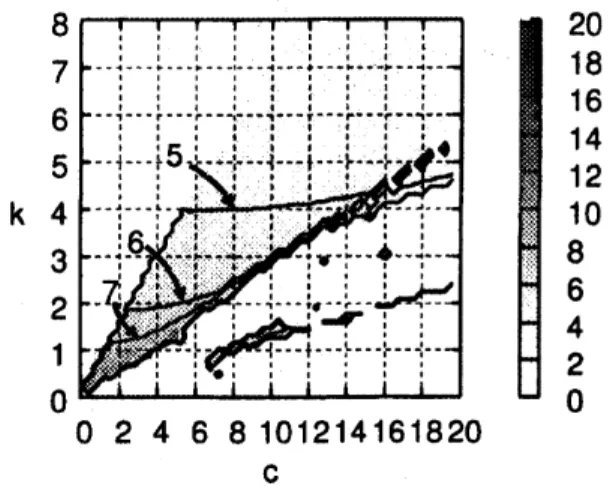
.FIG.2: Phasediagramof thetag model. For any
set of$(c, k)$, phase is automatically analyzed
us
ing $\mathrm{z}(\mathrm{t})$, and is characterizedby phase number.
III. NUMERICAL RESULT In thecases of (I) and (IV), phase number is 0.
andinthe
cases
of(II) and(III), phase numberEq.(5) is integrated numerically by the is period number ifit is smaller than 3. When first-Order Euler method with time step$At=$ period number is larger than 3, phase number 0.005. The initial condition is chosen
ran-
is 3. Boundary betweenthe region where phasedomly. Because eq.(5) is invariant under the number is zero and
nonzero
is shown.transformation
$carrow-c$,$zarrow\pi-z,$we
onlycalculate the
case
$c>0.$ Parameters $c$ and Wehaveone
stable steady solution $z(t)=$$k$ is changed in the range
$0<c<20$
and0
in the regionCo. This
area
is described$0<k<8.$ by $k>0.8c$ approximately, In this region,
the dump term $ki(t)$ surpasses the
output-force
term
$cF(z(t-1))$.
Eqs. (6) and (7)shows
that another interpretationfor
thisphase diagram.
For
example,the
behavior
of eq. (4) with
a
set of $(C, K, \tau)$ isequiva-lent to the behavior of eq. (5) with
a
set ofA. Phase Diagram $(c, k)=(C\tau^{2}, K\tau)$
.
Therefore, ifone
want toconsider how the behavior of eq. (4) varies
We analyzed the time variation oftherela- under the del.ay time $\tau$ with fixed $C$ and $K$,
tive position, $z(t)$, after transitiontime. The the change of thebehavior is shownalongthe
datais classified intothe following fourcate parabola $k= \frac{K}{\sqrt{c}}\sqrt{c}$in fig. 2.
gories (fig.2): (I) convergence($z(t)=$ const.), We have
a
region ofperiodic solutions, $\mathrm{P}$,(II) simple periodic ($z(t)$ is
a
periodic func- indicated by roughly $0.8c>k\sim 0.25c>$.
Thetion, and it has just one maximum in a pe- gray color shows “the period number of
peri-riod like sine function), (III) complex peri- odic solution”, which is the number
of
max-odic ($z(t)$
is
a
periodic function, and it has ima inone
period (note thatthis
is half ofmore
thanone
maximum ina
period), (IV) the definition in ref. [2]$)$.
In the most ofnon-periodic (which will be referred to as the region, tlxe period number is 1: simple
nar-row
regionofcon
$\mathrm{p}1\mathrm{x}\mathrm{p}$ riodic solutio.
Thi 8 20regio $\mathrm{i}$ tangled, but
one
of the region $\mathrm{i}$7 $—.–||---|-|\cdot---\cdot-|--$$-\cdot---,\cdot-|||||\cdot||’ 1|||$} 18
riod $\mathrm{i}$ determir ed mainly by $k$
exc
pt1 ear
$\mathrm{k}4561$ $-. \cdot-.\cdot.\cdot\cdot.\cdot.\cdot..-...\cdot.-.\cdot..\cdot j.’.\cdot..\cdot\cdot..,.\cdot.\cdot..\cdot..\cdot..\cdot\cdot,\cdot.\cdot \mathrm{t}---\downarrow \mathrm{r}-\sim---||--|\frac{j}{1}--|’\dot{}\backslash .|1115|\iota-\sim---!|||\iota_{----\}_{\overline{1}}}--\sim\wedge\wedge--|||-||-|\neg\acute{}_{---}\iota_{}^{\mathrm{t}}\mathrm{t}j^{{}^{\mathrm{t}}j}|-\tilde{--\iota \mathrm{L}}--\cdot--\sim--|\iota!_{1}^{\mathrm{i}}!^{l}|-_{11}-\sim\sim--|--\cdot$ $.\cdot _{\dot{}}^{^{}}.\cdot.\cdot..\cdot..\cdot.\cdot...$
. $4286101214$
round $k\simeq$ 0.1c,$c>7.$ 16
$r\mathrm{I}$he period of the periodic solution is
shown in fig.3. Roughly speaking, the pe-the boundary of this region. Th, region can
$23$
$-.\cdot!7|$
..6
$.\cdot$”’
$|.\cdot\wedge..\cdot.\cdot\cdot\cdot$
’‘–
be separated into two regions by the line
$=k_{c}\simeq 2.5.$ In the area where $k<k_{\mathrm{c}}$,
the $\mathrm{p}$ riod is
a
rapid decre ing functio of$\mathrm{k}$, while when $k>k_{c}$, the rate of decre ing 00
0 2 4 6 8101214161820 becomes
sm
11.$\mathrm{c}$
Theperiod
seerr
$\mathrm{s}$ to convergetoa
certainvalue , ali it $arrow\infty$
.
Thiscan
beunder-FIG. 3: Period of the periodic solution. Th
stood follows. Periodic solution$\mathrm{i}^{\backslash }$achieved
non-period region (convergence, $\mathrm{t}\mathrm{i}\mathrm{c}$) $\mathrm{i}_{1}^{\mathrm{t}}$
whe1 $c$ $\sim k.$ So in the li it $karrow\infty$, the
ec-ond term and the third term in the eq.(5) shown by $.\mathrm{t}\mathrm{e}$
.
Period is $\mathrm{s}\mathrm{h}\mathrm{o}$$1$by $\mathrm{a}\mathrm{y}\mathrm{s}$ $\mathrm{e}$
balance $\mathrm{e}$
$\mathrm{h}$ other. It
means
that the ph$\mathrm{e}$ and thr conto
$\mathrm{s}$ period$=$ , 6,7) $\mathrm{e}$ drawn
of two termsshould be coincides. Thusph $\mathrm{e}$ for convenie $\mathrm{c}$
.
shift for $z(t)$ in theterm $cF(z(t-1)) \mathrm{i}\frac{2\pi}{T}(T$ is the periodof thesolution), $\mathrm{d}$ in the term
ble equilibrium point $z(t)=\pi$ (correspond$\cdot$ $\mathrm{k}\mathrm{z}(\mathrm{t})$ is $\frac{\pi}{2}$
.
The balance of the two termsymptotic value of the period: $=4.$ The
$\mathrm{i}\mathrm{n}\mathrm{g}$ to $(z(t), z(t-1))=(\pi, \pi))$
.
A comple’periodic solution $\mathrm{i}$ sho in fig. $4(\mathrm{d})$. This
detail of the analysls can not be written in
$\mathrm{t}.\mathrm{s}$paperbecauseofthepagelimitation, but solution is a
$\mathrm{r}\mathrm{u}\mathrm{l}\mathrm{t}$ of ymmetry-breaking
and the shapeis not ymmetric with $\mathrm{r}\mathrm{e}\mathrm{p}$ $|$
we
report it elsewhere.to it elf. In this region,
we
ave
two soluIn the
region roughly $k<$ 0.25c,we
havetio $\mathrm{s}$ metric
$.\mathrm{t}\mathrm{h}\mathrm{e}$ $\mathrm{h}$ other, whic il $\mathrm{t}$
ee
“chaotic” regions (Ch) whic ispa-bifurcated from
a
$\mathrm{y}\mathrm{n}\mathrm{n}$ etric periodic solu $\cdot$rated
narrow
periodic $\mathrm{r}$ gions ($k\simeq 0.15c$andtion. Fig.4(c) shows achaotic solution. The
$k\simeq 0.1c$,$c>7)$
.
This regionshowsaperiodicchaoticsolution$\mathrm{s}$
ms
to$\mathrm{t}$.
$\mathrm{t}$aro
$\mathrm{d}$solution. We discus $\mathrm{t}\mathrm{e}$ behavior in thi $\mathrm{r}$
stable periodic solution. When this lutior
gion in the follo $.\mathrm{n}\mathrm{g}$ subsections mair$1\mathrm{y}$
.
is sho in $t-z$ space (not $\mathrm{s}\mathrm{o}\mathrm{n}$ ix tl it
paper), itshows mostly an illationaround
$z(t)$ $=0,$ but sometimes it shows arotary
motion. It should be not that the this
or
$\cdot$B. Orbit in Phase Space bit passes
near
the origin, which is an unstableequilibrium point. The aperiodic motion
Typical orbits in
the
space spanned byseems
to originate from the unstableness $0$$\mathrm{k}\mathrm{z}(\mathrm{t})z(t-1))$
are
shown in $\mathrm{f}\mathrm{i}\mathrm{g}.4$.
(we fixed the origin. However, there is ahole where$k=2,$ and $c$is changed). the path of the orbit
never
passes. It indi$\cdot$
Parameters for fig. $4(\mathrm{a})$ and fig.4(b)
are
cates that thecrosssectionoftheorbit has \’e in the region $\mathrm{P}$ in$\mathrm{f}\mathrm{i}\mathrm{g}.2$, $4(\mathrm{c})$ and $4(\mathrm{e})$ in the
narrow
width (see also fig.5 and fig. 6).region Ch.
Parameters
in fig. $4(\mathrm{d})$ and fig. Another periodic orbit is shown in fig $4(\mathrm{f})$are
ina
narrow
bands
in Ch region in $4(\mathrm{d})$.
This solution shows arotation il fig.2. $S^{1}$, which is different from the oscillation ilA simple oscillation is shown in fig. $4(\mathrm{a})$, fig.4(a) arzd $4(\mathrm{a})$
.
This rotary periodic solu$\cdot$which is symmetric with respect to the unsta- tion is sandwiched between two chaotic
re-$\mathrm{c}$ le is $\mathrm{e}$, $\prime \mathrm{n}$ $1-$ $\prime 1\mathrm{x}$ is $\mathrm{g}$, $\mathrm{t}$ $1-$ is 1-le $|\mathrm{n}$ is $\lfloor \mathrm{d}$ $|.\mathrm{y}$ r- a-In
af
re
.i-a $\mathrm{g}$.
$\downarrow \mathrm{n}|$ $\downarrow \mathrm{n}\}$ $\mathrm{L}|1-$ $\alpha-$gions characterized by fig.4(c) and fig.4(e). that the orbit is always rotary. The orbit
Chaotic
solution
shown infig.4(e)differs fromcovers
most of the space, although thecover
the chaotic solution in fig.4(c) in the
sense
ratio is dependent on $c$.
$\ovalbox{\tt\small REJECT}$
3 2 1 $\wedge\overline{\check{\mathrm{N}}\underline{‘}}$ 0 $-_{\mathrm{I}}$ -1 -2 -3 -3 -2 -1 0 1 2 3 $\mathrm{z}\{\mathrm{t})$ 3 2 1 $\underline{\wedge-_{\mathrm{t}}}\check{\mathrm{N}}$ 0 -1 -2 -3 -3 -2 -1 0 1 2 3 $\mathrm{z}(\mathrm{t})$FIG. 4: Orbit in the phasespace $(z(t), z(t-1))$. To display the orbit clearly, wedraw twoperiods
for each axis.
C. Cross Section fig. 5, and fig. 6(magnification offig.5). The value of $k$ is fixed to 2, which is the
same as
We show a Poincaresection (plot of$z(t-$ $\mathrm{f}\mathrm{i}\mathrm{g}.4$
.
In fig. 6, a bifurcation froma
sym-1) when $\sim.\gamma(t)=0$ $\mathrm{a}\mathrm{l}\mathrm{u}\mathrm{d}\sim\wedge’(\mathrm{t})>0$ $)$ of the
or-
metric periodic solution to asymmetric ones$\mathrm{c}1_{1}\mathrm{a}()$s is observed by $c\simeq 7.3.$ $\mathrm{I}\mathrm{r}1$ the region al. [2] reported that delay-differential
equa-$7.3<c<10$
, Poincare section has a width tion shows akind of simplificationofcomplexabout $0.5\sim 1.0$($\mathrm{d}\mathrm{e}\mathrm{p}\mathrm{e}\mathrm{n}\mathrm{d}\mathrm{i}_{1\mathrm{l}}\mathrm{g}$on $c$), which
cor-
behavior when delay term is replaced by theresponds to the situation typically shown by distributed delay. In their paper,
simplifica-fig.4(c), although many window-like struc- tion meansreduction of oscillation amplitude
ture is observed in the region. In the region or period. In particular, their result shows
$c>11,$the width increasingwith$c$, and when chaotic behavior recovers periodicity as the
$c>15,$ the section covers whole the domain width ofthe delay distribution increases.
of
$z(t)$( exceptthe
window $16<c<17$).We study a distributed delay version
of
eq.(5). $\mathrm{r}$ $\tilde{\mathrm{E}}\frac{1}{\check}\infty$ $\dot{\overline{*}}=\tilde{\aleph}$ $\epsilon\Phi c\frac{\yen}{\dot{\mathrm{L}}}$ $z(t)+cF(\overline{z}(t-1))+k\dot{z}(t)=0,$ (8) $\mathrm{c}$
FIG. 5: Cross section of orbit.
$\overline{z}(t)$ $=7_{\infty}^{\infty}z(t-1-t’)P(t’)\mathrm{d}t’$, (9)
$P(t)=\{$ $\frac{1}{\sigma}(t\leq\frac{\sigma}{2})$
0 $(t> \frac{\sigma}{2})$ ’ (10)
where $\sigma$ is the width of $\mathrm{t}1_{1}\mathrm{e}$
distribu-tion, and distribution function $P(t)$ is
a
normalized uniform distribution in $[- \frac{\sigma}{2}, \frac{\sigma}{2}]$,
$\int_{-\infty}^{\infty}P(t)\mathrm{d}t=1.$
$\mathrm{c}$
A detailed analysisshows ([5]) the chaotic
FIG. 6: Thesame asfig.5, but enlarged toshow region which is adjoint to $\mathrm{P},(7.3<c<10$
the transition to chaos. when $k=2$) vanishes
as
$\rho$ increases, whileother chaotic region remains chaotic. A
typ-ical stabilizing process for a parameter set
D. Stabilization of Chaotic Behavior by $(c, k)=(14,3.36)$ is shown in fig.7. Roughly
Distributed Delay speaking, stabilization
seems
to start when $\sigma>1.$ A branch whichsurvives to aperiodic In this subsection,we
analyze the effect solutionwhen$\sigma>1.2$stems when$\sigma=1,$ andof the suppression of chaotic behavior by chaotic region starts inverse period-doubling
$3<$ $2.5$ $2$ $1.5$ $1$ $0.5$ $0$ 仮
FIG.7: Poincaresection oftheorbit($c=14$,$k=$ FIG. 8: The stability boundary oflinear theory.
3.36), as afunctionof the width of the
distribu-tion $\sigma$
.
where y7 $=k^{2}/c$
.
Getting the equation of $\tau_{\mathrm{c}}$ is
as
follows:Calculating $k^{2}(13)+(14)^{2}$ is
$\mathrm{I}\mathrm{V}$
.
THEORETICAL RESULT$s^{2}+\eta s-1=0,$ (19)
A. linea stability
where $s=\cos(\omega)$
.
The solution ofeq.(19) isIn this section,
we
check the agreement oflinear
stability theory$\mathrm{w}$.
ith
numericalresults.
$s=\cos(\omega)=\eta\mu$.
(20)We
start witha
linearized
equation:We denote $\cos^{-1}(x)(=\theta)$ by the smallest
$y..(t)+$$\mathrm{c}\mathrm{y}\{t-1$) $+\mathrm{J}\mathrm{c}\dot{y}(t)=0.$ (11) non-negative
value which satisfies$\cos(\theta)=x$
It is easily known that the ch racteristic toobtain
equation for eq.(ll) is $\omega$$=\cos^{-1}(\eta\mu)$
.
(21)$x^{2}+ce$ $-\sigma+ko$ $=0$ (12) Equating eq. (18) to eq. (21), we get the
equationtodeterminethe stability boundary:
by putting $y(t)$
oc
$e^{\sigma t}$.
To obtain stability boundary,
we
set $\sigma=$ $k\sqrt{\mu}=\cos^{-1}(\eta\mu)$ (22)$\mathrm{i}\mathrm{w}\{\mathrm{u}\in \mathrm{R}$), and
we
get the equation for$\omega$,$\omega^{2}=$ ccos(o;) (13)
$k\omega$ $=$ $c\sin(\omega)$ (11) Fig.
8shows
the superposed picture of(15) fig.2 and stability boundary of eq. (22). Eq.
(22) agrees well with the numeric 1 result.
We
can
get theequationfor$\omega$ bycalculat-ing $(13)^{2}+(14)^{2}$:
V. SUMMARY
$\omega^{4}+k^{2}\omega^{2}-c^{2}=0.$ (16)
Itis easilyshown that the solutionof$\mathrm{e}\mathrm{q}\mathrm{s}.(14)$ Chasing prob.lem among two object is $\omega$exists. The explicit form of$\alpha J$ is: analyzed on
a
circle using simpledelay-differential
equation. In thecase
withoutde-$\omega$ $=k\sqrt{\mu}$
(17) lay, this equation only shows the capture
or
$\mu.--\cdot\backslash \cdot\frac{1}{2}(\sqrt{1\cdot\{-(\frac{2}{\eta})^{2}}-1)$
:
the flee depending
on
the parameterdeter-(18) mining the maximum output
force.
Unlike such trivial result above, this equationshowsvarious motions when time delay of process- ficient), the boundary of thesestate are
char-inginformation is considered. If the time de- acterized roughly by the line $K$ cx $C$. A lay is considered, the tag doesnot reach to an simple phenomenological theory is being
con-end in
a
wide range of parameters. In such structed, and itseems
to account for therea-parameter, theeluder eludes from
the chaser
son, butwe
will report thedetail for anothereven
ifthe abilityofthe chaser is larger than opportunity. the eluder.We analyzed the behavior numerically,
and classified it into convergent state,
peri-odicstate, and chaotic state. Linear stability Acknowledgments theory reproduces the boundarybetweenthe
convergent state and the periodic state well. We thank Prof. Miyazaki for valuable
The effect of replacing delay term with dis- comment for our research. This research
was
tributed delay
one
is also studied, and it is partially supported by the Ministry of Edu-shown thata
part ofchaotic region is stabi- ca.tion, Science, Sports and Culture,Grant-lized. The
reason
is unknown, but in such in-Aid for Young Scientists (B), 2003-2004,stabilized region,
Poincare map
of thenon-
15740230, and This researchwas
partiallydistributed
equation hasa
confined region. supported by theSumitomo
Foundation,Inthephasespacespanned by$C(\mathrm{t}\mathrm{h}\mathrm{e}$ $\max-$
Grant for
BasicScience
Research Projects,imum of the output force) and $K(\mathrm{d}\mathrm{u}\mathrm{m}\mathrm{p}$coef-
020757.
[1] A.S.Mikhailov and V. Calenbuhr. $Fmm$ cells light ffom a ring cavity. Phys. Rev. Lett.,
to societies:models
of
complexcoherent ac- 45(9):709-712, 1980.tion. Springer,Berlin, 2002. [4] N.MacDonald. Biological delay system: line
[2] A.Thiel, H. SChwegler, and $\mathrm{C}.\mathrm{W}$
.
Eurich. ear stability theory, volume 8 of CambridgeComplex dynamics is abolished in delayed stuies in mathematical biology. Cambridge
recurrent systems withdestributed feedbadc UniversityPress, 1989.
systems. Complexity, 8(4):102-108, 2003. [5] $*;\hslash \mathrm{E}\mathrm{X}$
.
$\Theta \mathbb{H}\mathrm{E}h\#$$\mathrm{S})^{\vee}\mathit{2}|\mathrm{q}\ovalbox{\tt\small REJECT}_{-}\mathrm{b}^{\backslash }\mathrm{g}\mathfrak{B}\mathrm{P}\mathrm{I}\mathrm{f}1\mathfrak{B}\sigma$)$\Re$$[3]$ K.Ikeda, H.Daido, and O.Akimoto. Optical {$\mathrm{E}\mathrm{M}\mathrm{f}\mathrm{f}\mathrm{l}\Re$
.
Master’sthesis, $\mathrm{l}\mathrm{b}\Phi \mathrm{E}*\mathrm{a}\mathrm{e}$,2003.turbulence: Chaotic behavior of transmitted
[5] $*;\hslash \mathrm{E}\mathrm{X}$