Pregeometric Shells
of
a Rational
Quartic
Curve
and
of
a
Veronese surface
姫工大 理 遊佐 毅 (Takeshi Usa)
Dept.
of
Math.
Himeji
Institute
of Technology
*Abstract
This is aresumeoftheauthor’s talk given at R.I.M.S. onJune 182003and isapartial revision ofa
recent paper [23] with additional results. The theme of that talkwasto give asupporting evidence for general conjectures raised in [20] (cf. Conjecture 0.1). We classify all the pregeometric shells of
a rational normal quartic curve $X$ (resp. ofa Veronese surface $X$), namely the closed subschemes
in $\mathrm{P}^{4}(\mathbb{C})$ (resp. in $\mathrm{P}^{5}(\mathbb{C})$) which include$X$ and whose homogeneous coordinate rings satisfy the$\mathrm{T}\mathrm{o}\mathrm{r}$
injectivity condition. This $\mathrm{T}\mathrm{o}\mathrm{r}$ injectivity condition is the same as to impose that for every
non-negative integer $q$, minimal generatorsof$q$-thsyzygy ofits homogeneous coordinate ring form apart
of minimal generators of $q$-th syzygy of the homogeneous coordinate ring $R_{\mathit{1}\iota}$ of $X$. We see that
all those pregeo metric shells turn out to be reduced and irreducible, and moreover the varieties of
A-genuszero (embedded bytheir complete linear systems, cf. Remark 1.3), namely the varieties of
minimal degree, aspredictedfromthese generalconjectures.
Keywords: pregeometric shell, rational quarticcurve, Veronesesurface, $\triangle$-genus,variety of minimal
degree
\S 0
Introduction.
Dreaming to construct a theory of projective embeddings modeled after the classical Galois theory, we
presented several conjectures and problems
on
the geometric structures of projective embeddings in ourprevious paper [20]. Oneof thekeyconcepts appeared in these conjectures and problems is “pregeometric shell” (abbr. $\mathrm{P}\mathrm{G}$-shell; cf. Definition 2.4), which was first introduced in [19] with expectation that it
may play a similar role as
a
concept of “intermediate extension field” in the Galois theory and rnay cutour
way to the dream.We already
saw
in [20] and [22] that the (pre)geometric shells inherit many excellent properties (cfProposition 2.5, Corollary 3.7) from their (pre)geometric core (abbr. $(\mathrm{P})\mathrm{G}$
core
; cf. Definition 2.4),which reflect the structure of higher syzygies of the homogeneouscoordinate ring of the (pre)geometric
core. “Pregeometric shells” had appeared implicitly in many classical works (cf. [13], [15], [5], [7], [16],
$[6],[3]$ etc.) as actual examples. However, there
are
still deep mysteries on pregeometric shells left (cf.[20]$)$
.
For example, the following conjectures are still open with slight modifications (precisely, only thefirst
one
is added after publishing of [20]$)$.’2167 Shosha, Himeji,
671-2201
Japan.$\mathrm{E}$-mail address : [email protected]
128
Conjecture 0.1 We
fix
the total space $P=\mathrm{P}^{N}(\mathbb{C})$ with the tautological ample line bundle $O_{P}(1)=$ $O_{P}(H)$ and considerits closed subschemesdefined
over
$\mathbb{C}$ with induced polarizations.(0.1.1) Assume that a closed subscheme$W$ is apregeometric shell
of
an arithmetically Cohen-Macaulayclosed subscheme V. Then the subscheme $W$ is also an arithmetically Cohen-Macaulay
sub-scheme. (N.B.
If
$dim(W)=dim(V)$ , then this is obviously true by Auslander-Buchsbaumfor
mula on the depths and the homological dimensions. Thus, in this case, $e.g$.if
$dim(V)>0,$then the case: $W=V\mathrm{I}\mathrm{I}\{1 pt.\}$ never occurs.)
(0.1.2) Assume that a closed subscheme $W$ is a pregeometric shell
of
a clos$ed$ subvariety $V\subseteq P$. Thenthe subscheme $W$ is also a variety, namely reduced and irreducible. (N.B. When the subscheme $W$ is a scheme
of
codimcnsion one, this is true.cf.
Lemma 3.2, Proposition 2.5 (2.5.1)$)$(0.1.3) Take closed subvarieties $V$ and $W$
of
positive dimension. Assume that the subvariety $V$sat-isfies
the arithmetic $D_{2}$ (depth $\geq 2$) condition, namely the natural map $H^{0}(P, O_{P}(m))\mathrm{e}$$H^{0}(V, O_{V}(m))$ is surjective
for
every integer $m$.If
$W$ is a pregeometric shellof
$V$, then ontheir $\triangle$-genera $(\mathrm{e}.\mathrm{g}. \triangle(V, \mathrm{O}_{V} (1))$ $:=dim(V)+deg(O_{V}(1))-h^{0}(V, O_{V}(1))$ ; (cf. [6]), the in-equality:
$\triangle(\mathrm{I}/, O_{V}(1))$ $\geq\triangle(W, O_{W}(1))$
holds, ($e.g$. As a typical case,
if
the polarizedmanifold
($V$,Oy(1)) is arithmetically no rmal andis a hypersurface cut
of
the polarizedmanifold
$(W, O_{W}(1))$, then $W$ is a $PG$-shellof
$V$ andthis inequality is obviously true. On the other hand,
if
we assume that $V$ is non-degenerate arithmetically Buchsbaum, and $W$ is a hypersurface, then the result71
$7f$ on spec$ial$ casesof
Eisenbud-Goto conjectureshows that this claim is also true.)
(0.1.4) Take a closed subvariety$W$, a vector bundle$E$ on$W$, a section$\sigma\in\Gamma(W, E)$, and put: $V=Z(\sigma)$.
Assume $:(a)$ the subscheme $V$ is a variety and
satisfies
the arithmetic $D_{2}$ condition; (b) therestricted section$\sigma|_{Reg(W)}\in\Gamma(Reg(W), E|_{Reg(W)})$ is transverse to the
zero
sectionon
the openset $Reg(W),\cdot(c)W$ is a pregeometric shell
of
$V$ and $Reg(V)\subseteq Reg(W)$. Then the bundle$E$ is a $nef$ bundle (N.B.
If
we do not assume the arithmetic $D_{2}$ conditionon
$V$, we have $a$counter-example,
cf.
[21]. On the other hand,if
$W=P$ and rank(E) $=2,$ this claimis true).Once we fix a closed scheme $V$, its $\mathrm{P}\mathrm{G}$-shells generally exist infinitely many, but by the elementary
properties of$\mathrm{P}\mathrm{G}$-shells (cf. Proposition 2.5 (2.5.4)), they are bounded by an algebraic family of finite
components, which suggests the theoretical possibility of classifying its $\mathrm{P}\mathrm{G}$-shells completely. Thus, to
find evidences forthese conjectures, what we should do first is to classify all the$\mathrm{P}\mathrm{G}$-shellsof the variety
$V$ of$\triangle$-genus zero.
Applying an elementary property (cf. Lemma 2.11) of$\mathrm{P}\mathrm{G}$-shells, we can easily reduced this problem
tothecasethat the variety$V$isanon-degeneraterational normalcurveof degree$d\geq 3.$ Then the easiest
but non-trivial
case
is the case : $d=4.$ This casealso relates with aVeronese surface which is the only heretical (and the most interesting) case inthe list of thevarieties with $\triangle$-genus zero.In this article, with a help of a classical result on varieties of minimal degree (cf. [12]), or of Fujita’s modern theory on polarized varieties by using $\triangle$-genera (cf. [6]), using rather primitive and classical
methods, we study these two cases as a first step toward those conjectures. After the classifications of
$\mathrm{P}\mathrm{G}$-shells, wc seethat all the claims above
are
affirmative in these twocases.
The author would like to express his deep gratitude to Prof. M. Green for inviting him to UCLA, which brought hirn calm days andaniceenvironment for research, to Prof. T. Ashikaga formuchincentive for this classification (cf. [1]), and to Prof. K. Konno for giving achance of the talkto the author.
\S 1
Main Results.
To give
an
overview, letus
summarize our main resultsas
two main theorems. We should emphasize again here that our “schemes” ofcourse may have a non-equidimensional component or a non-reduced structure. For precise definitions onterminology, see the next section52.
The first main theorem is
on
the classification of $\mathrm{P}\mathrm{G}$-shells of a rational normal quartic curve. Wewill give its full proof in the latter part of this article.
Main Theorem 1.1 Let$X$ be a non-degenerate non-singular rational quartic curve in a
4-th
projectivespace: $P=\mathrm{P}^{4}(\mathbb{C})$ with the tautological line bundle $O_{P}(1)=O_{P}(H)$, and a closed subscheme $W\subseteq Pa$
pregeometric shell
of
$X$ with coclirn(W,$P$) $>0.$ Then the scheme $W$ isone
of
the followingcases.
(1.1.1)
If
codim$(W)=\mathit{1}$, then $W$ be a divisorof
$P$ and an irreducible and reduced quadric hypersurfaceof
rank 3, 4, or 5($\iota.e$.
non-singular). Noneof
these quadric hypersurfaces is a FG-shell(cf.DefinitiOn2.4)
of
$X$.(1.1.2)
If
codim(W)$=\mathit{2}$, thenthe scheme$W$ isirreducible and reduced. The polarized variety$(\mathrm{W}, O_{W}(1))$is
of
$\triangle$-genus zero (of minimal degree). More precisely, thesurface
$W$ is a projective coneof
a $nor\iota$-singular twisted cubic
curve or
$a$one
point blow-upof
a projective plane $\mathrm{P}^{2}(\mathbb{C})$. In theformer
case, the curve $X$ passes through the vertexof
the cone, arid is not a Cartier divisorHence there is no shell
frame of
$X$ in W. In the latter case, the variety $W$ is embedded by $a$linear system coming
from
the conies passing the centerof
blow-up, and thecurve
$X$ is a $nef$(Cartier) divisor on $W$ (thus a unique shell
frame
($O_{W}(X)$,$\sigma x$) exists), which $co$omesfrom
$a$singular irreducible and reduced cubicplane curve passing through the center
of
blow up $doubl\mathrm{s}/$or
from
an irreducible conic which does notpass through the centerof
blow-up (more precisely,cf.
Proposition 3.6 and$S\mathit{4}\cdot$).(1.1.3)
If
codim(W)$=\mathit{3}$, then the scheme $W$ exactly coincides rryith $X$.Including the trivial
case:
codim(W) $=0$, i.e. $W=P$, a polarized scheme $(W, O_{W}(1))$ which is $a$pregeometric shell
of
thecurve
$X$ is always a varietyof
$\triangle$-genus zero (ofminimal degree), andtherefore
an
anthrnetically Cohen-Macaulay variety.Based
on
Main Theoreml.l , applyingLemma2.11, wecangetthenext main theoremon aclassification of$\mathrm{P}\mathrm{G}$-shells ofaVeronese surface which is the only heretical case in the classification on thevarieties of $\triangle$-genuszero.
In this article, we omit its proofbecause of the page limit. For its full proof, see [24].Main Theorem 1.2 Let$X$ be a Veronese surface, namely the image
of
a projective $pla$ne $\mathrm{P}^{2}(\mathbb{C})$ by $a$Veronesean embedding
of
degree 2 given bya
complete linear system : $|\mathrm{O}\mathrm{p}\circ-(\mathrm{C})(2)|$, in a 5-th projectivespace: $P=\mathrm{P}$“$(\mathbb{C})$ with the tautological line bundle $O_{P}(1)=O_{P}(H)$, and a closed subscheme $W\subseteq Pa$
pregeometric shell
of
$X$ with codim(W,$P$) $>0.$ Then the scheme$W$ is oneof
the following cases.(1.2.1)
If
codim(W)$=\mathit{1}$, then $W$ be a divisorof
$P$ and an irreducible arid reduced quadric hypersurfaceNone
of
these quadric hypersurfaces is a $FG$ shellof
$V$.(1.2.2)
If
codim(W)$=\mathit{2}$, then the scheme$W$ is$i$ reducible and reduced. The polarized variety$(W, Ow(1))$is
of
$\triangle_{-}$gervuszero (ofminimaldegree). More precisely, The singular locus Sing(W)of
$W$ isonlyonepoint$v_{0}$, which is included by the
surface
V. The onepointchordalvariety(cf. Lemma2.15):$Cd(v_{0}, V)$
of
thesurface
$V$ coincides with the variety W. Take a hyperplain $H$ which does not pass the point$v_{0}$ andintersects the variety $W$ transversely. Then, the hyperplain cut$W\cap H$ is isomorphic to $a$ one point blow upof
$\mathrm{P}^{2}(\mathbb{C})$. Thus, the variety$W$ is also a projective coneof
$a$30
(1.2.3)
If
codim(W)$=d\mathit{6}$, then the scheme $W$ exactly coincides with$X$.Including the trivial case: codim(W) $=0,$ $i.e$. $W=P,$ a polarized scheme $(W, O_{W}(1))$ which is $a$
pregeometric shell
of
the curve$X$ is always a varietyof
$\triangle$-genus zero (ofminimaldegree), andtherefore
an arithmetically Cohen-Macaulay variety.
Remark 1.3 With respect to a polarized variety $(V, L)$
.
namely a pairof
a projective variety $V$ andan ample line bundle $L$ on $V$, the main concern
of
Fujita$\prime s$ theory orof
the theoryof
$\triangle$-genus is inthe geometric analysis
of
the embedding into a weighted projective space associated to the line bundle $L$instead
of
the embedding into a usual projective space by the linear system $|L|$. However,if
we restrictourselves to the case that the line bundle $L$ is simply generated, or the variety $V$ is embedded into $a$
usual projective space with the “arithmetic $D_{2}$“conditeon, Fujita’s theory can be applied directly to our
problems. Thus, in this article,
if
ate say that the subvariety $V\subset P=\mathrm{P}^{N}(\mathbb{C})$ is a varietyof
$\triangle$-genuszero, it means that thepair ($V$,Ox(1)$|\mathrm{v}$) is a variety
of
$\triangle$-genus zero in the senseof
Fujita’s theory andthe va riety $V$ is embedded into $P$ by the comlete linear system $|$Ox(1)$|$
$V$$|$ (and
therefore
the variety $V$is non-degenerate in $P$), where the simple generation
of
the (very) ample line bundle $O_{P}(1)|$$V$ is alwaysguaranteed by Fujita’s theory
for
the varietyof
$\triangle$-genus zero (cf. $[\mathit{6}f$).j2 Preliminaries.
To avoid needless confusions, let us confirm our notation used in this article.
Notation and Conventions 2.1 In this paper, we use the terminology
of
[8] without mentioned, and always admit the conventions and use the notation belowfor
simplicity.(2.1.1) Every object under consideration is
defined
overthefield of
complexnumbersC. We will work inthe category
of
algebraic schemesover
$\mathbb{C}$ and algebraically holomorphic morphisms (or rationalmaps)
or
in the categoriesof
coherent sheaves and their ($O$-linear) homomorphisms othe rwisementioned.
(2.1.2) Let us take a complex projective scheme $X$
of
dimension$n$ and oneof
its embeddings$j$ : $X\mathrm{c}arrow$$P=\mathrm{P}^{N}(\mathbb{C})$. The
sheaf of
ideals defining $j(X)$ in $P$ and the conormalsheaf
are
denoted by$I_{X}$and $N_{X/P}^{\vee}=I_{X}/I_{X}^{2}$, respectively. Taking $a\mathbb{C}$-basis $\{Z_{0}, \ldots, Z_{N}\}$
of
$H^{0}(P$,Ox(1 ).
Thenwe
put.$\cdot$$S$ $:=$ $\oplus H^{0}(P, O_{P}(m))\mathrm{Y}$ $\mathbb{C}[Z_{0}, \ldots, Z_{N}]$ $m\geq 0$
$s_{+}$ :
$= \bigoplus_{m>0}H^{0}(P, O_{P}(m))\cong(Z_{0}, \ldots, Z_{N})\mathbb{C}[Z_{0}$,
. . .
’$Z_{N}]$$\overline{R_{X}}$ $:=$ $\oplus H^{0}(X, O_{X}(m))$ $m\geq 0$ $\Pi_{X}$ $:=$ $\bigoplus_{m\geq 0}H^{0}(P, I_{X}(m))$ $R_{X}$ $:=$ $Im[Sarrow\overline{R_{X}}]\cong$ S/I[X.
In this case, the induced ample line bundle$j’ O\mathrm{O}(1)=j^{*}O_{P}(H)$ isdenoted by$O_{X}(1)$ or$O_{X}(H)$.
If
the scheme $X$itself
is anotherprojective space $\mathrm{P}^{n}(\mathbb{C})$, then its tautological ample line bundle$o_{\mathrm{r}P^{n}(\mathrm{C})}(1)$ is denoted simply by $O(1)$ without any letter to specify the space, otherwise mentioned
explicitly. Thus,
if
we
consider the $d$-th Veronesean embedding $j$ : $X\mathrm{c}arrow P=\mathrm{P}^{N}(\mathbb{C})$for
$X=$(2.1.3) For
a
graded$S$-module$E$, the symbol$E(m)$ denotes the degree$m$partof
$E$, namely$E= \bigoplus_{m\in \mathrm{Z}}E_{(m)}$
.
The degree
shift:
$E(d)$of
the module $E$means
that $(E(d))(m):=$E{
$\mathrm{d})$.Affine sheafication
of
the $S$-module $E$ ($i.e$. a canonically constructed $O_{Spec(S)}$-module
from
a $S$-module ) is denotedby $E^{\sim}$ and projective
sheafication
of
the graded $S$-module $E(i.e.$ a canonically constructed$o_{Proj(S)}$-module
from
a graded$S$-module ) is denoted by $E^{(\sim)}$, respectively.(2.1.4) For a coherent
sheaf
$F$ on aclosed subscheme $V\subseteq P,$ we set the Hilbert polynomialof
thesheaf
$F$ to be:
$N$
$A_{F}(m):=$ $\mathrm{x}(F(m))=E(-1)^{q}\dim(H^{q}(V, F(m)))$.
$q=0$
In case
of
$F=Oy,$ we denote its Hilbert polynomial as $A_{V}(m)$ insteadof
$Ao_{v}(m)$.
Moreover,if
$(V, O_{V}(1))=(\mathrm{P}^{k}(\mathbb{C}), O_{\mathrm{I}\mathrm{P}^{k}(\mathrm{C})}(1))$, we simply write$A_{k}(m)$for
$\mathrm{J}_{\mathrm{P}^{k}(\mathbb{C})}(m)$. (Precise propertiesof
Hilbertpolynomials are
referred
to $[\mathit{1}\mathit{1}^{l},)$(2.1.5) Fora realvalued
function
$f(x)$defined
on thefield of
real numbers$\mathbb{R}$ (oron
the ringof
rational integers$\mathbb{Z}$), wedefine
the (first) (backward)difference
function
to be: $(\mathrm{V}\mathrm{f})(\mathrm{x}):=$ f(x)$-f(x-1)$ and the $k$-thdifference
function
to be $(\nabla^{k}f)(x):=(\nabla(\nabla^{k-1}f))(x)$for
a positive integer$k$ $(\mathrm{N}.\mathrm{D}$. $(\nabla^{0}f)(x):=f(x))$. The operator$\nabla$ is called (backward) difference operator.(2.1.6) Let $B$ be a projective line $\mathrm{P}^{1}(\mathbb{C})$
.
For a non-negative integer $e$ (or$.e$ to include $e=1$ ), we set : $\pi$ : $\Sigma_{e}:=\mathrm{P}(O_{\mathrm{P}^{1}(\mathrm{C})}\oplus o_{\mathrm{F}^{1}}(\mathrm{C}) (-e))arrow B,$ ($i$.
$e$. a rational ruledsurface of
degree $e$), $a$curve $C_{e}$ in the
surface
$\Sigma_{\mathrm{e}}$ to be a tautological$\pi$-ample divisor dete rmined by the vector bundleOpi$(\mathrm{c})\oplus O_{\mathrm{P}^{1}}(\mathrm{C})$$(-e)$ and a curve $f$ to be the
fibre
of
the morphism $\pi$.We will needaclassical and well-known result
on
the Picardgroup ofa
rational ruled surface (cf. [8]). Lemma 2.2 Under the circumstancesof
(2.1.6), let us consider a rational ruledsurface
$\Sigma_{e}$. Then thecurves:
$\{f, C_{e}\}$forrn
$\mathbb{Z}$-free
basisof
the Picardgroup $Pic(Ee)$of
thesurface
$\Sigma_{e}$ and have the followingproperties.
(2.2.1) The intersection numbers are : $c_{e}^{2}=-e$ $\leq 0;f^{2}=0;$ and$\mathrm{f}$.Ce $=1.$
(2.2.2) For integers$u$ artd $v$,
the chvisor $uf+vCe$ is very ample $\Leftrightarrow the$ $d\iota vis$or $uf+vC_{e}$ is ample 9 ”$v>0$, $u>ve$ ”
(2.2.3) For integers $u$ and$v$,
the linear system $|uf+\uparrow’ C_{e}|$ contains an irreducible $\tau\iota \mathit{0}r\iota$-srngular curve $\Leftrightarrow it$ contains an
irre-ducible
curve
9 ”$(u, v)$ $=(1,0)$or
$(0, 1))$.or
$v>0$,$u>ve$ ;
or
$e>0,$ $?’>0,$ $u=ve$”.(2.2.4) On the canonical divisor
of
thesurface
$\Sigma_{e}$, we have$K_{\Sigma_{e}}=(-2-e)f+(-2)C_{e}$
.
Sinceinourclassification,
we
have to consider non-reduced and non-equidimensionalschemes, needanaccurate handling on their nilpotent structures, and can not reduceour problems to the case of reduccd
132
Definition 2.3 For a Noetherian scheme $W$ and
finite
numberof
its closed subschemes$\{V_{s}\}_{s=1r}^{k^{\mathrm{r}}}$ schemetheoretic union $Y= \bigcup_{s=1}^{k}V_{s}$ is
defined
byan
idealsheaf
$I_{Y}:=$ I $s=1k$$I_{V_{\mathrm{s}^{\neg}}}$, namely the kernelsheaf:
$Ker[O_{P}arrow\oplus_{s=1}^{k-}O_{V_{s}}]$ On the otherhand, since there is
no
uniquenessof
primary decompositionof
idealsin Noetherian rings, once
if
an arbitrary Noetherian scheme $Y$ which may havea
nilpotent structure isgivenfirst, then it is notso trivial to
find
its closed subschemes $\{V_{s}\}_{s=1}^{k}$ such that each topological space $|V_{s}|$of
the subscheme $V_{s}$ is irreducible and the scheme theoretic union $\bigcup_{s=1}^{k}.V_{s}$ coincides with Y. Thuswe will restrict ourselves to the case that the scheme $Y$ is a closed subscheme
of
$P=\mathrm{P}^{N}(\mathbb{C})=$Proj(S)and will
define
its “primary decomposition” and “irreducible decomposition” (not uniquely). For theh0-mogeneous ideal$\mathrm{I}_{Y}$
of
$Y$, $u$)$e$ have a homogeneous primary decomposition in the shortest representation:$\zeta 1’=$ ’$s=1k^{\wedge}\mathrm{J}_{s}$, and we set
7.
$:=(\mathrm{J}_{s})^{(\sim)}$, $V_{s}:=(Supp(Op/J_{5}), O_{P}/J_{\mathrm{s}})$for
$s=1$,$\ldots$ ,$k$
.
It is easy tosee
that their scheme theoretic union $\bigcup_{s=1}^{k}$$V$ coincides with Y. We call thisfinite
setof
closed subschemes$\{V_{s}\}_{s=1}^{k}$. as a primary decomposition
of
Y. Nextwe
pick up all the minimalprime idealsof
$\mathrm{I}_{Y}$. Thenwe may assume that $\{\mathrm{J}_{i}\}_{i=1}^{t}(t\leq k)$ are the primary ideals associated to these minimal prime ideals,
respectively As is well-known, only these primary ideals: $\{\mathrm{J}_{\mathrm{z}}\}_{i=1}^{t}$ (resp. only these “maximal” primary
component subschemes :$\{V_{i}\}_{i=1}^{t})$ are determined uniquely by the ideal $\mathrm{I}_{Y}$ (resp. by the subscheme $Y$).
Now,
for
$i=1,$. . . ’$t$, $l\mathit{1}C\mathit{2}$ set a subscheme $U_{i}$ to be the scheme theoretic union:$U_{i}:=V_{s}\underline{\mathrm{C}}V_{1}\cup V_{s}$
.
Then we call the
finite
setof
closed subschemes $\{U_{i}\}_{\mathrm{z}=1}^{t}$ as an irreducible decompositionof
Y. Weshould make a remark that the homogeneous ideal$\lrcorner \mathrm{v}_{Y}$ does not have the irrelevant maximal ideal $S_{+}$ as
an associated prime by its definition, the homogeneous ideal$\mathrm{I}_{V_{\mathit{8}}}$ coincides with the ideal$J_{s}$, and that the homogeneous ideal $\mathrm{I}_{U_{l}}$ does with the ideal:
$\cap$ $\mathrm{J}_{6}$. $\sqrt{\mathrm{J}_{\mathrm{t}}}\subseteq\sqrt{\mathrm{J}_{\mathit{3}}}$
If
$dim(Y)=n$ , then a primary component $V_{6}$of
dimension $n$ (resp. an irreducible component $U_{i}$of
dimension $n$) is called amain primary component (resp. a main irreducible$\mathrm{c}\mathrm{o}\mathrm{m}\mathrm{p}\mathrm{o}\mathrm{n}\mathrm{e}\mathrm{n}\mathrm{t}/$
Now let us recall our key concepts for studying the geometric structures of projective embeddings, the first two : (“$\mathrm{P}\mathrm{G}$shell and ($‘ \mathrm{G}$-shell”)) of them
were
introduced first in [19]. On $\mathrm{G}$-shells,we
haveslightly modified its definition from$V\subseteq Reg(W)$ in [19] to $Reg(V)\subseteq Reg(W)$. By reconsideringclassical
examples in Complex Projective Geometry including varieties
of
minimal degree, with standing on thisnew pointof view, wecan find manygoodactual examples for these conceptsina number of works such
as [13], [15], [5], [7], [16], [6], [3] and so on.
Definition 2.4 (shells and cores) Let $V$ and $W$ be closed subschemes
of
$P=\mathrm{P}^{N}(\mathbb{C})$ which satisfy$V\subseteq W$ (namely the inclusion
of
the defining ideal sheaves: $I_{V}\supseteq I_{W}$ in the structuresheaf
$O_{P}$of
$Pj$ Inthis case, the subscheme$W$ is called simply an intermediate ambient scheme
of
$V$)If
the natural map:$\mu_{q}$ : $Tor_{q}^{S}(R_{W}, S/S_{+})arrow Tor_{q}^{S}(R_{V}, S/S_{+})$
is injective
for
every integer$q\geq 0$ (abbr. $” \mathrm{T}\mathrm{o}\mathrm{r}$injectivity condition”), we say that $W$ is$a$pregeometric
shell (abbr. $\mathrm{P}\mathrm{G}$-shell,)
of
$V$ and that $V$ is $a$ pregeometric core (abbr. $\mathrm{P}\mathrm{G}$-core)of
W. Moreover,if
$V$ and$W$ are closed subvarieties and the regular locus$Reg(W)$of
$W$ contains$Reg(V)$, we say that$W$ is $a$geometric shell (abbr. $\mathrm{G}$-shell)
of
$V$ and $V$ is$a$ geometric
core
(abbr. $\mathrm{G}$-core)of
W. Furthermore, weassume that (a) there exist a vector bundle $E$ on $W$ and a global section $\sigma\in\Gamma(W, E);(b)$ the
zero
locuswith $V$ including their scheme structures; (c) the restricted section $\sigma|_{Reg(W)}\in$ Reg(W),$E|_{Fteg(W)})$ is transverse to the
zero
section on $Reg(W)$, then we say that$W$ is $a$ framed geometric shell (abbr.FG-shell
of
$V$ and$V$ is $a$ framedgeometriccore (abbr. $\mathrm{F}\mathrm{G}$coreof
W. In this case, thepair$(E, \sigma)$ is called$a$ shell frame
of
$V$ inW. For the subscheme $V$, the total space$P$ and$V$itself
are called trivialPG-shells(ortrivial $\mathrm{G}$-shells
if
$V$ is a variety).Let us recall
a
propositionon
several elementary properties of$\mathrm{P}\mathrm{G}$-shells from [20]. The outline ofproof is referred to [20] (on the properties of $\mathrm{G}$-shells related to their restricted syzygy bundles and
infinitesimal syzygybundles, which are not presented here, see [22]$)$
.
Proposition 2.5 Let $V$ and $W$ be closed subschemes
of
$P=\mathrm{P}^{N}(\mathbb{C})$ which satisfy $V\subseteq W.$(2.5.1)
If
$W$ is ahypersurface ($i.$$e$. a divisorof
$P$;cf.
also Lemma 3.2), then $W$ is a pregeometricshellof
$V$if
and onlyif
the equationof
$W$ is a memberof
minimal generatorsof
the homogeneousideal$\mathrm{I}_{V}$
of
$V$.(2.5.2) Assume that the subscheme$V$ is a complete intersection. Then the scheme $W$ is apregeometric
shell
of
$V$if
and onlyif
the subscheme$W$ isdefined
by a partof
minimalgeneratorsof
$\mathrm{I}_{V}$.(2.5.3) Take a closed scheme $Y$ such that $V\subseteq Y\subseteq$ W. Assume that $W$ is a pregeometric shell
of
V. Then $W$ is also a pregeometric shellof
Y. In particular, the subscheme $W$ is also $a$pregeometric shell
of
the $m$-thinfinitesimal
$Jv\cdot\cdot,ighborhood$ $Y=(V/W)_{(m)}$of
$V$ in $W$, ?1)here$(V/W)_{(m)}=(|V|, O_{W}/I_{1\nearrow/W}^{m+1})$.
(2.5.4) Fix the subscheme $V$
of
codim(V,$P$) $\geq 2.$ Then all non-trivialpregeometric shellsof
$V$form
non
empty algebraic familyof finite
components (N.B. The familyof
all non-trivial $G$-shellsof
$V$ may be empty even
if
$V$itself
is a smooth variety).(2.5.5)
If
$W$ isapregeometric shellof
$V$, then we havean inequality: arith.depth(V) $\leq$ arith.depth(W)on their arithmetic depths. In particular,
if
$thc$ natural restriction map $H^{0}(P, O_{P}(m))$ $arrow$$H^{0}(V, O_{V}(m))$ is surjective
for
all integers $m(i.e. R_{V}=\overline{R_{V}})$, then the natural restriction map$H^{0}(P, O_{P}(m))arrow H^{0}(W, O_{W}(m))$ is also surjective
for
all integers$m(i.e.R_{W}=\overline{R_{W}})$. In otherwords, the arithmetic $D_{2}$ condition is inherited
from
pregeometric cores to their pregeometricshells.
(2.5.6)
If
thesubscheme$W$ is apregeometricshellof
the subscheme$V$ with arith.depth(V) $\geq 2,$ thenwehave aninequality ontheir
CastelnuovO-Mumford
regularity(cf. [4]): $reg^{CaM}(V)\geq reg^{CaM}(W)$.(2.5.7) Assume that there exist$r$ hypersurfaces$D_{1}$, . .. ,$D_{r}$ in$P$ with homogeneous equations$F_{1}$,$\cdots$ ,$F_{r}$
of
degree$m_{1}$,$\cdots$ ,$m_{r}$, respectively, and satisfying the conditions :(a) $V=W\cap D_{1}$ ’ . ..
$\cap D_{r}$ ,(b)$H^{0}(W_{t}, O_{W_{\mathrm{t}}})=\mathbb{C}(t=0, \cdots, r)$, where $\mathrm{i}$ $0:=W$ and$W_{t}:=W\cap D_{1}\cap\ldots \mathrm{q}$$D_{t}(t= 1, \cdots, r)$
; (c) the homogeneous equations $F_{1}$,$\cdots F_{r}$
form
an
$O_{W}$-regularsequence, namely the sequence :$0arrow O_{W_{\mathrm{t}-1}}(-m_{t})arrow\cross F$, $\mathit{0}_{W_{\mathrm{t}-1}}$,
is exact
for
$t=1,$$\cdots$ ,$r$.
If
arith.depth(V) $\geq 2,$ then $W$ is a pregeometric shell.(2.5.8) Assume that the subscheme $V$ is non-degenerate, namely no hyperplane contains V.
If
$W$ hasa 2-linear resolution, $i$
.
$e$.
the homogeneous coordinate ring $R_{W}$of
$W$ has a minimalS-free
resolution
of
theform
: $0arrow R_{W}7$ $Sarrow$ Fi$(-2)arrow F_{2}(-3)arrow\cdots\vdash$ $Fp(-p・1)$ $+-$ ..’
where $F_{u}(v)$ denotes (&S(v) :a directsum
of
several copiesof
$S$ with degree $v$ shift, then $W$ is134
Remark 2.6 Related to Proposition 2.5 there
were
two minor mistakes in the claimsof
[20]. Thefirst
one was in the old versionof
the claim (2.5.6). The author hadfailed
to attach the condition:arith.depth(V) $\geq 2$ by a misprint, whichis corrected in the improved version
of
[$\mathit{2}\mathit{0}f:math$.AGfOOOl
004.
The second one was afailure
to attach the condition: $H^{0}(W_{t}, O_{W_{\mathrm{t}}})=\mathbb{C}(t=0, \cdots, r)$of
the claim 2.5,7). Without this condition, the claim (2.5.7) is not true in general. A counterexample is given bythe next example.
Example 2.7 In $P$ $=$If$N$$(\mathbb{C})$ $(N\geq 4)$
.
take a smooth hypersuface $D_{0}\subset P$of
degree $m_{0}\geq 2,$ a line $L\circ$ which intersects the hypersuface$D_{0}$ transversely, anddefine
a closed subscheme$W$ to be $D_{0}\cup L_{0}$, namelyby a
sheaf of
ideals : $I_{W}:=I_{D_{0}}\cap I_{L_{0}}\subset \mathit{0}_{P}$. Now we take asmooth hypersuface$D_{1}\subset P$of
degree$m_{1}\geq 2$which intersects the hypersuface$D_{0}$ arid the line $L_{0}$ transversely, and
satisfies
$D_{1}\cap D_{0}\cap L_{0}=\phi$.
Thenwe see that $W_{1}=W\cap D_{1}=(D_{0}\cap D_{1})\cup$ {pi,$\cdots,p_{m_{1}}$
},
where the set $\{\mathrm{p}\mathrm{i}, \cdots,p_{m_{1}}\}$ is a setof
finite
points : $D_{1}\cap L_{0}$. Last we choose a smooth hypersu
fact
$D_{2}\subset P$of
degree$m_{2}\geq 2$ with two conditions:$D_{2}\cap\{p_{1}, \cdots, p_{m_{1}}\}$ $=$ ’; $D_{2}$ intersects $D_{0}\cap D_{1}$ transversely, and put $V:=W\cap D_{1}$ ”
$D_{2}$. The scheme
$V$ coincides with $D_{0}|\gamma D_{1}\cap D_{2}$. Then we see easily that arith.depth(V) $\geq 2,$ the trvo hypersurfaces $D_{1}$
and $D_{2}$
form
an $O_{W}$-regular sequence, $H^{0}(O_{W})\cong H^{0}(O_{V})\cong \mathbb{C}$, but $H^{0}(O_{W_{1}})\cong \mathbb{C}^{\oplus m_{1}+1}$.
Since thevariety $V$ is a complete intersection, its pregeometric shells are only complete intersections. However,
the scheme $W$ is obviously not a complete intersection, and
therefore
isnota
pregeometric shellof
V. Inthis case, it is easy to check that arith.depth(W) $\leq 2$ by seei $ngh^{1}(O_{W})=m_{0}-1$ $\geq 1.$
Relating to Remark(2.6), we summarize an easy result on homogeneous coordinate rings of closed
subschemas, which is well-known in the case ofclosed subvarieties.
Proposition 2.8 Let $W\subseteq P=\mathrm{P}^{N}(\mathbb{C})(N\geq 2)$ be a closed subscheme satisfying $H^{0}(O_{W})=\mathbb{C}$,
$D\subset P$ a hypersurface with a homogeneous equation $F$
of
degree $m_{0}$. Assume that the equation $F$of
$D$ is an$O1\mathrm{t}$-$r\cdot egu$la$r$ element, namely the multiplication : $\cross F$ : $O_{W}(-m_{0})arrow Ow$ is injective, and that
arith.depth(W $\cap D$) $\geq 2.$ Then, $R_{W\cap D}=R_{W}/F.R_{W}$, andarith.depth(W) $=$ arith.depth(W$\cap D$)$+1.$
Before starting its proof, let us recall aneasy fact from (5.2)Lemma of [18].
Lemma 2.9 Let$W\subseteq P=\mathrm{P}^{N}(\mathbb{C},)$ be
a
closed subscheme satisfying$\dim(W)\geq 1$ and$H^{0}(Ow)=\mathbb{C}$, and$o_{\nu v}(1)$ the restriction bundle
of
the tautological ample line bundle $O_{P}(1)$. Then $H^{0}(O_{W}(-m))=0$for
anypositive integer$m$.
ProofofProposition (2.8) Since we assume arith.depth(W$\cap D$) $\geq 2,$ we have the surjectivity of the
restriction map: $H^{0}(P, O_{P}(m))arrow H^{0}(W\cap D, O_{W\cap D}(m))$ for anyinteger $m\in \mathbb{Z}$. Let us show first that
arith.depth(W) $\geq 2,$ namely the surjectivity of the restriction map : $H^{0}(P, O_{P}(m))arrow H^{0}(W, O_{W}(m))$
for any integer $m\in \mathbb{Z}$ by induction on $m$. By the assumtion,
we
can apply Lemma(2.9) to the scheme$W$ and may
assume
that the restriction map: $H^{0}$($P$,Op$(\mathrm{m})$) $arrow H^{0}$($W$,Ow$\{\mathrm{m}’$)$)$ is surjective for anyinteger $rn’\in \mathbb{Z}$ with $m’<m$
as an
induction hypothesis. We apply the snake lemma to the diagram:0 0
$\uparrow$
$|$
0 $-arrow H^{0}(W, O_{W}(m-m_{0}))arrow \mathrm{x}FH^{0}$($W$,Op$(\mathrm{m})$) $arrow H^{0}(W\cap D, O_{W\cap D}(m))arrow 0$
$\uparrow|$ $\uparrow$ $\uparrow$
0 $-arrow H^{0}(P, O_{J^{\mathit{3}}}(m-m_{0}))$ $arrow \mathrm{x}FH^{0}$($P$
and see the surjectivity of therestriction map: $H^{0}$$(P, O_{P}(m)$$)$ $arrow H^{0}(W, O_{W}(m))$ (Thisargument is the
same to apply Nakayama’s lemma tothe $S$-module $\oplus_{m}H^{0}(W, O_{W}(m))$ based on the finite generation of
this module asserted by Lemma(2.9)$)$. Then, weagain apply the snake lemma to the diagram:
0 0
$\uparrow$ $\uparrow$
$0arrow H^{0}(W, O_{W}(m-m_{0}))arrow\cross FH^{0}$($W$,Oy$(\mathrm{m})$) $arrow H^{0}(W\cap D, O_{W\cap D}(m))$ $arrow 0$
$\uparrow$ $\mathrm{t}$ $\uparrow$ $0arrow$ $(R_{W})_{(m-m\mathrm{o})}\uparrow$ $arrow\cross F$ $(R_{W})_{(m)}\uparrow$ $arrow$ $(R_{W}/F.R_{W})_{(m)}$ $arrow 0$ 0 0
and see that $RwnD=Rw/F.Rw$, whichimplies that arith.depth(W) $=$arith.depth(W ”
$D$) $+1.$
Corollary 2.10 Let $V$ and It be closed subschemes
of
$P=$IF$N(\mathbb{C})$ which satisfy $V\subseteq W$. Assume that there exist$r$ hypersurfaces$D_{1}\ldots$.,$D_{r}$ in$P$ with homogeneousequations$F_{1}$,$\cdots$ ,$F_{r}$of
degree$\mathrm{m}\mathrm{i}$,$\cdot$ ,$m_{r}$,
respectively, and satisfying the conditions :(a) $V=W$ ” $D_{1}\cap\ldots\cap D_{\tau}$ ; (b) $H^{0}(W_{t}, O_{W_{L}})=\mathbb{C}(t=$
$0$,$\cdot$$\cdot$.
’$r$), where$W\circ:=W$ and $W_{t}:=W\cap D_{1}$ ”).
.
.$\cap D_{t}(t= 1, \cdot\cdot, r)$ ; (c) the homogeneous equations$F_{1}$,$\cdots$$F_{\mathrm{r}}$
form
an
$O_{W}$-regular sequence.If
arith.depth(V) $\geq 2,$ then $R_{W_{\ell}}=R_{W}/(F_{1}, \cdots , F,)R_{W}$, thesequence $F_{1}$,$\cdots$ ,$F_{r}$
form
$R_{W}$-regular sequence, andarith.depth(W) $=$arith.depth(V) $+r.$Bythe similarargument,wecan obtain the next helpful lemma for studying$\mathrm{P}\mathrm{G}$-shellsofarithmetically
Cohen-Macaulay $\mathrm{P}\mathrm{G}$
-cores.
In these cases, this lemma guarantees that we canapply the hyperplain cut
(or ”Apollonius”) method to reduce theproblems
on higher dimensional$\mathrm{P}\mathrm{G}$-cores into those on PG-core
curves.
Lemma 2.11 Let$V$ and $W$ be closed subschemes
of
$P=\mathrm{P}^{N}(\mathbb{C})$ which satisfy $V\subseteq W.$(2.11.1) Assume thatarith.depth(V) $\geq 9.$ and the scheme$W$ is apregeometric shell
of
$V$ inP.If
we takea hyperplain$H\subset P$ with
a
linear equation$F$ which is an $O_{V}$ and$O_{W}$-regular element, then thescheme$W\cap \mathit{1}$$H$ is
a
pregeometric shellof
$V\cap H$ in the projective space$H\cong$IF$N-1(\mathbb{C})$ (orin $P$). (2.11.2) Suppose that $H^{0}(O_{V})=H^{0}(O_{W})=\mathbb{C}$. Take a hyperplain $H\subset P$ with a linear equation $F$ which is an $O_{V}$ and$O_{W}$-regularelement. Assume thatarith.depth(V$\cap H$) $\geq 2$ and the scheme$W\cap H$ is a pregeometric shell
of
$V\cap H$ in the projectiue space $H$ (or in$P$). Therz the scheme$W$ is ($s$ pregeo’rnet’$ic$ shell
of
$V$ in$P$.Proof. Letus suppose the assumption of the claim (2.11.1). By the definition, the rings $R_{V}$ and $R_{W}$ can
be regarded assubringsof$\oplus_{m}H^{0}$($V$,Oy(m)) andof$\oplus_{m}H^{0}$($W$, Oy(m)), respectively, which implies that
theequation $F$is aregular element for $R_{V}$ and for $R_{W}$. The claim (2.5.5) shows that arith.depth(W) $\geq$
arith.depth(V) $\geq 2,$ which implies that $depth_{S_{+}}$ Rw/F.Rw, $\geq depth_{S_{+}}$(RV/F.RV) $\geq 1.$ Thus we see
that $RvnH=R_{V}/F.R_{V}$ and $RwnH=R_{W}/F.R_{W}$. By tensoring $S$
f
$S_{+}$ to the exact sequence:3El
we have anexact sequence:
$Tor_{q}^{S}(R_{V}(-1), S/S_{+})\underline{\cross F}\rangle$ $Tor_{q}^{S}(R_{V}, S/S_{+})$ $arrow \mathit{7}$$or_{q}^{S}$ RVnH $S/S_{+}$)
$arrow Tor_{q-1}^{S}(Rv(-1), S/S_{+})arrow \mathrm{x}FTor_{q-1}^{S}(R_{V}, S/S_{+})$.
Sincethe modules: $Tor_{q}^{S}(R_{V}(-1), S/S_{+})(q\geq 0)$
are
$S/S_{+}$-modules, the multiplication by$F$ annihilatesthe modules: $Tor_{q}^{S}$$(R_{V}(-1), S/S_{+})(q\geq 0)$. After the similar argument on $R_{W}$,
we
have an exactcommutative diagram:
$0arrow$ 7$or_{q}^{S}(R_{W}, S/S[perp])-arrow Tor_{q}^{S}(R_{W\cap H}, S/S_{+})arrow Tor_{q-1}^{S}(R_{W}(-1), S/S_{\tau})arrow 0$ $\downarrow|\mu_{q}$ $\downarrow\overline{\mu_{\mathrm{q}}}$ $\downarrow|\mu_{q-1}$
$0arrow Tor_{q}^{S}(R_{V}, S/S_{+})arrow Tor_{q}^{\mathit{8}}(R_{V\gamma H}, S/S_{+})arrow Tor_{q-1}^{S}(R_{V}(-1), S/S_{+})arrow 0.$
Then the assumption asserts the injectivity of the map $\mu_{q}$ and of the map $\mu_{q-1}$, which brings the
injectivity of the map $\overline{\mu_{q}}$, or equivalently the scheme $W$ \cap $H$ is a
$\mathrm{P}\mathrm{G}$-shell of $V\cap H$ in the projective
space $P$.
Next let us suppose the assumption of the claim (2.11.2). Then, the claim (2.5.5) shows that
arith.depth(W$\cap H$) $\geq$ arith.depth(W $\cap H$) $\geq 2.$ By Proposition (2.8), we see that $RVnH=R_{V}/F.Rv$,
$R_{W\cap J}f$ $=R_{W}/F$.$R_{W}$ and the equation $F$ is a regular element for $R_{V}$ and for $R_{W}$. By the similar
argumentin the proof of the claim (2.11.1) above, we get an exact commutative diagram:
$0arrow Tor_{q}^{S}(R_{W}, S/S_{+})arrow Tor_{q}^{S}(R_{W\cap H}, S/S_{+})arrow Tor_{q-1}^{S}(Rw(-1), S/S_{+})arrow 0$
$\downarrow\mu_{q}$ $\downarrow^{1}\overline{\mu_{q}}$ $\mathrm{v}|^{\mu_{q-1}}|$
$0arrow Tor_{q}^{S}$-Ry,$S/S_{arrow}$) $arrow Tor_{q}^{S}.(R_{V\cap H}, S/S_{+})arrow Tor_{q-1}^{S}(R_{V}(-1), S/S_{+})arrow 0.$
In this case, the assumption asserts the injectivity of the $\mathrm{m}\mathrm{a}\mathrm{p}:\overline{\mu_{q}}$, which induces the injectivity of the
map $\mu_{q}$. Thus we see that the scheme $W$ is a$\mathrm{P}\mathrm{G}$-shell of$V$in the projective space $P$.
Now let us show that the scheme $Y:=W\cap H$ is a $\mathrm{P}\mathrm{G}$-shell of the scheme $X:=V\cap H$ in $H$ if and
only if the scheme $Y:=W\eta$ $H$ is a $\mathrm{P}\mathrm{G}$-shell of the scheme X.— $V\cap$ $H$ in $P$
.
We mayassume
that$H=V_{+}(Z_{N})=$
Proj{T),
where $T=S/Z_{N}.S\cong \mathbb{C}[Z_{0}, \cdots, Z_{N-1}]$. Take a point $p_{0}$ in $P$ which is not contained in the hyperplain$H$. Then thespace $P$ can be consideredas the projective cone $C_{\mathrm{P}0}(H)$ with$\mathrm{c}\mathrm{h}t^{1}$ vertex
$p_{0}$, namely the ring$S$ canbe considered as the polynomial ring $T[Z_{N}]$, which is faithfully flat over the ring$T$
.
Consider theprojectivecones $\hat{X}:=C_{\mathrm{P}0}(X)$ of$X$ and $\hat{Y}:=C_{p0}(Y)$ of$Y$ withthe vertex $p0$. Then $R_{\hat{X}}=R_{X}3\tau$ $S$, $R_{\hat{Y}}=R_{Y}\otimes_{T}S$, $X=\hat{X}\cap H$, $Y=\hat{Y}$” $H$, and the equation $Z_{N}$ is a regularelement for the ring $R_{\hat{X}}$ and for the ring$R_{\hat{Y}}$
.
Thus, starting from the minimal 7-free resolutions of$R_{X}$and of $R_{Y}$, we can construct the minimal 5-free resolutions of $R_{\hat{X}}$ and of $R_{\hat{Y}}$ and the minimal 5-free
resolutions of $R_{\hat{X}\cap H}=R_{X}$ and of $R_{\hat{Y}\cap H}=R_{Y}$, successively. We can also construct all the induced homomorphisms of complexes for those minimal resolutions compatibly. Through these constructions,
we
see
that:$Tor_{q}^{S}(R_{W}, S/S_{+})\cong Tor_{q}^{T}(R_{W}, 7 /\mathrm{Y}_{+})\oplus T\mathrm{m}’-1(R_{W}, T/T_{+})$
$\mathrm{t}^{\mu_{\mathrm{q}},S}$ $\downarrow\mu_{q},\tau$ $\downarrow^{\mu_{q}-1T}|$
$Tor_{q}^{S}(R_{V}, S/S_{+})\cong Tor_{q}^{T}(R_{V}.T/T_{+})\oplus Tor_{q-1}^{T}(R_{V}, T/T_{+})$,
which shows that all the maps: $\{\mu_{q},s\}_{q\geq 0}$ are injective if and only if all the maps: $\{\mu_{q},\tau\}_{q\geq 0}$are injective,
Related to Conjecture 0.1(0.1.1), we havea very easyresult which srnplifies our argument later. Proposition 2.12 Let $V\subset P=\mathrm{P}^{N}(\mathbb{C})$ be avariety
of
$\triangle$-genus zero (cf. Remark1.3) whose dimensionis $n$, and a scheme $W\subset P$ a pregeometric shell
of
V. Assume that the scheme $W$ is arithmeticallyCohen-Macaulay and
of
(pure) dimension$m$.
Then, the scheme $W$ is also a varietyof
$\triangle$-genus zero.Proof. By the results of [6] and [5], our assumption implies that the homogeneous coordinate ring $R_{V}$
is Cohen-Macaulay and has a 2-linear minimal $\mathrm{S}$-free resolution. The minimal
$S$-free resolution of $R_{V}$
is of the form: $\mathrm{F}_{V}$
,.
: $0\prec-R_{V}\mathrm{w}$ $\mathrm{F}_{V,0}=Sarrow \mathrm{F}_{V,1}=\oplus S(-2)arrow i$$V$,$2=\oplus S(-3)arrow\cdotsarrow \mathrm{F}_{V,p}=$
$\oplus S(-p ・1)$ $<-\cdot$ .. $arrow \mathrm{F}_{V,r}=\oplus S(-r・1)$, where
$r=N-$
n. Since we assume that the scheme $W$is arithmetically Cohen-Macaulay and is a $\mathrm{P}\mathrm{G}$-shell of $V$, the homogeneous coordinate ring
$R_{\mathcal{W}}$ has a
minimal $S$-free resolution of the form: $\mathrm{F}_{W}$
,.
: 07 $R_{W}\mathrm{w}$ $\mathrm{F}_{W,0}=Sarrow-\mathrm{F}_{W,1}=\oplus S(-\underline{9})+-\mathrm{F}_{W,2}=$$\oplus 5(-3)arrow-\cdot$. $\succ \mathrm{F}_{W,t}=\oplus S(- t-1)$, where
$t=N-m=r-(m-n)$
. Thenwe apply Theorem 4.1.15 of[2] and see that $e:=deg(V)=(1/r!)\Pi_{k=1}^{r}(k+1)=r+1$ and $e’:=$ deg(V) $=(1/t!)\Pi_{k=1}^{t}(k+1)=t+1.$
Let us show that the scheme $W$ is avariety. Take a main primary component (cf.Definition 2.3): $W_{0}$ of
$W$ which includes $V$, give a reduced structure on $W_{0}$, and put $\overline{e_{0}}:=deg((W_{0})_{red})$
.
Since the scheme $W$is arithmetically Cohen-Macaulay, the scheme $W$ is locally Cohen-Macaulay and equidimensional. The
scheme $W$ is a variety if and only if$\overline{e_{0},}=e’$
.
Now we assume eo $<c’$.
Then $\overline{e_{0}}<t+1=N-m+1=$N-dim((i $0$) )$+1$, which implies that the variety $(W_{0})_{r\mathrm{e}d}$ indegenerate, namely there isahyperplain
$H$ including thevariety $(W_{0})_{red}$. Then $V\subset(W_{0})_{red}$ impliesthat the variety $V$is also degenerate, which
contradicts our assumption. I
Corollary 2.13 Let $V\subset P=\mathrm{P}^{N}(\mathbb{C})$ be a variety
of
$\triangle$-genus zero anda scheme $W\subset P$ a pregeometricshell
of
V. Assume that $\dim(V)=\dim(W)$. Then, $V=W.$Proof.By the assumption, using the claim (2.5.5),$\dim(R_{W})=$dinl(RV) $=de_{J}pf_{J}h_{S_{+}}(R_{V})\leq depth_{S_{+}}(R_{W})$,
which shows the ring $R_{W}$ is Cohen-Macauilay. Then, applying Proposition 2.12, we see that the scheme
$W$ is avariety, which implies $V=$ $W$. I
To handle Hilbert polynomials efficiently, weprepare the following lemn$1\mathrm{a}$.
Lemma 2.14 (Finite factorial series expansion ofTaylor type) Let us consider a polynomial
of
real
coefficients
$f(x)\in \mathbb{R}[x]$of
degree $r$, in other words, a real valuedfunction
$f(x)$defined
on thefield
of
real numbers$\mathbb{R}$ (or on the ringof
rationalintegers$\mathbb{Z}$) which has an expression byfactorial
monomials $x\mathrm{i}’ 1$ $(k=0,1, \ldots, r)$:$f(x)$ $=$ $c_{0}+( \frac{c_{1}}{1!})x^{\lfloor 1]}\mathrm{T}$ $( \frac{c_{2}}{2!},)x^{\lfloor 2]}+\cdot$
.
.$+( \frac{c_{r-1}}{(r-1)!})x^{[r-1]}$ $+( \frac{c_{r}}{r!})x^{1r\rfloor}\llcorner$$=$ $c_{r}A_{\mathrm{r}}(x)+c_{r-1}A_{r-1}(x)+\cdots+c_{1}A_{1}(x)+c_{0}$,
where the
coefficient
$c_{k}$ is also a real number, and the$k$-thfactorial
rnonomial$x^{[k|}$means
$(x+k)(x+k-$ $1)(x+k-2)\cdot$ $\cdot$.
$(x+1)$ and the Hilbertfunction
$A_{k}.(x)$of
$\mathrm{P}^{k}(\mathbb{C})$ is$A_{k}(x)= \frac{x^{[k]}}{k!}=(\begin{array}{l}x+kk\end{array})$ $= \frac{(x+k)(x+k-1)\cdots(x+1)}{k!}$
Then the
coefficient
$c_{k}$ can be computed by using the (backward)difference
operator$\nabla$ asfollows.
138
Proof. Analogously to the usual Taylor expansion, it is easy to see the formula on $c_{k}$ holding if we
take a notice on the facts that $\nabla x^{\lfloor 0]}=$ Vl $=0,$ for a positive integer $k$, $\nabla x^{[k]}.=k\cdot x[’-1]$, namely $\nabla A_{k}(x)=A_{k-1}(x)$ and that $A_{k}(a)=0$ ifand only if$a=-1,$-2,. . . $,$$-k$. $\mathrm{I}$
We should also recall a classical and well-known result for later use (cf. [8], [6]).
Lemma 2.15 (One point Chordal Variety) Let $V\subseteq P=\mathrm{P}^{N}(\mathbb{C})$ be a non-degenerate closed
subva-$7ir^{\lrcorner}ty$
of
degree $\geq 2.$If
we take a sufficiently general smoothpoint $x_{0}\in V.$ then there is a projective line$L$ satisfying the conditions: (a) this line $L$ contains the point $x_{0}$ and anotherpoint $y\in V;(b)$ this line
$L$
itself
is not contained in V. Now we put:Cd(xo,$V$) $:=$ $\cup$ line(xo,$x$),
$x\in V-\{x_{0}\}$
namelythe Zariski closure
of
the unionof
all the lines joining any pointof
$V-\{x_{0}\}$ and thepoint$x_{0}$.
Then thisvarietyCd(xo,$V$) coincides with the projectivecone with the vertex$x_{0}$
of
the Zariski closureof
the imageof
$V-\{x_{0}\}$ projectedfrom
the center $x_{0}$.
andtherefore
$dim(Cd(x_{0}, V))$ $=dim(V)+$ 1.Moreover, ate have: $deg(Cd(x_{0}, V))=deg(V)-$ $1$. (In case
of
emphasizing this construction process, wewill tall this variety$Cd(x_{0}, V)$ as “one point chordal variety” with vertex$x_{0}$ instead
of
“the cone” ). We will use the next proposition including singular cases. For its proof,we
refer to [10] and [8].Proposition 2.16 Let$Y$ be a complete intersection closed subscheme
of
type $(m_{1}$,. . . ,$m_{r})$ in$P=\mathrm{P}^{N}(\mathbb{C})$with $dim(Y)=N-r\geq 3.$ Then $Pic(Y)\cong$ ZOy(1). Moreover,
if
the scheme $Y$ is a variety, then thecanonical bundle $K_{U}:=det(\Omega_{U}^{1})$
of
the regular locus $U:=Reg(Y)$of
$Y$ can be extended to the dualizing lirle bundle $K_{Y}^{\mathrm{o}}$ $\mathrm{i}$ $O_{Y}$$(-N-1+5_{i=1}^{r}m_{i})$of
$Y$.Q3 Classification
on
$\mathrm{P}\mathrm{G}$-shells of
$(\mathbb{P}^{1}, O_{\mathrm{P}^{1}}(4))$.
Since a non-degenerate rational normal quartic curve $X\subset P=\mathrm{P}^{4}(\mathbb{C})$ is uniquely determined up to the
action of$PGL(5, \mathbb{C})$, weset up the circumstances
as
follows.Let $X$ be
a
projective line $\mathrm{P}^{1}(\mathbb{C})=$ Proj$(\mathrm{C}[\mathrm{Z}0, T_{1}])$ and embedded into the 4-th projective space: $P=\mathrm{P}^{4}(\mathbb{C})=Proj(\mathbb{C}[Z_{0}, \cdots, Z_{4}])$ which has the tautological line bundle $O_{P}(1)=O_{P}(H)$ by using the arnple line bundle$O(4)=O_{\mathrm{P}^{1}(\mathbb{C})}(4)$, ormoreprecisely, by using the morphism in which the homogeneouscoordinates $[Z_{0} :Z_{1} :Z_{2} :Z_{3} : \mathrm{Z}\mathrm{A}]$ correspond to $\lfloor\lceil T_{0}^{4}$: $T_{0}^{3}T_{1}$ : $T_{0}^{2}T_{1}^{2}$ : $T_{0}T\mathrm{j}$ :$T_{1}^{4}$]. Then the homogeneous
ideal$\mathrm{I}_{X}$ coincides with ($Z_{\mathrm{i}}^{2},$ $-Z_{2}Z_{4},$$Z_{2}Z_{3}$-Z2Z4,$Z_{1}Z_{3}$ -Z2Z4,$Z_{2}^{2}$-Z2Z4,$Z_{1}Z_{2}$ -ZOZ3$\mathrm{i}Z_{1}^{2}-Z_{0}Z_{2}$) $\cdot$$S$,
where $S=\mathbb{C}[Z_{0}, \cdots, Z_{4}]$. Since the sheaf $O_{X}$ has the CastelnuovO-Mumford regularity 1 with respect
the line bundle$O_{P}(H)$, it is easy tosee that the homogeneous coordinate ring$R_{X}=S/Ix$ hasaminimal graded $S$-free resolution of 2-linear type:
$\mathrm{F}\chi$
.
$\mathrm{O}arrow$ S $\underline{\varphi_{1}}\oplus^{6}S(-2)\underline{\varphi 2}\oplus^{8}S(-3)$ $\underline{\varphi \mathrm{s}}\oplus^{3}0(4)arrow 0$,where the maps $j$)$i(i= 1,2, 3)$ are described by the matrices:
$\mathrm{j}$$2$ $=[-Z_{0}-Z_{2}Z_{1}Z_{0}00$
$-Z_{2}-Z_{0}Z_{1}000$ $-Z_{3}-Z_{0}Z_{1}000$ $-Z_{0}-Z_{3}Z_{2}000$ $-Z_{2}Z_{4}Z_{1}000$ $-Z_{3}Z_{2}Z_{4}000$ $-Z_{3}Z_{1}Z_{4}000$ $-Z_{3}-Z_{4}Z_{2}z_{4}^{0}\mathrm{o}]$
$\mathrm{p}_{3}$$=[-Z_{0}-Z_{2}Z_{1}Z_{3}Z_{0}000$ $-Z_{4}-Z_{2}-Z_{2}-Z_{0}Zz_{0}\mathrm{o}_{1}^{3}$ $-Z_{2}-Z_{4}Z_{3}Z_{4}Z_{1}000]$
Next we take
a
$\mathrm{P}\mathrm{G}$ shell $W$ of the rational normal quartic curve $X\subseteq P$ and consider a minimalgraded $S$-free resolution$\mathrm{F}_{W}$
.
of the homogeneous coordinate ring $R_{W}$ of $W$. Then by the definition of$\mathrm{P}\mathrm{G}$-shell, we see easilythat this complex (resolution)
hasa form:
$\mathrm{F}_{W}$
.
$0arrow$ S$\underline{\psi_{1}}$
aS{-2)
$\underline{\psi_{2}}\oplus^{b}S(-3)\underline{\psi_{3}}\oplus^{c}S(-4)arrow 0,$and is a subcomplex of the complex$\mathrm{F}_{X}$
.
. Thenwe can compute the Hilbert polynomial $A_{W}(x)$ of $W$asfollows.
Lemma 3.1 Under the circumstances, using theintegers$a\in\{0,1, \ldots 6\}$, $b\in\{0,1, \ldots 8\}$, $c\in\{0,1, \ldots 3\}$
.
the Hilbert polynomial$A_{W}(x)$ is written in the
form:
$A_{W}(x)=(1-a+b-c)A_{4}(x)+$ ($2a-3b+$4c)Ai$(\mathrm{x})+(-a+3b-6c)A_{2}(x)+(-b+4c_{J})A_{1}(x)+(-c)$ Proof. Fromthe projective sheafication of the minimal graded $S$-free resolution$\mathrm{F}_{W}$
.
of the ring $R_{W}$, wehave the exact complexof sheaves:
$0arrow \mathit{0}warrow \mathit{0}_{P}\underline{\psi_{1}}\mathrm{e}6\mathrm{o}\mathrm{P}(-3)\underline{\psi_{2}}\oplus^{b}O_{P}(-3)\underline{\psi_{3}}$- $\oplus^{c}O_{P}(-4)arrow 0,$
which shows that $A_{W}(x)=A_{4}(x)-a\cdot A_{4}(x-2)+b\cdot A_{4}(x-3)$ $-c\cdot A_{4}(x-4)$. By applying Lemma 2.14,
we have the result. $\iota$
Now let us classify all the $\mathrm{P}\mathrm{G}$-shells of the rational normal quartic curve $X\subseteq P$ depending on
their codimensions. Here we should pay attention to the fact that the curve $X$ is a non-degenerate arithmetically normal non-singular projective variety of$\triangle$-genus zero and satisfiesall the assumptions of
Conjecture 0.1 except the last one (i.e. the existence ofa shell frame ($E$,$\sigma$)).
.
The Case of codim(W) $=1$First we handle the
case:
codim(W) $=1.$ Before we apply Lemma 2.5 directly, we should take carethe140
a $\mathrm{P}\mathrm{G}$-shcll of the scheme $V$ does not in general imply that the scheme
$W$ is
a
divisor of$P$ sincewe donot assume, for example, the scheme $W$ is equidimensional and so on. It may happen that the scheme $W$ has a primary component ofcodimension 1 and has another component of codimension more than 1
or an embedded component. Thus, to consider this case,
we
need the following lemma.Lemma 3.2 Let $V$ be a reduced and irreducible closed subscheme
of
$P=\mathrm{P}^{N}(\mathbb{C})$, a closed subscheme$\ddagger V$ is
of
codimension 1 in the total space $P$ and apregeometric shell
of
the variety V. Then $W$ is anirreducible and reduced divisor
of
$P$.Proof. We have only to show that $dim_{(S/s_{+})}Tor_{1}^{S}$(Rw,$S/S+$) $=1.$ Now $.\mathrm{a}$
assume
that$dim(s/s_{+})Tor_{1}^{6^{\mathrm{f}}}(R_{W}, S/S+)\geq 2.$
Then there are at least twoequations {Gi,$G_{2}$
}
of$W$ which is linearly independent in the $(S/S_{+})$-vectorspace$TorS1$$(R_{W}, S/S+)$. By the$\mathrm{T}\mathrm{o}\mathrm{r}$injectivity condition of
$\mathrm{P}\mathrm{G}$-shells,we
see
that the equations $\{G_{1}, G_{2}\}$form a part of a minimal generators of the homogeneous ideal $\mathrm{I}_{\mathrm{V}}$ of$V$
.
Since the ideal $\mathrm{I}_{V}$ is a primeideal, both the equations $G_{1}$ and $G_{2}$ are irreducible polynomials, otherwise they can not be a part of
minimal generators of the ideal $\mathrm{M}_{V}$. Since the equations : {Gi,$G_{2}$
}
are
linearly independent, they form$S$-regular sequence. Thus the closed subscheme $Y=\{G_{1}=G_{2}=0\}$ of$P$ is of pure codimension 2. On the other hand, by its construction, $W\subseteq Y$ and codim(Y) $=2,$ which is acontradiction.
1
Corollary 3.3 Let $W$ be a pregeometric shell
of
the rational quartic curve $X\underline{\mathrm{c}}P$ andof
codimension 1 in P. Then the scheme $W$ is a reduced and irreducible quadric hypersurfaceof
rank 3,4,or
5 whichmeans that $\triangle(W, O_{W}(1))$ $=0$ and the variety $W$ is arithmetically Cohen-Macaulay. Moreover,
if
thevariety $W$ be a $G$shell
of
$X$, then there is no shellframe
$(E, \sigma)$of
$X$ in$W$.
Proof. For the claim
on
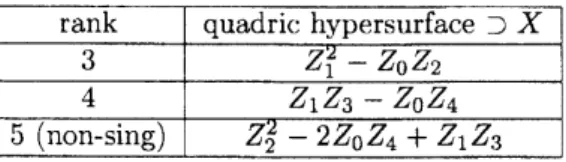
the rank ofquadric equations, we see that irreducibility of minimal generatorsimplies :rank $\geq 3.$ To see that every case occurs, we give examples of the quadric equations of the
rational quartic curve $X$ in Table 1.
rank quadric hypersurface $\supset X$
3 $\mapsto Z_{1}-Z_{0}\overline{Z_{2}}$
4 $Z_{1}Z_{3}-Z_{0}Z_{4}$ 5(non-sing) $Z_{2}^{2}-$$2\overline{Z_{0}Z_{4}}1$ $Z_{1}Z_{3}$
Table 1: Examples of Quadrics
All the claims except the last one have been already proved in Lemma 3.2. Now we
assume
that there existsashell frame$(E, \sigma)$ of$X$in$W$asinDefinition 2.4. From the homomorphism$\sigma$ : $E^{\vee}arrow$t $I_{X/W}\subseteq O_{W}$,we see that the norrnal bundle$N_{X/W}$ of$X$ in $W$is isomorphic to$E\otimes O_{X}$
.
Putting$U:=Reg(W)$ and thedualizing line bundle of$W$tobe $K_{W}^{\mathrm{o}}$ (cf. Proposition2.16),
we
have$O(-2)\cong K_{X}\cong K_{U}|_{X}\otimes detN_{X/W}\cong$($K_{W}^{\mathrm{O}}$ & detE) (&$\mathit{0}\chi$, namely the line bundle $O(-2)$ can be extended to a line bundle$L:=K_{W}^{\mathrm{o}}$ (& $detE$
on $W$. By Proposition 2.16 again, we havean isomorphism $Pic\{W$) $\cong \mathbb{Z}O_{W}(1)$. Then the line bundle $L$
and thereforethe line bundle $O(-2)$ can be extended to amultiple of the tautological line bundle$O_{P}(1)$
of$P$, which contradicts to the fact : $O_{X}(1)\cong O(4)$
.
.
The Case ofcodim(W) $=3$Next, skipping the most bothersome
case
ofcodim(W) $=2,$we
proceed to thecase
ofcodirn(W) $=3.$Then we easily get the following result from Corollary 2.13.
Lemma 3.4 Let$W$ be a pregeometric shell
of
the rationalquarticcurve
$X\subseteq P$ andof
codimension3 inP. Then the scheme $W$ coincides with the curve $X$.
.
The Case of codim(W) $=2$Now we has come to the remaining
case:
codim(W) $=\underline{9}$.
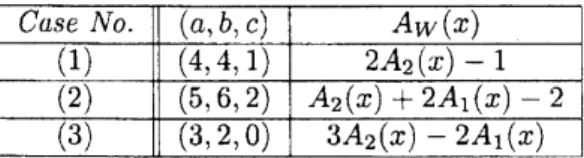
Let us list up all the cases of the triplet $(a, b, c)$ inthe order of handling in the sequel.Lemma 3.5 Let $W$ be
a
pregeometric shellof
the rational quartic curve $X\subseteq P$ andof
codimension2 in P. Then all thecases
of
the $Tor$-Betti numbers $(a, b, c)$of
the minimal graded $S$-free
resolution$\mathrm{F}_{W}$,.
and
of
the Hilbert polynomials are listed in Table 2 below.Case No. $(a, b, c)$ $A_{W}(x)$
(1) (4, 4,1) $2A_{2}(x)-1$
(2) (5, 6,2)
A2
$(x)+2A_{1}(x)-$$2$(3) (3, 2, 0) $3A_{2}(x)-2A_{1}(x)$
Table 2: Betti Numbers and Hilbert Polynomials
Proof. Since the degree of the Hilbert polynomial $A_{W}(x)$ is 2, applying Lemma 3.1, we have the
equa-tions below $((a, b, c)\in\{0,1, \ldots 6\}\cross\{0,1, \ldots 8\}. \cross \{0, 1, \ldots 3\} )$ , whichare easily solved and bring Table
2. $\{$
$1-a+b-c$
$=$ 0 $2a-3b+4c$ $=$ 0 $-a$ $4$ $3b-6c$7
0 1Now we will follow the order in Table 2 and handle each case, respectively.
so (1) The Case:(a,$b$,$c$) $=(4,4.1)$
It iseasy to
see
that thiscase
never happens.Since the Hilbert polynomial $Aw(x)$ is A2$(\mathrm{x})-1$, we see that $deg(W)=2.$ On the other hand, we
have $a=4,$ which means thatthere exit four $\mathbb{C}$-linearly independent quadric equations $\{G_{1}, G_{2}, G_{3}, G_{4}\}$
generating the homogeneous ideal$\mathrm{I}_{W}$. Now, using the condition that $W$ is
a
$\mathrm{P}\mathrm{G}$-shell of thecurve $X$, werecall the proof of Lemma 3.2 andseethat {Gi,$G_{2}$
}
formsa$S$-regular sequence and$Y=\{G_{1}=G_{2}=0\}$isanarithmetically Cohen-Macaulayclosed subscheme of pure codimensiontwo. Obviously, $X\subset W\subseteq Y,$ $dim(W)=dim(Y)=2,$ and cleg(Yl) $=4.$ Now wetake a primary component $Y_{0}$ of$Y$ containing $X$ and
142
consider $(Y_{0})_{re}d$ after putting the reduced structure on the space $|$}$\mathrm{o}$$|$
.
If de$7((Y\mathrm{o})_{re\mathrm{Z}})$ $\leq 2,$ then afterthe process of Lomma 2.15, the one point chordal variety Cd(xo,$(Y_{0})_{r\mathrm{e}d}$) turns out to be alinear variety of dimension 3. Since $X\underline{\subset}(Y_{0})_{red}\subseteq$ Cd(xo,$(Y_{0})_{red}$), we see that the curve $X$ is degenerate, which
is a contradiction. Hence we have $de/$((YQ)$\Gamma ed$) $\geq 3$ and the component $Y_{0}$
can
not contain any maincomponentof$W$. Now we have $W\cup$ (Yo)red $\subseteq Y$ and therefore $deg(Y)\geq 5,$ which is absurd.
..
(2) The Case:(a,$b$,$c$) $=(5,6.2)$Using a rather delicate argument than the caseabove, we show that thiscase never occurs.
On the Hilbert polynomial, we know that $A_{W}(x)=A_{2}(x)+2A_{1}(x)$-$2=(1/2)x^{2}+(7/2)x+1,$which
implies : $deg(W)=1.$ This shows us that the main component $F$is onlyone and itsstructuresheafas a
primary componentof$W$ is already reduced and isomorphic to the projective plane$\mathrm{P}^{2}(\mathbb{C})$. Since$X\subseteq W$
and $X$ is non-degenerate, we have $Xl$ $F$ and $Y=X$’ $F\subseteq W,$ where the closed subscheme $Y$ is a scheme theoretic union of the closed subschemes$X$ and $F$. At the generic point $\langle$of the main component
of$W$, $\mathit{0}_{W,\zeta}\cong O_{Y,\zeta}$, which implies that the support of the ideal sheaf$I_{Y/W}$ does not contain the generic
point $\zeta$, and therefore $dim(I_{Y/W})\leq 1.$ Then, the Hilbert polynomial of the ideal sheaf
$I_{Y/W}$ is the form
$:\chi(I_{YW}/(x))$ $=px+q$ ($p,$$r\in \mathbb{Z}$and$p\geq 0$ ) (cf. [11]). On the otherhand, $XnF$isfinite number of points,
which implies that the Hilbert polynomial is a $\mathrm{c}\mathrm{o}\mathrm{n}\mathrm{s}\mathrm{t}\mathrm{a}\mathrm{n}\mathrm{t}:\chi(\mathrm{O}_{\mathrm{X}\cap \mathrm{F}}\urcorner(x))=k,$ where $k=lengthO_{X\cap F}$. Now
lot usconsider the following two exact sequences:
0 $arrow I_{Y/W}arrow \mathit{0}_{W}arrow \mathit{0}_{Y}arrow 0$
$0arrow O_{Y}arrow O_{X}$ %$O_{F}arrow O_{X\cap F}arrow 0.$ Let us take their Hilbert polynomials, bind them up and get:
$A_{W}(x)$ $=$ $\mathrm{x}\{\mathrm{O}\mathrm{f}\{\mathrm{x}$)) $=\mathrm{x}$
{Of
$\{\mathrm{x}))+\chi(I_{Y/W}(x))$$=$ $\chi(O_{X}(x))+\chi(O_{F}(x))-\chi(O_{X\ulcorner 1F}(x))+\chi(I_{Y/W}(x))$
$=$ $A_{X}(m)+$ $4_{2}(x)-k+px$$+q$
$=$ $4x+1+$(l/2)$(\mathrm{x}+2)(x+1)+px$ $c$ $q-k$
$=$ $(1/2)x^{2}+((11/2)+p)x+(2+q-k)$ .
Comparing the coefficient of the second term in this Hilbert polynomial with that of $Aw(x)$ previously
obtained, we see that (7/2)=((11/2)+p)\geq (ll/7), which is a contradiction.
..
(3) The Case:(a,$b$,$c$) $=(3,2,0)$Thiscase really occurs and is tllc most interesting fromourview point.
Let us recall: $Ay/(x)=3\mathrm{A}2(\mathrm{x})-2A_{1}(x)$, which implies $deg(W)=3.$ Moreover, the length of the
minimalgraded $S$-free resolution$\mathrm{F}_{W}$
,.
is 2, and therefore arith.$de,pth(W)=$depth(R$y$) $=5-hds$$(Rw)=$
$5-2=3=dim(R_{W})$ . Thus the homogeneous coordinate ring$R_{W}$ is
an
arithmetically Cohen-Macaulayring. Applying Proposition 2.12, we see that the scheme $W$ is a variety of $\triangle$($W$,Aw(x)) $=0$ and of
degree3.
By the structure theoremonthe projective varieties of$\triangle$-genuszero (cf. [6]
or more
classically [12]),the singular locus Sing(W) of$W$ is alinear space and the variety $W$ is the generalized projectivecone
over a non-singular projective variety $M$ (this can be obtained by a generic linear space section of $W$
which does not meet the linear space Sing(Wl ) of $\triangle$-genus zero withthe vertex at their singular locus.
Since $dim(W)=2,$ we haveonlytwocases : (3-1) $dim(Sing(W))=-1$ (namely $W$ is non-singular) and
the non-singular variety $M$ is $W$ itself; or (3-2) $dim(Sing(W))$ $=0$ (namely Sing(W) $=\{p_{0}\}$) and the non-singular variety$M$ is a rational normal cubiccurve.
Moreover,the structure theorem says that in thecaseof(3-1) above, the polarizedvariety $(W, O_{W}(1))$
is
a
rational scroll $(\mathrm{P}(E), O_{\mathrm{P}(E)}(1))$, where the vector bundle$E$istheone overarationalcurve$B=\mathrm{P}^{1}(\mathbb{C})$and of the form: $E\cong O_{\mathrm{P}^{1}(\mathrm{C})}(2)\oplus O_{\mathrm{P}^{1}(\mathbb{C})}(1)$, the ample line bundle $o_{\mathrm{P}(E)}(1)$ is the relative tautological
line bundle of the projective bundle$\mathrm{P}(E)arrow B$ determined from the ample vector bundle $E$. In te rns of rational ruled surfaces, this variety $W$is isomorphic to $\Sigma_{1}$, arational ruled surface of degree 1 and is
embedded by a linearsystem 2$f+C_{1}|$
.
Ontheother hand, in thecaseof(3-2), the blow-up$q$ : $\overline{W}arrow W\subseteq P$of the variety$W$ atthevertex$p_{0}$ is obtained by$\overline{W}\cong \mathrm{P}(O_{1\mathrm{I}^{\nu 1}(\mathbb{C})}(3)\oplus O_{\mathrm{P}^{1}(\mathrm{C})})$ and byanatural homomorphism$\oplus^{5}\mathit{0}_{\mathrm{P}^{1}(\mathbb{C})}arrow O_{1\mathrm{P}^{1}(\mathrm{C})}(3)\oplus O_{1\mathrm{P}^{1}(\mathrm{C})}$
on a rational curve $B=\mathrm{P}^{1}(\mathbb{C})$. This variety $W$ is isomorphicto $\Sigma_{3}$, a rational ruled surface of degree 3
and the morphism $q$ : $\overline{W}arrow W\subseteq P$is given by
a
linear system $3f+C_{3}|$.Let us summarize these two
cases
in the following Table 3 and proceed to study how the curve $X$ isembedded in $W$ in each
case.
Case No. $dim(S^{\cdot}g(W))$ $\overline{W}$
or $\mathrm{Y}$
$1\mathrm{i}1$ear system (morph.)
(3-1) -1 (on-sing) $W\cong$$\Sigma_{1}$ $|2f+C_{1}|$ (embedding)
(3-2) 0 $\overline{W}\cong$
$\mathrm{g}_{3}$ $|3f+C_{3}|$
Table 3: Cases of $(W, O_{W(}’1))$
\ldots The Case (3-1)
Nowwe
assume
thatthe variety $W$ is isomorphic to the ruledsurface $\Sigma_{1}$ and embedded into$P$ by thelinear system $|2f+C_{1}|$. Since$X\in|uf+vC_{1}|$ for
some
integer$u$$\mathrm{t}^{\mathrm{t}}$ the fact: $deg(X)=4$and theLemma2.2 (2.2.3),
we
have : $(u, v)=(3,1)$ or $(2, 2)$. Let us takea
blow-down morphism $b$:II $arrow \mathrm{P}^{2}(\mathbb{C})=Y$ ofcontracting the exceptionalcurve$C_{1}$toapoint$p\in Y.$ Then the pull-back : $b^{*}O_{\mathrm{P}^{\underline{\circ}}(\mathbb{C})}(1)$ of the tautological
ample line bundle ofthe projective plane $Y$corresponds to the linear system $|f+C_{1}$$|$. Thus, if the curve
$X\in|3f+C_{1}|$, applying the projection formula tothe curve $X$ with respect to the morphism $b$, and the computation : $X.(f+C_{1})=3$, $X.C_{1}=2$ show that the the curve $X$ comes from a singular irreducible
and reduced cubic plane curve passing through the point $p$. Consideringthat 3$f+C_{1}=(2f+C_{1})+f,$
namely
a sum
of the ample divisor 2$f+C_{1}$ andan
(effective) nefdivisor $f$, we see that thecurve
$X$ is a nef divisor (an ample divisor).By the similar argument, if the
curve
$X\in|2f+2C_{1}|$, wesee
that the curve $X$ comes from anon-singular conic which does not pass through the point $p$
.
To see the curve $X$ isa
nef divisor (N.B. notample e.g. $X.C_{1}=0$), we have onlyto apply the projection formula to atest curvewith respect to the
morphism $b$since
$X\in|/\mathrm{t}’ O_{\mathrm{P}}\circ\sim(\mathbb{C})(2)|$.
\ldots The Case (3-2)
Next we consider the
case
:the $\mathrm{b}\mathrm{l}\mathrm{o}\mathrm{w}\underline{- \mathrm{u}}\mathrm{p}\overline{W}$of the variety $W$ at the vertex$p_{0}$ is isomorphic to the ruled surface $\Sigma_{3}$ and the morphism
$q$ : $Warrow W\subset P$ is given by the linear system $|3f+C_{3}|$. Now,
taking the strict transform$q^{-1}(X)$ of thecurve$X$ via the morphism$q$, weseek the integers $u$and $v$such
that $q^{-1}(X)\in|uf+vC_{3}|$. Then the condition $deg(X)=4$ means $q^{-1}(X).(3f+C_{3})=4.$ Since the
curve
$q^{-1}(X)$ is irreducible, we can apply Lemma 2.2 (2.2.3) to this case and get $(\iota x, \tau))=(4,1)$. ThenX.C3 $=(4f+C_{3}).C_{3}=4-$$3$ $=1,$ whichshows the curve$X$ passes simply through the vertex$p_{0}$.
4
ExistenceNow let
us
show the existence of the threecases
above and summarize the classification ofthe case144
Proposition 3.6 Let $X$ be a non-degenerate quartic
nor
rmalcurve
in $P=\mathrm{P}^{4}(\mathbb{C})=$ Proj(S) and $Wa$pregeometric shell
of
$X$ with codim(W) $=2.$ Then $W$ isreduced and irreducible and a varietyof
A-genuszero. The homogeneous coordinate ring$R_{W}$
of
$W$ has a minimal graded$S$-free
resolution$\mathrm{F}_{W}$,.
with the$Tor$-Betti numbers $(3, 2_{\backslash }0)$
.
There are three possible cases satisfying these properties as in Table4.
Case No. $d.m(S^{\cdot}/(W))$ $W$ or$W$ $l$. ear $sytem(mo h.)$ $X$ or$q^{-\mathrm{I}}(X)\in-$llnear system(3-1-1) -1 (on-s. $g$) $\cong\Sigma_{1}$ $|\mathit{2}f+C\mathrm{l}$$|$ (embeddi $g$) $X\in|37$ $+C_{1}|$ (ample)
(3-1-2) -1 $(0-\cdot. g)$ $W\cong\Sigma_{1}$ $|2f+C\mathrm{l}$$|(emb\overline{edd}. g)$ $X\in|2f+2C_{1}|$ ($nef$, not ample)
(3-2)
–0
$–\cong\Sigma$ $|3f+C_{3}|$ $q^{\overline{-1}}(X)\in|4f+C_{3}|$ Table4:
Casesof
a
surface
W and a curve$X$Conversely, there exista non-singularprojective
surface
$W$ and a non-singularprojective curve$X$ on$W$which satisfy the conditions in Table
4
above. Moreover, onceif
thesurface
$W$ and the curve $X$ on $W$are given asin Table
4
above, then thesurface
$W$ is always apregeometric shellof
the curve $X$ (cf. also\S 4
$\cdot$).Proof. It is enough to show the existence part of the claim above. If
we
do notassume
the condition of “pregeometricshells”,, Lemma 2.2 (2.2.3) shows theexistences of pairs ofanon-singular projective curveanda non-singularprojectivesurface: $X\subset W$in $P=\mathrm{P}^{4}(\mathbb{C})$ asin Table 4. Then, the curve $X$ is a curve
ofdegree 4 and thesurface $W$ isofdegree 3. Bythis construction, thesurface $W$is alinearlynormal, i.e.
a natural map $H^{0}(P, O_{\mathrm{P}}(1))arrow H^{0}(W, O_{W}(1))$ is surjective. On the non-degeneracy of $X$, using Table
4, we can check it easily by computing $H^{0}(W, I_{X/W}(H))\cong H^{0}(W, O_{W}(-X+H))$ $=0$ (if $W\cong\Sigma_{1}$) or
$H^{0}(\overline{7\overline{V}}, I_{q}1(X)/\tilde{W}(q^{*}H))\cong H^{0}(\overline{W}, O_{\overline{W}}(-q^{-1}(X)+q^{*}H))=0$ (if $\overline{W}\cong$
E3). This also shows the linear normalityof the rational curve $X$ (adjunctionformula and Lemma 2.2 (2.2.4)).
Let us show that the surface $W$ is apregeometric shell of$X$ in these three cases. In every case, both
the surface $W$ and the curve $X$ are varieties of$\triangle$-genera zero. Now we refer to the book [6] and apply
its results: (4.12) Corollary and the argument of (5.1), which imply that both varieties $X$ and $W$ are
with metically Cohen-Macaulay. Then the result of [5] showsthat the homogeneous coordinate rings $R_{W}$
has 2-lincar minimal graded $S$-free resolution. Applying Proposition 2.5 (2.5.8), we seethat the surface
It is a pregeometric shell of$X$. $\mathrm{I}$
The argunent in the proofof Proposition 3.6 brings also the following useful result.
Corollary 3.7 Let $V\subset W$ be closed subschemes
of
$P=\mathrm{P}^{N}(\mathbb{C})$. Assume that the scheme $V$ is non-deqcneratc and the scherne $W$ is linearly normal andof
a varietyof
$\triangle$-genus zero. Then the variety $W$is a pregeometric shell
of
$V$.Corollary 3.8 Let $V\subset P=\mathrm{P}^{N}(\mathbb{C})$ be a non-degenerate, linearly no rmal closed subvariety
of
codimen-sion$r$ and
of
$\triangle$-genus zero. Then, there isa
chainof
varieties:$V=W_{0}\subset W_{1}\subset W_{2}\subset\cdots\subset W_{k}\subset\cdots\subset W_{r}=P,$
where the variety $W_{k}$ $(k=0,1, \cdots, r)$ is apregeometric shell
of
$V$ with $cod_{i}m(W_{k}, P)$ $=r-k.$Proof. Starting from the variety $V$, we first construct inductively a chain of varieties $\{W_{k}\}_{k=0}^{r}$ with
$\triangle$-genus zero. Asan induction hypothesis, we assume