Introduction
The Mekong River begins in China (where it is called the Lancang), and flows through Myanmar, Laos, Thailand, Cambodia and Vietnam, before issuing in the South China Sea. It is the worldʼs 12th-longest river, flowing almost 4,900 kilometers from its source on the Tibetan plateau in Chinaʼs southwestern Qinghai province, 5,200 meters above sea level, and 72 million people depend on its resources for their livelihood.
The Mekong basin has two distinct parts. The upper part is shared by China (16%) and Myanmar (2%); and the lower by the four other riparian countries: Laos (35%), Thailand (18%), Cambodia (18%) and Vietnam (11%) (see Figure 1). This two-part division is politically significant in terms of river basin management: both China and Myanmar operate independently in development of the mainstream river, while the lower Mekong basin countries cooperate according to the 1995 Agreement on the Cooperation for <Article>
The Prevention and Resolution of International Conflicts
over Transboundary Water Resources
in the Mekong River Basin
Jo TORIYABE*
* Lecturer, Faculty of Law, Setsunan University, Japan. E-mail: [email protected].
ac.jp This paper is a revised version of the one presented at an international conference from 12-14 December, 2019, at the Chatrium Hotel Riverside, in Bangkok, Thailand (International Conference on Policies, Laws and Regulations for Water Resources Management in Southeast Asia Countries), sponsored by the Konrad Adenauer Foundation of Germany and the Department of Water Resources of Thailand. The author wishes to express his heartfelt gratitude to Dr. Noriko Okubo, Professor at the Graduate School of Law and Politics, Osaka University. This study was supported by research grants from KWEF (the Kurita Water and Environment Foundation) in 2019 and the Asahi Glass Foundation in 2020. The responsibility for any errors belongs to the author.
the Sustainable Development of the Mekong River Basin (hereinafter the “1995 Agreement”)1).The management of this lower part of the basin is
spearheaded by the Mekong River Commission (MRC)2), which was
established in the 1995 Agreement and comprises Thailand, Laos, Cambodia and Vietnam.
For years, China has been criticized for not joining the MRC, while unilaterally building dams on the most upstream section of the river; and its position appears, at last, to be gradually shifting in response. Since 2015, for example, China has become more closely involved in cross-border cooperation
1) Signed and entered into force on April 5, 1995, at Chieng Rai, Thailand, UNTS, Vol. 2069
(2002), p. 3.
Source: MRC, “Progress in Water Management at the River Basin Level: Mekong River Basin,” Presentation at 3rd WWF, INBO Official Session Otsu Prince Hotel, 20 March 2004, p. 9.
Figure 1: Configuration of the Mekong River basin
2
Lower Mekong Basin) was established by Cambodia, Laos, Thailand, and Vietnam during the 13th session of the United Nations Economic and Social Committee for Asia and the Pacific (ESCAP), to address the comprehensive development of water and related resources in the lower Mekong Basin. However, lack of stability in the region resulted in the interruption of the Mekong Committee sessions in the late 1970s. In response to
Cambodia’s absence, in 1977, Laos, Thailand, and Vietnam adopted a new statute forming the basis of the Interim Mekong Committee. When Cambodia finally requested readmission in 1991, lengthy discussions began, which led to the eventual transformation of the Mekong Committee through the 1995 Agreement. See Food and Agriculture Organization of the United Nations, “Transboundary River Basin Overview - Mekong,” FAO AQUASTAT Reports (2011), pp. 9-10. See also Greg Browder & Leonard Ortolano, “The Evolution of an
International Water Resources Management Regime in the Mekong River Basin,” Natural
Resources Journal, Vol. 40 (2000), pp. 504-525.
Source: MRC, “Progress in Water Management at the River Basin
Level: Mekong River Basin,” Presentation at 3rd WWF, INBO Official Session Otsu Prince Hotel, 20 March 2004, p. 9.
0 100 200 300 km CHINA MYANMAR LAOS THAILAND CAMBODIA VIET NAM GULF OF THAILAND LEGEND International boundary Basin boundary River Upper Mekong Basin Lower Mekong Basin
in hydropower and water resource management in the Mekong River basin; and the Lancang-Mekong Cooperation (LMC) Mechanism is a newly established, China-led initiative for cooperation on the Mekong River3). The
LMC is thus emerging at a time when the status of the MRC as an existing transboundary water governance institution is in flux, while the Mekong riparian states are founding members of the new mechanism4).
Due to the development of Chinese dams and the effects of severe drought in late 2015 and early 2016, the agricultural and fishery industries of Vietnam, Laos and Thailand were damaged, and the underground water near the Mekong Delta in Vietnam experienced seawater intrusion5). At the request
of downstream countries, China released more water from the Jinghong Dam to downstream rivers in March 20166).
According to the latest Mekong River Commission (MRC) analysis and available information, the 2019 drought has brought the Mekong water levels to their lowest point in living memory, or at least over the last 60 years, with most parts of the basin having experienced exceptionally low regional flow since June 20197). Such a situation could have devastating
consequences for the river fish, as well as the tens of millions of people living and working along the river. The crisis began when critical monsoon rains, which usually begin in late May 2019 in the Mekong region, failed to arrive. Dry conditions, driven by the El Niño weather phenomenon and exacerbated
2) Cooperation in the Mekong river basin began in the middle of the 20th century with the
formal signing of the Geneva Accords (1954), when the newly independent nations of Cambodia, Laos and Vietnam took their places on the world stage. In 1957, the United Nations-founded Mekong Committee (Committee for Coordination of Investigations of the Lower Mekong Basin) was established by Cambodia, Laos, Thailand and Vietnam during the 13th session of the United Nations Economic and Social Committee for Asia and the Pacific (ESCAP), to address the comprehensive development of water and related resources in the lower Mekong Basin. However, lack of stability in the region resulted in the interruption of the Mekong Committee sessions in the late 1970s. In response to Cambodiaʼs absence, in 1977, Laos, Thailand and Vietnam adopted a new statute forming the basis of the Interim Mekong Committee. When Cambodia finally requested readmission in 1991, lengthy discussions began, which led to the eventual transformation of the Mekong Committee through the 1995 Agreement. See Food and Agriculture Organization of the United Nations, “Transboundary River Basin Overview - Mekong,” FAO AQUASTAT Reports (2011), pp. 9-10. See also Greg Browder & Leonard Ortolano, “The Evolution of an International Water Resources Management Regime in the Mekong River Basin,” Natural Resources Journal, Vol. 40 (2000), pp. 504-525.
by climate change, persisted well into July 2019. At that time, observers say, the situation was made worse by upstream hydropower dam operators in China and Laos withholding water for their own purposes; and Chinaʼs decision to halve the water released from its Jinghong Dam for two weeks in July, for “grid maintenance,” is likely a major contributor to 2019ʼs historically low water levels in the Mekong River8). Ultimately, the above
situations suggest that even if cooperative arrangements are in place, disagreements over existing and planned transboundary hydropower developments are inevitable. Thus, the need to have effective dispute avoidance and dispute settlement mechanisms in place to resolve any differences will be an important factor in any future development.
However, the Mekong countries have different interests in exploiting
3) The main events relating to the development of cooperation in the LMC framework are
as follows. The framework was established in November 2015, just one year after Chinese Premier Li Keqiang formally put forward the initiative at the 17th China-ASEAN Summit, held in Nay Pyi Taw, Myanmar, in November 2014. In March 2016, the first LMC leadersʼ meeting was held, and the Sanya Declaration was adopted. In December 2016, the second LMC foreign ministersʼ meeting was held in Siem Reap, Cambodia. In March 2017, the China Secretariat for the LMC was established in Beijing, China. In December 2017, the third LMC foreign ministersʼ meeting was held in Dali, Yunnan, China. In January 2018, the second LMC leadersʼ meeting was held in Phnom Penh, Cambodia, and the Phnom Penh Declaration and Five-Year Plan of Action on the LMC (2018-2020) were adopted. In December 2018, the fourth LMC foreign ministersʼ meeting was held in Luang, Prabang, Laos. In July 2019, the MRC Secretariat was granted observer status in the LMC Joint Working Group on Water Resources, and China and the MRC agreed to renew their agreement on the provision of hydrological information during the flood season. With the increased cooperation, China agreed to maintain the same period and frequency of hydrological data sharing. The sharing takes place twice a day over five months, from June 1st until October 31st, every year. The MRC and China signed the first data sharing agreement in 2002, and renewed it in 2008 and 2013. See David J. Devlaeminck, “Timeline of the Lancang-Mekong Cooperation (LMC) Mechanism,” (2019), available at https://www. academia.edu/36426349/Timeline_of_the_Lancang-Mekong_Cooperation_LMC_ Mechanism_Last_Updated_August_2_2019_ (last access 21 December, 2019); MRC Website, MRC and China renew pact on water data provision and other cooperation initiatives, Vientiane, Laos, on 19 Jul 2019, available at http://www.mrcmekong.org/news-and-events/ news/mrc-and-china-renew-pact-on-water-data-provision-and-other-cooperation-initiatives/ (last access 21 December 2019). The LMC, however, originated with Thailandʼs proposal of the Conference on Sustainable Development in the Lancang-Mekong subregion, which aimed to establish means to address challenges, such as natural disasters, faced by all six Mekong riparian countries, and explore possible cooperation for sustainable development. Poowin Bunyavejchewin, “The Lancang-Mekong Cooperation (LMC) Viewed in Light of the Potential Regional Leader Theory,” Journal of Mekong Societies, Vol. 12, No. 3 (2016), p. 55.
water resources; China and Laos, for example, typically pay far more attention to hydropower development than the lower riparian states. The MRC estimates that Laos will receive 70% of the export revenues (US$2.6 billion per year) generated by the mainstream dams once all of them are operational9); while China, due to its current energy shortage, has an acute
need of electricity for its own development10). Fisheries on the Mekong
account for 12% of Cambodiaʼs gross domestic product (GDP), and provide its people with a vital source of nutrition11); while the Vietnamese part of the
Mekong Delta, the Cuu Long region, accounts for 33% of Vietnamʼs prosperous agricultural sector and 90% of its rice exports, which are the third largest in the world12). In a critical development, China has become the
largest stakeholder in transboundary water issues, both through its control
4) Until April 2015, the Greater Mekong Subregion (GMS) was the only Mekong forum to
include all six riparians. The GMS was initiated by the Asian Development Bank in 1992, to integrate the Mekong region through the construction of power, transport and communication networks. The forum is attractive to China because it focuses on infrastructure development, improving power, transportation and communication networks between Yunnan Province and the Indochina states. It does not impose strict aquatic environmental standards or dam-building restrictions on its members, so Chinaʼs sovereignty and freedom of action are not compromised. Elvira Bobekova, Scott Pearse-Smith & Isak Svensson, “Rivers of Peace Institutionalised Mekong River Cooperation and the East Asian Peace,” European Journal of East Asian Studies, Vol. 12 (2013), p. 20; Selina Ho, “‘Big Brother, Little Brothersʼ: Comparing Chinaʼs and Indiaʼs Transboundary River Policies,” Water Policy, Vol. 18, No. 1 (2016), p. 38; Selina Ho, “Chinaʼs Transboundary River Policies Towards Kazakhstan: Issue-linkages and Incentives for Cooperation,” Water International, Vol. 42, No. 2 (2017), p. 146. The LMCʼs purview is much broader than the GMS, which has the same membership. Most striking is the inclusion of cooperation on water resources, an issue which has been far outside the remit of the GMS.
5) Xing Wei, “Lancang-Mekong River Cooperation and Trans-Boundary Water Governance,”
China Quarterly of International Strategic Studies, Vol. 3, No. 3 (2017), p. 386.
6) Ibid.
7) MRC Website, Mekong water levels reach low record, Vientiane, Laos, on 18 July 2019,
available at http://www.mrcmekong.org/news-and-events/news/mekong-water-levels-reach-low-record/ (last access 20 January 2021).
8) National Geographic Website, Mekong River at its lowest in 100 years, threatening food
supply, on 31 July 2019, available at https://www.nationalgeographic.com/ environment/2019/07/mekong-river-lowest-levels-100-years-food-shortages/ (last access 20 January 2021).
9) Wei, 2017, supra note 5, p. 388. 10) Ibid.
of the upstream waters of key international basins, and through its economic, financial and political engagement, regarding water infrastructure, with the five other countries in the Mekong River basin. Even the parties subject to the 1995 Agreement, however, have found it difficult to reconcile their varying interests with respect to hydropower developments on the mainstream of the Mekong River, such as Laosʼs Xayaburi Hydroelectric Project on the lower Mekong (discussed below).
In light of the need for equitable and reasonable water sharing and water benefit sharing among all the Mekong basin countries, this article argues for and proposes a number of mechanisms requisite for establishing the rule of international law in the context of large-scale dam development in the Mekong mainstream, and suggests means of preventing and resolving international conflicts over transboundary water resources in the Mekong River basin. The rule of international law — that is, the rule of law at the international level — is a conceptual basis for proper governance of the international community. The objective of contemporary laws regarding international watercourses should be to relieve water stress among states that share such watercourses, and thereby enhance the water security of all riparian basin states. The rule of international law is fundamentally necessary to achieve this objective.
In order to help establish the rule of international law in the Mekong basin, this article will identify deficiencies in current management mechanisms such as the MRC and LMC, with respect to the development of large-scale dams along the Mekong River; and then present a model for achieving integrated water resource management throughout the basin, to overcome such deficiencies. Its central issues are examined primarily from two angles: the relationship between the countries in the lower Mekong River, and the relationship between the lower Mekong River countries and China, the most upstream country.
Structurally, the article first considers the political and economic implications for the region, of large-scale dam development in the Mekong River basin (see Section I A), and then reviews the transboundary water
resource management mechanisms related to dam development, having been established by the Mekong River basin countries (see I B). In addition, it identifies shortcomings in the current transboundary water resource management mechanisms in the Mekong River basin (see II). Finally it asks, if these mechanisms should not prove effective for sustainable development in the overall river basin, how may they be improved in accordance with the rule of international law (see Ⅲ).
I. Development of Large-scale Dams on the Mekong River Mainstream and the Current State of MRC
and LMC Management A. Background
1. Energy Demand in the Mekong River Basin
The regionʼs economic wealth and population, particularly in the urban centers, have grown dramatically in recent years; and this has been accompanied by a growing demand for electricity, especially in China, Thailand and Vietnam. China needs power to sustain its GDP growth, which remains above 6-7% per year; Thailandʼs government estimates that the countryʼs electricity demands will double to 58,000 megawatts (MW) by 2021; and Vietnamʼs government estimates that its demand will rise from about 48,600 MW currently to 60,000 MW by 2020 and 129,500 MW by 2030. Laos also views hydropower as necessary for the development of its mineral deposits, and Cambodiaʼs demand is driven in part by the need to provide more and cheaper energy for domestic consumption, and to satisfy the needs of nascent light industries such as garment manufacturing13).
2. Large-scale Dam Development in the Mekong River Mainstream
China, the most upstream country on the Mekong River, has built, or plans to build, a host of large-scale dams for hydroelectricity and mega-water
diversion facilities, which has triggered anxiety and complaints from downstream countries, as well as worldwide criticism14). As shown in Figure
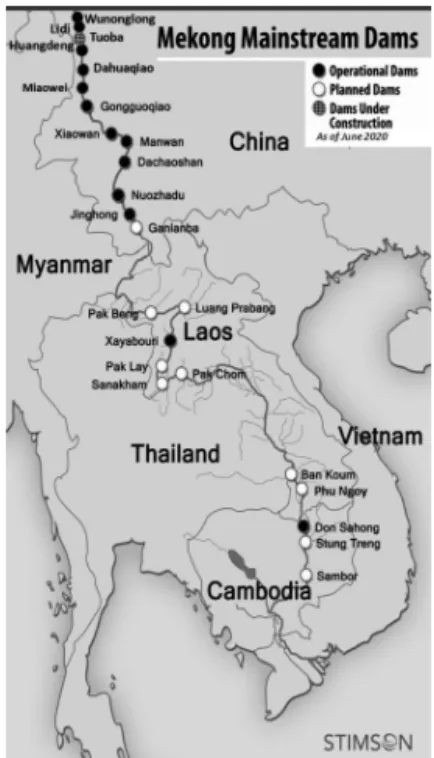
2, China currently operates a cascade of 10 dams on the stretch of the upper Mekong in Yunnan Province (at Nuozhadu, Xiaowan, Huangdeng, Jinghong, Manwan, Miaowei, Dachaoshan, Gongguoqiao, Wunonglong, Lidi), with a total installed capacity of 20,430 MW15); and if the hydropower-generation
capacity of future dams (Gushui, Ru Mei, Tuoba, Banda, Dahuaqiao, Ganlanba, Cege, Yue Long) is considered, its hydropower output could increase by another 8,473MW16).
In the words of US Secretary of State, Mike Pompeo, China is taking control of the flow of Southeast Asiaʼs most important river through a dam-building “spree,” at the same time as water levels along the Mekong reach record lows17); and its upstream development of hydropower dams and other
riverine infrastructure has been pursued with relative disregard for the less powerful downstream riparian states of Southeast Asia18). However, China
has insisted on a positive interpretation of the impact of its dam construction, arguing that dams can release more water into the river during the dry season, and provide flood control during wet season19). Therefore, it claims
that the dams will have little negative impact on the lower basin. In fact,
14) China is quite clearly the most important upstream country for transboundary water in
Asia. Its territory includes the ‘Asian Water Towersʼ of the Tibetan-Qinghai Plateau, and 110 international rivers and lakes along its southwest, northwest and northeast borders; and it is the source of Asiaʼs great rivers, which flow into 18 downstream countries. Owen McIntyre, “Benefit-sharing and Upstream/Downstream Cooperation for Ecological Protection of Transboundary Waters: Opportunities for China as an Upstream State,” in Patricia Wouters, Huiping Chen & James. E. Nickum (eds.), Transboundary Water Cooperation: Principles, Practice and Prospects for China and Its Neighbours (Routledge, 2017), p. 197.
15) See Mekong River Commission, State of the Basin Report 2018 (MRC, 2019), p. 181. 16) Ibid.
17) South China Morning Post Website, China ‘taking control’ of vital Mekong river through
dam-building spree, Mike Pompeo warns, on 2 August 2019, available at https://www.scmp. com/news/china/article/3021062/china-taking-control-vital-mekong-river-through-dam-building-spree-mike (last access 15 December 2019).
18) McIntyre, 2017, supra note 14, pp. 197-198.
19) Selina Ho, “River Politics: Chinaʼs Policies in the Mekong and the Brahmaputra in
however, Chinaʼs dams are likely to have a significant negative impact on the downstream countries in numerous respects, including a drop in the water level, reduction of fisheries and crop production, and degradation of the ecosystems. A growing number of research papers have carefully assessed the possible impact of Chinaʼs dams on downstream regions20), and increased
tension can certainly be expected between China and the lower basin riparian states as China continues its cascade of hydropower dam construction on the upper mainstream. Among other concerns, there is a fear that the huge storage capacity of its mainstream dams will effectively give China unilateral control over the release of water to downstream nations21).
Source: Stimson Center (https://www.stimson.org/2020/mekong-mainstream-dams/) (last access 30 November 2020)
Figure 2: Mainstream dams in the Mekong River basin
20) E.g. Seungho Lee, “Benefit Sharing in the Mekong River Basin,” in Patricia Wouters,
Huiping Chen & James E. Nickum (eds.), Transboundary Water Cooperation: Principles, Practice and Prospects for China and Its Neighbours (Routledge, 2017), p. 309.
In light of the foregoing, we should be concerned that the results of MRC analysis have typically reflected Chinaʼs position. A report by the MRC in 2017, for example, concluded that its dams do not adversely affect the water flow: rather than creating floods in the wet season and exacerbating drought in the dry season, the dams reduce the flow during the wet season and increase it during the dry season, as China has claimed22).
Meanwhile, Laos, comparatively upstream in the lower Mekong River basin, completed construction and commenced commercial operation of its Xayaburi Dam in October 2019. The dam, roughly 350 kilometers upstream of Vientiane, has a total installed capacity of 1,285 MW and annual energy production of 7,406 gigawatt-hours23). It is the first dam to be built in the
mainstream of the lower reaches of the Mekong River, and this makes it subject to the ‘prior consultationʼ requirement under the 1995 Agreement (see Section I B 1). Had the MRC failed to prevent Laos from proceeding with the planning and construction phase before the assessment of transboundary impacts of the dam had been completed, it would have demonstrated the institutionʼs inability to manage its members (see Section II A 2). However, the problem was resolved in 2015, not through the MRC, but via the Thai Supreme Administrative Court24).
3. Chinaʼs Increased Investment in the Lower Mekong Basin Countries
Reconciling seemingly competing national interests will be key to addressing transboundary challenges in the Mekong River basin. Most notably, China plays a major role in the geopolitical landscape of the Mekong, not only as a powerful upstream state, but also by providing loans for and investing in major infrastructure projects downstream, which results in reluctance on the part of the recipients to openly challenge its upstream
21) Scott W.D. Pearse-Smith, “‘Water Warʼ in the Mekong Basin?” Asia Pacific Viewpoint,
Vol. 53, No. 2 (2012), p. 153.
22) MRC, State of the Basin Report 2018, supra note 15, p. 174; MRC Website, The effects of
Chinese dams on water flows in the Lower Mekong Basin, Vientiane, Laos, on 6 Jun 2017, available at http://www.mrcmekong.org/news-and-events/news/the-effects-of-chinese-dams-on-water-flows-in-the-lower-mekong-basin/ (last access 20 January 2021).
23) Pt (Sole) Company Limited Website, available at http://www.ptsole.com/xayaburi (last
activities on the Mekong25).
From 2006 to 2011, for example, China invested over $6.1 billion in the hydropower sectors of which three countries alone26). According to Chinese
government data, in 2015, Chinaʼs total trade with Laos, Cambodia, Myanmar, Thailand and Vietnam reached US$193.9 billion27), and China is the most
important donor, creditor and foreign investor in Laos and Cambodia. Its loans to Laos, for example, accounted for roughly 35% of that countryʼs public debt in 201228), 44% by 201529), and 50% by 2018 when its public debt
was estimated to represent roughly 68% of its GDP30). Around half the 24) The Xayaburi dispute prompted a case to be lodged with a Thai administrative court by
30 villagers who might have been affected by the project. The case challenged the decision of the Thai government to approve the Power Purchase Agreement (PPA) between the Electricity Generating Authority of Thailand and the Xayaburi Power Company Limited. In August 2012, the group of 30 villagers filed a lawsuit in Thailandʼs Administrative Court against the relevant Thai government agencies. In February 2013, the Administrative Court of Thailand denied jurisdiction to hear the case because the plaintiffs could not be considered injured persons, and the court did not deem the conclusion of the PPA to be an administrative act. The plaintiffs filed an appeal in March 2013. In June 2014, the Thai Supreme Administrative Court accepted the case, stating, “evidence suggests that relevant authorities have failed to adequately listen to the opinions of the people and to comply with the PNPCA…”. In October 2014, the villagers filed an injunction with the Administrative Court, requesting a halt to the construction of the dam while the Supreme Administrative Court ruled on the legality of the PPA. However, in December 2015, the Supreme Administrative Court dismissed the case on the basis that “the defendants did not neglect their duty,” and that the PPA fulfilled the required notification and consultation procedures. See Business & Human Rights Resource Centre Website, Xayaburi dam lawsuit (re Laos & Thailand), available at https://www.business-humanrights.org/en/xayaburi-dam-lawsuit-re-laos-Thailand (last access 16 December 2019).
25) Bennett Bearden, Alistair Rieu-Clarke & Sokhem Pech, “Mekong Basin,” in Flavia Rocha
Loures & Alistair Rieu-Clarke (eds.), The UN Watercourses Convention in Force: Strengthening International Law for Transboundary Water Management (Routledge, 2013), pp. 182-183.
26) U.S. Energy Information Administration Website, Chinese investments play large role in
Southeast Asia hydroelectric growth, on 16 August 2013, available at https://www.eia.gov/ todayinenergy/detail.php?id=12571# (last access 16 December 2019).
27) Wang Yan, “Mekong countries look to bolster cooperation,” chinadialogue, on 5 April
2018, available at https://www.chinadialogue.net/article/show/single/en/10559-Mekong-countries-look-to-bolster-cooperation (last access 23 December 2019).
28) ASEAN Today, Why Laos’ reliance on Chinese money could bankrupt the country, on 22
February 2018, available at https://www.aseantoday.com/2018/02/why-laos-reliance-on-chinese-money-could-bankrupt-the-country/?lang=ms (last access 23 December 2019).
borrowed money is from China, and China has now edged out Thailand and Vietnam to become Laosʼs largest foreign investor, with accumulative Chinese investment in Laos standing at US $5.1 billion as of January 201431).
In Cambodia, meanwhile, Chinese loans and grants amounted to US$2.7 billion in 2012, making China Cambodiaʼs second-largest donor after Japan32).
4. Self-financing of the MRC
Established in the 1995 Agreement between the governments of Cambodia, Laos, Thailand and Vietnam, the MRC had a total annual budget of roughly US$12.4 million in 2017, including both basket and earmarked funding33).
Over the current 2016-2020 period, its total annual expenditures are forecast to decline to just under US$11 million, of which approximately 38% is expected to be financed by the member countries, suggesting that the MRC is just on track to be self-financed by 203034).
In January 2016, it was announced that the principally Western donor-funded MRC would have its budget cut by over half, to US$53 million for the period 2016-2020, significantly reducing its capability35). This funding cut was
partially the result of the donorsʼ own reduced aid budgets, but was also based on doubts regarding the MRCʼs performance in facilitating the recent
30) Ibid. In early 2017, the International Monetary Fund (IMF) increased Laosʼ risk of
“external debt distress” from moderate to high. IMF, Lao People’s Democratic Republic, on 6 January 2017, available at https://www.imf.org/external/pubs/ft/dsa/pdf/2017/ dsacr1753.pdf (last access 23 December 2019).
31) Ho, 2016, supra note 4, p. 37. In 2016, Cambodia saw the construction of six hydropower
dams and all of them were built and financed entirely by Chinese companies. The ASEAN Post Website, Cambodia’s hydropower dilemma, on 19 August 2018, available at https:// theaseanpost.com/article/cambodias-hydropower-dilemma (last access 23 December 2019).
32) Ibid.
33) MRC, State of the Basin Report 2018, supra note 15, p.169. 34) Ibid.
35) Carl Middleton & Jeremy Allouche, “Watershed or Powershed? Critical Hydropolitics,
China and the ‘Lancang-Mekong Cooperation Frameworkʼ” International Spectator, Vol. 51, No. 3 (2016), p. 113. Major donors included Denmark, Finland, Germany, Sweden, Belgium, Australia, the World Bank, the Netherlands, Japan, European Union, France and the United States. In particular, Denmarkʼs government gave US$86 million to the MRC over two decades, before ending its funding in 2015. Stephen Wright, “Mekong effort fails after years of lavish foreign funding,” The Associated Press, on 19 October 2016, available at https:// apnews.com/31978ed8726449dca8ba47c62816137a (last access 5 January 2020).
decision-making processes around the Xayaburi and Don Sahong mainstream dams36).
5. The Lancang-Mekong Cooperation (LMC) Mechanism
According to its website, the LMC mechanism is structured in terms of a “3 + 5 Cooperation Framework,” with three areas of cooperation (political and security issues; economic and sustainable development; and social, cultural and person-to-person exchanges), and five priorities (connectivity, production capacity, cross-border economic cooperation, water resources, agriculture and poverty reduction)37).
The LMC is especially significant because China has, for the first time, initiated a Mekong forum that includes all six riparian states. Moreover, the mechanism forms an integral part of Chinaʼs “One Belt, One Road” initiative, a development strategy that focuses on connectivity and infrastructure development among the Eurasian countries38).
The LMC was established when the MRC was suffering from the aforementioned budgetary constraints, which provided a golden opportunity to demonstrate the importance of the mechanism39). While only around 16%
of the Mekongʼs total annual flow originates in China, this volume provides China with further political power in the Mekong River basin, and a potential bargaining tool in negotiations with the other riparian states40).
36) Middleton & Allouche, 2016, supra note 35, p. 113.
37) LMC Website, 3 + 5 Cooperation Framework, on 14 December 2017, available at http://
www.lmcchina.org/eng/zyjz_3/35hz/t1519481.htm (last access 21 December 2019).
38) Ho, 2016, supra note 4, p. 38.
39) Imad Antoine Ibrahim, “Water Governance in the Mekong after the Watercourses
Convention 35th ratification: Multilateral or Bilateral Approach?” International Journal of Water Resources Development, Vol. 36, No. 1 (2020), p. 205.
B. The Current State of Transboundary Water Resource Management Mechanisms in the Mekong River Basin
1. The Relationship Between the Countries in the Lower Mekong River — Structure and Form of the MRC
(1) What is the MRC?
The MRCʼs organizational structure consists of three permanent bodies; the Council, the Joint Committee and the Secretariat. The highest tier, which is the decision-making body, is the Council, which meets once a year and consists of one member from each country at the ministerial or cabinet level41). The Council makes policy decisions, and provides other necessary
guidance concerning the promotion, support, cooperation and coordination of joint activities and programmes to implement the 1995 Agreement42). It has
overall governance of the MRC.
The Joint Committee (JC) consists of one member from each country at no less than the Head of Department level43). It is responsible for the
implementation of the policies and decisions of the Council, and supervises the activities of the MRC Secretariat44). This body functions as a board of
management.
The Secretariat is the operational arm of the MRC45), providing technical
and administrative services to the JC and the Council46), under the direction
of a Chief Executive Officer (CEO) who is appointed by the Council47). Under
the supervision of the JC, the CEO is responsible for the day-to-day operations of around 155 professional and general support staff48). In 2009 it was decided
that the Secretariat would be permanently co-hosted in two locations, in
41) 1995 Agreement, supra note 1, Article 15. 42) Ibid., Article 18. 43) Ibid., Article 21. 44) Ibid., Article 24. 45) Ibid., Article 30. 46) Ibid., Article 28. 47) Ibid., Article 31.
Vientiane (Laos) and Phnom Penh (Cambodia). The Assistant CEO is of the same nationality as the JC Chair, and serves a one-year term. The main national counterparts for MRC activities in the four member countries are the National Mekong Committees (NMCs), coordinating bodies linking the MRC to the national governments.
The MRC has developed procedures for information sharing and generating mutual agreements on projects that may affect the Mekong River resources. Based on Article 25 of the 1995 Agreement49), the following
five rules of procedure have been adopted: (i) Procedures for Data and Information Exchange and Sharing (PDIES) (approved in 2001); (ii) Procedures for Water Use Monitoring (PWUM) (approved in 2003); (iii) Procedures for Notification, Prior Consultation and Agreement (PNPCA) (approved in 2003); (iv) Procedures for the Maintenance of Flows on the Mainstream (PMFM) (approved in 2006); (v) Procedures for Water Quality (PWQ) (approved in 2007)50). Of chief importance is the PNPCA, which builds on the 1995
Agreement, to set out in detail the procedures that parties must follow to communicate the potential impacts of proposed uses of the Mekong basin, as well as the responsibilities of the various agencies in this process.
While Article 39 of the 1995 Agreement allows China and Myanmar to become full members, the latter have thus far participated only as “dialogue partners” in the work of the MRC51). The MRC and China did sign agreements
in 2002, 2008 and 2013, on the provision of hydrological information on the section of the Mekong River in Chinaʼs territory52); and on July 19, 2019, 48) FAO, 2011, supra note 2, p. 10; Richard Kyle Paisley, Riley T. Denoon, Theressa Etmanski
& Patrick Weiler, Transboundary Waters, Infrastructure Development and Public Private Partnership: Through the Prism of the Nam Thuen 2 and Xayaburi Hydropower Projects (Brill, 2017), p. 31.
49) Article 25 provides that: “The Joint Committee shall propose its own Rules of Procedures
to be approved by the Council.” 1995 Agreement, supra note 1, Article 25.
50) See the MRC website for details of the five procedures. available at http://www.
mrcmekong.org/about-mrc/mandate/ (last access 5 January 2020). Noteworthy, however, is that all the above-mentioned procedures are external to the 1995 Agreement, and it is questionable whether they are legally binding. This article considers them to be legally binding for the time being.
51) Patricia Wouters & Huiping Chen, “Chinaʼs ‘Soft-Pathʼ to Transboundary Water
Cooperation Examined in the Light of Two UN Global Water Conventions - Exploring the ‘Chinese Wayʼ” Journal of Water Law, Vol. 22 (2013), p. 239.
China agreed to continue sharing hydrological data with the MRC, which will contribute to better river monitoring and flood forecasting in the Mekong countries. However, China has adamantly refused to join the MRC, primarily because it does not want to be subject to the MRCʼs procedures on aquatic environmental issues and restrictions on dam building53), fearings that
multilateralism will encroach on its sovereign rights and freedom of action in managing a key natural resource54).
(2) Enforcement Mechanism — How Do the 1995 Agreement (Article 5) and PNPCA Work?
The PNPCA requirements cover five possible situations, depending on a combination of the following three water-use factors: the type of river (mainstream or tributary), the season (dry or wet) and the scope of water use (inter-basin or intra-basin): (i) if dam development with inter-basin diversion is to be carried out on the mainstream during the dry season, the consent of potentially affected states is required; (ii) if dam development with intra-basin diversion is to be carried out on the mainstream during the dry season, the planning state is required to conduct prior consultation with the potentially affected states; (iii) if dam development with inter-basin diversion is to be carried out on the mainstream during the wet season, the planning state is required to conduct prior consultation with the potentially affected states; (iv) if dam development with intra-basin diversion is to be carried out on the mainstream during the wet season, mere notification to potentially affected states is sufficient; (v) if dam development is carried out on a tributary, mere notification to potentially affected states is sufficient (see Figure 3). As we can see, dry-season water use is subject to more demanding supervision than wet-season use; and inter-basin diversion, where water is diverted from the Mekong basin to another river basin, is subject to a more
52) MRC Website, MRC and China renew pact on water data provision and other cooperation
initiatives, Vientiane, Laos, on 19 July 2019, available at http://www.mrcmekong.org/news- and-events/news/mrc-and-china-renew-pact-on-water-data-provision-and-other-cooperation-initiatives/ (last access 17 December 2019).
53) Ho, 2014, supra note 19, p. 8. 54) Ibid., p. 3.
thorough process than intra-basin water use. The construction of mainstream dams without proper adherence to the prior-consultation requirement has therefore put the credibility of the MRC to the test, and has increased the risk of conflict in the region55).
Notification means that any country proposing a project must provide details of the project to the other member countries before commencement of the project. Prior Consultation refers to a six-month process of technical evaluation and formal consultations, where notified member states have an opportunity to assess potential transboundary impacts on ecosystems and livelihoods, and recommend measures to address issues of concern, before water is used. Specific Agreement means that thorough consultation and negotiation must be conducted to achieve a consensus among all the member states, on the terms and conditions of any proposed project, prior to the proposed water use. Since 1998, there have been 49 Notifications, 4 Prior Consultations, and no Specific Agreements56); but since 2012, Laos is the only
country to have given notification of any projects for Prior Consultation under the PNPCA57).
55) MRC Website, Procedures for Notification, Prior Consultation and Agreement (PNPCA),
p. 3, available at http://www.mrcmekong.org/assets/Publications/PNPCA-brochure-11th-design-final.pdf (last access 16 December 2019).
56) MRC, State of the Basin Report 2018, supra note 15, p. 166. 57) Ibid.
Source: MRC Website, available at http://www.mrcmekong.org/assets/Publications/ PNPCA-brochure-11th-design-final.pdf (last access 16 December 2019)
2. The Relationship Between the Lower Mekong River Countries and China — the Establishment of a New Cooperation Mechanism (LMC)
While the LMC mechanism is far from being a river basin organization (an entity established to manage water resources straddling different countries that share one river), it is notable that China has been the driving force behind an initiative that explicitly includes water issues within its remit58).
China has long held the position that building water infrastructure on international rivers is not a multilateral issue59). Although some of the
watercourses at issue are shared between several countries, the water treaties signed by China are primarily bilateral in nature60). Effectively, China
seeks to protect its interests by conducting direct negotiations with the individual states with whom it shares surface water61). It should be noted
that, strictly speaking, the current LMC is also not a multilateral framework, but only a bilateral one between China and the lower Mekong River countries.
Chinaʼs active support for establishment of the LMC likely reflects at least the following three aims: to expand its market in order to address its excessive capacity issues and internationalize the Yuan62); to improve its
increasingly negative public image in Southeast Asia63); and as a countermove
to the Lower Mekong Initiative (LMI) established by the US in July 200964),
because China fears the US could use the water disputes in the Mekong River to drive a wedge between China and its neighbors65). In this sense, the
LMC is Chinaʼs response to the LMI and an attempt to exercise benevolent
58) Hongzhon Zhang & Mingjiang Li, “China and Global Water Governance: New
Developments,” in Hongzhon Zhang & Mingjiang Li (eds.), China and Transboundary Water Politics in Asia (Routledge, 2018), p. 227.
59) Ibrahim, 2020, supra note 39, p. 204.
60) E.g. the 1994 Agreement on Protection and Utilization of Border Waters (with Mongolia),
the 2001 Cooperation Agreement on the Utilization and Protection of Transboundary Rivers (with Kazakhstan), and the 2008 Agreement on Reasonable Utilization and Protection of Transboundary Waters (with Russia). See also Yu Su, “Contemporary Legal Analysis of Chinaʼs Transboundary Water Regimes: International Law in Practice,” in Patricia Wouters, Huiping Chen & James E. Nickum (eds.), Transboundary Water Cooperation: Principles, Practice and Prospects for China and Its Neighbours (Routledge, 2017), pp. 161, 167-168.
leadership in the Mekong region.
62) Patricia Wouters argues that China imposes constrains on itself with respect to its
riparian neighbors because it observes “limited territorial sovereignty,” which “means that national sovereign interests and actions are prescribed and circumscribed through rules of international law, both substantive and procedural”. Patricia Wouters, “The Yin and Yang of International Water Law: Chinaʼs Transboundary Water Practice and the Changing Contours of State Sovereignty,” Review of European, Comparative and International Environmental Law, Vol. 23, No. 1 (2014), p. 73. Wouters also argues that “From an international legal perspective, Chinaʼs approach to dealing with its riparian neighbors is based on dialogue, consultation and peaceful negotiations, and crafted around the notion of restricted territorial sovereignty”. Ibid., p. 72. According to this argument, China faces an “upstream dilemma”: how to meet its domestic water needs while taking into account the needs of neighboring countries in line with its policy of good neighborliness. See Ho, 2017, supra note 4, p. 147. However, China has demonstrated that it is not averse to using water as a political weapon to control and force compliance on its downstream neighbors. For instance, Article 10 of the 2013 MOU on sharing hydrological information between India and China states that India must pay RMB 850,000 to compensate China for this data provision. Yet China provides the data free of cost to Bangladesh, as mentioned in Article 4 of the 2008 MOU on the Provision of Hydrological Information of the Yarlung Zangbo/ Brahmaputra River in Flood Season. Anamika Barua, Sumit Vij & Mirza Zulfiqur Rahman, “Powering or Sharing Water in the Brahmaputra River Basin,” International Journal of Water Resources Development, Vol. 34, No. 5 (2018), p. 837. This illustrates how Chinaʼs diplomatic strategy varies according to the country it is dealing with.
63) In early 2010, China was confronted with unparalleled criticism of its dam building, after
record low water levels in the Mekong led to smaller fish catches, less water for irrigated agriculture, livestock and drinking, and suspended river transportation affecting trade and tourism. The media and NGOs blamed the operators of the large reservoir behind Chinaʼs Xiaowan dam for aggravating severe drought conditions at the time. As a result, China had to switch to a mode of “damage control” in order to calm the waves. China took unprecedented steps by sharing dry-season hydrological data from two of its mainstream dams (Manwan and Jinghong) during the crisis, and invited Mekong country representatives to visit the Jinghong dam for a tour inspection. Sebastian Biba, “China drives water cooperation with Mekong countries,” chinadialogue, on 1 February 2016, available at https://www.chinadialogue.net/article/show/single/en/8577-China-drives-water-cooperation-with-Mekong-countries (last access 23 December 2019). See also Sebastian Biba, China’s Hydro-politics in the Mekong: Conflict and Cooperation in Light of Securitization Theory (Routledge, 2018), pp. 96-161.
64) See Pich Charadine, “Cambodia in the Context of Mekong-Lancang Cooperation (MLC):
Progress and Ways Forward,” Working Paper (2018), p. 15. In 2009, the US launched the LMI, a multinational partnership including Cambodia, Laos, Myanmar, Thailand and Vietnam, to create integrated sub-regional cooperation. The Initiative has six pillars: agriculture and food security, connectivity, education, energy security environment and water and health. Wei, 2017, supra note 5, p. 389.
II. Problems with the Existing Transboundary Water Resource Management Mechanisms in the Mekong River Basin A. The Relationship Between the Countries in the Lower
Mekong River — Problems with the MRC
1. Limited Membership of the MRC Framework
China and Myanmar, the two upstream riparians, are only affiliated with the MRC as dialogue partners, and their contribution to the institution has been minor. Although the 1995 Agreement has a provision for extending the Commission to include these countries66), and MRC member states have
expressed their desire for China and Myanmar to become full-fledged members, the two countries have yet to show interest in doing so. According to China, the 1995 Agreement only imposes obligations on the upstream countries [e.g. notification and prior consultation (Chapter II ), maintenance of flows on the mainstream (Article 6), prevention of harmful effects (Article 7) and state responsibility for damages (Article 8)], and fails to acknowledge the benefits provided by the upstream dams to the downstream regions (e.g. reduction of flood damage during the wet season and maintenance of flows by periodic dam water discharge during the dry season). Further, Myanmar has little interests in regional water resource management, because the Mekong River only touches a minor part of an inaccessible region of this country.
Due to China and Myanmarʼs comparative non-participation in the MRC, its authority is limited in three critical respects: firstly, without the two countries, the MRC has no legitimacy to manage the entire Mekong basin; secondly, the two countries have no obligation to adhere to the MRCʼs procedures of cooperation in the management of the river basin areas within their territories; and thirdly, if Chinaʼs dams were to create negative externalities for the downstream countries, the latter would have little means to influence Chinaʼs dam management through the MRC. Therefore,
as long as China, and to a lesser extent Myanmar, does not become a member of the MRC, the ability to generate cooperation in the overall basin by means of the MRC is severely restricted.
2. Weakness of the MRCʼs Enforcement Mechanism
The 1995 Agreement is less binding than the previous regimes. The 1957 Agreement and the 1975 Joint Declaration of the Mekong Committee, which was the MRCʼs predecessor, both contained explicit veto rights and prior notification principles enabling riparian states to block unilateral action, which were removed in drafting the 1995 Agreement. As aforementioned, a member state must simply notify the others of activities in the tributaries within its territory; and for mainstream projects, prior consultation with other member states is required as a basis for arriving at an agreement, but consensus is not mandatory. Therefore, the MRC has effectively no instruments to enforce the 1995 Agreement if one of the members should pursue unilateral action.
3. Weakness of the MRCʼs Dispute Resolution Mechanism
The dispute resolution procedures in the 1995 Agreement are as follows. First, the MRC is responsible in the first instance for addressing any disagreements, where applicable, via the Council or the JC67). If the MRC
cannot resolve the dispute at this stage, the issue is referred to the respective governments, to be resolved diplomatically68). If this also proves unsatisfactory,
the countries may refer the issue to a third party, such as international organization, international professional group or individual for mediation69).
Finally, the countries may appeal to the principles of international law70). In
sum, then, the MRC in fact has no ultimate legitimacy or power to resolve conflicts.
In contrast, the Convention on the Law of the Non-navigational Uses of
67) Ibid., Article 34. 68) Ibid., Article 35. 69) Ibid.
International Watercourses71) (hereinafter the “1997 UN Watercourses
Convention”), has a specific provision in Article 33 that grant compulsory jurisdiction to a “Fact-finding Commission”72), whose review is initiated by
the referral of one of the concerned parties. The 1997 UN Watercourses Convention may provide a means for concerned parties to collaborate and engage in joint fact-finding, hopefully for leading to recommendations more likely to be accepted by stakeholders and stakeholder groups in both parties, even if total consensus cannot be reached73).
4. Was International Law Powerless in the Case of the Xayaburi Dam Construction?
(1) Violation of the Obligation to Provide Prior Notification in “Timely” Fashion
One of the first issues raised by the Xayaburi Dam project concerned the timing of the notification. The 1995 Agreement stipulates that such notification should be “timely,” in order to “allow the other member riparians to discuss and evaluate the impact of the proposed use upon their uses of water and any other effects”74). PNPCA 4.5 stipulates that “Notification of
proposed use shall be transmitted to the MRC JC in a timely manner prior to implementation” (emphasis added), while PNPCA 5.2.1 provides that “In
71) Adopted by the General Assembly of the United Nations on 21 May, 1997, entered into
force on 17 August, 2014, UN Doc. A/RES/51/229. Vietnam played a crucial role in 2014, as the 35th state to ratify the Convention, which allowed the latter to come into force, as 35 ratifications were required before it became binding. Several scholars have claimed that the provisions on prior notification of planned measures in the convention are more detailed and stricter than the ones in the 1995 Mekong Agreement, meaning that the 1997 UN Watercourses Convention would assist in the implementation and interpretation of similar provisions in the 1995 Mekong Agreement. In addition, it has been suggested that Vietnam ratified the 1997 UN Watercourses Convention as a way of dealing with the challenges of governance of transboundary waters and holistic management of the riverʼs water, in view of the lack of substantive and procedural frameworks in the 1995 Mekong Agreement. Ibrahim, 2020, supra note 39, pp. 205-206.
72) 1997 UN Watercourses Convention, supra note 71, Article 33(3).
73) Jacob D. Petersen-Perlman, Jennifer C. Veilleux & Aaron T. Wolf, “International Water
Conflict and Cooperation: Challenges and Opportunities,” Water International, Vol. 42, No. 2 (2017), p. 111.
addition to the data and information required for Notification, the notifying State shall timely provide the MRC JC with available and additional technical data and information on its proposed use of waters for an evaluation of impacts by the other riparian States...” (emphasis added). The PNPCA guidelines state that the “[t]ime of submission [to MRC JC] should be flexible, acknowledging that the MRC Secretariat requests up to one month in advance of intended implementation to allow for internal processing and distribution of the planned project to other member states”75). The PNPCA
guidelines also elaborate on the timing of notification, by suggesting that in actual practice it is likely that projects for proposed water use falling within the “prior consultation” category would be submitted two-six months in advance of the intended start-up date, because they are long-term, large-scale projects requiring considerable technical, economic, social and impact analyses76).
In terms of the above, Laos did not provide neighboring governments with an opportunity to evaluate transboundary impacts, and did not assess them itself before commencing the prior consultation on 20 September, 201077).
Therefore, Laos violated Chapter II of the 1995 Agreement and PNPCA 5.2.1. Support for such a conclusion may be seen in the Pulp Mills Case between Argentina and Uruguay, which was decided by the International Court of Justice (ICJ) in 201078). The ICJ held that the initial requirement to
inform should be satisfied “at the stage when the relevant authority has had the project referred to it with the aim of obtaining initial environmental
75) MRC, Guidelines on Implementation of the Procedures for Notification, Prior Consultation
and Agreement, done on 31 August 2005, in Vientiane, Laos, p. 3, I. A. 1., available at http:// www.mrcmekong.org/assets/Publications/policies/Guidelines-on-implementation-of-the-PNPCA.pdf (last access 25 January 2020).
76) Ibid.
77) On 20 September, the Laos government submitted the Xayaburi Dam to the PNPCA
process. Documentation included the feasibility study, and environmental and social impact assessments, but no assessment of the damʼs potential transboundary impact. Kirk Herbertson, “Xayaburi Dam: How Laos Violated the 1995 Mekong Agreement,” International Rivers, on 13 January, 2013, p. 19, available at https://www.internationalrivers.org/sites/ default/files/attached-files/intl_rivers_analysis_of_mekong_agreement_january_2013.pdf (last access 3 January 2020).
78) Case Concerning Pulp Mills on the River Uruguay (Argentina v. Uruguay), Judgment of
authorization and before the granting of that authorization”79). The ICJ also
observed that “the information provided will not necessarily consist of a full assessment of the environmental impact of the project, which will often require further time and resources;”80) and stated that “notification must take
place before the State concerned decides on the environmental viability of the plan, taking due account of the environmental impact assessment submitted to it”81).
(2) Violation of the Obligation to Suspend Construction Works During the Prior Consultation Period
According to PNPCA 5.4.382), Laos was obliged to suspend the project
during the prior consultation period. However, Laos and the developers involved began construction of the Xayaburi Dam in late 2010, before the MRC governments had even met to discuss the project. Because the Laos government issued a statement on 19 November 2012 that “the first stage of construction has begun in late 2010 and is currently on going which includes preparatory infrastructure works, right bank coffer dams, navigation locks, spillway, sediment flushing outlets, and an intermediate block”83). On 19
April, 2011, Cambodia and Vietnam requested a delay in the project, so that further transboundary studies could be carried out84); however, the Laos
government claimed that the PNPCA consultation process for the Xayaburi Dam automatically ended on 22 April, 201185).
Laos asserted that, under the 1995 Agreement, “preparatory work” was allowed86). However, it should not be overlooked that the ICJ held, in the Pulp
Mill Case, that, “this notification must take place before the State concerned
79) Ibid., para. 105. 80) Ibid.
81) Ibid., para. 120.
82) PNPCA 5.4.3 provides that: “…The notifying State(s) shall not implement the proposed
use without providing the opportunity of the other member States to discuss and evaluate the proposed use…”
83) Qi Gao, A Procedural Framework for Transboundary Water Management in the Mekong
River Basin: Shared Mekong for a Common Future (Brill Nijhoff, 2014), p. 115.
84) Herbertson, 2013, supra note 77, p. 20. 85) Ibid.
decides on the environmental viability of the plan, taking due account of the environmental impact assessment”87), and “Uruguay was not entitled, for the
duration of the period of consultation and negotiation…, either to construct or authorize the construction of the planned mills and the port terminal.”88)
Indeed, while the Judge Greenwood, as a separate opinion in the Pulp Mill Case, stated that “engaging in preliminary steps such as clearing vegetation from a proposed site, levelling the land or preparing foundations is unlikely in itself to have any adverse impact on navigation, the régime of the river or the quality of its waters”89), there is no doubt that the Xayaburi project went
beyond such preparatory work. In light of the above, Laos clearly violated PNPCA 5.4.3.
(3) Violation of the Obligation to Accept a Request for Extension of the Prior Consultation Period
To avoid a situation where the prior consultation is left open indefinitely, the PNPCA procedures mandate a specific timeframe: “The timeframe for Prior Consultation shall be six months from the date of receiving documents on Prior Consultation. If necessary, an extended period shall be permitted by the decision of the MRC JC.”90) This language originates directly from the UN
International Law Commissionʼs 1994 commentary on the international law of watercourses, and is also part of the 1997 UN Watercourses Convention91).
In sum, if a six-month timeframe is inadequate, downstream governments have a right to extend the consultations for a limited period of time. However, as aforementioned, Laos claimed that the prior consultation
86) A Bangkok Post investigation revealed that the Laos government had already begun
implementing the project. The investigation revealed that access roads were constructed and villagers had received as little as US$15 in compensation and were being resettled. Ibid.
87) Pulp Mills Case, 2010, supra note 78, para. 120. 88) Ibid., para. 143.
89) Ibid., Separate opinion of Judge Greenwood, para. 14. 90) PNPCA 5.5.
91) UN Doc. A/49/10 (Report of the International Law Commission on the work of its
forty-sixth session, 2 May 22 July 1994, Official Records of the General Assembly, Forty-ninth session, Supplement No. 10), p. 113, Article 13(b); 1997 UN Watercourses Convention, supra note 71, Article 13.
ended automatically after six months. During this initial six-month period, Laos failed to provide the information that the other governments needed in order to evaluate the projectʼs impacts, and this undermined the primary purpose of the prior consultation. As a result, Laos violated PNPCA 5.5.2. (4) Inadequate response of the MRC to Laosʼ Violation of International
Law in the Construction of the Xayaburi Dam
In light of the Laos governmentʼs violation of international law, the Xayaburi experience raised the question whether the MRC can be an effective entity for management of the Mekong River going forward; and this has reduced enthusiasm for the institution in recent years, leading to donor disengagement and significant cuts to the MRCʼs budget. Therefore, analysis of the Xayaburi Dam project shows that both the design and implementation of the MRCʼs prior consultation process should be improved. The need to strengthen this process is particularly pressing in light of the numerous plans to further exploit the hydropower potential of the Mekong River and its tributaries.
B. The Relationship Between the Lower Mekong River Countries and China — Chinaʼs Bilateral Approach to
Transboundary Water Issues
Compared to the cooperation in the lower Mekong region (for all its weaknesses), Chinaʼs record on prior notification and consultation for proposed projects on transboundary rivers is abysmal. In particular, the other riparian states have never been formally notified of Chinaʼs dam cascade plan on the upper basin of the Mekong River. China is a party to some 50 treaties governing or related to its shared transboundary water resources, with many of these concerning its borders (China has boundary agreements with 12 of its 14 neighbors)92), but all its transboundary
water-related agreements are bilateral, despite the fact that many relate to multi-state basins; for example, the Heilongjiang/Amur and Kherlen Rivers are
shared between China, Russia and Mongolia; the Tumen River is shared, between China, Russia and North Korea; and the Irtysh River, in the northern part of the country, is shared by China, Kazakhstan and Russia93). Chinaʼs
traditional bilateral approach on transboundary water domain reflects a profound unwillingness to sign onto multilateral legal commitments. Instead, China has established a number of joint commissions responsible for environmental and water cooperation with its neighbors, all at a bilateral level. These include the Sino-Kazakh Joint Commission on the Use and Protection of Transboundary Rivers, the Sino-Kazakh Commission on Cooperation in the Field of Environmental Protection, the Sino-Mongolian Joint Commission on Transboundary Waters and the Sino-Russian Joint Commission on the Reasonable Utilization and Protection of Transboundary Waters94). These joint commissions have similar remits, which usually include
information exchange, water quality monitoring, joint scientific research and emergency response cooperation95).
Currently the LMC is far from a multilateral cooperation system for achieving integrated water management in the Mekong basin. It is likely that China is merely using it as means and tools for establishing a new economic zone of influence, as part of the broader economic and diplomatic zone envisaged by its Belt and Road Initiative. In light of Chinaʼs bilateralism, it is feared that the LMC, in reality, is likely to reflect Chinaʼs uniformly bilateral approach, with China as the overwhelming presence, instead of reflecting a multilateral approach the limits Chinese hegemony. Given the current state of the 1995 Agreement and Chinaʼs very limited acceptance of multilateral cooperation, constructing and strengthening of multilateral cooperative mechanism would appear to be a more effective way forward in the Mekong River region.
93) Ibid., p. 232. 94) Ibid., p. 238. 95) Ibid.
III. The Need to Reform the Existing Transboundary Mechanisms of Water Resource Management in the Mekong River Basin in Accordance with the Rule of International Law
A. Two Requirements for Reform
1. Documentation of Customary and Evolving International Law
Two specific initiatives would enable the MRC and LMC to better manage the Mekong River basin. The first is the documentation of customary and evolving international law. It is important that the substantive obligations and procedures of customary international law on the use of international rivers are legally binding. Document-based lawmaking is of particular importance in this context because in general terms, laws not written on paper, such as customary international law, are less likely to be implemented by countries than those articulated in formal legal documents. In particular, it is important to document the procedural obligations of customary international law. The recent development of transboundary environmental impact assessment (TbEIA) is particularly noteworthy96). TbEIA refers to
procedures for evaluating the likely impact of proposed activities on the environment of other countries97), and is usually undertaken by the project
planning state.
TbEIA obligations are subdivided into four sequential phases: (i) the obligation to determine whether it is necessary to conduct TbEIA98); (ii) the
obligation to conduct TbEIA (including the obligation to notify and consult in good faith with the potentially affected states in conformity with due diligence obligation)99); (iii) a final decision regarding TbEIA, by the project
planning state; (iv) the obligation to continuously monitor conditions100) after
structures such as dams has been completed and put into operation, and/or
96) E.g. Mari Koyano, “The Significance of Procedural Obligations in International
Environmental Law: Sovereignty and International Co-operation,” Japanese Yearbook of International Law, Vol. 54 (2011), p. 98.
97) E.g. Patricia Birnie, Alan Boyle & Catherine Redgwell, International Law and the