• 検索結果がありません。

Video mosaicing for curved documents by structure from motion

N/A
N/A
Protected

Academic year: 2021

シェア "Video mosaicing for curved documents by structure from motion"

Copied!
1
0
0

読み込み中.... (全文を見る)

全文

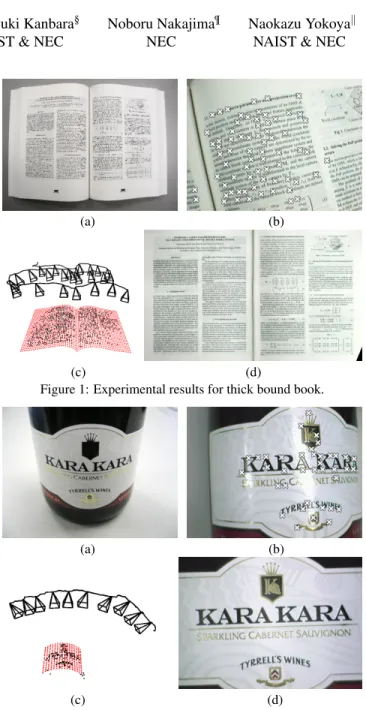
(1)Video Mosaicing for Curved Documents by Structure from Motion Tomokazu Sato∗ NAIST & NEC. 1. Akihiko Iketani† NEC. Sei Ikeda‡ NAIST. Masayuki Kanbara§ NAIST & NEC. (a). (b). (c) (d) Figure 1: Experimental results for thick bound book.. Approach. In our method, a user should just take a video image of a curved target by moving a video camera. The system automatically estimates 3-D information from the motion of image features, and a still image without geometric distortion is then generated. Our video mosaicing method is constructed of three phases as follows. Phase 1. 3-D reconstruction: 3-D positions of the feature points and 6-DOF extrinsic camera parameters in each frame are estimated by tracking image features in the video stream[Sato, T. et al. 2002]. Phase 2. Parameter refinement and surface fitting: The estimated camera parameters are globally optimized, and the shape of the target is approximated by fitting a polynomial of one variable to the point cloud. Reappeared features in video stream are also detected and utilized to increase the accuracy of 3-D reconstruction. Phase 3. Mosaic image generation: An unwrapped mosaic image is generated using the approximated shape and the extrinsic camera parameters.. 3. Naokazu Yokoya NAIST & NEC. Introduction. This sketch describes a novel method for digitizing documents on curved surfaces by mosaing using a hand-held video camera. Generally, the video mosaicing techniques give a cheap and lowresolution web-cam device the capability of high resolution and wide angle capturing of a target with improved imaging quality. However, most of existing video mosaicing methods[Szeliski, R. 1994; Hsu, C.T. et al. 2000] are only for flat or very far targets. Although there are some video mosaicing methods which can deal with curved surfaces[Grattono, P. and Spertino, M. 2003], they require an active camera and a slit light projection device. In this sketch, a novel video mosaicing method based on structure from motion is proposed. The proposed method can generate a distortion-free image of curved document from a video captured by a single camera, and thus requires no additional devices nor a priori knowledge on the target. The assumptions here are that intrinsic camera parameters are fixed and calibrated in advance to correct lens distortion. For curved documents, the curve of the target must lie along one direction and its curvature changes smoothly along this direction.. 2. Noboru Nakajima¶ NEC. Experiments. We have developed a prototype video mosaicing system which mainly consists of a laptop PC (IBM ThinkPad X31 1.6GHz, Memory 1GB) and an IEEE1394 CCD camera (Aplux C104T, VGA). Experiments have been carried out for a thick bound book with curved pages (Figure 1(a)) and a label on a wine bottle (Figure 2(a)). Each target is captured with the web-cam as a 5 fps VGA sized video (250 frames for the book, 100 frames for the wine label). Figures 1(b) and 2(b) show sampled frames of each input video stream. Cross marks in the figure indicate positions of tracked image features detected by Harris operator. 3-D reconstruction results are shown in Figures 1(c) and 2(c), where the curved line shows the camera path, pyramids show camera postures in every ∗ e-mail: † e-mail: ‡ e-mail: § e-mail: ¶ e-mail:.  e-mail:. [email protected] [email protected] [email protected] [email protected] [email protected] [email protected]. (a). (b). (c) (d) Figure 2: Experimental results for wine label. 10 frames, and black points are 3-D positions of feature points. The set of grid points in each figure represents a surface fitted to the 3-D point cloud. The unwrapped mosaic images are shown in Figures 1(d) and 2(d). As can be seen, the distortion on the target has successfully been removed in the resultant image.. References G RATTONO , P., AND S PERTINO , M. 2003. A Mosaicing Approach for the Acquisition and Representation of 3D Painted Surfaces for Conservation and Restoration purpose. Machine Vision and Applications, vol.15, no.1, 1–10. H SU , C.T., C HENG , T.H., B EUKER , R.A., AND H ONG , J.K. 2000. Feature-based Video Mosaicing. Proc. ICIP, vol.II, 887–890. S ATO , T., K ANBARA , M., YOKOYA , N., AND TAKEMURA , H. 2002. Dense 3-D Reconstruction of an Outdoor Scene by Hundreds-baseline Stereo Using a Handheld Video Camera. IJCV, vol.47, no.1-3, 119–129. S ZELISKI , R. 1994. Image Mosaicing for Tele-Reality Applications. Proc. IEEE Workshop on Applications of Computer Vision, 230–236..

(2)

Figure 1: Experimental results for thick bound book.

参照

関連したドキュメント

If we are sloppy in the distinction of Chomp and Chomp o , it will be clear which is meant: if the poset has a smallest element and the game is supposed to last longer than one

Certain meth- ods for constructing D-metric spaces from a given metric space are developed and are used in constructing (1) an example of a D-metric space in which D-metric

Certain meth- ods for constructing D-metric spaces from a given metric space are developed and are used in constructing (1) an example of a D-metric space in which D-metric

In this paper, we establish a Stroock-Varadhan support theorem for the global mild solution to a d (d ≤ 3)-dimensional stochastic Cahn-Hilliard partial differential equation driven by

By using the Fourier transform, Green’s function and the weighted energy method, the authors in [24, 25] showed the global stability of critical traveling waves, which depends on

[18] , On nontrivial solutions of some homogeneous boundary value problems for the multidi- mensional hyperbolic Euler-Poisson-Darboux equation in an unbounded domain,

Since the boundary integral equation is Fredholm, the solvability theorem follows from the uniqueness theorem, which is ensured for the Neumann problem in the case of the

If in the infinite dimensional case we have a family of holomorphic mappings which satisfies in some sense an approximate semigroup property (see Definition 1), and converges to