Abstract*
The cause of business and human rights dilemma in ASEAN1) member states lies not in the increased
globalization and regional integration in this region, but it lies in governance capacity of the states. Low governance capacity of some of the least developed nations in ASEAN have created governance gap2), a gap
between the scope and impact of economic forces and the capacity of states to regulate adverse consequences of business activities. Consequently, these circumstances have offered a permissive environment for human rights violations by corporate operation in the ASEAN region. Thus, to effectively address business and human right issues in ASEAN, how to improve governance capacity of states and how to narrow down and ultimately bridge governance gaps is a vital task. Against this background, this paper argues that the transnational regulatory framework, the multi-stakeholders initiated corporate norms3) have the capacity of constructing
The Role of Multi-Stakeholder Initiated Corporate Norms
Aliya Alimu
* The earlier draft of this article was presented at the Asian Society of International Law Regional Conference on “International Law and a Dynamic Asia” in June 2016. I am grateful to Professor Simon Chesterman for his valuable comments during the conference and to the Yokohama National University for providing me with the assistance for my trip to Hanoi. My most sincere thanks go to Professor Araki Ichiro, my academic supervisor for his encouragement and his guidance.
1) The Association of Southeast Asian Nations (ASEAN) was established on 8 August 1967, The member states of the Association are Brunei Darussalam, Cambodia, Indonesia, LaoPDR, Malaysia, Philippines, Singapore, Thailand, and Vietnam. See Secretariat, A. S. E. A. N. “The ASEAN charter.” Jakarta: ASEAN Secretariat (2008), 2.
2) The concept of “governance gap” have been widely discussed in recent year. It generally refers to the gap created when political integration lags behind economic integration in some policy fields. Governance gap is often considered to provide multinational enterprises with opportunities to externalize (social) costs which have in some cases led to corporate scandals such as environmental harm or human rights violations in the supply chain. See G. Gagnon, A. Macklin, P Simons, “Deconstructing Engagement: Corporate Self-Regulation in Conflict Zones-Implications for Human Rights and Canadian Public Policy: Summary.” (January 2003). University of Toronto, Public Law Research Paper No. 04‒07, 53; J. Ford, “Business and human rights: bridging the governance gap.” The Chatham House, Research Paper, (2015); P. Simons and A. Macklin. The Governance Gap: Extractive Industries, Human Rights, and the Home State
Advantage. (Routledge, 2014)
3) In general, the multi-stakeholder initiated corporate norms refer a regulatory framework that works with multiple stakeholders, usually business entities and civil societies, along with others including governments and non-governmental organizations (NGOs) to solve a business and human rights problems that no actor can solve alone. There
a network governance mechanism which can provide incentives as well as social pressures not only to non-state actors such as corporations and the civil society but also to non-state governments to work on their governing capacity and improve human rights conditions in their territories. This progress will eventually lead to improvement of overall business and human rights conditions in the ASEAN region.
Key words: Multi-Stakeholder Initiated Corporate Norms, Business and Human Rights, United Nations
Guiding Principles, Governance Capacity
Introduction
An increasing number of social and environmental issues – from sweatshop working conditions in factories to waste disposal, deforestation4), and to aiding and abetting human rights violations5) – occur
along globally stretched processes of value production. Many of those issues remain unregulated or under-regulated6). It is assumed that corporations, whose cross-border activities result in diverse social impacts, often
operate in a vacuum between insufficient national laws and non-existent or unenforceable international law.7)
While this assertion is largely correct, this paper contends that in the absence of corresponding development in governance capacity, there cannot be an effective control of corporate activities regardless of improvements in legal frameworks. It is exactly the case in the least-developed states in the ASEAN region, namely Cambodia, Lao PDR, Myanmar and Vietnam (these four countries are often referred to as CLMV nations). These states have an adequate judicial environment to control and prevent corporate human rights wrongdoings (to a certain extent). However, protecting human rights from wrongful business acts is often impeded by the lack of rule-of-law-based governance, and by corruption and social conflicts as its consequences in these nations.8)
While states are not compelled by binding obligations to take actions to address the challenges that lie at the intersection of business and human rights, it is recommended to mobilize other social actors to foster states engagement with these matters and press states to change their attitude toward human
are several different terms used to describe this concept, such as “multi-stakeholder initiatives”, “multi-stakeholder initiated corporate codes of conduct” or “multi-stakeholder initiated corporate norms”. See, H. Keller “Codes of Conduct and Their Implementation: The Question of Legitimacy.” Legitimacy in International Law, (2008), 219‒298; J. K. Jackson, “Codes of Conduct for Multinational Corporations: An overview”, CSR Report for Congress, (2013); T. Göbel, Multi-Stakeholder Initiatives’ Impact on Labor Rights in Global Supply Chains. (Nomos, 2010).
4) T. Bartley, “Transnational private regulation in practice: The limits of forest and labor standards certification in Indonesia.” Business and Politics 12.3 (2010).
5) D. Cassel, “Corporate aiding and abetting of human rights violations: Confusion in the courts.” Northwestern
University Journal of International Human Rights 6.2 (2008), 8‒16.
6) S. J. Kobrin, “Globalization, Transnational Corporations and the Future of Global Governance.” Handbook of
Research on Global Corporate Citizenship (2008), 249.
7) O. Amao, Corporate Social Responsibility, Human Rights and the Law: Multinational Corporations in Developing
Countries. (Taylor & Francis, 2011); P. Muchlinski, Multinational Enterprises and the Law. (Oxford University Press,
2007), 3; R. J. Fowler, “International environmental standards for transnational corporations,” Envtl. L., 25, 1 (1995) 8) The link between the lack of rule of law based governance and human right abuses have been widely discussed. See. e.g., L. Cockroft, “Corruption and Human Rights: A crucial link.” Documento de trabajo de Transparencia Internacional, (1998); J. T.Gathii, “Defining the relationship between human rights and corruption.” U. Pa. J. Int’l L. 31 (2009), 125; C. Apodaca, “Rule of Law and Human Rights.” Judicature 87 (2003), 292.
rights.9) Society involved in the governance can stimulate and improve state governance capacity.10) This
paper argues that the multi-stakeholder initiated corporate norms, the transnational regulatory framework that are promulgated by the participation of multi-stakeholders have the capacity of constructing network governance mechanism to assist governments to improve their governance capacity in tackling with business and human rights issues in the ASEAN region.
Foreign direct investment (FDI) is the main vehicle through which business entities expand into and impact states. Therefore, this paper starts with examining some of the distinct features of FDI inflows in the ASEAN region to highlight the human rights risky environment in this region. Then it attempts to address the role of the multi-stakeholders initiated corporate norms through demonstrating how these instruments can reflect the interests of various types of actors (including governments, corporations, trade unions, communities, non-governmental organizations (NGOs), and international organizations) that are involved in business-human rights spectrum. Lastly, it describes how this initiative can construct a network of supporting and monitoring system that can exert incentives as well as social pressures to each actor including state governments to respect and promote human rights and eventually help states to improve their overall governance capacities. As an example, this study explores benefits of participating in the United Nations Guiding Principles (UNGPs), one of the predominant multi-stakeholder norms for corporate activities improving human rights condition in the ASEAN region. In recent years, the voluntary nature of such multi-stakeholder initiated corporate norms has been the subject of criticism. Opponents of this approach claim that purely self-regulatory institution and their reliance on legitimacy for enforcement are ineffective in addressing and regulating business-related human rights issues.11) Instead, they are in favor of legally binding treaty solution.12) A binding treaty perhaps could
contribute to ending the impunity that business routinely enjoy for their human rights violations and ensure access to justice for victims. However, the failed attempts initiated at the United Nations level and national levels13) have taught us that in our current international society, consensus building on such a binding treaty
9) Importance of society involvement in governance have been discussed extensively. See S. Hickey, G. Mohan,
Participation―From Tyranny to Transformation: Exploring New Approaches to Participation in Development. (Zed books, 2004); S. Bell, A Hindmoor, Rethinking Governance: The Centrality of the State in Modern Society. (Cambridge University Press, 2009)
10) Bell and Hindmoor. (n. 8) 138.
11) See, e.g., K. Bäckstrand, “Multi-stakeholder partnerships for sustainable development: rethinking legitimacy, accountability and effectiveness.” European Environment 16.5 (2006), 290‒306; Simons and Macklin, The Governance
Gap (n. 3)
12) O. Amao, Corporate Social Responsibility, Human Rights and the Law, (n. 7) 201.
13) The failed attempts of binding norms at United Nation level are, e.g., the UN codes of conduct on transnational corporations in 1970s and the UN Draft Norms in 2005. See, K. P. Sauvant, “The negotiations of the United Nations code of conduct on transnational corporations: Experience and lessons learned.” The Journal of World Investment
& Trade 16.1 (2015), 11‒87 ; D. Weissbrodt, K. Muria,”Norms on the responsibilities of transnational corporations
and other business enterprises with regard to human rights.” The American Journal of International Law 97.4 (2003), 901‒922; A. Ramasastry, “Closing the Governance Gap in the Business and Human Rights Arena: Lessons from the Anti-Corruption Movement.” A Ramasastry, Closing the Governance Gap in the Business and Human Rights Arena:
Lessons from the Anti-Corruption Movement, in Human Rights Obligations of Business (2013), 162‒90.
The failed attempts at national level, e.g., the Canada’s failed attempt of passing a binding CSR norm to extractive industry, the Bill C-300 act in 2007. See Simons and Macklin, The Governance Gap, (n. 3) 260
on human rights responsibility of business entities is just not yet politically feasible, and perhaps may not be economically desirable.
Against all those negative perspectives on multi-stakeholder initiated corporate norms, this paper sets out to explore some of the positive roles of this instrument. It is not the aim of this paper to convince the readers that the multi-stakeholder initiated corporate norms are the best possible solution to regulate business-related human rights problems. Instead, this paper attempts to pursue a modest objective which is to bring readers attention to the positive roles of the multi-stakeholders initiated corporate norms by stressing the instrumental role of these corporate norms in improving regulatory capacities of governments in the ASEAN region, which is the necessary condition for improving business and human rights in the region. After all, there is no one size fits all solution for the business-related human rights issue.14) Legally binding or non-binding, so long as
any instrument that can serve to improve the human rights conditions and make businesses to realize that they have a responsibility to protect and respect human rights, states should actively take part in and utilize it.
1.Business and Human Rights Regime in ASEAN 1. 1 The Rise of the ASEAN Region and Its Effect on Business and Human Rights
Multinational corporations relocate their business activities for multiple reasons.15) Among other reasons,
the most obvious ones are to chase after low costs and low wages. When one market becomes too expensive, manufacturing operations often move to other less costly environments. Research done by the SMBC Nikkei Security shows that labor costs in China continued to rise at an annual pace of around 10 percent from 1995 to 201416)and this phenomenon has increasingly triggered international corporations to migrate their factories to the
ASEAN region,17) especially to the CLMV countries of Cambodia, Laos, Myanmar and Vietnam.18)According to
the ASEAN Investment Report of 2015, FDI total flows to ASEAN countries rose for the third consecutive year, from $117.7 billion in 2013 to $136.2 billion in 2014 (Figure 1). This level exceeded FDI inflows to China for the first time since 1993, making ASEAN the largest recipient of FDI in the developing world.19)
According to the Social Progress Index of 2014,20) the economic development, however, does not
14) J. Ruggie, Just Business: Multinational Corporations and Human Rights (Norton Global Ethics Series, WW Norton & Company, 2013)
15) L. M. Ellram, Offshoring, reshoring and the manufacturing location decision. Journal of Supply Chain
Management 49.2 (2013), 3‒5.
16) “Japanese companies move away from the ‘world’s factory’, Nikkei Asian Review” Nikkei Asian Review (December 7, 2015), http://asia.nikkei.com/Business/Trends/Japanese-companies-move-away-from-the-world-s-factory?page=1 Accessed October 17, 2016.
17) R. J. Bowman, “Manufacturing Capacity Is Leaving China. But Where’s It Going?”, Supply Chain Brain, (January 26, 2015), http://www.supplychainbrain.com/content/blogs/think-tank/blog/article/manufacturing-capacity-is-leaving-china-but-wheres-it-going/ Accessed October 17, 2016
18) A. Maierbrugger, “From China to Southeast Asia: Major shift in low-cost manufacturing,” Gulf Times, (August 14, 2014), http://www.gulf-times.com/story/404622/From-China-to-Southeast-Asia-Major-shift-in-low-co Accessed June 16, 2016.
19) ASEAN Secretariat, “ASEAN Economic Community Chart book 2015”, (2015), 5 http://asean.org/ storage/2016/06/12.-April-2016-ASEAN-Economic-Community-AEC-Chartbook-2015.pdf Accessed June 12, 2016.
20) S. Stern and A. Wares, “Social Progress Index 2014”, Methodological Approach. Washington: Social Progress Imperative. (2014) https://www2.deloitte.com/content/dam/Deloitte/cl/Documents/public-sector/cl_PS_ SocialProgressIndex 2014_ExecSummary.pdf
necessarily result in significantly improved social progress.21) The result of this report showed that in
2014, among regions, Europe, North America, and Oceania (Australia and New Zealand) were the best-performing regions on overall social progress. Sub-Saharan Africa, Central Asia, and South Asia were the worst performing regions,22) despite their economic growth. The increases in FDI flows have the possibility of
putting the ASEAN region at more risk of corporate human rights abuses. There are several features that need to be highlighted in the landscape of FDI inflows to ASEAN region in recent years to demonstrate the risky environment in this region measured in terms of human rights violations.
First, while there is a gradual increase in FDI, the portion of the intra-ASEAN investment in total FDI is on the rise. It rose by 26 percent, from $19.4 billion in 2013 to $24.4 billion in 2014 and it accounted for 18 percent of total inflows into the region (Figure 2). These figures indicate that more and more corporations in ASEAN states are engaging in intra-ASEAN business activities in recent years. This changing landscape in FDI in the ASEAN region demonstrates that the business and human rights discussion no longer belongs to the exclusive domain of the South-North dialogue.
The business and human rights conflict has taken different dimensions throughout history. During the mercantilist period and the colonial time, corporations from the Great Powers such as the United States, Britain, and Spain monopolized the market of the South and thus they were the chiefly responsible for business-related human rights violations. After colonialism, states of the South attained their independence, and the new economic relationship was established between the North and the South. The nascent states attempted to demand the countries of the North to regulate their corporations to make them more accountable
21) Ibid., The Social Progress Index 2014, ranked132 countries based on their social and environmental performance. According to this report, higher GDP per capita does bring benefits, particularly on ‘Basic Human Needs’, however, the rising incomes do not guarantee improvement on ‘Ecosystem Sustainability’, ‘Health and Wellness’ and ‘Opportunity’.
22) Ibid.
for their business activities regarding human rights.23) After the Cold War, however, the countries of the South
discovered to their dismay that their economic well-being was bound up with FDI from the North.24) Coupled
with this was the ending of international bank loans to the new states. Thus, in order to secure FDI inflow, the South prioritized economic development and gave away their bargaining power in the discussion of business and human rights in the international system.25)
From the 1980s, the raft of neoliberal policies known as the Washington Consensus pressured the South for the rollback of government and increased role for the private sector, and the opening up of the market to global free trade.26) As a result, more and more corporations from developing countries expanded their
operations worldwide. The South s attitude toward business and human rights shifted from pressing for business to respect human rights, to favoring the idea that it is acceptable for developing countries to give a low priority to certain human rights while focusing on economic development. However, over-stressing economic development often results in significant social and environmental costs and human rights violations. The idea of corporate social responsibility (CSR), the principle that the corporation has a responsibility to society beyond the profit maximization objective has a long history.27) However, the proliferation of CSR in
developed countries started roughly from the 1990s,28) and the awareness of the business impact on human
rights has risen rapidly. Governments and business entities of the North are now actively engaging in CSR initiatives and implementing corporate regulatory norms. In the developing countries, on the other hand, in spite of an increasing number of business-related human rights violations, the process, and scale of their involvement in the business and human rights regulatory regime lagged behind.29) The Business and Human
Rights Resource Center, an independent non-profit organization, conducted a research tracking companies human rights performance in the ASEAN regions in the span of a 10-year period. According to the briefing produced by this organization in 2013, over half (53 percent) of corporate-related human rights allegations were on companies headquartered in Asia. And, of these, most frequently they were headquartered in China, followed by South Korea, Thailand, and the Philippines.30)
Second, there is a considerable increase in FDI flows to the CLMV countries and sources of FDI come from both extra-regional investment and intra-regional investment in recent years. According to the ASEAN Investment Report 2015, FDI inflows to the CLMV countries declined marginally by 3 percent, to $12.8 billion in 2014 because of the huge and surprising drop in FDI inflows to Myanmar due to domestic political
23) R. S. Browne, “Delinkage-Response of a Spurned Lover or a Rational Path for Africa.” Howard LJ 27 (1984), 937.
24) O. Amao, Corporate Social Responsibility, Human Rights and the Law, (n. 7) 21.
25) Ibid., 22.
26) See R. Broad, “The Washington consensus meets the global backlash: shifting debates and policies.”
Globalizations 1.2 (2004), 129‒154; O. Amao, Corporate Social Responsibility, Human Rights and the Law, (n. 7)
27) P. Katsoulakos, M. Koutsodimou, A. Matraga, “A historic perspective of the CSR movement.” CSRQuest
Sustainability Framework (2004), 5.
28) Ibid., 15.
29) W. Visser, “Corporate social responsibility in developing countries.” (2008), 5.
30) Business and Human Rights Resource Center, “Development for all, or a privileged few? Business and Human Rights in Southeast Asia”, (2015), 3, https://business-humanrights.org/sites/default/files/Southeast%20Asia%20 Briefing%2016%20April%202015.pdf
instability. However, FDI to Cambodia, Lao PDR, and Vietnam rose. And for the last five years, FDI inflows are gradually increasing for these countries (Figure 3). Moreover, for the last few years, the Gross Domestic Product (GDP) has also been continuously growing in these four CLMV countries, in spite of the fall in total GDP of the ASEAN region (Figure 4). The rise in FDI plays an important role in expanding regional production networks and strengthens regional integration. However, the increased FDI also widens the governance gap further, a gap between the scope and impact of investors and the capacity of states to regulate adverse consequences of their business activities. This consequently puts human rights at risk.
The human rights investigation report prepared by the Business and Human Rights Resource Center also revealed that there were striking differences in the number of cases of alleged abuses in different countries in the ASEAN region. By far the highest number of approaches to companies was regarding alleged abuses in Myanmar (123 approaches), followed by the Philippines (48), Cambodia (46), Indonesia (43), and Malaysia (11). Although the number of cases was less in Laos and Vietnam, it was because civil society groups who report these abuses were more restricted in these countries compared to other countries.31) This research did not
mention whether the human rights abuses increased in these countries during the research-conducting period. However, the result demonstrates that in spite of economic growth in CLMV countries, most of the human rights abuse cases by business activities are concentrated in CLMV countries of the ASEAN region.
Third, the FDI inflows in infrastructure and energy sectors are increasing rapidly. Corporations from within ASEAN and outside the region are both active in investing in these sectors.32) Investment in
infrastructure and extractive sectors have positive effects on the economic development of the region. However, privatizing the public sector without proper regulatory framework often creates an environment for
31) Ibid., 7.
32) C. Middleton, A. Pritchard, Corporate Accountability in ASEAN: Human Rights Based Approach, (Forum-Asia, Figure 3 FDI inflows into CLMV nations (Millions of
dollars)
Author s work, Data Source: ASEAN FDI Databases, accessed April 2016
business to undermine human rights. There are widespread reports of land grabbing linked to the development of infrastructure projects and resource extraction projects. According to a research briefing prepared by Business and Human Rights Resource Center in 2014, almost half of the human rights abuse cases occurred in the ASEAN region from 2005 to date, related to the extractive sector including oil, gas and coal, and mining.
33) In 2015, with the establishment of the ASEAN Economic Community (AEC), more projects were proposed
and detailed within the ASEAN Economic Blueprints Plan. FDI increase in this sector has potentially profound implications on environmental, social and human rights. 34)
In conclusion, the changing landscape in FDI inflows in the ASEAN region has a considerable impact on the location and scope of human rights violation by business activities. First, the increase in intra-regional investment and FDI outflows of ASEAN region reflect the change in the traditional view that the business violation of human rights is exclusive to business entities from the developed North. Corporations from the South are also capable of committing human rights abuses. Governments of the ASEAN region need to actively engage in the works of business and human rights and improve their governing capacity of enforcing of laws and regulation that protect human rights, labor rights, and the environment. Second, the governments of CLMV countries often have the low regulatory capacity. Thus, the increased FDI in these countries might further expand the governance gap in business and human rights and put these regions at risk of business-related human rights abuses. Hence, improving governing capacity, implementing international standards on business and human rights are important steps to prevent further human rights damages in these regions. Lastly, generally speaking, business in the extractive industries, infrastructure sector has a tendency to cause more human rights violations.35) The FDI
inflows into these sectors are increasing in ASEAN region, especially in CLMV states. Therefore, ASEAN region needs to address these issues in its regional development plans and improve human rights institutions.
1. 2 ASEAN and its Human Rights Framework
In the ASEAN region, legal and institutional frameworks for human rights protection are relatively well-established. First, most of the ASEAN states have recognized the international human rights instruments. They play an important role in improving human rights condition because they detail internationally recognized human rights that are inalienable and guaranteed to all people equally.36) United Nations member states have
either ratified or accepted at least one of the nine core international human rights treaties, and 80 percent have ratified or acceded four or more of these instruments.37) In ASEAN, there are eight countries that have either
ratified or acceded to four or more human rights treaties, while Brunei and Singapore have only two accessions which are the Convention on the Elimination on All Forms of Discrimination against Woman (CEDAW) and
33) Business and Human Rights Resource Center, “Development for all, or a privileged few? (n. 29) 34) Middleton and Pritchard, Corporate Accountability in ASEAN, (n. 31) 8.
35) J. Ruggie, “Interim Report of the Special Representative of the Secretary-General on the Issue of Human Rights and Transnational Corporations and Other Business Enterprises”, (U.N. Doc. E/CN.4/2006/97,2006) http://hrlibrary. umn.edu/business/RuggieReport2006.html
36) The Core International Human Rights Treaties, (United Nations Publication, Sales No. E.14.XIV.1.)
37) United Nation, “The Universal Declaration of Human Rights: The Foundation of International Human Rights Law”, http://www.un.org/en/sections/universal-declaration/foundation-international-human-rights-law/index.html Accessed May 12, 2016.
the Convention on the Rights of the Child.38)
Second, at the national level, human rights are given protection under each state s constitutions. Furthermore, there are presently four Paris Principle-compliant39) national human rights institutions within
ASEAN, namely the National Human Right Commission of Indonesia, the Human Rights Commission of Malaysia, the Commission of Human Rights of the Philippines, and the National Human Rights Commission of Thailand. These national human rights institutions are obliged to carry out the mission of receiving complaints from victims, carrying out fact-finding missions, and offering remedial measures.40) In 2007, the
four national human rights institutions signed a Declaration of Corporation, committing to regular forums to facilitate the process of establishing an ASEAN Human Rights Mechanism.41) The network engagement and
region s respective national human rights institutions should play a leading role in regulating human rights problems related to business.
Third, at the regional level, the ASEAN Charter is or should be a major milestone for the protection of human rights in ASEAN. Article 1 and Article 2 of the Charter define ASEAN s purpose and principles respectively, make reference to the need to promote and protect human rights and fundamental freedoms, and Article 14 is committed to establishing an ASEAN Human Rights Body. The body, which is now the ASEAN Intergovernmental Commission on Human Rights (AICHR), was subsequently established in 2009.42)
The creation of AICHR was a big step forward for human right protection and promotion in ASEAN. However, despite all these international, regional and national human rights institutions and cooperative regulatory arrangements between these working bodies, protecting and promoting human rights still is a difficult task for the ASEAN region.
What are the possible factors that are impeding the process of implementing existing human rights instruments in ASEAN region? This study classifies possible answers into the following three categories. First, the priority of economic development over human rights. In many ASEAN countries, governments privilege the pursuit of economic growth over building credible and effective national and regional human rights system. As cited in Article 9 of the ASEAN Charter,43) the ASEAN Community Councils form the three ASEAN
pillars, i.e., the ASEAN Economic Community (AEC), the ASEAN Social-Cultural Community (ASCC), and the ASEAN Political-Security Community (APSC), and they are promoted as closely intertwined and
38) Middleton and Pritchard, Corporate Accountability in ASEAN, (n. 31) 24.
39) The International Coordination Committee of National Institutions for the Promotion and Protection of Human Rights (ICC) provides accreditation to NHRIs based on their respective compliance with the Principles relation to the status of National Intuitions, a set of principles adopted by the United Nations Human Rights Commission by Resolution 1992/54, and by the UN general Assembly in its Resolution 48/134/ of 1993.
40) V. Muntarbhorn, (2012), “Glimmers of hope for human rights gains”, Bangkok Post. This article is based on a new study by Prof Vitit commissioned by the European Parliament, titled: Development of the ASEAN Human Rights Mechanism, http://www.europarl.europa.eu/committees/en/supporting-analyses-search.html
41) See, Position Paper of the National Human Rights Institutions of Indonesia, Malaysia, Philippines, and Thailand On Human Rights Aspects of The ASEAN Charter, (2007), http://www.chr.gov.ph/MAIN%20PAGES/about%20hr/ advisories/pdf_files/positionpaper_bali.pdf,
42) ASEAN (2008). Charter of the Association of Southeast Asian Nations. 43) Ibid., 11.
mutually reinforcing. In practice, the political emphasis has been placed more on the AEC to further liberalize the regions economy and facilitate trade and investment. Far less emphasis has been placed on the regulations of the social and environmental consequence of economic growth and safeguarding human rights, which are addressed in the ASCC and APSC and within the mandate of the AICHR and the ASEAN Commission on the Promotion and Protection of Rights of Women and Children (ACWC). Policies often give public lip service to improving human rights yet have no intention of implementing them. The ASEAN Economic Community (AEC) is promising equitable development, yet it does not include any human rights clauses in its Blueprints. The close relationship between state and business in many instances has resulted in unaccountable decision-making on controversial business projects that have violated human rights.44)
Second, there is a problem of the weak governing capacity. With the exception of countries like Singapore, governance capacity of implementing and enforcing existing human rights regulatory frameworks are still weak in most part of the ASEAN region. The political systems are very diverse in ASEAN. There are political systems like the absolute monarchy of Brunei, the constitutional monarchies of Cambodia, Malaysia and Thailand, the socialist republics like Laos and Vietnam and the electoral military authoritarian system in transition in Myanmar, and the republics in Indonesia, the Philippines, and Singapore. This indicates that in spite of increasing economic integration, there are uneven levels in the rule of law and government regulatory capacities among the ASEAN states, which impedes effective implementation of regional human rights instruments.
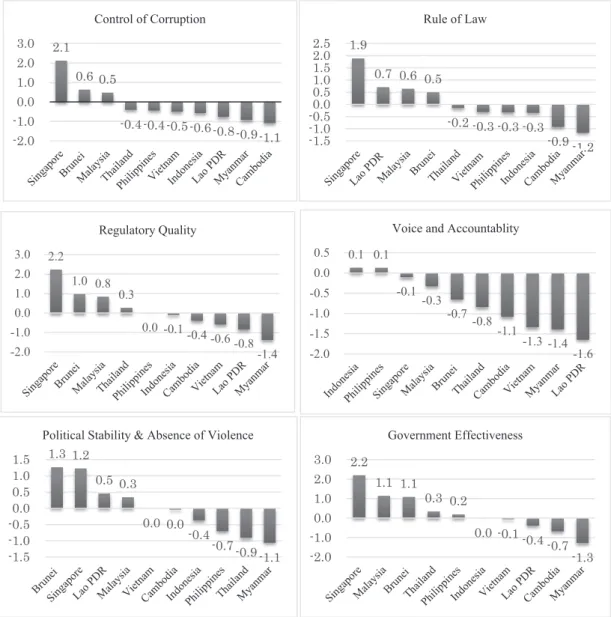
According to the World Bank Governance Indicators in 2014, with the exception of Singapore, Brunei, and Malaysia, most of the states in the ASEAN region had the common characteristics of weak governance (Figure 5). The CLMV countries stood out as the countries with the weakest governance.45) There are other
indicators that partially cover ASEAN region. They can also help us to comprehend governance capacity of some ASEAN states. The Global Justice Project 2015 46) ranked 102 jurisdictions according to 44 factors
are grouped them into eight categories, including the absence of corruption, civil justice, constraints on government powers, criminal justice, fundamental rights, open government, order and security, and regulatory enforcement. While Brunei and Laos were not ranked by this project, most of the ASEAN countries was ranked at low levels, except Singapore, which was ranked as number nine and Malaysia, which was ranked as number 39. CLMV countries were highlighted as the worst performers in 2015. Myanmar was ranked at 92nd for government interference in the civil and criminal justice systems, and corruption in the judiciary. Cambodia – the worst performer in ASEAN came in 99th place globally. It was ranked worst in the world for civil justice, and second worst for its regulatory enforcement, just above Venezuela.
44) Middleton and Pritchard, Corporate Accountability in ASEAN, (n. 31) 78
45) The World Bank Governance Indicators capture six key dimensions of governance. They are voice and accountability, political stability and lack of violence, government effectiveness, regulatory quality, rule of law, and control of corruption. www.govindicators.org
46) The World Justice Project (WJP) is an independent, multidisciplinary organization working to advance the rule of law around the world. The rankings are based on the results of 1,000 people surveyed in each jurisdiction, and reflect some regional variation within jurisdictions. http://worldjusticeproject.org/rule-of-law-index
Third is the lack of public participation47) in government decision-making process. AICHR has operated
to date with the lack of transparency and access to information, and with many limited consultations with civil society. According to Forum-Asia Report in 2013, while drafting the ASEAN Human Rights Declaration,
47) Public participation is the process by which an organization consults with interested or affected individuals, organizations, and government entities before making a decision.
13
Author`s work. Data Source: World Bank Governance Indicators (Accessed on 22.05.2016)
Third is the lack of public participation
47in government decision-making process.
AICHR has operated to date with the lack of transparency and access to information, and
with many limited consultations with civil society. According to Forum-Asia Report in
2013, while drafting the ASEAN Human Rights Declaration, AICHR only held two
regional consultations, and only four civil societies from each member states were
allowed to participate. At the national level, only four out of ten countries, namely
Indonesia, Malaysia, the Philippines, and Thailand, held national consultation with civil
47 Public participation is the process by which an organization consults with interested or affected
individuals, organizations, and government entities before making a decision. 2.1 0.6 0.5 -0.4 -0.4 -0.5 -0.6 -0.8 -0.9 -1.1 -2.0 -1.0 0.0 1.0 2.0 3.0 Control of Corruption 1.9 0.7 0.6 0.5 -0.2 -0.3 -0.3 -0.3 -0.9 -1.2 -1.5 -1.0 -0.50.0 0.5 1.0 1.5 2.0 2.5 Rule of Law 2.2 1.1 1.1 0.3 0.2 0.0 -0.1 -0.4 -0.7 -1.3 -2.0 -1.0 0.0 1.0 2.0 3.0 Government Effectiveness 1.3 1.2 0.5 0.3 0.0 0.0 -0.4 -0.7 -0.9 -1.1 -1.5 -1.0 -0.5 0.0 0.5 1.0 1.5
Political Stability & Absence of Violence 2.2 1.0 0.8 0.3 0.0 -0.1 -0.4 -0.6 -0.8 -1.4 -2.0 -1.0 0.0 1.0 2.0 3.0 Regulatory Quality 0.1 0.1 -0.1 -0.3 -0.7 -0.8 -1.1 -1.3 -1.4 -1.6 -2.0 -1.5 -1.0 -0.5 0.0 0.5
Voice and Accountablity
Figure 5 The Governance Indicators in ASEAN in 2014
AICHR only held two regional consultations, and only four civil societies from each member states were allowed to participate. At the national level, only four out of ten countries, namely Indonesia, Malaysia, the Philippines, and Thailand, held national consultation with civil society groups on the Declaration.48) In recent
years, however, governments of ASEAN have started to realize the importance of public participation. For instance, 14th ASEAN Summit was held from February 28 to March 1, 2009. This Summit, under the theme of ASEAN Charter for ASEAN peoples , emphasized the importance of enhancing people s participation and people-oriented ASEAN so that every sector of the society can benefit from the process of ASEAN integration and community building. This was a noticeable step. However there have not been specific action plans on how to promote public participation in ASEAN overall decision-making process. 49)
In conclusion, factors such as over-prioritizing economic development, the weak regulatory capacity of governments and lack of civil society participation in policy makings are impeding the process of improving human rights conditions in ASEAN region. However, therefore, capacity building and awareness-rising through regional-state-civil society collaboration can play a vital role in improving human rights conditions in ASEAN.
2. Role of Multi-Stakeholders Initiated Corporate Norms and the Business and Human Rights in ASEAN
2. 1 Multi-stakeholder Initiated Corporate Norms
The previous section examined the business and human rights conditions in the ASEAN region and highlighted several obstacles that impede improvement of business and human rights process. This section begins its explorations of the role of the multi-stakeholder initiated norms that purport to govern transnational corporate behaviors on human rights by assessing these initiatives. In doing so, it argues that these initiatives show valuable characteristics and can complement existing legal instrument and enhance ASEAN states governing capacity and empower them to further improve their human rights conditions.
In the absence of direct international human rights law obligation on corporations, or a clear international legal obligation on states to regulate the transnational activity of their corporate nationals, public press to address business to respect human rights has promoted governments, corporations, and NGOs to develop and implement a variety of self-regulatory initiatives.50)
The multi-stakeholder initiated corporate norms are part of those initiatives. This transnational institution includes actors beyond states. It governs some of the complex areas of international affairs. They contribute to the elaboration of policies and standard setting, standard monitoring, achieving standard compliance, and sectioning non-compliance51) with international norms such as international labor standards, international
human rights framework and the environmental protection regulations. These norms avail themselves of the institutionalized inclusion of multiple non-state actors in policy designing, implementation and monitoring process. Furthermore, unlike the vertical top-down mode (vertical mode), which is a prototype style for
48) Middleton and Pritchard, Corporate Accountability in ASEAN, (n 31) 34 49) Ibid., 36
50) R. Mayne, “Regulating TNCs: The role of voluntary and governmental approaches.” Regulating International
Business, (1999), 239.
states and public actors to authoritatively enforce rules, the multi-stakeholder initiated corporate norms rely on the horizontal political coordination and non-hierarchical navigating model.52) They rely on processes of
bargaining and arguing.
The multi-stakeholder initiated norms are different in their scope, purpose, function and their forms.53) They
may be formed to address global level social, environmental and human rights issues related to business activities such as UN Guiding Principles, UN Global Compact, the Sullivan Principles or the Global Reporting Initiatives. They may be promulgated to address specific sectors, such as Marine Stewardship Council, International Code of Conduct for Private Security Companies, the Extractive Industries Transparency Initiative, and the Kimberly Process Certification Scheme. They may be initiated for specific purposes such as aiming to improve labor standards, elimination of child labor such as the Fair Labor Association (FLA). They are different in terms of the function that they perform as well. Some of them mainly focus on fostering dialogue among stakeholders such as the Ethical Trading Initiatives while others create standards with a mechanism to enforce them.
The multi-stakeholder initiated corporate norms are a regulatory framework that works with multiple stakeholders, usually business entities, civil society groups, along with others including governments and non-governmental organizations (NGOs) to solve business and human rights problems that no actor can solve alone. It was highlighted in the previous section that ASEAN states are equipped with fairly adequate institutional framework governing core areas of human rights. However, the absence of good governance, including lack of transparency, lack of the rule of law, weak regulatory capacity and low civil society participation is impeding effective implementation of human rights regulatory frameworks in this region. The governance gap, a gap between the scopes and impact of economic forces and the governing capacity of ASEAN states is becoming more apparent as the FDI inflows increased in recent years. This might further put the weaker states at risk of facing more human rights abuses. Thus, this research concludes that to narrow down and bridge this governance gaps is a vital task for the ASEAN states to regulate negative business impacts on human rights. To do so, improving governance capacity is a possible first step to take. In these contexts, multi-stakeholders initiated corporate regulatory norms can serve as a new governance tool to address these issues.
2. 2 Role of Multi-Stakeholder Initiated Corporate Norms in the ASEAN States
Diverse in their forms and functions, multi-stakeholders initiated corporate norms have following important roles in the business and human rights regime. First, the multi-stakeholder initiated corporate norms enhance governance capacity of weak states, such as the CLMV states in ASEAN. The topic of improving governance capacity through interacting with non-state actors has been widely discussed in the existing literature. Hobson suggests that states are more likely to be able to achieve their goals if the interest of the state and society are advanced collaboratively rather than competitively.54) Similarly, Bell and Hindmoor argue that
governments can extend their capacity to govern by developing a closer relationship with non-state actors, and
52) Bell and Hindmoor. Rethinking governance, (n 8) 85.
53) D. Baumann-Pauly, J. Nolan, A. van Heerden, M. Samway, “Industry-Specific Multi-Stakeholder Initiatives that Govern Corporate Human Rights Standards―Legitimacy Assessments of the Fair Labor Association and the Global Network Initiative.” Journal of Business Ethics (2015) http://ssrn.com/abstract=2576217
116 横浜国際社会科学研究 第 21 巻第 6 号(2017 年 2 月)
thus the relationship between government and interest groups ought to be viewed as positive-sum rather than zero-sum.55) Braithwaite also writes about expanding governance capacity through partnerships. He says that
state capacity to govern is extended by capacities to enlist through negotiation the governance capacities of other actors.56) Non-state actors that are involved in the multi-stakeholder initiated norms provide legitimacy
expertise and sometimes direct assistance in implementing policies. Of course, governments are the leading player within this network governance, however, to formulate successfully and implement policy; governments need to acquire the expertise, support or assistance of interest groups and NGOs. As it was examined in the second section, the main obstacles of impeding the improvement of human rights condition in the ASEAN region are the weak regulatory capacity of governments to enforce and implement existing institutions. Multi-stakeholders initiated norms offer a platform where different Multi-stakeholders work on defining and analyzing core problems together and exchange different perspectives. Capacity-building and awareness-raising through participating in multi-stakeholders initiated norms can play a vital role in helping ASEAN states to fulfill their duty to protect including the sharing of information about challenges and best practices, thus promoting more consistent approaches.
Second, multi-stakeholder initiated corporate norms have the capacity of utilizing collective action power of stakeholders to monitor each actor within and exert pressure to participant actors to fulfill their given responsibilities. There exist no heretical top-down structure in the multi-stakeholder norms. In contrast, each actor equally patriates in the problems solving process. Multi-stakeholder norms embody a form of
17
weak regulatory capacity of governments to enforce and implement e isting institutions.
Multi-stakeholders initiated norms offer a platform where different stakeholders work on
defining and analyzing core problems together and e change different perspectives.
Capacity-building and awareness-raising through participating in multi-stakeholders
initiated norms can play a vital role in helping ASEAN states to fulfill their duty to protect
including the sharing of information about challenges and best practices, thus promoting
more consistent approaches.
Second, multi-stakeholder initiated corporate norms have the capacity of utilizing
collective action power of stakeholders to monitor each actor within and e ert pressure to
participant actors to fulfill their given responsibilities. There e ist no heretical top-down
structure in the multi-stakeholder norms. In contrast, each actor e ually patriates in the
problems solving process. Multi-stakeholder norms embody a form of networked
governance that places behavior of each actor that have an impact on human rights
under the scrutiny of a multiplicity of stakeholders including not only states but also
NG s, unions, industry bodies and international organizations.
It is to say that, unlike the Corporate Social Responsibly instruments, in which
corporations are principals and only partly in control of the process, in
multi-stakeholder norms, corporations are no more than a participant.
57Network-governance
is an innovative model of governance that is solutions-oriented with a focus on public
value, where diverse stakeholders can work in partnership to improve the management of
57
. Roloff,
A life cycle model of multi‐stakeholder networks. , Business Ethics: A European Review
17.3 (2008),311-325.
Governments Corporations Regional International rganizations Civil society Individuals NG s Business and Human RightsFigure 6. Multi-stakeholder initiated corporate norms: Network governance
Figure 6 Multi-stakeholder initiated corporate norms: Network governance
55) Bell and Hindmoor. Rethinking Governance (n) 64
56) J. Braithwaite, Regulatory Capitalism: How It Works, Ideas for Making It Work Better, (Edward Elgar Publishing, 2008)
networked governance that places behavior of each actor that have an impact on human rights under the scrutiny of a multiplicity of stakeholders including not only states but also NGOs, unions, industry bodies and international organizations.
It is to say that, unlike the Corporate Social Responsibly instruments, in which corporations are principals and only partly in control of the process, in multi-stakeholder norms, corporations are no more than a participant.57) Network-governance is an innovative model of governance that is solutions-oriented with a focus
on public value, where diverse stakeholders can work in partnership to improve the management of public resources and delivery of services. The network governance capacity of the multi-stakeholder initiated norms is to bring together government, civil society, and the private sector to address complex development challenges that no one party alone has the capacity, resources, and know-how to overcome the obstacles. For instance, in the network governance by multi-stakeholder initiation, multiple actors commit to one particular goal, for the purpose of regulating diverse business impact on human rights (Figure 6). Multiple actors involved in the paradigm of business and human rights form a network through communications and collaboration. This network helps each actor to peruse their individual strategic objectives while working together to reach the collective goal.
In most of the human rights abuses allegations, the business entities either directly involved in human rights abuses or complicit within human rights violations are lobbying with corrupted governments. It is also the case in CLMV countries in ASEAN. A report by the Business and Human Rights Resource Center in 2015 revealed58) that heavy-handed actions by governments are often converged with economic interests,
at the expense of workers and affected communities in the ASEAN region. Of the 278 cases of human rights allegation in Southeast Asia that this Center investigated, 70% involve some form of direct abuses by government forces, for example in the form of forced eviction of communities from their land or the use of violence in breaking up worker s protest. It is unrealistic to expect these corrupted governments to regulate and address these human rights problems on their initiatives. The network governance established by a strategic alliance between international organizations, governments, corporations, and civil societies, can put the press on states to change their attitude toward human rights. Furthermore, one aspect of the investment in ASEAN countries is a greater willingness of governments to allow MNCs to own or manage projects in key public sectors, such as energy, telecommunications, transport, water, and sanitation. While there may be benefits from privatizing decision-making in such sectors, problems occur when the core societal needs and natural resources are largely controlled by entities that governments may not have the capacity to hold accountable for customer service and compliance with local law. In this context, multi-stakeholder network-governance also play an important role in addressing these issues.
Third, the multi-stakeholder corporate norms have the potentiality to evolve from voluntary norms to soft law or even to the binding legal instrument and helps to fill the regulatory void in business and human rights regime. The industry-specific multi- corporate norms can develop metrics to track progress and mechanisms to measure compliance, and they ensure accountability in a more industry-specific context. Therefore they
57) J. Roloff, “A life cycle model of multi‐stakeholder networks.”, Business Ethics: A European Review 17.3 (2008), 311‒325.
have more potential to address governance gaps.59) It is noteworthy that early multi-stakeholders initiated
corporate norms addressing human rights concerns such as the Ethnical Trading Initiatives and the Fair Labor Association (FLA) which brought together companies, NGOs, and other key societal actors committed to protecting works rights in member company operations worldwide, focusing in particular on the garment industry, have matured in their governance through multi-stakeholder-networking. These efforts, which involved initial support from the UK and US governments respectively, have grown over the past decade into the well-established institution. Also, they have begun to expand their reach to address labor-related supply chain challenges for corporations in a wider range of industry sectors, as can be seen in the decision of computer maker Apple to join the FLA.60) The development and reliance on the multi-stakeholder approaches
in recent decades implicitly acknowledges the limitations of traditional command and control regulation, a technique that relies primarily on the state to regulate corporate performance.61)
Despite criticisms concerning their legitimacy and effectiveness,62)the multi-stakeholder initiated corporate
norms have positive roles in improving governance capacity and can help to address and fulfill human rights and business governance gaps in ASEAN regions. Especially in the human rights vulnerable countries like CLMV, multi-stakeholder initiated norms have the potentiality to play a key role in regulating human rights-related challenges.
3.United Nations Guiding Principle and ASEAN 3. 1 United Nations Guiding Principle in Brief
To further highlight the role of multi-stakeholder initiatives, this section examines the 2011 UN Guiding Principles on Business and Human Rights (UNGPs). The UNGPs framework provides – for the first time – a global standard for preventing and addressing the risk of adverse impacts on human rights linked to business activity.63) It is an international level multi-stakeholder initiated norms for business human rights responsibilities.
There have been mixed reactions and feelings from society toward this Framework.64) Critiques of the
UNGPs condemn that UNGPs has no any clear language of legal obligations and they argue that in the business and human rights spectrum, the third party who violates human rights often operates in the countries
59) Baumann-Pauly, Nolan, Heerden, Samway, “Industry-Specific Multi-Stakeholder Initiatives that Govern Corporate Human Rights Standards”, (n. 52)
60) Fair Labor Association, “Apple Joins Fair Labor Association.”, (2012), 1
61) D. Sinclair, “Self-regulation versus command and control? Beyond false dichotomies.” Law & Policy 19.4 (1997), 529-559.
62) See, e.g., K. Bäckstrand, Multi-stakeholder partnerships for sustainable development: rethinking legitimacy, accountability and effectiveness. European Environment 16.5 (2006), 290‒306; Simons and Macklin. The Governance
Gap, (n. 2)
63) OHCHR, Business and Human rights , http://www.ohchr.org/EN/Issues/Business/Pages/BusinessIndex.aspx, Accessed May 11, 2016.
64) See, e.g., M. Neglia, “The Implementation of UN Guiding Principles on Business and Human Rights: Some Reflections on European and US Experiences.”, Working Paper No. 2014/35, (2014); R. C. Blitt, “Beyond Ruggie’s guiding principles on business and human rights: charting an embracive approach to corporate human rights compliance.” Texas International Law Journal 48.1 (2012);N. Jagers, “UN guiding principles on business and human rights: making headway towards real corporate accountability.” Neth. Q. Hum. Rts. 29 (2011),159.
with weak intuitions and malfunctioned judicial system or states that are unwilling to address human rights issue due to their interests in economic profits. These arguments are one-sided, and they ignore the reality of current international legal orders.
The nexus of business and human rights potentially traverses a vast range of issues, and indeed, the scope of business and human rights is itself an issue.65) The UNGPs choice of setting a broader normative
expectations and responsibilities for the actors that involve in the business and human rights spectrum rather than attempting to promulgate precise legal duties on them can be seen as a frank acknowledgment of the limited development, the objectivity of international law. In spite of the critics on its voluntariness, UNGPs differ from the conventional CSR initiatives exclusive to only business entities and it is broader in its content, including both states and corporations in its framework:
The Framework rests on three pillars. The first pillar is the state duty to protect against human rights abuses by third parties, including business enterprises, through appropriate policies, regulation and adjudication. The second is the corporate responsibility to respect human rights, which means that business enterprises should act with due diligence to avoid infringing on the rights of others and to address adverse impacts with which they are involved. The third is the need for greater access by victims to effective remedy, both judicial and non-judicial. Each pillar is an essential component in an interrelated and dynamic system of preventative and remedial measures: the state duty to protect because it lies at the international human rights regime; the corporate responsibility to respect because it is the basic expectation society has of business in relation to human rights, and access to remedy because the most concerted efforts cannot prevent all abuses.66)
Moreover, in spite of the mixed feelings toward its effectiveness, the UNGPs have had a significant impact so far. Ever since promulgation, it has begun to integrate into intergovernmental, governmental and business policy and management system, and into the agenda of organizations that lobby and monitor these constituencies.67) International standards, including the United Nations Global Compact s Ten Principles, the
Organization for Economic Co-operation and Development (OECD) Guidelines for Multinational Enterprises, and the International Finance Corporation (IFC) s Performance Standards on Environmental and Social Sustainability have been updated to reflect aspects of the UNGPs. At the national level, many states have either developed or are developing general National Action Plans (NAPs) on the implementation of UNGPs. The UNGPs framework s particular strength lies in the fact that they are the result of six years of robust multi-stakeholder consultations, engaging, and unprecedented variety of actors from the business community, to civil society organization, employers and works organizations, UN member states, and international organizations. In this regard, the UNGPs is the one comprehensive, predominant multi-stakeholder initiated norm which reflects the interest of multiple actors involved in business and human rights.
3. 2.National Action Plan framework and ASEAN
65) F. Jolyon ,”Business and Human Rights: Bridging the Governance Gap.” The Chatham House, Research Paper, (2015), 4.
66) UNHRC, “The UN Guiding Principles on Business and Human Rights”, para. 6.
Three years after the endorsement of the UNGPs, in 2014, the UNHRC called on all Member States to develop National Action Plans (NAPs) to promote the implementation of the UNGPs within their respective national contexts.68)
NAPs have a range of potential merits.69) First, their development can trigger government commitments
to implement business and human rights standards, so delivering better vertical alignment of national laws, policies, and institutional practices with international commitments, strengthening the rule of law and, ultimately, greater human rights effectiveness.70) In this context, for the weaker countries in ASEAN such
as Cambodia, Myanmar, and Vietnam, developing a National Action Plan on Business and Human Rights enhances states governing capacity and consequently improves human rights conditions.
Second, UNGPs requires states to adopt principles such as transparency, inclusion, participation, and non-discrimination in the production of NAPs; this should empower rights-holders and generate space for dialogue and greater mutual understanding between stakeholders. If NAPs include clear and evidence-based targets, milestones, and indicators, they could additionally provide a basis for holding governments to be accountable for their policy and institutions.
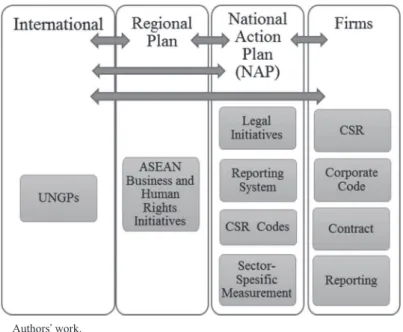
Third, NAPs as centralized policy documents allow governments to articulate to stakeholders a coherent policy position even over-complex, broad-ranging issues like business and human rights. It connects actors from firm level to international level (see Figure 7).
As was mentioned in the previous part, that ASEAN countries are diverse in terms of the political and cultural background. The level of the rule of law, governance capacities are different among these countries. Endorsing UNGPs with NPAs offers shared vision and guidebook for member states for further collaboration. States also can view NAPs development processes as promising avenues for building awareness and capacity among all stakeholder groups and for developing multi-stakeholder approaches that are inclusive, transparent, and designed to ensure opportunities for stakeholders to provide feedback from the outset.
In ASEAN, at the regional level, regional organizations of ASEAN have shown some level of support to the UNGPs and its NAPs. For instance, ASEAN s Intergovernmental Commission on Human Rights (AICHR) has undertaken a thematic study on CSR and Human Rights, which reviews national measures concerning the UNGPs.71) And during the annual UN Forum on Business and Human Rights in 2013, representatives of the
ASEAN Intergovernmental Commission on Human Rights and the Inter-American Commission on Human Rights, as well as the Council of Europe, expressed support for national implementation of the UNGPs and the role of regional organizations in encouraging such implementation through measures at the regional level.72)
68) The Danish Institution for Human Rights Project, A Toolkit for the Development, Implementation, and Review of State Commitments to Business and Human Rights Frameworks , (2014)
http://icar.ngo/wp-content/uploads/2014/06/DIHR-ICAR-National-Action-Plans-NAPs-Report3.pdf 69) Ibid., 28.
70) Ibid., 26.
71) See Workshop on CSR and Human Rights in ASEAN: Outcomes of the AICHR Thematic Study, AICHR, http:// aichr.org/press-release/workshop-on-csr-and-human-rights-in-asean-outcomes-of-the-aichr-thematic-study/ Accessed June 17, 2016.
72) Video: Towards Global Implementation of the UN Guiding Principles - Panel Discussion, Forum on Business and Human Rights 2013, UN WEB TV (Dec. 3, 2013), http://webtv.un.org/meetings-events/watch/ towards-global-implementation-of-the-un-guiding-principles-panel-discussion-forum-on-business-and-human-rights-2013/2887919959001.
121 Business and Human Rights in ASEAN (Aliya Alimu)
However, at the national level, countries of ASEAN have been slow to implement the UNGPs. Although countries like Malaysia, Indonesia and the Philippines have expressed that they might embark on developing National Action Plan (NAP) to implement the GPs, however, no country in the region have yet developed an NAP.
Conclusion
In recent years, the voluntary nature of multi-stakeholders initiated corporate norms has been subject to criticisms. Opponents of this approach claim that purely self-regulatory institution and their reliance on legitimacy for enforcement are ineffective in addressing and regulating business-related human rights issues. Against all those negative perspectives on multi-stakeholder initiated corporate norms, this paper attempted to explore some of the positive roles of this instrument.
This paper first assessed the condition of business and human rights in the ASEAN region and speculated human right risky environment in some of the ASEAN states by analyzing the features of FDI. Then, it looked at the factors that can impede the improvement of business and human rights conditions in this region. Further, it analyzed some of the positive roles of the multi-stakeholder initiated norms and demonstrated how these instruments could reflect the interests of various types of actors.
This study found that ASEAN states have fairly adequate legal frameworks governing the core areas of business and human rights although some gaps exist among these states. However, the key challenge is the absence of valid governance capacity that can effectively implement and enforce existing norms and laws. Therefore, this study posits that capacity building and awareness-rising through the regional-state-civil society collaboration can play a vital role in improving human rights conditions in the states of ASEAN. In
22
accountable for their policy and institutions.
Third, NAPs as centralized policy documents allow governments to articulate to
stakeholders a coherent policy position even over-comple , broad-ranging issues like
business and human rights. It connects actors from firm level to international level (see
Figure 7).
Figure 7. NGPs Implementation Process
Authors work.
As was mentioned in the previous part, that ASEAN countries are diverse in
terms of the political and cultural background. The level of the rule of law, governance
capacities are different among these countries. Endorsing NGPs with NPAs offers
shared vision and guidebook for member states for further collaboration. States also can
view NAPs development processes as promising avenues for building awareness and
capacity among all stakeholder groups and for developing multi-stakeholder approaches
that are inclusive, transparent, and designed to ensure opportunities for stakeholders to
provide feedback from the outset.
In ASEAN, at the regional level, regional organizations of ASEAN have shown some
level of support to the NGPs and its NAPs. For instance, ASEAN s Intergovernmental
Commission on Human Rights (AICHR) has undertaken a thematic study on CSR and
Human Rights, which reviews national measures concerning the NGPs.
71And during
the annual N Forum on Business and Human Rights in 2013, representatives of the
71
See Workshop on CSR and Human Rights in ASEAN: utcomes of the AICHR Thematic Study,
AICHR,
http: aichr.org press-release
workshop-on-csr-and-human-rights-in-asean-outcomes-of-the-aichr-thematic-study
Accessed une 17, 2016.
Figure 7 UNGPs Implementation Process
Authors work.
this context, the multi-stakeholder initiated corporate norms have the potentiality of serving as a network governance mechanism by which various stakeholders govern the actions of the corporations in collaboration and can catalyze states to improve their regulatory capacities in the ASEAN region.