ミュージアム鑑賞空間に関するデジタル技術を活用した
多層化モデル構築の試み
要旨
本稿は、デジタル技術を活用した、ミュージアムに おける鑑賞空間の多層化モデル構築のために実施した 二つの調査開発プロジェクトに関わる研究報告である。 調査開発プロジェクトのひとつは、立命館大学国際 平和ミュージアム春季展での展示デザインに携わった 開発プロジェクト、もうひとつは、江戸時代の長崎の出 島を案内する、多感覚・身体性に訴えるインタラクティ ビティを組み込み、ゲーム方法論的な文脈からアトラク ティブな鑑賞法が可能なバーチャルリアリティ(Virtual
Reality;
VR)システムを構築するための準備作業に関 わる調査プロジェクトである。キーワード
文化財復元、バーチャルリアリティ、ミクストリア リティ、テレビゲーム、マルティモーダルインタラク ションKeywords
Restoration of Cultural Heritage, Virtual Reality,
Mixed Reality, Video game, Multimodal interaction
1.立命館大学国際平和ミュージアムにおける
展示実践に関わる研究報告
まず、ミュージアム鑑賞空間のモデル構築のための 課題をより精緻に考察するために、仮想型鑑賞空間の モデル設計と実践に関して、立命館大学国際平和ミュー ジアムにおける2012年度春季特別展示に展示アドヴァ イザーとして参加することを通しておこなった実践的 調査について報告する。 立命館大学国際平和ミュージアムにおける春季特別 展示は、東日本大震災に起因する原発事故を受け、主 に中高生を対象に、放射能・原子力に対する正しい理 解を深め、未来のエネルギーのあり方を考えることを テーマとしている。本研究プロジェクトが、出島プロ ジェクトの準備作業も兼ねた、デジタル技術やゲーム 型誘導法を取り入れた展示開発は、パネルや資料展示 といった従来型の静的かつ一方向性の情報提示に加え て、インタラクティブ映像技術の援用や遊戯的鑑賞設 計の導入により、見学者が興味を持って積極的に学ぶ モチベーションを喚起し、印象深く記憶に残る展示方 法を検討・実現することである。 同展示に関わるスタッフとミーティングを5回にわた り開催し、「インタラクティブ映像装置の制作」と「展 示鑑賞の周遊的体験デザインの制作」の二つのプロジェ クトを実施することを決定した。詳細は以下のとおりで ある。 Aプロジェクト:インタラクティブ映像装置の制作 インタラクティブ映像装置の制作に関して、本年度 の成果として、①「原子力発電所のVR
体験」:実写とCG
をリアルタイムで精度よく合成提示するミクストリ アリティ(Mixed Reality; MR,
複合現実感)機能を用 いたバーチャル原子力発電所体験システムと、②「見 えない放射能を見る・検出する体験」:赤外線による放 射能の擬似的な検出機能を付加したインタラクティブ 展示パネルシステムの二つの展示システム機能の設計 と試作を行った。 ①原発体験VR
システムでは、システムの設計とコン テンツのデザインをおこない、開発をおこなった。本 システムでの体験シナリオとしては、見学者はHMD
(Head-Mounted Display;
頭部装着型表示装置)を装着 し、日本地図全体の俯瞰からの福島原発上空へのアプ ローチを衛星写真にて体験する。福島原発上空からは、北 野 圭 介
(立命館大学映像学部教授)大 島 登 志 一
(立命館大学映像学部教授)渡 辺 修 司
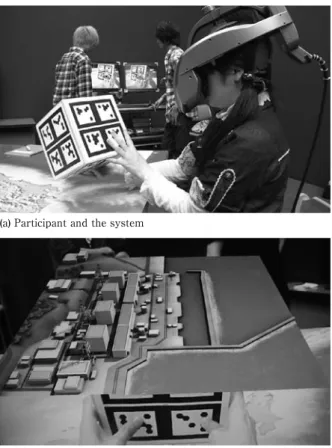
(立命館大学映像学部准教授)俯瞰する2次元的マップからより低空に回り込むと同時 に、3次元のバーチャル原発モデルの立体表示に遷移し、 原子力発電所敷地全体のスケールで海や建屋の位置関 係を直感的に把握できる。また、建屋一つのスケールへ と行き来することもできる仕様とした。また建屋スケー ルでの体験では、建屋から炉心内部までの複数レイヤ の切り替えを行い、その構造を詳しく見ることができる。 図1に体験の様子と、体験者視点の映像を示す。 (a) 体験の様子 図1 バーチャル原発ジオラマ (b) 主観視点映像 ②今回試作した、赤外線による放射能の擬似的な検 出機能を付加したインタラクティブ展示パネルシステム は、展示パネル内部に埋め込んだ赤外線発光ダイオー ドを放射線源に見立て、ガイガーカウンターを模擬した 電子装置によって、放射性物質がどこにたまりやすいの か、線源からの距離と放射強度との関係、などをリアリ ティ高く理解することができるものである。放射線の特 質を全く無害な赤外線で模擬することによって、安全な 体験型展示を実現した。また、携帯カメラあるいは赤 外線カメラを利用することによって、赤外線の発光源を 視覚的に確認することもできる。肉眼では見ることので きない赤外線を使いつつもそれを観察する仕組みを用 意する展示によって、目に見えない放射線への漠然とし た恐怖に対して、赤外線の疑似体験を通じて、正しい 知識と併せて冷静に考えることを伝えることができると 期待している。図2にバーチャル・ガイガーカウンター の体験の様子を示す。 (a) 体験の様子 図2 バーチャル・ガイガーカウンター (b) グループでの体験 また、以上の事例開発の取組では、映像研究科の院 生も制作に関わり、領域横断かつ研究の教育への還元 と循環する仕組みを試行している。事例開発を通じて 知見をバーチャル出島体験へと反映し、システムの試作 に取り組んでいく。 Bプロジェクト:展示鑑賞の周遊的体験デザイン 「コロがシティ」の制作 今回、鑑賞体験の形態に、遊戯的な方法、とりわけゲー ミフィケーションとよばれるデジタルゲームから展開し た参加者の誘導方法の観点を取り入れることを提案す る。これは従来のシリアスゲーム、
e-Learning
の手法で 行われる、デジタルゲームのインターフェースのデジタ ル上の応用ではなく、ゲームデザインそのものの現実世 界への応用という領域である。そのデザインの注視点 は、「根源的な心の高揚であり、壁を乗り越えたい、戦 いに勝ちたい、危機に打ち勝ちたいという挑戦への欲 求である。」(ジェイン・マクゴニガル『幸せな未来はゲー ムが創る』pp.
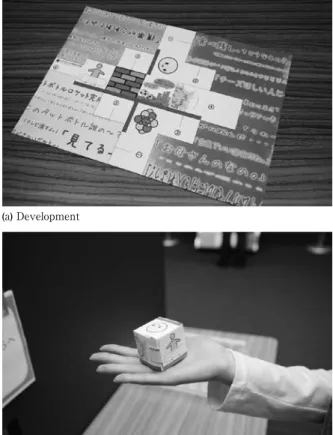
59早川書房2011) 特に今回の展示においては、短時間ながらも現実世 界のゲームデザインとして、以下の3点の試みを計画した。すなわち、①紙の切り抜くという行為による感情移 入対象のデザイン、②サイコロを利用した課題フィール ドの制作、③サイコロの切り抜きを利用した廃棄のデザ インの試みである。 詳細は以下のとおりである。 ①紙の切り抜くという行為による感情移入対象のデザイン 今回の国際平和ミュージアムに訪れる来館者の多く が、修学旅行生の小中学生であるという事が、過去の データからわかっている。 そのため、今回のプレイヤーとみなす者は、同一の年 齢かつ親しい者同士が、班活動、または個々の友人グ ループで行動する事が想定される。 彼らをゲーム的な手法で展示体験してもらうために、 まず自己投影を行う対象を作る必要がある。特に感情 移入を行わせるための儀式的行為として、紙面の展開 図から切り抜きを行い、正六面体を制作させる行為を行 わせる事とした。 その後、このサイコロ型のプレイヤーキャラクターを 利用して展示内に点在させた課題フィールドにおいて利 用させる事でさらなる愛着を与えさせる。(図3) (a) サイコロの展開図 図3 紙の切り抜くという行為による感情移入対象の デザイン (b) 完成したサイコロ ②サイコロを利用した課題フィールドの制作 プレイヤーキャラクターたるサイコロを利用し、展示 パネルに記載された内容に即して以下の
A
~C
の展示 を行う予定である。A
:最大4人まで参加可能な被爆防護を行うための 隔壁ゲーム展示B
:最大4人まで参加可能な、中性子とウランによ る核分裂の体感展示C
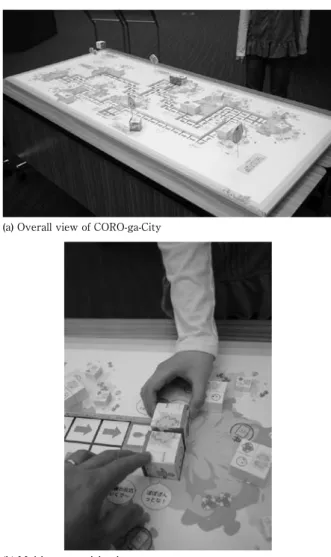
:持ち帰ったサイコロを再利用し、家庭で展示内 容を伝搬する事を期待したリーフレット盤 それぞれ、サイコロの使い方が異なるものであり、ユ ニークな特徴をもった展示、およびリーフレットとなる。 図4 サイコロを利用した課題フィールドの制作 (a) 「コロがシティ」 全体図 (b) 「コロがシティ」複数での体験 ③サイコロの切り抜きを利用した廃棄のデザイン プレイヤーキャラクターたるサイコロは、展示の入場 脇に設けられた制作用のテーブル上で行う事になるが、 当然、そのとき必ず半端な余り紙が出る事になる。 この回収用としての投入口が設置されており、余り紙 はそこで回収される。 鑑賞者は、展示全体を回遊し、すべての展示パネル を閲覧すると共に、自ら作ったサイコロを利用しながら 遊戯展示を体験していく。会場全体の動線は、最終的な到達地点として出口脇 に到達するが、そこは、先ほどのポストの背面にまわる ように設計されている。 ポストの背面は、余り紙の投函時には見えなかった が、地球の断面図が描かれており、鑑賞者自身の廃棄 した紙自体が、地中深くに埋められた、廃棄物を表す一 つの展示として機能するようになっている。 自ら作り出したサイコロの方もまた、遊戯展示の中で は、自身の身体や家族の生活、富やエネルギーをもたら すものと象徴されており、展示全体として“廃棄とその 代価”の当事者として、参加していた事に気が付く事を 狙いとしている。 図5 サイコロの切り抜きを利用した廃棄のデザイン (a) 切り抜きの投入口 (b) 展示終了後の積層 これらの展示においては、展示の主目的となるパネル 展示を邪魔しない程度の適度な難易度を設定し、高揚 感を得られるようにデザインされており、詳細な設計や テストプレイを映像学部渡辺・安倍・馬場ゼミにて行っ ている。
2.「出島」の仮想化へ向けてのプロジェクト
まず研究の背景から述べたい。 デジタル技術により映像表現は多彩な展開を示して きているが、近年、ヴィジュアリゼーションおよび情報 美学と呼ばれる領域において、科学データのインパクト のある可視化、消失文化財の復元、都市計画のモデル 構築などがデジタル技術を用いた映像表現の新たな可 能性の地平として世界的な規模で活発化してきている。 関連する事例としては、インカ文明の遺跡「マチュピ チュ」をデジタルモデルとして再現し、国立科学博物館 で開催の「インカ帝国展」において大型のスクリーンで インタラクティブに視点を移動させながら立体表示した VR映像作品『マチュピチュ~太陽の聖地』(凸版印刷 株式会社,
2012)などがある。 本プロジェクトは、そうした領域における近年の蓄積 を土台に、さらにインタラクションの技術を組み込み参 加探索型の回路を設置するとともに、鎖国下にあった 江戸期の日本において、西洋と東洋の人々が個別の場 面で具体的に出会い交流する国際交流の唯一の拠点で あった人工島「出島」の歴史的特殊性に着目し、当時の 人々が体験したであろう言語的な課題や、交渉的な課 題に対しての工夫を、短時間で体験できるよう抽象化を 施すといったゲームデザインを導入する。それを踏まえ て立体的かつ動態的な世界観の奥行きを体験できるよ う、バーチャルリアリティ(Virtual Reality
、以下VRと 略す)システムをつくることを目指す。 既存のデジタルゲーム作品では、同時代を描いたも のに『大航海時代Online
』(コーエーテクモゲームス 2005)、『Patrician
Ⅳ』(Kalypso Media
2010)などがあ げられるが、経済圏の拡大を主眼とした海戦や貿易を プレイ対象とするため、海路を自由に移動できる可能な 交易人の視点や、町全体を俯瞰する事が可能な総督と しての視点で描かれる事になる。また、先に挙げたよう な従来型のVR映像作品では、主に3次元空間への視 覚的没入をその体験の核として実現することに注力さ れる。 一方、本プロジェクトでは、出島の空間的再現と没入 体験を実現するのみならず、その仮想環境を基盤とし た鎖国という外世界との境界面を有する閉鎖空間において、人の活動・交流、社会的・歴史的体験のインタ ラクティブなナラティブを主観的に実現しようとする点 でユニークである。 長崎出島に関わる実施調査およびそれに応じた研究 会を通じて、VR型の重層的構造とゲーム的ストーリー 的展開の双方を視野に収めた準備モデルを作成した。 より具体的には、以下の視点からの「出島」の仮想化 の作業が必要であるとされた。すなわち、 ・国際交流をいかに映像を通したかたちで叙述モデ ル化し映像化するかという構想化の水準 ・それらに対応した、インタラクション技術の設計と VRシステムの開発の水準 ・仮想環境上に実現する動態的世界観の構築と高度 RPG型のコンテキストの水準 である。 これに対応させながら、以下、(1)仮想体験上のス ケール設定、(2)システム開発上の準備調査と考察、(3) デバイスに依存しない体験環境の構築の可能性、の三 つの視点からの考察を記しておきたい。ちなみに、これ らの観点は、相互に関連していることはあきらかである が、現段階では、それらを総合する包括的な観点をあ らかじめつくることは控え、よりボトムアップ型の調査 と議論をすすめながら構成していくことが参加メンバー において共有されている。
(1)出島をめぐる外部環境の区分けと
それに応じた仮想体験上のスケール設定
デジタル技術環境においては、映画などの上映時間 の単線性に拘束される様態、つまり、リニア型物語構造 と異なって、ノンリニア型ストーリー様態が可能である。 もう少しいえば、<事件→解消>といった回復型、あ るいは<問題→乗越え>といった循環型、あるいはさ らに平衡回復型/均衡達成型といった多岐にわたるプ ロットが相互に作用しながら展開することが可能な表現 媒体のプラットフォームを可能とするということである。 だが、これは同時に、ストーリーが複線的に並行し、か つかるダイナミックに展開するための遷移状態のスケー ル設定を必要とすることを意味する。これを受け、本調 査研究プロジェクトでは、出島という、世界のなかで多 層的なストーリーを展開していると考えうる場を、いく つかのスケール(遷移状態の大カテゴリー)を区分し、 より開発上接近しやすいかたちに整備することとした。 具体的には、出島に関わる歴史研究を中心に収集し た文献資料出島をとりまく環境は、①出島と往時の国際 関係上の環境との応答、②日本における出島の外部と の交通、③出島の内部世界、の三つの水準がかさなり あるものであることが確認された。 これを受け、たとえば、以下のような区分による体験 スケールの分類と関連する項目が可能であるとした。 〔スケール1〕 大航海時代における海外との交流 1-a
)ポルトガル→オランダをはじめとした貿易(バタビアの東インド会社の拠点との交流含む → 使用人) 1
-b
)キリスト教の伝来(ザビエル、島原の乱、隠れ キリシタン) 1-c
)ナポレオン戦争 1-d
)フェートン号事件/シーボルト事件 1-e
)ケンペル、シーボルトなどの日本国紹介 〔スケール2〕 日本国内 2-a
)長崎奉行 2-b
)幕府参拝 2-c
)唐人屋敷 2-d
)遊女と僧との交流 〔スケール3〕 出島内 3-a
)商取引 3-b
)祭り:交代の宴、和欄冬至、バドミントン、ビリ ヤード 3-c
)江戸への献上品 3-d
)人物(乙名およびそのほかの役人/商館長(カ ピタン)/船長/使用人/遊女)(2)システム開発上の準備調査と考察
これは、<没入型バーチャル体験と複合現実型実地 仮想経験の併用>の可能性としてまとめておくことがで きる。 具体的には、まず、視野全体をCG
によるバーチャル 映像で覆う「没入型バーチャル体験」の機能によって、 時代の変遷を任意速度で体験し得る時間軸方向の自由 度と、他国との往来を渡航者自身あるいは超高度から地 球を俯瞰するなどの空間的視点の自由度を最大限に実 現することができる。 次に、CG
と現実風景のシームレスな融合映像を主観 視点で体験する「複合現実型実地仮想体験」の機能に よって、現実の出島地区において、実際に復元された建築物を観察・体験すると同時に、未復元あるいは復元 不可能な周辺環境や建築物を
CG
で同時に合成体験する ことが可能となると思われる。 こうしたVR
システム構築上の技術要素およびその要 件として、一般的に下記のように分類しておくことがで きる。A
)映像生成技術:リアルタイム性、立体映像生成 機能、広視野表示実現のための複数表示面機能、 高度なリアリティB
)映像表示技術:没入的映像表示機能、立体表示 機能、広視野表示機能C
)対話操作技術:三次元空間とのユーザインタ フェースD
)ソフトウェア開発環境技術:VR
システム用各種 インタフェースに対応し得るインタラクティブ 3DCG
コンテンツ開発のためのプログラミング環 境や統合開発環境E
)データ管理・共有技術:データベース、サーバ、 インターネットなどデータ通信技術 これを受け、次のような調査と検討をおこなった。 現段階では、バーチャル出島体験の具体的な内容に ついては検討を進めている途上であることから、本年 度は特定のシステム構成は想定せず、まず幅広くその 可能性を探るとして、コンテンツ開発・運用のプラッ トフォームとなるグラフィック機能を強化した高機能な コンピュータであるグラフィック・ワークステーション (Graphic Workstation; GWS
)を構成するCPU
やビデオ カードなどをはじめ、立体表示装置・ソフトウェア開発 環境の技術・製品動向調査をおこなうこととした。 技術・製品動向調査として、ハードウェアとソフトウェ アに跨って、①映像生成技術、②対話操作技術、③ソ フトウェア開発環境技術、④映像表示技術に関して調 査した。本調査は、インターネットなどの一般的な製品 調査だけでなく、複数の国内専門商社およびバーチャ ルリアリティ・ソリューションベンダーの技術担当者へ のインタビューにて実施した。その結果、2000年代半 ば頃であれば、複数台のGWS
をネットワークで接続し たうえでビデオカードの映像を同期させた特殊な構成で なければできなかった複数画面の立体表示が昨今ではCPU
のマルチコア化やマルチスレッド化の進展、およ びGPU
のマルチビデオカード構成の実現などにより、1 台のGWS
のみでシリンドリカルスクリーン表示やCAVE
(部屋の4面、床・前方・左右に立体映像が提示される 装置)の表示環境が実現できる状況になっている。また、 立体表示プロジェクタなども低価格かつ高性能な製品 が出てきており、VR
システムの構築について自由度が 大きくなっている。総じて、今後試験的なシステムを構 築する上で必要とされる技術的なサーベイを行うことが できた。 また、さらに、上記サーベイを踏まえて、設備を共有 し得る関連研究プロジェクトと連動させ、先行して試験 的なシステム・プラットフォームの検討を行い、そうし たプラットフォームとなりうるシステムの仕様設計およ びその試験的構築を行った。本システムは、以降、「バー チャルリアリティ実験システム(VR
実験システム)」と 表記する。仕様設計において重視した点は、コンピュー タグラフィックス(CG
)の描画能力やCPU
性能などGWS
としての基本性能の他に、設置場所の自由度を担 保し得るある程度のポータビリティである。特にこの点 について説明する。前記調査の知見によれば、1台のPC
で複数スクリーンへの立体映像提示が可能な構成を 実現できることが分かり、大きなラックマウントのPC
ク ラスタでは難しい設置場所の移設の可能性が高まった。 本研究の企図として、VR
の様々な利用を目指すもので ある。この観点から検討を行った結果、気軽に持ち歩 けるほどのコンパクトさは不要であるにしても、例えば、 ミュージアムや博物館施設などの企画展示やイベントな ど、体験者がわざわざバーチャルリアリティ施設に訪れ るのではなく、逆に、より応用ドメインのフィールドに 近いところの施設などに設置して、ある期間展示できる ような可搬性のあるシステムスペックが必要であるとい う結論に達した。 10年ほども以前であれば規模に関わらず数千万は要 したVR
システムだが、前記調査の知見に基づき、VR
ソリューション開発企業(株式会社ソリッドレイ研究所) ともディスカッションを重ね、①映像生成性能、②立体 表示機能、③広視野表示機能、④複数面描画機能、⑤ 設置可搬性、⑥ソフトウェア開発環境の全てを実用上 高いレベルで満たし得る仕様設計を実現し、60インチ3 面の可搬型スクリーンシステムを含めても500万円以内 で実現可能であると試算できた。本年度の成果として は、上記VR
実験システム全体の仕様設計と、試験的構 築として最低限実際にVR
実験システムとして活用しう る最小単位の核としてグラフィック・ワークステーショ ン本体を導入した。GWS
の基本仕様としては、CPU
はIntel
社製6コアのXeon
プロセッサ、GPU
はNVIDIA
社製Quadro
5000を採 用している。GPU
は同社のSLI
という機能によって複数 毎のビデオカードに拡張することが可能であり、今回 の導入は1枚構成で2面までだが、2枚構成への拡張で4面の立体表示が可能である。4面構成であれば部屋全体 がスクリーンとなる
CAVE
システムの構築が可能であり、 多様な表示環境に対応し得る基礎システムを設計でき た。立体表示機能については、①液晶シャッタメガネ による立体視と②偏光メガネによる立体視の主に二種 類の選択があるが、偏光メガネによる方式では「シル バースクリーン」という特殊なスクリーンが必要であっ て、前述のようにいわゆる出張展示の柔軟性に鑑みれ ば、スクリーン材質の自由度が高い液晶シャッタメガネ 方式を想定することとした。また液晶シャッタメガネ方 式を採用するならば、建築物や実際の様々な物体に映 像を重畳して多様な表現を実現する「プロジェクション・ マッピング」という映像表現手法によっても立体視を実 現し得る。出島プロジェクトにおいて、①複合現実型体 験、②没入型バーチャル体験、③プロジェクション・マッ ピングによる現実空間の投影、という3種類のVR
体験 を本システムによって試行することができる仕様とした。(3)デバイスに依存しない体験環境の構築の
可能性
一方、本プロジェクトをデジタルゲームとしてみた場 合、最終的な成果物としては、VR
システムとの融合を 目標とするが、その途中経過の段階においては、可能な 限りインターネットを通じての公開やテストプレイを通 じた、スパイラルモデル型の開発を行う事で、プレイヤー と世界の均衡性を、より確かなものとして構築できる事 を目指すべきである。 そのため、デバイスに依存しない普及したメディアや エンジン、および特殊なデバイスを利用しないものでの 開発が望まれる。最終的には、
Adobe Flash
やUnity
などのブラウザで のプラグインで動作するものを選択した。これにより、Windows
やApple
といったOSへの依存、およびタブ レット型、セルラー型、および従来のPC型などのデバ イス形状やIO
の変化などを仮想化する形での制作が可 能となる。また、実際に現段階において、複数のOSで、Flash
、Unity
の両開発環境で制作されたソフトに対して 問題なくブラウザ上からプレイできる事を確認している。3.今後の調査への課題整理
上記の調査、調査結果の報告、準備モデル構築とそ の実践を踏まえた上で、仮想化モデルの構築に向けた、 次のステップとしての課題整理もおこなった。立命館国際平和ミュージアムにおける展示実
践に関する課題整理
Aプロジェクト:インタラクティブ映像装置の制作 ①「バーチャル原発ジオラマ」 通常のCG
による映像展示では、映像世界と鑑賞者 との間に画面の壁があり、一方、実物の模型展示でも 多くの場合、ガラスケースに封じられて手では触れら れない。これに対し、ミクストリアリティによれば、 現実世界と共にバーチャル空間をそれに重畳して自由 な主観視点体験が可能である上に、手を使った操作が 可能である。 その効果として期待されることは、ジオラマ模型以 上のリアリティを体感させるコンテンツデザインも可 能ではないかということである。コンテンツ変更が容 易であることやその場で観察対象を瞬時に切り替えた り、連続的なスケール変更のような機能により、展示 物空間への没入性向上や来館モチベーションの向上を 促すことができる。 一方、課題としては、以下のものがあげられる。第一 に、コスト上の問題として、機材の初期導入コストおよ び運用スタッフの必要性がある。これに付随して、機材 が未だ一般的なものではないことに起因し、使用方法の 教示と装着などの補助が必要であること、また、高額な 精密機械であるために放置して自由に利用するという運 用スタイルでは故障が頻発する懸念があることなどへも つながる。第二に、展示自体としては、バーチャルな展 示である点から、インスタレーションや造形にも配慮し て興味を持って体験する行為へと導入する演出上の工 夫が求められることになることも課題であろう。 ②「バーチャル・ガイガーカウンター」 目に見えぬ放射能を安全に代替する仕組みを通して 放射線に関する理解を深めることを企図したデザインは、 従来型パネル展示では一方的な情報提示にくらべ、パ ネル展示にインタラクティブな体験の要素を付加し、学 習のモチベーションと効果を高めることに成功したと思 われる。それは、体験者からのアンケートからも裏付け られるものであった。 課題としては、こうした「インタラクティブ・パネル 展示」は、当然のことながら、どのような形態で実現し 得るかは、展示しようとする情報の内容や展示企画に 大きく依存する。本展示では、ガイガーカウンターとい う手に持つ形のデバイスが実際上の対象として存在す る内容であったので、それを代替するデバイスを持つ体 験スタイルが適していたが、パネル鑑賞に関係するさまざまなアクションの精査と同定が必要となる。 Bプロジェクト:展示鑑賞の周遊的体験デザイン「コロ がシティ」の制作 課題としては、そもそもの出発点として、ゲームデザ インと、ミュージアムにおける展示内容のマッチングに 関わる問題がある。本来、ゲームデザインとは、デジタ ルゲームの設計に用いられ、プレイヤーにポジティブな 心的状況を作り出し質の高い没入体験を与える事を期 待するものである。他方で、この主たるデザイン技法を 博物館の展示に利用することは一般的にいって容易で はない。たとえば、これまでも、博物館でのデジタルゲー ムの応用事例には、大阪海遊館での「海遊館ニンテン ドー
DS
ガイド」(2010年)や、科学未来館常設展示「ア ナグラのうた」(2011年)などがあるとはいえ、それら は、親しみ深いゲームデバイスの活用や、個々の展示を 統括するナラティブの導入としての利用に限定されてい たといえるだろう。 今回の特別展では、東日本大震災以降における放射 能展示という事もあり、主催者側の視座は当然ながら重 要なメッセージとなるため、“ゲーム”や“遊び”とい う表現技法が、不必要な連想や誤解を招く事も十分に 考えられるだろうし、没入体験が、展示全体の滞在時 間の偏重を生み、展示全体の導線を破壊する事も危惧 される。 ここでは、こうした課題については、以下のような工 夫が一定程度の効果をあげたのではないかと推察して いるが、検証も含めて、今後の課題である。従来、開 発現場においては、プレイ参加者(2eyes
)のみならず、 第三の視点(+
2eyes
)へ与えるインターフェースデザイ ンが想定されていることが多く、その点に方法論的に着 目して、「4eyes Interface
」(以下4eyes
)として考えうる ような手法を工夫としておこなった。体験を重層的に展 示空間内に拡大していくことを狙ったのである。出島仮想化のモデル構築に関する課題整理
上で触れたように、現段階では、VR型の重層的構 造の観点とゲーム的物語展開の観点のそれぞれに一定 程度分けた上で調査研究をおこなっていることを踏まえ、 以下のような整理をおこなった。 まず、VR型の重層的構造の観点からの課題整理は 以下のとおりである。 出島では、現在国の復元プロジェクトにおいて形を 失った出島全体の景観とその建物を長期的な計画で復 元すべく、発掘調査と周囲の土地の買い上げなども含 む大規模な取り組みを行っている。しかしながら、河川 幅の拡張によって失われた部分の回復はほぼ不可能で あり、この点ミクストリアリティ機能の実装により仮想 的に復元することが効果的と考えられる。また、出島の 建築物は、1636年から1859年に至るまで、様々な変遷 を経ており、建築物の復元も記録が残されている江戸 時代末期の風景を想定している。すなわち、このような 状況での本VR
システムの果たす役割は、その時代の移 り変わりを任意に連続的に体験し得る機能を提供するこ とである。またさらに、そうした3次元仮想空間体験の みならず、出島を中心とした多様な国際的交流、すなわ ち人々の往来、貿易、科学や宗教の伝来など、様々なデー タ・ビジュアリゼーションの機能も実現することの重要 性もあきらかとなった。パイロット版として構想する仕 様の例を下記に示す。 ①物品・人の往来、文化の往来についての基本的デー タベースを構築する。 ②複合現実型体験機能により、現実空間を補完する バーチャル映像を重畳観察する。 ③没入型バーチャル体験機能により、空間的・時間 的な制約を越える体験を実現する。 ④マルチモーダル・ユーザインタフェース機能により、 多感覚に訴えるインタラクション これらを可視化しを直感的にわかりやすく伝えることを 通じて、出島の仮想体験はより充実したものになると思 われる。 次に、ゲーム的物語展開の観点からの課題整理は以 下のとおりである。 今年度の調査においてはデジタルゲーム的な観点か ら、物語を語る上でのストーリーテラーの視点、および それを客観的に映し出すカメラの視点という2つの視点 を決定するための調査をおこない、次のような論点を整 理した。 ①ストーリーテラーの視点 出島という極めて限られた空間の中においても、そ こに関係する者は、日本とオランダの人々だけではなく、 周辺としてイギリスや中国、そしてその航路の中継地点 となる各国の人々の関係が関係する。 特に出島を訪れての調査においては、当初は想定も していなかったインドネシアからの連れて来られた使用 人が、バドミントンやビリヤードなどを楽しんでいた歴 史が明らかになっている。 おそらく彼らは、ある日突然に、見たこともない日本 という国に連れてこられ、そこで必ずしも苦しい生活だけではない日々をすごしたに違いない。 彼ら第3の視点を主人公(つまり、プレイヤーキャラ クター)として利用する事は、出島を訪れる現代人と同 じように、異世界への来訪者の視点として有用に機能 する事が期待できる。 また、言語としても、彼らから聞こえた、日本語やオ ランダ語という、外国語を“わからないなりの言葉”と して表現する事で、彼ら使用人から見た出島を描き出す 事が期待できる。 ②カメラの視点 調査において、特に多くの浮世絵に残された出島の 様子を見る中で、この浮世絵による出島の抽象化手法 が、特にカメラの取り回しにおいて多いに意味のある ものとなると考察された。浮世絵を代表する日本画は、
Ortho
(ギリシャ語で正しい,ひずみの無い)視点によ る非パース型の視点である。これは、我々の視覚系から 援用するならば、極めて遠方からズームしたような表現 である。 この表現手法は、現代のデジタルゲーム、特に「スー パーマリオブラザーズ」(任天堂1985)に代表されるよ うな2D
ゲーム時代にも通じるものがあるといえるだろう。 また、浮世絵で表現される建築物、は屋根や天井を ぶち抜いた仮想的な吹き抜け表現となっており、その中 で広げられているドラマを、広い空間の中を見る者に瞬 時に理解させる事が可能となる。 以上の点から出島をリアルに再現するのではなく、「浮 世絵に描かれた出島」のヴィジュアライズという方向性 を検討する事でカメラの視点、およびその世界の抽象 化技法を決定する。参考文献
長崎出島関連 ・浅田實『東インド会社 巨大商業資本の盛衰』(講談社現代新書、 1989年) ・片桐一男『開かれた鎖国 長崎出島の人・物・情報』(講談社現 代新書、1997年) ・片桐一男『平成蘭学事始 江戸・長崎の日蘭交流史話』(智書房、 2004年) ・志岐隆重『長崎出島四大事件 長崎奉行との緊迫の対決』(長 崎新聞社、2011年) ・長崎市教育委員会編集『出島』(長崎教育委員会発行、平成7年) ・長崎市広報広聴課企画・編集『恋も仕事も事件もあった 出島 生活』(長崎市発行、平成13年) ・永積昭『オランダ東インド会社』(講談社学術文庫、2000年) ・波多野純建築設計室・株好き会社文化財保存計画協会編集『国 指定史跡「出島和蘭商館跡」よみがえる出島オランダ商館』(長 崎市発行、2001年) ・松方冬子『オランダ風説書 「鎖国」日本に語られた「世界」』(中 公新書、2010年) ・森岡美子『世界史の中の出島 日欧通交史上長崎の果たした役 割』(長崎文献社、2005年) VR関連Craig, A., Sherman, W. and Will, J. (2009). Developing Virtual
Reality Applications: Foundations of Ef fective Design [Morgan
Kaufmann]
Sherman, W. and Craig, A. (2002). Understanding Virtual Reality:
Interface, Application, and Design [Morgan Kaufmann]
ゲーム関連 文献 ・ジェイン・マクゴニガル『幸せな未来はゲームが創る』(早川書 房2011年) 作品 ・『大航海時代Online』(コーエーテクモゲームス、2005) ・『PatricianⅣ』(Kalypso Media、2010)
・『スーパーマリオブラザーズ』(任天堂、1985)
謝辞
On the structuring of a model for multiplying exhibition
experience through utilizing digital technologies
Abstract:
This paper discusses a research repor t for str ucturing a model for multiplying exhibition experience through utilizing digital technologies such as Virtual Reality(VR) and game design creation based on two field research projects.
One of the projects is about achievements and findings of exhibition practice conducted in spring 2012 at Kyoto Museum for World Peace, Ritsumeikan University. The other is about preparatory stages of a project of which the main purpose is to structure a game-inspired Virtual Reality system in which one could experience a digital simulation of Nagasaki’s
Dejima in the Edo Period in Japan through multi-modal
interactivity.
Keywords:
Cultural heritage restoration, Virtual Reality, Mixed Reality, Digital games, Multimodal interaction.
1. Research Report on the project of
Exhibiting Practice Space in Kyoto Museum
for World Peace, Ritsumeikan University
For examining furthermore the first stage of the practical exhibiting concept, practical surveying and research was conducted through participation as exhibition advisers in the spring 2012 exhibition at Kyoto Museum for World Peace, Ritsumeikan University.
The theme of this exhibition was based on the
future of energy and was primarily aimed at teenagers to deepen their understanding of nuclear power and radioactivity in the wake of the nuclear accidents triggered by the Great East Japan Ear thquake. Ser ving as preparator y work for the Dejima Project by mobilizing digital technology and video-game-inspired induction methodology into exhibit development, through the incorporation of interactive visual technology with playful design in addition to conventional one-way information presentation, such as through the use of panels and exhibits, the interests and motivation of visitors can be raised, and realization of memorable exhibiting can be considered.
Five meetings were held with staff members involved in this exhibition in which it was decided to conduct two projects: A) Production of interactive visual systems; and B) Production of tour experiencing design for exhibiting and viewing. Details of the projects are as follows:
Project A: Production of interactive visual systems With respect to the production of interactive visual systems, the development of the following two exhibiting functions were proposed as achievements for the current Japanese academic year: 1) The nuclear power plant VR experience: a system utilizing Mixed Reality(MR) feature synthesizing actual and Computer Graphics(CG) visuals accurately in real-time, enabling the experience of a virtual nuclear power plant; and 2) The experience of seeing and detecting-radioactivity: an interactive exhibiting panel system with pseudo radioactivity detection functions using safety infrared.
1) With regards to the nuclear power plant VR
KITANO, Keisuke
(Professor, College of Image Arts and Sciences, Ritsumeikan University)
OHSHIMA
,
Toshikazu
(Professor, College of Image Arts and Sciences, Ritsumeikan University)
WATANABE
,
Shuji
experience system, the system and contents have been developed. Visitors wear a Head-Mounted Display (HMD) to experience an aerial view of the entire map of Japan before approaching the Fukushima nuclear power plant from the sky above. As the altitude is lowered above the power plant, a transition is made to a three-dimensionally displayed virtual model, and on a scale of the entire site of the nuclear power plant, the positional relationship of the sea and buildings can be recognized intuitively. The specifications, additionally, allow the user to proceed to the actual size of a single building structure. In this building-scale experience, the specifications allow for switching through the multiple layers between the building and the reactor core to take a closer look at its structure. Figure 1. shows scenes of experiencing the system.
Figure 1. Nuclear power plant VR experience system (a) Participant and the system
(b) View from the participant
2) Regarding the interactive exhibit panel system with infrared radiation detection features that was created for this study, infrared light emitting diodes are embedded inside of the panel display to resemble a radiation source. An electronic device which simulates a Geiger counter then helps to understand the reality of where radioactive material tends to accumulate as
well as the relationship between radiation intensity and distance from the radiation source. By using infrared lighting which is harmless, yet, possesses the characteristics of radiation, a safe interactive experience becomes possible. It is also possible to visually check the infrared light-emitting sources by using a mobile phone or a digital camera. Depending on the exhibits prepared with mechanisms to observe infrared lighting, which cannot be seen with the naked eye, it is expected that, regarding the general scare towards radiation, proper knowledge along with the aspect of thinking calmly, through this infrared simulation experience, are communicated. Figure 2. shows scenes of experiencing the system.
Figure 2. Virtual Geiger Counter (a) Using the device
(b) Multi-user participation
Additionally, students in the Graduate School of Image Arts at Ritsumeikan University have been involved in the aforementioned development case efforts, and a cross-disciplinary mechanism aimed at returns and circulations to research education are being examined. A prototype system is being worked on so that knowledge and information attained through the case developments are reflected in the virtual
Project B: “CORO-ga-City”Production of tour experiencing design for exhibiting and viewing
Incorporating a playful method or more specifically, a participant guidance method evolving from video games called gamification, into the form of the viewing experience is proposed. This does not refer to the digital application of digital game interfaces in traditional serious games and e-learning approaches, but rather, to the area of applying video game designing itself into the real world. The fixation points of design are “the fundamental elation of the heart and desires to overcome obstacles, altercations, and crisis.” (Gonigal, 2011).
Particularly in this exhibition, although time was limited, three experimental points were scheduled as game design for the real world. These include:
1) Design for empathy by way of the act of cutting out paper.
2) Production of assignment field using dice.
3) Design of the act of scrapping by utilizing clippings of dice.
Specifically:
1) Design for empathy by way of the act of cutting out paper
Based on past records, many of the visitors to Kyoto Museum for World Peace at Ritsumeikan University are to be elementary and junior high school students on school trips. Therefore, the presumption is that those regarded as players for this project are of similar age, are well acquainted with each other, and either act in assigned groups or in groups of friends. To have these players participate in the exhibiting experience from a game approach, it is firstly necessary to create a subject for self-projection. As a ritualistic act to have participants empathize, it was decided that developmental plans were to be cut out from paper, and hexahedrons would be made. This dice-shaped player character would then be used in the various assignment fields interspersed within the exhibition, in order to attain affection.
Figure 3. Design for empathy by way of the act of cutting out paper
(a) Development
(b) Completed dice
2) Production of assignment field using dice
Using the dice as a player character, the plan is to base the exhibits on the information written on the exhibit panels in the following ways:
A) A par titioning game exhibit for exposure protection in which up to four people can take part.
B) A physical sensing exhibit for nuclear fission caused by neutrons and uranium in which up to four people can take part.
C) A leaflet board expecting that the dice, after being taken home, would be reused to propagate the contents of the exhibition at home.
The use of the dice is different in each situation allowing for uniqueness in the exhibits and leaflet board.
3) Design of the act of scrapping by utilizing clippings of dice
The dice, as the player character, are constructed on the construction table situated near the exit of the
exhibition. Along with their construction obviously comes the excess paper which is collected into a portable mailbox with a mail slot. Participants continue to view all exhibited panels while they make rounds of the entire exhibition, using their dice to experience the playful exhibits.
The flow line of the entire hall ultimately leads to the side of the exit, which is set so that it appears in the rear-side of the aforementioned mail slot. Although not seen when the excess paper is initially collected into it, on the rear-side of the mail slot is a drawing of a cross-sectional view of the Earth. The paper that the participants place into it functions as an exhibit itself, representing waste buried deep underground.
Further, the dice that participants construct symbolize sources of their own and of their families’ health, living situation, wealth, and energy, and the
exhibition as a whole aims to have participants realize that they are involved in the project as the subject of “negligence and the price to pay for it.”
a) Posting mouth
Figure 5. Design of the act of scrapping through utilizing clippings of dice
(b) Lamination
2. Research report on the project of virtualizing
“Dejima”
Let us begin by setting out the background of this project.
With the advancement of digital technology, visual expression has shown a variety of deployments in recent years. In the fields known as visualization and information aesthetics, however, the visualization of impacting scientific data, restoring lost cultural Figure 4. Production of assignment field using dice
(a) Overall view of CORO-ga-City
property, and structural models of urban planning have increasingly shown global activity forming a horizon of new possibilities for visual expression.
An example case of this is the work of Toppan Printing Co. Ltd. in which the Machu Picchu ruins of the ancient Inca civilization are reproduced digitally and shown in three-dimensional form across a large screen. This VR production, “Machu Picchu – The Holy Land of the Sun”, was screened during the Inca Empire Exhibition held at the National Museum of Nature and Science in 2012.
On the other hand, Digital games such as
Daikokai Jidai Online [Age of Discover y Online]
(Tecmo-Koei Games, 2005) and Patrician IV (Kalypso Media, 2010) currently do exist and depict themes of the same era. As the object of playing in this project, however, focuses on economic expansion and the naval battles and trade relating to it, the perspectives of merchants who travel sea routes freely as well as regional governors who can overlook the land they administer will be depicted. Conventional VR visual works such as those previously mentioned are committed to the realization of immersive visual experience leading mainly to the three-dimensional world. In contrast, this project is unique in that it attempts to not only achieve the immersive experience and reproduction of the spatial Dejima, but to use this virtual environment as a foundation to subjectively realize an interactive nar rative of the activity, interaction, and social and historical experiences of people who were isolated from the rest of the world.
Investigation findings, through research sessions reviewing them by aurthors, reveal that the concept model containing a view to both the multi-layered structure using VR and video-game-inspired stor y deployment was elaborated. More specifically, it is necessary to act on the virtualization of Dejima from the following perspectives:
・ The formulation standard of visualizing by narrative-modeling through visuals for inter-national exchange.
・ The level of VR-type development and designing of interaction technology corresponding to the above.
・ The structuring of a dynamic worldview and advanced RPG-type context onto a vir tual environment.
In response to this 1) scale settings of the virtual experience; 2) implications and preparatory investigations of system development; and 3) possibilities of str ucturing experience-based environments that are not reliant on devices shall be implied. Incidentally, it is clear that these perspectives are mutually related. At this stage, however, the authors agree to refrain from constructing a comprehensive perspective which generalizes these elements, and to form a bottom-up type survey and discussion.
(1) Scale settings of the virtual experience
corresponding to the subdivisions of the
external environment surrounding
Dejima
In digital technology environments, conditions bound to a single line of time, such as film screenings, or in other words, non-linear stor y conditions as opposed to linear story structures, become possible. Additionally, a platform for medium of expression which allows a wide range of plots to expand while mutually interacting becomes possible. Such plots include: recovery types such as incident-resolution; circulation types such as problem-overcoming; and fur ther, equilibrium recover y types and balance achievements types. This, however, also indicates that scale settings in transition states are necessary in order to allow the story to parallel in multiple tracks and to expand dynamically. With this in mind, it was decided for developmental purposes to organize Dejima, a place in the world thought of as developing multi-layered stories, in a further accessible state by classifying it into several scales, or major categories in transition states.
Specifically, it was confirmed that the following three standards overlap each other regarding the environment sur rounding Dejima according to historical literature collected: 1) communications with
the environment surrounding bygone international relations of Dejima; 2) external traveling means within Japan from Dejima; and 3) the internal world of Dejima.
In response to this, it was agreed that division of the classifications of experience scales and associated items in, for example, the following ways was possible: (SCALE 1) Exchanges with the outside world during the Age of Discovery
1
-a
)International trade such as that between Por tugal and the Netherlands (including interaction with the East India Company in Batavia → Laborers1
-b
)The introduction of Christianity (including Francisco de Xavier, the Shimabara Rebellion, and clandestine Christians)1
-c
)The Napoleonic Wars1
-d
)The Phaeton Incident / The Siebold Incident 1-e
)The introduction of Japan by Kaempfer andSiebold
(SCALE 2) Within Japan
2
-a
)Nagasaki bugyo (officials of the Tokugawa Shogunate)2
-b
)Shogunate worship2
-c
)Tojin yashiki (Chinese residential district)2
-d
)Relations between priests and prostitutes (SCALE 3)3
-a
)Business dealings3
-b
)Festivals – Feasts of change, Japanese-Dutch winter solstice, badminton, billiards3
-c
)Japan-Dutch winter solstice 3-d
)Offerings for Edo3
-e
)People – Chieftains and other officials, Chief Factor (Capitão), ship captains, laborers, prostitutes(2) Implications and preparatory
investi-gations of system development
This can be summarized as a possible solution to combining immersive VR experience with on-site virtual experience using Mixed Reality. Specifically,
the function of immersive VR experience which covers one’s whole field of view with virtual CG images can be utilized to realize, to their fullest extent, the degrees of freedom in the time axis enabling the experience of the changing of times at preferred speeds and spatial perspectives such as traveling to and from other countries from the point of view of the traveler, or looking down on the earth from high altitudes.
In addition to this, by utilizing the features of on-site virtual experience using Mixed Reality which enables subjective viewing of seamless CG and actual landscape visuals, obser vations of reconstructed buildings in the Dejima district as well as its surroundings and buildings which are either left unreconstructed or are impossible to reconstruct, can be experienced synthetically using CG technology.
These technical factors and requirements for the structuring of a VR system are generally classifiable as follows:
A)
Image generation technology, which includes Real-time features, stereoscopic image generatingfunctions, multiple display functions for wide-view implementation, and advanced reality.
B)
Image displaying technology, which includes Immersive image display functions, stereoscopicdisplay functions, and wide-view display functions.
C)
Interactive operation technology, which includes User interfacing with three-dimensional space.D)
Software development environment technology, which includesProgramming and integrated development environments for interactive three-dimensional CG contents development corresponding to various VR system interfaces.
E)
Data management and sharing technology, which includesData communication technology such as databases, servers, and the internet.
As the specifics of the virtual Dejima experience are being considered at present, it was decided that particular system configurations would not be
hypothesized in the current Japanese academic year. Rather, the Graphic Workstation (GWS), which is a highly-functional computer possessing enhanced graphic capabilities to serve as a platform for content development and operation, and the Central Processing Unit (CPU) and video cards that it comprises, along with stereoscopic devices, technology and product trends in the software development environment are to be examined for their vast potential.
Surveying of technology and product trends was carried out in hardware and software regarding: 1) image generation technology; 2) interactive operation technology; 3) software development environment technology; and 4) image displaying technology. Rather than limiting to general product surveying using the internet, technical personnel of multiple domestic trading companies as well as VR solution vendors were interviewed.
The findings revealed that stereoscopic displaying using multiple screens which, in the mid-2000s, was not possible without a special configuration synchronizing video card images to multiple GWS connected to a network, are now, with the advancement of multi-core and multi-threading CPU developments as well as the creation of Graphic Processing Unit (GPU) multi-graphic cards, the current environment enables cylindrical screen displaying and CAVE, a device which projects three-dimensional images in a room to four walls -the floor, front, left, and right ends- with only one GWS. In addition, products such as stereoscopic projectors are now available at reasonable prices and offer high performance, allowing a larger degree of freedom concerning the structuring of a VR system. Thus, all technical surveying necessary for the structuring of an experimental system was completed.
With this surveying in mind, an experimental system platform was considered in advance through possible sharing of facilities with related research projects, and specifications and experimental structure were designed for said platform system. This system shall hereinafter be referred to as VR Experimental System. In addition to the basic functions of GWS such
as its CG drawing capabilities and CPU performance, a certain degree of portability ensuring flexibility with setting and installation were prioritized, which shall be described in particular.
According to the findings, it is possible to achieve a structure enabling stereoscopic images to be presented on multiple screens emitted from a single computer, which leads to increased possibilities in relocation, a challenging task to carry out with a large rack-mounted computer cluster. A contemplation of this study is to aim for a variety of VR usage. From this perspective, while compactness to the extent of effortless portability may not be necessary, the authors conclude that there is a need for system specifications that allow enough portability for instances such as museum events and exhibitions where users would not have to physically attend a virtual reality equipped facility, but rather, a venue where the system is set in an applied domain closer to the field involved.
As far as up to ten years ago, a VR system would have cost tens of millions of yen. However, based on these findings and after collaborations with the VR solutions development firm Solidray Co.,Ltd., it is estimated that a 60 inch three surface portable screen system is achievable for under 5,000,000 yen, and would possess highly practical design specifications such as: 1) video generating performance functions; 2) stereoscopic display functions; 3) wide view display functions; 4) multiple screen display functions; 5) setting por tability; and 6) software development environment. As an achievement for the current Japanese academic year, the design specifications for the aforementioned VR Experimental System as a whole, and, as an exploratory structure, a GWS was introduced as the smallest possible core to be used, at minimum, for the VR Experimental System.
Basic specifications of the GWS include implement-ations of the Intel Xeon six-core processor as the CPU and the NVIDIA Quadro 5000 as the GPU. With the use of the manufacturer’s Scalable Link Interface (SLI) feature, two or more video cards are linkable together. Although application is for one card,
hence two sides this time around, the configuration can be expanded to two cards enabling four-sided stereoscopic display. With four sides, structuring of a CAVE, in which the whole room functions as a screen, becomes possible and has resulted in the designing of a basic system corresponding to a variety of display environments.
There are two choices regarding stereoscopic display function; one being stereoscopic vision with LCD shutter glasses, and the other being stereoscopic vision with polarized glasses. The polarized glasses option, however, requires a specialized screen known as a silver screen, and after considering the aforementioned adaptability needed for external exhibiting, it was decided to pursue the LCD shutter glasses option for its flexibility with screen material. Furthermore, with the LCD shutter glasses option, stereopsis is achievable through a visual expression method known as projection mapping, which realizes various forms of visual expression by superimposing various buildings and objects. For the Dejima Project, the three types of specifications of VR experiences possible through the use of this system are: 1) virtual experience using Mixed Reality(MR); 2) immersive VR experience; and 3) reality projection through projection mapping.
(3) The potentials of structuring an
environ-ment non-dependant on devices
When viewing this project as a digital game, the ultimate goal would be to fuse it with a VR system. However, in the stages leading up to the goal, the aim should be to structure a balance between the player and the world conducting a spiral model of development through disclosure and test-playing on the internet as much as possible. Therefore, development is desirably non-dependant on special devices, media, or game engines.
Ultimately, those that function with web-browser plug-ins, such as Adobe Flash and Unity, were selected allowing production by virtualization of changes in IO and device forms, such as tablet-type, cellular-type, and
conventional PCs, along with dependence on Windows and Apple operating systems. In the current stage, it has additionally been confirmed that the playing of software manufactured under both Flash and Unity development environments on web-browsers, and through multiple operating systems, show no problems.
3. Arrangements for Further Research
In light of the results, preparator y model structure, and practice of this study, issues were sorted as the next step to the consideration of the question of structuring of a model for multiplying exhibition experience through utilizing digital technologies
For the project of Exhibiting Practice Space in
Kyoto Museum for World Peace, Ritsumeikan
University
Project A: Production of interactive visual systems Many of exhibition forms showing visual images assume that there is a screen of this or that kind between the world of the visual images and the viewer, and even exhibition forms presenting real object(s) simply provide the condition in which the visitor cannot touch those objects since they are protected by glass cases or something. In contrast to such forms, exhibition forms utilizing MR technology can offer the space where the visitor can experience multiplied worlds related to the subject in question, moving freely according to her or his subjective viewpoint, and furthermore she or he is allowed to touch and manipulate them virtually.
The kind of interaction in MR systems can embody the type of design for museum exhibition that could offer a more sensory-conscious experience to the visitor than diorama models can. Specifically speaking, it would be much easier to change the content to be exhibited relatively swiftly, and to realize the effect of immersion into the universe exhibited and of enhancing visiting motivation through changing scales of exhibited virtual worlds without drastic rupture.
problems, or tasks to be solved in a further research. Firstly, the cost by which mechanic systems are to be introduced and to be operated is still a question to be considered. In addition, since such systems as MR systems are not easily available, physical assistance would be needed for operation and outfitting. Also because they are still highly expensive, one cannot leave the system kept in exhibition space without proper attendance. Second, since MR systems are supposed to be a part of the whole exhibition space, one has to consider how they should be installed most effectively in each case, whose procedure might be more simplified in future design.
Using infra-red light instead of radiation, both of which are invisible but are essentially different in terms of effects to human body, this design adds interactivity to the panel exhibition, stimulating the visitors’ motivation, which is clearly shown by the results of questionnaire for the visitors.
However, how one can utilize this sort of panel device considerably depends on what is exhibited and what is intended in the exhibition project in question. In the exhibition the authors engaged in this time, what is to be represented, namely Geiger counter, exits in reality, and what one should do is just to turn out a proper alternative device. However, in general, how and what an interactive panel device can do needs further consideration.
Project B: “CORO-ga-City”Production of tour experiencing design for exhibiting and viewing
One may say, how one can utilize game design for exhibition space is in general a question to be examined with much deliberation. Basically, game design is expected to be created to produce some positive psychological effect and provide a sophisticated immersion experience. Then it is not so easy to utilize such game design for exhibition since to what extent it can match what is pursued in exhibiton because there are cases that any positive psychological effect or immersion experience is not what is intended in exhibition. As a result, previous attempts such as “Kaiyukan NintendoDS Guide” in Osaka Kaiyukan
(2010) and “Anagura-no-uta” in Miraikan (2011) simply place a video game device in museum or uses the device to prepare the narrative-style introduction into the exhibition channel.
However, this time, since the exhibition mainly concerns with the problem of radiation after the Great Earthquake of Eastern Japan and the very viewpoint of the the organizer and planner of the exhibition in Kyoto Museum for World Peace would be a important message to the society, such phrases as “video game” and “playing” could possibly cause by themselves some unnecessar y association misunderstanding, and immersion experience would itself misguide the intended orientation of the exhibition project.
This difficulty was approached in our design in the way that what might be called the “4 eyes” interface, which mean that recently video game design tends to take in to consideration not only the two eyes of the player but also the eye(s) of the third person watching the playing game behind the player. Mobilizing this “4 eyes” approach into the exhibition space, we attempted to multiply the participatory experience in the corner we designed. At lease this interface design produced some effective involvement along the line of the concept of the exhibition although it should be examined with further application
For the project of virtualizaing “Dejima”
As previously mentioned, given that the perspectives of this study are divided, to a certain extent, into the multi-layered structure using VR and video-game-inspired story deployment, subjects are hereby organized.First, issues are sorted from the point of view of the multi-layered structure using VR. As part of a government-lead Dejima restoration project, massive long-term ef for ts which include excavations and purchasing of surrounding property are being made to restore lost landscape and architecture. However, since recovery of portions lost due to the widening of rivers is almost impossible, it is believed that virtual restoration