Monitoring Ada
Tasking Programs
Correctly
程 京徳 荒木 啓二郎 牛島 和夫
Jingde CHENG, Keijiro ARAKI, and
Kazuo
USHIJIMA
Department of Computer
Science
and
Communication Engineering
Kyushu
University
Hakozaki,
Higashi-ku,
Fukuoka
812,
Japan
Abstract
A newcorrectness concept, called partial-order preserving property,for event-driven execution monitoring of Ada tasking programs is presented. By
using this concept, we can describe whether or not the tasking behavior of
monitored Ada programs refrains from interference by monitoring actions of an
event-driven execution monitor. In this paper,
we
define the equivalence ofdynamic concurrent structures with respect to Ada program transformation, and
propose this equivalence
as
a partial-order preserving criterion of the $pro$gramtransformation used in a preprocessor ofan event-driven execution monitor of Ada
tasking programs. The equivalence is formally based on the lattice of dynamic
concurrentstructureof Ada programs which provides an abstraction ofthe tasking
behavior of Adaprogramsin termsof task interactions.
1.
Introduction
In a software developmentenvironment,monitoringthe behaviorofprograms is
very important in order to verify ifa monitored program satisfies both functional
and performance requirements [Fairley-80, Plattner-81, Snodgrass-84, Taylor-85].
This is particularly critical in concurrent applications, where it is often hard to
discover
errors
and faults (e.g., time-dependent errors, deadlocks, and livelocks)which
can
be traced by accurate executionmonitoring [German-84, Helmbold-85a,85b, LeBlanc-85, LeDoux-85, Maio-85].
Execution monitoring is one of the facilities to be supported by an Ada
programming support environment (APSE) [DoD-80, Fairley-80, Taylor-85]. On
thebasis ofthis requirement, we aredevelopingan event-driven execution monitor
for Ada tasking programs. Our execution monitor is a testing andlor debugging
tool. It monitors the execution of a target Ada tasking program, reports
information about dynamic tasking behavior of the program, detects tasking
communication deadlocks(ifany)during executionof the program,
saves
traces oftaskingbehavior ofthe program, analyses timing of task interactions, and
answers
the queries about saved taskingbehaviorofthe programto
users.
Whenwe develop the event-driven executionmonitor for Ada tasking programs,
it is indispensable to makecertain that themonitor should always report correctly
the information abouttasking behavior of targetprograms.
In our approach, execution monitoring is achieved through interaction between
a
target Ada tasking program and the execution monitor running in parallel. Inorder to let the monitor follow what is happening in the program, the program
must tell the monitor what its tasks
are
doing. To this end, the target programundergoes aseries of transfornations at source code level. These transformations
introduce the monitor implemented
as
an Ada task, assign a unique identifier toeach task, and insert calls to the monitor. So the monitor can follow the task
interactions of the program at run time, collects information about tasking
behavior fromtheprogram, anddetects deadlocks.
The major factors afTecting correctness of information reported by the execution
monitor are
as
follows:1) Because of interference by monitoring actions of the monitor, tasking
behavior ofthe transformed program $P$’ may be so different from that ofthe
original program $P$ that the constraints on the ordering of events of $P$
are
changed. This problem arises not only in monitoring Ada tasking programs, butalso in determining thecorrectness of Ada-to-Ada program transformation;
2) Because offault of transforming $and/or$monitoring algorithms, the “tasking
behavior of the target program” reported by the monitor may be incomplete or
false evenif the real tasking behavior ofthe transformed program$P$’ preserves
constraints on theorderingof taskingeventsofthe original program P.
This paper discusses how to solve the first problem. The second problem relates
to the “completeness” and ”pertinence” of the execution monitor which have been
discussed in detail in [Plattner-81]. These concepts can also be applied to develop
anevent-drivenexecutionmonitorofAda tasking programs and further discussion isbeyondthe scopeofthis paper.
Several execution monitors of Ada programs have been developed for various
aims [German-84, Helmbold-85a,85b, LeDoux-85, Maio-85], but, these literatures
have not discussed how to preserve constraints on the ordering of events of the
original program during execution monitoring. So they fail to prove formally the
correctness of the transforming $and/or$ monitoring algorithms used in the
execution monitors.
In this paper, we present
a
new correctness concept, called partial-orderpreserving property, for event-driven execution monitoring of Ada tasking
programs. By using this concept, we
can
describe whether or not the behavior ofmonitored Ada taskingprograms refrains from interference by monitoring actions
of the event-driven execution monitor. In section 2, we define the tasking state
space of Ada programsfor determining the domain of our discussion. In section 3,
we
formalize the task interactions ofAda programs by using the lattice theory inorderto providean abstraction of the taskingbehavior ofAdaprograms interms of
task interactions. In section 4,
we
define the equivalence ofdynamic concurrentpartial-order preserving criterion ofprogram transformation used in the preprocessor of
an
event-driven execution monitor of Adatasking programs. In section 5, we givesome
simple examples. Concludingremarksare
given insection 6.For the following discussion, knowledge ofthe semantics of Ada tasking
[DoD-83]
are
prerequisites.2.
Tasking
State Space of Ada Programs
The primary mechanism for Ada task interactions is the rendezvous form of
remote procedure call. Because comnunication and synchronization among tasks
using message passing are more general than those using shared variables, we
concentrate attention ononlytask interactionsin termsofrendezvouseven though
theAdatasks mayinteractbyusing shared variables. Itis assumed that the tasks
of all Ada tasking programs referred in this paper interact by using only
rendezvous form. Thus, the tasking behavior ofsuch Ada programs is determned
bythe inputandtherendezvousamong tasks.
Because
we
would like to be able to understand an Ada taskingprpgram
interms ofitscomponenttasksandtheir interaction,withoutregard for howthey are
executed, we make no assumption aboutexecution rates ofconcurrently executing tasks,exceptthefinite progress assumption (i.e.,rates of tasksall arepositive).
On the otherhand, themain program ofanAdaprogram acts
as
ifcalledbysome
environment task [DoD-83]. In this paper, such an environment task is called the
main task. Itisassumed thatthe main task starts its execution at the elaboration
ofall library units needed by the main program, and terminates its execution at
theterminationof all tasks and the main program.
Accordingto the semantics of Ada tasking[DoD-83], a task may be inany one of
thefollowingstates:
1) Starting activation : The elaboration of the declarative part of the task is
started.
2) Activating: The declarativepart ofthe taskisbeing elaborated.
3) Activated: Thedeclarativepartof the task hasbeen elaborated.
4) Executing: A statement in thebodyofthe taskora subprogramcalledbythe
task isbeingexecuted.
5) Delay: The task isbeing delayed as aresultofexecution ofa delaystatement
inits own body.
6) Entry calling: The task has issued an entry call (simple or conditional or
timed)to anothertask butthisentry callhasnotyetbeen accepted.
7) Accepting: The taskis waiting at an accept statement for any corresponding entrycall.
8) Selective waiting : The task is waiting at a selective wait for any one ofits
9) Starting block activation: The elaboration of the declarative part ofa block
statementin thebody of the task isstarted; or the elaboration ofthe declarative
part ofa subprogram calledbythetaskis started.
10) Block Activating: The declarative part ofablockstatementinthe body of the
task is being elaborated; or the declarative part of a subprogram called by the
task isbeingelaborated.
11) Block Activated: The declarative partofablock statement in the body of the
task hasbeen elaborated; or the declarative part ofa subprogram called by the
task hasbeen elaborated.
12) Block completed: The execution ofa block statement in the body ofthe task
has been completed; or the execution of a subprogram called by the task has
been completed.
13) Block termination waiting : The task is waiting at the end of a block
statement in its own body for all tasks dependent on that block statement to
terminate; or the task is waiting at the end ofa subprogram called byitself for
all tasksdependentonthat subprogram toterminate.
14) Block terminated: The execution ofa block statement in the body ofthe task
has been completed, and all dependent tasks of the block statement have terminated; or the execution of a subprogram called by the task has been completed,and all dependenttasks ofthe subprogram have terminated.
15) Abnormal : The task is abnormal
as
the result of the execution of an abort statement.16) Completed: The execution of statements in the body of the task has been completed.
17) Termination waiting: The task is waiting at the end ofits own body for all dependenttasks to terminate.
18) Terminated : The execution ofstatements in the body ofthe task has been completed, andall dependenttasks of the task have terminated.
19) Rendezvous : The task has issued an entry call to another task which has
acceptedthisentry call;orthetask hasaccepted
an
entrycall issuedby another task.20) Suspended by rendezvous: The task has issued an entry call which has been accepted by the called task, but the execution of the corresponding accept
statement has notyet been completed.
21) Continue: The task which hasissued an entry call resumes its execution
as
the result of the completion ofthe corresponding rendezvous; or the task has
completed the executionofanacceptstatement and continues its execution.
A sequence of states of a task from ”Starting activation” to “Terminated” is
calleda
life
cycleof thetask.Definition 2.1 A dynamic concurrent state of a task is specified by a
$T$ is a task identifier by which the task
can
be uniquely identified during theexecutionof the program;
$t$is$time^{*}$whenthestateofthe task$T$ischanged;
$s$isastate of the task$T$;
$e$ is
a
communicatingentrybetweenthe task$T$and the othertask, andis definedifandonlyif$s$isin anyone of thefollowingstates:
Entry calling, Accepting, Rendezvous,
Suspended byrendezvous,and
Continue,
otherwise, $e$is not definedand denoted$by\perp$;
$m$ is a set ofmessages which are passed between the task $T$ and the other task
duringtheirrendezvous,andisdefined ifand onlyif$s$isin anyone ofthe following
states:
Entry calling,
Accepting,
Rendezvous, and Continue,
otherwise,$m$is not definedanddenoted$by\perp$
.
$\square$Definition 2.2 A tasking state space$TSS(P, I)$ created by an execution ofAda
tasking program$P$with input Iis a setof dynamic concurrent states passed by any
taskofPasaresultoftheexecutionofPwhichreadsI
as
input. $\square$Note that repeated executions ofan Ada taskingprogram $P$ with the sameinput
I may create different tasking state spaces even without regard for the time in
dynanic concurrent states. Because $P$ may contain nondeterministic statements,
repeated executionsof$P$with the
same
inputImay executedifferent pathsin P.Wealsonote that$TSS(P, I)$ will beinfinite whentheexecution $ofP$does not halt.
3.
The
Dynamic Concurrent Structure of Ada
Programs
We now formalize the task interactions ofAda tasking programs for providing
an abstraction of the tasking behavior of Ada programs to discuss partial-order
preservingproperty ofevent-driven execution monitoring.
A relation $\leqq$ on the set A is called a partial order if it satisfies the three
conditions [Birkhoff-61]:
$R$(Reflexivity): Foreveryain$A,$ $a\leqq a$
.
A(Antisymmetry): For every $a,$ $a$’ in $A$, ifboth a $\leqq a$’ and $a’\leqq$ a hold,
then$a=a’$
.
* This time may be physical time in an interleaved implementation of Ada, or may be
$T$(Transitivity): For every$a,$$a’,$ $a$’ in$A$,ifboth $a\leqq a$’and $a’\leqq a$’ hold,
then$a\leqq a’$
.
If$\leqq$ is
a
partial order on $A$, we eall the pair $(A, \leqq)$ a poset (shortfor partially orderedset) [Birkhoff-61].Twoelements $a,$ $a$’ ofa poset$(A, \leqq)$
are
called to be incomparable with respectto $\leqq ifneithera\leqq a$’nor$a’\leqq$ a [Birkhoff-61].
We
assume
thatchangeofstateofataskisaneventin an executionofthe task.There may exist a binary relation ”happened after“ between two states of a tasking state space $TSS(P, I)$ which describes the
occurrence
order of two statesaccording to Ada tasking semantics. For example, a tasks must be created after
the start ofexecution ofits master, and must terminate before the termination of
executionofits master.
The relation “happened after” isonly a panial order of the states in the tasking
state space $TSS(P, I)$ because it is sometimes that no order between two states is
detemlinedby thesemanticsofprogram P. Thispartial ordercanbe viewedto be a
minimum constraints on the occurrence order of tasking events during the
executionofprogram$P$, andis detemined onlybythe semanticsofprogramP.
Therelation“happened after”canbe fornally defined asfollows.
Definition 3.1 Given anyAda taskingprogran $P$, for any two tasks A and $B$
during an execution of the$P$, the task Ais called theparent of the task $B$, and the
task $B$ is called a child of the task A if and only if they satisfy any one of the
following conditions:
1) Thetask Ais the master on which thetask$B$ depends directly.
2) The task A is the master on which the task $B$ depends indirectly, but there
existsnotask whichisthemasterofthetask$B$ and depends onthe taskA.
3) The task A is the main task, and the master on which the task $B$ depends
directlyisa library package.
4) The task A is the main task, and the master on which the task $B$ depends
indirectly isalibrary package, butthere existsno task thatisthe masterofthe task$B$and dependsonthe library package. $\square$
Definition3.2 Given any$TSS(P, I)$, abinaryrelation DS: $TSS(P, I)arrow TSS(P$,
I)is defined
as
follows:For any two elements $S_{1}=(T_{1}, t_{1}, s_{1}, e_{1}, m_{1})$ and $S_{2}=(T_{2}, t_{2}, s_{2}, e_{2}, m_{2})$ in the
$TSS(P, I),$ $(S_{1}, S_{2})\epsilon$ DS if and only if $S_{1}$ and $S_{2}$ satisfy any one of the following
conditions:
1) $T_{2}=T_{1}$,
$t_{2}=\min\{t|(T, t, s, e, m)\in TSS(P, I)\wedge t\geqq t_{1}\wedge T=T_{1}\wedge s\neq s_{1}\}$,
$s_{2}\neq s_{1}$
.
2) $T_{2}$is achild$ofT_{1}$,
$t_{2}=\min\{t|(T, t, s, e, m)\in TSS(P, I)\wedge t\geqq t_{1}\wedge$($T$isa child$ofT_{1}$)$\wedge$
$s_{2}=StaRing$activation,
$s_{1}=Starting$activation $vs_{1}=Starting$block activation.
3) $T_{2}$ is
a
parent of$T_{1}$,$t_{2}=\min\{t|(T, t, s, e, m)\in TSS(P, I)\wedge t\geqq t_{1}\wedge$ ($T$is the parent$ofT_{1}$)$\wedge$
($s=Activatedvs=Block$ activated)},
$s_{2}=Activatedvs_{2}=Block$ activated, $s_{1}=Activated$
.
4) $T_{2}$ is theparent of$T_{1}$,$t_{2}=\min\{t|(T, t, s, e, m)\in TSS(P, I)\wedge t\geqq t_{1}\wedge$ ($T$is the parent$ofT_{1}$)$\wedge$
($s=Terminated\vee s=Block$ terminated)},
$s_{2}=Tern\dot{u}natedS_{2}=Block$terminated, $s_{1}=Terminated$
.
5) An entry$ofT_{2}$is calledby$T_{1}$, $t_{2}=t_{1}$, $s_{2}=s_{1}=Rendezvous$, $e_{2}=e_{1}$
.
6) $T_{2}$calledanentry$ofT_{1}$, $t_{2}=t_{1}$, $s_{2}=s_{1}=Continue$, $e_{2}=e_{1}$
.
If$(S_{1}, S_{2})\in$ DS, then$S_{2}$is called adirectsuccessor$ofS_{1}$
.
$\square$$\nwarrow$
Definition 3.3 Given any $TSS(P, I)$, the transitive reflexive closure ofDS on
the $TSS(P, I)$ is called taskingpartial ordering relation ofAda program $P$ and is
denotedby $\leqq_{TPO}$for
DS’.
$\square$Lemma 3.1 Given any $TSS(P, I)$, then $\leqq_{TPO}$is a partial orderon the $TSS(P$, I),i.e., (TSSIP,$I$)
$,$ $\leqq_{TPO}$)is aposet. $\square$
Let$(A, \leqq)$ be
a
poset. An elementof$A$, denoted by$0$, is calledthe leastelementof A if$0\leqq$ a foreverya in A. An element of$A$, denoted by 1, is calledthe greatest
element of A if$a\leqq 1$ forevery ainA. [Birkhoff-61]
Lemma 3.2 Given any$(TSS(P, I),$ $\leqq_{TPO}$), then it hasthe leastelement$0$ given
by $0=$ ($M,$ $t_{0}$, Starting activation, $\perp,$ $\perp$); if$(TSS(P, I),$ $\leqq_{TPO}$) is finite, then it also
hasthe greatest element 1 given by $1=$ ($M,$ $t$, Terninated, $\perp,$ $\perp$); where $M$ is the
identifierof the main task$ofP$
.
$\square$A poset $(A, \leqq)$ is called a chain if either a $\leqq a$’ or $a’\leqq$ a for every $a,$ $a$’ in A [Birkhoff-61].
Lemma 3.3 Given any $(TSS(P, I),$ $\leqq_{TPO}$), then any subset ofthe $(TSS(P, I)$, $\leqq_{TPO})$in which any elementshavethesametask identifier is a chain. $\square$
Lemma3.1\sim Lemma 3.3can be provedbyDefinition3.1\sim 3.3.
Let $(A, \leqq)$ be a poset. Let$A$’ be a subset of A. An element $b$ ofA is called an
lowerbound(1.b. )for$A$’ifb $\leqq$ afor every ain$A’,$ $b$iscalledgreatestlowerbound $($
g.l.$b$
.
) for$A’$, if$b’\leqq bfor\cdot every$ l.b. $b$’ for$A’$.
An element$b$ ofA is called an upperbound(u.p. ) for$A$’if$a\leqq b$ foreverya in$A’,$ $b$is called least upperbound(l.u.$p$
.
)for$A$’ifb $\leqq b$’ forevery u.b.$b$’ for$A’$
.
We denote g.l.$b$.
andl.u.$p$.
for$A’ by\cap A$’ andU $A$’respectively. If$A$’ hasonlytwoelements, wewrite $a_{1}\cap a_{2}$ (read: $a_{1}$ meet$a_{2}$ )
and $a_{1}\cup a_{2}$ (read: $a_{1}$join$a_{2}$ ), respectively,
for
$\cap\{a_{1}, a_{2}\}$ and $U\{a_{1}, a_{2}\}$[Birkhoff-61].
Ameet-semilattice is
a
poset $L$ any two of whose elements have a g.l.$b.$; a$L$ which is both
a
meet-semilattice anda
join-semilattice; a complete lattice isa
poset$L$in which every subset hasboth ag.l.$b$
.
anda l.u.$b$.
[Szasz-63].Theorem 3.1 Given anyAdaprogram$P$, then any$(TSS(P, I),$ $\leqq_{TPO}$)isa
meet-semilattice; if$(TSS(P, I),$ $\leqq_{TPO}$) is finite, then it is not only
a
lattice but alsoa
completelattice. $\square$
Theorem 3.1 can be proved by Lemma $3.1\sim 3.3$ and Ada tasking semantics;
further discussionis given inthe appendix ofthis paper.
Lattice $(TSS(P, I),$ $\leqq_{TPO}$) (both semilattice and lattice) is called the lattice
of
dynamic concurrent structure
of
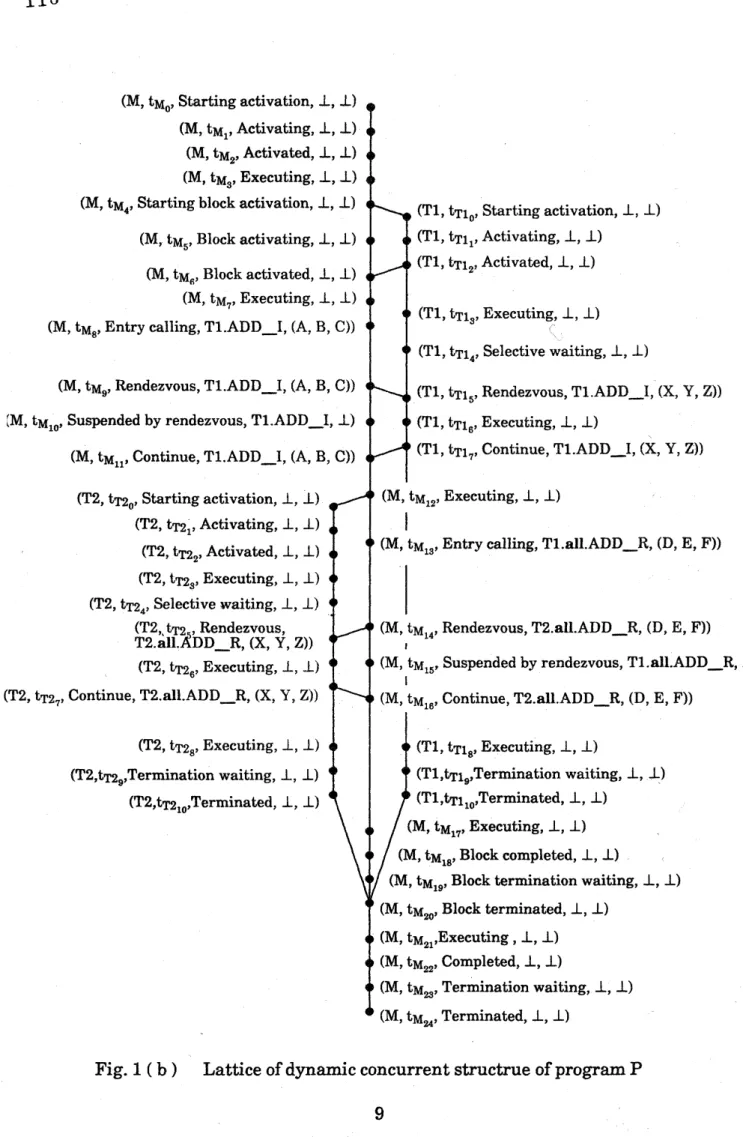
$Ada$ programs; it provides an abstraction of thetaskingbehaviorofAdaprogransin terms of task interactions.
We may represent a poset $(A, \leqq)$ by Hesse diagrams. In where, the nodes
represent the element of$A$, there is a path from a to $a$’ which goes entirely in the
downwarddirectionif and only ifa $\leqq a’$
.
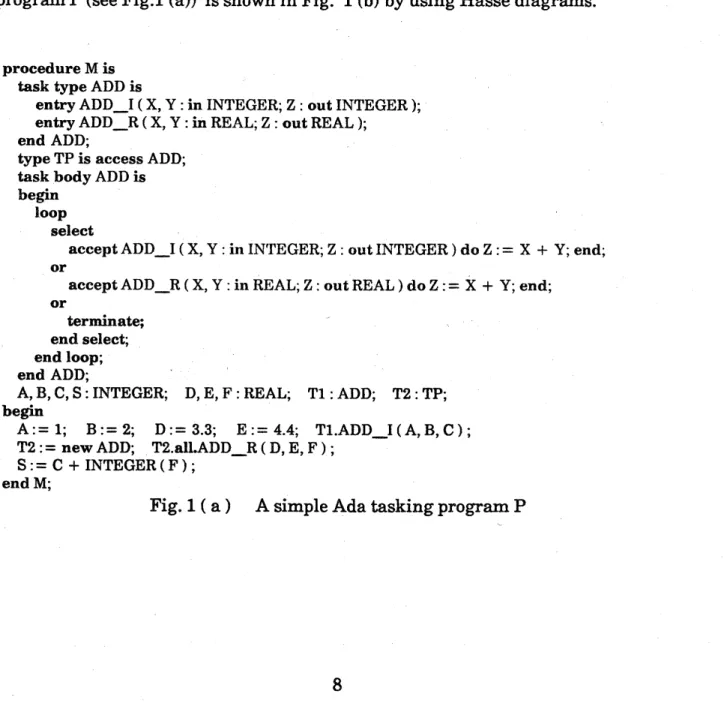
An example of the lattice of dynamic concurrent structure of a simple Ada
program$P$(see Fig.1 $(a)$) isshown in Fig. 1 (b) byusing Hassediagrams.
procedure$M$is task type ADDis
entry$ADD\lrcorner$($X,$$Y$:in INTEGER;$Z$: outINTEGER);
entry$ADDR-$($X,$$Y$: inREAL;$Z$ : outREAL);
endADD;
type TPis accessADD;
task body ADDis
begin
loop
select
accept$ADD\lrcorner$($X,$$Y$:inINTEGER;$Z$:outINTEGER)do$Z:=X+Y$; end;
or
acceptADD–R(X,$Y$: inREAL;$Z$:outREAL)do $Z:=X+Y$; end;
or
terminate; endselect;
end loop; end ADD;
A, B,$C,$$S$: INTEGER; $D,$ $E,$$F$ :REAL; Tl:ADD; T2:TP;
begin
$A:=1$; $B:=2$; $D:=3.3$; $E:=4.4$; $T1.ADD\lrcorner(A, B, C)$;
T2:$=new$ADD; T2.all.$ADDR-(D, E, F)$;
$S:=C+INTEGER(F)$ ; end$M$;
Fig.1 (a) Asimple Ada taskingprogram$P$
4.
The Equivalence of Dynamic
Concurrent
Structures
on
Ada Program Transformation
In our approach, it is obvious that the “taskingbehavior of the target program” reported by the event-driven execution monitor is meaningful only if the partial
order oftasking events duringthe execution oftargetprogram is not interfered by
monitoring actions of the execution monitor. This
means
that the event-drivenexecution monitoring must preserve the partial order of tasking events which is
determined only by the semanticsof the targetprogram.
We say that an event-driven execution monitoring ispartial-order preserving if
it preserves the partial order of tasking events which is deternined only by the
semanticsofthe targetprogram.
We also say that an event-driven execution monitor of Ada tasking programs is
partial-order-transparent if its execution monitoring is always partial-order
preserving for any target Ada program. In other words, the existence of such a
monitor is transparentforanytarget Ada program withrespectto the partialorder
of tasking eventsduring execution of theprogram whichis determinedonly by the
semanticsofprogram.
On the basis of the lattice of dynamic concurrent structure ofAda programs, we
can..discuss
the equivalence between a target Ada program $P$ and a transformedAda program $P$’ with respect to preserving the partial order of tasking events
duringexecution of$P$which is determinedonlybythe semantics of P.
We
assume
that an Ada-to-Ada program transformation is a partial mappingbetween two sets of Ada programs, and can specified by a set of program
transformation rules. A progran transformation rule is also a partial mapping
fromasetof Adaprograms tothe other.
We write $\Phi$ : $P(Ada)arrow RP(Ada)$ for an Ada-to-Ada program transformation,
where $P(Ada)$ is a set of Ada programs and $R$ is a set of Ada program
transformationrules, $R$canbe omittedwhen itneed not be shown explicitly.
We now defineaseries ofbasicconceptswhich will be usedin laterdiscussions.
Definition4.1 Let$(S_{1}, \leqq_{1})$and $(S_{2}, \leqq_{2})$betwoposets.
1) A mapping $\Psi$ : $S_{1}arrow S_{2}$is called an order homomorphism or an isotone or an
order preserving mapping if $s_{1}\leqq_{1}s_{2}$ then $\Psi(s_{1})\leqq_{2}\Psi(s_{2})$ for any $s_{1},$ $s_{2}$ in $S_{1}$
[Birkhoff-61, Szasz-63].
2) A mapping $\Psi$ : $S_{1}arrow S_{2}$ is called a conservative homomorphism or a
conservative mapping if$s_{1}$and$s_{2}$areincomparablewith respectto $\leqq_{1}$ then $\Psi(s_{1})$
and$\Psi(s_{2})$areincomparable with respectto $\leqq_{2}$forany
$s_{1},$$s_{2}$in $S_{1}$
.
3) A mapping $\Psi$ : $S_{1}arrow S_{2}$is called
a
partial-order homomorphism or apartial-order preserving mapping ifand only ifitis both an order homomorphism and a
conservative homomorphism. $\square$
Definition 4.2 Let$(L_{1}, \leqq_{1})$ and $(L_{2}, \leqq_{2})$ betwo meet-semilattices.
1) Amapping $\Psi$ : $(L_{1}, \leqq_{1})arrow(L_{2}, \leqq_{2})$ is called ameet-homomorphism if$\Psi(a\cap b)$
$=\Psi(a)\cap\Psi(b)$for any $a,$$b$in$L_{1}$ [Birkhoff-61, Szasz-63].
2) Ameet-homomorphism is called
a
meet-homomorphous one-to-one ifit is alsoone-to-one.
3) Ameet-homomorphism iscalled
a
meet-homomorphousonto ifit is also onto. 4) A meet-homomorphism is calleda
meet-isomorphism if it is both ameet-homomorphousone-to-one and ameet-homomorphousonto. $\square$
Lemma 4.1 Let $\Psi$ : $(L_{1}, \leqq_{1})arrow(L_{2}, \leqq_{2})$ be a bijection. Then $\Psi$ is a
partial-order homomorphism ifand only ifit is ameet-isomorphism. $\square$
Theproof of Lemma4.1 is givenin the appendix of thispaper.
Basedon Lemma4.1,wehave
Definition 4.3 A program transformation $\Phi$ : $P(Ada)arrow P(Ada)$ is called an
equivalence
transformation
for
dynamic concurrent structures if and only if forevery $P$ in the $P(Ada)$ and any given input I there exists a meet-homoInorphism
$\Psi$ : $(TSS(P, I),$ $\leqq_{TPO}$) $arrow(TSS(\Phi(P), I),$ $\leqq_{TPO}$) which is a meet-isomorphism from
$(TSS(P, I),$ $\leqq_{TPO}$) to$(\Psi(TSS(P, I)),$ $\leqq_{TPO}$). $\square$
In fact, Definition 4.3
means
thatan equivalence transfornation $\Phi$ : $P(Ada)arrow$P(Ada) for dynamic concurrent structures preserves the partial order of tasking
events oforiginal program$P$in the transformed program$\Phi(P)$
.
Note that the equivalence of dynamic concurrent structure defined by
Definition 4.3 describes only a correspondence between the original and the
transformed programs in terms of abstract algebraic structure, and no concrete
semanticsof original programs such as the identifier or the tasking state ofa task
is considered inthis equivalence.
We can consider a strong equivalence of dynamic concurrent structure which
describesthe complete taskingsemanticsof original programs
as
follows:Definition 4.4 A program transformation $\Phi$ : $P(Ada)arrow P(Ada)$ is called a
strong equivalence
transformation for
dynamic concurrent structures if and only iffor every $P$ in the $P(Ada)$ and any given input I, there exists a
meet-homomorphism $\Psi$ : $(TSS(P, I),$ $\leqq_{TPO}$) $arrow(TSS(\Phi(P), I),$ $\leqq_{TPO}$) which
is
ameet-isomorphism from $(TSS(P, I),$ $\leqq_{TPO}$) to $(\Psi(TSS(P, I)),$ $\leqq_{TPO}$) and satisfies the
followingcondition:
Forany $(T_{1}, t_{1}, s_{1}, e_{1},m_{1})$in the$(TSS(P, I),$ $\leqq_{TPO}$),if$\Psi((T_{1}, t_{1}, s_{1}, e_{1}, m_{1}))=$
$(T_{2}, t_{2}, s_{2}, e_{2}, m_{2})$then$T_{1}=T_{2},$ $s_{1}=s_{2},$ $e_{1}=e_{2},$$m_{1}=m_{2}$
.
$\square$A strong equivalence transformation for dynamic concurrent structures
preservesthe partialorderof taskingevents and the complete taskingsemantics of
original programs in the transformed programs. Therefore we have the following
proposition.
Proposition If the program transformation usedby an event-driven execution
dynamicconcurrentstructures, then the event-driven execution monitor is
partial-order-transparent. $\square$
Definition 4.5 Let $\Phi;P(Ada)arrow RP(Ada)$ be
a
program transformation. Thenthe program transfornation rules of$R$
are
said to be superposable if they satisfythefollowingcondition:
For any $P$ in the $P(Ada)$, there exists
a
sequence of indices $i_{1},$ $i_{2},$$\ldots,$
$i_{n}$ for
which thefollowingformula holds:
$\Phi(P)=r_{i_{n}}$$(... (r_{i_{2}}(r_{i_{1}}(P)))\ldots)$, where,$r_{k}\in R,$$k=i_{1},$$i_{2},$
$\ldots,$
$i_{n}$
.
$\square$Lemma 4.2 Let $\Psi_{1}$ : $(L_{1}, \leqq_{1})arrow(L_{2}, \leqq_{2})$ and $\Psi_{2}$ : $(L_{2}, \leqq_{2})arrow(L_{3}, \leqq_{3})$ are two
meet-homomorphisms, then their composite $\Psi_{2}\cdot\Psi_{1}$ : $(L_{1}, \leqq_{1})arrow(L_{3}, \leqq_{3})$ is also a
meet-homomorphism. $\square$
Theorem 4.1 Let $\Phi$ : $P(Ada)arrow RP(Ada)$ be a program transformation. If$R$
satisfiesthe conditions:
1) Theprogramtransformation rules of$R$
are
superposable;2) For any program transformation rule $r$in $R$, and for every $P$ in $P(Ada)$ and
any given inputI, there exists ameet-homomorphous $\Psi_{r}$ : $(TSS(P, I),$ $\leqq_{TPO}$) $arrow$
$(TSS(r(P), I),$ $\leqq_{TPO}$) which is a meet-isomorphism from $(TSS(P, I),$ $\leqq_{TPO}$) to
$(\Psi_{r}(TSS(P, I)),$ $\leqq_{TPO}$),
then $\Phi$isanequivalenttransformation fordynamicconcurrent structures.
Ifin additiontothe above conditions$R$satisfiesthe followingcondition:
3) For every $\Psi_{r}$ in the condition 2) and for any $(T_{1}, t_{1}, s_{1}, e_{1}, m_{1})$ in $th_{\wedge}e(TSS(P$,
I), $\leqq_{TPO}$),if$\Psi_{r}((T_{1}, t_{1}, s_{1}, e_{1}, n_{1}))=(T_{2}, t_{2}, s_{2}, e_{2}, m_{2})$ then$T_{1}=T_{2},$$s_{1}=s_{2},$ $e_{1}=$ $e_{2},$$m_{1}=m_{2}$,
then $\Phi$ isastrong equivalenttransformation for dynamicconcurrentstructures.$\square$
Theorem 4.1canbeprovedby Definition 4.3\sim 4.5and Lemma 4.2.
Theorem 4.1
means
that the equivalence problem of dynamic concurrentstructure of a program transformation can be reduced into the
meet-homomorphous problem of every transformation rule of the program
transfornation. In general, the latter problem is easier to solve than the former
because itonlyneedsto discusslocal propertiesof targetprograms.
Consequently, for developing a partial-order-transparent event-driven
execution monitor ofAda tasking programs on the basis of above discussion, we
must do two things. The firstis to design programtransformation rules which are superposable(andofcourse, satisfythe requirements ofexecution monitoring), and
the second is to check whether or not every program transformation rule of the
execution monitor satisfies the conditionsof Theorem 4.1.
5.
Examples
We now give two examples. The first example is a program transformation
which introduces an entry
SET–ID
for every task type of a target program toaccept unique identifier, but it is not strongly equivalent for dynamic concurrent
structures. In the second example a revised transformation is applied to the
same
target programs
as
in the first example. It is strongly equivalent for dynamicconcurrent structures.
5.1 ProgramTransformation without Strong
Equivalenc\’e
Let
us
consider the following transformation [German-84]. It consists of apattern and a replacement, where, a numeral in square brackets, for instance [1],
is a pattern variable, the program textcovered by apattern variable is copied into the replacement. The pattern variables may be restricted; i.e., for instance, [2-statements] canonlymatch a sequence ofstatements.
pattern:
task type$T$is[11;
taskbody$T$is[$2$-declslbegin[$2$-statementsl ; end;
replacement:
task type$T$is
entrySET–ID($N$: inINTEGER);
[1];
taskbody$T$is
ID:INTEGER;
begin
acceptSET–ID($N$: inINTEGER)doID:$=N$ ; end; declare [2-declsl begin [$\dot{2}$-statements]; end; end;
This transfornation moves the declarative part of the task body of a target
program into an innerblock in order to accept the identifier inside of the taskbody
before elaborating the task’s declarative part. But this transformation is not
strongly equivalent for dynamic concurrentstructures.
Let
us assume
that sometask, for instanceTl,is declared in the declarativepartof task $T$, then the outline oflattice of dynamic concurrent structure of a target
program and its transformed program is shown in Fig.2 (a) and Fig.2 (b)
respectively.
Obviously, there exists no meet-isomomorphism that satisfies the conditions of Definition 4.4 because elements $a_{5}$ and $a_{14}$
are
incomparable in lattice A but $b_{15}$and$b_{14}$ arecomparablein lattice B.
As a result of the transformation, because it is not strongly equivalent for
dynamic concurrent structures, the transformed program may not preserve
equivalence with respect to
some
tasking behavior of the target program suchas
exceptions raised during the elaboration of the declarative part of the task
T Tl
(a) $A$:Latticeof targetprogram (b) $B$ : Lattice of transformed program
Fig. 2 Anexampleof program transformation withoutstrong equivalence However, note that this transformation is equivalent for dynamic concurrent
structures and
a
meet-isomomorphismwhich satisfies the conditionsof Definition4.3 hasbeenshown inFig.2 by the
same
indices of the corresponding elements.5.2 ProgramTransformationwith Strong Equivalence
The second example is a revision of the program transformation given by the
firstexanple. The revised transformation isshown below. Everytask is assigned
a unique identifier by initialization of task identifier ID by calling a function
$GET-TASK-ID$
.
pattern:
tasktype$T$is[1] ;
task body$T$is[2-decls]begin[2-statements] ;end;
replacement :
task type$T$is[1] ;
taskbody$T$is
ID: INTEGER:$=$ GET–TASK–ID;
[2-decls]
begin
[2-statementsl ; end;
where thefunction
GET–TASK–ID
isdefinedas follows:functionGET–TASK–ID returnINTEGER is
ID: INTEGER;
begih
TASK–ID–MANAGER. GET–ID(ID); returnID; end;
Thistransformation isstrongly equivalent for dynamicconcurrent structures. A
meet-isomomorphism which satisfies the conditions ofDefinition 4.4 is shown in Fig. 3by the
same
indicesofthe correspondingelements.6.
Conclusion
This paper has presented a new correctness concept, called partial-order
preserving property, for event-driven execution monitoring of Ada tasking
programs. By using this concept, we can describe whether or not the tasking
behavior of monitored Ada programs refrains from interference of monitoring
actionsof the event-driven executionmonitor.
We have presented an approach to solve the partial-order preserving problem which is important for both monitoring and transformng Ada tasking prograns.
The featuresofourapproach are to abstract the taskingbehavior of Ada programs
in terms of task interactions by using lattice theory, and to discuss the
correspondence between target programs and transformed programs in terms of
abstractalgebraicstructure on thebasis ofthis abstraction.
The equivalence of partial-order preserving property on transformation of
concurrent programs is an important research
area.
In order to solve thepartial-order preserving problem on monitoring Ada tasking programs, we have defined the equivalence of dynamic concurrent structures with respect to Ada program
transformation. This equivalence can be used
as
a partial-order preservingcriterion of program transformation used in a preprocessor of an event-driven
execution monitor of Ada tasking programs. It can be easily extended to
applications to other concurrent languages based on message-passing mechanism such
as
CSP [Cheng-86].On the basisof the correctnessconcept presentedin this$paper_{f}$we have designed
an event-driven execution monitor for Ada tasking programs and implemented its
T Tl
(a) $A$ :Lattice of targetprogram (b) $B$ :Latticeoftransformed program
Fig.3 An example of program transformation with strongequivalence
monitoring andlor transforming algorithms used by our event-driven execution
monitor can be proved with the help of the strong equivalence of dynanic
concurrent structureswith respectto Ada program transformation.
References
[Birkhoff-61]Birkhofr,G. : LatticeTheory, RevisedEdition,Am. Math. Soc., 1961.
[Cheng-86] Cheng,J., Araki,K. and Ushijima,K. : The Equivalence of Dynamic Concurrent Structureson ConcurrentProgramTransformation,Proc. 32th Annual Convention IPSJapan, 4C-7,pp.13-14, 1986(inJapanese).
[DGC-841 Data General Corp. : Ada Development Environment (ADE) (AOSNS) User’s
Manual, 1984.
[DoD-80] United States Department of Defense : ”STONEMAN”, Requirements for Ada
Programming SupportEnvironment, 1980.
[DoD-831 United States Department of Defense : Reference Manual for Ada Programming Language (ANSI/MIL-STD-1815A), Jan. 1983.
[Fairley-80]Fairley,R.E.: Ada DebuggingandTestingSupportEnvironments, ACM SIGPLAN
Notices, Vol.15, No.11,pp.16-25, 1980.
[German-84] German,S.M. : Monitoring for Deadlock and Blocking in Ada Tasking, IEEE
Trans. Softw. Eng.,Vol.SE-10, No.6,pp.764-777, 1984.
[Helmbold-85a] Helmbold,D. and Luckham,D. : Debugging Ada Tasking Programs, IEEE
Software,Vol.2, No.2,pp.47-57, 1985.
[Helmbold-85b1 Helmbold,D. and Luckham,D.C. : Runtime Detection and Description of
DeadnessErrorsin Ada Tasking,ACMAdaLetters, Vol.4,No.6,pp.60-72,1985.
[Jefferson-851Jefferson,D.R. : Virtual Time,ACM Trans. Program. Lang. Syst., Vol.7,No.3,
pp.404-425, 1985.
[Lamport-781 Lamport,L. : Time, Clocks, and Ordering of Events in a Distributed System,
Comm. ACM, Vol.21, No.7, pp.558-565, 1978.
[LeBlanc-85] LeBlanc,R.J. and Robbins,A.D. : Event-Driven Monitoring of Distributed
Programs, Proc. ofthe 5th International Conference on Distributed Computing Systems, pp.515-522,1985.
[LeDoux-851LeDoux,C.H. and Parker,Jr.D.S. : Saving TracesforAda Debugging, Ada inUse, pp.97-108, Proc. of the Ada InternationalConference,Paris 14-16May1985.
[Maio-851 Maio,A.D, Ceri,S. and Reghizzi,S.C. : Execution Monitoring andDebuggingToolfor
Ada Using Relational Algebra, Ada inUse,pp.109-123, Proc. ofthe AdaInternational Conference,
Paris 14-16May1985.
[Plattner-811 Plattner,B. and Nievergelt,J. : Monitoring Program Execution: A Survey, IEEE
Computer,Vol.14, No.11,pp.76-93, 1981.
[Snodgrass-84] Snodgrass,R. : Monitoring in a Software Development Environment: a
Relational Approach,ACM SIGPLANNoticesVol.19, No.5,pp.124-131, 1984.
Appendix
Proof of Theorem 3.1For any$S_{1}=(T_{1}, t_{1}, s_{1}, e_{1}, m_{1}),$ $S_{2}=(T_{2}, t_{2}, s_{2}, e_{2}, m_{2})$ in the$(TSS(P,$I), $\leqq_{TPO}$), if
$T_{1}=T_{2}$,thenby Lemma 3.3, thefollowingformula hold:
g.l.b.$\{S_{1}, S_{2}\}=\{\begin{array}{l}S_{1}whenS_{2}\leqq_{TPO}S_{l}S_{2}whenS_{1}\leqq_{TPO}S_{2}\end{array}$
$IfT_{1}\neq T_{2}$,thenbyLemma3.2,$\{S_{1}, S_{2}\}$has at leastonel.b. such
as
$0$.
Ifwe
assume
that there exists no g.l.$b$.
$\{S_{1}, S_{2}\}$, then $\{S_{1}, S_{2}\}$ must have two l.b.’s$b_{1}=(T_{1}, b_{1}, s_{b_{1}}, e_{b_{1}}, m_{b_{1}})$ and $b_{2}=(T_{2}, t_{b_{2}}, s_{b_{2}}, e_{b_{2}}, m_{b_{2}})$ which
are
incomparablebecause $\{S_{1}, S_{2}\}$ has at least one l.b.; i.e., $b_{1}\leqq_{TPO}S_{1},$ $b_{1}\leqq_{TPO}S_{2},$ $b_{2}\leqq_{TPO}S_{1},$ $b_{2}$
$\leqq_{TPO}S_{2}$,butneither$b_{1}\leqq_{TPO}b_{2}$nor$b_{2}\leqq_{TPO}b_{1}$
.
Accordingto Definition3.2, theabove assumptionis true if and only ifthere are
two elements$S_{1}’=(T_{1}, t_{1}’, s_{1}’, e_{1}’, m_{1}’)$ and $S_{2}’=(T_{2}, t_{2}’, s_{2}’, e_{2}’, m_{2}’)$ of the $(TSS(P$,
I), $\leqq_{TPO}$)which satisfy the followingconditions:
1) $b_{1}\leqq_{TPO}S_{1}‘\leqq_{TPO}S_{1}$, $b_{2}\leqq_{TPO}S_{2}’\leqq_{TPO}S_{2}$;
2) $(b_{1}, S_{2}’)\in$ DS, $(b_{2}, S_{1}’)\in$ DS;
i.e.,there isavalid combinationof theconditions 2\sim 6 ofDefinition 3.2 forwhich
$(b_{1}, S_{2}’)\in$ DSand $(b_{2}, S_{1}’)\in$ DS$a\tilde{r}e$ to be true.
We now consider every combination ofthe condition $2\sim 6$ of Definition 3.2
as
follows; note that $b_{1}$ and $b_{2}$
are
incomparable, and the number ofcombinations ofthose conditionsis$(^{5+2_{2}-1})=15$ :
1) $b_{1}$ and$S_{2}$’satisfythecondition 2; $b_{2}$ and$S_{1}$’satisfythe condition2:
This
means
that $T_{2}$ is a child of$T_{1}$ and started activation at $t_{2}’$; and $T_{1}$ is achild$ofT_{2}$ and started activation at$t_{1}’$
.
2) $b_{1}$ and$S_{2}$
’satisfythe
condition 2;$b_{2}$ and$S_{1}$
’satisfy
the condition 3 :
This
means
that $T_{2}$ is a child of$T_{1}$ and started activation at $t_{2}’$; and $T_{1}$ is aparent$ofT_{2}$and$T_{2}$ is activated at$t_{b_{2}}$
.
3) $b_{1}$and$S_{2}$
’satisfy
the condition2;$b_{2}$and $S_{1}$
’satisfythecondition
4:
This
means
that $T_{2}$ isa
child of$T_{1}$ and started activation at $t_{2}’$; and $T_{1}$ is aparent$ofT_{2}$and$T_{2}$teminated at$t_{b_{2}}$
.
4) $b_{1}$ and$S_{2}$’satisfythe condition2;$b_{2}$ and$S_{1}$
’satisfythe condition 5:
This
means
that$T_{2}$ is a child of$T_{1}$ and started activation at $t_{2}’$; and $T_{2}$ calledanentry$ofT_{1}$ andthiscallisaccepted by$T_{1}$ at$t_{1}’$
.
5) $b_{1}$and$S_{2}$’satisfythecondition 2;$b_{2}$and $S_{1}$
’satisfythe condition 6:
This
means
that$T_{2}$ is a childof$T_{1}$ andstarted activation at $t_{2}’$; and $T_{1}$ calledanentry$ofT_{2}$ andcorrespondingrendezvousfinishedat$t_{b_{2}}$
.
186) $b_{1}$ and$S_{2}$ satisfythecondition3;$b_{2}$and$S_{1}$ satisfythe condition 3
:
This
means
that$T_{2}$ isa parent of$T_{1}$ and$T_{1}$ started activation at$t_{b_{1}}$; and $T_{1}$ isaparent$ofT_{2}$ and$T_{2}$ started activation at$t_{b_{2}}$
.
7) $b_{1}$ and$S_{2}$
’satisfythe condition3;
$b_{2}$ and$S_{1}$’satisfythe condition 4:
This
means
that$T_{2}$ isa parent$ofT_{1}$ and$T_{1}$ started activation at $t_{b_{1}}$; and $T_{1}$ isaparent$ofT_{2}$and$T_{2}$terminated at$t_{b_{2}}$
.
8) $b_{1}$ and$S_{2}$’satisfy thecondition3;$b_{2}$ and$S_{1}$’satisfy thecondition 5:
This
means
that $T_{2}$ is a parent of$T_{1}$ and $T_{1}$ started activation at $t_{b_{1}}$; and $T_{2}$calledanentry$ofT_{1}$ andthiscallisaccepted by$T_{1}$ at$t_{1}’$
.
9) $b_{1}$ and$S_{2}$’satisfythe condition3;$b_{2}$and $S_{1}$
’satisfy thecondition 6:
This
means
that $T_{2}$is
a parent of$T_{1}$ and $T_{1}$ started activation at $t_{b_{1}}$; and $T_{1}$calledanentry of$T_{2}$ andcorrespondingrendezvousfinished at$t_{b_{2}}$
.
10) $b_{1}$ and$S_{2}$
’
satisfy the condition4;$b_{2}$ and$S_{1}$
’ satisfy thecondition 4 :
This
means
that $T_{2}$ is a parent of $T_{1}$ and $T_{1}$ termnated at $t_{b_{1}}$; and $T_{1}$ is aparent$ofT_{2}$ and$T_{2}$ terminated at$t_{b_{2}}$
.
11) $b_{1}$ and$S_{2}$
’
satisfythe condition4;$b_{2}$and$S_{1}$
’ satisfy the condition 5:
This
means
that$T_{2}$ isa parent$ofT_{1}$ and$T_{1}$ terminated at$t_{b_{1};}$ and $T_{2}$ calledanentry$ofT_{1}$ andthiscallisacceptedby$T_{1}$ at$t_{1}’$
.
12) $b_{1}$ and$S_{2}$
’satisfythe condition4;
$b_{2}$ and$S_{1}$
’ satisfy thecondition 6 :
This
means
that$T_{2}$ isa parent$ofT_{1}$ and$T_{1}$ terminated at$t_{b_{1}}$; and$T_{1}$ calledanentry of$T_{2}$and correspondingrendezvous finished at$t_{b_{2}}$
.
13) $b_{1}$ and$S_{2}$’satisfy thecondition5;$b_{2}$ and $S_{1}$’satisfy the condition5 :
This
means
that$T_{1}$ called an entry of$T_{2}$ and this call is accepted by $T_{2}$ at $t_{2}’$;and$T_{2}$ calledan entry$ofT_{1}$ and thiscallisacceptedby$T_{1}$ at$t_{1}’$
.
14) $b_{1}$ and$S_{2}$’satisfy thecondition5; $b_{2}$and $S_{1}$’ satisfy thecondition 6:
This
means
that$T_{1}$ called an entry of$T_{2}$ and this call is accepted by $T_{2}$ at$t_{2}’$;and$T_{1}$ calledanentry of$T_{2}$ and correspondingrendezvousfinished at$t_{b_{2}}$
.
15) $b_{1}$ and$S_{2}$’satisfy the condition6;$b_{2}$ and $S_{1}$’satisfy thecondition 6:
This
means
that $T_{2}$ called an entry of $T_{1}$ and corresponding rendezvousfinished at $t_{b_{1}}$; and $T_{1}$ called an entry of $T_{2}$ and corresponding rendezvous
finishedat$t_{b_{2}}$
.
However, anyone ofthese 15 situationscannotoccurbecause of the semanticsof Ada tasking [DoD-83]. This
means
that our assumption is not true. Therefore,theremustexistg.l.$b$
.
$\{S_{1}.’S_{2}\}$
.
Consequently,for any$S_{1},$ $S_{2}$inthe $(TSS(P, I),$ $\leqq_{TPO}$)$,$ $\{S_{1}, S_{2}\}$has ag.l.
$b.$, i.e., the
$(TSS(P, I),$ $\leqq_{TPO}$)is ameet-semilattice.
On the other hand, ifthe $(TSS(P, I),$ $\leqq_{TPO}$) is finite, then for any $S_{1},$ $S_{2}$ in the
$(TSS(P, I),$ $\leqq_{TPO}$), the discussion of l.$u.b$
.
$\{S_{1}, S_{2}\}$ holdsas
well as that ofg.l.$b$.
$\{S_{1}$, $S_{2}\}$.
Therefore, the $(TSS(P, I),$ $\leqq_{TPO}$) is a lattice. Because any finite lattice iscompletelattice [Birkhoff-61, Szasz-631, the $(TSS(P, I),$ $\leqq_{TPO}$) is acompletelattice. 口
homomorphism. Thenfor any$a,$$b$in$L_{1}$,
(1) $a\leqq_{1}biff\Psi(a)\leqq_{2}\Psi(b)$
.
Suppose$a\cap b=c$,then$c\leqq_{1}$
a
and$c\leqq_{1}b$.
By(1),(2) $\Psi(c)\leqq_{2}\Psi(a),$ $\Psi(c)\leqq_{2}\Psi(b),$$i.e.,$$\Psi(c)\leqq_{2}\Psi(a)\cap\Psi(b)$
.
Suppose $\Psi(a)\cap\Psi(b)=\Psi(d)$, then
(3) $\Psi(c)\leqq_{2}\Psi(d)$,and
(4) $\Psi(d)\leqq_{2}\Psi(a),$ $\Psi(d)\leqq_{2}\Psi(b)$
.
By(1)and(4),
(5) $d\leqq_{1}a,$ $d\leqq_{1}b,$ $i.e.,$$d\leqq_{1}a\cap b,$ $i.e.,$$d\leqq_{1}c$
.
Therefore,by(1),
(6) $\Psi(d)\leqq_{2}\Psi(c)$
.
By(3) and(6),$\Psi(d)=\Psi(c)$, i.e., $\Psi(a\cap b)=\Psi(a)\cap\Psi(b)$
.
Consequently, $\Psi$ isa meet-isomorphism.
Let$\Psi:(L_{1}, \leqq_{1})arrow(L_{2}, \leqq_{2})$beameet-isomorphism. Then forany $a,$$b$in$L_{1}$,
(7) $\Psi(a\cap b)=\Psi(a)\cap\Psi(b)$
.
Suppose$a\leqq_{1}b$,thena $\cap b=a,$$\Psi(a\cap b)=\Psi(a)$
.
By(7)(8) $\Psi(a)=\Psi(a)\cap\Psi(b),$$i.e.,$ $\Psi(a)\leqq_{2}\Psi(b)$
.
Ontheotherhand,suppose$\Psi(a)\leqq_{2}\Psi(b)$, then$\Psi(a)\cap\Psi(b)=\Psi(a)$
.
By (7)(9) $\Psi(a\cap b)=\Psi(a)$
.
Therefore,
(10) $a\cap b=a$, i.e.,$a\leqq_{1}b$
.
Consequently, $\Psi$ isa partial-order homomorphism. 口