コーパスに基づいた、外国語指導の環境と学習者のアップテイクの関
係に関する研究
昭和女子大学大学院文学研究科 言語教育・コミュニケーション 大橋由紀子
A Corpus-Based Study on the Relationship
Between the Foreign Language Classroom Context and Learners’ Uptakes
コーパスに基づいた、外国語指導の環境と学習者のアップテイクの関係に関する 研究 要旨 日本における外国語としての英語の授業では、いまだに日本語が多く使用される傾向が見 られる。しかし、学習指導要領の改訂が行われ、これまでより多くの英語が授業で使われる傾 向にあると期待される。金子 (1991)は、外国語授業内で学習者と教員がともに英語を使用す ることが学習者の理解を高めることを示し、教室内での学習言語(英語)使用を推奨している。 Slimani(1987)は、学習者の理解度を、学習者のアップテイク(授業直後の、学習者による、 何を学んだかの記述)によって証明している。本研究においては、アップテイクを調査するこ とで、指導環境と学習者の理解の関係を研究することとした。また新たに、言語活動という視 点を加え、録音した授業データを基にコーパスを作成し、学習者の理解と使用言語や活動の関 係ついて、2段階にわけて調査を行った。本論文では「活動」を授業で扱われる学習内容(タ スク、翻訳、ドリル)と規定している。大学生を対象とした調査では、学習者のアップテイク が習得につながっているか、そしてどのような言語と活動が学習者の習得に効果があるかを調 べ、中学、高校生を対象とした調査では、教室で主に使用されている言語や活動の違いと、学 習者の理解度の関連を分析した。リサーチクエスチョンは以下の通りである。 1)学習者のアップテイクは習得につながっているか。 2)学習者(大学生)のアップテイク、習得を促進するためには、教師は母語(L1)と 学習言語(L2)のどちらを使用することが効果的か。 3)学習者(大学生)のアップテイク、習得を促進するためには、授業内でどのような活 動を行うことが効果的か。 4)授業で主に使用されている言語の違いによって、学習者(中学生、高校生)のアップ テイクには差が見られるのか。 5)授業で行われている活動の違いによって、学習者(中学生、高校生)のアップテイク には差が見られるのか。 大学生を対象とした調査では、リサーチクエスチョン1から3に答えるために、大学 1 年生対 象の外国語の授業を録音したもの、授業前、授業直後、授業1週間後に行ったテストの結果、 授業直後に学習者が学んだと思った単語、英文、文法等を記入したアンケート形式のアップテ イク調査をデータとして使用した。各授業では、タスク、翻訳、ドリルのいずれかの活動を行 い、同じ活動で異なる言語(L1、L2)を使用し、使用言語と活動の効果を調査した。結果 の分析には、分散分析を使用した。また、アップテイクの信頼性を証明するために、学習者が 「アップテイク」としてアンケートに書いた内容がテストに出された場合に、正答できている
かを、相関分析を用いて検証した。 中学、高校生を対象とした調査では、リサーチクエスチョン4、5に答えるために、中学校 外国語(英語)授業より 11 クラス、高等学校での英語授業(コミュニケーション英語Ⅱ)よ り 11 クラス、合計 22 クラスの授業を録音したものと、授業直後に学習者が学んだと思った単 語、英文、文法等を記入したアンケート形式のアップテイク調査を使用した。まず初めに、授 業の録音を書き起こし、必要なタグをつけてコーパス化した。そのデータに基づいて、各クラ スで使用されている日本語と英語の割合、学習者と教師の発話量の割合、授業で行われた活動 を比較し、分析のために必要な以下の2種類のデータを抽出した。使用言語が異なり活動内容 が同じクラスのデータ群1(中学4クラス、高校4クラス)と、活動内容が異なり使用言語が 同じクラスのデータ群2(中学4クラス、高校4クラス)である。データ群1,2のクラスで の学習者のアップテイクの調査を元に、使用言語と活動の違いにより、学習者のアップテイク に差が生じるのかを検証する分析を進めた。分析には、ノンパラメトリック検定、クラスカル ウォリス、マンウィットニーのU検定を使用した。分析の結果は以下の通りである。 1)学習者のアップテイクは習得につながった。 2)教師が学習言語を使用する方が、母語を使用するよりも学習者の語彙、英文の習得を促進 した。 3)タスク活動は、翻訳、ドリル活動よりも習得を促進した。 4)授業内で主に使用する言語によって、学習者のアップテイクの量に差が生じた。L2中心 クラスは、L1中心クラスや両言語を同量使用しているクラスに比べて、英文と、語彙の アップテイクがより多くなる傾向が見られた。また、L1中心クラスでは、語彙のアップ テイクは低かった。文法のアップテイクに関しては、どちらの言語を使用してもアップテ イクの量に差はみられなかった。 5)授業内で行われる活動によって、学習者のアップテイクには違いが生じた。特に、英文の アップテイクに関しては、タスク活動を行っているクラスが、翻訳やドリルを行っている クラスよりも高くなる傾向が見られた。 上記の結果に加えて、アップテイクに書かれた項目と授業の書き起こしとの照合を行い、 学習者の理解をもたらす要因について質的な考察も加えた。質的な考察からは、教師に促され るのではなく、学習者が自発的に英語を発することによって、教師とのインタラクションや教 師によるフィードバックが発生し、それが、学習者がより英文や文法を理解することにつなが ることが示唆された。 本論文では、授業後のアップテイク調査の結果を、質的な視点も加えて主に量的な側面から 検討し、学習者の理解と、外国語授業内で行われている活動および、教師による使用言語との 関係を明らかにした。最後に、今後の研究の可能性を検討し、より多くのデータを収めた授業 コーパスとそれに基づいた研究の重要性について言及した。
i
A Corpus-Based Study on the Relationship
Between the Foreign Language Classroom Context and
Learners’ Uptakes
A Dissertation Submitted to the Showa Women’s University Graduate School
In Partial Fulfillment
of the Requirements for the Degree of Doctor of Philosophy
by Yukiko Ohashi
June, 2014
Examining Committee Members
Tomoko Kaneko, Advisory Chair, Showa Women’s University Yoshimasa Ogawa, Showa Women’s University
Gordon Robson, Showa Women’s University
ii © Copyright 2014 by Yukiko Ohashi
iii
ABSTRACT
Currently, in English education in Japan, Japanese (L1) is still used frequently by teachers; however, more English (L2) is expected to be used since the curriculum guidelines were revised by the Japanese Ministry of Education, Culture, Sports, Science and Technology (MEXT). Using the L2 in the classroom is said to benefit students’ learning and is recommended for use in classrooms (e.g. Kaneko, 1991). The languages mainly used in class as well as the activities primarily conducted in class are known to affect the quantity of students’ uptake (Slimani, 1987). Slimani used an ‘uptake chart’ in which students wrote down what they claim they have learned.
This study explores whether students’ uptake can lead to their learning and the relationship among students’ uptake and the languages used in class as well as the activities done in class. In order to observe students’ uptake, an uptake chart questionnaire that Slimani (1987) used was employed.
The study has two phases: University Research and Junior and Senior High School Research. University Research examined whether students’ uptake leads to learning, and the effect of the language used in class as well as the activities conducted in class. The subjects were university students. Junior and Senior High School Research focused on the relationship between students’ uptake and languages mainly used in class and between students' uptake and activities mainly used in class, i.e. the classroom context. The subjects were junior and senior high school students. The research questions were as follows:
(1) Will learners’ uptake lead to their learning?
iv uptake and learning?
(3) Which activity is the most effective to facilitate learners’ uptake and learning? (4) Is there any difference in the quantity of uptake depending on the type of
language mainly used in class?
(5) Is there any difference in the quantity of uptake depending on the type of activity carried out in class?
Lightbown and Spada (2006) describe learning conditions such as the language used by teachers or the activities done in the classroom as the foreign language classroom context. Thus, in this dissertation, the language used by teachers or the activities done in classrooms are described as ‘context.’ ‘Activities’ selected to examine in this study were ‘Language-learning tasks,’ ‘Translation,’ and ‘Drill practice.’
University Research was conducted to answer Research questions (1), (2), and (3). Data for University Research was collected from six English classes conducted in a university located in Japan. The subjects were university students who are not majoring in English. In each class, one of the activities, Language-learning tasks, Translation, and Drill practice was carried out and both L1 and L2 were used for an equal amount of time. Based on pretest, posttest, delayed test, and the results of student uptake questionnaires to students, whether students’ uptake led to learning was examined. In the questionnaire, students were given three questions in order to examine what they had learned in each class. In the first question, students were asked to write the vocabulary that they had learned in class. The second question was to write English sentences, and for the third question, students were asked to write grammatical points that they had learned in class. The students were not allowed to look at the textbooks or the materials used in class while
v
answering these questions in the uptake chart. For the analysis of the data, ANOVA was conducted. Also, the relationship between the number of items written in the uptake questionnaire and the number of items which were correctly answered in the posttest or delayed test were examined by correlation analysis.
Junior and Senior High School Research was conducted to answer Research questions (4) and (5). Data for Junior and Senior High School Research was collected from 22 Japanese EFL (English as a Foreign Language) classes. The subjects were junior and senior high school students who were taking a required English course. The main body of data for Junior and Senior High School Research consists of transcribed utterances from 22 classes, which were made into a corpus, and student uptake questionnaires.
All the transcribed data were tagged and types and tokens of each tagged utterance were counted for each class. Based on this data, all the classes were compared and classified into the same type of groups. This tagged data were made into a corpus of classroom interaction. The data showed the differences among the classes such as the language used in class, and the activities done. The ratio of teachers’ and students’ utterances was also calculated. Based on this corpus data, the author selected two types of classes for the analysis both from junior and senior high schools: (a) classes where the main activity was the same, but where the main language used was different, and (b) classes where the main language used is the same, but where the main activity was different. Using students’ answers on the uptake questionnaire, the Kruskal-Wallis nonparametric test and Mann-Whitney U test were conducted as follow-up tests to examine the differences among students’ uptakes and classroom context. Answers for research questions were as follows:
vi
2) Teachers’ use of the L2 was more effective in facilitating the students’ vocabulary and sentence uptake than using the L1.
3) Language-learning tasks were more effective in facilitating the students’ uptake than Translation, or Drill practice.
4) The quantity of students’ uptake varied depending on the main language used in class. Students with more exposure to the L2 than the L1 had the highest sentence uptake. In classes where both the L1 and the L2 were equally used, vocabulary uptake tended to be higher than in other classes. Students with more exposure to the L1 than the L2 had the lowest vocabulary uptake. No statistical difference was seen in grammar uptake that depended on the main language used in class.
5) Depending on the activities conducted in class, students’ sentence uptake varied. Among the three activities, Language-learning tasks, Translation, and Drill practice, the results of the pairwise comparison and descriptive statistics in both the junior and senior high schools demonstrated that the language learning task group had a greater level of sentence uptake than the other Drill practice or Translation groups.
Qualitatively, students’ utterances initiated by themselves and the teachers’ enhanced input could greatly influence their uptakes.
In this dissertation, using classes conducted with university students and corpus data compiled from the recorded junior and senior high school classes, the results were stated quantitatively and qualitatively. This study will conclude with some implications of the results and the possibilities for further study.
vii
ACKNOWLEDGEMENTS
First and foremost, I would like to convey my gratitude and great respect to Dr. Tomoko Kaneko, my supervisor, for providing me with continuous advice and patient encouragement. I am deeply grateful for the opportunity to work with such a wonderful professor, who not only is a brilliant researcher but an honorable teacher respected by many students. Her comments and criticisms have played a vital part in the development of this work. Without her ceaseless support, this dissertation would never have been completed. I will never forget what she taught me as well as what she conveyed to me during her classes.
Many thanks are due to my three examiners, Professor Fujiko Sano at Yokohama National University, Dr. Yoshimasa Ogawa, and Dr. Gordon Robson at Showa Women’s University. I would like to thank Dr. Ogawa, who read my thesis thoroughly and gave me constructive feedback. Dr. Ogawa’s instructive suggestions helped me complete the paper. I am grateful for his giving me helpful advice to choose appropriate statistical measures for my study. Dr. Robson’s statistics and psycholinguistics classes provided me with important knowledge for conducting SLA research. I am grateful for his giving me insightful comments on a paper I wrote.
My special thanks also go to Dr. Rod Ellis and Dr. Yukio Tono, who have given seminars once a year at Showa Women’s University. I gained in-depth knowledge about second language acquisition from Dr. Ellis. I am also grateful to Dr. Yukio Tono for helping me notice the beauty of the developing corpus. I am also thankful to my colleagues at Showa Women’s University for giving me continuous encouragement. I am fortunate to have great friends like them.
viii
I would also like to thank all the students and teachers who participated in this study. I appreciate their hard work and cooperation while collecting the data. The research reported in this dissertation could not have been conducted without their generous co-operation. I am thankful to all the participants who provided the material necessary for the study.
Last but not least, many thanks should be extended to my family, especially my husband, Norio, who kept encouraging me all the time and gave continuous help and placed my work on this dissertation above all other duties, and my mother-in-law, Kyoko, who kindly advised me to study at Showa Women’s University and gave me much helpful support and encouragement. They have been on my side whatever happened during my work on this dissertation. I would like to express my cordial gratitude for their love and continuous support while I completed this dissertation. In showing gratitude to everyone who helped me, I will make great efforts to put what I have learned through this experience into practice in my work with my future students.
ix
TABLE OF CONTENTS
PAGE ABSTRACT………..………….……….………….iii ACKNOWLEDGEMENTS………..……….…….…..…...….….…….vii LIST OF TABLES…...…….………..…..xiiiLIST OF FIGURES ………...…...……...….xvii
ABBREVIATIONS AND KEY TERMS………...………...……...….xix
CHAPTER
1. INTRODUCTION………...….………...….1Background of the Present Study………..…...….……….1
The Present Language Educational Settings in Japan …..……….……..…....…...2
Aims of the Present Study ...………..………….…..…….……….4
Organization of the Study ….………..…………..………..4
2. LITERATURE REVIEW
…………..……….…….…..……….…...5Chapter Overview ...……….….………..…………..…..5
Students’ Uptake………...…….……….………..…....6
Languages Used in Classrooms………...………9
Research Supporting L1 Use………..………….………..11
Research Recommending the Use of the TL Instead of the L1……..……..14
Research Neither Opposing nor Supporting the Use of the L1……..……..14
Research of Actual Classes: the Amount of L1 and L2 Use……….15
Students’ Views, Anxieties, Beliefs, and Attitudes Regarding the Use of the L1 and the TL ………..………...…..16
x
Reasons for L1 Use……….…………..……...……..….17
Activities in SLA Classes……….……….22
Drill………...….…..……..………..22
Task-based Approach………...25
Grammar Translation………...……….28
Classroom Observation Schemes……….……….29
Observation Categories……….………..…….30
Classroom Observation in Japan……….………….………35
Classroom observation Based on Corpus………..………...………….…..38
Research Questions………41
3. METHODS
………..………………..….…...…..………43University Research Pilot Study… ………...….………...43
University Research………...44
University Research Participants……….……….………...44
University Research Instrumentation…….……….…….……45
University Research Instructional Treatments and Procedures...……....…46
Junior and Senior High School Research………..…51
Junior and Senior High School Research Participants……….…51
Junior and Senior High School Research Instrumentation and Procedures……….51
Building up a Corpus………..………..……...…....……52
xi
4. Results
………...……62University Research Results………..…62
One-Way Repeated Measures ANOVA Results………..62
Two-Way Repeated measures ANOVA on Activity and Test Effect…...…………..……….…..68
Junior and Senior High School Research Results……….82
Junior High School Uptake Results……..……….……….….…...84
Senior High School Uptake Results….………..………...95
Qualitative Results……….105
5. DISCUSSION
……….………...112Answers to Research Questions………...112
Answers to Research Questions 1, 2, and 3 and Discussion of University Research. ………..…………...112
Answers to Research Questions 4 and 5 and Discussion of Junior and Senior High School Research……...…..…115
Qualitative Considerations…...117
6. CONCLUSION
…...122Theoretical Implications...123
Pedagogical Implications…...124
Methodological Implications…...125
Some Other Implications………...………..126
Limitations of the Present Study……….……….……...127
Final Conclusion………...………..……….127
xii APPENDICES
A. PRE-TEST, POST-TEST, AND DELAYED POST-TEST
USED IN EACH ACTIVITY ………...138
B. STUDENTS’ QUESTIONNAIRE...144
C. CLASSROOM DATA...145
D. TABLES USED FOR COUNTING UPTAKES…..………...146
E. TAGGED UTTERANCES EXAMPLE………...……...147
F. DISTRIBUTIONS OF UPTAKE SCORES IN JUNIOR AND SENIOR HIGH SCHOOL………....……...154
xiii
LIST OF TABLES
Table Page
1. Drill Techniques………..25
2. Definitions of 'task' Based on the Figure Presented by Ellis (2003)………..……….27
3. Ten-Category System of FIAC by Flanders (1970) ………...…..31
4. Flint 2 Developed by Moskowitz (1971) ………...…….……..33
5. Observation Schedule Developed by Partington and Lucker (1984)…….…….……34
6. Categories in the VICS by Amidon and Hunter (1967) ………...……..…34
7. Categories in the ELCI System by Sohguch and Harada (1981) ………...36
8. FORCE Developed by Yamamori (2007) ………..………….36
9. University Research Procedure………...………...…….47
10. University Research Classes Procedures…………...……….……….49
11. Activity Definitions..……….……….……….50
12. Activity Details in Classes……….……….50
13. Classroom Corpus Tagset Design……….………...………...….55
14. Junior and Senior High School Research Procedures………..………...61
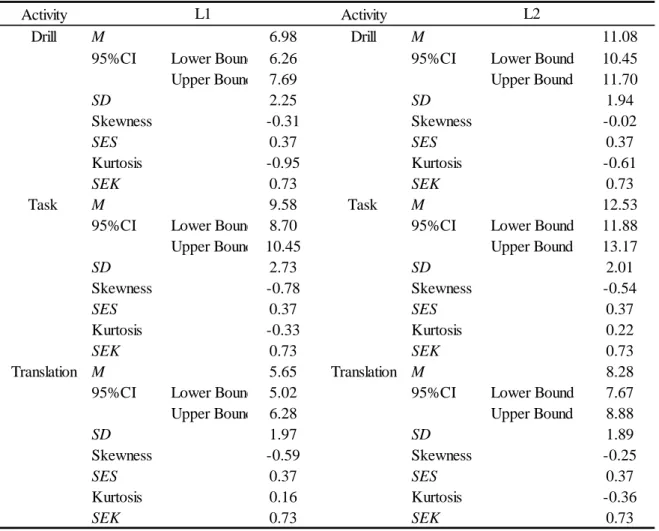
15. Descriptive Statistics of One-way Repeated-measures ANOVA…………..………..63
16. Multivariate Test Results of the One-Way Repeated- Measures ANOVA……….….65
17. Univariate Test Results of the One-Way Repeated-Measures ANOVA……….…….65
18. Pair-wise Comparisons Results………...67
19. Correlations Between the Frequency of Items Written in the Uptake Chart and the Frequency of Items Correctly Answered……….………..………68
20. Descriptive Statistics for Total Gain Scores………....……69
21. Multivariate Test Results for the Two-Way Repeated Measures ANOVA on the Total Gain Scores……….…………..………..70
xiv
22. Univariate Test Results for the Two-Way Repeated Measures ANOVA
on the Total Gain Scores………....………..………..70 23. The Results of Activity Pair-wise Comparisons on the Total Gain Scores……...…..71 24. The Results of Activity and Language Pair-wise Comparisons
on the Total Gain Scores………..……….……..72 25. Descriptive Statistics of Vocabulary Gain Scores ………...…….…..73 26. Multivariate Test Results of Two-Way Repeated Measures ANOVA
of Vocabulary Gain Scores……….…..………...……..….74 27. Univariate Test Results for the Two-Way Repeated Measures ANOVA
on the Vocabulary Gain Scores……….….74 28. The Results of Activity Pair-wise Comparisons on the Vocabulary Gain Scores…...75 29. The Results of Activity and Language Pair-wise Comparisons
on the Vocabulary Gain Scores……….……….….75 30. Descriptive Statistics for the two-way repeated ANOVA
on the Sentence Gain Scores………...……..……….…77 31. Multivariate Test Results for the Two-Way Repeated Measures ANOVA
on the Sentence Gain Scores………...………...78 32. Univariate Test Results for the Two-Way Repeated Measures ANOVA
on the Sentence Gain Scores……….….78 33. The Results for the Activity Pair-wise Comparisons
on the Sentence Gain Scores…...79 34. Descriptive Statistics for the two-way repeated ANOVA on the
Grammar Gain Scores………..………..80 35. Multivariate Test Results for the Two-Way Repeated Measures ANOVA
on the Grammar Gain Scores……….……81 36. Univariate test Results for the Two-Way Repeated Measures ANOVA
on the Grammar Gain Scores……….…81 37. The Results for the Activity Pair-wise Comparisons on the Grammar Gain Scores...82 38. The Uptake Seen in the Transcriptions and Uptake Written in the
xv
39. Types and Tokens for Classroom Utterances in Junior High School Classes……...86 40. Types and Tokens for Direction, Question, Feedback, Response,
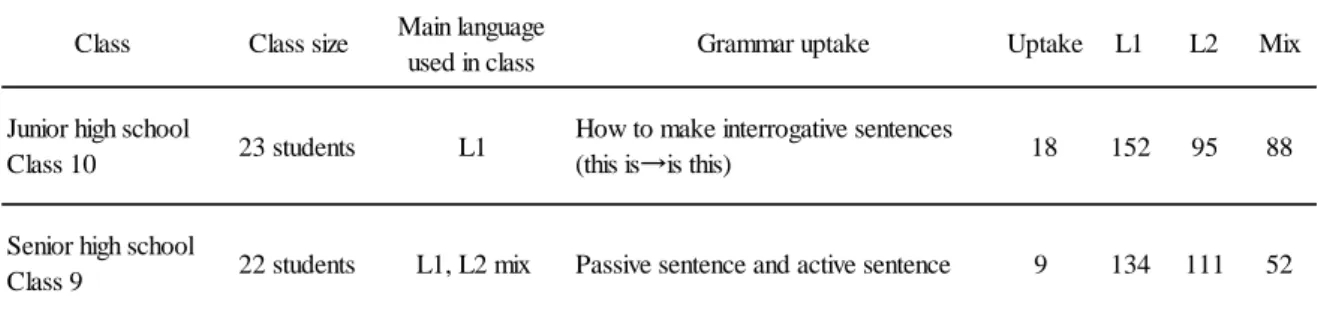
and Initiation in Junior High School Classes…….………..…..87 41. Characteristics of Junior High School Groups with Different Language Use...……88 42. Descriptive Statistics for the Vocabulary Uptake for Kruskal-Wallis Tests
in Different Language Use Groups……….………....89 43. Descriptive Statistics for the Sentence uptake for Kruskal-Wallis Tests
in Different Language Use Groups………..………..89 44. Descriptive Statistics for the Grammar Uptake for Kruskal-Wallis Tests
in Different Language Use Groups……….………..…..90 45. Descriptive Statistics for the Total Uptake for Kruskal-Wallis Tests
in Different Language Use Groups……….90 46. The results for the Mann-Whitney U Test between Different
Language Use Groups…...91 47. Characteristics of Junior High School Groups with Different Activities………92 48. Descriptive Statistics for the Vocabulary Uptake for Kruskal-Wallis Tests
in Different Activity Groups...93 49. Descriptive Statistics for the Sentence Uptake for Kruskal-Wallis Tests
in Different Activity Groups……….………...93 50. Descriptive Statistics for the Grammar Uptake for Kruskal-Wallis Tests
in Different Activity Groups……….………..………..….93 51. Descriptive Statistics for the Total Uptake for Kruskal-Wallis Tests
in Different Activity Groups……….………..…..….94 52. The results for the Mann-Whitney U test between Groups with Different Activity...95 53. Types and Tokens of Classroom Utterances in Senior High School Classes……...97 54. Types and Tokens for Directions, Questions, Feedback, Responses,
and Initiations in Senior High School Classes………..…………..………...98 55. Characteristics of Senior High School Groups with Different Language Use………99 56. Descriptive Statistics for the Vocabulary Uptake for Kruskal-Wallis Tests
xvi
57. Descriptive Statistics for the Sentence Uptake for Kruskal-Wallis Tests
in Different Language Use Groups………99 58. Descriptive Statistics for the Grammar Uptake for Kruskal-Wallis Tests
in Different Language Use Groups………..………100 59. Descriptive Statistics for the Total Uptake for Kruskal-Wallis Tests
in Different Language Use Groups………..………100 60. The results for the Mann-Whitney U test between
Different Language Use Groups………...………101 61. Characteristics of Senior High School Groups with Different Activities………….103 62. Descriptive Statistics for the Vocabulary Uptake for Kruskal-Wallis Tests
in Different Activity Groups………..………..…103 63. Descriptive Statistics for the Sentence Uptake for Kruskal-Wallis Tests
in Different Activity Groups………..……….…….103 64. Descriptive Statistics for the Grammar Uptake for Kruskal-Wallis Tests
in Different Activity Groups…………..……….….104 65. Descriptive Statistics for the Total Uptake for Kruskal-Wallis Tests
in Different Activity Groups………..……….……….104 66. The results for the Mann-Whitney U test between Groups
with Different Activity………....….105 67. The Largest Grammar Uptake and the Teacher’s Utterances
xvii
LIST OF FIGURES
Figure Page
1. Classroom learning processes hierarchy….……….………....…….6
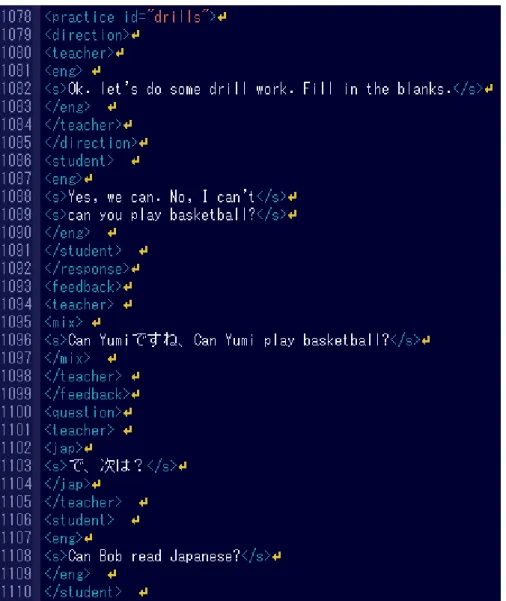
2. Tagged classroom transcriptions sample. ………..…….56
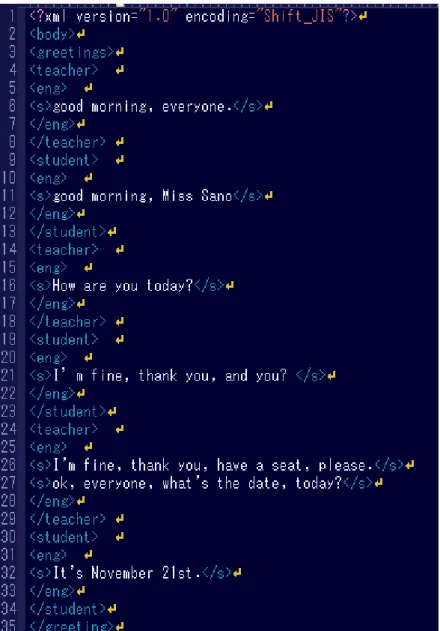
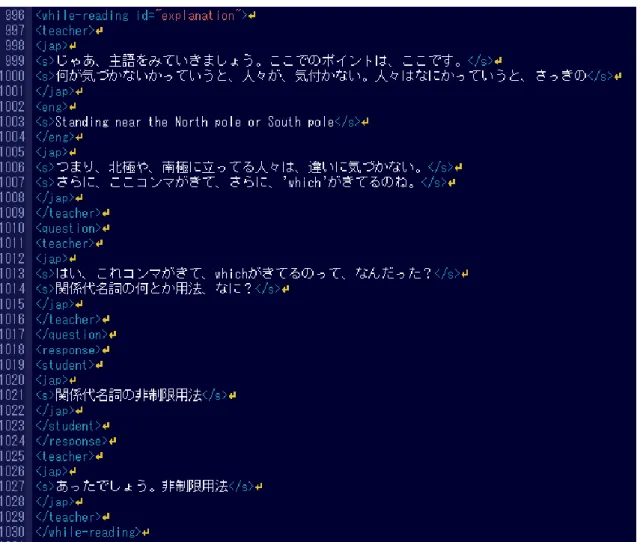
3. Tagged utterances example in ‘Greeting’ category. ………..……….……..147
4. Tagged utterances example in ‘Review’ category. ……….……..147
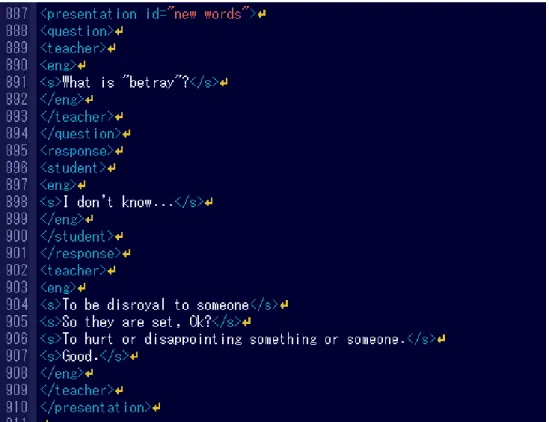
5. Tagged utterances example in ‘New vocabulary’ category. ………...……..148
6. Tagged utterances example in ‘New structure’ category. ……….…….……..148
7. Tagged utterances example in ‘Drill practice’ category. ………....……..149
8. Tagged utterances example in ‘Language-learning task’ category. ………...……..150
9. Tagged utterances example in ‘Oral introduction and reading aloud’ category……151
10. Tagged utterances example in ‘Translation’ category. ………..….……..151
11. Tagged utterances example in ‘Explanation’ category. ……….……….……..152
12. Tagged utterances example in ‘Listening’ category. ……….……….……..152
13. Tagged utterances example in ‘Consolidation’ category. ………….…….….……..153
14. Tagged utterances example in Discorse function category. …….……….…..……..153
15. Vocabulary uptakes Comparisons among selected junior high school classes with different language Use. ..………...…..154
16. English sentence uptakes comparisons among selected junior high school classes with different language use. ………...………...…..154
xviii
classes with different language use. ………...……...…..155 18. Total uptakes comparisons among selected junior high school classes
with different language use………...………...…..155
19. Vocabulary uptakes comparisons among selected junior high school classes
with different activity. ……...………...………...…..156 20. English sentence uptakes comparisons among selected junior high school
classes with different activity. ………...………...…...…..156 21. Grammar uptakes comparisons among selected junior high school classes
with different activity. ………...………...…………...…..157
22. Total uptakes among comparisons selected junior high school classes
with different activity. ………...……...………...…..157 23. Vocabulary uptakes comparisons among selected senior high school classes
with different language use. ………...……...………...………...…..158 24. English sentence uptakes comparisons among selected senior high school classes
with different language use. ………...……...………...………...…..158 25. Grammar uptakes comparisons among selected senior high school classes
with different language use. ………...……...………...………...…..159 26. Total uptakes comparisons among selected senior high school classes
with different language use. ………...……...………...………...…..159 27. Vocabulary uptakes comparisons among selected senior high school classes
with different activity. ………...……...………...………...…..160 28. English sentence uptakes comparisons among selected senior high school classes
with different activity. ………...……...………...………...…..160 29. Grammar uptakes comparisons among selected senior high school classes
with different activity. ………...……...………...………...…..161 30. Total uptakes comparisons among selected senior high school classes
xix
ABBREVIATIONS AND KEY TERMS
AntConc A freeware concordance program for English words. ANOVA Analysis of variance.
Corpus A collection of written texts on a particular subject. Drill Mechanical and meaningful activities in which students
acquire the form taught by teachers through examples or explanation.
EFL English as a foreign language.
Input The language to which a learner is exposed. KhCorder A free software for text mining.
Language-learning task Activities in which learners use the learned form of the target language and perform workplans with emphasis on meaning. L1 The learners’ first language or mother tongue.
L2 The learners’ second language or target language. M Mean, the average.
Mixed L1 and L2 mixed language. SD Standard Deviation.
Translation Activities in which teachers explain grammatical points through the work of translation.
Type The number of different items. Token The frequency of total words.
Utterance A stream of speech with at least one of the following characteristics: (a) under the intonation contour, (b) bounded by pauses, and (c) constituting a single semantic unit.
1
CHAPTER 1 INTRODUCTION
Background of the Present Study
Since the curriculum guidelines issued by the Japanese Ministry of Education, Culture, Sports, Science and Technology (MEXT) in 2008 brought about considerable changes, foreign language education in Japan has been expected to change. English education in elementary school started in Japan and it has become compulsory in 2013. The goal of English education was established by MEXT at each stage of education. In elementary school, it is to prepare the ground for communicating in English and in junior high school, it is to cultivate a basic knowledge of communicating in English. In senior high school, the goal extends to include cultivating communication ability in English.
Along with English education in elementary school, the amended curriculum guidelines emphasize a series of educational goals with the aim of cultivating communication ability in English. Because communication ability is focused on, whether teachers are allowed to use the students’ mother tongue (L1) in foreign language classrooms where teachers and students share the same L1 has been a crucial issue. Kaneko (1991) recorded 23 Japanese EFL (English as a Foreign Language) classes and examined what the role of the L1 is in classroom interaction. She showed that the L1 is used for core goals, which relate to the explicit pedagogic purpose of the lesson and most Japanese teachers depend on the L1; however, it is the target language (L2) that can most influence students’ learning. Although using the L2 is said to be beneficial for students’ learning, the L2 classroom language environment in Japan seems not to have changed drastically even after 20 years since Kaneko’s (1991) study. This study aims to investigate current practices in language classrooms in Japan as to the extent to which teachers
2
actually use the L2 or the L1 in classrooms and examine how and in what context L2 use in classrooms is beneficial for students’ learning.
The following two sections introduce what motivated me to conduct this study and outline my aims in doing so. The organization of the study will be presented in the last section of this chapter.
The Present Language Educational Settings in Japan
The latest curriculum guidelines introduced by MEXT in Japan encourage teachers to use the target language in classrooms. The curriculum guidelines issued in 1998 focused on practical communication skills. Moreover, in 2008, the amendment that English classes should be given in English was included in the junior high school guidelines. However, using the L2 in classrooms is not yet prevalent. Some teachers still predominantly depend on the L1. In addition, not only the languages used in class but also the teaching conditions are different among classes. Historically, several studies concerning the use of the language in class (see Chapter 2), also show that each language used by teachers has a role.
In Japanese educational settings, for example, Kaneko’s (1991) study showed that instead of the L2, the target language, teachers use their shared L1, the native language, with students in class as a convenient and useful tool to facilitate communication. In the Japanese educational environment, students tend to study English only because English is included in the major subjects in the entrance examination to universities. Teachers also tend to focus on lessons for entrance examinations. Unlike the statements issued by the curriculum guidelines, English cannot be the main medium of verbal communication in English classes and students are furthermore less exposed to the practical use of the L2 than the L1. In this context, it is worth trying to explore teachers’ and students’ actual use of the L1 and the L2 in present language classes.
3
In a study of the use of the L1 and the L2 in Japanese classrooms, Ohashi (2012) recorded three language classes. It was found that for each class, the language used by the teachers and students as well as activities, were different, although the purpose of language learning was almost the same. This finding led me to wonder if the differences in the use of language and class activities might influence students’ learning.
Lightbown and Spada (2006) describe learning conditions such as the learners’ characteristics, the language used by teachers or activities done in classrooms as “context” for language learning (p.29). Referring to this word, the authors call what is occurring in classrooms such as languages used by teachers or students and activities carried out in classrooms as “classroom context.”
Depending on classroom context, what is occurring in classrooms such as languages used by teachers or students and activities carried out, the author believe that students’ learning might be different and that is why investigating how classroom context affects students’ learning is essential. Thus, by investigating the relationship between students’ learning and classroom context, the author would like to examine what can facilitate students’ learning with the focus on the classroom context, namely languages used in classroom and activities carried out in class.
To examine how well students are learning, this study adopts an ‘uptake chart,’ in which students write what they think they learned on the day after each class. Some studies, such as Slimani (1987) and Kaneko (1991), adopted an ‘uptake chart,’ referring to the definition of ‘uptake’ by Allwright (1984). Allwright defines ‘uptake’ as what students claim to have learned at the end of the lesson, and in this study, I use the term ‘uptake’ as ‘what students claim to have learned in class.’ There is a variety of statements defined as ‘uptake’ by different researchers. Studies of uptake will be explained in Chapter 2.
4
Aims of the Present Study
Knowing the present situation of language education in Japan and what is occurring in classrooms is necessary and beneficial. The ultimate goal of this study is to examine the relationship between classroom context and students’ uptake and what can facilitate students’ uptake. To examine classroom context, a corpus was constructed from recorded classes by the author to compare the differences of classroom context among classes. Constructing a corpus will be useful for counting each type and token of tagged words uttered in classes.
By describing the relationship between students’ uptakes and classroom context, and what can facilitate their uptakes, I believe this study can shed light on what language teachers should do to help students effectively learn languages.
Organization of the Study
Chapter 1 explains the background of this study. In Chapter 2, I will review former studies which have a close relationship with the present study on English as a foreign language in the classroom environment. The procedure of statistical methods for this study will be explained in Chapter 3. The statistical results will be reported in Chapter 4, which will be crucial for answering the research questions. Based on the results stated in Chapter 4, a discussion will follow in Chapter 5. Finally, the conclusions of this study will be stated in Chapter 6.
5
CHAPTER 2
LITERATURE REVIEW
Chapter Overview
Lightbown and Spada (2006) state that “A general theory of second language acquisition needs to account for language acquisition by learners with a variety of characteristics in a variety of contexts” (p.33). Lightbown and Spada also point out two different types of context: 1) the learners’ characteristics and 2) the learning conditions such as the language used by teachers or the activities done in the classroom. They suggest thinking about how such characteristics and learning conditions may differ.
Because the aim of this study is to examine the classroom environments where second language acquisition occurs, namely, what is actually occurring in each classroom such as the language the teachers and students use, the interactions between them, and activities given to students, for the purpose of this study, I will focus on the learning conditions (2) stated by Lightbown and Spada (2006) above. The learning conditions play an important role in the learners’ acquisition. Chaudron (1988) and Ellis (1988) argue that it is difficult to establish a correlational relationship between learner participation and their learning because of the difficulties of showing whether the effects are caused only by learners’ participation. However, it is possible to show a relationship by seeing what the students think they learned in class using an uptake chart because the results indicated in the chart are believed to reflect learners’ participation.
In this section, definitions of ‘uptake’ will be reviewed. Then, a review of studies on languages as well as activities used in the classroom will follow. In addition, to compile a corpus for this study, studies on classroom observation will be reviewed so that observation categories can be found in common to make a tagset for the corpus.
6
Students’ Uptake
With regard to the process of language learning, Van Lier (1988) shows a hierarchy of classroom learning processes. According to Van Lier, language learning occurs through the process of exposure, input, and intake. Exposure includes learners’ attention, participation, and interaction. Figure 1 shows the process of learning proposed by Van Lier (1988).
tasks, cooperation, transmission
communication
interaction
participation
attention
Aim: language learning
Input
Exposure Intake
Figure 1. Classroom learning processes hierarchy. Adapted from
"The Classroom and the Language Learner " by Van Lier, L.,1988, p.94. Copyright 1988 by Longman.
Loewen (2013) points out that “Uptake refers to several different constructs in SLA research” (p.675). The most common definition in interactionist research that Loewen (2013) referred to is “learners’ immediate responses to linguistic feedback” (p.675). There are also some other studies which define uptake as a response to teachers’ feedback. Lyster and Ranta (1997) classified uptake as one type of ‘repair,’ in which a learner successfully
7
repairs the initial problem or ‘needs repair,’ where the learner’s response fails to successfully repair the initial utterance.
In contrast, Allwright (1984) defines uptake as what learners report they noticed during or at the end of a lesson. This study argues that students’ uptakes occur in the process from input to intake shown in Figure 1 and it is students’ uptake that is required in learning. It is worth examining what can lead to students’ uptakes in classrooms.
Slimani (1987) tried to examine how interaction in the classroom affects language acquisition. The data for the study consisted of transcriptions of 22 recorded classes taught by different teachers. The subjects were 13 male university students ranging in age from 18 to 21. In Slimani’s (1987) study, the aim of uptake research was to find out “what learners have managed to learn in the midst of the lesson independently of the teacher’s intention” (p.94). Slimani used an uptake chart to measure students’ reported uptake. Mackey (2012) points out that by using an uptake chart, it is possible to elicit information regarding learners’ perceptions and what they notice in class. Kaneko (1991) used an uptake chart to examine students’ uptake in her study. The result showed that the teachers’ or students’ spontaneous use of the L2 tended to facilitate uptakes although the main language used in class was the L1. These studies use Allwright’s (1984) definition of uptake.
Ellis, Basturkmen, and Loewen’s study (2001) takes a different perspective of ‘uptake.’ They investigated private language school classes in New Zealand to see how many successful uptakes occurred. They distinguished successful uptakes from unsuccessful ones. Successful uptakes were defined as “uptake in which a student correctly repaired a linguistic feature or clearly demonstrated understanding of an item,” while unsuccessful uptakes were defined as “uptake where there was no attempt to repair or where an attempted repair failed or where it failed to clearly demonstrate understanding of the targeted feature” (p.299). The result of their study was student-initiated focus on form
8
instruction had more successful uptakes than teacher initiated focus on form instruction. As for the definition of uptake, Ellis, Basturkmen, and Loewen (2001) state that “we wish to take a broader perspective, to acknowledge that uptake can occur even when the previous move does not involve corrective feedback” (p.286). They proposed a definition of uptake as follows:
1) Uptake is a student move. 2) The move is optional.
3) The uptake move occurs in episodes where learners have demonstrated a gap in their knowledge (e.g., by making an error, by asking a question, or by failing to answer a teacher’s question).
4) The uptake move occurs as a reaction to some preceding move in which another participant (usually the teacher) either explicitly or implicitly provides information about a linguistic feature. (p.286)
There are two main ways to define ‘uptake.’ They have a perspective in common in terms of ‘student’s move,’ which is defined in Ellis, Basturkmen, and Loewen (2001).
Being engaged in language teaching in Japanese educational settings, I am interested in examining the relationship between students’ uptake and the current language classroom context. As Mackey (2012) points out, the possibility of eliciting information regarding learners’ perception through an uptake chart, which Kaneko (1991) and Slimani (1987) adopted, can be used to procure information about what learners notice in class. Also, to examine the relationship between students’ uptake and the language classroom context, observing the classroom context is necessary.
9
presented first. Then, studies of classroom activities will be reviewed because languages and activities observed in class are the main components of classroom context which could affect students’ uptake.
Languages Used in Classrooms
As Chaudron (1988) states, it is important to investigate the role of both first language (L1) and target language (TL) use in foreign language classrooms. The L1 is the students’ native language, and the TL or L2 means the language students are learning. The language used in classrooms changes depending on historical background, the teaching methodology and purpose. Hawatt (1984) referred to the Reform Movement, where monolingual L2 teaching methodology was adopted, and said it influenced language teaching method in the late 19th century. Then, the Direct Method took its place, and it prevailed throughout Europe. The use of the L1 was not banned; however, it was rarely used in the Direct Method.
At present, some research, which focuses on teachers’ language use in the classroom, shows that the present teaching methodology should not be monolingual. A number of researchers support using the L1 in foreign language classrooms, while some teachers maximize their use of the TL. In this section, research on teachers’ language use and theories as well as implications will be presented. Macaro (2001) surveyed the research results concerning the use of the L1 in L2 classrooms up to 2000. A number of conclusions can be drawn from his survey: a) None had found a majority of teachers in favor of excluding the L1 completely, b) None had found a suggestion that more L1 should be used than L2 because generally the majority of the interaction was expected to be in the L2, c) The L1 was used mostly for procedural instructions for complex activities, relationship building, control and management, teaching grammar explicitly, and providing brief L1
10
equivalents, d) Learner ability was a major factor in how much L1 was used, and e) Time pressure (e.g. exams) was another major factor in how much L1 was used. Based on the findings above, Macaro introduced three theoretical positions for teachers to consider. They were:
1. The Virtual Position
The classroom is like the target country. Therefore, we should aim at total exclusion of the L1. There is no pedagogical value in L1 use. The L1 can be excluded from the FL classrooms as long as the teacher is skilled enough.
2. The Maximal Position
There is no pedagogical value in L1 use; however, perfect teaching and learning conditions do not exist and therefore teachers have to resort to the L1.
3. The Optimal Position
There is some pedagogical value in L1 use. Some aspects of learning may actually be enhanced by the use of the L1. There should therefore be a constant exploration of pedagogical principles regarding whether, and in what ways, L1 use is justified.
Existing literature can be classified into the three positions stated above by Macaro (2001), although there are some exceptions.
11
Research Supporting L1 Use
A number of studies show a positive effect of L1 use, and the use of the L1 in the classroom is supported. This research can be included in The Optimal Position. The benefits of using the L1 in the sociocultural interactionist approach, consciousness-raising, and task-based approaches are supported, showing how learners use the L1 when engaged in collaborative L2 learning tasks (Brooks & Donato, 1994; Cook, 2001; Scottt, V. and de la Fuente, M, 2008; Carless, D., 2007). There is some research that refers to a framework based on Vygotskian psycholinguistics (Anton & DiCamilla, 1998; Storch & Wiggleworth, 2003; Brooks & Donato, 1994). They agreed on the role of the L1 in students’ collaborative interactions.
Anton and DiCamilla (1998) studied the use of the L1 in the collaborative interaction of L2 learners. They stated that, within the sociocultural perspective, the use of the L1 is beneficial for language learning because it acts as a critical psychological tool that enables learners to construct effective collaborative dialogues in the completion of meaning-based language tasks. They found that the L1 serves not only cognitive functions, but social functions as well in students’ collaborative interactions. The study suggests that students’ use of the L1 in collaborative interactions such as group work is necessary. In this research, although the importance of using the L1 among students is stated, the role of the L1 in classroom interaction between students and teachers is not discussed.
Storch and Wigglesworth (2003) investigated the amount of L1 use in an ESL class. They recorded some classes and checked whether learners were using their L1 as a mediating tool, and then they analyzed which cognitive functions were seen in the students’ task completion. Each episode was then coded for their functions. They were: a) task management, b) task clarification, c) vocabulary and meaning, and d) grammar. The above functions were similar to those introduced by Swain and Lapkin (2000). The results
12
show that these functions are clearly related to the use of the L1 as a mediating tool that facilitates task completion. They concluded that the L1 enabled learners to complete tasks at a higher cognitive level especially when they work collaboratively. Cook (2001) also supports the use of the L1 in task learning and states that through the L1, students may explain the task to each other, negotiate roles based on which role they are going to take, or check their understanding or production of language against that of their peers. Cook supports the use of the L1 and suggested some ways of introducing the L1 into the classroom as follows:
1) To convey and check the meanings of words or sentences via the L1. 2) Teacher’s use of the L1 for explaining grammar.
Referring to Mohamed & Acklam (1992) who showed the difficulty of explaining the meaning of words in the L2, Cook stated that the L1 can be used for the checking of comprehension. Also, Cook recommended using the L1 in explicit grammar teaching and said even advanced L2 users are less efficient at absorbing information from the L2 than from the L1. Cook’s (2001) statement supports the ideas of Brooks & Donato (1994), in which they explain that L1 use is a normal psycholinguistic process that facilitates L2 production and allows the learners both to initiate and sustain verbal interaction with one another. The above studies support L1 use in task-based learning where ‘scaffolding’ occurs. Cook notes that the purposes of using the L1 clearly fit well with the overall rationale for using the task-based learning approach. The term ‘scaffolding’ comes from the work of Wood, Bruner and Ross (1976), in which ‘scaffolding’ is defined as the type of assistance offered by a teacher or peer to support learning.
13
engaged in consciousness-raising, form-focused tasks. The findings suggest that the exclusive use of the L2 during consciousness-raising, form-focused tasks may impose cognitive demands on learners, which might have a negative impact on the allocation of cognitive resources for the task. On the other hand, using the L1 for these kinds of tasks may reduce cognitive overload, sustain collaborative interaction, and foster the development of metalinguistic terminology.
As mentioned above, research supports Vygotskyan approaches stating that language learning activity must be viewed as cognitive activity. Considering Vygotskyan perspectives, activities with L1 use, which can lead to learning, could be effective for L2 learners to develop their acquisition as well as to build up interlinked L1 and L2 knowledge in the students’ minds.
Some studies support the use of the L1 even in immersion classes (Behan & Turnbull, 1997; Swain, M. & Lapkin, S. 2000). Phillipson (1992) argued from sociolinguistic perspectives that imposing the exclusive use of the TL on the classroom is a form of linguistic imperialism. Based on his claims, even in immersion classes, using the L1 seems to be required in task-based activities. In the research by Behan and Turnbull (1997), French immersion students using their L1 completed their task better than those who were using the L2 only. They concluded that using the L1 can both support and enhance L2 development. They considered the L1 as an effective tool for dealing with cognitively demanding content. Swain and Lapkin (2000) also recorded French immersion classes, and the results showed that depending on the task, the quantity of L1 use was different. There were tasks which require less use of the L1 among higher-achieving students whereas the same tasks require more use of the L1 among lower-achieving students compared to other tasks. As shown by this research, the L1 was used even in immersion classrooms to some extent, and it served important cognitive and social functions.
14
Although the studies above reveal the effect of using the students’ L1, they also point out the need to use the L2 as well. Cook notes that code-switching is a natural phenomenon in settings where speakers have a shared language, which implies the L2 should be used. Edstrom (2009) comments that L1 use is inextricably tied to classroom circumstances and can neither be determined nor easily generalized from one context to another.
Research Recommending the Use of the TL Instead of the L1
Some research views using only the L2 in a favorable light, which belongs to the Virtual Position (Chambers, F., 1991; Macdonald, C., 1993; Cummins, 2005). F. Chambers (1991) pointed out the possibilities of using the L2 as the normal means of communication in class if instruction is systematically given in the L2 with a planned approach and materials. Cummins (2005) described two-way bilingual immersion programs in which instruction should be exclusively in the target language and translation should be avoided. Although most research supporting the Vygotskian theory provides favorable results for using the L1, some research in favour of the use of the L2 alone in the classroom is also supported by Vygotskian sociolcultural theory. Their theoretical perspective is that language is understood as a mediating tool for deriving cognitive functions from social activities.
As for motivation, Macdonald (1993) argues that the teacher’s maximized use of the TL has an impact on student motivation. He maximized his own use of French in the classroom, resulting in students’ comments that they learned more by the end of the year.
Research Neither Opposing nor Supporting the Use of the L1
There are some studies showing an intermediate position regarding the use of the L1 (Ellis, 1984; Krashen, 1988; Chaudron, 1988; Atkinson, 1993; Edstrom 2009). Atkinson
15
(1993) referred to Krashen’s (1988) monitor theory and said that the belief that L2 teachers and learners should use only the L2 is based on the theory that acquisition is different from learning. He adopts an intermediate position arguing that there was no research to support the use of only the L2. Ellis (1984) states that the teacher should use the students’ L1 as little as possible in order to maximize students’ exposure to L2 input. Chaudron (1988) and Edstrom (2009) believe that it is not teachers, but learners that can decide the language choice. Chaudron argues that what is important is to study the effects of TL and L1 use in the development of L2 proficiency. Edstrom (2009) states that learners themselves constitute an extremely important variable in determining whether or not L1 use is appropriate.
Research of Actual Classes: the Amount of L1 and L2 Use
Some research showed significant amounts of L1 use in classes (Kaneko, 1991; Polio & Duff, 1994), while there are also studies that show the results of relatively low frequencies of L1 use (Macaro, 2001; Kim & Elder, 2005). Kaneko collected data from 23 EFL classes with about 24 students in each class. Sixty-five percent of total teacher talk was in the L1, while the L2 was used only 17 % of the time. Polio and Duff (1994) researched six university EFL classes and revealed that most teachers used the L1 rather than the L2. They described problems that teachers encounter in their use of the L1 and L2 in the language classroom, such as: a) Teachers have little idea about when, how, and how often the L1 should be used, b) Using the L2 requires more time in ‘negotiation of meaning,’ so teachers tend to resort to the L1, which deprives students of the opportunities to negotiate in the L2 that can develop their strategies.
On the other hand, Kim and Elder researched four EFL classes with an average number of 16 students. Their results showed that all the participating teachers used the L2
16
as the medium of instruction unless the activity was complicated. As Polio and Duff state, although there appeared to be no systematic relationship between teachers’ language choices and particular pedagogic functions, the research revealed that the TL was the dominant language for modeling, correcting, and scaffolding. These are three strategies that can help students learn either a grammatical structure or pronunciation in the TL. Also, they stated that teachers’ language choice varies depending on the type of lesson and teachers’ beliefs about language learning, and their attitudes to the TL greatly affect language choices. Their study revealed that the quality of the TL used in class as well as the quantity of the TL input should be considered.
Macaro (2001) researched 14 classes taught by six teachers, where French was the L2 and English was the L1 of the learners, and revealed that the amount of L1 use was from 0.0% to 15.2 % as a proportion of the different lessons. In only two lessons was the total L1 use more than 10 percent, which is well below the reported L1 use in the literature by Kaneko (1991) or Polio and Duff (1994). There does not appear to be a link between teacher code-switching and students’ L1/L2 use. Macaro also states in the paper that students’ use of the L2 was not brought about by higher amounts of the teacher’s L2 use.
Students’ Views, Anxieties, Beliefs, and Attitudes Regarding the Use of the L1 and the TL
Storch and Wigglesworth (2003) administered a questionnaire about students’ attitudes toward the use of their L1 in completing tasks in an L2 setting. Students found using their L1 useful in the following ways: a) Their use of the L1 enabled them to provide definitions of difficult vocabulary and explanations of grammar, particularly when they did not have the required metalanguage, b) The L1 made it easier for them to negotiate and provide justifications for grammatical choices.
17
Whereas most students noted that the L1 was beneficial in completing their tasks, the students’ interview data showed that students were reluctant to use their shared L1 for these two reasons: a) The use of the L1 would slow down the activity, b) They believed that they should use their L2 as much as possible in an ESL setting.
Levine (2003) presents the results of an Internet-based questionnaire study on TL and L1 use in university-level foreign language classes. He concluded that denying a role for the L1 is futile, and that learners should play an active role in managing the use of the L1 and the L2 to create bilingual norms that are typical of multilingual environments outside the classroom. Moreover, he made a case for using the L1 as a useful tool in the classroom to relieve anxiety.
In a study by Macaro (1997), students willingly used the L1 for classroom management. However, Ianziti and Varshney’s (2008) study showed different results. Most students favorably used the L2.
While most researchers recognized the role of the L1, Ianziti and Varshney’s (2008) research implied that L1 use may alleviate classroom anxiety. However, it can also be a demotivating factor as well, which could be regarded as one of the problems of using the L1. In sum, from the questionnaire studies above, it can be said that students’ attitudes vary depending on their background details such as their age, educational history, major, and even whether they share the same L1.
Reasons for L1 Use
There are some studies which focused on how often and in which contexts teachers use the L1 in classrooms. The following is a list of common contexts where the L1 was used in second or foreign language classrooms. Many of the functions of teachers’ L1 use correspond to those introduced by Polio and Duff (1994), which are shown below:
18
a) Grammar explanation (Cook,2001; Polio & Duff, 1994; Kim & Elder, 2005; Edstrom, 2006)
b) L1’s efficacy for task-based learning, the use of the L1 can enable learners to complete tasks (Cook,2001)
c) Vocabulary (translation of unknown vocabulary/ administrative vocabulary) (Polio & Duff, 1994; Cook, 2001; Storch and Wigglesworth, 2003)
d) Classroom management, procedural instruction for activities (Polio & Duff,1994; Macaro, 2001; Edstrom, 2006)
e) Clarification when students are confused (Polio & Duff,1994; Kim & Elder, 2005; Edstrom, 2006)
f) In response to the students’ use of the L1 (Polio & Duff, 1994) g) Reprimand (Edstrom, 2009; Macaro, 2001)
Kim and Elder (2005) state that teachers’ language choices vary depending on the type of lesson, and that teachers’ beliefs about language learning and attitudes to the TL greatly affect language choices. Edstrom’s comment (2009) about L1 use in grammar explanation, which seems to be supported by a number of teachers, is shown below:
What is appropriate or justifiable depends on a number of factors including the grammatical concept to be presented, the learners’ level and prior language learning experience, the reason for which learners need to learn or use that particular grammar point, as well as unanticipated student reactions. Generalization’s about L1 use become even more problematic when one evaluates the more subjective aspects of language teaching. (p.15)
19
In Kaneko’s (1991) work on the English educational settings in Japan, she researched how often and for which functions Japanese teachers use the L1 in classrooms. Using three categories (core goals, framework goals, and social goals as per Ellis, 1984), L1 and L2 utterances and students’ uptake were analyzed. Fifty percent of the teachers’ L1 utterances were core goals, 17% were framework goals and 6% were social goals. Kaneko’s research revealed first that the L1 was the main language used in class and also that, in fact, teachers’ use of the L1 had little effect on students’ uptake. It was students’ L2 use that contributed to their uptake. Moreover, the more L1 teachers used, the less uptake students had.
In Yoshida and Yanase’s study (2003), although they show the importance of Japanese, the L1, which can play an important role in a monolingual culture, they also show the effectiveness of using the TL with young learners as well. They imply the choice of language should be adjusted depending on the class situation.
Students sharing the same L1 might be exposed to more L1 than L2. As Kaneko’s (1991) study showed, the percentage of L1 use in the classrooms was quite high; however, using too much L1 might not lead to students’ uptake.
Summarizing the above studies, most researchers support L1 use. However, they stress the necessity of using the L2 as well. As Stern (1992) argues, keeping the languages visibly separate in language teaching contradicts the invisible processes in students’ minds. This means the L1 and L2 should be connected in the foreign language classroom.
Different positions draw on different perspectives. In the ideas of collaborative interaction in the L2 classroom stated above (Anton, M. & Dicamilla, F., 1998; Brooks, F., & Donato, R., 1994), the L1 is said to enable students to negotiate meaning and communicate successfully in the TL. Chaudron (1991) also said one way to ensure that