• 検索結果がありません。

When Frequent (Pandemic) Occurs in a Non-Frequent Disease: COVID-19 and Fabry Disease: Report of Two Cases

N/A
N/A
Protected

Academic year: 2021

シェア "When Frequent (Pandemic) Occurs in a Non-Frequent Disease: COVID-19 and Fabry Disease: Report of Two Cases"

Copied!
5
0
0

読み込み中.... (全文を見る)

全文

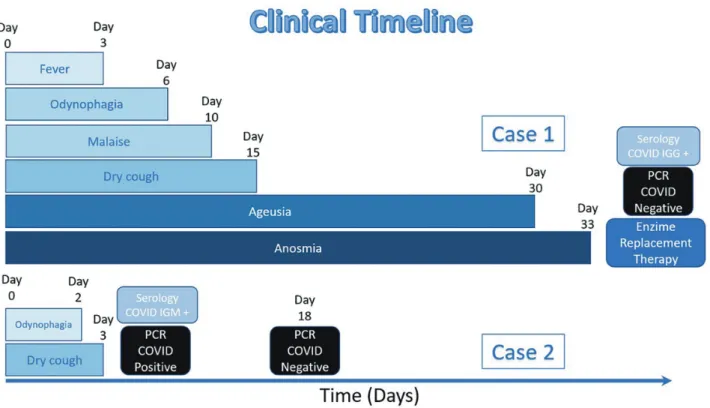
228. INTRODUCTION Fabry d isease (FD) i s a lysosomal s torage. disease caused by a deficiency of the enzyme alpha galactosidase A, which stems from a genetic mutation of the X chromosome (1). Depending on the level of involvement and the expressed genetic variant, FD has various clinical presentations. It can affect multiple organs, including the kidneys, heart, or lungs, among others (1,2).. Coronavirus disease 2019 (COVID-19) is caused by severe acute respiratory syndrome coronavirus 2 (SARS-CoV-2) that mainly affects the lungs and can produce diverse clinical manifestations ranging from asymptomatic forms to severe lung involvement and even multi-organ dysfunction (3–5). Thus, the fatality rate of COVID-19 is 13–30% (6–8), with the highest in Peru (8). Risk factors associated with a severe COVID-19 disease include old age, diabetes, hypertension, obesity, and chronic kidney disease (9– 11).. Patients who have an increased risk of serious clinical manifestations due to COVID-19 are those who have. had a previous lung disease and comorbidities, causing a major concern in patients with FD (2).. On the other hand, SARS-CoV-2 has the angiotensin converting enzyme type 2 (ACE-2) receptor, which is its main host cell receptor. ACE2 mRNA is expressed in the lungs, heart, blood vessels, and kidneys, among others. The genetic regulation of this receptor is controlled by the genes present in the X chromosome (12), a chromosome that is altered in FD (1,13). To date, the significance of this mutation for the COVID-19 infection has not been elucidated. Therefore, whether it favors the infection or generates protection against COVID-19 is unknown. Low expression of ACE2 mRNA is also associated with hypertension, dyslipidemia, and/or heart failure in patients with COVID-19 (12).. Thus, the aim of this study is to present 2 patients with FD who were infected with the COVID-19. Therefore, our report sheds light on the clinical course of patients who have these 2 diseases simultaneously.. MATERIALS AND METHODS Two patients who had both FD and COVID-19 were. treated at the National Hospital in Lima, Peru.. RESULTS CASE 1: A 49-year-old woman was diagnosed with. FD 7 years ago, as she was suffering from proteinuria and paresthesias for 6 months. The diagnosis involved a genetic tests that detected a likely pathogenic mutation. Original Article. When Frequent (Pandemic) Occurs in a Non-Frequent Disease: COVID-19 and Fabry Disease: Report of Two Cases. Martín Gómez-Luján1,2, Cesar Cruzalegui1, Cristian Aguilar3,5, Mayita Alvarez-Vargas4,5, and Pedro Segura-Saldaña5,6,7*. 1Department of Nephrology and 6Department of Cardiology, Edgardo Rebagliati Martins National Hospital, Lima; 2Federico Villarreal National University, Lima;. 3Pathology Laboratory, Cardiovascular National Institute, Lima; 4Department of Internal Medicine, Guillermo Almenara Irigoyen National Hospital, Lima; . 5Department of Cardiology Research, Torres de Salud National Research Center, Lima; and 7Biomedical Engineering, Universidad Peruana Cayetano Heredia, Lima, Peru . SUMMARY: Fabry disease (FD), like COVID-19, can affect multiple organs, including the lungs. Patients with FD are expected to develop severe COVID-19, due to involvement of not only the lungs but also the kidneys and the presence of other comorbidities. We present 2 cases of mild COVID-19 in patients with FD who were infected with the COVID-19 virus. Although it is unknown whether the X chromosome mutation in patients with FD affects the development of severe COVID-19, it is suggested that it may play a protective role against COVID-19 infection. Based on these cases, we suggest that FD is not a risk factor for severe COVID-19.. Received August 25, 2020. Accepted October 22, 2020. J-STAGE Advance Publication November 30, 2020. DOI: 10.7883/yoken.JJID.2020.729 * Corresponding author: Mailing address: Department of. Nephrology, Edgardo Rebagliati Martins National Hospital, 160 Emilio Fernandez Street Apartment1204, Cercado de Lima, Lima, Peru. Tel: +51947496600, E-mail: pedro. [email protected]. Jpn. J. Infect. Dis., 74, 228-232, 2021. COVID-19 and Fabry Disease. 229. c.389A > C (p.Lys130Thr). Her kidney biopsy showed typical FD lesions on electron microscopy (EM), and histopathological damage was accompanied by undescended kidney function, which indicates stage 1 chronic kidney disease. The patient was subjected to enzyme replacement therapy (ERT) with 1 mg/kg of agalsidase beta every 15 days. Moreover, the patient was treated with 5 mg QD of intravenous (IV) enalapril.. Thirty-three days before hospitalization, the patient complained of fever (39°C) for 3 consecutive days and odynophagia for 6 days, malaise for 10 days, dry cough for 26 days, which was more persistent in the first 15 days, and anosmia and ageusia. These were not accompanied by shortness of breath or any other symptoms (Fig. 1).. On day 33, the patient was admitted for ERT administration, with normal vital signs and no pathological findings on physical examination. Following the hospital protocol, a serological test was performed, which revealed IgG-positivity for SARS- CoV-2; subsequently, a real-time reverse transcription polymerase chain reaction (RT-PCR) test was performed, with a negative result. The laboratory data on admission are presented in Table 1. Thorax computed tomography (CT) revealed bilateral ground glass-like subpleural lesions compatible with COVID-19 CO- RADS 2 infection (Fig. 2A, B). Based on these findings, 1 mg/kg of agalsidase beta (Fabrazyme™, SANOFY GENZYNE [Bridgewater, NJ, USA]) was infused without adverse reactions. On day 50, the patient was asymptomatic, in a good overall condition.. CASE 2: A 48-year-old woman was diagnosed with FD 3 years ago, due to the presence of symptomatic sinus bradycardia that required a permanent pacemaker implant and hypertrophic cardiomyopathy, confirmed by genetic tests that detected a pathogenic mutation c.2T>A (p.Met1Lys). A kidney biopsy showed typical. Fig.1. (Color online) Evolution of the disease of reported cases.. Table 1. Laboratory findings at admission of both cases. Parameter at admission Case1 Case 2 Glucose 97 96 Urea (mg/dL) 34 41 Creatinine (mg/dL) 0.58 0.72 GFR (e) CKD-EPI 108.2 99 White blood cells 4,870 7,940 Lymphocytes 2,890 2,612 Hemoglobine 12.9 13.1 Platelets 249,000 279,000 CRP (mg/dL) 0.4 0.5 LDH (UI/L) 226 288 pH 7.37 7.44 pCO2 42.2 32.8 pO2 76.6 96.4 % Sat O2 95 97 % FiO2 21 21 SatO2/FiO2 4.52 4.33 PaO2/FiO2 3.65 4.59 HCO3 23.8 22 Albumin 4.1 4.7 AST (UI/L) 32 30 ALT (UI/L) 26 31 Ferritin (ng/dL) 97 113 D-dimer 0.56 0.67 IgM SARS-CoV-2 No reactive Reactive IgG SARS-CoV-2 Reactive No reactive RT- PCR SARS-CoV-2 No detected Detected. 230. FD lesions on EM, and histopathological damage was accompanied by undescended kidney function, which corresponds to stage 1 chronic kidney disease. The patient was undergoing an ERT with IV agalsidase beta (1 mg/kg every 15 days), she also took 50 mg QD of losartan.. Three days before the admission, the patient was complaining of odynophagia for 2 days, as well as of dry cough for 3 days. She denied fever, malaise, ageusia, anosmia, or respiratory distress.. The patient was admitted for ERT administration on day 4, with normal vital signs and without any pathological findings on physical examination. Following the hospital protocol, a serological test was performed which revealed IgM-positivity for SARS- CoV-2. Subsequently, an RT-PCR molecular test was also positive. The laboratory data on admission are presented in Table 1. In addition, a thoracic CT scan did not show any COVID-19-related lesions (Fig. 2C, D), deferring the start of ERT. The patient was discharged for home isolation. Follow-up appointments were made 14, 50, and 60 days later. During the first follow-up (at day 14), the reactive IgM and IgG were found positive, while the RT-PCR test was negative for COVID-19. At days 50 and 60, the patient remained stable and asymptomatic, but was unable to receive ERT therapy due to logistical problems.. DISCUSSION Patients with FD and COVID-19 in this report had. similar symptoms as the majority of infected people (i.e. mild infection), although these patients would be expected to present moderate-severe forms of COVID-19.. Patients with COVID-19 are asymptomatic in 30–40% of cases, mild in 80%, moderate in 14%, and severe in 5% of patients (4,9,10,14). Our patients were diagnosed with mild COVID, as they were symptomatic but with no evidence of hypoxia or viral pneumonia.. COVID-19-associated symptoms include fever (83– 99%), cough (59–82%), fatigue (44–70%), anorexia (40–84%), dyspnea (31–40%), and myalgia (11–35%), as reported by the World Health Organization (15); therefore, our patients had the most common symptoms.. The first patient (case 1) complained of fever (Fig. 1) that subsided on day 3 and odynophagia that subsided on day 7, similar to the cases in Wuhan reported by Wang et al. (16) with 98% of patients with fever, 59.4% with dry cough and 17.4% with pharyngalgia. Cough in the FD patient persisted for 26 days, while it was more intense and persistent during the first 14 days, while ageusia persisted for 30 days and anosmia for 33 days. The prolongation of the cough could be due to a previous pulmonary condition related to FD. Up to 32.2% of patients with FD have altered lung. Fig. 2. Chest CT scan of both reported cases. Case 1 (A, B): bilateral subpleural ground glass opacifications, CO-RADS 2. Case 2 (C, D): normal CT.. COVID-19 and Fabry Disease. 231. function tests, mainly with altered FEV1 (obstructive pattern) (2,17); however, the patient in case 1 did not report wheezing or any obstructive pulmonary disease symptoms.. The second patient (case 2) developed anosmia from the beginning of the disease, which is aligned with findings of Mao et al. (18) in Chinese patients with a frequency of 5.1% hyposmia and 5.6% hypogeusia. In line, Vaira et al. (19) reported that patients with COVID- 19-related ageusia and anosmia do not suffer from nasal obstruction or other symptoms of rhinitis, probably due to a direct damage of the virus at the level of the olfactory and gustatory receptors. This characteristic was similar also in the first patient. . Among radiological manifestations of the lung damage in COVID-19, pleural thickenings have been reported, including the cobblestone pattern, the predominance of ground glass opacities in bilateral involvement of the lower lobes, and the peripheral and posterior locations (18,20). In the first case, the lesion CO-RADS 2 was present in both lungs with peripheral and posterior location (Fig 2); however, in the second patient with FD, there was no lung injury as evidenced by the CT scan on the 3rd day of the disease. Since the patient remained asymptomatic, a new chest CT scan was not required.. Patient 1, who had positive IgG test, negative RT- PCR test, and tomography revealing lung injury, was in good condition 50 days after the onset of symptoms.. Patient 2, who had dry cough for only 3 days and odynophagia for 2 days, with a positive RT-PCR test and tomography without lung injury (14), was also in good condition 50 days later and remained asymptomatic afterwards.. The first patient with FD and COVID-19 presented positive IgG on day 30 of the illness, probably because the majority of patients with COVID-19 present positive serology from day 17–19 after the start of symptoms (21). Moreover, the sensitivity of serology is reportedly 79.8% (69.9–87.6%) after 15 days (22).. The patient in case 2 had positive serology for IgM (with a sensitivity of 43.8%), probably due to short time since the onset of her symptoms (3 days). RT-PCR tests from nasopharyngeal samples can be positive from the day 3 following the onset of symptoms and are also found in asymptomatic patients (23).. Both cases described here share the same clinical characteristics, disease progression, and prognosis of the general population, despite having FD. Although it is difficult to generalize based on 2 isolated cases, our observations indicate that patients with FD do not have a severe form of the COVID-19 disease. In the general population the presence of comorbidities is associated with more severe forms of COVID-19, and both of the presented cases had chronic kidney disease stage 1 and case 2 had cardiomyopathy, but neither of them presented a severe form of COVID-19. Based on this finding we hypothesize that the underlying mechanism that causes FD (mutation on the X chromosome), and the sex difference in renal ACE2 activity (24), could contribute to a mild form of the COVID-19 disease.. Likewise, no exacerbation of FD symptoms was reported during the time of viral infection in the described cases, especially in the respiratory system. (e.g. wheezing, dyspnea, hemoptysis, or pulmonary thromboembolism triggered by loss of lung elasticity, bronchial hyperreactivity, inflammation of the airway due to accumulation of glycosphingolipids and hyperplasia of smooth muscle cells and respiratory epithelium [1,12,21]). Had such symptoms been present in the reported cases, the etiology of the 2 entities, i.e. FD and COVID-19, would have been indistinguishable.. Another important observation is related to potential safety of ERT infusion when a patient does not have COVID-19 symptoms and when the molecular test is negative, as in the first case, who did not develop any related complications.. A previous report evaluated the impact of the COVID-19 emergency in patients with FD receiving ERT (22), and found, as in the second case, difficulties in infusing the ERT. This was due to multiple factors such as reorganization of infusion centers, fear of infection, and COVID-19 symptoms present in patients. Here, the second patient was unable to receive her ERT doses, which reflects the situation of healthcare in the midst of the COVID-19 pandemic, also in other countries, e.g. in Italy.. This case report is not a categorical basis for any clinical recommendations; however, in rare diseases such as FD, isolated case reports help expand the scientific knowledge of a given condition. More cases of COVID-19 and FD need to be evaluated globally in order to draw further conclusions on the topic.. In conclusion, we described 2 cases of mild SARS- CoV-2 infection in patients with FD. Our observations indicate that FD is not a risk factor for severe COVID19, but further studies are required to fully explain this association.. Acknowledgments The researchers would like to acknowledge all the hospital staff who participate in the medical care of patients with Fabry disease.. Conflict of interest None to declare.. REFERENCES 1. Germain DP. Fabry disease. Orphanet J Rare Dis. 2010;5:30. 2. Jezela‐Stanek A, Chorostowska‐Wynimko J, Tylki‐Szymańska A.. Pulmonary involvement in selected lysosomal storage diseases and the impact of enzyme replacement therapy: a state‐of‐the art review. Clin Respir J. 2020 ;14:422-9.. 3. Sahu K, Mishra A, Lal A. Comprehensive update on current outbreak of novel coronavirus infection (2019-nCoV). Ann Transl Med. 2020;8:393.. 4. Struyf T, Deeks JJ, Dinnes J, et al. Signs and symptoms to determine if a patient presenting in primary care or hospital outpatient settings has COVID-19 disease. Cochrane Database Syst Rev. 2020;7: CD013665.. 5. Singh SP, Pri tam M, Pandey B,et al . Microstructure, pathophysiology and potential therapeutics of COVID‐19: a comprehensive review. J Med Virol.2021;93:275-99.. 6. Cummings MJ, Baldwin MR, Abrams D, et al. Epidemiology, clinical course, and outcomes of critically ill adults with COVID-19 in New York City: a prospective cohort study. Lancet. 2020;395:1763-70.. 7. Zhou F, Yu T, Du R, et al. Clinical course and risk factors for mortality of adult inpatients with COVID-19 in Wuhan, China: a retrospective cohort study. Lancet. 2020;395:1054-62.. 8. Acosta G, Escobar G, Bernaola G, et al. Description of patients with severe COVID-19 treated in a national referral hospital in Peru. Rev Peru Med Exp Salud Publica. 2020;37:253-8.. 232. 9. Guan W, Ni Z, Hu Y, et al. Clinical characteristics of coronavirus disease 2019 in China. N Engl J Med. 2020;382:1708-20.. 10. Huang C, Wang Y, Li X, et al. Clinical features of patients infected with 2019 novel coronavirus in Wuhan, China. Lancet. 2020;395:497-506.. 11. Rodriguez-Morales AJ, Cardona-Ospina JA, Gutiérrez-Ocampo E, et al. Clinical, laboratory and imaging features of COVID-19: a systematic review and meta-analysis. Travel Med Infect Dis. 2020;34:101623.. 12. Devaux CA, Ro la in J -M, Raou l t D . ACE2 recep to r polymorphism: susceptibility to SARS-CoV-2, hypertension, multi-organ failure, and COVID-19 disease outcome. J Microbiol Immunol Infect. 2020;53:425-35.. 13. Gómez M. Fabry disease. Rev Fac Med Hum. 2018;18:1-25. Spanish.. 14. Pascarella G, Strumia A, Piliego C, et al. COVID‐19 diagnosis and management: a comprehensive review. J Intern Med. 2020;288:192- 206.. 15. World Health Organization (WHO). Clinical Management of COVID-19. Available at <https://www.who.int/publications/ i/item/clinical-management-of-covid-19>. Accessed April 27, 2021.. 16. Wang D, Hu B, Hu C, et al. Clinical characteristics of 138 hospitalized patients with 2019 novel coronavirus–infected pneumonia in Wuhan, China. JAMA. 2020;323:1061-9.. 17. Franzen D, Krayenbuehla PA, Lidovec O, et al. Pulmonary. involvement in Fabry disease: overview and perspectives. Eur J Intern Med. 2013;24:707-13.. 18. Mao L, Wang M, Chen S, et al. Neurological manifestations of hospitalized patients with COVID-19 in Wuhan, China: a retrospective case series study medRxiv. 2020. Available at <https://www.medrxiv.org/content/10.1101/2020.02.22.2002650 0v1>. Accessed April 27, 2021.. 19. Vaira LA, Salzano G, Deiana G, et al. Anosmia and ageusia: common findings in COVID‐19 patients. Laryngoscope. 2020;130:1787.. 20. Lv M, Wang M, Yang N, et al. Chest computed tomography for the diagnosis of patients with coronavirus disease 2019 (COVID-19): a rapid review and meta-analysis. Ann Transl Med. 2020;8:622.. 21. Long Q-X, Liu B-Z, Deng H-J, et al. Antibody responses to SARS-CoV-2 in patients with COVID-19. Nat Med. 2020;26:845- 8.. 22. Zhao J, Yuan Q, Wang H, et al. Antibody responses to SARS- CoV-2 in patients of novel coronavirus disease 2019. Clin Infect Dis. 2020;71:2027-34.. 23. Zou L, Ruan F, Huang M, et al. SARS-CoV-2 viral load in upper respiratory specimens of infected patients. N Engl J Med. 2020;382:1177-9.. 24. Klein SL, Dhakal S, Ursin RL, et al. Biological sex impacts COVID-19 outcomes. PLoS Pathog. 2020;16:e1008570.

Table 1. Laboratory findings at admission of both cases  Parameter at admission Case1 Case 2

参照

関連したドキュメント

High rates of long-term renal recovery in survivors of coronavirus disease 2019–associated acute kidney injury requiring kidney replacement therapy.. Figure 1Renal outcomes

This equation encompasses many important integral and functional equations that arise in nonlinear analysis and its applications, in particular integral equations (1.1), (1.2),

Atherosclerosis is a disease of the vasculature that is characterized by an accumulation of lipid-laden immune cells and apoptotic cells in the arterial wall.. Recently, the

7) CDC: Cleaning and Disinfection for Community Facilities (Interim Recommendations for U.S. Community Facilities with Suspected/Confirmed Coronavirus Disease 2019), 1 April, 2020

キーワード:感染症,ストレスマネジメント,健康教育,ソーシャルネットワーキングサービス YOMODA Kenji : Concerns and stress caused by the novel coronavirus disease

Protected Code Stroke: Hyperacute Stroke Management During the Coronavirus Disease 2019 (COVID-19) Pandemic. Temporary Emergency Guidance to US Stroke Centers During the

This thesis tries to examine the conflict between female desire and Victorian ideology in Bront ë’s novels through anal yses of colonial and foreign images.. It will show not onl

Remarks Begin applications prior to disease development and continue on a 7- to 14-day interval.. Use higher rate and shorter interval when disease pressure