Impact of the Bim Deletion Polymorphism on Survival Among Patients With
Completely Resected Non–Small-Cell Lung Carcinoma
Jun Atsumi Kimihiro Shimizu Yoichi Ohtaki Kyoichi Kaira Seiichi Kakegawa Toshiteru Nagashima Yasuaki Enokida Seshiru Nakazawa Kai Obayashi Yoshiaki Takase Osamu Kawashima Mitsuhiro Kamiyoshi- hara
Masayuki Sugano Takashi Ibe Hitoshi Igai Izumi Takeyoshi Authors’ disclosures of potential conflicts of interest and contributions are found at the end of this article.
Corresponding author:
Kimihiro Shimizu, MD, PhD, Department of Thoracic and Visceral Organ Surgery, Gunma University Graduate School of Medicine, 3- 39-22 Showa-machi, Maebashi, Gunma 371- 8511, Japan; e-mail:
Purpose A deletion polymorphism of theBim gene has been reported to be a prognostic factor for patients with non–small-cell lung cancer (NSCLC) treated with epidermal growth factor receptor- tyrosine kinase inhibitors in the Asian population. We investigated the impact of the Bim deletion polymorphism on survival among patients with completely resected NSCLC.
Patients and Methods TheBim polymorphism was detected by polymerase chain reaction analysis.
We measured overall survival (OS) and recurrence-free survival rates in 411 patients and postrecur- rence survival (PRS) in 94 patients who experienced recurrence and received additional anticancer therapy.
Results The Bim deletion polymorphism was detected in 61 patients (14.8%). OS rates were significantly lower for patients with theBim deletion polymorphism than for those with the wild-type sequence. On multivariable analysis, theBimdeletion polymorphism was identified as an independent prognostic factor for OS (hazard ratio, 1.98; 95% CI, 1.17 to 3.36;Pⴝ.011). Among the 94 patients who experienced recurrence and were treated with anticancer therapy, patients with theBimdeletion polymorphism showed significantly poorer PRS than those with the wild-type sequence (median, 9.8 monthsv26.9 months, respectively;P<.001). Multivariable analysis revealed that theBimdeletion polymorphism was an independent predictor of PRS (hazard ratio, 3.36; 95% CI, 1.75 to 6.47; P<
.001). This trend remained apparent in subgroup analyses stratified by EGFR status, histology, and therapeutic modality.
Conclusion TheBimdeletion polymorphism is a novel indicator of shortened PRS among patients with recurrent NSCLC treated with anticancer therapy in the Asian population.
J Glob Oncol 99. © 2015 by American Society of Clinical OncologyLicensed under the Creative Commons Attribution 4.0 License
INTRODUCTION
Lung cancer is the leading cause of cancer death worldwide.1Even after radical surgery in patients with early-stage non–small-cell lung cancer (NSCLC), 30% to 40% of patients experience recurrence within 5 years.2,3Postoperative recur- rent disease is usually treated as metastatic NSCLC. Although molecule-targeted drug therapies such as epidermal growth factor receptor-tyrosine kinase inhibitors (EGFR- TKIs) have produced considerable survival ben- efits in patients with both advanced disease and postoperative recurrence of EGFR-mutated NSCLC,4-8 the majority of patients eventually become refractory to these therapies.
B-cell chronic lymphatic leukemia lymphoma 2-like 11 (BCL2L11), or BIM, is a proapoptotic
member of the Bcl-2 protein family and is a key modulator of EGFR-TKI–induced apoptosis in NSCLC cell lines.9Ng et al10reported a common intronic deletion with a 2,903-base pair (bp) poly- morphism in the gene encoding BIM. This deletion polymorphism leads to impaired expression of BH3-containing BIM isoforms, resulting in resis- tance to EGFR-TKIs in patients with NSCLC who haveEGFR mutations. Interestingly, this deletion polymorphism was observed only in East Asian populations.10 Several clinical studies of East Asian populations have indicated that the Bim deletion polymorphism is an independent prog- nostic factor for progression-free survival in ad- vanced EGFR-mutated NSCLC treated with EGFR-TKIs11,12 and cytotoxic chemotherapy.13 TheBim deletion polymorphism is expected to
original report abstract
be a novel biomarker in anticancer therapy against inoperable NSCLC, especially adenocar- cinoma. Patients with NSCLC who have recur- rence after curative surgery have a more favorable prognosis than those with advanced- stage disease at initial presentation, because patients with NSCLC who have postoperative recurrence have different characteristics from those with stage IV disease.14,15However, there have been no studies regarding the prognostic power of the Bim deletion polymorphism in postoperative patients with lung cancer, includ- ing those with non-adenocarcinoma histology, or the influence of the polymorphism on postrecur- rence treatment.
We hypothesized that the Bim deletion polymor- phism affects survival among patients with postoper- ative recurrent NSCLC who have received anticancer therapy. In this study, we investigated the impact of theBimdeletion polymorphism on the outcomes of patients with completely resected NSCLC.
PATIENTS AND METHODS Patients and data collection
A total of 565 patients with NSCLC who underwent pulmonary resection at Gunma University Hospital between June 2003 and December 2013 were identified in our database. Among these patients, 481 underwent complete resection (lobectomy or greater with systematic lymph node dissection) without induction chemotherapy or radiotherapy.
We excluded patients with residual lesions (mac- roscopically or microscopically apparent), as well as those with pathologic stage IV disease and those without adequate documentation. Consequently, 411 patients were eligible for inclusion in this study. Histologic diagnoses were made on the basis of WHO criteria,16 and disease stage was determined according to the TNM Classification of Malignant Tumors, 7th edition. This study was approved by the ethics committee of Gunma Uni- versity Hospital. Informed consent for a global genome analysis of samples was obtained from each patient before inclusion in the study. Institu- tional review board approval for the study was obtained for the analysis of Bim and other genes in those samples.
Diagnosis of Recurrence and Survival Analysis Patients were followed at 3-month intervals for the first 2 years and at 6-month intervals thereafter on an outpatient basis. Follow-up evaluation included a physical examination, chest radiography, and blood analysis, including analysis of pertinent tu- mor markers. Computed tomography of the chest
and abdomen or positron emission tomography- computed tomography was performed annually.
When symptoms or signs of recurrence were detected, further evaluations were performed. Re- currence was diagnosed based on compatible physical examination and diagnostic imaging findings, and the diagnosis was confirmed histologically when clinically feasible. The date of recurrence was defined as the date of histo- logic confirmation, or in patients whose diagno- sis was based on clinical evidence, the date of recognition of recurrent disease by the attending physician. Local recurrence was defined as disease recurrence at the surgical margin, ipsi- lateral hemithorax, or mediastinum. Distant me- tastasis was defined as disease recurrence in the contralateral lung or outside the hemithorax and mediastinum.
The overall survival (OS) period was defined as the time between the date of surgery and the date of death as a result of any cause. Patients who were lost to follow-up were censored from analysis at the time of the last negative follow-up. For the patients who developed recurrent disease during follow-up, postrecurrence survival (PRS) was measured from the date of initial recurrence to the date of death as a result of any cause or the date on which the patient was last known to be alive. Recurrence-free survival (RFS) was measured from the date of surgery to the date of initial recurrence.
DNA Extraction and Gene Analysis
After surgical removal of the tumor, a portion of each sample was immediately frozen and stored at
⫺80°C before DNA extraction. Genomic DNA was extracted from a 3- to 5-mm cube of tumor tissue by using DNA Mini Kits (QIAGEN, Hilden, Ger- many) and was subsequently diluted to a concen- tration of 20 ng/L.EGFRmutations in lung cancer tissue were analyzed by peptide nucleic acid–
enriched sequencing, as described previously.17 Presence of theBimdeletion polymorphism was analyzed by first extracting DNA from peripheral blood mononuclear cells by using a QIAamp DNA Blood Mini Kit (QIAGEN, Venlo, the Netherlands) followed by polymerase chain reaction assay as described previously.11
Statistical Analysis
Statistical analyses were conducted by using SPSS software for Windows, version 12.0 (SPSS, Chicago, IL) and Power and Sample Size Calculation software, version 3.1.2 (http://biostat.
mc.vanderbilt.edu/wiki/Main/PowerSampleSize).
All categorical variables were analyzed by using the
2 test. Continuous variables were compared by
using the independent samplesttest. Survival was analyzed by using the Kaplan-Meier method, and statistical analysis was performed by using the log-rank test. Prognostic groups were assessed by using Cox proportional hazards regression analysis.
Variables significantly associated with OS and PRS on univariable analysis were tested by multivariable analysis using a Cox proportional hazards regres- sion model. A two-tailed Pvalue of less than .05 was taken to indicate statistical significance. On the basis of previous reports,12,13,18we assumed that 13.7% of Japanese patients had the Bim deletion polymorphism and an OS of 24.8 and 16.8 months, respectively, for patients with advanced
NSCLC who received anticancer therapy in the Bimwild-type andBimdeletion groups. Under these assumptions, with a two-tailed␣of .05 and power at 0.8, 64 patients with theBim deletion poly- morphism and 403 patients with the wild-type sequence were required to evaluate the effect of the Bim deletion polymorphism on PRS for anticancer therapy.
RESULTS
Clinicopathologic Characteristics
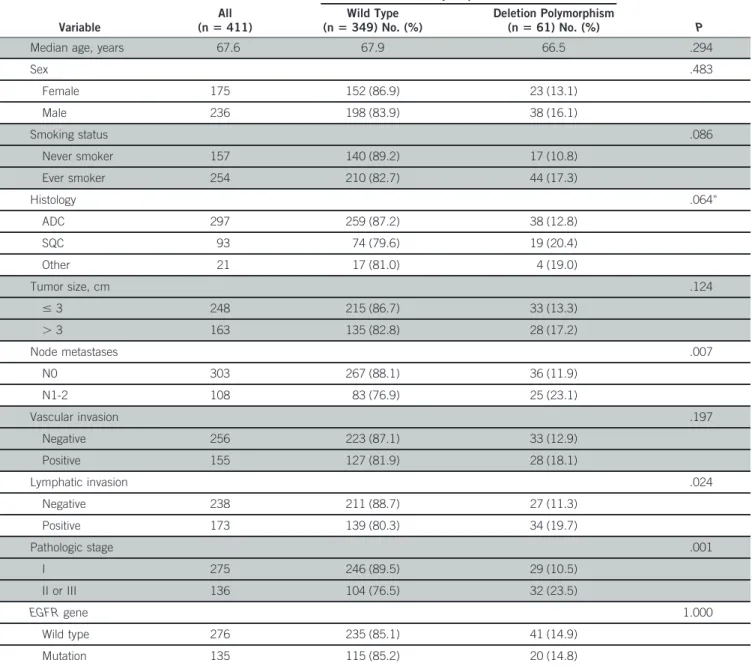
Patient characteristics are presented inTable 1. All patients were Japanese. The median age at the
Table 1 – Baseline Patient Characteristics andBimDeletion Polymorphism Distribution
Variable
All (nⴝ411)
BimPolymorphism Status
P Wild Type
(nⴝ349) No. (%)
Deletion Polymorphism (nⴝ61) No. (%)
Median age, years 67.6 67.9 66.5 .294
Sex .483
Female 175 152 (86.9) 23 (13.1)
Male 236 198 (83.9) 38 (16.1)
Smoking status .086
Never smoker 157 140 (89.2) 17 (10.8)
Ever smoker 254 210 (82.7) 44 (17.3)
Histology .064ⴱ
ADC 297 259 (87.2) 38 (12.8)
SQC 93 74 (79.6) 19 (20.4)
Other 21 17 (81.0) 4 (19.0)
Tumor size, cm .124
ⱕ3 248 215 (86.7) 33 (13.3)
⬎3 163 135 (82.8) 28 (17.2)
Node metastases .007
N0 303 267 (88.1) 36 (11.9)
N1-2 108 83 (76.9) 25 (23.1)
Vascular invasion .197
Negative 256 223 (87.1) 33 (12.9)
Positive 155 127 (81.9) 28 (18.1)
Lymphatic invasion .024
Negative 238 211 (88.7) 27 (11.3)
Positive 173 139 (80.3) 34 (19.7)
Pathologic stage .001
I 275 246 (89.5) 29 (10.5)
II or III 136 104 (76.5) 32 (23.5)
EGFRgene 1.000
Wild type 276 235 (85.1) 41 (14.9)
Mutation 135 115 (85.2) 20 (14.8)
Abbreviations: ADC, adenocarcinoma; EGFR, epidermal growth factor receptor; SQC, squamous cell carcinoma.
ⴱADCvSQC and other.
time of surgery was 67.6 years (range, 36 to 90 years), and the study population consisted of 175 females and 236 males. On the basis of the histology of the lesions, the study population in- cluded 297 adenocarcinomas, 93 squamous cell carcinomas, 12 large-cell neuroendocrine carcino- mas, seven large-cell carcinomas, and two adeno- squamous cell carcinomas. With regard to diagnosis, 275 patients were classified as patho- logic stage I, and 136 patients were classified as stage II or III.EGFRmutation was detected in 135 tumors (32.8%) consisting of 133 adenocarcino- mas and two squamous cell carcinomas. TheBim deletion polymorphism was detected in 61 patients (14.8%). The percentage of patients according to sex, smoking history, histology, and EGFRmuta- tional status did not differ significantly between the Bim wild-type and Bim deletion polymorphism groups, although the percentage of lymph node metastases, positive lymphatic invasion, and ad- vanced stage in the patients with Bim deletion polymorphism was significantly higher than in those with the wild-typeBimsequence (Table 1).
Prognostic Impact ofBimPolymorphism on OS and RFS
Factors associated with OS and RFS, as revealed through univariable analysis, included sex, smok- ing status, histology, vascular invasion, lymphatic invasion, pathologic stage,EGFRgene status, and Bim polymorphism. In the multivariable analysis, pathologic stage, EGFR gene mutation, and the Bimdeletion polymorphism were independent fac- tors associated with OS, and pathologic stage and lymphatic invasion were independent factors asso- ciated only with poor RFS (Table 2). The Bim deletion polymorphism was independently associ- ated with OS but not RFS in 411 patients. The 5-year OS rate was significantly lower for patients with the Bim deletion polymorphism compared with those with wild-type Bim (58.8% v 78.9%,
respectively;P⬍.001;Fig 1A). To eliminate bias, we analyzed survival by using propensity score matching (Data Supplement). The 5-year OS in the propensity score–matched analysis was also signif- icantly poorer in patients withBimdeletion than in those with wild-typeBim(58.8%v80.3%, respec- tively;P⫽.036;Fig 1B).
In addition, we investigated RFS among patients who developed recurrence. As of October 2014, 109 patients had experienced recurrence. Patient characteristics are shown in the Data Supplement.
In the univariable analysis, the variables associated with RFS in patients with recurrence were vascular invasion and Bim deletion polymorphism, and these remained as independent factors in the multivariable analysis (Data Supplement). Further- more, patients with theBimdeletion polymorphism showed significantly shortened RFS compared with those with wild-typeBim(median, 9.8v13.9 months, respectively;P⫽.003;Fig 2A).
Prognostic Impact ofBimPolymorphism on PRS To determine the impact of the Bim deletion polymorphism on outcome after recurrence, we investigated 94 (86%) of 109 patients with recur- rent disease who received additional anticancer therapy, including cytotoxic chemotherapy, EGFR- TKIs, or radiotherapy with curative intent. The characteristics of the 94 patients who received anticancer therapies are summarized inTable 3.
The median time to follow-up was 16.4 months (range, 2.0 to 91.8 months), median age at recur- rence was 68.6 years (range, 37 to 80 years), and the patients consisted of 38 females and 56 males.
There were 65 patients with adenocarcinoma and 29 with non-adenocarcinomas (23 squamous cell carcinomas, four large-cell neuroendocrine carci- nomas, and two large-cell carcinomas). Sixteen patients (17%) harbored the Bim deletion poly- morphism, and 29 patients (31%) harbored
Table 2 – Multivariable Analysis of Predictors of OS and RFS
Variable
OS RFS
HR (95% CI) P HR (95% CI) P
Female sex 1.008 (0.456 to 2.229) .985 1.056 (0.562 to 1.985) .866
Ever smoker 0.817 (0.330 to 2.020) .662 0.974 (0.487 to 1.945) .940
ADC histology 0.656 (0.375 to 1.147) .139 0.776 (0.495 to 1.218) .271
Positive vascular invasion 1.211 (0.704 to 2.084) .489 1.039 (0.675 to 1.601) .861
Positive lymphatic invasion 1.210 (0.674 to 2.171) .524 1.673 (1.032 to 2.711) .037 Pathologic stage II or III 5.213 (2.913 to 9.327) ⬍.001 4.738 (2.994 to 7.498) ⬍.001
EGFRmutated 0.358 (0.172 to 0.743) .006 0.762 (0.466 to 1.245) .277
Bimdeletion polymorphism 1.979 (1.166 to 3.357) .011 1.231 (0.781 to 1.939) .370
Abbreviations: ADC, adenocarcinoma;EGFR, epidermal growth factor receptor; HR, hazard ratio; OS, overall survival; RFS, recurrence-free survival.
EGFR-mutated tumors. Thirty-seven patients (39%) showed local recurrence only, and 59 pa- tients (61%) showed distant recurrence. Recur- rence in multiple foci was detected in 65 patients (69%). Treatment for recurrence consisted of platinum-based chemotherapy in 43 patients (46%), radiotherapy in 43 patients (46%), and EGFR-TKIs in 33 patients (35%). No significant differences in age, sex, tumor histology, smoking status, pathologic stage, site of recurrence, num- ber of recurrent foci,EGFRgene status, or thera- peutic modality were observed between patients with the Bim deletion polymorphism and those with wild-typeBim(Table 3).
Univariable analysis indicated that RFS shorter than 12 months, EGFR gene status, and Bim polymorphism influenced PRS, all of which re- mained as independent prognostic factors for PRS in the multivariable analysis (Table 4). Median PRS was 26.9 months among those with wild-typeBim and 11.4 months among those with the Bim deletion polymorphism (P⬍.001;Fig 2). Subset analysis of PRS showed that patients with wild-type Bimconsistently showed prolonged survival com-
pared with those with the deletion polymorphism when stratified by EGFR gene status (mutated:
median, 61.0v 23.2 months;P⬍.001;Fig 3A;
wild-type: median, 19.7v9.8 months;P⫽.001;
Fig 3B) or tumor histology (adenocarcinoma: me- dian, 33.9 v 11.4 months; P ⫽ .009; Fig 3C;
non-adenocarcinoma: median, 19.7v9.8 months;
P⫽.013;Fig 3D). When analyzed according to therapeutic modality, the median PRS was signifi- cantly shorter in patients with the Bim deletion polymorphism compared with those with the wild- type Bim or EGFR-mutated NSCLC treated with EGFR-TKIs (median, 38.1v23.2 months, respec- tively;P⫽.007;Fig 4A), those treated with cyto- toxic chemotherapy alone (median, 18.5 v 6.2 months, respectively;P⫽.003;Fig 4B), and those treated with radiotherapy alone (median, 26.9 v 11.4 months, respectively;P⫽.046;Fig 4C). No bias was observed in the distribution of theBim deletion polymorphism in terms of platinum or taxane use among the 23 patients who received cytotoxic chemotherapy. Similarly, there was no significant difference in the distribution of theBim deletion polymorphism according to the radiother- apy method (conventional or cyberknife) or total
A
0
Overall Survival (probability)
Time (months)
1.0
0.8
0.6
0.4
0.2
12 24 36 48 60
WT Bim (n = 350): 5-year survival rate, 78.9%
Bim deletion (n = 61): 5-year survival rate, 58.8%
Log-rank P < .001
Hazard ratio, 2.55 (95% CI, 1.53 to 4.26)
B
0
Overall Survival (probability)
Time (months)
1.0
0.8
0.6
0.4
0.2
12 24 36 48 60
WT Bim (n = 61): 5-year survival rate, 80.3%
Bim deletion (n = 61) : 5-year survival rate, 58.8%
Log-rank P = .036
Hazard ratio, 2.27 (95% CI, 1.03to 4.98)
Figure 1 – Kaplan-Meier curves for overall survival according to theBim polymorphism. Overall survival in (A) 411 patients with non–
small-cell lung cancer and (B) propensity score–matched patients (n⫽122).
WT, wild type.
A
0
Recurrence-Free Survival (probability) Postrecurrence Survival (probability)
Time (months)
1.0
0.8
0.6
0.4
0.2
12 24 36 48 60
WT Bim: 13.9 months Bim deletion: 9.8 months Log-rank P = .002 Hazard ratio, 2.21 (95% CI, 1.31 to 3.73)
WT Bim: 26.9months Bim deletion: 9.8 months Log-rank P < .001 Hazard ratio, 3.65 (95% CI, 1.93 to 6.90)
B
0
Time (months)
1.0
0.8
0.6
0.4
0.2
12 24 36 48 60
Figure 2 –
Kaplan-Meier survival curves for patients who developed recurrent disease classified according to theBim deletion polymorphism.
(A) Recurrence-free survival in 109 patients who developed recurrence. (B) Postrecurrence survival in 94 patients who received anticancer therapy after recurrence. WT, wild type.
radiation dose among the 22 patients who received radiotherapy alone (Table 5).
DISCUSSION
TheBimdeletion polymorphism has been investi- gated in inoperable advanced NSCLC and identi- fied as a heritable factor conferring resistance to EGFR-TKIs and chemotherapy in the Asian population.10-13,19 However, only one report has examined the impact of theBimdeletion polymor- phism on survival in patients with resectable NSCLC.18In this study, we demonstrated the impact of theBim deletion polymorphism on NSCLC out- comes (survival) after complete tumor resection. The Bim deletion polymorphism was an independent unfavorable prognostic factor of OS in all patients with NSCLC who received complete resection, which was the result of shorter RFS and PRS associated with the Bimdeletion polymorphism among those who devel- oped recurrent disease. Furthermore, the PRS trend was consistent in subgroup analyses stratified by EGFR mutation status, histology, and therapeutic modality. On the basis of the results of this study, we suggest that theBimdeletion polymorphism has a positive impact on early emergence of metastasis and a negative impact on anticancer treatment in recur- rent NSCLC.
There have been few studies regarding the biologic characteristics associated withBimdeletion poly- morphism,10 but several basic studies demon- strated that the BIM protein is essential for anticancer therapy-induced apoptosis. EGFR-TKI–
induced apoptosis requires BIM protein expression inEGFR-mutated NSCLC cell lines,9and clinical studies have focused on the relationship between theBimdeletion polymorphism orBimmessenger RNA expression and EGFR-mutated NSCLC treated with EGFR-TKIs.10-13,20Our results support the notion that theBimdeletion polymorphism is an indicator of significantly poorer outcomes for EGFR-TKI therapy againstEGFR-mutated NSCLC (Fig 4A). In terms of cytotoxic chemotherapy, BIM protein was shown to mediate apoptosis induced by paclitaxel in NSCLC cells and to be a major determinant in the response of tumors to pacli- taxel.21,22Wang et al23reported that BIM plays a Table 3 – Characteristics of Patients Who Received Anticancer Therapy After
Recurrence andBimDeletion Polymorphism Distribution (n⫽94)
Variable
All (nⴝ94)
BimPolymorphism Status
P Wild Type
(nⴝ78) No. (%)
Deletion Polymorphism
(nⴝ16) No. (%)
Median age (years) 68.6 69.2 66.1 .284
Sex 1.000
Female 38 32 (84.2) 6 (15.8)
Male 56 46 (82.1) 10 (17.9)
Smoking status .405
Never smoker 33 29 (87.9) 4 (12.1)
Ever smoker 61 49 (80.3) 12 (19.7)
Histology .244ⴱ
ADC 65 56 (86.2) 9 (13.8)
SQC 23 18 (78.3) 5 (21.7)
Other 6 4 (66.7) 2 (33.3)
Pathologic stage .135
I 29 27 (93.1) 2 (6.9)
II or III 65 51 (78.5) 14 (21.5)
Recurrence-free survival, months .093
⬍12 39 29 (74.4) 10 (25.6)
ⱖ12 55 49 (89.1) 6 (10.9)
Site of recurrence .579
Local only 37 32 (86.5) 5 (13.5)
Distant 57 46 (80.7) 11 (19.3)
Recurrent foci .573
Single 30 24 (80.0) 6 (20.0)
Multiple 64 54 (84.4) 10 (15.6)
EGFRgene 1.000
Wild type 65 54 (83.1) 11 (16.9)
Mutation 29 24 (82.8) 5 (17.2)
Treatment
Platinum-based chemotherapy 43 35 (81.4) 8 (18.6) .786
Radiotherapy 43 34 (79.1) 9 (20.9) .415
EGFR-TKI 33 30 (90.1) 3 (9.1) .160
Abbreviations: ADC, adenocarcinoma; EGFR-TKI, epidermal growth factor receptor-tyrosine kinase inhibitor; SQC, squamous cell carcinoma.
ⴱADCvSQC and other.
Table 4 – Univariable and Multivariable Analyses of Predictors of PRS
Variable
Univariable Analysis Multivariable Analysis
HR (95% CI) P HR (95% CI) P
RFS⬍12 months 1.990 (1.172 to 3.380) .011 1.804 (1.045 to 3.117) .034
Bimdeletion polymorphism 3.645 (1.925 to 6.901) ⬍.001 3.363 (1.747 to 6.474) ⬍.001
EGFRmutated 0.356 (0.189 to 0.668) .001 0.344 (0.183 to 0.647) .001
Abbreviations:EGFR, epidermal growth factor receptor; HR, hazard ratio; PRS, postrecurrence survival; RFS, recurrence-free survival.
critical role in cisplatin resistance, demonstrating that BIM protein is degenerated in cisplatin- resistant but not in cisplatin-sensitive cells, and inhibition of BIM degeneration can effectively in- duce cancer cell death. Because expression of the proapoptotic BH3 domain in BIM is suppressed in individuals with theBimdeletion polymorphism,10 sensitivity to cytotoxic chemotherapy may be low in such patients. Consequently, as demonstrated here and in a previous study,13 patients with the Bim deletion polymorphism tend to have shorter survival periods than those with wild-typeBimafter cytotoxic chemotherapy (Fig 4B).
With regard to radiotherapy-induced apoptosis, it has been reported that radiation increases FOXO3a protein expression, leading to upregula- tion of BIM expression and apoptotic induction, a reaction that is downstream of the PI3K/AKT sig- naling pathway and independent of the p53 path- way.24,25The PI3K/AKT pathway, which regulates BIM expression, is expected to contribute to radio- therapy resistance, and blockade of the pathway may enhance cancer cell radiotherapy sensitiv- ity.25,26Our results indicate that theBimdeletion polymorphism is an indicator of poorer radiother-
apy outcomes in recurrent NSCLC after complete resection (Fig 4C). Taken together, these findings suggest that theBimdeletion polymorphism con- fers resistance against treatment with EGFR-TKIs, chemotherapy, and radiotherapy.
The relationship between BIM and tumor develop- ment has been investigated in several solid tumors.
Comparison of BIM levels in primary and meta- static tumors revealed progressive decreases in BIM expression in melanoma,27 renal cell carci- noma,28 and colon carcinoma cells.29 In NSCLC cells, low BIM expression was observed more frequently in cases of advanced pathologic stage, poorer differentiation, and squamous histology, although no impact on survival was observed.30 These studies support the suggestion that BIM protein plays an important role in suppressing tumor development. Merino et al31 recently re- ported thatBimloss does not affect proliferation or the expression of epithelial-mesenchymal transi- tion markers but does increase the number of lung metastases in breast cancers. They suggested that the loss ofBimmay be responsible for dissemina- tion of tumor cells and their colonization of distant Figure 3 –
Kaplan-Meier curves for postrecurrence survival (PRS) according toEGFR gene status and histology. (A) PRS in EGFR-mutated tumors according to wild-type (WT)Bim(n⫽24) or theBimdeletion polymorphism (n⫽5).
(B) PRS in wild-type EGFRtumors according to wild-type Bim(n⫽54) or the Bimdeletion polymorphism (n⫽ 11). (C) PRS in adenocarcinoma according to wild-type Bim(n⫽56) or the Bimdeletion
polymorphism (n⫽9).
(D) PRS in nonadeno carcinoma according to wild-typeBim(n⫽22) or theBimdeletion polymorphism (n⫽7).
tissues.31Subgroup analyses in our study revealed no significant differences between patients with stage I NSCLC with or without the Bim deletion polymorphism (n ⫽ 275) with respect to the percentage of patients with lymphatic invasion (27.6%v23.6%, respectively; P⫽.648), to the 5-year OS rate (81.8%v90.4%, respectively;P⫽ .402), or to the 5-year RFS rate (83.1%v70.0%, respectively;P⫽.806), consistent with a previous report.18 Furthermore, our study demonstrated that theBimpolymorphism was a significant pre- dictor of RFS only for patients with recurrence (Data Supplement). These results suggest that the Bimdeletion polymorphism is associated with tu- mor development in disseminated or metastatic lesions, whereas it has little influence on the pri- mary lesion. Patients with recurrence are likely to have micrometastases at the time of surgery, and thereforeBimdeletion polymorphism may somehow be involved in growth of these metastatic lesions.
Taken together, theBimdeletion polymorphism has little effect on tumor aggressiveness or survival in early and/or primary NSCLC but may have an impact on tumor survival in metastatic NSCLC.
To the best of our knowledge, this is the first investigation of the impact of Bim deletion poly- morphism on PRS in patients with NSCLC. Previ- ous studies10-12,14 demonstrated that the Bim deletion polymorphism is a prognostic factor for progression-free survival in patients with stage IIIB or IV NSCLC who received EGFR-TKIs and chemo- therapy, although all but one study13 showed no obvious impact on OS. The reasons underlying these inconsistencies regarding the impact of the Bim deletion polymorphism in this and previous studies are unclear. However, previous studies indicated that patients with NSCLC who had recur- rence after curative surgery had a favorable prog- nosis compared with those with advanced-stage disease at initial presentation.15,32 These results suggest that although both patient groups can be classified as advanced NSCLC, biologic character- istics, such as EGFR-TKI and/or chemotherapy treatment outcome, may be distinct.
TheBimpolymorphism may be a novel germline biomarker for therapy resistance in patients with advanced NSCLC. The presence of theBimdele- tion polymorphism may be a negative indication for standard therapies, with the exception of surgery, because such patients are at risk of developing aggressive cancer refractory to EGFR-TKI, chemo- therapy, and radiotherapy. Thus, patients with unresectable or recurrent NSCLC who harbor the Bim deletion may benefit from treatment with a BH3-mimetic drug9,10 or histone deacetylase in- hibitor33to overcome therapy resistance.
This study had several limitations. The first and most important one was the small sample size. The survival analysis included heterogeneous patient backgrounds. Because the subset analyses ac- cording to histology or therapy modality were per- formed by using small sample sizes, this study lacked statistical power, and further investigation is required with a larger sample. Second, this was a retrospective study. Although the indications and therapeutic strategies for recurrent disease were reviewed by the cancer board of our department, not all patients received treatment according to the
A
0
Time (months)
1.0 0.8 0.6 0.4 0.2
12 24 36 48 60
Postrecurrence Survival (probability)
EGFR-mutated NSCLC patients EGFR-mutated NSCLC patients treated With EGFR-TKI (n = 21) treated With EGFR-TKI (n = 21) WT Bim : 38.1 months WT Bim : 38.1 months Bim deletion : 23.2 months Bim deletion : 23.2 months Log-rank
Log-rank P = .007 = .007 Hazard ratio 6.70 Hazard ratio 6.70 (95% CI, 1.34 to 33.5) (95% CI, 1.34 to 33.5) EGFR-mutated NSCLC patients treated With EGFR-TKI (n = 21) WT Bim : 38.1 months Bim deletion : 23.2 months Log-rank P = .007 Hazard ratio 6.70 (95% CI, 1.34 to 33.5)
B
0
Time (months)
1.0 0.8 0.6 0.4 0.2
12 24 36 48 60
Postrecurrence Survival (probability)
Patients treated with chemotherapy alone (n = 23) WT Bim: 18.5 months Bim deletion: 6.2 months P = .003
Hazard ratio 6.34 (95% CI, 1.55 to 25.97)
Patients treated with radiotherapy alone (n = 22) WT Bim: 26.9 months Bim deletion: 11.4 months Log-rank P = .046 Hazard ratio 3.02 (95% CI, .966 to 9.415)
C
0
Time (months)
1.0 0.8 0.6 0.4 0.2
12 24 36 48 60
Postrecurrence Survival (probability)
Figure 4 –
Kaplan-Meier curves for postrecurrence survival (PRS) according to therapeutic modality. (A) PRS in patients with EGFR-mutated non–
small-cell lung cancer (NSCLC) who received epidermal growth factor receptor-tyrosine kinase inhibitors (EGFR-TKIs) according to wild-type (WT)Bim(n⫽18) or theBimdeletion polymorphism (n⫽3).
(B) PRS in patients treated with cytotoxic chemotherapy alone according to wild-type Bim(n⫽19) or the Bimdeletion
polymorphism (n⫽4).
(C) PRS in patients treated with radiotherapy alone according to wild-type Bim(n⫽17) or the Bimdeletion
polymorphism (n⫽5).
Table 5 – Therapeutic Background of Patients Who Received Cytotoxic Chemotherapy or Radiotherapy Alone
Type of Treatment
BimStatus
P Wild Type
No. (%)
Deletion Polymorphism No. (%)
Chemotherapy 19 4
Platinum
Yes 12 (75.0) 4 (25.0) .273
No 7 (100.0) 0 (0.0)
Taxane
Yes 3 (75.0) 1 (25.0) 1.000
No 16 (84.2) 3 (15.8)
Radiationⴱ 17 5
Conventional 15 (88.2) 4 (11.8) .637
Cyberknife 2 (66.7) 1 (33.3)
ⴱTotal dose average: patients with wild-type sequence, 66.0 Gy (range, 39-100 Gy); patients with deletion polymorphism, 52.0 Gy (range, 30-104 Gy);P⫽.217.
same standard. A prospective multicenter study is required to determine the clinical significance of the Bim deletion polymorphism with regard to therapy for advanced and recurrent NSCLC.
Finally, this polymorphism is observed only in Asian populations. Even if the significance of the Bim deletion polymorphism is validated, the results would not provide any benefit to non- Asian patients with NSCLC.
In conclusion, theBimdeletion polymorphism was an indicator of poor RFS and PRS in patients with recurrence after complete resection and is conse-
quently an independent unfavorable prognostic factor for OS in all patients with NSCLC who received complete resection. The polymorphism was associated with tumor aggressiveness and therapy resistance in metastatic disease. If vali- dated, these results suggest that theBimpolymor- phism may be a biomarker of poor outcome for multimodal therapies in treating recurrent or ad- vanced NSCLC in the Asian population.
DOI: 10.1200/JGO.2015.000638
published online ahead of print at jgo.acsopubs.org on December 23, 2015
AUTHOR CONTRIBUTIONS
Conception and design:Kimihiro Shimizu
Collection and assembly of data:Jun Atsumi, Yoichi Ohtaki, Seiichi Kakegawa, Toshiteru Nagashima, Yasuaki Enokida, Kai Obayashi, Yoshiaki Takase, Osamu Kawashima, Mitsuhiro Kamiyoshihara, Masayuki Sugano, Takashi Ibe, Hitoshi Igai, Izumi Takeyoshi
Data analysis and interpretation:Jun Atsumi, Kimihiro Shimizu, Yoichi Ohtaki, Kyoichi Kaira, Seshiru Nakazawa Manuscript writing:All authors
Final approval of manuscript:All authors
AUTHORS’ DISCLOSURES OF POTENTIAL CONFLICTS OF INTEREST
The following represents disclosure information provided by authors of this manuscript. All relationships are considered compensated. Relationships are self-held unless noted. I⫽ Immediate Family Member, Inst⫽My Institution.
Relationships may not relate to the subject matter of this manuscript. For more information about ASCO’s conflict of interest policy, please refer towww.asco.org/rwcor jco.ascopubs.org/site/ifc.
Jun Atsumi
No relationship to disclose Kimihiro Shimizu
No relationship to disclose Yoichi Ohtaki
No relationship to disclose Kyoichi Kaira
No relationship to disclose
Seiichi Kakegawa No relationship to disclose Toshiteru Nagashima No relationship to disclose Yasuaki Enokida
No relationship to disclose Seshiru Nakazawa No relationship to disclose Kai Obayashi
No relationship to disclose Yoshiaki Takase
No relationship to disclose Osamu Kawashima No relationship to disclose Mitsuhiro Kamiyoshihara No relationship to disclose Masayuki Sugano No relationship to disclose Takashi Ibe
No relationship to disclose Hitoshi Igai
No relationship to disclose Izumi Takeyoshi
No relationship to disclose ACKNOWLEDGMENT
We thank Yuriha Iwata, Masaki Shinohara, Ryosuke Konuma, and Nao Kobayashi, Gunma University, for their technical assistance.
AFFILIATIONS
Jun Atsumi, Kimihiro Shimizu, Yoichi Ohtaki, Kyoichi Kaira, Toshiteru Nagashima, Yasuaki Enokida, Seshiru Nakazawa, Kai Obayashi, Yoshiaki Takase, Masayuki Sugano, and Izumi Takeyoshi, Gunma University Graduate School of Medicine, Maebashi, Gunma; Seiichi Kakegawa and Osamu Kawashima, National Hospital Organization Nishi-Gunma Hospital, Shibukawa, Gunma; and Mitsuhiro Kamiyoshihara, Takashi Ibe, and Hitoshi Igai, Maebashi Red Cross Hospital, Maebashi, Gunma, Japan
REFERENCES
1. Siegel R, Naishadham D, Jemal A: Cancer statistics, 2012. CA Cancer J Clin 62:10-29, 2012
2. Sugimura H, Nichols FC, Yang P, et al: Survival after recurrent nonsmall-cell lung cancer after complete pulmonary resection. Ann Thorac Surg 83:409-417, 2007
3. Kelsey CR, Marks LB, Hollis D, et al: Local recurrence after surgery for early stage lung cancer: An 11-year experience with 975 patients. Cancer 115:5218-5227, 2009
4. Maemondo M, Inoue A, Kobayashi K, et al: Gefitinib or chemotherapy for non-small-cell lung cancer with mutated EGFR. N Engl J Med 362:2380-2388, 2010
5. Mok TS, Wu YL, Thongprasert S, et al: Gefitinib or carboplatin-paclitaxel in pulmonary adenocarcinoma. N Engl J Med 361:947-957, 2009
6. Ohtaki Y, Shimizu K, Kakegawa S, et al: Postrecurrence survival of surgically resected pulmonary adenocarcinoma patients according to EGFR and KRAS mutation status. Mol Clin Oncol 2:187-196, 2014 7. Katayama T, Matsuo K, Kosaka T, et al: Effect of gefitinib on the survival of patients with recurrence of lung
adenocarcinoma after surgery: A retrospective case-matching cohort study. Surg Oncol 19:e144-e149, 2010 8. Takenaka T, Takenoyama M, Yamaguchi M, et al: Impact of the epidermal growth factor receptor mutation
status on the post-recurrence survival of patients with surgically resected non-small-cell lung cancer. Eur J Cardiothorac Surg 47:550-555, 2015
9. Cragg MS, Kuroda J, Puthalakath H, et al: Gefitinib-induced killing of NSCLC cell lines expressing mutant EGFR requires BIM and can be enhanced by BH3 mimetics. PLoS Med 4:1681-1690, 2007
10. Ng KP, Hillmer AM, Chuah CT, et al: A common BIM deletion polymorphism mediates intrinsic resistance and inferior responses to tyrosine kinase inhibitors in cancer. Nat Med 18:521-528, 2012
11. Zhao M, Zhang Y, Cai W, et al: The Bim deletion polymorphism clinical profile and its relation with tyrosine kinase inhibitor resistance in Chinese patients with non-small cell lung cancer. Cancer 120:2299-2307, 2014 12. Isobe K, Hata Y, Tochigi N, et al: Clinical significance of BIM deletion polymorphism in non-small-cell lung
cancer with epidermal growth factor receptor mutation. J Thorac Oncol 9:483-487, 2014
13. Lee JH, Lin YL, Hsu WH, et al: Bcl-2-like protein 11 deletion polymorphism predicts survival in advanced non-small-cell lung cancer. J Thorac Oncol 9:1385-1392, 2014
14. Lee JK, Shin JY, Kim S, et al: Primary resistance to epidermal growth factor receptor (EGFR) tyrosine kinase inhibitors (TKIs) in patients with non-small-cell lung cancer harboring TKI-sensitive EGFR mutations: An exploratory study. Ann Oncol 24:2080-2087, 2013
15. Sekine I, Nokihara H, Yamamoto N, et al: Comparative chemotherapeutic efficacy in non-small cell lung cancer patients with postoperative recurrence and stage IV disease. J Thorac Oncol 4:518-521, 2009 16. Travis WD, Colby TV, Corrin B, et al: Histological Typing of Lung and Pleural Tumors (ed 3). Berlin, Germany,
Springer-Verlag, 1999
17. Miyamae Y, Shimizu K, Mitani Y, et al: Mutation detection of epidermal growth factor receptor and KRAS genes using the smart amplification process version 2 from formalin-fixed, paraffin-embedded lung cancer tissue. J Mol Diagn 12:257-264, 2010
18. Ebi H, Oze I, Nakagawa T, et al: Lack of association between the BIM deletion polymorphism and the risk of lung cancer with and without EGFR mutations. J Thorac Oncol 10:59-66, 2015
19. Ong ST, Chuah CT, Ko TK, et al: Reply: The BIM deletion polymorphism cannot account for intrinsic TKI resistance of Chinese individuals with chronic myeloid leukemia. Nat Med 20:1090-1091, 2014
20. Costa C, Molina MA, Drozdowskyj A, et al: The impact of EGFR T790M mutations and BIM mRNA expression on outcome in patients with EGFR-mutant NSCLC treated with erlotinib or chemotherapy in the randomized phase III EURTAC trial. Clin Cancer Res 20:2001-2010, 2014
21. Li R, Moudgil T, Ross HJ, et al: Apoptosis of non-small-cell lung cancer cell lines after paclitaxel treatment involves the BH3-only proapoptotic protein Bim. Cell Death Differ 12:292-303, 2005
22. Tan TT, Degenhardt K, Nelson DA, et al: Key roles of BIM-driven apoptosis in epithelial tumors and rational chemotherapy. Cancer Cell 7:227-238, 2005
23. Wang J, Zhou JY, Wu GS: Bim protein degradation contributes to cisplatin resistance. J Biol Chem 286:
22384-22392, 2011
24. Yang JY, Xia W, Hu MC: Ionizing radiation activates expression of FOXO3a, Fas ligand, and Bim, and induces cell apoptosis. Int J Oncol 29:643-648, 2006
25. Hein AL, Ouellette MM, Yan Y: Radiation-induced signaling pathways that promote cancer cell survival (review). Int J Oncol 45:1813-1819, 2014
26. Toulany M, Lee KJ, Fattah KR, et al: Akt promotes post-irradiation survival of human tumor cells through initiation, progression, and termination of DNA-PKcs-dependent DNA double-strand break repair. Mol Cancer Res 10:945-957, 2012
27. Dai DL, Wang Y, Liu M, et al: Bim expression is reduced in human cutaneous melanomas. J Invest Dermatol 128:403-407, 2008
28. Zantl N, Weirich G, Zall H, et al: Frequent loss of expression of the pro-apoptotic protein Bim in renal cell carcinoma: Evidence for contribution to apoptosis resistance. Oncogene 26:7038-7048, 2007
29. Sinicrope FA, Rego RL, Okumura K, et al: Prognostic impact of bim, puma, and noxa expression in human colon carcinomas. Clin Cancer Res 14:5810-5818, 2008
30. Sakakibara-Konishi J, Oizumi S, Kikuchi J, et al: Expression of Bim, Noxa, and Puma in non-small cell lung cancer. BMC Cancer 12:286, 2012
31. Merino D, Best SA, Asselin-Labat ML, et al: Pro-apoptotic Bim suppresses breast tumor cell metastasis and is a target gene of SNAI2. Oncogene 34:3926-3934, 2015
32. Yoshioka H, Mitsudomi T, Morita S, et al: Final overall survival results of WJTOG 3405, a randomized phase 3 trial comparing gefitinib (G) with cisplatin plus docetaxel (CD) as the first-line treatment for patients with non- small cell lung cancer (NSCLC) harboring mutations of the epidermal growth factor receptor (EGFR). J Clin Oncol 32, 2014 (suppl 5s; abstr 8117)
33. Nakagawa T, Takeuchi S, Yamada T, et al: EGFR-TKI resistance due to BIM polymorphism can be circumvented in combination with HDAC inhibition. Cancer Res 73:2428-2434, 2013