Abstract
Distance higher education in Japan has developed since the early 1950s, functioning as an open system of higher learning. Owing to deregulation and structural reform in education, the number of universities offering distance learning programs has increased in recent years, and distance learning insti- tutions have become more open and conducive to learning. However, the number of students enrolled in distance learning universities is decreasing.
Meanwhile, demand for education at distance learning graduate schools re- mains high due to a greater focus on educational credentials and practice-ori- ented study. The low level of demand for distance higher education in Japan is likely a consequence of concerns about the quality of education provided, or, in other words, the result of low social valuation.
Introduction
Since its inception in 1950, distance higher education in modern Japan has functioned as an open system of higher learning. In particular, distance higher education has developed significantly as a platform for lifelong learning and re-education for working adults. However, the number of students participat- ing in distance higher education has recently leveled off and is now showing a downward trend. This indicates that distance higher education in Japan has
Education in Present-day Japan:
Deregulation of Education and the Special Zones for Structural Reform Takahiro Tajima
〔125〕
entered a “period of decline.” Kubota et al. (2008) note that Japanese distance education is failing to meet the needs of learners. They also show that for distance education to succeed, it is important to provide various forms of ed- ucation that meet the needs of learners through information and communica- tions technology (ICT), while maintaining motivation among students. Bray et al. (2008) found that although students were generally satisfied with the learning provided by online universities in Japan, there are problems with regard to maintaining motivation and securing time for study. The issues of securing time for study and preparing reports have been identified as factors related to why students may find it difficult to continue studying in distance learning programs (Ishihara & Suzuki, 2008). One study has also found that working adults may be unable to gain the understanding of their workplaces as regards learning in such programs (Uno, 2008). Tajima (2012a) analyzed potential demand for distance higher education and found that people seeking to increase their income or enjoy their student life had a stronger desire to enroll in distance learning universities. The, it can be assumed that the num- ber of people looking to distance higher education for economic benefits and enjoyment of student life has declined.
Thus, there appears to be various reasons for the decline in the number of students participating in distance higher education in Japan. Historically, the development process of distance education has been connected to the social and economic environments of the time and of the nation (Perraton, 2000;
Perraton, 2004; Panda & Gaba, 2008). In Japan, the late 1980s saw the emer- gence a “lifelong learning society,” followed by vigorous higher education re- form from the 1990s. Then, from the 2000s, driven by the advancement of ICT, distance higher education moved into a “period of prosperity.” After that, as education underwent further deregulation, the number of universities in- creased significantly, and distance education was expected to reach even
greater heights, but, in an unfortunate turn, the sector experienced a down- turn.
This paper examines distance higher education in present-day Japan from the perspectives of the social environment and educational policy around dis- tance learning. It begins with an overview of the origin of distance higher education in Japan, its development process, and its present state. Then, re- cent developments are considered in relation to the social environment in which distance higher education operates, as well as educational deregulation and structural reform.
Overview of Distance Higher Education’s Development Process Origins of Distance Education
The origin of modern distance education is generally attributed to the shorthand instruction of British educator Isaac Pitman (Verduin & Clark, 1991). In 1837, Pitman published the instructional pamphlet Stenographic Sound-Hand, in which he explained his own system of shorthand; three years later in 1840, he began providing corrections and instructions in shorthand and assessing students’ transcriptions.
Distance education in Japan, however, is believed to have originated in Su- zunoya, a private school for kokugaku (national studies) operated by Japanese scholar Motoori Norinaga (1730–1801) (Shiraishi, 1990). Initially, Motoori gave lectures to the local townspeople in the evenings, but he also conducted dis- tance learning, through letters, for pupils who lived away from the town or were unable to study at Suzunoya in the evening (Rubinger, 1982). Although Suzunoya did not issue completion certifications or other such documents, it had an organizational structure and classrooms and provided interactive edu- cation to remote locations that was accessible to all at a low cost. Thus, it can be said that Motoori was conducting systematic distance education before
Isaac Pitman.
The origin of distance learning in Japanese higher education has been traced to transcripts of university lectures created in the mid-1880s (Amano, 1994). It was in 1950 that distance higher education was first approved for regular degree programs. Six institutions received approval at this time: Hosei University, which had established a distance learning program in 1947, Keio University (1948), Chuo University (1948), Nihon University, Japan Women’s University (1949), and Tamagawa University (1950). Distance learning univer- sities and attendance-based universities have since been distinguished by law, which continues to the present day.
Figure 1. Changes in the numbers of distance learning universities and students.
Source: Ministry of Education, Culture, Sports, Science and Technology, Basic Survey of Schools 2019.
Note: The bars represent the number universities, and the line indicates the number of students.
Figure 1 shows the changes in the numbers of distance learning university and students since 1955, the year in which the statistical survey of distance higher education in Japan began. Around 1950, when distance learning univer- sities began providing regular degree programs, these were taken up by a diverse range of students, including working youths who could not attend a university for financial reasons, former soldiers who were prevented from at- tending university by the occupation policy of Japan’s General Headquarters, farmers, fishermen, and public servants, as well as some members of parlia- ment and doctors of medicine. Moreover, in the early days, these institutions functioned as organs for teacher training and re-education for teachers and a large proportion of entrants were teachers (Nishimoto, 1957). In the 1960s and 1970s, as the Japanese economy developed and technology advanced, distance learning universities began to be used for re-educating adult learners, result- ing in a further increase in the number of students.
Arrival of Lifelong Learning
From the 1980s, the concept of lifelong learning gained prominence, and in response to socio-economic advancement and diversification, demand among working adults wishing to relearn their knowledge and skills at university also increased. In 1983, The University of the Air (subsequently renamed as The Open University of Japan in 2007) was established as the first Japanese institution to offer only distance learning programs. The University of the Air was established as an official institution for lifelong learning with the aim of expanding access to university education to groups such as working adults. It is Japan’s largest distance learning university, with learning centers in each of Japan’s prefectures, and provides distance learning by means of broadcast courses through television and radio, face-to-face courses, and online courses (introduced in 2015). After The University of the Air was established, in the
1990s and 2000s, the number of students enrolled in distance learning univer- sities rose dramatically, and the number of universities increased to accommo- date this change. Regarding the social background to this sudden increase in distance learning universities, as well as the increase in opportunities for life- long learning, demand was expected to be created in relation to social welfare policy. Of the 24 distance learning universities established between 2000 and 2012, the year in which the number of such universities peaked, there were 15 universities with graduate schools or faculties related to social welfare. During that period, in 2001, the long-term care insurance system was introduced, and the number of nursing care staff doubled from about 550,000 in 2001 to about 1.12 million just five years later. This suggests that many distance learning universities were established in anticipation of educational demand for train- ing and re-educating the rapidly increasing number of care workers.
Deregulation of Education
Another social factor related to the sudden increase in distance learning universities from the 2000s was the deregulation of education. Until March 1998, the law required that out of the 124 credits needed for graduation, 94 were to be provided through “print-based” courses wherein printed materials were posted to students, “broadcast courses” based on terrestrial or satellite broadcasts, or “face-to-face courses” conducted in classrooms (Figure 2). For the remaining 30 credits, students were required to take face-to-face courses (although 10 of the 30 credits could be substituted for broadcast courses). In distance higher education in Japan, face-to-face courses provided an important opportunity for promoting interaction between students and faculty members and among students (Aoki, 2010). Therefore, until 2000, students were obliged to take face-to-face courses. However, from the time of their inception, distance learning universities hosted a large number of working students, and these
face-to-face courses placed a heavy burden on students, preventing them from continuing their studies (Nishimoto, 1957).
From March 1998, instead of face-to-face courses, universities were permitted to introduce some “media courses,” which utilized real-time, interactive video conference systems. Due to this change, students could earn up to 104 of the 124 credits from real-time, interactive media courses, which enabled them to take classes from remote locations via teleconferencing; nevertheless, students were still required to earn the remaining 10 credits from face-to-face courses (Figure 3).
In 2001, the Standards for Establishment of Universities were finally revised, and media courses (e-learning) delivered using the Internet and other ICT tools were permitted as a substitute for face-to-face courses (Figure 4). Following this revision, it is now possible to earn all 124 of the credits required for graduation through media courses delivered via the Internet or similar means.
Figure 2. Graduation requirements for distance learning universities until March 1998.
Figure 3. Graduation requirements for distance learning universities from March 1998.
Due to the deregulation of higher education, many universities introduced new internet-based media courses (e-learning) to reduce the burden of partic- ipating in face-to-face courses. This led to the appearance of a large number of distance learning universities using e-learning as their selling point. In 2004, Yashima Gakuen University was established as the first Japanese university where students could also take all face-to-face courses (30 credits) through e-learning. Then, in 2007, Cyber University was established as the first Japa- nese university to provide all of its courses solely through e-learning. Cyber University was therefore the first university where students could earn a bachelor’s degree only through e-learning, without having to travel to the university at all.
Since the 2000s, with the advancement of ICT, the systems and modes of study adopted by Japan’s distance learning universities have undergone rapid change. Of the 24 universities established between 2000 and 2012, 16 offer some form of e-learning or online subject tests. Furthermore, since it became possible to earn credits through e-learning, universities could offer courses in new fields of study, opening up previously inaccessible domains in the arts and science/technology.
These social factors, then, can be seen to have driven the increase in dis- tance learning universities in Japan. Nevertheless, although the number of universities remains high, as the number of students peaked in 2005, distance
Figure 4. Graduation requirements for distance learning universities from 2001.
learning moved from its “period of prosperity” into a “period of downturn,”
and then, more recently, into a “period of decline.”
Status of Graduate Schools
Although distance education at the graduate level was identified as a matter for consideration in a 1974 meeting of the University Establishment Council, since then, no detailed deliberations have taken place. In the meantime, since the 1990s, higher education reform and deregulation have been pursued as measures for helping working adults continue to graduate school. For example, the following systems and measures have been established: ⑴ special entrance examinations for working adults; ⑵ evening schools; ⑶ schools with afternoon and evening classes; ⑷ a system for non-degree students; ⑸ a system for long- term completion of programs; ⑹ professional graduate schools; ⑺ more flexible completion limits for master’s programs; ⑻ establishment of satellite classrooms in urban areas; ⑼ relaxation of graduate school entry requirements; and ⑽ adoption of an education and training benefit system. However, there is a limit to what can be done to meet the requirements of working adults simply by reforming graduate school education under the attendance-based system (Suzu- ki, 1998). Due to these factors, along with the advancement of ICT, in 1999, insti- tutions were finally permitted to establish distance learning graduate schools (master’s programs) at four universities: Nihon University, Meisei University, Bukkyo University, and Seitoku University. In 2003, permission was extended to doctoral programs, which were then offered by Nihon University, Bukkyo University, and Seitoku University.
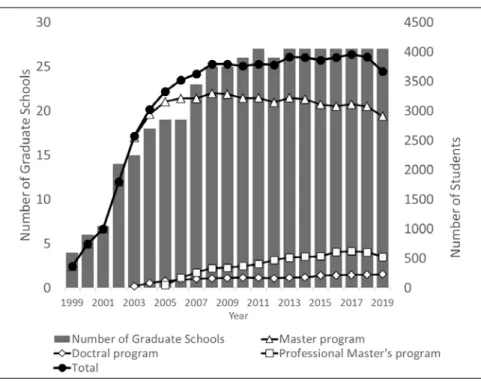
While the number of students enrolled in distance learning universities has recently decreased, the situation for distance learning graduate schools is slightly different. Distance learning graduate schools are still moving from a
“period of prosperity” toward a “peak.” Figure 5 shows the changes in the
numbers of distance learning graduate schools and students. Both the number of schools and the number of students is increasing. While there has been little change in the numbers of students in doctoral and master’s programs, the number of students studying for professional master’s degrees is increasing.
By age, master’s and doctoral students in distance learning graduate schools aged 39 or younger account for about 26% and 16%, respectively, whereas the proportion for professional master’s degrees, mainly offered in business ad- ministration, is extremely high at around 46%, which is roughly the same as the proportion for undergraduate students (Table 1). For professional master’s degrees, students aged 49 or younger account for around 86% of all students, providing a clear indication that a large proportion of students at the peak of their working lives. When the 2019 data is compared with that of 2010, around 10 years earlier, we see that both the numbers of students aged 39 or young- er and 49 or younger have decreased, showing that the average age of stu- dents enrolled at the schools is increasing. It appears that the heightened focus on academic credentials and practice-oriented study among working adults has led to an increase in demand for distance learning graduate schools.
Table 1 Age Breakdown of Students Enrolled in Distance learning Graduate Schools
Age 22-39 Age 22-49
(unit: %) FY2010 FY2019 FY2010 FY2019
master’s program 33.7 25.9 62.9 54.0
professional master’s program 63.7 45.5 94.6 86.1
doctoral program 24.7 15.5 59.2 41.6
(undergraduate) 57.7 45.5 78.6 54.0
Source: Ministry of Education, Culture, Sports, Science and Technology, Basic Survey of Schools 2019.
Figure 5. Change in the numbers of distance learning graduate schools and students.
Source: Ministry of Education, Culture, Sports, Science and Technology, Basic Survey of Schools 2019.
Note: The bars and lines represent the number of graduate schools and students, respectively.
Structural Reform’s Impact on Distance Higher Education Special Zones for Structural Reform
There has been considerable concern in Japan about the educational effects of distance learning. This is also evidenced by the fact that for many years,
“face-to-face courses” were mandatory at distance learning universities and distance learning graduate schools were not approved by the government. Re- searchers of Japanese distance education have noted that, “The reason for the scarcity of literature on distance education in Japan is that researchers in the field of education are indifferent about it,” criticizing the fact that, “Distance learning is separated off from mainstream education, as shown by the fact that distance learning programs do not exist at national universities, whose mission it is to make higher education equally accessible to all citizens”. Another criti- cism has been that, “Distance learning universities have been all but forgotten, not only among faculty members in Japan but also by the various stakeholders affiliated with universities, including politicians and the administration” (Tajima, 2012b). Previously, national law around the establishment of higher education institutions of distance learning also treated distance learning institutions as
“attachments” or “exceptions” to attendance-based programs (Tajima, 2012c).
Presently, although “attendance-based programs” and “distance learning pro- grams” are treated equally in law concerning the establishment of universities, social valuation of distance higher education is low.
To examine social valuation of distance learning universities in recent years, it is necessary to consider the impact of the structural reforms of the early 2000s. After the collapse of Japan’s “bubble economy” in the early 1990s, the Japanese economy entered a long period of recession. During this period, the Junichiro Koizumi administration (2001–2006) pursued a program of “structur- al reform with no sacred cows” (seiiki naki kozo kaikaku), implementing vari- ous deregulatory measures based on a system of “Special Zones for Structural
Reform” (Cabinet Secretariat, 2003; Ministry of Foreign Affairs of Japan, 2013).
These Special Zones for Structural Reform were created in 2002 based on the law on Special Zones for Structural Reform. Their purpose was to vitalize specific areas by promoting structural reforms there. Koizumi’s structural reforms sought to achieve “small government” by instigating a move from public to private, and from centralized governance to local governance, as a way of addressing Japan’s structural problems, including its declining birth- rate/aging population and fiscal deficit. To stimulate and grow the Japanese economy, the government sought to raise fiscal awareness on the supply side, encourage businesses to produce and supply goods and services with added value, and develop a market based on free competition. In the education sec- tor, there were various regulations concerning the establishment of schools and educational methods, and the national government had maintained a strong grip on supply and demand for educational services. Before the re- forms, only incorporated educational institutions were permitted to establish universities in Japan and that permission was not extended to stock compa- nies (commercial enterprises) or non-profit organizations. Furthermore, incor- porated educational institutions were required to meet strict standards re- garding the land on which the university was built, the university buildings and the facilities inside them, and the number of faculty and staff members.
Since the first round of applications for approval in 2003, a total of 1,331 appli- cations for Special Zones for Structural Reform have been approved (as of October 2019; Cabinet Office, Bureau for the Promotion of Regional Revitaliza- tion, Government of Japan, 2019)
The Problem with Special Zone 832
The Special Zones for Structural Reform that had a direct impact on dis- tance learning universities were “Special Measure No. 816: Program for the
Establishment of Schools by School-establishing Companies” (Special Zone 816) and “Special Measure No. 832: Program for the Establishment of Universities Through Increased Flexibility in Regulations Regarding University Buildings and Facilities in Universities That Provide Classes Using Only the Internet, Etc.” (Special Zone 832). Special Zone 816 permitted stock companies to estab- lish schools and Special Zone 832 permitted the establishment of “online uni- versities,” even where the amount of land or buildings they possessed was small. Through these special zones, new distance learning universities were established, and expectations rose for an increase in demand from learners;
however, as mentioned above, the total number of students enrolled in dis- tance learning universities peaked in 2005, before beginning to fall, as the measures failed to spark a turnaround.
There are two main reasons why the distance learning universities that were established because of these structural reforms did not flourish. The first con- cerns the problems in relation to universities established by stock companies.
Although stock companies were previously not allowed to establish universities in Japan, because of Special Zone 816, stock companies proceeded to establish both distance learning universities and attendance-based universities. However, for the first university in Japan established by a stock company, problems re- lated to course content, instruction methods, and building facilities repeatedly came to light, and social problems emerged as universities due to be estab- lished cancelled their plans or changed their status from stock company to incorporated educational institution. Then, as public opinion worsened and operators experienced financial difficulties, some universities closed.
The second reason concerns the issue of student “identification” in online universities (Kawahara, 2010). This was problematic in that universities some- times failed to confirm students’ identities when taking classes or final course examinations, so that identity fraud was easily possible. With the appearance
of problems related to universities established through the Special Zones for Structural Reform, in August 2012, the Ministry of Education, Culture, Sports, Science and Technology held a meeting of experts involved in research on the use of ICT in university distance education and decided to investigate “mea- sures to facilitate face-to-face contact between faculty members and students”
in online universities (Ministry of Education, Culture, Sports, Science and Technology, 2012).
During this meeting of experts, a major problem was identified with Special Zone 832. Provided that the university satisfied certain criteria under the system of Special Zones for Structural Reform, Special Zone 832 allowed for the establishment of universities that offered classes using the Internet only, with a smaller amount of capital investment, without applying the standards for buildings and facilities required under regulations such as the Standards for Establishment of Universities. Moreover, it promoted the establishment of universities that would respond to the demands of society regarding issues such as the re-education for adults. The online universities established under Special Zone 832 are approved under the condition that they can have fewer classrooms and facilities, and smaller grounds, than regular distance learning universities. Therefore, it became clear that, according to law, online universi- ties established under Special Zone 832 faced the problem that they were unable to meet the requirements concerning classrooms, facilities, and land area needed to conduct “face-to-face courses,” and would therefore be unable to provide these.
The objective of the reforms was to ease regulations, entice various forms of universities into the distance learning market, and stimulate free competi- tion. However, Special Zone 832 gave rise to a contradiction by creating a new rule that prohibits online universities from providing face-to-face courses. This contradiction around Special Zone 832 resulted in a situation whereby new
entrants were prevented or discouraged from entering the market, which was reminiscent of the former Japanese education system. During the meeting of experts, calls were made for measures to redress the lack of face-to-face con- tact between faculty members and teachers in view of the rule prohibiting face-to-face courses. However, the meeting concluded that although face-to- face courses would not be accepted as credits for graduation even if they were conducted, it was necessary to make up for the lack of personal contact through face-to-face oral examinations and television conferences in contexts such as thesis supervision. Today, there still exists the contradiction that face-to-face courses are not accepted as credits despite the emphasis on face- to-face contact at online universities.
When we consider the above series of structural reforms around distance learning universities, it can be seen that while the government pursued dereg- ulation, it also recognized that online universities that enable students to graduate through internet courses solely are insufficient in terms of their ed- ucational effects. Although the government pursued deregulation through structural reform, and demand for distance higher education was expected to rise, ultimately, this gave society a negative view of online universities and of distance higher education as a whole. This can be seen as the reason for the
“decline” of distance higher education in modern Japan.
Conclusion
The development of the Internet and reform of higher education provided a considerable advantage for distance higher education. In the 2000s, e-learn- ing courses were permitted in place of the conventional face-to-face method, enabling students to learn without attending university, and this was expected to bring advantages for working adults. Due to deregulation of the education system, demand for lifelong learning for working adults was expected to in-
crease; “online universities,” where students could graduate through e-learning alone, were established; and existing distance learning universities offered a large number of e-learning courses. However, the increase in student numbers was less than expected. Since working adults—the subjects of lifelong learn- ing—are likely to be older and have more free time and financial resources, there would appear to be a tendency among this group to prefer face-to-face methods over e-learning. In recent years, some distance learning universities have placed importance on face-to-face communication, and some have sought to move away from online methods and focus on face-to-face components, es- tablishing new attendance-based programs (for example, Yashima Gakuen University and the University of Human Arts and Sciences).
Another reason for the lower-than-expected increase in demand is the longstanding low social approval of distance higher education. Although struc- tural and educational reforms were implemented by the government, people remain skeptical about the educational effects of distance education. Thus, it can be concluded that owing to inflated expectations around demand for life- long learning and education that utilized ICT (e-learning), distance higher ed- ucation can no longer win the competition with attendance-based universities to control the “adult student market.” As expectations and demand for dis- tance higher education fall, in the future, we must continue to consider the kind of role that distance higher education should play.
References
Amano, I. (1994). DAIGAKU KOUGIROKU NO SEKAI. Report on Multimedia Education, 67, 8-37
Aoki, K. (2010). The Challenges of ICT Applications in Distance Higher Education in Japan. Asian Journal of Distance Education, 8⑵: 29-39
Bray, E., Aoki, K., & Dlugosh, L. (2008). Predictors of Learning Satisfaction in Japanese Online Distance Learners. International Review of Research in Open and Distance Learning, 9⑶. Retrieved from http://www.irrodl.org/index.php/irrodl/
article/view/9.3.2/1153
Cabinet Office, Government Of Japan. (2019). Retrieved from https://www.kantei.
go.jp/jp/singi/tiiki/kouzou2/index.html
Cabinet Secretariat. (2003). Special Zones for Structural Reform. Retrieved from http://japan.kantei.go.jp/policy/kouzou2/sanko/030326setumei_e.pdf
Chuo University. Retrieved from http://www2.chuo-u.ac.jp/global/
Cyber University. Retrieved from https://www.cyber-u.ac.jp/english/
Hosei University. Retrieved from http://www.hosei.ac.jp/english/
Ishihara, H., & Suzuki, K. (2008). TSUSINSEI DAIGAKUIN NI OKERU GAKUSYUJOKYO NI TSUITE. Proceedings of the 60th Annual Meeting of The Japan Society for Educational Sociology, 60, 207-208
Japan Women’s University. Retrieved from http://www.jwu.ac.jp/eng.html
Kawahara, H. (2010). Student Authentication for Course Credit in Distance Learning.
Journal of Multimedia Education Research, 7⑴, 57-63
Keio University. Retrieved from http://www.keio.ac.jp/index-en.html
Kubota, K., Terashima, K., Nakahashi, Y., & Morioka, H. (2008). Analyzing Learning Environments of Distance Education in Japan. Distance Learning and the Internet Conference 2008, 163-169.
Ministry of Education, Culture, Sports, Science and Technology. (2012). Retrieved from http://www.mext.go.jp/b_menu/shingi/chousa/koutou/053/index.htm Ministry of Foreign Affairs of Japan. (2013). Japanese Economy. Retrieved from
https://www.mofa.go.jp/policy/economy/japan/situation0302.html
Nihon University. Retrieved from http://www.nihon-u.ac.jp/intldiv/en/index.html Nishimoto, M. (1957). Correspondence Education in Japan:Post-War Development:
1947-1957. Japan Correspondence Education Association.
Panda, S., & Gaba, A. (2008). Funding distance education. In Bramble, W. J. & Panda, S. (Ed.) Economics of Distance and Online Learning, New York: Routledge.
Perraton, H. (2000). Open and Distance Learning in the Developing World. London:
Routledge.
Perraton, H. (2004). Aims and purpose. In Perraton, H. & Lentell, H. (Ed.) Policy for Open and Distance Learning, London: Routledge.
Rubinger, R. (1982). Private academies of Tokugawa Japan. New Jersy: Princeton University Press.
Shiraishi, K. (1990). SHOGAI GAKUSHU TO TSUSHIN KYOIKU. Tokyo: Tamagawa University Press.
Suzuki, K. (1998). The Establishment of a Distanc Elearning System at the Graduate School Level - Background and Significance of the University Council report -.
Media and Education, 1, 39-56.
Tajima, T. (2012a). An Analysis of Potential Demand for Distance Education University : From the Standpoint of Benefits of Higher Education. The Economic Review, 63(2
· 3), 275-292
Tajima, T. (2012b). Relationship between Stagnation of Distance Higher Education and Scio-economic in Contemporary Japan. The Economic Review, 62⑷, 95-114 Tajima, T. (2012c). ENKAKU KOTOU KYOIKU NO JUYO KOZO NI KANSURU
KOSATSU. The Japanese Journal of Distance Education, 23, 37-48 Tamagawa University. Retrieved from http://www.tamagawa.jp/en/
The Open University of Japan. Retrieved from http://www.u-air.ac.jp/eng/index.html University of Human Arts and Sciences. Retrieved from https://www.human.ac.jp/
en/index.html
Uno, K. (2008). Correspondence graduate courses: ideals vs reality and the key role of peer support. The Bukkyo University Graduate School Review, 36, 103-120.
Verduin, J. R., & Clark, T. A. (1991). Distance Education. San Francisco: Jossey-bass publishers.
Yashima Gakuen University. Retrieved from https://www.yashima.ac.jp/univ/