Bull. Fac. Educ. Hirosaki Univ. 95 :103~112 (Mar. 2006)
Course Design for EFL Teacher Education
Rideo KO]IMA*, Yuko KO]IMA**
IJ" IJt~ ?Ii: ~*. IJ" IJt~
:m
-f-**Abstract
In Japan teacher training practices for English language teaching (ELT) seem to have received relatively little attention. Today, however, Japanese teachers of English as a foreign language (EFL) are involved in a large scale of educational reform in a fashion that fundamentally affects higher education. This paper aims to study some approaches to teacher preparation and development, and also the design process and key design issues of an EFL teacher education course. The authors discussed three approaches to teacher education, identified issues to be considered in the design of teacher education courses, considered the theoretical and practical content of teacher education courses, and referred to the methodology for delivering teacher education courses. As a result, an overview of the key issues of an EFL teacher education course was presented and some implications for new approaches were considered. A teacher education course will be the product of the designers' and deliverers' training and educational philosophy, and a course design should be based on coherent and valid principles.
Key words: EFL teacher education, three approaches, course design, theoretical/practical content, training methodology
1. Introduction
Language teachers in Japan have been involved in a large scale of educational reform.
The action plan (2003) for cultivating "Japanese with English Abilities" was proposed by the Ministry of Education, Culture, Sports, Science, and Technology (MEXT), and an intensive training program for all secondary school EFL teachers in Japan started in 2003, aiming at their on-going professional development in five-year plans. However, the field of EFL teach- er education in Japan may be a relatively underexplored one at both pre- and in-service ed- ucation levels.
According to Richards and Schmidt (2002 : 542), pre-service teacher education deals with basic teaching skills and techniques, typically for novice teachers. These skills include such dimensions of teaching as preparing lesson plans, classroom management, teaching the four skills, techniques for presenting and practicing new teaching items, correcting errors, and so on. On the other hand, in-service teacher education looks beyond initial training and deals with the on-going professional development of teachers. This includes a focus on teacher self-evaluation, investigation of different dimensions of teaching by the teacher, and examination of the teacher's approach to teaching.
*
5L1W*$ftw$ff~*~ftftw~~Department of English, Faculty of Education, Hirosaki University
**~mI.~~WM$~*~~~~~.
Part-Time Teacher of English, Akita National College of Technology
We have noticed that the term teacher training is considered somewhat politically incor- rect by some within the ELT profession, and that, instead, the terms teacher education and teacher development are preferred. The distinction between training and education is rea- sonably clear; training implies the instilling of habits or skills, while education involves guiding towards "moral and intellectual excellence and to be involved with the higher pur- poses of human civilization" (Edge 1988 : 1). Few would now dispute the desirability of educating teachers rather than merely training them, and this is indeed reflected in the content and delivery of most teacher preparation courses, although the generic tern1 for teacher preparation in the UK largely remains as teacher training.
However, a term which has gained increased currency recently is teacher development.
Training or education is something that can be managed by someone else, whereas devel- opment "is something that can be done only by and for oneself" (Wallace 1991 : 2). The concept has spawned terms such as the teacher-researcher and the self-directed teacher (Nunan and Lamb 1996), a publication in which the authors claim, "Rather than attempt to push a particular line, we invite you to consider the issues, challenges and options in a re- flective way and relate them to the pedagogical contexts with which you are familiar"
(Nunan and Lamb 1996 : 3). Moreover, the focus is more firmly placed on the process of teacher development rather than theproduct, to the extent that in the introduction to The Self-Directed Teacher, Nunan and Lamb state, "In the final analysis, all teachers have to develop and refine their own teaching style."
What writers like Edge, Nunan and Larnb are arguing for is that teachers should not ac- cept uncritically the methods presented on education courses and in the literature, but should select from and adapt these in an informed way in order to develop an appropriate methodology for their local context. Teachers should be encouraged to consider developing a lifelong experience. Reflective practice, through activities such as observation of and by colleagues, and action research will enable them to continually adjust and adapt their ap- proach to fine-tune it to their teaching context as it changes over time.
In this paper we consider three approaches to teacher education and some fundamental issues in the design of EFL teacher education courses. The objectives of this paper are as follows:
• To consider three approaches to teacher preparation and development
• To identify issues to be considered in the design of EFL teacher education courses
• To consider the theoretical and practical content of teacher education courses, and the relationship between theory and practice
• To consider the methodology for delivering EFL teacher education courses 2. Three Approaches to Teacher Education
Wallace (1991) describes three approaches to teacher education: the craft model, the ap- plied science model, and the reflective modeL
2.1 The craft model
In this model, the wisdom of the profession resides in an experienced professional practi- tioner : someone who is expert in the practice of the "craft" : the young trainee learns by imitating the expert's techniques, and by following the expert's instructions and advice.
By this process, expertise in the craft is passed on from generation to generation.
Wallace (1991 : 6-7) points out that this approach to teacher education, which is "identical to the system whereby new workers on an assembly line in a factory learn to do routine tasks," is conservative in nature.It does not take into account the fact that in contemporary society"the one thing we can be sure is that in ten years' time things will be very differ- ent from what they are now." We live in an era of change, and the idea of the venerable old master teacher is difficult to sustain.
However, there may be some elements of teaching, often categorized as skills, highly complex in nature and not fully predictable, which cannot be fully explained by sciences such as psychology or language acquisition theory. In these areas, an apprentice teacher can indeed benefit from the wisdom of the experienced practitioner. Thus, the craft ap- proach seems to be concerned mainly with the how of teaching without necessarily at- tempting to explain why a technique is successful or not.
2.2 The applied science model
Wallace(1991 : 8-11)suggests that the applied science model is the model which typically underlies most education programs for the professions, where the findings of empirical re- search inform the decisions made when planning how best to achieve specific, desired ob- jectives. For instance, a psychologist who has studied behavior modification might instruct trainees on the subject of maintaining discipline. If the trainees fail to put the conclusions from the scientific findings presented to them into practice, it may be because they have not understood these properly, or have not applied them properly. Their failure may also be due to a flaw in the scientific knowledge, and in practice such knowledge is continuously being refined and updated. Notice that such changes to theory are only made by "the ex- perts," however, and not by the practicing teachers themselves.
The type of knowledge that is generated through the activities of these experts usually consists of facts, data and theories, often related to research. For instance, discourse analy- sis and the resulting theory of discourse patterns, theories of language testing and the con- cept of communicative competence are some that we will be familiar with. Wallace (1991) calls this "received knowledge," since trainees receive it from external sources rather than experience it in their own professional action.
2.3 The reflective model
In contrast to this received knowledge is what Wallace terms "experiential knowledge."
This is derived from the almost intuitive knowledge possessed by the experienced teacher, which allows him/her to make judgments and take action in the classroom without being able to articulate the underlying rules, criteria or procedures: he/she just knows that it works. If these feelings and intuitions are reflected upon by the practitioner, he/she may consciously develop insights into why their practice paves the way to possible self-improve- ment.
Wallace (1991 : 14-15) concludes that structured professional education should thus con- tain two kinds of knowledge development: received knowledge, in which the trainee be- comes familiar with the research findings, theories and skills which are widely accepted as being part of the necessary intellectual content of the profession; and experiential knowl- edge, where the trainee develops "knowledge-in-action" by practice of the profession, and will have had, moreover, the opportunity to reflect on that knowledge-in-action.
Wallace (1991 : 17) himself points out that the reflective model is a compromise model,
but he also draws our attention to the difference in status afforded to experience (including observation of others) in the craft. on the one hand, and reflective models on the other. In the former, trainees experience others teaching in order to imitate, whereas in the latter, such observation will be a matter for reflection. Within the context of a teacher education course, observation will be carefully structured in order to encourage reflection.
3. Course Design for Teacher Education 3.1 Course design and assessment checklist
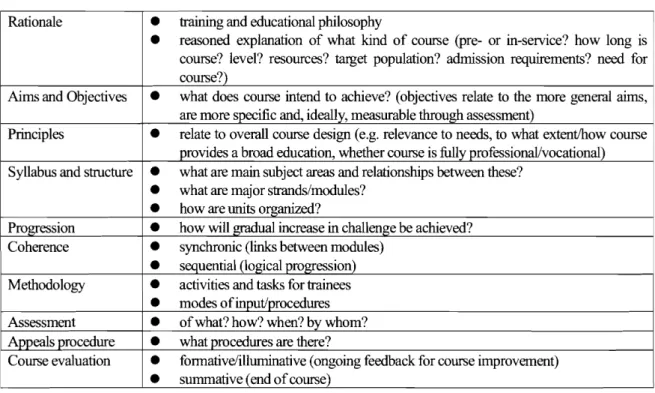
Whether we are considering staff development for specific change implementation or a more general purpose course, the training philosophy, or rationale, of a program is just the first of many factors that need consideration. Below is a summary of the issues that Wal- lace(l991 : 141-164) considers important.
Table 1 Course design and assessment checklist Rationale
•
training and educational philosophy•
reasoned explanation of what kind of course (pre- or in-service? how long is course? level? resources? target population? admission requirements? need for course?)Aims and Objectives
•
what does course intend to achieve? (objectives relate to the more general aims, are more specific and, ideally, measurable through assessment)Principles
•
relate to overall course design (e.g. relevance to needs, to what extent/how course provides a broad education, whether course is fully professional/vocational) Syllabus and structure•
what are main subject areas and relationships between these?•
what are major strands/modules?•
how are units organized?Progression
•
how will gradual increase in challenge be achieved?Coherence
•
synchronic (links between modules)•
sequential (logical progression) Methodology•
activities and tasks for trainees•
modes ofinput/procedures Assessment•
of what? how? when? by whom?Appeals procedure
•
what procedures are there?Course evaluation
•
fonnative/illuminative (ongoing feedback for course improvement)•
summative (end ofcourse) 3.2 PRESET, INSET and OUTSETPre-service training (PRESET) or education is a course or program of study which stu- dent teachers complete before they begin teaching. PRESET often sets out to show future teachers basic teaching techniques and give them a broad general background in teaching and in their subject matter. PRESET teachers may have teaching practice built in to their course, but this is usually quite limited, and often occurs right at the end of a course or in blocks at the end of each semester.
PRESET may be compared with in-service training (INSET) or education, which refers to experiences that are provided for teachers who are already teaching and that form part of their continued professional development. PRESET usually takes place for a specific pur- pose and often involves the following cycle of activities: assess participants' needs; deter- mine objectives for in-service program; plan content; choose methods of presentation and learning experiences; implement; evaluate effectiveness; and provide follow-up assis- tance.
A third category of program is the type designed for experienced teachers who leave their post for an extended period of time, several weeks or even years, to study at an edu- cational establishment, often overseas. These are called out-of-service training(OUTSET) programs. Although INSET and OUTSET participants are experienced teachers, in some respects OUTSET teachers resemble more closely student teachers on a PRESET course, since they cannot tryout and evaluate the usefulness of the ideas presented to them until they are back in post.
4. Theoretical and Practical Content of Teacher Education 4.1 Categories of knowledge in language teaching
While the specific content of a course will be highly dependent on the target group, ra- tionale, training context etc., there is a small number of broad categories of item that plan- ners can consider. DayCin Richards and Nunan 1990 : 43) describes the two most basic cat- egories of knowledge required by teachers: subject matter knowledge and action system knowledge, where for language teachers, the former refers to target language proficiency and knowledge about the target language (KAL) and the latter refers to information dealing with teaching and learning in general. Both types of knowledge can be developed either as received knowledge or as experiential knowledge. Wallace's (1991 : 15) diagram can be elab- orated as follows :
_ _ _ _ _ ~~VedknOWled~
[Action system
knowled~
ISubject matter knowledd~--.~ ¢=>
IReflection - - . Wfofessionalcompetenc~
(skill +theory) (proficiency + KAL)
----
fuvious experiential knowledd KAL=knowledge about the target language Figure 1 Basic categories of knowledge in language teaching
Wallace (1991) argues that received knowledge element should both directly inform the experiential knowledge element and be informed by it. Within the context of a course, this means relating input sessions on topics such as linguistics, methodology, and language ac- quisition theory to the periods of teaching practice or school experience. As Wallace (1991) suggests, ways should be found of making the relationship reciprocal, not one-way, so that the trainee can reflect on the received knowledge in the light of classroom experience, and so that classroom experience can feed back into the received knowledge sessions. This type of reflection that can result in trainees perceiving the relevance of theory to practice may be done privately, on an individual basis, outside the formal framework of the course, but should preferably be a shared experience, which is focused along selected parameters.
Techniques for achieving this include micro-teaching, directed observation, classroom-based research, use of video and lesson transcripts and diary studies.
4.2 Syllabus content for teacher education
With respect to the subject matter knowledge, the language itself, teachers should argu- ably possess a degree of explicit knowledge about language, but must also be reasonably fluent users of the language. Lewis and Hill (1992) assert that teachers of any subject must have a clear idea of the subject they are teaching-not only the facts of the subject, but an
overall view of the nature of the subject. This is as true for the language teacher as for any other teacher. Wright (1994) stresses the importance of language teachers' ability to have insights about English, and to make connections between knowledge about the system of English and knowledge of how English is used and learned, and thus of how it might be taught. Teachers of English need to know how the language works as well as what it can achieve.
The action system knowledge part of a course includes items such as classroom manage- ment, teaching the four skills, lesson planning, theory of language learning, using a course book, error correction, teaching at different levels, teaching grammar and vocabulary, test- ing, and an assortment of specific techniques(e.g. dialogue building, using games and songs, teaching one-to-one). This type of syllabus implies an applied science approach. On post-ex- perience courses a greater level of reflection is usually encouraged, but it is still the norm to find a particular approach or method is promoted, through the techniques presented and the training methodology employed by the trainers themselves.
5. Training Methodology
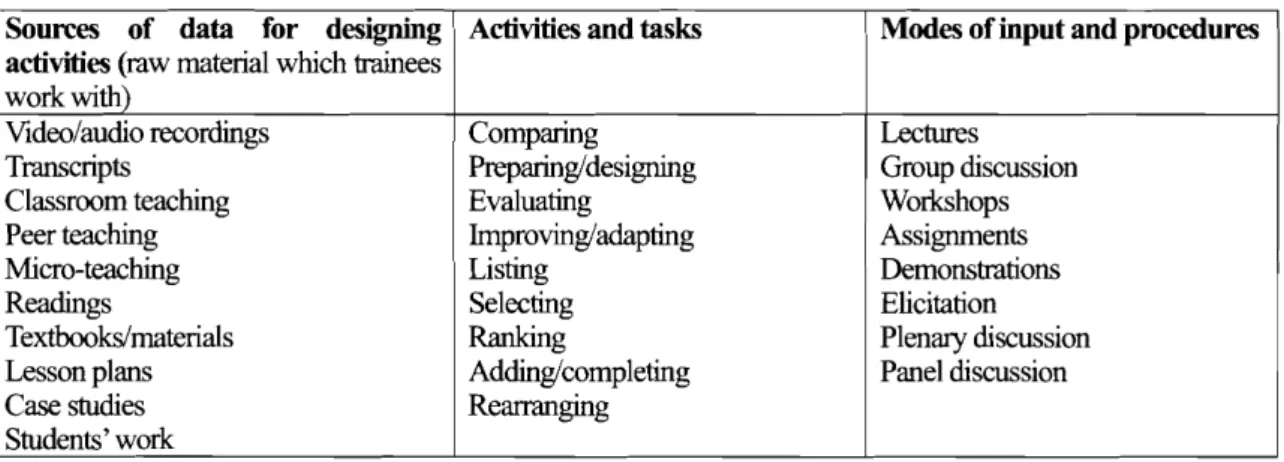
Perhaps, once we have decided on the rationale and content of a teacher education course, the methodology we promote should be the single most important guiding principle in our subsequent materials and activities designing. In terms of specific activities and pro- cedures for teacher education, Ellis(in Richards and Nunan 1990)presents a wide number of options summarized below.
Table 2 Specific activities and procedures for teacher education Sources of data for designing
activities(raw material which trainees work with)
Video/audio recordings Transcripts
Classroom teaching Peer teaching Micro-teaching Readings
Textbooks/materials Lesson plans Case studies Students' work
Activities and tasks
Comparing Preparing/designing Evaluating
Improving/adapting Listing
Selecting Ranking
Adding/completing Rearranging
Modes of input and procedures
Lectures Group discussion Workshops Assignments Demonstrations Elicitation Plenary discussion Panel discussion
Day (in Richards and Nunan 1990) discusses training methodology under the heading
"teacher preparation practices," which he sees as divided into experiential activities and awareness-raising activities, with the two types being potentially integrated. Teacher train- ees should be encouraged to develop their experiential and awareness-raising practices, which are closely related to and subsumed under the notion of autonomy. Experiential practices involve the trainee in actual teaching. This can occur through teaching practice, where the trainees are required to teach actual students in real classrooms, or it can occur in simulated practice. On the other hand, awareness-raising practices are intended to devel- op the trainees' conscious understanding of the principles underlying EFL teaching and the practical techniques which teachers can use in different kinds of lessons. Both practices do not need to be separated; they can be combined in a single way.
Observing professional teachers or fellow teachers at work also seems to be very impor-
tant. Observing and evaluating their approaches in a critical way may bring answers to a variety of questions, so that we can make use of those answers for developing our own pro- fessional competence. In this case, in order to help trainees develop their competence in a more realistic way, trainers and trainees need to have opportunities to consult with each other as often as possible. Trainees should be involved more closely in the decision-making process.
Furthermore, teacher education programs need to be more concerned with metacogni- tive processes of self-awareness, self-direction, and self-evaluation, on which practical mod- els for teacher development may be built. Self-awareness is an essential prerequisite for our development. Awareness-raising components listed by Britten (1988) are: discovering learn- ing whenever possible; trainee-mediated presentation when practicable; a steady increase in the amount of self-access work; case studies for problem solving in later stages of train- ing; regular samples or elicitations of trainees' attitudes with questionnaires for self-report and discussion; and maximum small-group discussion in earlier parts of the program and little or no group work later. As for self-direction and self-evaluation, they are not easy skills for young trainees to develop. The age and maturity of trainees are important factors to be considered when thinking about ways of developing reflective practitioners.
6. Conclusion
In this paper, we have introduced three approaches to teacher education and have at- tempted to present an overview of the key issues to be considered when designing an EFL teacher education course. Designing a language teacher education course has many paral- lels with designing a language course, but is complicated by the fact that it is higher in the stack. In the context of language teacher education, the relationship between theory and practice in both language and pedagogy must be considered, as n1ust the learning process- es of the trainees and the methodology that can be best facilitate effective teacher develop- ment : we have options in terms of selecting the course content(the information, skills or knowledge to be taught or learned) ; we also have options in terms ofprocess(how the in- formation or knowledge is going to be taught or learned).
Teacher education programs and teacher educators are seen to be sources of knowledge, experience, and resources for teacher trainees to use in exploring and developing their own approach to teaching. Teacher educators are expected to try their own philosophies and theories precisely in order to improve the quality of teacher education courses.
On the other hand, as Legutke and Thomas (1991) suggest, there are signs that the role relationship between educators and teacher trainees is becoming less hierarchical and more heterarchical. The role of teacher education is now not to deliver sacred principles to a grateful profession but to facilitate change by helping trainees to become self-directing and researchers of their own work. Such trends reveal a growing awareness that teacher de- velopment at the individual level and change at the institutional level is more likely to oc- cur when teachers are involved in articulating their needs and shaping how such change may take place. This concern for the actualities of the classroom and the direct preoccupa- tions of teachers parallels the way in which teaching in the learner-centered communica- tive classroom is seeking in turn to involve and exploit the needs and contributions of learners.
Becoming an EFL teacher and teaching in a confident, competent, creative and ethical manner is a challenging and complex learning process, where teacher-learners can learn
from their teaching experiences, question the educational values, evaluate their own prac- tice, and develop their teacher autonomy. Teacher autonomy involves ideas of professional freedom and self-directed professional development. In order to foster autonomy among learners, teachers should be both free and able to assert their own autonomy in the prac- tice of reflective teaching and research. With the help of networking at home and abroad, and through continuous research and practice, we need to promote an effective approach to EFL teacher education in ] apan.
References
Benson, P. & P. Voller. (EdJ, 1997.Autonomy & Independence in Language Learning. New York: Longman.
Britten, D. 1988. "Three stages in teacher training." ELT Journal 42, 1,3-8.
Brown, H. D. 2001. Teaching by Principles: An Interactive Approach to Language Pedagogy. New York: Longman.
Edge, ]. 1988. Training, Education, Development: Worlds Apart. Revised version of a plenary paper presented at the United Kingdom Association of Teachers in Overseas Education. Moray House, Edinburgh.
Freeman, D. 2001. "Second Language Teacher Education." In R. Carter and D. Nunan (EdsJ, The Cambridge Guide to Teaching English to Speakers of Other Languages.
Cambridge: Cambridge University Press.
Kojima, H. 1999. "Developing an Effective Approach to Teacher Education" Bulletin of the Tohoku English Language Education Society 20,49-58.
Kojima, H. (2005). "Teacher Roles in Lerner-Centered Communicative EFL Instruction."
Bulletin of the Faculty of Education, Hirosaki University 94, 59-71.
Kennedy, C. and C. Edwards. 1998.ELT Management. The Student Handbook. CELS at the University of Birmingham.
Legutke, M. and H. Thomas. 1991. Process and Experience in the Language Classroom.
New York : Longman.
Lewis, M. and]. Hill. 1992. Practical Techniques. Hove, UK : Language Teaching Publications.
MEXT. (2003). Regarding the Establishment of an Action Plan to Cultivate "Japanese with English Abilities" [Online]. Available:
<
www.mext.go.jp/english/topics/03072801.htm>
Nunan, D. 1988. The Learner-Centred Curriculum. Can1bridge : CaInbridge University Press.
Nunan, D. 1991. Language Teaching Methodology: A Textbook for Teachers. New York:
Prentice-Hall.
Nunan, D. and C. Lamb. 1996. The Self-Directed Teacher: Managing the Learning Process.
CaInbridge : CaInbridge University Press.
Richards, ]. C. and D. Nunan. (Eds.). 1990. Second Language Teacher Education.
Cambridge: Cambridge University Press.
Richards, ]. C. and R. Schmidt. (2002). Longman Dictionary of Language Teaching &
Applied Linguistics. London : Longman.
Scarcella, R.C. & R. 1. Oxford. 1992. The Tapestry of Language Learning: The Individual in the Communicative Classroom. Boston: Heinle & Heinle Publishers.
Wallace, M. 1991. Training Foreign Language Teachers: A Reflective Approach.
Cambridge: Cambridge University Press.
Wright, T. 1994. Investigating English.London: Edward Arnold.
(Accepted on January 10. 2006)