• 検索結果がありません。

Leadership Communication Courses for Career Success and Leadership Conceptualization Research

N/A
N/A
Protected

Academic year: 2021

シェア "Leadership Communication Courses for Career Success and Leadership Conceptualization Research"

Copied!
27
0
0

読み込み中.... (全文を見る)

全文

(1)

Leadership Communication Courses for Career Success and Leadership Conceptualization Research

journal or

publication title

Global communication studies 

number 9

page range 29‑54

year 2020‑03

URL http://id.nii.ac.jp/1092/00001668/

(2)

L eadership Communication Courses for Career Success and Leadership

Conceptualization Research

K NIGHT Kevin

Knight (2015d) explores the leadership conceptualization process and illuminates how leadership communication program development for L2 learners in the International Business Career (IBC) major at Kanda University of International Studies in Chiba, Japan was infl uenced by the instructor’s leadership conceptualization cycle and other underlying motivational factors. This paper also views the co-creation and implementation of such programs as Scollon’s (2001) “nexus of practice.” Investigating two new leadership communication courses created and taught by Knight and offered to KUIS students of all majors in April 2019, the paper initially explores the historical context of and pedagogical connections among specifi c courses that preceded the development of Leadership Communication I & II and then considers the design, implementation, and evaluation of the two courses. In the light of the instructor’s motivational relevancies (Sarangi & Candlin, 2001, 2011) to prepare his students for success in the global workplace, the paper concludes that the two courses expose students to the language of leaders (Nickerson, 2014). The students are provided with approaches to analyze conceptualizations of leadership and to frame their own leadership experiences in professional settings such as job interviews.

Keywords: Leadership communication, leadership conceptualization, nexus analysis, program development

1. Introduction/Background

Heffernan (2019), who is the former CEO of fi ve businesses,

speaks about “the human skills that we need in an unpredictable

world”:

(3)

Preparedness, coalition-building, imagination, experiments, bravery — in an unpredictable age, these are tremendous sources of resilience and strength. They aren’t effi cient, but they give us limitless capacity for adaptation, variation and invention. And the less we know about the future, the more we’re going to need these tremendous sources of human, messy, unpredictable skills.

As an English for specifi c purposes (ESP) practitioner, my aim has been to empower my students with the English language communication skills needed for success in training or work, and at Kanda University of International Studies in Chiba, Japan, I have had the opportunity to develop various programs that prepare my students for success in the global workplace upon graduation.

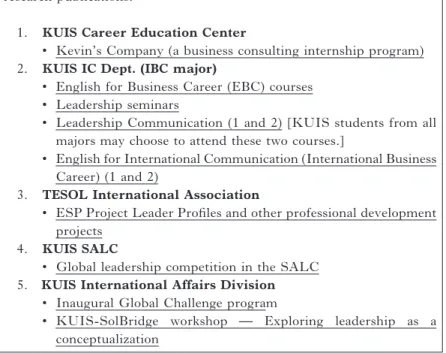
These KUIS programs, which are all related to leadership and communication, are listed on my personal website launched in January 2016 titled The Leadership Connection Project (TLCP).

(See Table 1.) In this paper, the creation of my courses offered in the KUIS Career Education Center and the Department of International Communication is discussed in this introductory background section (1), and the development of my leadership communication courses in particular is explored from a refl ective stance in the sections that follow.

Knight’s (2013d) leadership conceptualization of communicating

to create and achieve visions is refl ected in all of the KUIS

programs in Table 1. (See the Discussion & Conclusions section 3.)

However, the courses were developed for different reasons, and this

introductory section (1) illuminates various factors that infl uenced

their creation. The start of my career at KUIS followed a ten year

period providing primarily corporate language training programs at

an affi liate of KUIS; specifi cally, Kanda Gaigo Career College

(KGCC). Prior to working at KGCC, I had been doing similar

(4)

The Leadership Connection Project

Exploring the conceptualization of leadership worldwide!

Leadership Development Activities and Research Publications My aim has been to give my students and colleagues the opportunity to explore “leadership” through leadership-related research and activities.

I conceptualize leadership to be a “creative” activity that involves: 1)

“communicating to create visions” and 2) “communicating to achieve visions.” Click on the links below to learn more about the activities and research publications.

1. KUIS Career Education Center

• Kevin’s Company (a business consulting internship program) 2. KUIS IC Dept. (IBC major)

• English for Business Career (EBC) courses • Leadership seminars

• Leadership Communication (1 and 2) [KUIS students from all majors may choose to attend these two courses.]

• English for International Communication (International Business Career) (1 and 2)

3. TESOL International Association

• ESP Project Leader Profi les and other professional development projects

4. KUIS SALC

• Global leadership competition in the SALC 5. KUIS International Affairs Division

• Inaugural Global Challenge program

• KUIS-SolBridge workshop — Exploring leadership as a conceptualization

Table 1: The Leadership Connection Project website (extract from top

page)

(5)

work at Sony. During the fi rst stage of my career at KUIS, I was in charge of curriculum development in the KUIS Career Education Center (CEC), and in addition to creating and teaching one-semester courses in management and marketing, I developed a two-semester business internship program featuring a simulated company titled Kevin’s Company where students acted as business consultants. The client of Kevin’s Company was British Hills (BH), which is another institution in the Kanda Gaigo Group and located in Fukushima prefecture. The program was designed to meet a specifi c need of KUIS students for substantial business/

leadership experience using English, which was not being met by their other internships in Japan. Table 2 contains the description of my program that appears on the TLCP website.

As consultants, the participants in the business internship program are responsible for obtaining information about the operations of BH and for making recommendations to BH administrators. The students need to learn to view BH from a leadership perspective in order to see business opportunities for BH. In addition, they need to persuade BH decision makers to accept their recommendations for improvement. Although the program is no longer being conducted, the evolution of the program has been recorded in a variety of presentations and publications (Knight, 2006, 2007, 2008a,b,c; 2009, 2010a,b; 2011a; 2012a,b,c; 2013a,b).

The next stage of my career at KUIS began with the

establishment of the International Business Career (IBC) major in

the Department of International Communication for students who

wanted to study business and English, and in my role as a founding

IBC instructor, I created the four English for business career

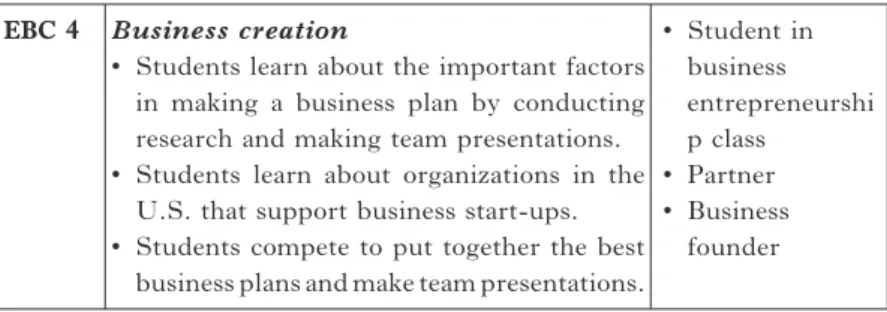
(EBC) courses. (See Table 3.) Although the courses were designed

with my expectation that IBC students would be required to take

all of the courses in order from EBC 1 to EBC 4, the IBC curriculum

gave students more fl exibility. The second-year students were all

(6)

In the year-long internship program, the participants perform in an extended role play in which they act as business consultants in a simulated consulting company (i.e., not a real company) titled Kevin’s Company.

• Each participant is assigned to a consulting team.

• Classroom sessions are conducted as company meetings.

• The instructor is a native English speaker.

• The instructor teaches business research and business communication to the participants and directly supervises the consulting teams.

• All meetings are conducted in English.

• The meetings are conducted in two locations: 1) KUIS and 2) British Hills (BH).

• The client of Kevin’s Company is British Hills.

• The participants work in small teams to conduct business research in connection with British Hills.

• The teams prepare presentations and reports in which they give their recommendations for improving the business operations of British Hills.

The aim of the internship program is to give a leadership experience to the participants. At British Hills, the participants interact with the leaders of the various departments and are treated not as undergraduate students but as business professionals.

Table 2: Kevin’s Company

The EBC courses were originally designed so that students would take them in order from EBC 1 to EBC 4. (See below the focus and learner’s role in each course as adapted from Knight, 2014:12). The aim was for students to experience each business role in succession, starting with the role of company employee and fi nishing with the role of business founder.

Accordingly, the Leadership Seminars complement the EBC courses.

Table 3: English for Business Career (EBC) courses

(7)

Course Focus Learner’s role EBC 1 Business communication

• Business communication in the offi ce (meeting people, telephoning, company performance)

• Business meetings (based on short business case studies; human resources, marketing, investment)

• Personal accomplishment stories (in preparation for job interviews or study abroad; situation, action, result)

• Student in business communication class

• Learner

• Prospective employee

• Employee

EBC 2 Business strategy

• Business case studies (for native English speakers)

• Materials (PowerPoint presentations and business case studies; marketing, operations, people, fi nance, strategy, external development)

• Activities (selecting case studies, making presentations, leading discussions of case studies in class)

• Student in business case study class

• Teacher

• Manager

EBC 3 Business management

• Onsite and online business management simulation.

• Students are owners of small businesses and must make strategic decisions concerning business operations.

• Students learn about fi nancial statements (balance sheet, income statement, cash fl ow statement), strategic management, and business ethics.

• Students work in teams to make business decisions and deliver presentations about company performance.

• Student in business simulation class

• President

• Partner

• Business owner

(8)

EBC 4 Business creation

• Students learn about the important factors in making a business plan by conducting research and making team presentations.

• Students learn about organizations in the U.S. that support business start-ups.

• Students compete to put together the best business plans and make team presentations.

• Student in business entrepreneurshi p class

• Partner

• Business founder

required to take EBC 1, and many of the third-year and fourth-year students chose to take two or three of the other courses. In my opinion, the higher-level EBC courses (2 to 4) were the most important for developing leadership skills. The four EBC courses (1 to 4) were also featured in my presentations and publications (Knight, 2010c, 2011b,c; 2012d, 2013c, 2014a, 2015a,b; 2016).

As an IBC founding instructor, I was given the option to teach a two-year seminar to second and third year IBC students. The design of the seminar was of my own choosing. It had been suggested to me that my seminar could be the business internship program (i.e., Kevin’s Company that I had created) and focus on marketing-related student consulting for BH. My undergraduate degree (BA) is in English, and my fi rst two graduate degrees are in Pacifi c international affairs (MPIA) and business administration (MBA), which qualifi es me to teach international affairs, business, marketing, and management. However, my Ph.D. is in linguistics, and my doctoral research investigates the leadership conceptualization process, so I decided that my seminar should focus on leadership.

Table 4 provides the course description on the TLCP website.

In combination with the business internship program and the

EBC courses, the leadership seminar became what I saw as a

capstone course for my IBC students. From a refl ective stance, and

after discussions with my students, I realize that including an

(9)

Leaders in companies are often considered to be successful members of society. The KUIS seminars, which are conducted for 2nd and 3rd year undergraduate students in the International Business Career major, focus on understanding leadership in an organization (e.g., a company):

1. What is leadership?

2. How do leaders practice leadership?

3. How do leaders communicate?

4. What are leadership skills?

5. How can leadership (skills) be developed?

6. What can we learn from leaders?

7. How can research on leadership be conducted?

The seminars are conducted in English only and may focus on the material from various articles or from a book such as the following:

• Nohria, N. & Khurana, R. (Eds.) (2010). Handbook of leadership theory and practice: A Harvard Business School centennial colloquium.

Boston, MA: Harvard Business Press.

• Liu, L. (2010). Conversations on leadership: Wisdom from global management gurus. San Francisco, CA: Jossey-Bass.

• Fairhurst, G. (2011). The power of framing: Creating the language of leadership. San Francisco, CA: Jossey-Bass.

The research in the seminars is related to leadership (i.e., leadership in practice, leadership communication, leadership development, leadership identity, leadership and gender, etc.). For example:

• Interviews with leaders (original research, etc.) to understand leadership in different organizations/industries

• Examining the spoken and written communications of leaders (speeches, interviews annual reports, websites, etc.)

• Examining the communication in leadership teams

• Examining leadership development programs/approaches (and/or their effectiveness)

Table 4: Leadership seminars

(10)

adapted version of Kevin’s Company in the seminar would have resulted in valuable leadership training for my students. However, a campus-wide curriculum revision at KUIS eliminated the two- year IBC seminars. My presentations and publications also focused on the leadership seminars (Knight, 2011d, 2012e, 2013d,e; 2014b,c;

2015c,d, 2017, Knight & Candlin, 2015, Knight & Murphey, 2017).

The KUIS curriculum revision resulted in the introduction of two new courses in the IBC curriculum: English for International Communication (International Business Career) (1 and 2). These EIC-IBC courses replaced EBC 1 to 4. Each of the EIC-IBC courses was twice the length of the EBC courses 2 to 4; i.e., two days a week instead of one day. As the courses could be taken by only third-year and fourth-year IBC students, I adapted the contents of EBC 2 to 4 into two courses that focus respectively on the following: 1) international business cases and communication (i.e., EBC 2), and 2) business promotion and strategic management (i.e., EBC 3 & 4). In each course, business content and business communication have been combined. The course descriptions in Table 5 have been adapted from those in the TLCP website.

The two EIC-IBC courses may be considered to include a mix of English as mediated instruction (EMI), content-based instruction (CBI), and ESP training (for students with immediate or near-term English language communication needs) in the areas of international business, business communication, and strategic management. As

• Investigating the difference between male and female leadership styles

• Investigating the difference between leadership in different types of organizations

Project-based learning is also an important part of the seminars as the

participants learn to communicate to create and achieve their visions in a

socially responsible manner.

(11)

EIC-IBC 1: International Business Cases and Communication The course provides an overview of international business and the actions of managers in international business contexts. The objective of the course is to deepen the participants’ knowledge of the English used in business. In the course, the participants discuss business topics, read business texts, acquire business communication skills, and learn from business cases.

Day 1: Before class, the participants are expected to have read a business case. In class, the participants are given a quiz about the reading assignment. After listening to a presentation and/or watching a video about the case, the participants work in teams to write an essay about the case. The team essay must be submitted on Day 2 at the beginning of the class. The team members evaluate each other on contributions to the team essay.

Day 2: After receiving the team reports, the instructor leads a “cold calling” style class discussion about the case in which the participants are graded on their contributions.

Outside of class: The assigned reading and preparation for quizzes and discussions must be done outside of class on an individual basis. Teams are also required to write case essays and to create the fi nal presentation outside of class.

EIC-IBC 2: Business Promotion and Strategic Management The two strands in this course focus on English used in 1) infl uencing stakeholders in a series of scenarios that involve self-promotion and/or promotion of an organization, and 2) decision making and communication related to strategic management and business operations. The discussions, presentations, and communication training in this course help to prepare the participants for leadership communication in companies. The participants evaluate each other on individual and team performances throughout the course.

Strand 1 (Day 1): The communication activities include the individual

Table 5: EIC-IBC courses

(12)

such, these courses help IBC students to prepare themselves for international business careers. The content of the courses is refl ected in the presentations related to the EBC courses listed above. In addition, Knight (2019) discusses how the case method used in Harvard Business School is applied with IBC students.

When the KUIS curriculum revision was implemented, my one- semester leadership communication courses were launched for third-year and fourth-year students of all majors. Both courses are offered in the spring and fall semesters. In effect, these courses are a version of my leadership seminar and focus on the following: 1) the analysis of leadership conceptualizations, and 2) framing as the language of leadership. Table 6 contains the course descriptions from the TLCP website.

The courses were launched in April 2019, and a few of the students asked if I taught a leadership seminar. A seminar would provide the students with the opportunity to conduct research and write a graduation thesis. Although the leadership communication presentation of a STAR/CAR success story, a Kickstarter-related team presentation and video, and the team presentation of a business plan (in an elevator pitch format). In connection with such business communication activities, the participants are taught linguistic concepts (including framing) and are introduced to different types of speeches (e.g., informative, persuasive, entertaining, and the 1AC in academic debate).

Strand 2 (Day 2): The participants learn the language of fi nancial statements, discuss business topics, read business texts, acquire business communication skills, learn from business cases, and participate in a computerized business simulation.

Outside of class: The participants are required to prepare for individual

and team presentations and to make and submit team decisions in a

business simulation outside of class. Additional details are provided in

class.

(13)

courses do not provide students with the thesis-writing opportunity, they give students an understanding of leadership and introduce them to the analysis of leadership communication and leadership conceptualizations. This paper is the fi rst publication to explore these leadership communication courses, and the next section (2) focuses on the design, implementation, and evaluation of the two courses.

Leadership Communication I

Leadership may be viewed as a socially constructed conceptualization with various inputs (Knight, 2015), and the participants in the course learn to critically analyze a leadership conceptualization as they address the questions: 1) “How is leadership being defi ned?” and 2) “Why is leadership being defi ned in this way?” In the course, the participants read “conversations with leaders/leadership experts” and watch

“videos of leaders/leadership experts talking about leadership.” The conceptualizations of leadership in the examples of professional communication are explored as intersections of 1) language, 2) culture, 3) the workplace and 4) one other theme: politeness, identity, or gender.

The conceptualizations of leadership are also viewed in the light of social power interests, positions and alignments, and sociocultural or historical or cultural patterns expressed (Scollon & Scollon, 2004).

Leadership Communication II

Framing may be viewed as the language of leadership (Fairhurst, 2011), and the course builds upon concepts introduced in Fairhurst’s The Power of Framing: Creating the Language of Leadership, which is intended for three audiences: 1) leaders/managers, 2) MBA students, and 3) communications students. The course participants view communication examples from a variety of sources including business, politics, sports, academia, and the arts. In the course, the participants also consider other sources on framing such as Raffoni’s (2009) “How To Frame Your Messages for Maximum Impact” in Harvard Business Review.

Table 6: Leadership Communication courses

(14)

2. Design, Implementation, & Evaluation of Leadership Communication I & II

My personal journey in my roles as a researcher and instructor has had a signifi cant infl uence on how I have come to see leadership.

For example, my doctoral research gave me the opportunity to talk about leadership in interviews with leaders in the public, private, and academic sectors. In these research interviews, I sought to gain knowledge and expertise in leadership that I could use in my KUIS classes for the benefi t of my students. My motivation as a teacher has been to share with my students the excitement that I have experienced learning about leadership so that they want to learn more about leadership on their own.

The two leadership communication courses are intended to familiarize my students with leadership communication. Leadership communication in this context refers to 1) how people talk or write about leadership and 2) how leaders use persuasive communication (and framing, in particular) to infl uence others. The courses are labeled as academic lectures, and the content of my former leadership seminars has been adapted and revised to fi t the lecture format.

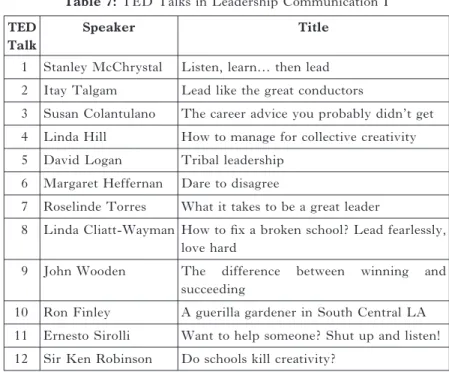
The lectures are delivered as PowerPoint presentations, so my refl ective description of the content of the class draws upon these presentation materials. Leadership Communication I includes TED Talks about leadership. The students are asked to analyze the conceptualizations of leadership in each TED Talk from various perspectives. In the spring semester of 2019, the TED Talks, which were delivered by male and female leaders and/or leadership experts, focused on one or more aspects of leadership. (See Table 7.)

The TED Talks are followed by quizzes that test the students’

understanding of specifi c aspects of the conceptualizations of

leadership presented. In addition to the TED Talks, the students

(15)

are exposed to conceptualizations of leadership in publications, including white papers and case studies (e.g., Ernst & Chrobot- Mason, 2010, Ernst & Yip, 2009, Knight, 2015d, Liu, 2010, Nohria & Khurana, 2010). The students are also asked to communicate about their accomplishments as leaders with the S.T.A.R. (situation, task/target, action, result) and C.A.R.

(challenge, action, result) frameworks used to respond to behavioral questions in job interviews.

In contrast to Leadership Communication I, the focus of Leadership Communication II is on framing. A key reference for the course is Fairhurst (2011). Fairhurst describes framing as the shaping of reality, and the students are introduced to six reality construction rules. (See Table 8.) In the process of exploring the

TED Talk

Speaker Title

1 Stanley McChrystal Listen, learn… then lead 2 Itay Talgam Lead like the great conductors

3 Susan Colantulano The career advice you probably didn’t get 4 Linda Hill How to manage for collective creativity 5 David Logan Tribal leadership

6 Margaret Heffernan Dare to disagree

7 Roselinde Torres What it takes to be a great leader

8 Linda Cliatt-Wayman How to fi x a broken school? Lead fearlessly, love hard

9 John Wooden The difference between winning and succeeding

10 Ron Finley A guerilla gardener in South Central LA 11 Ernesto Sirolli Want to help someone? Shut up and listen!

12 Sir Ken Robinson Do schools kill creativity?

Table 7: TED Talks in Leadership Communication I

(16)

reality construction rules in Table 8, the students learn about topics related to framing, including discourse, mental models, and sensitivity to the framing concept. In addition, the students conduct research interviews with leaders (whom they identify and select) in an investigation of how the leaders frame the concept of leadership and their performances as leaders. At the end of the term, the students share and discuss their research approaches and results, and the leaders’ narratives are analyzed with the S.T.A.R./C.A.R.

frameworks.

The students in both classes are also asked to draw pictures of leadership. Although the instructions for drawing leadership are the same for both classes, the reasons for doing so differ. In Leadership Communication I, the students need to understand what a conceptualization of leadership is so that they can analyze the conceptualizations of leadership in the TED Talks and publications

• Leaders often cannot control events, but they can control the context under which events are seen if they recognize a framing opportunity.

• At its most basic level, framing reality means defi ning “the situation here and now” in ways that connect with others.

• “Reality” is often contested. Framing a subject is an act of persuasion by leaders, one imbued with ethical choices.

• It is the uncertainty, confusion, and undecidability of “the situation here and now” that opens it up for interpretation and provides an opportunity for the more verbally skilled among us to emerge as leaders.

• Ultimately, leadership is a design problem. Leaders must fi gure out what leadership is in the context of what they do and, through their framing and actions, persuade themselves and other people that they are doing it.

• Effective framing requires that leaders be able to control their own spontaneous communications.

Table 8: Six reality construction rules (Replicated from Fairhurst, 2011:

2–14)

(17)

to which they are exposed in class. In Leadership Communication II, the students may choose to ask the leaders, whom they select and interview, to draw pictures of leadership because a leader’s framing of the concept of leadership in their interview responses may be illuminated by the drawing. Table 9 lists the steps that the students follow in class. These steps were adapted from Knight (2015d).

The drawing activity introduces the students to the leadership conceptualization process. In effect, a drawing of leadership does not occur in a vacuum. Various factors have infl uenced how leadership is drawn by the students in the class. The questions in Table 10 may be used to increase student awareness of the leadership conceptualization process and enable students to refl ect on their drawings before describing them to others.

Instructions for students

1. You will have one minute to draw a picture of leadership. Do not write any words. Only pictures. Stick fi gures are fi ne.

2. Write your name at the top of your paper.

3. Turn your paper over.

4. Think about leadership, but do not write anything. (Two minutes) 5. Draw a picture of leadership. (One minute)

6. Turn your paper over.

7. Do not show your drawing to the other participants.

8. Write your defi nition of leadership in your own words. (Two minutes)

9. Write one word only that describes leadership in your drawing.

(One minute)

10. Look at the drawings of leadership on the table.

11. Match the drawings and the members of your group.

12. Guess the single word that is used to defi ne a drawing.

13. Explain your drawings and defi nitions to the other members of your group.

Table 9: Personal conceptualizations of leadership

(18)

By responding to the questions in Table 10 about their own drawings, the students are preparing to analyze conceptualizations of leadership other than their own.

Various improvements were made to the two courses throughout the spring semester to make the content more accessible to the students. One obstacle that needed to be overcome was the language level of some of the materials used in the courses. For example, TED Talks with Japanese subtitles were used in Leadership Communication I, but more than one student wanted to watch the TED Talks with English subtitles before class because the quiz

1. How would you explain what your drawing shows?

2. What real-life example of leadership would you give to clarify your drawing?

3. How would your audience and the related power dynamics have infl uenced how leadership was drawn?

4. What socio-economic and cultural factors would have had an effect on your drawing?

5. How would your skill and choices as an artist have affected your drawing?

6. What would the drawing say about you, personally, and your beliefs about leadership?

7. How would the instructions to draw a picture (i.e., without words in a short time) have infl uenced how leadership was drawn?

8. How would the medium of the paper limited or enhanced your communication about leadership?

9. Would you have always thought about leadership as indicated in your drawing?

10. Would your drawing be the only way in which you could see leadership at the time?

11. For your drawing of leadership to be understood, should it be considered in the context in which it was created?

Table 10: Questions for refl ecting on a drawing of leadership before

describing it

(19)

questions were related to the English content, so all students were informed of the presentations in advance. In Leadership Communication II, the language used in Table 8 was diffi cult for the students. In order to make the course easier, the fi rst day of the fall term began with framing opportunities with which the students are already familiar (e.g., explaining their good and bad grades at school to various stakeholders) and introduced them to the persuasive framework of the Monroe Motivated Sequence (for framing their hometowns as the solution to a problem) and Sinek’s TED Talk “The Golden Circle” (for getting “buy in” from stakeholders at the emotional level).

3. Discussion & Conclusions

Knight (2015d) argues that the creation and implementation of an online forum for discussions about leadership in his KUIS leadership seminars can be viewed as a nexus of practice subject to a nexus analysis. Lane (2014:5) write’s about Scollon’s (2001) nexus analysis as a tool used to identify and map social action:

The starting point of a Nexus analysis is to identify a crucial social action, and then to map the cycles of the people, places, discourses, objects, and concepts which circulate through the moment when the social action takes place (Scollon and Scollon 2004:159). Thus, the focus of the analysis is not primarily on discourse, but rather language is seen as tool used in order to accomplish actions (Norris 2002:97).

When my ongoing program development at KUIS is viewed as social action, a nexus analysis is relevant.

One question that has been addressed in this paper is “What has infl uenced the creation of my program development at KUIS?”

Hult’s (2017, p. 94) description of the historical body discourse

(20)

cycle in a nexus of practice may be applied to my program development (as action) described in this paper:

The historical body discourse cycle draws attention to life histories and the experiences of the social actors involved in the action being analyzed (Scollon & Scollon, 2004:160–161).

Spatially, it is about an individual or personal scale. Thus, the kinds of questions we might want to ask include: What beliefs does the actor hold about issues related to the action? What education, training, or socialization has the actor had that might infl uence how they engage in the action?… What beliefs and experiences of successive earlier generations enter into an actor’s (language) socialization? What experiences during a specifi c period of life, such as teacher education or professional apprenticeship, is particularly relevant to an action being studied?

The factors that have already been described in earlier sections include: 1) my educational background, 2) institutional restructuring, and 3) my research. However, it is my motivational relevancies (Sarangi & Candlin, 2001, 2011) that appear to connect all of my program development. Specifi cally, my desire to prepare my students for success in the global workplace has resulted in research decisions and course creation aimed at providing my students with skills that can be used in leadership roles.

Heffernan (2019) speaks about the importance of coalition-

building as one of the fi ve skills needed for success in the future,

and in Leadership Communication I, the boundary spanning

leadership of Ernst and Chrobot-Mason (2010) and Ernst and Yip

(2009) was discussed. More importantly, by watching the TED

Talks listed in Table 7, the students were able to see that leaders

and leadership experts have different views of leadership, and the

(21)

students came to understand that conceptualizations of leadership are contextually bound. For example, although the information in Susan Colantulano’s TED Talk applies to the career advancement of men and women, her focus is on helping women to be promoted to the C-level positions (i.e., CEO, CFO, etc.) in a business organization, and she can promote her work as a consultant. In Leadership Communication II, the students also came to understand how leadership may be defi ned differently, but it was through the co-construction of leadership conceptualizations in research interviews conducted with self-identifi ed leaders and not by the means of TED Talks.

Nickerson (2014:5) states in a 2011 plenary address:

Finally, and perhaps most importantly, we should develop closer ties with the sort of people working in business and industry that our students aspire to become — it is only through listening to them that we will understand the communication knowledge and skills that will ultimately lead to professional competence.

In agreement with Nickerson, I have designed the two leadership courses to expose my L2 students to the language of leaders. The students learn how leadership may be defi ned, and in addition, they learn to recognize their own leadership experiences. The students are provided with approaches to analyze conceptualizations of leadership and to frame their own leadership accounts in professional settings such as job interviews.

Korn and Belkin (2019) write the following in an article that lists Harvard University as the top school in the United States in “The Wall Street Journal’s” higher education rankings:

Research shows again and again that what matters in the end

(22)

isn’t so much where you go to college that counts, but how you go. What you major in, how hard you study, where you intern and what connections and relationships you build with classmates and professors can trump the name of the institution on a diploma.

I would add to the above the importance of connections and relationships that students build with professionals outside of the classroom. KUIS students need to forge ties with leaders.

According to the Times Higher Education Japan University Rankings 2019, KUIS ranked 34

th

overall and 7

th

among private universities. The translated version of the KUIS website states that the university will continue to focus on improving the English language skills of all students and developing independent learners.

The importance of communication skills and independent learning is summed up in a “Harvard Business Review” article about educating the next generation of leaders (Hoffman, Yeh, & Casnocha, 2019).

In the Networked Age, every day is exam day — full of new, unpredictable challenges. Often the best way to learn how to meet them is to talk to people who have faced similar situations.

All you need to do is ask.

Leadership Communication I & II contribute to the missions of

KUIS and Japan by helping students to acquire the knowledge of

leadership discourse that they need to build relationships with

leaders. As KUIS students develop the confi dence and skills to

interact effectively with leaders, they will learn from those leaders

how to obtain the support of others and become effective leaders in

the future.

(23)

References

Ernst, C. & D. Chrobot-Mason (2010) Boundary Spanning Leadership: Six Practices for Solving Problems, Driving Innovation, and Transforming Organizations. New York, NY: McGraw-Hill Professional.

Ernst, C. & J. Yip (2009) Boundary spanning leadership: Tactics to bridge social identity groups in organizations. In T.L. Pittinsky (ed.), Crossing the Divide: Intergroup Leadership in a World of Difference (pp. 89–99).

Boston, MA: Harvard Business School Press.

Fairhurst, G. (2011) The Power of Framing: Creating the Language of Leadership. San Francisco, CA: Jossey-Bass.

Heffernan, M. (2019, August) Margaret Heffernan: The Human Skills We Need in an Unpredictable World [Video fi le]. Retrieved from https://

www.ted.com/talks/margaret_heffernan_the_human_skills_we_need_in_

an_unpredictable_world

Hoffman, R., C. Yeh & B. Casnocha (2019, Mar.-Apr.) Learn from people, not classes (Spotlight series/Educating the next generation of leaders).

Harvard Business Review.

Hult, F.M. (2017) Nexus analysis as scalar ethnography for educational linguistics. In M. Martin-Jones & D. Martin (eds.), Researching Multilingualism: Critical and Ethnographic Perspectives (pp. 89–104).

London, UK & New York, NY: Routledge.

Knight, K. (2006) Kevin’s company at KUIS. [PowerPoint presentation].

Fukuoka, JA: JALT 2006.

Knight, K. (2007) Kevin’s company at KUIS. [PowerPoint presentation].

Ibaraki, JA: JALT Ibaraki Chapter.

Knight, K. (2008a) Global workforce development through business internship program: Kevin’s company at Kanda University of International Studies. The Journal of Kanda University of International Studies, 20, 207–234.

Knight, K. (2008b) Kevin’s company at KUIS. [PowerPoint presentation].

New York, NY: TESOL 2008.

Knight, K. (2008c) Kevin’s company from the perspective of professional communication research. [PowerPoint presentation]. Hong Kong:

APACLSP 2008.

Knight, K. (2009) Business internship program development in light of

professional communication research: Kevin’s company at Kanda

University of International Studies. In V. Bhatia, W. Cheng, V. Du-

(24)

Babcock & J. Lung (eds.), Language for Professional Communication:

Research, Practice & Training (pp. 235–249). Hong Kong: City University of Hong Kong, Asia-Pacifi c LSP and Professional Communication Association and the Hong Kong Polytechnic University.

Knight, K. (2010a) Leadership development in business internship program: Kevin’s company at Kanda University of International Studies. The Journal of Kanda University of International Studies, 22, 245–273.

Knight, K. (2010b) Framing for success in business internship program.

[PowerPoint presentation]. Kuala Lumpur, MY: APACLSP 2010.

Knight, K. (2010c) Teaching intellectual property English creatively.

[PowerPoint presentation]. Nagoya, JA: JALT 2005.

Knight, K. (2011a) Kevin’s company at KUIS. [PowerPoint presentation].

New Orleans, LA: TESOL 2011.

Knight, K. (2011b) Teaching intellectual property (IP) English creatively.

In A. Stewart (Ed.), JALT2010 Conference Proceedings, pp. 619–626.

Knight, K. (2011c) Teaching business skills and ethics through airline management simulation. The Journal of Kanda University of International Studies, 23, 49–73.

Knight, K. (2011d) Discourses of leadership as basis for developing leadership communication skills: Obtaining the insights of leaders through semi-structured interviews [PowerPoint presentation]. Sydney, AU: Macquarie University HDRO Showcase.

Knight, K. (2012a) Developing global competencies and leadership skills in undergraduates: The evolution of Kevin’s company at KUIS in the light of ESP best practices. [PowerPoint presentation]. Southern Taiwan University of Science and Technology: 2012 International Conference &

Workshop on English for Specifi c Purposes.

Knight, K. (2012b) Developing global competencies and leadership skills in undergraduates: The evolution of Kevin’s company at KUIS in the light of ESP best practices. In conference proceedings of 2012 International Conference & Workshop on English for Specifi c Purposes (CD-ROM).

Knight, K. (2012c) Creatively designing intensive business English programs to meet learner needs. [PowerPoint presentation]. Philadelphia, PA: TESOL 2012.

Knight, K. (2012d) Teaching business case studies through PowerPoint

(25)

presentations. The Journal of Kanda University of International Studies, 24, 1–28.

Knight, K. (2012e) Discourses of leadership as basis for developing leadership communication skills: Co-construction of online forum [PowerPoint presentation]. Sydney, Australia: Macquarie University HDRO Showcase.

Knight, K. (2013a) Leadership: A crucial variable in a business internship program. [PowerPoint presentation]. Dallas, TX: TESOL 2013.

Knight, K. (2013b) Developing global competencies and leadership skills in undergraduates: The evolution of Kevin’s company in the light of ESP best practices. [PowerPoint presentation]. Dallas, TX: TESOL 2013.

Knight, K. (2013c) Global resources in ESP: Kickstarter! TESOL Blog.

Alexandria, Virginia: TESOL International Association.

Knight, K. (2013d) Looking at communication through a leadership lens.

TESOL Blog. Alexandria, Virginia: TESOL International Association.

Knight, K. (2013e) The S.T.A.R. format in identifying and generating conceptualizations of leadership in study of discourses of leadership.

[PowerPoint presentation]. Sydney, Australia: Macquarie University HDRO Showcase.

Knight, K. (2014a) Preparing undergraduate students in Japan for the global workplace through four EBC courses. Professional and Academic English, 42, 8–14.

Knight, K. (2014b) Teaching leadership communication skills to Japanese learners through online forum. [PowerPoint Presentation]. Portland, Oregon: TESOL 2014.

Knight, K. (2014c) Creation of online forum for leadership development of KUIS students. The Journal of Kanda University of International Studies, 26, 195–223.

Knight, K. (2015a) Teaching business English and project leadership with Shark Tank. TESOL Blog. Alexandria, Virginia: TESOL International Association.

Knight, K. (2015b) Using an entrepreneurship video for interview training.

TESOL Blog. Alexandria, Virginia: TESOL International Association.

Knight, K. (2015c) Teaching leadership with the world’s fi rst $9 computer.

TESOL Blog. Alexandria, Virginia: TESOL International Association.

Knight, K. (2015d) Analysing the Discourses of Leadership as a Basis for

(26)

Developing Leadership Communication Skills in a Second or Foreign Language (Published doctoral dissertation). Sydney, Australia: Macquarie University.

Knight, K. (2016) Conducting professional communication training with Kickstarter. The Journal of Kanda University of International Studies, 28, 233–252.

Knight, K. (2017) Conceptualizing leadership development in the KUIS SALC. Studies in Self-Access Learning Journal, 8(4), 294–304.

Knight, K. (2019) Conducting business case discussions with undergraduates in Japan. The Journal of Kanda University of International Studies, 31, 313–333.

Knight, K. & C. N. Candlin (2015) Leadership discourse as basis and means for developing L2 students into future leaders. In P. Shrestha (ed.), Current Developments in English for Academic and Specifi c Purposes:

Local Innovations and Global Perspectives (pp. 27–50). Reading, UK:

Garnet.

Knight, K. & T. Murphey (2017) Soft assembling project-based learning and leadership in Japan. TESL-EJ, 21(1) [Online].

Korn, M. & D. Belkin (2019, updated Sep. 4) The top-ranked college is…

The Wall Street Journal [Online].

Lane, P. (2014) Nexus analysis. Handbook of Pragmatics, 18, 1–18.

Liu, L. (2010) Conversations on Leadership: Wisdom from Global Management Gurus. San Francisco, CA: Jossey-Bass.

Nickerson, C. (2014) Unity in diversity: The view from the (UAE) classroom. Language Teaching, FirstView (6), 1–15. (Plenary speech published online by Cambridge University Press: 22 May 2012.)

Nohria, N. & R. Khurana (eds.) (2010) Handbook of Leadership Theory and Practice: A Harvard Business School Centennial Colloquium. Boston, MA:

Harvard Business Press.

Norris, S. (2002) A Theoretical Framework for Multimodal Discourse Analysis Presented via the Analysis of Identity Construction of Two Women Living in Germany. Doctoral Dissertation, Georgetown University. UMI Raffoni, M. (April, 2009) How to frame your messages for maximum

impact. Harvard Business Review. Retrieved from https://hbr.org/2009/

04/leaders-frame-your-messages-fo

Sarangi, S. & C. N. Candlin (2001) Motivational relevancies: Some

methodological refl ections on sociolinguistic practice. In N. Coupland,

(27)

S. Sarangi & C. N. Candlin (eds.), Sociolinguistics and Social Theory (pp.

350–388). London, UK: Pearson.

Sarangi, S. & C. N. Candlin (2011) Professional and organizational practice: A discourse/communication perspective. In C. N. Candlin, &

S. Sarangi (eds.), Handbook of Communication in Organizations and Professions. Berlin, DE: De Gruyter Mouton.

Scollon, R. (2001) Mediated Discourse: The Nexus of Practice. London, UK: Routledge.

Scollon, R. & S. W. Scollon (2004) Nexus Analysis: Discourse and the

Emerging Internet. London, UK: Routledge.

Table 1:  The Leadership Connection Project website (extract from top  page)
Table 4 provides the course description on the TLCP website.
Table 7: TED Talks in Leadership Communication I

参照

関連したドキュメント

The Beurling-Bj ¨orck space S w , as defined in 2, consists of C ∞ functions such that the functions and their Fourier transform jointly with all their derivatives decay ultrarapidly

In order to explore the ways to increase nurses’ job satisfaction, the relationship between nurses’ job satisfaction, servant leadership, social capital, social support as well as

Taking the opportunity of leadership training, we set three project goals: (1) students learn about Japan beyond the realm of textbooks, (2) teachers and students work in

These results are motivated by the bounds for real subspaces recently found by Bachoc, Bannai, Coulangeon and Nebe, and the bounds generalize those of Delsarte, Goethals and Seidel

2 To introduce the natural and adapted bases in tangent and cotangent spaces of the subspaces H 1 and H 2 of H it is convenient to use the matrix representation of

The following result about dim X r−1 when p | r is stated without proof, as it follows from the more general Lemma 4.3 in Section 4..

0.1. Additive Galois modules and especially the ring of integers of local fields are considered from different viewpoints. Leopoldt [L] the ring of integers is studied as a module

  The importance of middle leadership has been emphasized recently in early childhood education and care research. This paper aimed; 1) to determine the term “ ECEC middle leader ”