Black Mountain Conjugational Morphology, Proto‑Tibeto‑Burman Morphosyntax, and the Linguistic Position of Chinese
著者(英) Georgevan Driem
journal or
publication title
Senri Ethnological Studies
volume 41
page range 229‑259
year 1995‑07‑17
URL http://doi.org/10.15021/00002997
SENRI ETHNoLoGIcAL STuDIEs 41 1995
Black Mountain Conjugational Morphology, Proto‑Tibeto‑Burman Morphosyntax,
and the Linguistic Position of Chinese
George vAN DRiEM*
t
In the following, an account is given of Black Mountain verbal agreement morphology. The existence of conjugational morphology of the Black Mountain type in a Bodish language, the first and only language of Shafer's (1974) Bodish branch for which such a system has been described, has implications for our understanding of Proto‑Tibeto‑Burman morphosyntax.i) It is in this context that Benedict's 'recent claims about agreement markers in Old Chinese are discussed and related to new insights into Chinese affbrded by Baxter's (1992) reconstruction.
Bodman's (1980) ̀tentative new view' is reassessed.
1. THEBLACKMOUNTAINMONPA
The Black Mountains are a southern spur of the Great Himalayas, which runs from north to south over a distance of some 200 km and separates western from central Bhutan. The range was allegedly so called by the British because of its dense vegetation and its formidable and precipitous, dark grey escarpments. In the Black Mountains, a small aboriginal group resides, locally called M6npa. To distinguish this indigenous East Bodish group of central Bhutan from the many other ethnolinguistic groups in Central Asia which designate themselves as M6npa, or which are so designated by others, I use the term Black Mountain MOnpa, or just Black Mountain. There is a distinct western and an eastern dialect of Black Mountain M6npa. The western dialect, which appears to be more conservatiVe, is spoken by a tribe known as' the 'Ole,2) and their dialect is referred to locally as 'Olekha3) ̀the 'Ole language'. First mention of the existence of a language by this name is by Sangga D6ji (1990: i). Research on'Black Mountain MOnpa and other languages of Bhutan is conducted by the author and his Bhutanese colleagues in the service of the Linguistic Survey of Bhutan, a research programme of the Royal
*Rijksuniversiteit Leiden; e‑mail driem @rullet. Ieidenuniv. nl
1) This article is an elaborated version of a paper presented at the 26th Interna'tional Conference on Sino‑Tibetan Languages and Linguistics at the National Museum of Ethnology, Osaka in 1993 (van Driem 1994).
2) tw'"tai・
3) ec・iS}・F・
229
Government of Bhutan coordinated by the Dzongkha Development Commjssion in Thimphu.
Dzongkha is the national language of Bhutan and the native language of western Bhutan. Classical Tibetan, known in Bhutan as ChOke4) ̀language of the Dharma', has traditionally functioned as the literary exponent of the much evoived and indeed quite different vernacular language of western Bhutan. Therefore, both written Ch6ke and spoken Dzongkha exert influence on the other languages of Bhutan. In the following, Bhutanese names and Tibetan terms with a Dzongkha pronunciation are given in the system of romanization known as Roman Dzongkha. The system was oMcially introduced in 1991 and refined in 1994.
Roman Dzongkha is a phonological transcription of the standard dialect of modern Dzongkha, which makes use of 22 of the letters of the Roman alphabet (F, Q, V and X are not used) and of three diacritics: the apostrophe, circumflex accent and diaeresis. Written at the beginning of a syllable, the apostrophe marks high tone in syllables beginning with a nasal, liquid or vowel. Following a letter or digraph representing an initial con,sonant, the apostrophe indicates a devoiced consonant followed by a low tone murmured vowel. The circumflex accent indicates vowel length. The diaeresis indicates a long, apophonic vowel. The initial consonant symbols are: k, kh, g, g', c, ch, j, j', t, th, d, d', p, ph, b, b', pc, pch, bj, bj', tr, thr, dr, dr', ts, tsh, dz, zh, z, zh', z', sh, s, y, 'y, w, 'w, r, hr, 1, '1,,lh, ng, ny, n, m, 'ng, 'ny, 'n, 'm, h. The vowel sounds are a, a, a, e, e, i, i, o, 6, 6, u, U. Roman Dzongkha is explained elsewhere by the author (forthcoming, a). Roman Dzongkha is not intended to replace the traditidnal script. The modern Bhutanese orthography in traditional script is provided in the endnotes.
The main 'Ole settlement is Rukha,5) a village located on the western slopes of the Black MQuntains. The younger and middle‑aged generations have become linguistically assimilated to their Dzongkha6) speaking 'Ngalop7) neighbours to the west. There are six remaining speakers of 'Ole MOnpa in the village of Rukha.
Three of these are blind: 'Ap Jag'a8) and his wife 'Am Dr6m,9) both born in the year of the Earth Monkey, viz. 1908‑1909, and their son Tekpa,iO) born in the year of the Water Bird, viz. 1933‑1934. Two other speakers are Rindzi Phup,ii) born in the year of the Water Monkey, viz. 1932‑1933, and Ch6dr6m,i2) of the year of the Wood Dog, vi,z. 1934‑1935. All 'Olekha・data in the present study originate from
4) 5) 6) 7) 8) 9) 1O) 11) 12)
as" rv' MK'
l5'N・
E"C'pa' Ept"c"・
su' S'H・K'
v
twec' Nptec'
'eN
M'"' R4'aR"'gK"'
as"
N・ N"ptec'
Black Mountain Conjugational Morphology 231 Rindzi Phup and Ch6dr6m, who worked with me during my two visits to Rukha in March 1992 and May 1993. The sixth speaker of 'Olekha in Rukha is 'Ap Siga,i3) born of a Khengpa father and an 'Ole mother in the year of the Water Monkey, viz. 1932‑1933. 'Ap Siga claims not to speak 'Olekha because ofhaving spent the whole of his youth in the Henkha speaking area to the north. Rindzi Phup and Ch6drdm report that 'Ap Siga has always lived in Rukha, and his evasive attitude is a source of puzzlement to both of them.
There is a second 'Ole settlement of seven households, known variously as Reti,i4) BaUgangi5) or by the Nepali name of Gofigkhola,i6) located on the eastern slopes of the Black Mountains. Whereas Rukha is situated within what is reported to be the traditional 'Ole area, the settlement at Reti was established by four brothers during the reign of the first hereditary monarch of Bhutan, king 'Uga 'Wangchu") (imperabat 1907‑1926). These four 'Ole brothers, originally from the Rukha area, fled to the site of the present settlement to escape forced labour as tea porters between the tea gardens of Devangirii8) (Dewathangi9)) and 'Wangdi Phodr'a.20) All my Reti data are from Tandri2i) with whom I consulted in Trongsa22) in May 1991 and who was then 45 years of age by Bhutanese reckoning, i.e., 44 years old. All the Western Black Mountain data cited in this study, however, are from Rukha.
The Eastern Black Mountain M6npa live on the eastern slopes of the Black Mountains in the villages of Wang'ling,23) Jambi,24) and Phumz'ur,25) all located in Trongsa District south of Trongsa, and in the village of Cunseng26) in Zh'amgang27) District, near the 'Ole settlement of Reti. The Eastern Black Mountain MOnpa are fast linguistically assimilating to the larger neighbouring ethnolinguistic groups, who speak Henkha in the north, and Kheng in the south. M6npa from settlements such as Berdi in Zh'amgang District report that they no longer speak their language, although they evidently know the meaning of common Black Mountain words.
Eastern Black Mountain data are from a lad named 'Namga28) of Cungseng, whom
13) us"・NK'spt' 14) at"s・
15) NN'5pt'MK'
16) tw
v
17) es'S5'KqC'S.H'
18) tmft
lg) q"s'q'nc' 20) KqrasN'4'Nc 21) 9af15' 22). iliC'NM' 23) NK' :NK' 24) gK'gN' 25) gN' .g ."4' 26) gc'rvK'
27) Kqpt'MK' (recently also gqpter$c')
I consulted in Zh'amgang in May 1991.
2. EASTBODISH
In Shafer's (1955, 1974) phylogeny, Bodish is divided into a West, Central (inc.
̀South') and East Bodish branch. On the basis.of lexical comparison, Shafer concluded that the East Bodish languages are the most conservative or archaic branch of Bodish, more conservative in fact than Central Bodish. Shafer's terminology is a bit misleading because for Central Bodish he also uses the name
̀Old Bodish', since Tibetan, a Central Bodish Ianguage, has the oldest literary tradition of any Bodish language.
Northeast of Bhutan lies Tawang, a former Tibetan vassal state known in Tibetan sources as D'akpa Tsho'nga29) ̀The Five Hosts of the Dakpa' (Aris 1979a:
xv). The language of Tawang identified as ̀Northern Monpa' by Aris is Dakpa, and Hodgson's (1853) ̀Takpa' data are from the same language. Aris (1979a: xvi) points out that Hodgson's ̀Takpa' was confused by・Shafer with ̀Dwags',30) a Tibetan dialect spoken south of the Tsangpo3i) and west of the Kongbo area.32) Shafer's (1954, 1955, 1974) comparative work on ̀Dwags' and ̀proto‑East Bodish' should therefore be read as applying to Dakpa and, by consequence, to the languages of the Bumthang group, which Aris (1979a) first identified as ̀East Bodish'. In fact, with the exception of Dakpa, all modern East Bodish languages are native to central and northeastern Bhutan. East Bodish can be divided into Archaic and Mainstream East Bodish. The Archaic branch consists of the (1) Western and (2) Eastern dialect of Black Mountain M6npa. Mainstream East Bodic includes (1) the diverse dialects of Henkha, known variously as Henkha, Mangde, 'Nyenkha, 'Adap and Phobjikha, (2) the three languages comprising the
̀Greater Bumthang Language', viz. Bumthang, Kheng and Kurt6p, (3) Chali, (4) Dzala, and (5) Dakpa. It deserves to be stressed that the subgrouping of East Bodish outlined here is mere impressionism based on gleanings from what little is known about the lexicon and grammar of these languages. Future research could demonstrate that the ̀Archaic East Bodish' grouping, which has been posited here on the basis of a combination of archaic phonological traits and the retention of a verbal agreement system cognate with other Tibeto‑Burman conjugations, might prove to be' fallacious, as if, whilst lacking historical data on the Germanic languages, we were to preliminarily classify modern Icelandic and Faeroese as
̀Archaic Germanic' and the remaining modern Germanic languages as ̀Mainstream Germanic' whereas the actual phylogeny of Germanic is more complex. In fact,
28) aN'spa'
29) Aris (1979a: xv) lists KN'"'g'"r,but in Bhutan the spelling yN'"' is used・
30) YN・"'"・
31) ‑.gK;""・
32) ,rlK'"'
Black Mountain Conjugational Morphology 233 comparative work by Michailovsky (1994a) suggests that the deeper split within East Bodish may lie elsewhere and that Da,kpa might be the odd man out.
Bodish
West Central East
Archaic East Bodish
Mainstream East Bodish
Black MOuntain
M6npa
Mangde Greater Bumthang
Chali Dzala Dakpa
Western ('Olekha)
Eastern , Phobjikha
Henkha, Mangde 'Adap,
'Nyenkha
Bumthang, KurtOp,
Kheng
・ Chali Dzala Dakpa
Diagram 1 Tentative Family Tree of East Bodish
Although the genetic relationship of Bodish languages might not be thoroughly
understood for some time to come, the idea underlying the tentative tree presented
above is a widespread historical linguistic phenomenon, well illustrated, for
example, by the currently accepted classification of Germanic.
Germanic and Scandinavian
Gothic the rest west east
Scandinavian x
the rest
Icelandic Faeroese west'
Norwegian I (archaic)
east
English, German, etc. Danish Swedish
Norwegian II (mainstream)
Diagram 2 Currently Accepted Phylogeny of Germanic'
These schematic representations of the phylogeny of Germanic reflect a hjstorical development whereby stable eddies whirl about in deep pools which lie out of reach of the torrent. Relict areas are like calm backwaters which lie tran‑
quilly aside from the mainstream.
proto‑language
archaic mamstream
archaic malnstream
archaic memnstream
archaic malnstream
In terms of language change, even if not in other respects, the fluvial metaphor
furnishes a more suggestive analogy than the traditional arborescent one. Agard's
(1980) Stammbaum illustrates how the same principle holds in the evolution of
Black Mountain Conjugational Morphology 235
3. SOME REMARKS ON BLACK MOUNTAIN PHONOLOGY
Before embarking on our discussion of Black Mountain conjugational morphology, some phonological observations are in order. Black Mountain dis‑
tinguishes fourteen vowel phonemes. The rounded back vowels /U/ and /6/ are long in duration and have the phonetic realisations [y:] and [i:] respectively. The remaining twelve vowel phonemes can be arranged in six pairs, each consisting of a long and a short vowel. The long and short members of each such pair differ not only in length but also in timbre: Long /i/ is realised as a long unrounded closed front vowel [i:1, whereas short /i/ has various realisations [iNi"ve]. Long /e/ has a rather open phonetic realisation [ee:Ne:], and short /e/ is realised as half‑open [e].
Long /a/ is a long open vowel [a:], and short /a/ has more central realisations [oNa]. Long /5/ and short /o/ are realised as the rounded half‑open back vowels [o:] and [o]. Long /6/ and short /o/ are realised as the rounded half‑closed back vowels [o:] and [o]. Long /a/ and short /u/ are realised as the rounded closed back vowels [u:] and [u]. The use of the circumfiex accent to indicate long vowels is in accordance with a convention used in Roman Dzongkha.
i 1
ee 6 aa
u fi
o6
o5
As in Bumthang and Dzongkha, high and low register tone is distinctive in syllables beginning with vowels, voiced nasals, voiced liquids and semivowels. In such syllables high tone is indicated by an apostrophe, as in Roman Dzongkha, e.g. high tone 'ma vs. Iow register ma. Syllables with voiced initial plosives, afuicates and sibilants are automatically in low register tone, and syllables with voiceless initial plosives, affricates, sibilants and liquids are in the high register tone.
4. BLACKMOUNTAINCONJUGATIONALMORPHOLOGY
BIack Mountain personal pronouns, particularly those of the first person, are
not as ̀Bodiform' as those of Bumthang, which here are juxtaposed to the
Dzongkha pronouns. Lepcha is spoken in Sikkim, Darjeeling district and in an
enclave in southwestern Bhutan. Gongduk is a Tibeto‑Burman language with an
elaborate conjugational morphology spoken in a relatively inaccessible area in the
Kheng district of central Bhutan. The first singular pronouns of Black Mountain,
kb ̀I', and Gongduk, ・za ̀I', appear to be related, i.e. if we may'assume that the
Gongduk initial is the result of palatalisation. It should be pointed out that the
Gongduk third person pronoun gon is cognate with the Bumthang deictic pronoun
gon ̀he, she, the other one', comparable in meaning to Dzongkha zhenmi.33) The
33) Nq4'at'
Lepcha pronouns are listed as given by Mainwaring (1876), whereby I use a circumflex accent for the flourish in the native Lepcha script known as a ran.
Mainwaring (1876: 5), who retains the native diacritic in his Roman transliteration of Lepcha, describes it as ̀a sort of circumflex sign', which is used in combinatjon with Lepcha orthographic a and i to represent two pairs of distinct vowels.
Table l Personal Pronouns
1 2 3
1 2 3
Lepcha (Mainwaring 1876)
singular
go h6 hu
dual
ka‑nyi a‑nyf hu‑nyi
Black Mountain (Rukha)
singular plural
k6 ondat, opnak [inc]; anak [exc]
io, andat innak, in ho?ma [m] ho?oo, hopnak
ho?met [fl
plural ka‑yti a‑yU hu‑yU
Gongduk singular plural
za zllj
gi gip
gon gonmat
1 2 3
Bumthang
singular
pat wet khit
plural net yin bot
Dzongkha
singular nga34) ch636) kho38) [m]
moco) [fl
plural ngace35) chti37) khong39)
In Rukha, the plural suffix <‑nak> in plural pronouns may be replaced by the collective suMx <‑chachap>, a loan suffix from Dzongkha.
Each cell in tables 2 and 3 lists the ending of the future form of the verb and, below it, of the plain or non‑future form. Agreement endings of negative future and negative plain forms are the same as those of the athrmative forms. Negation is indexed by the negative prefix <ma‑ > , which has the form <man‑> before verb stems with initial /y/.
34) K・
.35) K'gsN'
v 36) eK' 37) igK' 38) M・
39) pu"'K・
40) .‑.
Black Mountain Conjugational Morphology 237 Table 2 Endings of the Black Mountain
Intransitive' Conjugation
1
2 3
s p
‑oam‑
pa
‑yam
‑ya
‑kim
‑ka
‑nakkim
‑nakka
Table 3 Endings of the Black Mountain Transitive Conjugation
patient
a g e
n
t ls
lp
2s
2p
3s
3p
‑oam
‑na
‑yam
‑ya
‑yam
‑ya
‑kim
‑ka
‑sapkim
‑saljka
‑nakkim
‑nakka
‑yam
‑ya
‑kim
‑ka
‑sankim
‑saljka
‑nakkim
‑nakka
'
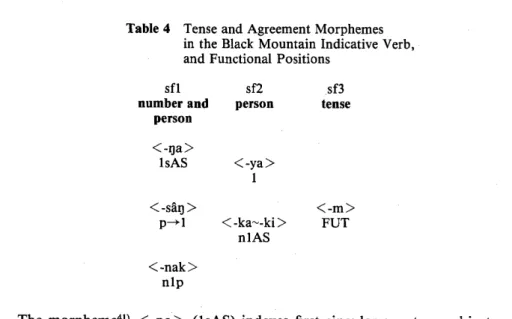
Table 4 Tense and Agreement Morphemes in the Black Mountain Indicative Verb, and'Functional Positions
sfl number and person <‑lja>
1 sAS
< ‑sap >
p.1
<‑nak>
nlp
sf2 person
<‑ya>
1
< ‑ka"‑‑ki >
n1AS
,sf3
tense
<‑m>
FUT
The morpheme4i) <‑lja> (lsAS) indexes first singular agent or subject and occurs in intransitive verb forms with a first singular subject and in transitive ls‑>2/3 forms. The Suffix <‑na> occurs in the person and number slot, suflixal slot sfl. The morpheme <‑pa> has the allomorph <‑na> after verb stem final /t/ and /n/ and <‑ma> after final /p/ or /m/.
The portemanteau morpheme <‑san > (p‑>1) indexes the transitive relation‑
ship between a plural agent and a first person patient and occurs in 2p‑>1 and 3p‑‑>1 forms in suthxal slot sfl, preceding the suffix <‑kan‑‑ki> (nlAS).
The morpheme < ‑ya> (1) marks the involvement of a first person actant in all forms in which first person actant is not indicated by another morpheme, viz. by the first singular agent/subject morpheme <‑lja> or by the p‑‑>1 portemanteau morpheme <‑sao>. The suffix <‑ya> occurs in intransitive verb forms with a first plural subject and in transitive lp.2/3, 2s‑>1 and 3s.1 forms. First person involvement, indexed by any one of the three morphemes <‑oa> (lsAS),
<‑san> (p.1) and <‑ya> (1), is obligatorily marked in the Black Mountain verb.
The morpheme <‑nak> (nlp) indexes plural number of a non‑first person
41) 1 2 3 nl s
d p ns
NEG Q
Abbreviations used in morpheme glosses are as follows:
first person second person third person non‑first person singular dual plural non‑singular question marker negation morpheme
A P
s
. ERG PAT EV PRG GER FUT
agent of a transitive verb patient of a transitive verb
subject of an intransitive or reflexive verb marks the direction of a transitive relationship ergative marker on a nominal constituent patient marker on a nominal constituent evidential
progresslve gerund
future tense marker
Black Mountain Conjugational Morphology . 239
agent or subject and occurs in intransitive forms with a non‑first person plural subject and in transitive 2p‑‑>3 and 3p.2/3 forms in suffixal slot sfl, preceding the morpheme <‑kaN‑ki> (nlAS). The'suffix <‑nak> is cognate with the suffix
<‑nak> in the plural personal pronouns. The suffix <‑nak> does not occur in 2p.1 and 3p‑‑>1 verb forms where plurality of agent is indexed by the portemanteau morpheme <‑sao > (p.1).
The morpheme <‑ka・v‑gae‑‑kiN‑gi‑‑taN‑ti> (nlAS) indexes a non‑first person agent or subject. The morpheme occurs in intransitive forms with a non‑
first person subject and in transitive 2.3, 3‑>2/3, 2p‑L>1 and 3p.1 forms. The suffix has the allomorphs <‑kiN‑giN‑ti> before the future tense suthx <‑m>, the allomorphs <‑gaN‑gi> following a vowel, and the allomorphs <‑ta"v‑ti> after stem final /t/. The non‑first person agent/subject morpheme does not occur in 2s.1 and 3s.1 forms, which are formally indistinct ftom.lp.2/3 fOrms and intransitive first plural forms. Occurrence of the first person morpheme <‑ya> in suffixal slot sf2 precludes the occurrence of the non‑first person agent/subject suffix. The vowel /a/ in the non‑first person agent/subject morpheme <‑kaN
‑gaAu‑ta> (nlAS) becomes /e/ in yes‑no questions.
The Black Mountain future tense in <‑m> expresses some future event, whether it be a potential future, a factual or scheduled future event or a present future of imMediate realisation. There is a Black Mountain evidential suffix
<‑go>, which is similar in meaning to the Dzongkha ending <‑b)‑wa>42) and expresses a recently acquired insight, or a deduced or recently observed phenomenon. The evidential does not occur in the future tense and is not attested in forms with a first person agent or subject̀ The full form of the evidential suffix
<;go> occurs after the ending <‑ya> in 3s‑>1 forms, e.g. 'ho?ine‑se kO‑ija baheya‑go (he‑ERG I‑PAT give‑PRG‑1 EV) ̀he is giving it to me'. In other forms, the evidential fuses with the non‑first person agent/subject suflix <‑kaN‑gaN‑ta> to give the ending <‑koN‑goN‑to>.
Table 5 Endings of the Imperative 2.1
2s.3
2p‑・3
(ma)‑£‑sap‑lo (ma)‑z‑lo (ma)‑Z‑nak‑lo
Other Black Mountain person and number agreemerit markers are found in the imperative and in the perfect gerund. A morpheme <‑salj> marks 2‑>1 imperative forms and is evidently related to the suffix <‑san> (p.1), which indexes transitive relationships between a plural agent and a first person patient in
42) "N'‑qN'
indicative forms. The non‑first person plural morpheme .<‑nak> (nlp) marks 2p.3 imperative forms and renders them distinct from 2s‑‑>3 imperatives. All imperative forms take the imperative suffix <‑lo> and, in the negative, the negative prefix <ma‑> .
The Black Mountain perfect gerund translates into Dzongkha as the past participle in <‑di>43) and into Nepali as the gerund in <‑era>. The gerund expresses an action or event preceding the situation denoted by the main verb or an activity adverbially modifying the situation denoted by the main verb. The Black Mountain gerund has the form < ‑ga> (GER/1s) when the subject or agent is a first person singular actant, and the form <‑sa> (GER) when the subject or agent is not a first person singular actant, e.g. Kb‑IOse hb‑ga ba‑ija (I‑ERG wash‑GER/ls give‑lsAS) ̀Having washed it, I gave it [to him]'. Dirik kb‑ija hb‑sa ba‑sau‑ga (today I‑PAT wash‑GER give‑p.1‑nIAS) ̀Today, having washed it, they gave it to me' , Kb sha‑ga gb‑ua‑m. Iij ya sha‑sa ma‑gb‑ge2 (I wander‑GER/ls go‑lsAS‑
FUT. .you too wander‑GER NEG‑go‑nlAS/Q) ̀I am going a‑wandering. Aren't you gomg a‑wandering too?'
5. EASTBODISHVERBALAGREEMENTANDPROTO‑TIBETO‑BURMAN MORPHOSYNTAX
̀ The Black Mountain first person singular agent/subject suflix < ‑oa> (lsAS) is cognate with the first person singular ending "<‑pN‑na> (ls) in my reconstructed model of Proto‑Tibeto‑Burman verbal agreement (van Driem 1993a, modified in forthcoming, b). The velar initial of the distinct Black Mountain first person singular gerund < ‑ga> (GER/ls), as opposed to the general gerund ending <‑sa>
(GER), may also represent the reflex of the interaction of some older segment with the Proto‑Tibeto‑Burman first person singular morpheme *<‑p‑J‑lja> (ls). The Black Mountain p‑>1 portemanteau <‑sao > appears both to reflect the first person singular proto‑morpheme "<‑oN‑oa> (ls) and to embody some reflex /s/ ' of the Proto‑Tibeto‑Burman dual morpheme *<‑si> (d), reanalysed as a marker of plural meaning. The Black Mountain morpheme may in its entirety be cognate with the Hayu preterite first person singular patient/subject morpheme <‑sun >
(lsPS/PT), which, to our present state of knowledge, may or may not be compatible with an etymological relationship with the Proto‑Tibeto‑Burman dual morpheme *<‑si>.
The Black Mountain first person ending <‑ya> (1) appears to be a reflex of
the Proto‑Tibeto‑Burman first and second person plural marker *<‑i> (lp/2p),
widely reflected both in Kiranti languages and in Tibeto‑Burman conjugations
outside of the Himalayan region. Whereas the first person singular and the dual
proto‑morphemes, '<‑o"v‑pa> (ls) and *<‑si> (d), occupy anterior positions in
the suffixal chain of the Proto‑Tibeto‑Burman verb, the first and second person
43) si・‑B・‑R・
Black Mountain Conjugational Morphology 241 plural proto‑morpheme *<‑i> (lp/2p) is located at the end of the suffixal chain.
This ancient element order is reflected in the,relative position of the Black Mountain agreement markers.
The Black Mountain non‑first person agent/subject marker <‑ka"‑‑ga"‑‑kiN
‑gifv‑tarv‑ti> (nlAS) appears to be cognate with the Dumi second and third person subject morpheme <‑a> (nlS) and the Dumi second/third person singular suffix
<‑a> (s2/s3). If this is the case, it would necessitate revamping earlier specula‑
tions concerning the provenance of these Dumi suMxes to bring them, and perhaps the Bahing 3s.3 portemanteau <‑a>, into line with the Qiang, Nocte, Jinghpaw and Primi reflexes of the posited Proto‑Tibeto‑Burman 'third person suffix
"<‑a>. Benedict (personal communication, 7 July 1994) feels confident about identifying these verbal affixes' with a Proto‑Tibeto‑Burman third person pronominal source "a, which Benedict (1972: 121ff.) reconstructed much earlier, and which constitutes one of the corners of his (1983) ̀deictic trianglel set up for Proto‑Tibeto‑Burman.
The Black Mountain non‑first person plural suffix <‑nak> (nlp) does not seem to have any obvious cognate in the flexional systems of other Tibeto‑Burman verbs. The fact that this suffix also occurs in Black Mountain pronouns suggests that the morpheme, and the incorporation of this suffix into the Black Mountain conjugation, may have been a recent or local development.
Black Mountain has preserved no reflex of either the Proto‑Kiranti non‑
preterite tense suffix *<‑k> or the Proto‑Tibeto‑Burman preterite tense suffix
"<‑te>. The Black Mountain future morpheme <‑m> appears to be a reflex of the same ancient copula which underlies the Hayu assertive marker and nomi‑
nalising sufiix <‑mi> (<‑m> after vowels), the Dumi nominalising and imperfective aspect suMx <̀m> and the Newar relativiser <‑mho>, suffixed to verbs which are used adnominally to singular animate referents. A modern full reflex of this ancient copula is the Dumi fourth conjugation copula used with animate referents <‑mo:‑/‑mi‑/‑mu‑> .
It is a novel discovery that a conjugation which refiects the hypothetical Proto‑
Tibeto‑Burman verbal agreement system has been retained in an archaic represen"
tative of East Bodish, which itself is held to be a conservative branch of Bodish.
The likely implication is that loss of conjugational morphology was a secondary
development in Bodish. Not only do the agreement affixes of the Black Mountain
conjugation match reconstructed proto‑morphemes in form and meaning, the
sequential order of elements in the East Bodish verb also appears to match that of
the periphrastic agreement model reconstructed for the Proto‑Tibeto‑Burman.verb
(van Driem 1993a, modified in forthcoming, b). The effects of analogical processes
are more likely to have made themselves felt in richly inflecting Tibeto‑Burman
languages than in languages of the isolating Lolo‑Burmese type which lack
comparable morphological patterns. Yet the East Bodish evidence lends strong
support to the hypothesis that the tongue ancestral to the modern Bodish
languages possessed a verbal agreement system, reflected in modern Archaic East
Bodish and cognate with other Tibeto‑Burman conjugational systems. The
implication for the historical status of verbal agreement in Tibeto‑Burman is that common conjugational morphology existed at the Tibeto‑Burman level, or that a common morphosyntactic system expressing verbal agreement was operative at the Tibeto‑Burman level which led to the genesis of the observed modern verbal agreement systems.
The Mainstream East Bodish languages, which have not retained any conjugational morphology, are spoken by population groups whose ancestors were involved in the early spread of Buddhism in central Bhutan in the eighth and ninth centuries. The spread of the Greater Bumthang Language into the Kheng and Kurt6p areas may, in fact, have been contemporaneous with the introdUction of Buddhism into these areas. Black Mountain, on the other hand, is spoken by a people who until recent historical times‑at least on the western slopes of the Black Mountainsrled a semi‑nomadic existence, inhabiting a village site for a few generations before moving on to clear land elsewhere. Only now are the Western Black Mountain M6npa gradually adopting traditional Bhutanese architecture, and many houses are still built in the style of temporary dwellings. The ancestors of Black Mountain speakers appear to have lived largely beyond the bounds of traditional, mainstream Bhutanese culture and, until recent times, to have remained relatively unstirred by many of the developments which led to the formation of this culture.
In the historical‑comparative study of morphological systems, it is essential to distinguish between cognate systems and secondarily innovated systems. This essential distinction was observed in Indo‑European historical linguistics from the very outset: ̀Noch jetzt sind sehr viele Spuren dieser aeltern Sprachform im Deutschen, im eigentlichen Deutschen mehr, als im Englischen und in den skandinavischen Mundarten uebrig; wenn aber im Ganzen hier das Princip der neuern Grammatik, die Conjugation vorzueglich durch Huelfsverba, die
Declination durch Praepositionen zu bilden, herrschend ist, so darf uns dieB um so
weniger irre machen,,da auch die saemmtlichen aus dem Lateinischen abstammenden romanischen Sprachen, wie nicht minder alle hindostanische Mundarten, wie sie jetzt noch gesprochen werden, die sich zum Sanskrit etwa eben so verhalten, wie jene zum Lateinischen, eine aehnliche Veraenderung erlitten haben. Es bedarf auch keiner aeuBern Ursa.che, um diese ueberall gleichfoermig sich zeigende Erscheinung zu erklaeren' (Schlegel 1808: 34‑35). Indeed, the development towards a ̀Grammatik durch Huelfsverba und Praepositionen' was seen by Schlegel as a natural process which had spont'aneously taken place independently in the various branches of Indo‑European. Well aware of the independent rise of similar morphosyntactic patterns in different branches of Indo‑
European, Schlegel distinguished these patterns from inherited, cognate
morphology. Notably, for Schlegel (1808: 1) it was cognate morphology which
represented the strongest argument for establishing Indo‑European as a language
family: ̀Die Aehnlichkeit liegt nicht bloB in einer groBen Anzahl von Wurzeln, die
Black Mountain Conjugational Morphology 243 sie mit ihnen gemein hat, sondern sie erstreckt sich bis auf die inperste Structur und Grammatik'. It is useful to recall that the fruitful comparison of cognate morphological systems in Indo‑European by Schlegel, Bopp and other early researchers preceded the discovery of the first sound laws. According to Beekes (1990: 36‑37), the first decisive proof of a genetic relationship between Sanskrit and Latin was provided by the FrenchV priest Coeurdoux in 1767 on the basis of morphological evidence, nineteen years before Sir William Jones' famous oration in Calcutta.
Just as a ̀Grammatik durch Huelfsverba und Praepositionen' has developed in many Indo‑European languages, evidential and conjunct‑disjunct systems have arisen in many modern Tibeto‑Burman lariguages. DeLancey (1992) has shown that these systems, although similar, are not cognate and appear all to have arisen independently. Matisoff (1994c: 603) is undoubtedly correct in concluding that the Sangkong verbal system does not ̀constitute evidence for the existence of a reconstructible system of pronominal accord at the Proto‑Tibeto‑Burman level'.
Neither does it constitute evidence for the opposing view, however. Evidential and conjunct‑disjunct systems, by their very semantic nature, interact unevenly with the person categories, but such innovative systems are different in kind from the verbal agreement systems widely observed in Tibeto‑Burman. Quite typically, the Sangkong evidential‑type system is neither reminiscent of, nor cognate with the conjugations upon which Tibeto‑Burman morphological comparisons have been based. This is why the case of Sangkong is hardly relevant to establishing the veracity of the hypothesis that cognate conjugational systems in Tibeto‑Burman languages represent the retention, of an ancient trait. In fact, it is no coincidence that one finds an innovative system of the type observed in Sangkong in the very branch of Tibeto‑Burman in which, by virtue of its innovative character, particularly in the realm of mor.phosyntax, one would least expect to find the retention of a verbal agreement system of the Proto‑Tibeto‑Burman type.
6. PROTO‑TIBETO‑BURMANANDCHINESEMORPHOSYNTAX
Karlgren (1920) .presents decisive arguments that the Old Chinese dialect in which the LanyU was writt' en preserves a Proto‑Chinese distinction between what might be called a casus rectus (more precisely a fnominatif‑genitif') and a casus
obliquus (̀cas regime') in the first and second person pronouns. These pronominal forms are given in Table 6. These and other Old Chinese forms are given in Baxter's' (1992) reconstruction.
t