Introduction
Balance is defined as the ability to move within a weight-bearing posture without falling,1 relying upon input from the visual, vestibular, and somatosensory systems, and measured in aspects of steadiness, symmetry, and dynamic stability.2 Disturbances of balance have been found in the geriatric population3,4,5,6,7 and in people with specific neurological diagnoses, including cerebral vascular accident (CVA),1,2,8-11 Parkinson’s disease (PD),12-15 and multiple sclerosis (MS).7,16-18
Whether imbalance is due to age and/or neurological disease or injury, it is a primary cause of increased fall rates. Previous studies have shown falls to be physically, psychologically and economically detrimental to the quality of life for older adults.19,20 Falls, whether or not they result in physical injury, contribute to a fear of falling which initiates a recognized fall sequelae of diminished activity, deconditioning, decreased agility and balance, and increased dependence on caregivers for activities of daily living.19,23-27 Falls and fall-related injuries are also common in
persons with such neurological disorders as CVA,8 PD,12 and MS.16 Of adults who report falling, CVA is found to be the most common diagnosis.28 It has also been suggested that asymmetrical standing in individuals post-CVA causes postural sway abnormalities,1,8,10 which may contribute to falling. Koller et al12 noted that falling and frequency of falling were correlated with postural instability in individuals with PD.
In addition, Kasser et al16 denotes that individuals with MS demonstrate a decline in mobility and balance which leads to an increase in the likelihood of falls.
Programs aimed at improving balance to reduce a person’s overall risk for falls have been developed and researched. The types of benefits that have been reported differ depending on the outcome measurements used. Some studies have examined function and performance following balance retraining,49,57, 63, 64 whereas others assess specific impairments.14, 15, 29, 51, 54, 56, 61 Most of these studies have been conducted in the geriatric population without a specific diagnosis.20,49-52
Imbalance and falling are common problems in
The effect of a university-based individualized balance retraining class on self-reported balance problems in people
with and without a neurological diagnosis
Peggy R. Trueblood, PT, PhD. Nikki Cornell, MPT. Cori Rowe, MPT, OCS. Kimberlee Curtis, MPT.
Tracy Halmos, MPT, ATC, CSCS. Kathleen Curtis, PT, PhD. Toni Tyner, PT, MHL Key words : Stroke, Postural control, Geriatric, Falls, Balance re-training
PR Trueblood, PT, PhD is Professor and Chair, Department of Physical Therapy, California State University, Fresno; 2345 East San Ramon Ave. M/S MH29; Fresno, CA 93740-8031 (USA) ([email protected]). Address all correspondence to Dr. Trueblood.
N Cornell, MPT, is Staff Physical Therapist, Children's Hospital of Central California, Madera, California.
C Rowe, MPT, OCS, is Co-owner of Physical Therapy Unlimited Inc., Hanford, CA
K Curtis, MPT, is Staff Physical Therapist, Pacific Gardens Rehabilitation Center, Fresno, California.
T Halmos, MPT, ATC, CSCS is Owner/Physical Therapist, Individualized P.T., Morgan Hill, California.
K Curtis, PT, PhD, is Dean of the College of Health Sciences at the University of Texas at El Paso.
T Tyner, PT, MHL, is Assistant Professor, Department of Physical Therapy, California State University, Fresno
Funding provided in part from the Associated Students Inc. and College of Health and Human Services, California State University, Fresno; and Rolling Hills Enterprises - MORE Software.
This study was approved by the Committee on the Protection of Human Subjects at California State University, Fresno.
both the geriatric population as well as people with neurological disorders such as CVA, PD, and MS. Balance re-training intervention studies have been conducted in these groups separately,1,10,11,16,2 9,48,53-62 however no study has compared these two groups in the same study using the same intervention approach and outcome measures.
Therefore the purpose of this study was to compare the effects of a community-based program aimed at improving balance in a varied group which includes both subjects with and without a neurological disorder and with self- reported balance problems. The intervention strategy was based on a multidimensional approach as that described by Shumway-Cook49 examining both performance- and impairment- based outcome measures.
Methods Subjects
Twenty-two community dwelling adults between the ages of 33-94, with self-reported balance problems, completed this study. Subjects were volunteers recruited from a pool of 94 community dwelling adults who participated in a free balance-screening clinic. The balance- screening is referred to as Time 1. Individuals who opted to enroll in the multi-dimensional balance retraining class, offered through the University’s Extended Education program, returned 8 weeks later for re-testing; this is denoted as Time 2. Identical data were collected on these same individuals at the end of the 8-week balance intervention, Time 3.
Individuals were assigned to a diagnostic category based on signs and symptoms and results of a clinical examination. The diagnostic categories included a non-neurologic designation, which was defined as a person with no known neurologic diagnosis to account for their balance problem and who was also over the age of 65.
The second diagnostic category included subjects with neurologic deficits. The subject with
neurologic considerations was defined as a person with specific neurologic system pathology with complaints of imbalance.
General inclusion criteria for both categories included: 1) a self-reported balance or mobility problem, 2) ability to ambulate 40 feet, 3) stand for a minimum of 5 minutes without an assistive device, 4) able to follow simple commands, 5) willingness to attend data collection sessions at specified intervals, and 6) willingness to enroll in class and pay associated fee of $150. Participants were excluded if they scored lower than 26 (out of 30) on the Mini-Mental Exam,66 had extreme hypertension at or over 220/110, or were currently under the care of a physical therapist.
Specific exclusion criteria for each diagnostic category were also developed. Exclusion criteria for the non-neurologic category included being under the age of 65. In the neurologic category, one subject with PD was dropped from the study secondary to change in medication during the 8-week intervention.
Thirteen subjects were assigned to the non- neurologic category, 8 females and 5 males, ranging in age from 68-94 years of age with a mean age of 82.5 years (SD=16.4). The neurologic category consisted of a total of 9 subjects, 5 females and 4 males, ranging in age from 33-86 years of age with a mean age of 68.4 years (SD=16.2). Over one half of the subjects in this category were diagnosed with CVA; one subject was diagnosed with PD and one with Supranuclear Palsy; two subjects were diagnosed with MS.
In comparing the non-neurologic and n e u r o l o g i c c a t e g o r i e s , d e m o g r a p h i c characteristics were similar, including living situation and with whom they lived. One exception was that only 23% of the subjects in the non-neurologic category used an assistive device, in contrast to 78% of the subjects in the neurologic category did. Additionally, 3 of the 9 subjects in the neurologic category were under
age 65, yet overall, we noted that 77% of our subjects were over the age of 70. See Table 1 for a summary of demographics between the two categories.
Design
This is a 2-factor repeated measure quasi- experimental study to analyze the effect of an 8-week intervention on selected balance and gait measures over time (Time 1, Time 2, Time 3) and between diagnostic category (non-neurologic and neurologic).
Instrumentation
The Smart Balance Master (SBM)® with version 5.0 software was used to perform the Sensory Organization Test (SOT) for each subject. The SBM is a computerized system that assesses postural sway via force plates resting on pressure transducers.67 The SOT is an established clinical tool for assessing balance deficits, 68 and has been proven to be sensitive to changes in
postural control.69 The higher the score, the less postural sway, indicating greater postural control.67
The LOS was also performed on a computerized force plate system, the Balance Master (BM)® with software version 6.11, with a long force plate accessory unit. The LOS test assessed the subject’s ability to maintain postural stability while shifting their center of gravity (COG), represented by a central cursor, to a circle of 8 targets set at 100% of their limits of stability with a stationary base of support. The LOS is calculated by the computer relative to the individual’s height, and is reflected in the following 5 parameters: 1) Reaction time (RT), 2) Movement Velocity (MV), 3) Endpoint Excursion (EPE), 4) Maximum Excursion (MXE), and 5) Directional Control (DCL). This system has demonstrated moderate to high test-retest reliability in testing dynamic balance.70 The LOS has been strongly correlated with Berg Balance scores and gait velocity.9
TABLE 1.
Demographic Characteristics of Non-Neurologic and Neurologic Categories Non-Neurologic(13) Neurologic(9) Gender
Male 5(38%) 4(44%)
Female 8(62%) 5(56%)
Mean age + SD 80.7 + 6.6 66.8 + 17.2
Age range 66-93 yrs 32-84 yrs
Over the age of 70 12(92%) 5(56%)
Use of Assistive Device(cane or walker) 3(23%) 7(78%)
Lives with Spouse, Friend, or Paid Assistant 7(54%) 8(89%)
Lives in Home 11(85%) 9(100%)
Fall History(Time 1)
Fallen in last 6 weeks 4(31%) 4(44%)
Fallen in last 6 months 4(31%) 3(33%)
Fallen in Last Year 3(23%) 1(11%)
No history of falls 1(8%) 0
Mobility skills were measured using the TUG,71 the Dynamic Gait Index,72 and the Tinetti Mobility Test.73 The TUG71 and Tinetti74,75 have been shown to be valid measures of physical mobility and functional capacity with high inter- rater reliability. The TUG was developed for the assessment of physical mobility and is a useful practice measure for evaluation of daily life maneuvers.71 It also correlates well with other measures of balance, gait speed, and functional ability.71 The test asks the subject to perform a rise from a standard arm chair, walk to a line on the floor three meters away, turn, return, and sit down again.71 The Tinetti Mobility Test was designed as a time efficient performance-oriented tool for assessment of mobility problems in elderly patients75 which scores balance and gait characteristics for a range of daily position changes.73 The Dynamic Gait Index72 is a test given to evaluate how an individual is able to respond to changes or activities performed during ambulation. It was developed as a test for predicting falls in the geriatric population and has been shown to have inter-rater reliability equal to .96 and test-retest reliability equal to .98.21 A modified version of the Dynamic Gait Index using only the first 5 of the 8 items was administered secondary to time and equipment constraints; therefore, fall prediction was not utilized.
Lastly, a subjective Confidence Score was also collected at all 3 times. The subjects were asked to rate their confidence on a scale of 0 to 10, with 0= no confidence, and 10= maximum confidence.
Confidence Scores were in regards to how the subject felt in terms of falling or losing their balance in three environments: the home, the yard, and the community.
Standard clinical tools (stethoscope, sphygmomanometer, goniometer, and tuning fork) were used for assessment of blood pressure, range of motion, and ankle proprioception.
Procedures
Each subject signed an informed consent before participating in this study, in accordance with institutional human subjects protection policies. After giving informed consent, all subjects underwent a comprehensive assessment of balance and mobility skills. Inter-rater reliability was analyzed between co-investigators for the Tinetti Mobility Test, with Gait and Balance sum ICC= .90, and the Dynamic Gait Index, with ICC results ranging from. 60 to .89 for the 5 items. The assessment design was similar to that described by Shumway-Cook et al,49 which measured functional abilities relating to balance and mobility, underlying sensory and motor strategies, as well as sensory and motor impairments that could potentially impact balance and stability. All screening, pre-testing, post- testing and intervention were conducted in a large classroom at a University setting, under the direct on-site supervision of a licensed physical therapist.
Prior to testing, a demographic questionnaire was administered and then reviewed with each subject. Any additional information regarding changes in demographics, medical history, health status, medication, or balance history was noted.
The Mini-Mental Exam66 was then administered to screen for cognitive impairments and the ability to follow simple commands. Next, blood pressure was taken in sitting and then in standing to screen for postural hypotension as well as any abnormal readings.
Postural control was measured using a Smart Balance Master® for the SOT and a Balance Master® for the LOS. Each subject’s height was measured without shoes or socks for appropriate foot placement parameters as prompted by the computer. Additional measurements were recorded for the distance between the midpoint of each heel and from the midpoint of each heel to the back edge of the force plate. Measurements were in inches, to 1/16th of an inch. This was done
in an attempt to replicate conditions during post- testing and to re-position feet in the event of any foot movement during testing.
Verbal instructions were given to each subject, as prompted by the monitor, prior to commencing with each condition of the SOT. They were asked to remain as upright as possible, with either eyes open or closed depending on the test, with special instructions to maintain heel contact and placement. Their task was to maintain center of gravity during the following 6 conditions: 1) eyes open (EO), fixed support, measures static sway and center of gravity; 2) eyes closed (EC), fixed support, primarily challenges somatosensory system; 3) sway reference vision (SV), fixed support, challenges an individual's somatosensory ability; 4) eyes open, sway surface (EO/SS), challenges primarily vision with carryover to the vestibular system; 5) eyes closed, sway surface (EC/SS), challenges the vestibular system; 6) sway reference vision, sway surface (SV/SS), challenges vestibular by destabilizing somatosensory and vision. Subjects were allowed 3 attempts on the first trial of each condition and 3 attempts on each subsequent trial. If a subject could not complete the trials with the allotted attempts, the condition was scored as 0% stability and testing continued with the next condition. An average of 3 trials was calculated for each condition. Condition 1, EO with fixed support was a baseline measurement and therefore not used in the analysis.
The LOS test was performed on the Balance Master®. Each subject was allowed to practice moving their COG icon to 2 targets in order to establish familiarity with performing the test.4 Instructions given during the test were limited to asking the subject to hold the COG icon in the center target until the computer monitor prompted them to shift to a designated target, at which time a verbal cue of “shift” was also given. Thus, the RT parameter on the LOS was not analyzed in this study.
Subjects performed the Tinetti Mobility Test and TUG from an armless straight back chair.
The subjects wore shoes and used an assistive device if necessary. An investigator demonstrated the TUG prior to the subject performing 3 consecutive timed trials. All of the tests were videotaped for later analysis if warranted.
Subjects who used an assistive device in pre- testing were instructed to use the same device in post-testing for consistency. The gait portion of the Tinetti Mobility Test and the Dynamic Gait Index were performed by each subject, videotaped, and scored by an investigator at the time of the test.
The order of the testing varied according to availability of equipment and no systematic order was followed. Upon completion of all tests, results were evaluated by the investigator and any impairments found were classified according to the system involved. Findings were discussed with each subject. All individuals tested as part of the screening process were given educational materials directed at reducing fall risk factors.
Subjects who met the inclusion/exclusion criteria and accepted the recommendation for balance re-training registered for the 8-week Balance Disorders class. Graduate physical therapy students in their final year of a Master of Physical Therapy degree program were assigned a balance class subject for whom they would design and implement an individualized intervention with the supervision of the primary investigator. As part of their education requirements, these students received previous balance laboratory and lecture training as well as review lectures regarding equipment use.
The class was structured for individualized balance re-training sessions lasting for one hour, twice weekly for 8 weeks. Missed appointments were rescheduled to maximize subject convenience. The student participated in the balance class as part of an assignment in a clinical decision making course. In addition to treatment,
students were required to submit periodic written assignments documenting the referral, pathology, impairments, initial assessment, treatment planning and goals, and discharge summary for the balance class participant assigned to them.
Physical therapy students formulated a comprehensive treatment plan based on results of tests administered before the course began.
Treatments were tailored to address the individual impairments of each subject and consisted of a variety of interventions including, but not limited to, the following: community gait training, functional activities, obstacle course, balance boards, vestibular rehabilitation exercises, computerized force plate systems training (Smart Balance Master® and Balance Master®), physioball activities, strengthening, and education on fall prevention. In comparing the percentage of treatment time spent in the varying activities, subjects in both diagnostic categories received very similar treatment except for the increased use of treadmill training (5% vs. 0%), as well as general gait training (14% vs. 8%) in the neurologic category. All subjects were prescribed an individualized home exercise program, which was approved by the supervising therapist and modified as the subject progressed.
At the end of the 8-week intervention, all subjects were post-tested (Time 3) using the same assessment protocols previously described and discharged with home program to continue on their own.
Data Analysis
Objective assessment and outcome scores were collected on six tests (18 individual dependent variables): 1) Tinetti Mobility Test, 2) Timed Up and Go, 3) Sensory Organization Test, 4) Limits of Stability, 5) Dynamic Gait Index, and 6) Confidence Scores. These dependent variables were selected for data analysis to determine the effectiveness of the 8-week intervention. The independent variables included time (Time 1, 2, 3)
and neurologic and non-neurologic categories.
A 2-factor repeated measure analysis of variance was used to test changes in scores on the SOT, LOS, TUG, Tinetti, Dynamic Gait Index, and Confidence Scores across time. The ANOVA analyzed the effect of 2 factors, diagnostic category and time, on each variable from the 6 tests. Subjects were grouped by the categories of neurologic or non-neurologic. We followed up each significant finding on the SOT, LOS, TUG, Tinetti Mobility, Dynamic Gait, and Confidence Scores with apriori comparisons to compare means for each variable between Time 1 and 2, and between Time 3 and the equally weighted combination of Times 1 and 2 (baseline). The data analysis was performed on Superanova 1.11 (Abacus Concepts, Inc, 1991.)
Results
Tables 2 and 3 summarize the results of the 2-factor repeated measure analysis of variance.
There was a significant main effect of time in 16 of 18 variables and a significant main effect of diagnostic category in 5 of 18 variables. The ANOVA failed to show a significant interaction of diagnostic category and time for any of the 18 variables.
Effect of Time
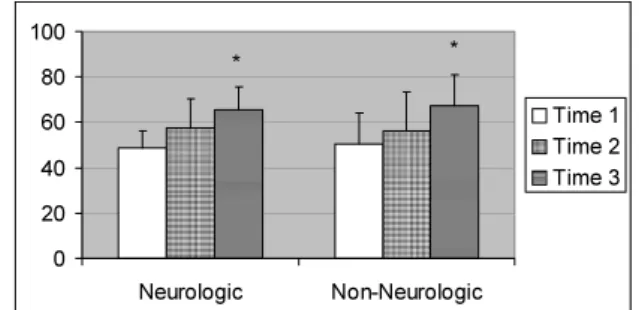
Sixteen of eighteen dependent variables showed a significant main effect of time. (Figures 1-6) And, in all cases, a priori comparisons revealed significant difference between Time 3 and Time 1-2. In the majority of variables (15/18) there was no statistically significant difference in scores from Time 1 to Time 2. However, as noted in Table 2, velocity measure of the LOS significantly declined from Time 1 to Time 2 in both diagnostic categories. Also, the score during Condition #6 (SV/SS), as well as the Average Stability Score (Figure 2) on the SOT significantly increased from Time 1 to Time 2 in both diagnostic categories.
Effect of Diagnostic Category
There was a significant main effect for diagnostic category in 5/18 dependent measures.
These were: velocity measure of the LOS, Dynamic Gait Index score, Tinetti Gait score, Tinetti Total score, and the TUG. With all five TABLE 2
2 Factor ANOVA; Impairment-Based Measures Neurologic Category
Mean(SD) Non-Neurologic Category
Mean(SD) 2-Factor Repeated Measure ANOVA(p value)
Pre-1 Pre-2 Post Pre-1 Pre-2 Post Main
Effect Dx.(A)
MainEffect Time (B)
Interaction (AB)
LOS(n=21) Non-Neuro=12 Neuro=9
Velocity 2.4
(.75) 2.1
(.31) 2.6
(.53) 2.7
(.38) 2.3
(.43) 3.4
(.78) .0327† .0001∝* .1688 End Pt. Exc. 54.2
(16.39) 45.8
(11.68) 56.9
(10.43) 52.1
(13.87) 50.6
(14.74) 61.7
(10.47) .5639 .0096* .5117
Max Exc. 67.3
(14.36) 56.8
(10.84) 68.2
(10.55) 65.3
(14.71) 64.0
(15.97) 76.5
(8.88) .2836 .0054* .2737 Direct. Control 49.6
(24.47) 44.7
(21.73) 59.3
(17.82) 59.6
(14.16) 56.7
(17.35) 67.9
(12.85) .1273 .0088* .9147 SOT(n=22)
Non-Neuro=13 Neuro=9
EC 88.1
(4.85) 89.4
(4.81) 87.6
(4.27) 85.8
(6.60) 86.3
(6.76) 84.5
(7.06) .2276 .3930 .9441
SV 83.0
(9.63) 86.5
(6.16) 83.4
(6.39) 82.6
(9.57) 82.1
(11.06) 84.8
(6.45) .7328 .6221 .2066
EO/SS 77.0
(8.05) 80.8
(6.78) 83.8
(4.01) 54.8
(38.53) 62.9
(30.39) 81.2
(9.88) .1052 .0025* .0841
EC/SS 6.0
(17.89) 17.7
(27.70) 32.9
(27.85) 23.4
(28.13) 25.9
(29.66) 41.3
(30.26) .2639 .0017* .6705 Neurologic Category
Mean(SD) Non-Neurologic Category
Mean(SD) 2-Factor Repeated Measure ANOVA(p value)
Pre-1 Pre-2 Post Pre-1 Pre-2 Post Main
Effect Dx.(A)
Main Effect Time (B)
Interaction (AB)
SV/SS 2.2
(6.67) 23.0
(27.89) 45.7
(34.64) 16.0
(24.86) 26.4
(31.57) 48.2
(26.27) .4780 .0001∝* .6224 Avg. Stability 48.7
(7.42) 57.7
(12.59) 65.6
(10.04) 50.4
(13.93) 56.4
(17.23) 67.5
(13.69) .8783 .0001∝* .7690
∝Pre 1 - Pre 2 < .05 *Pre 1 - Pre 2 vs. Post 1 planned comparison of the mean < .05 † p < .05
variables, subjects in the non-neurologic category scored better than the subjects in the neurologic category. For example, on the Dynamic Gait Index, subjects in the non-neurologic category ended the intervention scoring 11.1, versus the subjects in the neurologic category, who at Time 3 scored only 9.1 (Table 3). Power calculations were low (.05 to .19) in 11 of the 13 remaining dependent measures, suggesting that with a larger sample size the analysis may have resulted in a significant main effect for diagnostic category in more variables.
Discussion
The results of the data analyses support the efficacy of the balance intervention and it seems to be equally effective for either group of subjects. Results show that subjects in both the neurologic and non-neurologic categories improved in both subjective and objective measures. The fact that subjects in both categories demonstrated significant improvements suggests that a community-based balance disorder and fall prevention program, such as the one described in this study at an academic setting, benefits self- reported fallers who have no known diagnosis and those with known neurological disorders.
Our results confirm that even subjects with chronic and often progressive disabilities, with sensory and/or motor systems involved, can improve balance with an appropriately designed and implemented course of balance retraining and exercise. For physical therapists working with patients with balance disorders, these are important and relevant findings.
Similar results of improvement have been found in other studies on these populations individually, with varied treatment protocols.14,16,4
9,51,54,77 Our findings are in support of the following studies that demonstrate improvement on impairment- and performance-based measures of balance.
In a study by Rose and Clark29, fallers, age 70
and above with no known medical diagnoses, demonstrated significant improvement on both performance- and impairment-based tests following 8 weeks of individualized balance re- training using computerized force-plate systems.
When comparing the control and experimental groups, results showed a significant interaction for time and group, as well as significant improvement over time on the LOS, SOT, TUG and Berg Balance Scale. Although the authors used a standard protocol, which progressed by week, the difficulty level was based on individual impairments. And, the intervention used biofeedback-based computerized balance training systems, similar to our study. However, in addition to the computerized force-plate systems, we used more conventional physical therapy interventions such as community gait training and balance re-training without the computerized force-plate systems. Approximately 25-30% of Rose's intervention was conducted on the Balance Master with emphasis on dynamic weight shifting and center of gravity control or the Smart Balance Master where the environment was manipulated, emphasizing multi-sensory training. Even though Rose included only subjects with no known medical diagnosis, the fact that our group of subjects with neurological disorders made significant improvements with similar treatment strategies suggest that biofeedback-based computerized balance training systems, in particular, may be useful for either group of people with balance impairments. Although not all of our intervention was conducted on computerized force-plate systems, the current study is one of the first studies to document improvements in balance in both neurologic and non-neurologic groups given similar strategies of treatments.
Shumway-Cook et al,49 also found that a multidimensional exercise program for balance and mobility resulted in significant improvements in geriatric subjects on the Berg Balance Scale,
TABLE 3.
2 Factor ANOVA; Performance-Based Measures Neurologic Category
Mean(SD) Non-Neurologic Category
Mean(SD) 2-Factor Repeated Measure ANOVA(p value)
Pre-1 Pre-2 Post Pre-1 Pre-2 Post Main
Effect Dx.(A)
MainEffect time(B)
Interaction (AB)
Tinetti(n=22) Non-Neuro=13 Neuro=9
Balance 10.7
(4.72) 9.7
(4.53) 12.3
(2.40) 11.5
(2.57) 11.7
(3.445) 14.8
(1.482) .1664 .0001* .3909
Gait 6.3
(1.87) 5.9
(2.76) 8.2
(1.79) 8.9
(1.38) 8.8
(1.64) 10.4
(1.33) .0003† .0001* .7217
Total 17.2
(5.72) 15.6
(7.12) 20.6
(3.78) 20.4
(3.20) 20.5
(4.14) 25.2
(2.73) .0209† .0001* .5410 Dynamic Gait
Index Sum (n=22)
6.4(2.01) 8.1
(2.21) 9.1
(1.62) 8.8
(1.92) 8.6
(1.85) 11.1
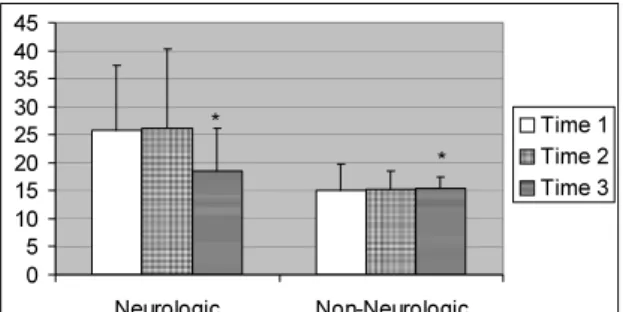
(1.85) .0070† .0002* .2254 TUG (n=22) 25.8
(11.64) 26.1
(14.10) 18.5
(7.61) 15.0
(4.69) 15.2
(3.35) 15.5
(1.87) .0050† .0935* .0528 Confidence
(n=22)
Home 6.3
(2.00) 6.4
(2.40) 8.6
(1.59) 6.8
(2.38) 7.8
(2.15) 9.1
(.95) .2215 .0001* .5805
Yard 5.8
(3.23) 5.3
(2.92) 7.1
(2.85) 5.8
(2.05) 6.2
(2.41) 8.2
(1.07) .4843 .0006* .5570 Community 7.3
(3.39) 6.4
(3.13) 8.9
(1.69) 6.5
(2.07) 7.6
(1.81) 8.5
(1.20) .9820 .0022* .1527
∝Pre 1 - Pre 2 < .05 *Pre 1 - Pre 2 vs. Post 1 planned comparison of the mean < .05 † p < .05
Figure 1 Mean Tinetti Mobility Index Sum scores (with standard deviation bars) comparing the neurologic and non- neurologic categories over time. *p<.05
Figure 2 Average Stability Equilibrium score (with standard deviation bars) of the SOT comparing neurologic and non- neurologic categories over time. *p<.05
the Dynamic Gait Index, the Tinetti Mobility Test, and a subjective confidence scale.
Improvements in the LOS have been demonstrated in the geriatric population using balance and strength training intervention.14,51
Again, a multi-dimensional exercise program can improve balance in people with neurological disorders, as well as older adults at risk for falls.
Thus, much of what we have learned from studies conducted with people over age 65 and without specific diagnoses may be applicable to our patients with neurological disorders that have significant balance impairments. In particular, the use of a systems approach for evaluation and treatment, as described by Shumway-Cook49 can be applied to the older adult with a chronic
progressive neurological disorder, as well. And, the idea of manipulating the task and environment within the individual’s capabilities29 to improve balance may also be applicable to this population.
Hirsch et al,77 using resistance exercises, improved balance in subjects with Parkinson’s disease, measured with dynamic posturography.
Additionally, improvements on the SOT as well as overall increases in balance, have been demonstrated in patients over age 65,14,51 patients diagnosed with MS,16 as well as patient’s post chronic CVA.54 The present study is the first study, however, to demonstrate parallel improvements in gait and balance measures following an individualized balance intervention program in people with self-reported balance Figure 3 Mean Maximum Excursion (with
standard deviation bars) of the Limits of Stability (in percent limits of stability) comparing the neurologic and non- neurologic categories over time. *p<.05
Figure 4 Mean subjective community confidence scores (with standard deviation bars) comparing neurologic and non-neurologic categories over time. *p<.05
Figure 5 Mean score (with standard deviation bars) for the Timed Up and Go (in seconds) comparing neurologic and non-neurologic categories over time.
*p<.05
Figure 6 Mean Dynamic Gait Index score (with standard deviation bars) comparing the neurologic and non-neurologic categories over time. *p<.05
problems, regardless of the etiology.
Effect of Diagnostic Category
The Velocity component of the LOS; Dynamic Gait Index score; Tinetti Gait and Total Scores;
and the TUG all demonstrated significant differences between the diagnostic categories. In looking at these results, in every case, the subjects in the neurologic category did poorer on these items at Time 1 and at Time 3, as compared to the subjects in the non-neurologic category.
Although there was relative improvement over time in subjects in both categories, a more guarded prognosis is suggested for subjects in the neurologic category. For example, average Total Tinetti mean scores for subjects in the non- neurologic category increased 4.8 points from Time 1 to Time 3; mean scores for the subjects in the neurologic category increased by 3.4 points.
Subjects in both categories improved but subjects in the non-neurologic category moved from a moderate risk for falls at Time 1 to a low risk for falls at Time 3 while subjects in the neurologic category moved from a high risk for falls at Time 1 to a moderate risk for falls at Time 3. These results demonstrate parallel improvement that may indicate either the differing potentials for improvements and outcomes in these two diagnostic categories or the fact that persons with neurological disorders may just take longer to attain higher levels of balance.
Effect of Time
In looking at both categories over time, our subjects responded to the intervention with significant improvement in 16 of 18 variables.
However, three variables, including velocity measure on the LOS, Condition #6 (SV/SS) of the SOT, and Average Stability of the SOT, showed a significant change from Time 1 to Time 2. Velocity measure of the LOS declined at Time 2, whereas the score for condition #6 (SV/SS) and Average Stability score significantly
improved from Time 1 to Time 2. This may be explained by a learning effect. Rose and Clark29 were able to decrease the learning effect of the SOT in their study by conducting the test over two separate days and only using the data from the second test day. An alternative explanation, may be that the educational material given to the subjects at Time 1 had an effect on their performance of the SOT at Time 2. Since the subjects were educated on the use of sensory systems for balance this could have influenced this test, in particular.
There were no significant differences in two components of the SOT, including Condition #2 (EC) and Condition #3 (SV) for subjects in either the neurologic or the non-neurologic category over time. This may be due to the ceiling effect, where the means were already high at all three data collection times. For example, at Time 1, the mean score for EC for subjects in the neurologic category was 88.1 and 85.8 for the non-neurologic category, both of which are near normal limits.78 Interaction of Time and Diagnostic Category
The analysis failed to show a significant interaction for any variable measured. Several variables (TUG and EO/SS in the SOT) showed a strong trend toward a statistically significant interaction. We anticipated that more variables would have shown a statistically significant interaction between diagnostic categories over time. An explanation as to why our categories over time responded similarly to our training, without significant differences, may be the use of a “multi-dimensional” approach for treatment.
This approach included activities to promote optimal use of sensory systems and motor systems for balance. Community gait training with integration of multisensory re-training, as well as center of gravity exercises were emphasized and implemented with most subjects.
We did not use traditional exercises such as range of motion and strengthening during treatment
with either group, with the exception of exercises incorporated into a home exercise program.
During intervention, for example, if lower extremity weakness was identified as a significant impairment in a person with a stroke, we did not do traditional lower extremity exercises. Instead, we promoted appropriate muscle activity with aggressive balance re-training using various surfaces, such as even vs. uneven or firm vs.
compliant, while shifting weight. In addition to being multi-dimensional, the treatment was highly individualized for each subject’s impairments. For example, head-eye coordination exercises were used for subjects that demonstrated evidence of poor gaze stabilization with our evaluation.
Another explanation for the lack of a significant interaction of diagnostic group and time could relate to the fact that the disabilities of the subjects included in the neurologic category were chronic in nature. Moreover, most subjects in the neurologic category were over the age of 60 (7/9), and therefore present with additional impairments due to aging in addition to their neurological condition.3,4,29,33,34
One of the challenges associated with our study is the fact that our subject sample is a self- selected population. The participants in this study were self-referred; therefore our sample was probably a very highly motivated, as well as a very compliant group of people. The current study did not examine frequency of falls.
However, a separate study will examine the effects of this type of intervention in people with and without a specific neurological condition on fall reduction up to one year post-intervention.
Conclusion
Balance disturbances are a serious problem resulting in limitations of the quality of life in people with and without neurologic disorders such as CVA, MS and Parkinson's Disease. The results of our study demonstrate the success of an
8-week individualized intervention program for individuals of these varied groups with self- reported balance problems. Our results confirm that even subjects with many sensory and motor impairments, as well as chronic and progressive diseases, can improve balance with an appropriately designed and implemented course of balance re-training and exercise.
References
1) Nichols DS. Balance retraining after stroke using force platform biofeedback. Phys Ther. 1997;77:553-558.
2) Goldie PA, Bach TM, Evans OM. Force platform measures for evaluating postural control: reliability and validity. Arch Phys Med Rehabil. 1989;70:510-517.
3) Berg K. Balance and its measure in the elderly: a review. Physiother Can.
1989;41:32-51.
4) Weindruch R, Korper SP, Hadley E. The prevalence of dysequilibrium and related disorders in older persons. Ear Nose Throat J. 1989; 68: 925-929.
5) Camicioli R, Panzer V, Kaye J. Balance in the healthy elderly: posturography and clinical assessment. Arch Neurol. 1997; 54:
976- 981.
6) Bohannon RW, Larkin PA, Cook AC, et al.
Decrease in timed balance test scores with aging. Phys Ther. 1984; 64: 1067-1070.
7) Manchester D, Woollacott M, Zederbauer- Yhlton N, et al. Visual, vestibular, and somatosensory contributions to balance control in the older adult. J Gerontol. 1989;
44(4): M118-127.
8) Cheng PT, Liaw MY, Wong MK, et al. The sit-to-stand movement in stroke patients and its correlation with falling. Arch Phys Med Rehabil. 1998; 79: 1043-1046.
9) Liston RA, Brouwer BJ. Reliability and validity of measures obtained from stroke patients using the balance master. Arch Phys
Med Rehabil. 1996; 77: 425-430.
10) Shumway-Cook A, Anson D, Haller S.
Postural sway biofeedback: It’s effect on reestablishing stance stability in hemiplegic patients. Arch Phys Med Rehabil. 1988; 69:
395- 400.
11) Dickstein R, Nissan M, Pillar T, et al. Foot- ground pressure pattern of standing hemiplegic patients: major characteristics and patterns of movement. Phys Ther. 1984;
64: 19- 23.
12) Koller KC, Sander G, Vetere-Overfield B, et al. Falls and parkinson’s disease. Clin Neuropharmacol. 1989; 12(2): 98- 105.
13) Panzer VP, Moyle GA, Nashner LM, et al.
The effects of clinical manifestations in parkinson’s disease on standing balance.
XIIth International Congress on Biomechanics.
14) Improving Balance in Patients with Parkinson’s Disease. Clackamus, OR:
NeuroCom International, Inc., Clinical Application Series; 1993.
15) Aita JF. Why patients with Parkinson's disease fall. JAMA. 1982; 238: 515- 516.
16) Kasser SL, Rose D, Clark S. Balance training for adults with multiple sclerosis:
multiple case studies. Neurol Rep. 1999;
23(1): 5- 12.
17) Herrera W. Vestibular and other balance disorders in multiple sclerosis, differential diagnosis of disequilibrium and topognostic localization. Neurol Clin. 1990; 8(2): 407- 420.
18) Williams NP, Roland PS, Yellin W.
Vestibular evaluation in patients with early multiple sclerosis. Am J Otol. 1997;
18(93-100): 93- 99.
19) Tinetti M, Speechley M. Prevention of falls among elderly. N Engl J Med. 1989; 320:
1055- 1059.
20) Tinetti ME, Baker DI, McAvay G, et al. A multifactorial intervention to reduce the risk
of falling among elderly people living in the community. N Engl J Med. 1994; 331: 821- 827.
21) Shumway-Cook A, Baldwin M, Pollisar NL, et al. Predicting the probability for falls in community-dwelling older adults. Phys Ther. 1997; 77: 812- 819.
22) Nevitt MC, Cummings SR, Hudes ES. Risk factors for injurious falls: a prospective study. J Gerontol. 1991; 46:M164- 170.
23) Tinetti ME, Williams CS. The effect of falls fall injuries on functioning in community- dwelling older persons. J Gerontol. 1998;
53A: M112-119.
24) Tinetti ME, Richman D, Powell L. Falls efficacy as a measure of falling. J Gerontol.
1990; 45: P239-243.
25) Tideiksaar R, Kay A. What causes falls? A logical diagnostic procedure. Geriatrics.
1986: 41: 32-51.
26) O’Loughlin JL, Robitaille Y, Boivin JF, et al.
Incidence of and risk factors for falls and injurious falls among the community- dwelling elderly. Am J Epidemiol. 1993;
137: 32-51.
27) Tinetti ME, Mendes de Leon CF, Doucette JT, et al. Fear of falling and fall-related efficacy in relationship to functioning among community-living elders. J Gerontol. 1994;
49: M140-147.
28) Mayo NE, Korner-Bitensky N, Becker R, et al. Predicting falls among patients in a rehabilitation hospital. Am J Phys Med Rehabil. 1989; 8: 139-146.
29) Rose D, Clark S, Fujimoto K. Dynamic balance retraining: Does it transfer to gait? J Am Coll Sports Med. 1995; 27(5): S5.
30) O’Sullivan SB, Schmitz TJ. Physical Rehabilitation: Assessment and Treatment (3rd ed.) Philadelphia, PA: F.A. Davis Company. 1994: 327-360.
31) Skinner HB, Barrack RL, Cook SD. Age- related declines in proprioception. Clin
Orthop. 1984; 184: 208-211.
32) Whanger AD, Wang HS. Clinical correlates of the vibratory sense in elderly psychiatric patients. J Gerontol. 1974; 29: 39-45.
33) Rosenhall U. Degenerative patterns in the aging human vestibular neuroepithelia. Acta Otolaryngol. 1973; 76: 208-220.
34) Sekuler R, Huntman LP. Spatial vision and aging: Contrast sensitivity. J Gerontol. 1980;
35: 692-699.
35) Nashner LM. Organization and programming of motor activity during posture control.
Prog Brain Res. 1979; 50: 177-84.
36) Tinetti ME, Speechley M, Ginter SF. Risk factors for falls among elderly persons living in the community. N Engl J Med. 1988; 319:
1701- 1707.
37) Light KE, Spirduso WW. Effects of adult aging on the movement complexity factor of response programming. J Gerontol. 1990 May; 45(3): P107-109.
38) Reilly MA, Spirduso WW. Age-related differences in response programming. Res.
Q Exerc Sport. 1991 Jun 62(2): 178-86.
39) Stelmach GE, Phillips J, DiFabio RP, et al.
Age, functional postural reflexes, and voluntary sway. J Gerontol. 1989 Jul; 44(4):
B100-6.
40) Doherty TJ, Vandervoort AA, Taylor AW, et al. Effects of motor unit losses on strength in older men and women. J Appl Physiol. 1993 Feb; 74(2): 868-74.
41) Vandervoort AA. Effects of ageing on human neuromuscular function: implications for exercise. Can J Sport Sci. 1992 Sep; 17(3):
178-84.
42) Vandervoort AA. Aging of the human neuromuscular system. Muscle Nerve. 2002 Jan; 25(1): 17-25.
43) Badke MB, Duncan PW. Patterns of rapid motor responses during postural adjustments when standing in healthy subjects and hemiplegic patients. Phys Ther. 1983; 63:
13-20.
44) Dettmann MA, Linder MT, Sepic SB.
Relationships among walking performance, postural stability, and functional assessments of the hemiplegic patient. Am J Phys Med.
1987; 66: 77-90.
45) Goldie PA, Matyas TA, Evans OM, et al.
Maximum voluntary weight bearing by the affected and unaffected legs in standing following stroke. Clin Biomech. 1996; 11:
333-342.
46) Horak FB, Esselman P, Anderson ME, et al.
The effects of movement velocity, mass displaced, and task certainty on associated postural adjustments made by normal and hemiplegic individuals. J Neurol Neurosurg Psychiatry. 1984; 47: 1020-1028.
47) Ponichtera JA, Rodgers MM, Glaser RM, et al. Concentric and eccentric isokinetic lower extremity strength in person with multiple sclerosis. J Orthop Sports Phys Ther. 1992;
16: 114- 122.
48) Tesio L, Gatti R, Perucca L, et al. Balance disturbances in multiple sclerosis patients: A prescription algorithm for rehabilitation exercise. Dept. of Research, Functional Assessment and Quality Assurance in Neuromotor Rehabilitation. 1996; 85-93.
49) Shumway-Cook A, Gruber W, Baldwin M, et al. The effect of multidimensional exercises on balance, mobility, and fall risk in community-dwelling older adults. Phys Ther. 1997; 77: 46-57.
50) Judge JO, Lindsey C, Underwood M, et al.
Balance improvements in older women:
effects of exercise training. Phys Ther. 1993;
73: 254- 265.
51) Wolfson L, Whipple R, Derby C, et al.
Balance and strength training in older adults:
Intervention gains and Tai Chi maintenance.
JAGS. 1996; 44: 498-506.
52) Steinberg M, Cartwright C, Peel N, et al. A sustainable programme to prevent falls and
near falls in community dwelling older people; results of a randomized trial. J Epidemiol Community Health. 2000; 54:
227-232.
53) Petajan J, White AT. Recommendations for physical activity in patients with multiple sclerosis. Sports Med. 1999; 27(3): 179-191.
54) Simmons RW, Smith K, Erez E, et al.
Balance retraining in hemiparetic patient using center of gravity biofeedback: A single case study. Percept Mot Skills. 1998; 87:
603-609.
55) Comella C, Stebbins G, Brown-Toms N, et al. Physical therapy and parkinson’s disease:
A controlled clinical trial. Neurology. 1994;
44: 376-378.
56) Hirsh MA. Activity-dependent enhancement of balance in persons with parkinson’s disease following strength and balance training. Diss Abst Int. 1996; 57- 03A: 1073.
57) Lord ST, Wade DT, Halligan PW. A comparison of two physiotherapy treatment approaches to improve walking in multiple sclerosis: a pilot randomized control study.
Clin Rehabil. 1998; 12: 477-486.
58) McRae J, Panzer V, McKay M.
Rehabilitation of hemiplegia: functional outcomes and treatment of postural control.
Phys Ther. 1994; 74(suppl): S119. Abstract.
59) Winstein C, Gardner E, McNeal D, et al.
Standing balance training: effect on balance and locomotion in hemiparetic adults. Arch Phys Med Rehabil. 1989; 70: 755-762.
60) Wannstedt GT, Herman RM. Use of augmented sensory feedback to achieve symmetrical standing. Phys Ther. 1978; 58:
553- 559.
61) Sackley C, Baguley B. Visual feedback after stroke with the balance performance monitor: two single-case studies. Clin Rehabil. 1993; 7: 189-195.
62) Walker C, Brouwer BJ, Culham EG. Use of visual feedback in retraining balance
following acute stroke. Phys Ther. 2000; 80:
886-895.
63) Duncan P, Richards L, Wallace D, et al. A randomized, controlled pilot study of a home-based exercise program for individuals with a mild and moderate stroke. Stroke.
1998; 29(10): 2055- 60.
64) Toole T, Hirsch MA, Forkink A, et al. The effects of a balance and strengthening program on equilibrium in Parkinsonism.
Neuro Rehab. 2000; 14: 165-174.
65) Geiger RA, Allen JB, O’Keefe J, et al.
Balance and mobility following stroke:
Effects of physical therapy interventions with and without biofeedback/forceplate training. Phys Ther. 2001; 81: 995-1005.
66) Mitrushinia M, Satz P. Reliability and validity of the mini-mental state exam in neurologically intact elderly. J Clin Psychol.
1991; July: 47(4): 517-543.
67) Topp R, Mikesky A, Thompson K.
Determinants of four functional tasks among older adults: An exploratory regression analysis. J Orthop Sport Phys Ther. 1998;
27: 144-153.
68) Tang PF, Moore S, Woollacott MH.
Correlation between two clinical balance measures in older adults: Functional mobility and sensory organization test. J Gerontol.
1998; 53:M140-M146.
69) Cevette MJ, Puetz B, Marion MS, et al.
Aphysiologic performance on dynamic posturography. Otolaryngol Head Neck Surg. 1995; 11: 676-688.
70) Clark S, Rose DJ, Fujimoto K.
Generalizability of the limits of stability test in the evaluation of dynamic balance among older adults. Arch Phys Med Rehabil.
1997;78: 1078- 1084.
71) Podsiadlo D, Richardson S. The timed “Up
& Go”: a test of basic functional mobility for frail elderly persons. J Am Gerontol Soc.
1991; 39(2): 142-
72) Shumway-Cook A, Woollacott M. Motor Control: Theory and Practical Applications.
Baltimore, MD: Williams and Wilkins;(1st ed), 1995.
73) Tinetti ME. Performance-oriented assessment of mobility problems in elderly patients. JAGS. 1986; 34: 119-126.
74) Tinetti ME, Williams TF, Mayewski R. Fall risk index for elderly patients based on number of chronic disabilities. Am J Med.
1986; 80: 429-434.
75) Cipriany-Dacko LM, Innerst D, Johannsen J, et al. Interrater reliability of the Tinetti Balance scores in novice and experienced physical therapy clinicians. Arch Phys Med Rehabil. 1997; 78: 1160- 1164.
76) Baloh RW, Jacobson K, Honrubia V.
Horizontal semicircular canal variant of benign positional vertigo. Neurology. 1993;
43: 2542- 2549.
77) Hirsh M, Rider R, Toole T, et al. Fall prevention in individuals with parkinson’s disease. Palaestra. Summer 1998.
78) Smart Balance Master Operator’s Manual, Version 8.0. Clackamus, OR: Neurocom International, Inc.; 2001