26
Published by Research Institute for Humanity and Nature Proceedings of the Online International Symposium on the Sanitation Value Chain 2020 (SVC2020)
https://doi.org/10.34416/svc.00036
Sanitation Value Chain Vol. 5 (1) pp.026–027, 2021
* Correspondence
Physical and Mental Health of Sanitation Workers in an Urban Slum of Indonesia: Personal Hygiene and the Construction of Self-Esteem in Waste-Handling
Akira SAI
1*, Radhitiya AL FURQAN
2, Ken USHIJIMA
3, Umi HAMIDAH
4, Mayu IKEMI
5, Widyarani
4, Neni SINTAWARDANI
4, Taro YAMAUCHI
1, 61 Faculty of Health Sciences, Hokkaido University, Japan
2 WISE – WASH in Southeast Asia Foundation, Indonesia
3 Building Research Development, Hokkaido Research Organization, Japan
4 Research Unit for Clean Technology, Indonesian Institute of Sciences, Indonesia
5 Department of Tourism, Sapporo International University, Japan
6 Research Institute for Humanity and Nature, Japan
Keywords: dirty work, personal hygiene, urban slum, self-esteem, solid waste management
Background: Garbage workers, that is, sanitation workers, play a significant part in existing sanitation systems.
In developing countries like Indonesia that are faced with a massive challenge in waste management due to the lack of sophisticated sanitation infrastructure, garbage workers engage in informal waste management, specifically, waste collection, segregation, and recycling at the expense of their safety, health, and self-esteem. On reaching the dumpsite, unsegregated waste predisposes these workers to a range of health risks caused by improper manual waste-handling without protective gear. At the same time, many studies have argued that garbage workers face social denigration and marginalization because of the nature of their work that requires daily contact with dirt, subsequently making the society to view them as “dirty workers”. This study aimed to examine physical and mental health of garbage workers in terms of (1) sanitation issues at their workplace, (2) waste-handling and personal hygiene, and (3) the construction of self-esteem.
Method: Based on the purpose above, this study was conducted with a sample of 7 garbage workers in an urban slum of Bandung in West Java Province, Indonesia through actual participation in garbage segregation and semi-structured interview. The former was aimed at exploring how garbage workers handle a range of wastes and behave towards waste characteristics (e.g., wetness, odor, dirt), whereas the latter was for examining (1) the extent to which they feel annoyed by aforementioned sanitation issues, (2) self-consciousness of being viewed and evaluated by the society about their job, and (3) views towards their job (e.g., motives).
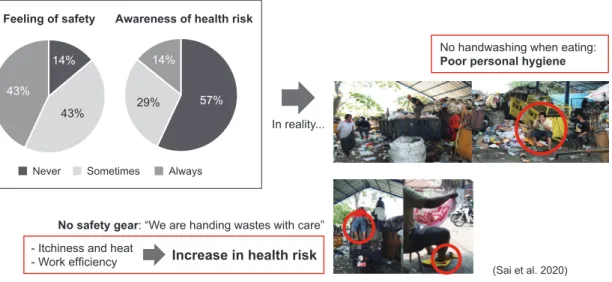
Results and Discussion: Results indicated certain waste issues affecting garbage workers, representing wetness (i.e., menstrual products and animal corps) and hazardous waste (i.e., medical syringes, broken glasses, and skewers). However, the study confirmed that workers handled the aforementioned waste with no proper safety gear (e.g., gloves, boots and long pants) due to physical discomfort experienced from its use. Safety gear caused itchiness, body heating and work inefficiency, which contributed to actual injuries and food intake without handwashing by some workers. Although participants stated being well aware of exposure to potential health risks and their ability to avoid them by consciously handling waste with care, their familiarity with waste handling could lead to poor personal hygiene and subsequently expose workers to wide-ranging health risks.
Denials of self-esteem were reported by some workers, reporting no appreciation and undervaluation of their job from others. In this sense, preparedness of physical dirt and potential health risks may further erode workers’ self-
Oral presentation
27
Proceedings of the Online International Symposium on the Sanitation Value Chain 2020 (SVC2020)
Sanitation Value Chain Vol. 5 (1) pp.026–027, 2021
esteem as it displays tolerance of a distasteful work environment leading to disparaging attitudes towards their job and themselves from the society. At the same time, however, tolerance of physically demanding and exhausting work may also be seen as traditional masculinity. Our study also revealed a reframing from occupational ideologies, in particular the social significance of their job in the residential areas. Furthermore, workers reported self-reliance attained through financial stability for their family, and freedom at work credited to flexible working hours and no supervisions from the superior. These elements reported are seen as social comparisons and refocusing. Thus, garbage workers may neutralize or transform the stigmatized aspects of their job by reframing, refocusing and social comparisons with others.
Conclusion: Taken together, the overall findings suggest that physical health of garbage workers may be compromised due to their improper personal hygiene but certain techniques of occupational ideologies and social comparisons may allow them to maintain/construct positive identity by imbuing positive values.
Figure 1. Waste-handling at dumpsite.
No handwashing when eating:
Poor personal hygiene
- Itchiness and heat
- Work efficiency Increase in health risk No safety gear: “We are handing wastes with care”
In reality...
(Sai et al. 2020)
Reference
Sai, A., Al Furqan, R., Ushijima, K., Hamidah, U., Ikemi, M.,Widyarani, Sintawardani, N. and Yamauchi, T. 2020.
Personal Hygiene, Dignity, and Economic Diversity among Garbage Workers in an Urban Slum of Indonesia.
Sanitation Value Chain 4(2): 51–66. https://doi.org/10.34416/svc.00019
Never 14%
43% 29% 57%
14%
43%
Sometimes Always Awareness of health risk Feeling of safety