Support for Education using Computer Aided Control System Design
著者 Nishigami Keigo
雑誌名 技術報告
巻 18
ページ 27‑32
発行年 2013‑03‑12
出版者 Shizuoka University. Technical Division URL http://doi.org/10.14945/00007105
Support for Education using Computer Aided Control System Design
Keigo Nishigami
Division of Technical Service, Shizuoka University Safety and Research Project Support Section
1.
1.
1.
1.AbstructAbstructAbstructAbstruct
Recent developments of Computer Aided Control System Design (CACSD) have made possible not only control systems design but also a wide variety of analysis/design relevant to control systems. CACSD is literally a tool to provide computer aided design of control systems, which permits an effective design having a dialogue with computer. Because of this, it becomes an indispensable tool in control systems design, and mastering the tool is quite important with a view to fulfilling a better control systems design. Furthermore, by using CACSD as numerical and computational tools, the further development of fields in science and engineering will be promoted. CACSD possessing these merits offers a profound benefit for education support such as student experiments and research supports. In many universities and each one of laboratories, the CACSD has already been extensively introduced in itself.
The Matlab was employed mainly as a CACSD on this training, numerical calculations and the notion of control systems design were described. Also, the same demonstrations exploiting Scilab and Octave were performed. Furthermore, for the purpose of supporting education, potentials in CACSD using open source software (OSS) were discussed.
2 2 2
2....CACSDCACSDCACSDCACSD
Matlab, Scilab and Octave are known as the CACSDs (see Table 2.1). The Matlab played a main role as one of CACSDs, which is introduced into PCs placed at computer room in Goudoutou-Ichigoukan on this training. Using laptop purchased on a training budget, Scilab and Octave were installed to the laptop, and they were also used as CACSD as well as Matlab.
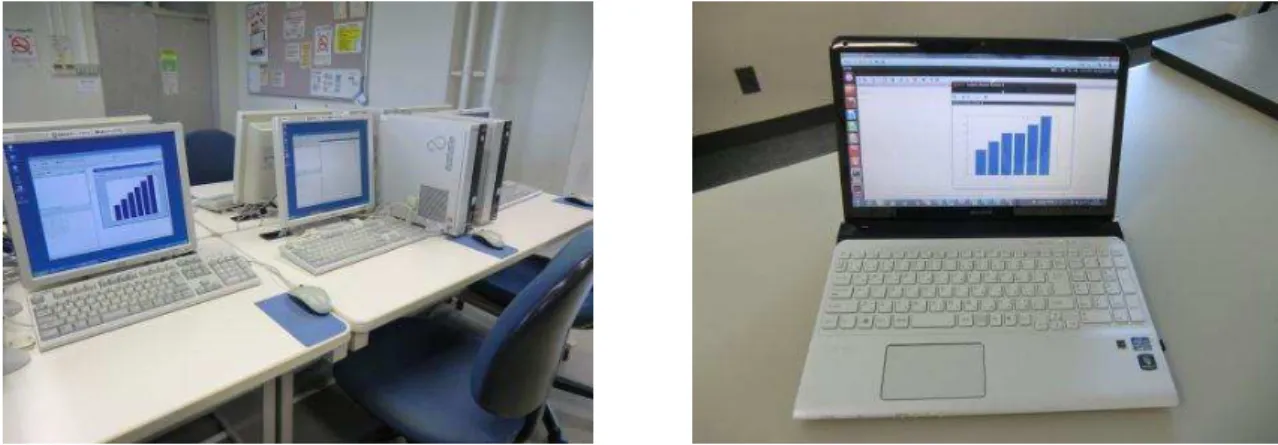
Matlab is the CACSD developed by Mathworks company[1], which is sold for a fee. Figure 2.1 shows the training environment and an example of numerical computations using CACSD.
Table 2.1 CACSD CACSD Version Developer
Matlab Scilab Octave
R14SP3 5.3.3 3.6.2
Mathworks Scilab Enterprises
John W. Eaton
Fig 2.1 Training environment and the CACSD
3 3 3
3....PracticePracticePracticePracticessss of of of of CACSDCACSDCACSDCACSD
Numerical computations and control systems design were conducted on the training. In numerical computations, algebraic manipulation based on matrix, plotting graphs and solving an optimization problem were demonstrated. Also, simple DC servomotor systems design was described in control systems design. The Matlab was exploited mainly throughout the training, but Scilab and Octave were also used secondarily. Figure 3.1 illustrates Matlab’s start screen and one of numerical calculations results. Figure 3.2 denotes an example of the DC servomotor control systems design making use of Matlab.
Fig. 3.1 Matlab’s start screen and the graphical plot of numerical calculations result
Fig.3.2 An example of the DC servomotor control systems design with Matlab
In order to illustrate the numerical computations, a wide range of computations from basic algebraic manipulations to optimization problems were demonstrated. Furthermore, in order for the control systems design to be understood, not only theoretical background but also the notion of control systems design was explained in detail. In particular, relationships between PID control which is widely utilized in industry and loop-shaping method that is taught in control engineering lecture were showed kindly.
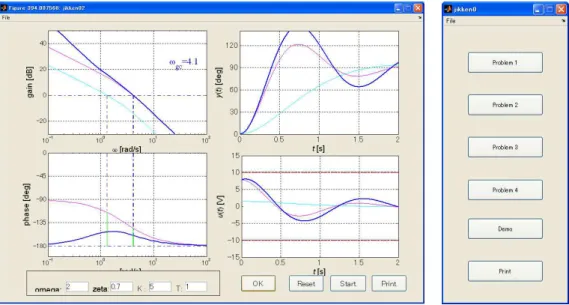
In addition, Matlab GUI environment specialized for the training was also utilized for making out what the control systems design was. Figure 3.3 is the screen shot of Matlab GUI environment, which is made by the Matlab default function “guide”. The details of the GUI environment are explained in the paper [2].
Figure 3.3 One of screen shots of Matlab GUI environment
4 4 4
4....CCCConsiderations for Education Supportonsiderations for Education Supportonsiderations for Education Supportonsiderations for Education Support
Not only knowing CACSD but also confirming the effectiveness of open source software (OSS) such as Scilab and Octave was proposed on the training. Matlab is much better for the education support than OSS in the sense that there are highly efficient functions and sophisticated graphical user interfaces (GUI) (ie., Simulink is the typical example of GUI) in Matlab. However, Matlab is quite expensive to buy for the purpose of education support. So, introducing OSS environment for the education support provides a big advantage. This is because OSS environment is nearly cost free. Because of this, constructing a CACSD making use of OSS environment was proposed on this training. Table 4.1 shows the OSS environment, which is made of Scilab and Octave running on Linux operating system Ubuntu.
Tabel. 4.1 OSS environment with Linux
Ubuntu ver. 12.04(on Vmware) Scilab ver. 5.3.3 and Octave ver.3.2.4 Ubuntu ver. 12.04(on USB) Scilab ver. 5.3.3 and Octave ver.3.2.4
First, Vmware virtual environment was constructed on the laptop for the purpose of achieving Linux environment, and Ubuntu was installed as one of major Linux operating systems.
Secondly, Scilab and Octave were installed to the virtual environment. The environment that was constructed in this training provides a low-cost environment, even a low-cost education
support. USB flash memory was also tested for constructing a low-cost environment. These environments worked without error messages, and the same results of numerical calculations using Matlab were obtained. Figure 4.1 denotes one of the simulation results with the environment constructed on the laptop.
Fig.4.1 Simulation results with the OSS environment
It is possible to install a virtual environment into USB flash memory. For example, Portable-VirtualBox can realize the virtual environment in USB flash memory (Portable-VirtualBox is a free and open source software tool that allows us run any operating system from a USB flash memory without separate installation).
Combining OSS and CACSD, a nearly cost free environment for education support can be realized. In particular, when it comes to using external storage devices such as USB flash memory, SD card and so on, there is no need for installing OSS to computers. This means being able to realize an OSS environment with only external storage devices.
5.
5.
5.
5.ConclusionConclusionConclusionConclusion
This training describes numerical computations and the notion of control systems design using CACSD for the purpose of supporting education. In order to support education, possibilities of CACSD using open source software such as Scilab and Octave are explained.
This training might provide a valuable opportunity for education support. Using the system proposed on this training as the education support is one of important challenges.
AA
AAcknowledgementscknowledgementscknowledgementscknowledgements
The author would like to thank Prof. Kenji Hirata whose comments and suggestions were innumerably valuable throughout the training.
Bibliography Bibliography Bibliography Bibliography
[1] Mathworks: http://www.mathworks.co.jp/
[2] Kenji Hirata, Shinsuke Oh-hara and Hidenori Shingin: A Control System Synthesis and Experimental Evaluation Environment for Undergraduate Educations, The 5th SICE Annual Conference on Control Systems, 749/752, 2005 (in Japanese).
[3] Stephen L. Campbell, Jean-Philippe Chancelier:Modeling and Simulation in Scilab/ Scicos With Scicoslab 4.4,Springer-Verlag,2009.
[4] Masakatsu Kawata: Scilab de manabu wakariyasui suuchikeisanhou, Morikita Press, 2008.