• 検索結果がありません。

Underlying histological activity of hepatitis Plays an Important Role for Tumor Recurrence After Curative Resection of Hepatocellular Carcinoma

N/A
N/A
Protected

Academic year: 2021

シェア "Underlying histological activity of hepatitis Plays an Important Role for Tumor Recurrence After Curative Resection of Hepatocellular Carcinoma"

Copied!
8
0
0

読み込み中.... (全文を見る)

全文

(1)

Introduction

Hepatocellular carcinoma (HCC) is one of the common causes of cancer death in Asia. Hepatic resection has been established as a curative treatment for hepatocellular carcinoma. Nevertheless, the prognosis remains poor because postoperative recurrences fre- quently occur (50 - 60%).

1-3

Such recurrences could originate from the intrahepatic metastases of the primary HCC

4,5

and the multicentric occurrence of new tumors in the postoperative liver remnant.

6-8

These unique features might be due to underlying liver diseases such as chronic active hepatitis with hepatitis B and C viral infection. There were several reports that HCC development

was significantly linked to underlying liver diseases.

6,9,10

Shuto et al.

11

suggested that hyperplastic foci (HPF), which are defined as a focal hepatic parenchymal lesion where the hepatocytes have dense and small nuclei as well as eosinophilic cytoplasm, was an impor- tant predictor of recurrence of HCC after hepatic resection.

Therefore, not only HCC tumor factors but also the underlying liver status should be carefully examined in order to select the op- timal treatments and also better predict tumor recurrence after curative resection.

The present study was conducted to clarify the risk factors asso- ciated with intrahepatic recurrences in HCC patients who under- went curative hepatic resection by investigating tumor factors, op- Address correspondence: Hikaru Fujioka, M.D., Ph.D. National Hospital Organization Nagasaki Medical Center, Department of Surgery & Clinical Research Center, 2-1001-1 Kubara, Omura, Nagasaki 856-8562 JAPAN

TEL: +81-(0)957-52-3121, FAX: +81-(0)957-53-6675, E-mail: [email protected] Received January 14, 2009; Accepted February 6, 2009

MS#AMN 07041

Underlying histological activity of hepatitis Plays an Important Role for Tumor Recurrence After Curative Resection of Hepatocellular Carcinoma

Kazuma K OBAYAS HI ,

1

Hikaru F UJIOKA ,

2

Yukio K AMOHARA ,

3

Sadayuki O KUDAIR A ,

1

Katsuhiko Y ANAGA ,

3

Junichiro F URUI ,

1

Takashi K ANEMATSU

1

1

De partment of Tr ansplant and Digestive Surgery, Nagasaki University Gra duate School of Biom edical Sciences, Nagasa ki, Japan

2

Na tional Hospital Or ganization Nagasaki M edical Center, Omura, Ja pan

3

De partment of Surge ry, Jikei University School of Medicine, Tokyo, Japan

Background: Hepatocellular carcinoma (HCC) commonly develops in patients with chronic hepatitis. This situation is one of the reasons why intrahepatic recurrence frequently occurs even after curative resection. There are two different components of such recurrences, which occurs within 12 months (the early recurrence group) and at more than 12 months after resection (the late recurrence group). The present study was conducted to clarify the factors contributing to these different types of HCC recurrence.

Methods: Ninety seven patients who underwent curative resection for HCCs were followed for initial recurrence, and predictive factors of re- currence were examined.

Results: Early and late intrahepatic recurrences developed in 30 and 42 patients, respectively. In the former group, univariate analyses showed the serum AFP level (>100ng/ml, P=0.045), higher inflammatory activity (Grading) (p=0.048) and status of fibrosis (Staging) (p=0.027) in non-cancerous liver tissues to be significant risk factors, while the serum AFP level (>100ng/ml) was the only independent risk factor based on a multivariate analysis (RR: 2.78). In the latter group, only the presence of hyperplastic foci (HPF) was found to be a significant risk factor (p=0.005). Higher Grading tended to be linked to shorter disease-free survival time, although not significant. In the non-cancerous liver tissues with HPF, the level of Grading, Staging, and PCNA labeling index was significantly higher (p=0.033, 0.003, 0.040, respectively). Conclusion:

Not only the tumor factors but also the underlying hepatic status including HPF, Grading, and Staging were significant risk factors for intrahepatic recurrence after curative resection for HCC.

ACTA MEDICA NAGASAKIENSIA 53: 97−104, 2008

Keywords: Hepatocellular carcinoma; Early and late recurrence; HPF; Grading; Staging

(2)

Kazuma Kobayashi et al.: Recurrence of HCC after Hepatectomy erative factors, and patient characterization giving special attention

to the underlying status of non-cancerous liver tissues.

Patients and methods Patients and follow up

Ninety-seven patients underwent curative resection for HCC was closely followed up for more than 12 months after resection at Department of Transplant and Digestive Surgery, Nagasaki University Graduate School of Biomedical Sciences. They included 81 males and 16 females, with a mean age of 61 years old (range: 20-80).

Twenty-four patients (24.7%) were positive for hepatitis B virus surface antigen (HBV) only, 48 (49.5%) for hepatitis C virus anti body (HCV) only, 4 for both (4.1%), and 21 were negative for both.

The serum chemistry and the serum levels of alpha-fetoprotein (AFP) were measured monthly, and ultrasonography as well as com puted tomography scan were performed at a 3-month interval.

Magnetic resonance imaging, angiography and liver biopsies were also performed to make a definitive diagnosis of recurrence, if needed.

Pathological examination

Resected liver specimens were fixed in 10% formaldehyde solu- tion. After a macroscopic examination, a slice containing the maxi- mum tumor diameter and other slices of lesions suspicious for me- tastases or venous invasion were embedded in paraffin. Tissue sections were stained with hematoxylin and eosin (H & E).

According to the classification of Primary Liver Cancer by the

Liver Cancer Study Group of Japan

12

, the histological findings of each tumor were examined regarding the histological stage, the de- grees of portal venous invasion and hepatic venous invasion as well as the presence of intrahepatic metastases.

Inflammatory activity (Grading), fibrotic status (Staging) and hyperplastic foci (HPF) in non-cancerous liver tissues

To classify the degree of hepatic inflammation (hepatitic activ- ity), we used the Histological Activity Index (HAI) score as de- scribed by Knodell et al.

13

Based on their criteria, the H & E stained specimens of the non-cancerous liver tissues were exam- ined and classified into four categories according to Desmet's method

14

; G0 (normal, or minimal chronic hepatitis), G1 (mild chronic hepatitis), G2 (moderate chronic hepatitis), and G3 (severe chronic hepatitis). To classify fibrosis, Scheuer's method

15

were used. The stage of fibrosis was categorized as F0 (non-fibrosis), F1 (enlarged, fibrotic portal tracts), F2 (fibrosis in periportal or portal- portal septa, but an intact architecture), F3 (fibrosis with architec- tural distortion, but not obvious cirrhosis) and F4 (probable or defi- nite cirrhosis). Figure 1 shows a liver with inflammatory and fibrotic change (G2 and F3).

Hyperplastic foci (HPF) were defined as a focal hepatic parenchymal lesion where the hepatocytes have dense and small nuclei as well as eosinophilic cytoplasm

11,16

(Figure 2). The presence of HPF was examined in H&E-stained specimens of non-cancerous liver tissues. The liver tissue with at least one lesion of hyperplastic cells was defined as positive for HPF. The pathological findings were independently judged by two pathologists (K.K. and S.O.).

98

Figure 1. The liver with inflammatory and fibrotic change (G2 and F3).

(3)

Proliferating cell nuclear antigen labeling index (PCNA L.I.)

The labeling index of PCNA was examined according to a method described in a previous report

17

, which was determined by the ratio of PCNA-positive hepatocytes per 1000 hepatocytes.

Statistical analyses

Possible risk factors for early recurrence were compared using the chi-square test with Yates' correction (or Fisher's exact test where appropriate) for nominal variables and/or unpaired Student t test for continuous variables. Risk factors in either the chi-square or Student t test for early recurrence were consecutively analyzed based on multivariate logistic regression models. Possible risk fac- tors for late recurrence were entered into Cox's multivariate pro- portional hazard model. The cumulative recurrence-free survival curves were analyzed using the Kaplan-Meier method and then were compared with the log rank test. A p value of less than 0.05 was considered to be statistically significant.

Results

Figure 3 shows the cumulative recurrence-free survival curve among 97 patients in the present study. Seventy-two of them (74.2

%) developed intrahepatic recurrence while the remaining 25 had no recurrence during the follow-up period. Two different compo- nents were observed in the recurrence-free survival curve. The first component was rapidly decreased within 12 months after curative hepatectomy, and these patients were classified as the early recur- rence group. The second component was slowly decreased thereaf- ter, and this group was classified as the late recurrence group.

Five patients (5.2 %) developed extra-hepatic recurrence, 7 (7.2

%) underwent a re-resection, and 27 (27.8 %) received chemo- lipiodolization. The 1-, 3-, and 5-year recurrence-free survival rates were 69 %, 38 % and 23 %, respectively. The median recur rence-free survival time was 30.7 months (range: 4.5 - 106.5 months).

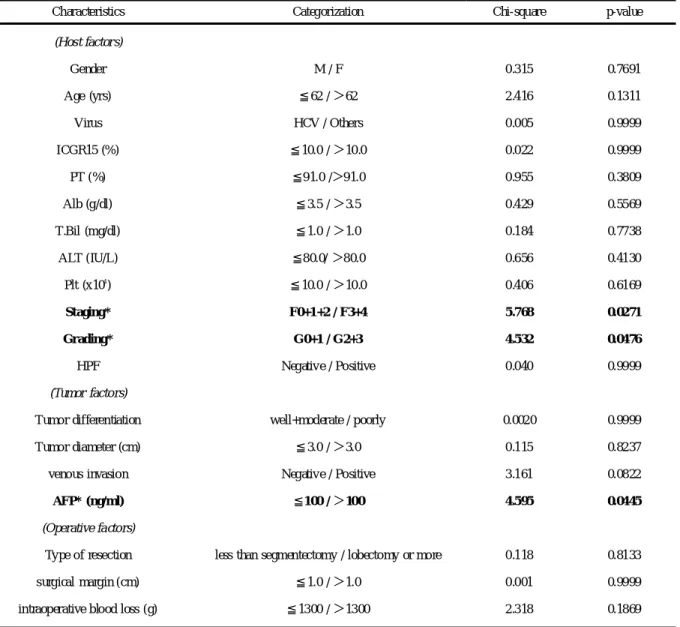
Preoperative patient characterization, tumor factors, and operative factors associated with HCC recurrences are shown in Table 1. The early and late recurrences developed in 30 and 42 patients, respec- tively.

Risk factors for early intrahepatic recurrence (Tables 1-3)

Thirty of 72 patients with recurrent HCCs (41.7 %) developed early intrahepatic recurrence within 12 months after a curative re- section. The median recurrence-free survival time in the early phase was 5.9 months. Higher Grading (G2+G3; p=0.048), Staging Figure 2. Hyperplastic foci is defined as a focal hepatic parenchymal lesion where the hepatocytes have dense and

small nuclei as well as eosinophilic cytoplasm (in boxes) (x200, x400)

Figure 3. The cumulative recurrence-free survival curve after curative re- section of HCC. There were two different components as follows; 1) rapid decrease within 12 months and 2) slow decrease more than 12 months.

months after resection

(4)

Kazuma Kobayashi et al.: Recurrence of HCC after Hepatectomy (F3+F4; p=0.027), and serum AFP levels (>100ng/ml; p=0.045)

were significant risk factors based on a univariate analysis, whereas no operative factors were found to be significant. Eleven of 30 patients suffered from the early recurrence had HPF in the

non-cancerous liver tissues. The presence of HPF was not signifi- cantly related to the early recurrence. A multivariate analysis dem- onstrated only the serum AFP levels to be independently signifi- cant (RR: 2.78).

100

Early recurrence Late recurrence No recurrence

Charasteristics Categorization (n=30) (n=42) (n=25)

(Host factors)

Gender Age (yrs)

Virus

ICGR15 (%) PT (%) Alb (g/dl) T.Bil (mg/dl)

ALT (IU/L) Plt (x10

4

/ml)

staging grading HPF

(Tumor factors) Tumor differentiation

Tumor diameter (cm) venous invasion or satellite lesion

AFP (ng/dl)

(Operative factors) Type of resection

surgical margin (cm) intraoperative blood loss (g)

M F

≦62

>62 B B+C

C None

≦10.0

>10.0

≦ 91.0

>91.0

≦3.5

> 3.5

≦1.0

>1.0

≦ 80.0

>80.0

≦10.0

> 10.0 F0+1+2 F3+4 G0+1 G2+3 (-) (+)

well moderate

poorly necrosis

≦3.0

> 3.0 (-) (+)

≦ 100

>100

subsegmentectomy or less segmentectomy lobectomy or more

≦1.0

> 1.0

≦1300

>1300

26 4 19 11 8 1 15 6 10 20 18 12 23 7 24 6 23 7 9 21 10 20 10 20 19 11

4 20 2 4 11 19 13 17 18 12

16 4 10 14 16 12 18

34 8 19 23 9 2 22

9 11 30 21 20 34 7 35

7 34

8 10 32 23 19 20 22 21 21

3 32

4 3 18 24 23 19 33 9

13 14 15 25 17 20 22

21 4 12 13 7 1 11

6 10 15 11 13 22 3 21

4 22

3 6 19 17 8 18

7 20

5

3 20

1 1 9 16 19 6 21

4

11

9

5

6

19

18

7

Table 1. Differences between early, late, or no recurrence

(5)

Table 2. Univariate analysis for early recurrence

Characteristics Categorization Chi-square p-value

(Host factors) Gender Age (yrs)

Virus ICGR15 (%)

PT (%) Alb (g/dl) T.Bil (mg/dl)

ALT (IU/L) Plt (x10

4

) Staging*

Grading*

HPF (Tumor factors) Tumor differentiation Tumor diameter (cm)

venous invasion AFP* (ng/ml) (Operative factors)

Type of resection surgical margin (cm) intraoperative blood loss (g)

M / F

≦ 62 / > 62 HCV / Others

≦ 10.0 / > 10.0

≦ 91.0 / > 91.0

≦ 3.5 / > 3.5

≦ 1.0 / > 1.0

≦ 80.0/ > 80.0

≦ 10.0 / > 10.0 F0+1+2 / F3+4 G0+1 / G2+3 Negative / Positive

well+moderate / poorly

≦ 3.0 / > 3.0 Negative / Positive

100 /100

less than segmentectomy / lobectomy or more

≦ 1.0 / > 1.0

≦ 1300 / > 1300

0.315 2.416 0.005 0.022 0.955 0.429 0.184 0.656 0.406 5.768 4.532 0.040

0.0020 0.115 3.161 4.595

0.118 0.001 2.318

0.7691 0.1311 0.9999 0.9999 0.3809 0.5569 0.7738 0.4130 0.6169 0.0271 0.0476 0.9999

0.9999 0.8237 0.0822 0.0445

0.8133 0.9999 0.1869

* significant factor

variables Risk ratio 95% confidence interval p-value

AFP* (ng/ml)

Grading Staging

2.779

0.472 0.51

1.016-7.600

0.166-1.338 0.183-1.426

0.0464

0.1579 0.1995

* signific ant factor

Table 3. Multivariate analysis for early recurrence

(6)

Kazuma Kobayashi et al.: Recurrence of HCC after Hepatectomy Risk factors for late intrahepatic recurrence

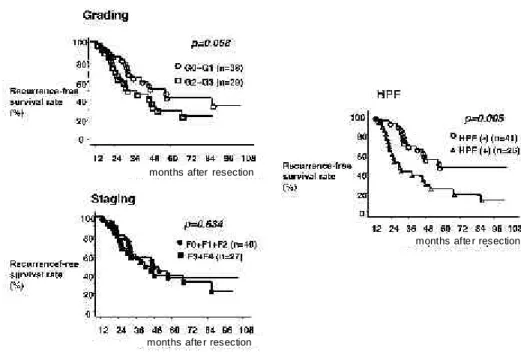
Forty-two of 72 patients with recurrent HCCs (58.3 % ) devel- oped late intrahepatic recurrence and the median recurrence-free survival time was 46.1 months. Regarding the cumulative recur- rence-free survival, patients with higher grading (G2+G3) tended to have a shorter recurrence-free survival time, although the differ- ence was not statistically significant (Figure 4). On the other hand, Staging in non-cancerous liver tissues did not affect the late recur-

rence (Figure 4). Twenty-one of 42 patients suffered from the late recurrence had HPF in the non-cancerous liver tissues. The pres- ence of HPF was a significant risk factor for the late recurrence (Table 4, Figure 4), while neither operative factors nor tumor fac- tors were not significant risk factors for the late recurrence (Table 4). In addition, HPF-positive livers demonstrated not only higher Grading and Staging but also higher score of PCNA L.I. than those in HPF-negative livers (Figure 5).

102

Figure 4. Relationship of recurrence-free survival time with Grading, Staging, and HPF.

The presence of HPF was significantly related to shorter recurrence-free survival time. Higher Grading (G2+G3) tended to be associated with shorter recurrence-free survival time, whereas Staging was not associated.

Figure 5. Relationship between HPF and Grading, Staging, PCNA L.I.

HPF is significantly associated with higher Grading, Staging and PCNA L.I.

months afte r resection months after resection

months afte r resection

(7)

Discussion

In the present study, the recurrence-free survival curve after curative resection for HCC had different components including the early recurrence within 12 months after resection and late recur- rence after more than 12 months. This finding was consistent with the report by Poon et al.

4

In the early recurrence group, a multivari- ate analysis revealed that the significant risk factor was higher serum AFP level (>100ng/ml). This finding suggests that tumor factors such as malignant potential of HCC cells are one of the im- portant risk factors for the early recurrence.

18-20

In addition, univariate analyses in the risk factors of early recurrence also showed higher Grading and Staging of non-cancerous liver tissues

to be significant risk factors, suggesting that higher hepatitic activ- ity also enhanced early intrahepatic recurrence.

6

This finding also suggests that one of the mechanisms for early recurrence is due to metachronous occurrence of new tumors (multicentric origin, re- ferred to as MO). However, the rate of intrahepatic recurrence due to MO is not so high (14 - 25%).

17,21

Therefore, high incidence of early recurrence in the active hepatitis group (G2+G3, F3+F4) compared to the other group (G0+G1, F1+F2) could not be ex- plained by the MO-mechanism alone. It was previously reported that the expression of vascular adhesion molecules including endo- thelial leukocyte adhesion molecule-1 (ELAM-1), intercellular ad- hesion molecule-1 (ICAM-1), vascular cell adhesion molecule-1 and CD-44 in the hepatocytes and/or hepatic sinusoidal lining cells Characteristics categorization Hazrd ratio 95% confidence p-value

interval (Host factors)

Gender Age (yrs)

Virus Staging Grading HPF*

ICGR15 (%) PT (%) Alb (g/dl) T.Bil (mg/dl)

ALT (IU/l) Plt (x10

4

/ μ l) (Tumor factors) Tumor differentiation Tumor diameter (cm)

fc fc-inf venous invasion

AFP (ng/ml) (Operative factors) Type of operation

a )

surgical margin (cm) Intraoperative blood loss (g)

M / F

≦62 / >62 C / others F0+1+2 / F3+4

G0+1 / G2+3 (-) / (+)

≦10.0 / >10.0

≦91.0 />91.0

≦ 3.5/ > 3.5

≦1.0 / >1.0

≦80.0 / >80.0

≦ 10.0 / > 10.0

well+moderately / poorly

≦ 3.0 / > 3.0 (-) / (+) (-) / (+) (-) / (+)

≦100 / >100

A+B/C (-) / (+)

≦1300 / >1300

1.000 1.090 1.656 0.852 0.611 2.611 1.507 0.633 0.629 1.288 1.365 0.694

0.4430 1.162 0.683 1.019 1.650 0.955

1.657 1.845 1.831

0.438-2.285 0.566-2.100 0.699-3.923 0.441-1.467 0.316-1.180 1.346-5.067 0.721-3.147 0.320-1.251 0.240-1.647 0.534-3.109 0.595-3.130 0.322-1.494

0.097-2.021 0.603-2.238 0.282-1.655 0.466-2.226 0.852-3.195 0.417-2.189

0.737-3.727 0.949-3.587 0.944-3.552

0.9970 0.7973 0.2520 0.6346 0.1425 0.0045 0.2753 0.1885 0.3449 0.5733 0.4620 0.3501

0.2929 0.6531 0.3981 0.9629 0.1373 0.9141

0.2219 0.0708 0.0735 Table 4. Analysis for late recurrence by Cox's proportional hazard model

a) A: subsegmentectomy or less; B: segme ntectom y; C: lobectom y or m ore. *signific ant factor

(8)

Kazuma Kobayashi et al.: Recurrence of HCC after Hepatectomy was up- regulated in chronic active hepatitis.

22,23

These adhesion

molecules, especially ELAM-1, were reported to mediate the adhe- sion of HepG2 cells and the serum ICAM-1 levels also increased after a hepatectomy.

23

The up-regulation of adhesion molecules and hepatitic activity could enhance early intrahepatic metastasis from primary HCCs. Adachi et al.

17

reported that hepatic resection espe- cially in the active hepatitis group might give rise to various grades of impaired immunity. If HCC cells were spread in the remnant liver during and/or after resection, it would be easy for them to sur- vive and proliferate in the liver of patients with such an impaired immunity. Taking together, early intrahepatic recurrence after curative resection of HCCs seems to be associated with not only primary tumor factors but also underlying hepatitic activity.

On the other hand, the significant risk factor for late recurrence in the present study was only the underlying hepatic status such as the presence of HPF, but neither primary tumor factors nor opera- tive factors. The livers with HPF had higher hepatitic activity (higher Grading, and/or Staging) and higher scores of PCNA L.I.

than HPF-negative ones. Hyperplastic foci are analogous to parts of adenomatous hyperplasias (AHs) or early HCCs.

11

Wakasa et al.

24

reported that the proliferative activity of HPF, as expressed accord- ing to the PCNA L.I., is almost the same as that of AHs and early HCCs. They also reported that HPF-positive livers had a higher hepatitic activity and HPF lesions reflected the risk of multicentric hepato-carcinogenesis. Tarao et al.

9

and Koike et al.

10

reported that HCC development was significantly linked to underlying liver dis- eases with a high degree of DNA synthesis, suggesting that inflam- matory liver tissues has a potential to develop HCCs. Therefore, it is possible that HPF itself may be one of the precancerous lesions in multicentric carcinogenesis.

In conclusions, not only the tumor factors but also the underly- ing hepatic status including Grading, Staging, and the presence of HPF were significant risk factors for the intrahepatic recurrence after curative resection for HCC. To achieve better outcome in HCC patients after curative resection, anti-hepatitis treatments as well as anti-tumor treatments during pre- and post-operative phase should be established.

Acknowledgment

We thank Mr. Terao, who worked for Department of Transplant and Digestive Surgery, Nagasaki University Graduate School of Biomedical Sciences, for his valuable technical assistance in proc- essing the pathological specimens.

References

1. Shim ada K, Sakamoto Y, Esaki M , et al. Ana lysis of prognostic factors affecting survival after initial recurrence and treatment ef fica cy for recurrence in patients undergoing potentially curative hepatectom y for hepatocellula r carc inoma. Ann Surg Oncol 14: 2337-2347, 2007

2. Kim BW, Kim YB, Wa ng HJ, Kim MW. R isk factor s for imm ediate post- oper ative fa tal recurrence after c urative resection of hepa tocellular c arcinoma.

World J Gastroenterol 7: 99-104, 2006

3. Shah SA, Cleary SP, We i AC, e t al. R ecur rence after liver resection for hepa tocellular c arcinoma: R isk factors, treatment, a nd outcome s. Surgery 141:

330-339, 2007

4. Poon RT, Fan ST, Ng IO, Lo CM, Liu CL, Wong J. Different risk factors and prognosis for ea rly and late intrahe patic re cur renc e af ter curative resection of hepa tocellular carc inom a. C ancer 89: 500-507, 2000

5. Lang H, S otiropoulos GC, B rokalaki EI, e t al. S urvival and r ecurrence rates afte r resection for hepatocellular carc inoma in noncirrhotic liver s. J Am Coll Surg 205:

27-36, 2007

6. Matsum oto K, Yoshim oto J, Sugo H, Kojima K, Futaga wa S, M atsumoto T.

Relationship between the histological degre es of hepa titis and the postoperative re - currence of hepatocellular ca rcinoma in patients with hepa titis C. Heptol Res 23:

196-201, 2002

7. Ima mur a H, M atsuya ma Y, Tanaka E, et al. Risk factors contributing to early and late phase intrahepatic r ecurrence of hepatocellular car cinoma af ter hepatectom y.

J Hepatol 38: 200- 207, 2003

8. Shah SA, Greig PD, Gallinger S, et al. Factors associate d with early re curr enc e after resection for hepatocellular carcinoma and outcomes. J Am C oll Surg 202:

275-283, 2006

9. Tarao K, Takemiya S, Ta mai S, et al. Relationship betwe en the re curr enc e of hepa tocellular carcinoma (HCC) and serum alanine aminotr ansferase levels in hepa tec tomized pa tients with he patitis C virus-associa ted cirrhosis and HCC.

Cancer 79: 688-94, 1997

10. Koike Y, S hiratori Y, Sato S, et al. R isk fac tors for recurring hepa tocellular c arci- nom a differ according to infec ted hepa titis virus - an ana lysis of 236 consecutive patients with a single lesion. Hepatology 32: 1216-23, 2000

11. Shuto T, Hirohashi K, Wakasa K, Ikebe T, Kinoshita H. Hyperplastic foci as a prognostic factor after resection of hepatocellular carcinoma. Hepatogastroenterology 46: 2439-2441, 1999

12. The Live r Cancer Study Group of Japan. Classification of Primary Liver Canc er.

Tokyo: Kaneha ra & C o., Ltd., 2000

13. Knodell R G, Isha k KG, Black WC, et al. Formulation and a pplication of numerical scor ing system for assessing histological ac tivity in asymptomatic chronic a ctive hepa titis. Hepatology 1: 431-5, 1981

14. Desmet VJ, Ge rbe r M , Hoofnagle JH, M anns M , Sheure P. Classifica tion of chronic hepatitis: diagnosis, grading and staging. Hepatology 19:1513-20, 1994 15. Brunt EM. Gr ading and staging the histopathological lesions of c hronic hepatitis:

the Knodell histology activity index and beyond. Hepatology 31: 241-6, 2000 16. Kato K, Ozaki D, Zheng K, et al. Characterization of hyperplastic foci observed

in surgical spec ime ns of hepa tocellular carcinom a. Pathol Int 51:20-25, 2001 17. Ada chi E, Mae da T, M atsumata T, et al. Riska factors f or intrahepatic re cur renc e

in human small hepatocellular car cinoma. Gastroe nterology 108: 768-775, 1995 18. Kamiya ma T, Takahashi M, Na kagawa T, et al. AFP mR NA detected in bone ma r-

row by re al-time quantitative RT-PCR analysis predicts survival and re curr enc e after curative hepatectomy for hepatocellular carcinom a. Ann Sur 244: 451-463, 2006

19. Furihata T, S awa da T, Kita J, et al. Serum alpha-fetoprote in level per tum or vol- ume r efle cts prognosis in patie nts with he patocellula r carcinom a after cur ative hepa tec tomy. Hepatogastroe nterol 55: 1705-1709, 2008

20. Zou WL, Zang YJ, C he n XG, S hen ZY. Risk factors for fata l recurrence of hepa tocellular carcinoma a nd their role in selecting c andidates for liver transplan- tation. He patobiliary Pancreas Dis Int 7: 145- 151, 2008

21. Shir abe K, Takenaka K, Taketom i A, et al. Postoperative hepatitis status as a sig- nificant risk fac tor for recurrence in cirrhotic patie nts with sm all he patocellula r carc inom a. C ancer 77: 1050-1055, 1996

22. Volpes R, van den Oord JJ, Desmet VJ. Vasc ular adhesion molecules in acute and chronic liver inflam mation. Hepatology 15: 262-275, 1992

23. Rice GE, Bevilacqua MP . An inducible endothelial cell surf ace glycoprotein medi- ates melanoma adhesion. Scienc e 264: 1303-1306, 1989

24. Wakasa K, Haba T, Sasaki M, et al. Hyperplastic foci in c hronic liver disease:

The ir prolife rative ac tivity assessed by nucleolar organizing re gion. Pathol Intl 48:

29-32, 1998

104

Figure 1. The liver with inflammatory and fibrotic change (G2 and F3).
Figure 3 shows the cumulative recurrence-free survival curve among 97 patients in the present study
Table 2. Univariate analysis for early recurrence
Figure 4. Relationship of recurrence-free survival time with Grading, Staging, and HPF.

参照

関連したドキュメント

By con- structing a single cone P in the product space C[0, 1] × C[0, 1] and applying fixed point theorem in cones, we establish the existence of positive solutions for a system

First algorithm of our classifier is classif yCeq, which classifies the simple sin- gularities in characteristic p > 0 with respect to the contact equivalence.. This

By applying combinatorial Grothendieck conjecture, all the results concerning the tame anabelian geometry of smooth curves over algebraically closed fields of characteristic p >

W loc 2,p regularity for the solutions of the approximate equation This section is devoted to prove the W 2,p local regularity of the solutions of equations (5) and, as a by-product,

Answering a question of de la Harpe and Bridson in the Kourovka Notebook, we build the explicit embeddings of the additive group of rational numbers Q in a finitely generated group

Next, we prove bounds for the dimensions of p-adic MLV-spaces in Section 3, assuming results in Section 4, and make a conjecture about a special element in the motivic Galois group

Maria Cecilia Zanardi, São Paulo State University (UNESP), Guaratinguetá, 12516-410 São Paulo,

Hence, in the Dirichlet-type and Neumann-type cases respectively, the sets P k used here are analogous to the sets (0, ∞) × T k+1 and (0, ∞) × S k , and we see that using the sets P