On the Readability of the English Technical Writing Test:
With Special Reference to the Textbooks Used in Technical High Schools and Colleges of Technology in Japan
Daisuke KUKITA and Minoru FUKUDA
The purpose of this study is to evaluate the difficulty of the English Technical Writing Test (KOUGYOU-EIKEN) and compare it with the textbooks used in technical high schools and colleges in terms of readability. Since readability is a factor that helps ESL learners learn English effectively and understand target materials easily, it is important to investigate the targeted difficulty level of the test administrated to applicants and the textbooks they use.
Additionally, McGrath (2002: 11, 2006: 171) emphasizes the importance of textbooks in a teaching-learning situation. This study examines the readability of the English Technical Writing Test, and that of textbooks used in technical high schools and colleges. The readability of the tests and textbooks is calculated by means of two readability formulas: the Flesch Reading Ease Formula and Flesch-Kincaid Formula.
The results are then discussed in the light of previous studies.
In conclusion, the present study clarifies the current situation and presents suggestions for further studies and improvements.
: the English Technical Writing Test, the Flesch Reading Ease Formula, the Flesch- Kincaid Formula, readability, textbooks, technical high schools, colleges of technology, MEXT
Table of Contents
Ⅰ Introduction
Ⅱ The Characteristics of the English Technical Writing Test
Ⅲ Readability
1 Readability Formulas
2 Readability Scores of the English Technical Writing Test 3 Readability Scores of Textbooks in Technical High Schools 4 Readability Scores of Textbooks in Colleges of Technology
Ⅳ Analysis of the Findings Key Words
1 The Gap between the Technical English Writing Test and the Textbooks 2 How to Bridge This Gap
Ⅴ Conclusion
I Introduction
Technical high schools and colleges of technology (Kosen) aim to train engineers with highly practical skills. After graduation, students are expected to play an active part in their major field internationally or proceed to tertiary level education. It is essential that they present their research in English. However, in technological high schools and colleges, compared with high schools, fewer English classes are held per week (Soda and Esaki 2005:
13). Technological high schools devote only two hours per week to English classes (Soda and Esaki 2005: 13). In fact, according to Okuyama (2005; cited in Okuyama and Nagano 2012:
9), the number of English classes per week in colleges of technology is 30 % lower than that in other general high schools. This is partly because technological high schools and colleges typically focus on technical subjects. In such a situation, where English is not a major focus, can students pass the English Technical Writing Test by using only the textbooks that are approved by Ministry of Education, Culture, Sports, Science and Technology (MEXT) or by school administrators and teachers? Textbooks are expected to develop the following four skills in a balanced manner: listening, speaking, writing, and reading. The textbooks approved by MEXT are designed to this end (Taniguchi 1998: 155-157). Moreover, as McGrath (2002: 11, 2006: 171) points out, textbooks are a central element in teaching-learning encounters.
This paper examines the English Technical Writing Test and the textbooks adopted in technical high schools and colleges from the perspective of readability. It is organized as follows. In section 2, we indicate the characteristics of the English Technical Writing Test and its difficulty level as officially stated by the Japan Society for Technical Communication.
In section 3, by means of the Flesch Reading Ease Formula and Flesch-Kincaid Formula, which can be easily accessed by computer users, we investigate the difficulty level of selected textbooks as well as the English Technical Writing Test. In section 4, we analyze the results of our investigation. In section 5, we summarize our claims, offering suggestions for future studies.
II The Characteristics of the English Technical Writing Test
According to the official web site of the Japan Society for Technical Communication, each grade of the test requires examinees to have different level of English skills and backgrounds. For example, examinees for the first and second grades are supposed to have practical writing skills and experience; on the other hand, applicants for the third and fourth grade need to have basic reading skills and knowledge of technical terms (Kyouno 2010: 19).
Details are presented in Table 1 below.
Table 1
Classification Examination Questions
4th Grade
E x a m i n e e s w i t h b a s i c knowledge of technical English in technical high sc h ools or c olle g e s of technology
・English-Japanese Translation
・Supplementary Exercise
・Vocab Test
3rd Grade
Examinees with practical knowledge of technical E n g l i s h i n t e c h n i c a l universities, upper grades in colleges of technology or technical schools
・English-Japanese Translation
・Japanese-English Translation
・Supplementary Exercise
・Vocab Test
pre-2nd Grade
E x a m i n e e s w i t h b a s i c k n o w l e d g e o f h i g h l y t e c h n i c a l E n g l i s h i n technological universities, post-graduate universities a n d u p p e r g r a d e s i n colleges of technology
・English-Japanese Translation
・Japanese-English Translation
・Supplementary Exercise
・Rhetoric
2nd Grade
Examinees with practical e x p e r i e n c e a n d h i g h l y technical knowledge
・English-Japanese Translation
・Japanese-English Translation
・Rhetoric
1st Grade Examinees with practical experience as an expert
・English-Japanese Translation
・Japanese-English Translation
・Rhetoric
・Interview and listening
Kyouno (2010: 19) demonstrates the evaluation criteria of the English Technical Writing Test (see Table 2). Because the writing component of the test is not discussed in this article,
only the reading criteria are listed in Table 2.
Table 2
EVALUATION CRITERIA
Grade Skills Levels
4 reading
・can read easy sentences on science and technology
・can read easy instruction or precautious on experiment or process of production
・can read easy sign board, notice in laboratory or production spot
3 reading
・ can read basic sentences on science and technology
・ can read easy instruction manuals
・ can read instruction or precautious on experiment or process of production
・ can read sign board, notice in laboratory or production spot
pre2 reading
・ can read English on science technology correctly
・ can understand English on his/her majors
・ can read correctly technological information
2 reading
・ can read and understand the difference of the style in technological passages on instruction manuals, specifications, theses
・ can read and understand almost correctly journal or trade magazine
・ can read almost correctly his/her major theses
1 reading
・ can read and understand perfectly the difference of the style in technological passages on instruction manuals, specifications and theses
・ can read theses or articles on his/her majors perfectly
According to Shioya (2008: 279-282), introducing the English Technical Writing Test has some favorable effects on students in terms of intrinsic and extrinsic motivation. First, the test can be treated as a part of the credit transfer system, so if a student passes a certain grade of the test, he or she will be assigned a credit that satisfies the English requirement at school. Without doubt, this is beneficial to students. This aspect is in accordance with what Lewis’s (2002: 41-42) observation that “extrinsic motivation can come through rewards, and intrinsic motivation is the benefits of learning a particular language.” Negative attitudes and beliefs can reduce learners’ motivation and affect language learning, while positive
attitudes and beliefs can do the reverse. Therefore, the introduction of the English Technical Writing Test into classes helps to motivate learners and makes English learning more effective.
III Readability
Taniguchi (1998: 187), and Takanashi and Ujou (2000; cited in Chujo and Hasegawa 2004:
46) define readability as a measure that indicates the difficulty level of passages for reading comprehension. In terms of readability, we can also evaluate the target passages and their difficulty levels in comparison to those used in school grades in the United States. For example, if the difficulty level of the English Technical Writing Test exceeds that of the textbooks, students’ independent study will not be expected and they will be demotivated.
1 Readability Formulas
Nine readability formulas are frequently referenced in related studies. Among these formulas, the Flesch Reading Ease Formula, Flesch-Kincaid Formula and Power-Sumner- Kearl Formula are measures that estimate the difficulty level of the reading passages by evaluating such textual features as the number of syllables per word, average number of words per sentence, and number of sentences per paragraph. Further, the Flesch Reading Ease Formula and Flesch-Kincaid Formula have been adapted for computers, which enables computerized checking; they are widely available and are often installed in mainstream word processing packages (Kimura 1996: 86).
In the case of the Flesch Reading Ease Formula, the higher the reading grade level, the easier is the passage. On the other hand, with regard to the Flesch-Kincaid Formula, the reading grade level represents the corresponding grade in the USA.
2 Readability Scores of the English Technical Writing Test
Although the English Technical Writing Tests for the first grade and second grades require the students to have practical experience, it is difficult to judge whether the students of technical colleges actually possess such experience by means of the test. On the other hand, students of the third and fourth grades must have basic reading skills and knowledge of fundamental technical terms, which are taught in class. Therefore, these two grades (i.e.,
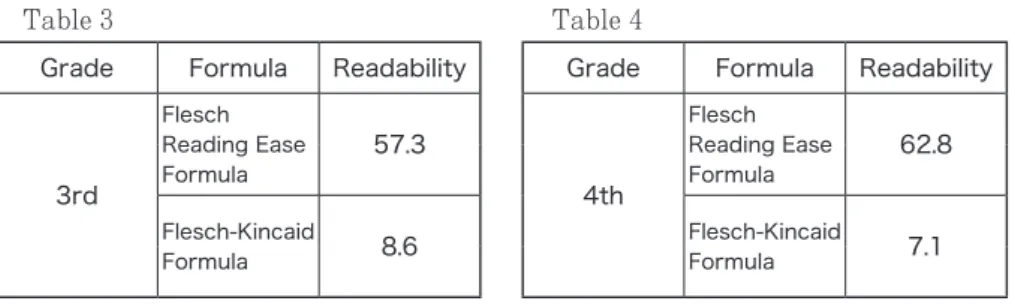
the third and fourth grades) are considered in our study. Before examining the scores on these grades, instructions and multiple choices in Japanese are extracted in order to measure the difficulty level accurately. Table 3 and Table 4 shown below represent readability scores of the third and fourth grades, respectively.
Table 3 Table 4
Grade Formula Readability Grade Formula Readability
3rd
Flesch Reading Ease Formula
57.3
4th
Flesch Reading Ease Formula
62.8
Flesch-Kincaid
Formula 8.6 Flesch-Kincaid
Formula 7.1
Chujo and Hasegawa (2004: 49) examined reading grade levels, using Japanese textbooks.
They concluded that the level (score 8.7) of the textbooks used by Japanese high school students corresponds to that of the eighth or ninth graders in the US.
3 Readability Scores of Textbooks in Technical High Schools
To evaluate the readability scores of textbooks used in technical high schools, CROWN Communication Ⅱ and Big Dipper Reading Course, two MEXT-approved textbooks, were
chosen. Three lessons were randomly chosen from each textbook. This is because it is statistically not necessary to investigate all the lessons and passages. Before the analysis, we assumed that all the lessons were basically designed at almost the same reading level.
After evaluating the difficulty scores, the average scores of each textbook were calculated, as indicated in Table 5.
Table 5
Textbook Lesson Formula/Readability
Flesch Reading Ease Formula Flesch-Kincaid Formula
CROWN Communication
Ⅱ
1 68.6 6.5
4 72.6 6.8
8 65.6 7.4
average 68.9 6.9
Big Dipper Reading Course
1 60.8 8.8
4 64.1 7.8
8 78.4 5.7
average 67.8 7.4
4 Readability Scores of Textbooks in Colleges of Technology
In order to assess the readability scores of textbooks used in colleges of technology, two textbooks were selected: UNICORN ENGLISH COURSE and UNICORN ENGLISH READING. These two books are fairly widely used for third-year students in technical colleges (Higashi 200: 195-203), and are also authorized by MEXT. The average scores shown in Table 6 are almost the same as those indicated in Table 5.
Table 6
Textbook Lesson Formula/Readability
Flesch Reading Ease Formula Flesch-Kincaid Formula
UNICORN ENGLISH COURSE
1 70.4 6.1
4 59.0 8.1
8 65.9 7.9
average 65.1 7.3
UNICORN ENGLISH READING
1 80.2 6.1
4 67.6 7.7
8 52.6 9.7
average 66.8 7.8
IV Analysis of the Findings
The results revealed that the readability scores of some lessons in the textbooks used in technical high schools and colleges of technology are higher than expected. However, it must be noted that the passage in Lesson 1 of Big Dipper Reading Course, whose reading score is 60.8 according to the Flesch Reading Ease Formula and 8.8 according to the Flesch-Kincaid Formula, is not a reading passage but a kind of advertisement. Also, the score of Lesson 4
in the Unicorn English Course is 59.0 according to the Flesch Reading Ease Formula and 8.1 as per the Flesch-Kincaid Formula, and the passage is about the history of fashion.
Additionally, the reading score of Lesson 8 in Unicorn English Reading is 9.7 according to the Flesch-Kincaid Formula, which is the highest score among all of the target materials.
This is because relative pronouns and participial constructions are used in the passage, which is about politics in many different countries and full of technical terms. It is, therefore, quite difficult to understand the passage. These factors may account for their high scores of the lesson.
1 The Gap between the Technical English Writing Test and the Textbooks
Except for some lessons in the surveyed textbooks, readability scores calculated by the Flesch Reading Ease Formula and Flesch-Kincaid Formula are almost the same. That is, in terms of readability level, students in the technical high schools and colleges of technology should be able to pass the fourth grade of the English Technical Writing Test, but they are not ready for the third grade of the test. This is because the English Technical Writing Test is different from the textbooks in that the passages of the test are not annotated and, as shown in Table 1, examinees of the third grade are required to have more technical knowledge than fourth grade examinees. Besides, compared to the fourth grade, the test contains more examination questions, because it includes questions on Japanese-English translation.
2 How to Bridge This Gap
In this study, we focus only on the textbooks approved by MEXT. However, some technological colleges independently adopt their own textbooks (Higashi 2000: 204).
Therefore, in order to bridge this gap, supplemental materials would be very useful in such colleges. Through the introduction of supplemental materials in classrooms, students are expected to read more English passages than if they are using only MEXT-approved textbooks, and they are also expected to learn more technical terms if related supplemental materials are used.
This strategy is similar to what Davis (1995: 329-330) refers to as extensive reading. He describes extensive reading as “pleasurably reading at learners’ own level, no-pressure of testing or marks, and what is more, its watchword of quantity and variety.” A sizeable quantity of reading materials allows learners to become engaged in the rich reading environments. As a result, the knowledge acquired by the extensive reading recall learners’
already information. This aspect can be described as what Wallace (1992: 22) refers: prior knowledge helps relate incoming information to already known information.
By implementing extensive reading, students in technological high schools and colleges will most likely acquire the indispensable aspects of reading comprehension, such as knowledge of syntax and text structures.
V Conclusion
The readability scores of the fourth grade English Technical Writing Test calculated by means of the Flesch Reading Ease Formula and Flesch-Kincaid Formula are almost equivalent to those of the textbooks used in technical high schools and colleges. That is, in terms of readability level, students in technical high schools and colleges of technology should be able to pass the fourth grade of the English Technical Writing Test. However, as Carrell (1987: 28-29) mentions, in second/foreign language readability, the text has often been exclusively focused on, and moreover, readability formulas are designed for prediction regarding already-existing texts, not production. In addition, Laufer (1989; cited in Chujo 2004: 231) considers 95% “coverage” of unknown words to be the threshold. That is, it is necessary to focus on students’ production and words in textbooks and the English Technical Writing Test. Therefore, in addition to readability, more attention should be paid to students’ written production and coverage of words. These matters are left open for future research.
References
Carrell, P, L. (1987) “Readability in ESL,” Reading in a foreign language 4, 21-40.
Chujo, K. (2004) “Measuring Vocabulary Levels of English Textbooks and Tests Using a BNC Lemmatized High Frequently Word List,” English Corpora under Japanese Eyes, ed. by Nakamura J., Inoue, N and T, Tabata, 231-249, Rodopi, Amsterdam.
Chujo, K. and S. Hasegawa (2004) “Assessing Japanese College Qualification Tests Using JSH Test Coverage and Readability Indices,”Journal of the College of Industrial Tehnology 37, 45-54, Nihon University.
Davis, C. (1995) “ER: An expensive extravagance?” ELT Journal 49/4, 329-336.
Higashi, T. (2000) “A Survey of the Syllabi of National Colleges of Technology on the
English Programs and the English Textbooks,”Memoirs of the Tomakomai National College of Technology 36, 187-204.
Kimura, S. (1996) “High School English Textbooks and College Entrance Examinations: A Comparison of Reading Passage Difficulty,” JALT Journal 18, 81-95.
Kyouno, N. (2010) “English Skills for Engineers Required by the English Technical Writing Test,” Journal of JSEE, 58-53.
Laufer, B. (1989) “What Percentage of Text Lexis Is Essential for Comprehension?”
Special Language: from Human Thinking to Thinking Machines, ed. by C. Lauren and M.
Nordman, 316-323, Multilingual Matters, Clevedon.
Lewis, M. (2002) “Classroom Management,” Methodology in Language Teaching-an Anthology of Current Practice, ed. by Richards, J. and W, Renandya, 40-48, Cambridge
University Press.
McGrath, I. (2002) “Material Evaluation and Design for Language Teaching,” Edinburgh Textbooks in Applied Linguistics, Edinburgh University Press.
McGrath, I. (2006) “Teachers’ and Learners’ images for course books,” ELT Journal Volume 60/2, Oxford University Press.
Okuyama, Y. (2005) “The Present State and the Theme in the New English Curriculum of Ibaraki Technological College (茨城高専英語教育新カリキュラムの現状と課題),” Cocet 24, 19-26.
Okuyama, Y. and M, Nagano (2012) “Analysis of Vocabulary in ESP Textbooks on Engineering,” Ibaraki National College of Technology 47, 9-12.
Shioya, M. (2008) “The Effects of Introducing ‘English Technical Writing Test’ in the English Classes,” Numazu College of Technology 42, 279-284.
Soda, T. and K, Esaki (2005) “A Discussion on Improvement Measures for Business High school English Education through A Fact-Finding Survey of A Technical High School Students’ English Learning - Keeping English Education of Business High School except That of Commercial High School as well in Mind,” Chiiki Souken Journal 1/3, 13-20.
Takanashi, H. and Y, Ujou (高梨康雄・卯城祐司) (2000) English Reading Dictionary (英語リー ディング辞典), Kenkyusya.
Taniguchi , K. (谷口賢一郎) (1998) The Philosophy of Innovative English Instruction (英語教 育改善へのフィロソフィー), Taisyukan.
The English Technical Writing Test, downloaded from the website of JSTC, 20 October, 2014.
Wallace, C. (1992) “Reading,” The Cambridge Guide to Teaching English Speakers of Other Languages, ed. by Carter, R. and D, Nunan, 21-27, Cambridge University Press.