1 Title page
1
2
Circulating Angiopoietin-like protein 2 levels and mortality risk in patients receiving 3
maintenance hemodialysis: a prospective cohort study 4
5
Jun Morinaga, M.D., Ph.D.1,2,3,4*, Tatsuyuki Kakuma, Ph.D.4, Hirotaka Fukami, M.D.1,2, 6
Manabu Hayata, M.D., Ph.D.1, Kohei Uchimura, M.D., Ph.D.5, Teruhiko Mizumoto, M.D., 7
Ph.D.1, Yutaka Kakizoe, M.D., Ph.D.1, Taku Miyoshi, M.D., Ph.D.1, Naoki Shiraishi, M.D., 8
Ph.D.1, Masataka Adachi, M.D., Ph.D.1, Yuichiro Izumi, M.D., Ph.D.1, Takashige 9
Kuwabara, M.D., Ph.D.1, Yusuke Okadome, MMSc.2, Michio Sato, M.D., Ph.D. 2, Haruki 10
Horiguchi, Ph.D. 2, Taichi Sugizaki, M.D., Ph.D. 2, Tsuyoshi Kadomatsu, Ph.D.2, Keishi 11
Miyata, M.D., Ph.D.2, Saeko Tajiri, M.D.6, Tetsuya Tajiri, M.D.6, Kimio Tomita, M.D., 12
Ph.D.1, Kenichiro Kitamura, M.D., Ph.D.5, Yuichi Oike, M.D., Ph.D.2*, Masashi 13
Mukoyama, M.D., Ph.D.1* 14
15
1Department of Nephrology, 2Department of Molecular Genetics, Graduate School of 16
Medical Sciences,Kumamoto University, 1-1-1 Honjo, Chuo-ku, Kumamoto, Kumamoto, 17
860-8556, Japan; 3Department of Clinical Investigation, Kumamoto University Hospital, 18
2
1-1-1 Honjo, Chuo-ku, Kumamoto, Kumamoto, 860-8556, Japan; 4Biostatistics Center, 1
Kurume University, 67 Asahimachi, Kurume, Fukuoka, 830-0011, Japan; 5Third 2
Department of Internal Medicine, Faculty of Medicine, University of Yamanashi, 1110 3
Shimokato, Chuo, Yamanashi 409-3898, Japan; 6Medical Corporation, Jinseikai, 2-3-10 4
Toshima-nishi Higashi-ku, Kumamoto, Kumamoto, 861-8043, Japan;
5
6
*Address for correspondence:
7
Jun Morinaga, M.D., Ph.D., Department of Nephrology, Graduate School of Medical 8
Sciences, Kumamoto University, 1-1-1 Honjo, Chuo-ku, Kumamoto 860-8556, Japan.
9
TEL: 81-96-373-5164; FAX: 81-96-366-8458; E-mail: [email protected] 10
Yuichi Oike, M.D., Ph.D., Department of Molecular Genetics, Graduate School of 11
Medical Sciences, Kumamoto University, 1-1-1 Honjo, Chuo-ku, Kumamoto 860-8556, 12
Japan. TEL: 81-96-373-5142; FAX: 81-96-373-5145; E-mail:
13
Masashi Mukoyama, M.D., Ph.D., Department of Nephrology, Graduate School of 15
Medical Sciences, Kumamoto University, 1-1-1 Honjo, Chuo-ku, Kumamoto 860-8556, 16
Japan. TEL: 81-96-373-5164; FAX: 81-96-366-8458; E-mail:
17
3 1
Key words: hemodialysis, chronic inflammation, senescence, mortality risk, 2
angiopoietin-like protein (ANGPTL) 2 3
4
5
4 Abstract
1
2
Background: Prognosis of patients undergoing hemodialysis treatment is poor, as many 3
of them exhibit premature aging. Systemic inflammatory conditions often underlie 4
premature aging phenotypes of the uremic population. Thus, we asked whether 5
Angiopoietin-like protein (ANGPTL) 2, a factor that accelerates progression of 6
aging-related and non-infectious inflammatory diseases, was associated with mortality 7
of hemodialysis patients.
8
Methods: We conducted a multicenter prospective cohort study of 412 patients 9
receiving maintenance hemodialysis treatment and evaluated relationships between 10
circulating ANGPTL2 levels and risk for all-cause mortality. Circulating ANGPTL2 levels 11
were log-transformed to correct for skewed distribution, and analyzed as continuous 12
variable.
13
Results: Of 395 subjects analyzed statistically, time-to-event data analysis revealed 14
high circulating ANGPTL2 levels associated with increasing risk for all-cause mortality 15
after adjustment for age, sex, hemodialysis vintage, nutrition status, metabolic 16
parameters, and circulating high sensitivity C-reactive protein values [HR: 2.04, 95%CI 17
(1.10, 3.77)]. High circulating ANGPTL2 levels were also strongly associated with 18
5
increased mortality risk, particularly in patients with a relatively benign prognosis [HR:
1
3.06, 95%CI (1.86, 5.03)]. Furthermore, the relationship between circulating ANGPTL2 2
levels and mortality risk was especially strong in populations showing less senescent 3
phenotypes, such as younger patients [HR: 7.99, 95%CI (3.55, 18.01)], short 4
hemodialysis vintage [HR: 3.99, 95%CI (2.85, 5.58)], or non-diabetes [HR: 5.15, 95%CI 5
(3.19, 8.32)].
6
Conclusion: We conclude that circulating ANGPTL2 levels are positively associated with 7
mortality risk of patients receiving maintenance hemodialysis, and that ANGPTL2 may 8
uniquely reflect progression of premature aging and subsequent mortality risk in that 9
population in all but the most advanced senescent phenotypes.
10
11
6 Introduction
1
2
The number of chronic kidney disease (CKD) patients is increasing, with >30 million 3
people in the US and 13 million in Japan estimated to be affected [1, 2]. In the end stage 4
of CKD, a large proportion of patients has no choice other than to go life-saving renal 5
replacement therapy, often, hemodialysis treatment. In 2016, >457,000 individuals 6
underwent hemodialysis in the US and >329,000 in Japan [1, 3]. Clinically, prognosis of 7
these patients is poor [4]. Therefore, evaluating mortality risk for these patients is 8
extremely important.
9
Patients receiving hemodialysis exhibit significant premature aging phenotypes 10
relative to healthy individuals or patients undergoing renal transplant, a phenotype that 11
increases mortality risk in these individuals [5]. Pathological mechanisms underlying 12
premature aging in these patients are complex, as multiple considerations such as 13
uremia, fluid overload, oxidative stress, comorbidities including heart failure, or 14
exogenous factors including dialysis treatment itself may play a role in the phenotype [6, 15
7]. However, basically, each of these pathological mechanisms is associated with 16
chronic inflammation [6, 7]. In advanced CKD, inflammatory triggers include activation 17
of innate immune system, defective regulation of inflammatory processes, and 18
7
increased cytokine secretion from uremic senescent cells, a collection of events known 1
as the senescence-associated secretory phenotype [8]. Subsequently, chronic systemic 2
inflammation in uremia significantly promotes modification of metabolism in favor of 3
increased catabolic pathways and pro-aging activity and away from anabolic pathways 4
and anti-aging mechanisms [6, 7]. These changes accelerate phenotypes of premature 5
aging such as muscle wasting, osteoporosis, vascular calcification, and cardiovascular 6
hypertrophy, and contribute to patient mortality [5, 7]. Accordingly, we hypothesized that 7
circulating levels of inflammation-related factor(s) may be correlated with premature 8
aging phenotypes and associated mortality in uremic patients.
9
Angiopoietin-like protein (ANGPTL) 2, which possesses an N-terminal coiled-coil 10
domain used for oligomerization and C-terminal fibrinogen-like domain, is a secreted 11
protein structurally similar to angiopoietin but that does not bind to the angiopoietin 12
receptor [9]. Previously, we demonstrated that ANGPTL2 functions in physiological 13
tissue remodeling and plays crucial roles in pathological conditions associated with 14
chronic noninfectious inflammation or aging [10-12]. ANGPTL2 plays pivotal roles in 15
progression of multiple age-related diseases such as atherosclerosis, carcinogenesis, 16
sarcopenia, frailty, and CKD, and is a significant inducer of chronic inflammation [12-16].
17
Interestingly, because circulating ANGPTL2 levels parallel local secretion of the protein 18
8
in tissues, analysis of circulating ANGPTL2 reportedly represents a useful biomarker of 1
inflammation and aging-related outcomes, including de novo incidence of diabetes and 2
cardiovascular disease in non-uremic subjects [17, 18]. However, an association of 3
ANGPTL2 levels with clinical outcomes has not been made in the uremic population.
4
To address this need, we conducted a multicenter prospective cohort study of patients 5
receiving maintenance hemodialysis in Kumamoto, Japan, to determine whether 6
circulating ANGPTL2 levels predict mortality risk of patients receiving maintenance 7
hemodialysis, after adjustment for confounding factors.
8
9 10
9 Materials and Methods
1
2
Study design 3
This study was conducted with an observational, multicenter prospective cohort 4
design targeting a population receiving maintenance hemodialysis in five clinics in 5
Japan. From March 2011 to March 2012, 412 subjects out of 515 patients who received 6
hemodialysis treatment in those clinics were enrolled after submitting written informed 7
consent to participate in the study (figure S1). Then, their clinical charts were followed 8
for 6 years. This study was conducted in keeping with Helsinki Declaration and with 9
approval of ethics committees for clinical research at Kumamoto University.
10
11
Measurement of circulating ANGPTL2 levels 12
Serum specimens were stored at -80°C, and then, in 2012, ANGPTL2 protein levels 13
were measured at the Department of Nephrology, Kumamoto University, using a human 14
ANGPTL2 enzyme-linked immune-sorbent assay (ELISA) kit designed to detect full 15
length ANGPTL2 with antibodies targeting respective N- and C-termini of the protein 16
(Immuno-Biological Laboratories., Gunma, Japan)[11, 17, 18]. Antibody specificity was 17
confirmed, and antibodies did not cross-reacted with other ANGPTLs.
18
10 1
Statistical analysis 2
To prepare for statistical analysis, list-wise case deletion was applied to the dataset, 3
and the number of subjects (412 subjects) was decreased to 395 (figure S1). All 4
variables were visually examined, and ANGPTL2, hemodialysis vintage, high sensitive 5
C-reactive protein (hs-CRP), whole parathyroid hormone (w-PTH), ferritin, iron (Fe), 6
transferrin saturation (TSAT), triglycerides (TG), creatine kinase (CK), platelets (Plt), 7
amylase, γ-glutamyltransferase (GGT), alkaline phosphatase (ALP), aspartate 8
aminotransferase (AST), alanine transaminase (ALT), total bilirubin (T-Bil), and 9
frequency of percutaneous transluminal angioplasty (PTA) treatment were 10
log-transformed to correct for skewed distribution.
11
Prognostic stage was determined in two steps. First, the random forest method was 12
employed to rank strength of association with the outcome using all 52 variables 13
collected from routine clinical data. After clinical consideration, the 10 highest risk 14
factors were selected to establish prognostic stage. Then, the survival tree method was 15
applied to create 9 patient groups with similar prognostic profiles[19]. Then, to generate 16
the final prognostic stage, hazard ratios among 9 groups of subjects were compared 17
and combined to obtain parsimonious model with 4 prognostic strata.
18
11
To perform time-to-event data analysis, the Cox proportional hazard (PH) model was 1
applied. In particular, in evaluating ANGPTL2 effects and adjusting for prognostic strata, 2
strata-specific baseline hazard with strata-specific hazard parameter (1) and common 3
hazard parameter (2) models shown below were fitted[20].
4
( ) ( ) ( ) ( ) ( ) ( )
paraeter hazard
common strata
parameter hazard
specific strata
hazard baseline
specific strata
x t x
t
x t x
t
S S
S
S S
: :
:
2 ...
' exp
|
1 ...
' exp ) ( )
| (
0
0 0
β β λ
β λ
λ
β λ
λ
=
=
5
To ensure robustness of hazard estimates from the Cox PH model, bootstrap analysis 6
with 10,000 replications were performed, and the average hazard ratio with a 95 percent 7
confidence interval was evaluated. To evaluate relationships between circulating 8
ANGPTL2 levels and aging-related parameters, we applied a mixed model adjusting for 9
medical facility location to account for random effects. All statistical analysis was 10
performed using STATA 15.0 (Stata corp. LLC., Lakeway Drive, College Station, TX), 11
except for JMP Pro 13.2.1 (SAS Institute, Cary, NC) for random forest analysis. All P 12
values were two-tailed, and P<0.05 was taken as statistically significant.
13
14
12 Results
1
2
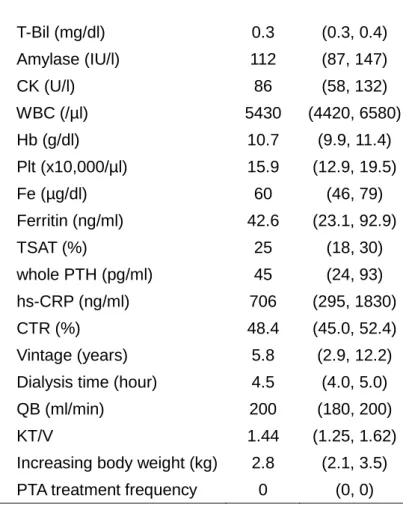
Characteristics of study participants at baseline are shown in Table 1, and Figure 1 3
shows a histogram of circulating ANGPTL2 levels and the corresponding proportion of 4
patients (%) receiving hemodialysis [median, 3.3 ng/ml, interquartile range: (2.5, 4.0)].
5
In the 395 subjects analyzed statistically, the median follow-up time for survival analysis 6
was 2,213 days, and 94 of those 395 patients died. To evaluate a potential association 7
between circulating ANGPTL2 levels and patient mortality risk using survival data, we 8
applied the Cox proportional hazard (PH) model. That analysis revealed a significant 9
association of high circulating ANGPTL2 levels with high mortality risk in patients 10
undergoing hemodialysis after adjustment for age, sex, smoking, diabetes, 11
hypertension, dyslipidemia, body mass index, cancer, hemodialysis vintage, albumin, 12
cardio-thoracic ratio (CTR), and the product of adjusted Ca and inorganic phosphorus 13
levels (Table 2, model 2). As shown in model 3 of the table, that association remained 14
significant following adjustment for hs-CRP values (Table 2). These data suggest that 15
circulating ANGPTL2 levels could serve as a useful biomarker to predict mortality risk in 16
patients receiving maintenance hemodialysis following adjustment for confounding 17
factors.
18
13 1
Establishment of prognostic profiles of hemodialysis patients 2
Next, to define clinical characteristics of patients in which circulating ANGPTL2 levels 3
were strongly associated with mortality risk, we performed stratified analysis using a 4
variable that indicated a patient's prognostic profile. To do so, we generated a synthetic 5
stratum variable indicative of patients' mortality risk by employing 52 variables collected 6
from routine medical assessment (table 1). In generating the stratum, we first performed 7
random forest analysis to rank variables according to strength of association with 8
patient mortality risk. After clinical consideration, we then selected 10 high-ranking risk 9
factors as prognostic indicators (table S1). We then used the survival tree method to 10
place patients into 9 groups, compared hazard ratios among those 9 groups, and then 11
combined them to obtain a parsimonious model termed “Prognostic stage” consisting of 12
4 prognostic strata (figure S2, and table S2). In that analysis, patients were divided into 13
3 groups, a younger group (age≤69), a middle age-elderly group (age 70-80), and the 14
most elderly group (age≥81) (figure S2). In the youngest group, patients with the most 15
benign prognosis were categorized as stage 1, and decreasing levels of circulating 16
creatinine (Cr) (<9.7mg/dl) or uric acid (UA) level (≤7.5mg/dl) were selected as 17
indicators of worsening prognosis (figure S2). Next, patients of the middle-elderly group 18
14
(age 70 to 80) were categorized as prognostic stage 2 or more, and effectors indicative 1
of worsening conditions for these patients included cardiomegaly (CTR>52.4%) or 2
decreased circulating levels of UA (UA ≤6.3 mg/dl) (figure S2). Finally, in the 3
highest-aged group (age≥81), prognostic stages, namely stages 2 and 4. In this group, 4
higher hs-CRP (>992.3 ng/ml) or higher ferritin (>40 ng/ml) levels were significant 5
effectors indicative of worsening mortality (figure S2). Overall, prognostic stages were 6
defined as: Stage 1, patients of age≤69 with Cr≥9.7 and UA>7.5; Stage 2, patients of 7
age≤69 with Cr≥9.7 and UA≤7.5, or patients of age≤69 with Cr<9.7 or patients aged 8
70-80 with CTR<52.4 and UA>6.3, or patients of age≥81 with hs-CRP≤992.3 and 9
ferritin≤40; Stage 3, patients aged 70-80 with either CTR<52.4 and UA≤6.3 or with 10
CTR>52.4; Stage 4, patients of age≥81 with either hs-CRP≤992.3 and ferritin>40 or with 11
hs-CRP>992.3 (figure S2).
12
Kaplan-Meier survival curves for patients at each prognostic stage are shown in figure 13
2. The Cox PH model and corresponding bootstrap replication analysis also revealed 14
that the hazard ratio for patient mortality increased with as prognostic stage advanced 15
(table S3). In addition, circulating ANGPTL2 levels also increased with advanced 16
prognostic stage (figure S3). Taken together, these data suggest that prognostic stages 17
established here are useful as a statistical adjustment to suppress confounding factors 18
15
when evaluating the relationship between circulating ANGPTL2 levels and mortality risk.
1
Thus, we conducted multivariate survival analysis to evaluate that relationship, following 2
adjustment by our prognostic stage.
3
4
Clinical characteristics of patients whose circulating ANGPTL2 levels are strongly 5
associated with mortality risk 6
We next analyzed a potential association between circulating ANGPTL2 levels and 7
mortality at each prognostic stage using the Cox PH model and bootstrap analysis. This 8
analysis revealed that high circulating ANGPTL2 levels are significantly associated with 9
increased risk of mortality for hemodialysis patients in prognostic stages 1, 2, and 3, 10
which are relatively benign prognostic groups, but that association was not significant at 11
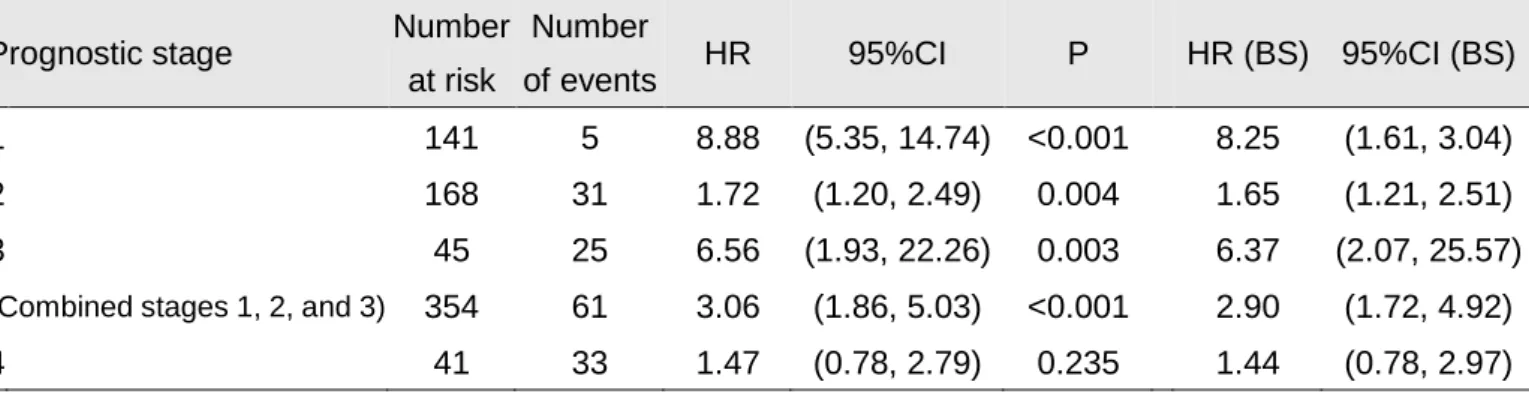
stage 4, the highest risk group (table 3). To simplify clinical interpretation of this analysis, 12
we next evaluated the combined hazard ratio of circulating ANGPTL2 levels for mortality 13
of prognostic stages 1, 2, and 3, but not stage 4. The combined hazard ratio for mortality 14
was also significant (table 3). In addition, residual analysis of this model revealed that 15
ANGPTL2 levels and the hazard ratio for mortality were almost linearly associated 16
(figure S4). By contrast association between circulating ANGPTL2 levels and mortality 17
risk was weaker in stage 4 patients, who had poor prognosis and exhibited advanced 18
16
senescence phenotypes such as older age and increases in circulating hs-CRP or 1
ferritin levels (table 3, figure S2). Next, to determine whether relationships between 2
circulating ANGPTL2 level and mortality risk were affected by senescence-associated 3
clinical factors, we conducted stratification analyses using populations from prognostic 4
stages 1, 2, and 3. These analyses revealed that the association between high 5
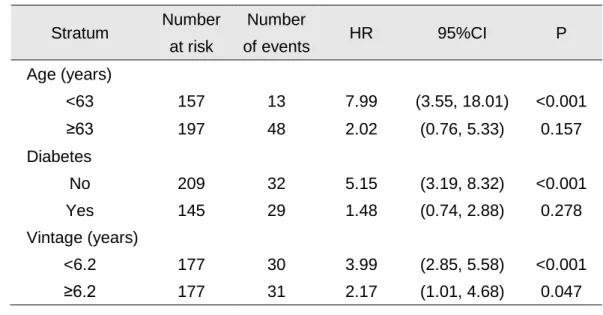
circulating ANGPTL2 levels and increasing of mortality risk was strong, especially in 6
subjects with less-senescent phenotypes such as younger than the median age (<63 7
years old), in the group without diabetes, and in shorter dialysis vintage than the median 8
(<6.2 years) (table 4). In addition, our analysis revealed that these senescence-related 9
parameters (age, complication of diabetes, or longer hemodialysis vintages) are 10
positively correlated with circulating ANGPTL2 levels (table S4).
11
12
17 Discussion
1
2
In the current study, we conducted a prospective cohort study to evaluate whether 3
circulating ANGPTL2 levels are associated with mortality risk of patients receiving 4
hemodialysis treatment. We first demonstrated that high circulating ANGPTL2 levels are 5
a significant risk for mortality. Next, exploratory stratified analysis revealed that high 6
circulating ANGPTL2 levels are associated with high mortality risk, in particular in 7
patients with relative benign prognosis and fewer senescence phenotypes. Ours is the 8
first report indicating that circulating ANGPTL2 levels can predict clinically important 9
outcomes in the uremic population.
10
11
Circulating ANGPTL2 levels and mortality in patients undergoing hemodialysis 12
Multivariate survival analysis reported here revealed that the relationship between 13
high circulating ANGPTL2 levels and increasing mortality risk was significant after 14
adjustment for age, sex, hemodialysis vintage, nutrition status, or metabolic parameters, 15
such as complications of diabetes, dyslipidemia or hypertension. Moreover, this 16
relationship remained significant after further adjustment for hs-CRP-related 17
inflammatory status. Previously, our group reported that excess ANGPTL2 secretion 18
18
promotes progression of senescence-related disease such as metabolic syndrome, 1
sarcopenia, cancer, chronic kidney disease or atherosclerosis in animal models or in 2
vitro [11-16, 21]. In the progression of aging-related disease, ANGPTL2 potently 3
accelerates senescence phenotypes through activation of reactive oxygen species or 4
signaling through transforming growth factor β or nuclear factor-kappa B [9, 12, 13, 5
16]. These reports are in agreement with our current data from patients in the uremic 6
population who exhibit phenotypes of accelerated premature aging relative to healthy 7
individuals. Our analysis suggests that circulating ANGPTL2 levels reflect progression 8
of premature aging in uremic individuals.
9
Interestingly, our analysis revealed significant relationships between high circulating 10
ANGPTL2 levels and increased mortality risk in patients with a relatively benign 11
prognostic profile (stages 1, 2, and 3), unlike the case in the elderly or the highest 12
mortality group (stage 4). Accordingly, our exploratory analysis revealed that this 13
association remained in the population showing less senescent phenotypes among 14
younger people or individuals without diabetes or of shorter hemodialysis vintage.
15
Evaluating mortality risk is difficult in hemodialysis patients, particularly in individuals 16
who do not exhibit poor prognostic/senescent indicators, such as aging, accelerated 17
inflammation, excess intracorporeal iron, long hemodialysis vintage, or diabetes 18
19
complications [22, 23]. Although both ANGPTL2 and CRP are inflammatory markers, 1
calculation of Spearman’s correlation coefficient between circulating ANGPTL2 levels 2
and those of hs-CRP at baseline indicated a significant but not strong positive 3
correlation (correlation coefficient: 0.27, P<0.001). Furthermore, our finding that a 4
significant association of high circulating ANGPTL2 levels with high mortality risk in 5
patients undergoing hemodialysis after adjustment for confounding factors including 6
hs-CRP values supports the idea that circulating ANGPTL2 levels are unique and could 7
serve as a useful biomarker of mortality risk not detected by CRP analysis. However, we 8
note that in the oldest patients with advanced aging phenotypes related to diabetes or 9
prolonged hemodialysis, circulating ANGPTL2 levels do not predict mortality risk for 10
reasons currently unknown and which require further investigation.
11
Next, based on our preliminary analysis, circulating ANGPTL2 levels in uremic 12
patients analyzed here were higher than those in the general population of the 13
Hisayama study based on multivariate analysis and adjusted by age and gender [17, 14
18]. Further investigations using the same assay conditions in one cohort are needed to 15
determine whether ANGPTL2 levels in uremic populations are increased relative to 16
healthy subjects 17
18
20
Prognostic staging of patients receiving hemodialysis 1
Survival tree analysis (figure S2) revealed that decreased levels of Cr (<9.7mg/dl at 2
ages ≤69) or UA (≤7.5mg/dl at ages ≤69, and ≤6.3mg/dl at ages 70-80) were indicators 3
of poor prognosis. Others have reported that high circulating Cr levels are associated 4
with lowered risk of mortality in hemodialysis patients [22, 24, 25]. Circulating Cr levels 5
reportedly reflect changes in muscle mass altered by imbalanced anabolic/catabolic 6
metabolism in uremic individuals[25]. In addition, others report that high circulating UA 7
levels are associated with lowered risk for mortality in hemodialysis patients and that 8
those levels may reflect patient nutritional status [26-28]. Moreover, UA reportedly 9
antagonizes adverse effects of uremic toxins such as indoxyl sulfate through antioxidant 10
activity or by enhancing nitric oxide bioavailability in vascular endothelial cells [26, 29].
11
These reports are in agreement with our data, which indicates that decreased 12
circulating Cr or UA levels are associated with higher all-cause mortality in hemodialysis 13
patients. Next, survival tree analysis (figure S2), also revealed that increased CTR 14
(>52.4% at ages 70-80) as an indicator of poor prognosis. Our current findings are 15
supported by a previous report indicating that cardiomegaly accelerates patient 16
mortality risk in uremic population [30, 31]. Finally, higher hs-CRP levels (>992.3 ng/ml 17
at ages ≥81) or higher ferritin levels (>40 ng/ml at ages ≥81) were significant effectors 18
21
indicative of increased mortality risk, findings that coincided with previous reports 1
showing that circulating CRP or ferritin levels were significantly associated with 2
increased risk of mortality in uremic patients [23, 32, 33]. In the highest aged group 3
(≥81), patients may be less tolerant of inflammatory stress due to either uremia or 4
infection or to the presence of excess intracorporeal iron due to decreased iron 5
bioavailability or excess iron loading.
6
Taken together, our prognostic staging of the uremic population indicates that 7
prognostic risk factors differ across age groups, an outcome important to recognize 8
when assessing mortality risk.
9
10
One limitation of our study is that we did not evaluate whether circulating ANGPTL2 11
levels predict cause-specific death, such as cardiovascular or cancer death, or death 12
from infection. Moreover, we collected clinical data and assayed ANGPTL2 levels at 13
baseline and did not evaluate an association between time-dependent changes in 14
ANGPTL2 level and clinical outcomes. Further clinical cohort studies using larger 15
sample sizes may be needed to assess uremic hemodialysis patients.
16
In summary, we demonstrate that circulating levels of the senescence-associated 17
factor ANGPTL2 are significantly associated with mortality risk in patients receiving 18
22
hemodialysis who have a relatively benign prognostic profile. We conclude that 1
ANGPTL2 could serve as a biomarker for progression of premature aging in the uremic 2
population in all but the most advanced senescent phenotypes.
3
4
23 Disclosure
1
None.
2
3
4
Acknowledgements 5
The authors thank Ms. N. Nakagawa, Ms. K. Saito, Ms. N. Hirano, Ms., and H.
6
Shibuta for technical assistance. The authors also thank Rika Yamazoe, M.D. for 7
supporting data collection. This work was supported by JSPS KAKENHI Grant Number 8
17K09703 (to Jun Morinaga.) and 17K09706 (to Masashi Mukoyama).
9 10
24 Supplementary information
1
2
Table S1. Ten of the highest-ranking valuables selected by the random forest methods 3
for all-cause mortality in patients receiving maintenance hemodialysis.
4
5
Table S2. Hazard ratios (HR) for mortality of 9 groups of subjects based on survival tree 6
analysis.
7
8
Table S3. Hazard ratio for mortality in each prognostic stage.
9
10
Figure S1. Recruitment and follow-up flow diagram.
11
12
Figure S2. Determination of prognostic stage of patients undergoing hemodialysis.
13
Numbers in squares indicate groups derived from survival tree analysis (1 to 9), and 14
square colors indicate prognostic stage grades.
15
16
Figure S3. Association between prognostic stages and circulating ANGPTL2 levels 17
(n=395).
18
25 1
Figure S4. Martingale residual of combined survival analysis in the population including 2
prognostic stages 1, 2, and 3 (n=354). Dark blue dots, martingale residuals. Red line, 3
lowess smoothing of martingale residuals.
4
5
Supplementary methods 6
Clinical evaluation and laboratory testing 7
8
9
10
Supplementary information is available at Nephrology Dialysis Transplantation's 11
website.
12
13
26 References
1
2
1. Bethesda. Aannual data report: Epidemiology of kidney disease in the United States.
3
United States Renal Data System. https://www.usrds.org/. https://www.usrds.org/.
4
2. Okada H. Evidence-based Clinical Practice Guideline for CKD 5
https://cdn.jsn.or.jp/data/CKD2018.pdf. https://cdn.jsn.or.jp/data/CKD2018.pdf.
6
3. Masakane I. Annual Dialysis Data Report, JSDT Renal Data Registry.
7
https://docs.jsdt.or.jp/overview/. https://docs.jsdt.or.jp/overview/pdf2017/i.pdf.
8
4. Canaud B, Tong L, Tentori F, et al. Clinical practices and outcomes in elderly 9
hemodialysis patients: results from the Dialysis Outcomes and Practice Patterns Study (DOPPS).
10
Clin J Am Soc Nephrol 2011;6(7):1651-1662 11
5. Kooman JP, Broers NJ, Usvyat L, et al. Out of control: accelerated aging in uremia.
12
Nephrol Dial Transplant 2013;28(1):48-54 13
6. Kooman JP, Dekker MJ, Usvyat LA, et al. Inflammation and premature aging in 14
advanced chronic kidney disease. Am J Physiol Renal Physiol 2017;313(4):F938-F950 15
7. Kooman JP, Kotanko P, Schols AM, et al. Chronic kidney disease and premature 16
ageing. Nat Rev Nephrol 2014;10(12):732-742 17
8. Wang WJ, Cai GY, Chen XM. Cellular senescence, senescence-associated secretory 18
phenotype, and chronic kidney disease. Oncotarget 2017;8(38):64520-64533 19
9. Kadomatsu T, Endo M, Miyata K, et al. Diverse roles of ANGPTL2 in physiology and 20
pathophysiology. Trends Endocrinol Metab 2014;25(5):245-254 21
10. Oike Y, Tian Z, Miyata K, et al. ANGPTL2- A New Causal Player in Accelerating Heart 22
Disease Development in the Aging. Circ J 2017;81(10):1379-1385 23
11. Tabata M, Kadomatsu T, Fukuhara S, et al. Angiopoietin-like protein 2 promotes 24
chronic adipose tissue inflammation and obesity-related systemic insulin resistance. Cell Metab 25
2009;10(3):178-188 26
12. Zhao J, Tian Z, Kadomatsu T, et al. Age-dependent increase in angiopoietin-like 27
protein 2 accelerates skeletal muscle loss in mice. J Biol Chem 2018;293(5):1596-1609 28
13. Aoi J, Endo M, Kadomatsu T, et al. Angiopoietin-like protein 2 accelerates 29
carcinogenesis by activating chronic inflammation and oxidative stress. Mol Cancer Res 30
2014;12(2):239-249 31
14. Endo M, Nakano M, Kadomatsu T, et al. Tumor cell-derived angiopoietin-like protein 32
ANGPTL2 is a critical driver of metastasis. Cancer Res 2012;72(7):1784-1794 33
15. Horio E, Kadomatsu T, Miyata K, et al. Role of endothelial cell-derived angptl2 in 34
27
vascular inflammation leading to endothelial dysfunction and atherosclerosis progression.
1
Arterioscler Thromb Vasc Biol 2014;34(4):790-800 2
16. Morinaga J, Kadomatsu T, Miyata K, et al. Angiopoietin-like protein 2 increases renal 3
fibrosis by accelerating transforming growth factor-beta signaling in chronic kidney disease.
4
Kidney Int 2016;89(2):327-341 5
17. Doi Y, Ninomiya T, Hirakawa Y, et al. Angiopoietin-like protein 2 and risk of type 2 6
diabetes in a general Japanese population: the Hisayama study. Diabetes Care 7
2013;36(1):98-100 8
18. Hata J, Mukai N, Nagata M, et al. Serum Angiopoietin-Like Protein 2 Is a Novel Risk 9
Factor for Cardiovascular Disease in the Community: The Hisayama Study. Arterioscler Thromb 10
Vasc Biol 2016;36(8):1686-1691 11
19. Putten Wv. CART: Stata module to perform Classification And Regression Tree 12
analysis (https://ideas.repec.org/c/boc/bocode/s456776.html).
13
https://ideas.repec.org/c/boc/bocode/s456776.html.
14
20. Thall PF, Lachin JM. Assessment of stratum-covariate interactions in Cox's proportional 15
hazards regression model. Stat Med 1986;5(1):73-83 16
21. Tazume H, Miyata K, Tian Z, et al. Macrophage-derived angiopoietin-like protein 2 17
accelerates development of abdominal aortic aneurysm. Arterioscler Thromb Vasc Biol 18
2012;32(6):1400-1409 19
22. Floege J, Gillespie IA, Kronenberg F, et al. Development and validation of a predictive 20
mortality risk score from a European hemodialysis cohort. Kidney Int 2015;87(5):996-1008 21
23. Maruyama Y, Yokoyama K, Yokoo T, et al. The Different Association between Serum 22
Ferritin and Mortality in Hemodialysis and Peritoneal Dialysis Patients Using Japanese 23
Nationwide Dialysis Registry. PLoS One 2015;10(11):e0143430 24
24. Arase H, Yamada S, Yotsueda R, et al. Modified creatinine index and risk for 25
cardiovascular events and all-cause mortality in patients undergoing hemodialysis: The 26
Q-Cohort study. Atherosclerosis 2018;275:115-123 27
25. Terrier N, Jaussent I, Dupuy AM, et al. Creatinine index and transthyretin as additive 28
predictors of mortality in haemodialysis patients. Nephrol Dial Transplant 2008;23(1):345-353 29
26. Hsu WL, Li SY, Liu JS, et al. High Uric Acid Ameliorates Indoxyl Sulfate-Induced 30
Endothelial Dysfunction and Is Associated with Lower Mortality among Hemodialysis Patients.
31
Toxins (Basel) 2017;9(1) 32
27. Bae E, Cho HJ, Shin N, et al. Lower serum uric acid level predicts mortality in dialysis 33
patients. Medicine (Baltimore) 2016;95(24):e3701 34
28. Park C, Obi Y, Streja E, et al. Serum uric acid, protein intake and mortality in 35
hemodialysis patients. Nephrol Dial Transplant 2017;32(10):1750-1757 36
28
29. Latif W, Karaboyas A, Tong L, et al. Uric acid levels and all-cause and cardiovascular 1
mortality in the hemodialysis population. Clin J Am Soc Nephrol 2011;6(10):2470-2477 2
30. Yen TH, Lin JL, Lin-Tan DT, et al. Cardiothoracic ratio, inflammation, malnutrition, and 3
mortality in diabetes patients on maintenance hemodialysis. Am J Med Sci 2009;337(6):421-428 4
31. Ito K, Ookawara S, Ueda Y, et al. A Higher Cardiothoracic Ratio Is Associated with 5
2-Year Mortality after Hemodialysis Initiation. Nephron Extra 2015;5(3):100-110 6
32. Karaboyas A, Morgenstern H, Pisoni RL, et al. Association between serum ferritin and 7
mortality: findings from the USA, Japan and European Dialysis Outcomes and Practice Patterns 8
Study. Nephrol Dial Transplant 2018;33(12):2234-2244 9
33. Yeun JY, Levine RA, Mantadilok V, et al. C-Reactive protein predicts all-cause and 10
cardiovascular mortality in hemodialysis patients. Am J Kidney Dis 2000;35(3):469-476 11
12 13
29
Variable categories Number Percentage
Male gender 250 63.3
Current smoking 66 16.7
Obesity 57 14.4
Hypertension 325 82.3
Diabetes 162 41
Dyslipidemia 205 51.9
Cancer 32 8.1
Rheumatoid arthritis 5 1.3
PAD 85 21.5
Stroke 65 16.5
Statin 82 20.8
RAS inhibitor 211 53.4
Continuous variables Median IQR
Age (years) 65 (58, 74)
BMI (kg·m-2) 21.17 (19.2, 23.6) systolic BP (mmHg) 148 (134, 161) diastolic BP (mmHg) 77 (67, 87) Total protein (g/dl) 6.6 (6.3, 7.0)
Albumin(g/dl) 3.8 (3.6, 4.0)
BUN (mg/dl) 60.7 (52.3, 71.3) Creatinine (mg/dl) 11.09 (9.2, 12.5) Uric acid (mg/dl) 7.8 (6.9, 8.7)
T-Cho (mg/dl) 151 (131, 172)
HDL-Cho (mg/dl) 45 (37, 57)
LDL-Cho (mg/dl) 78 (63, 94)
Triglyceride (mg/dl) 84 (59, 126)
aCa (mg/dl) 9.4 (8.9, 9.9)
IP (mg/dl) 5.3 (4.6, 6.2)
Ca x P (mg·dl-1)2 48.5 (42.2, 57.0)
Mg (mg/dl) 2.7 (2.5, 2.9)
AST (U/l) 13 (9, 17)
ALT (U/l) 10.0 (7, 13)
LDH (IU/l) 182 (163, 212)
GGT (IU/l) 19 (13, 28)
ALP (IU/l) 216 (171, 279)
30
T-Bil (mg/dl) 0.3 (0.3, 0.4)
Amylase (IU/l) 112 (87, 147)
CK (U/l) 86 (58, 132)
WBC (/µl) 5430 (4420, 6580)
Hb (g/dl) 10.7 (9.9, 11.4)
Plt (x10,000/µl) 15.9 (12.9, 19.5)
Fe (µg/dl) 60 (46, 79)
Ferritin (ng/ml) 42.6 (23.1, 92.9)
TSAT (%) 25 (18, 30)
whole PTH (pg/ml) 45 (24, 93) hs-CRP (ng/ml) 706 (295, 1830)
CTR (%) 48.4 (45.0, 52.4)
Vintage (years) 5.8 (2.9, 12.2) Dialysis time (hour) 4.5 (4.0, 5.0)
QB (ml/min) 200 (180, 200)
KT/V 1.44 (1.25, 1.62)
Increasing body weight (kg) 2.8 (2.1, 3.5) PTA treatment frequency 0 (0, 0) 1
Table 1. Patient characteristics at baseline (n=395); PAD, peripheral artery disease;
2
RAS inhibitor, renin angiotensin system inhibitor. IQR, inter quartile range; BMI, body 3
mass index; BP, blood pressure; BUN, blood urea nitrogen; T-Cho, total cholesterol;
4
HDL-Cho, high density lipoprotein cholesterol; LDL-Cho, low density lipoprotein 5
cholesterol; aCa, adjusted calcium; IP, inorganic phosphorus; Mg, magnesium; AST, 6
aspartate aminotransferase; ALT, alanine transaminase; LDH, lactate dehydrogenase;
7
GGT, γ-glutamyltransferase; ALP, alkaline phosphatase; T-Bil, total bilirubin; CK, 8
creatine kinase; WBC, white blood cell; Hb, hemoglogin; Plt, platelets; Fe, iron; TSAT, 9
31
transferrin saturation; Whole-PTH, whole parathyroid hormone, Ca x P, the product of 1
aCa and IP; Hs-CRP, high sensitivity C-reactive protein; CTR, cardio-thoracic ratio; QB, 2
quantity of blood flow; KT/V, dialysis dose; PTA, percutaneous transluminal angioplasty.
3
4
32
Model HR 95% CI P
1 2.83 (1.54, 5.19) 0.001 2 2.32 (1.43, 3.75) 0.001 3 2.04 (1.10, 3.77) 0.023 1
Table 2. Circulating ANGPTL2 levels and mortality risk in hemodialysis patients (n=395).
2
Hazard ratio of log(ANGPTLT2) for mortality, 95% CI, and P value are indicated. Model 3
1: Crude. Model 2: multivariate Cox proportional hazard model adjusted by age, sex, 4
smoking habit, diabetes, hypertension, dyslipidemia, BMI, cancer, hemodialysis vintage, 5
albumin, CTR, Ca x P and medical facility location. Model 3: model 2 plus hs-CRP.
6
Hs-CRP and ANGPTL2 were transformed to natural-log values. HR, Hazard ratio; 95%
7
CI, 95 percent confidence interval; P, probability; BMI, body mass index; CTR, 8
cardio-thoracic ratio; Ca x P, a product of aCa and IP. hs-CRP, high sensitivity C-reactive 9
protein; ANGPTL2, Angiopoietin-like protein 2.
10
11
33 Prognostic stage Number
at risk
Number
of events HR 95%CI P HR (BS) 95%CI (BS)
1 141 5 8.88 (5.35, 14.74) <0.001 8.25 (1.61, 3.04)
2 168 31 1.72 (1.20, 2.49) 0.004 1.65 (1.21, 2.51)
3 45 25 6.56 (1.93, 22.26) 0.003 6.37 (2.07, 25.57)
(Combined stages 1, 2, and 3) 354 61 3.06 (1.86, 5.03) <0.001 2.90 (1.72, 4.92)
4 41 33 1.47 (0.78, 2.79) 0.235 1.44 (0.78, 2.97)
1
Table 3. Relationship between circulating ANGPTL2 levels and hazard ratio for mortality 2
at each prognostic stage of hemodialysis patients. The Cox proportional hazard model 3
was used and adjusted by prognostic stage and medical facility location.
4
(n=395). Combined analysis of stages 1, 2, and 3 were adjusted for prognostic stages 5
and medical facility location (n=354). HR, hazard ratio; 95% CI, 95 percent confidence 6
interval; P, probability; HR (BS), average HR estimated by bootstrap replication; 95%CI 7
(BS), 95%CI estimated by bootstrap replication.
8
9
34 Stratum Number
at risk
Number
of events HR 95%CI P
Age (years)
<63 157 13 7.99 (3.55, 18.01) <0.001
≥63 197 48 2.02 (0.76, 5.33) 0.157
Diabetes
No 209 32 5.15 (3.19, 8.32) <0.001
Yes 145 29 1.48 (0.74, 2.88) 0.278
Vintage (years)
<6.2 177 30 3.99 (2.85, 5.58) <0.001
≥6.2 177 31 2.17 (1.01, 4.68) 0.047
1
Table 4. Relationship between circulating ANGPTL2 levels and hazard ratio for mortality 2
in each senescence-related category in patients receiving hemodialysis. Patients at 3
stages 1, 2 and 3 were analyzed (n=354). The Cox proportional hazard model was used 4
and adjusted by prognostic stage and medical facility location. ANGPTL2 levels were 5
transformed to natural-log values. HR, Hazard ratio; 95% CI, 95 percent confidence 6
interval; P, probability.
7
8
35 Figure Legends
1
2
Figure 1. Histogram showing circulating ANGPTL2 levels and the corresponding 3
proportion of patients (%) receiving hemodialysis. Median, 3.3ng/ml; interquartile range, 4
(2.5, 4.0).
5
6
Figure 2. Kaplan-Meier survival curve of patients receiving hemodialysis at each 7
prognostic stage. Table below graph indicates the number of patients at risk in each 8
prognostic stage. Blue line, stage 1; green line, stage 2; yellow line, stage 3; and red 9
line, stage 4.
10 11