名古屋工業大学学術機関リポジトリ Nagoya Institute of Technology Repository
Theoretical study of real‑gas effects on shock wave phenomena
著者(英) Shigeru Taniguchi
学位名 博士(工学)
学位授与番号 13903甲第794号 学位授与年月日 2011‑03‑23
URL http://id.nii.ac.jp/1476/00002972/
Theoretical study of real-gas effects on shock wave phenomena
2011
Shigeru TANIGUCHI
Nagoya Institute of Technology
Theoretical study of real-gas effects on shock wave phenomena
(
衝撃波現象における実在気体効果に関する理論的研究)
A dissertation for the Doctor Degree of Engineering Submitted To
Department of Scientific and Engineering Simulation, Nagoya Institute of Technology,
Japan Written By
Shigeru TANIGUCHI
2011
Supervised By Professor
Masaru SUGIYAMA
Abstract
Compared to shock waves in rarefied gases, shock waves in condensed matters, namely, dense gases, liquids and solids, have not been fully understood. In order to construct the basic theoretical framework of shock wave phenomena in condensed matters, we propose the following strategy with two steps:
(i) We study shock wave phenomena in a hard-sphere system which is a good reference system of materials in liquid state.
(ii) By using all the results obtained in step (i) and by using the perturba- tion method developed in the theory of liquid-state physics, we study shock wave phenomena in physical systems with more realistic interatomic potential with both repulsive and attractive parts.
Shock wave phenomena are theoretically and numerically studied on the basis of the system of Euler equations with the caloric and thermal equations of state for sev- eral models of condensed matters. First Rankine-Hugoniot conditions are analyzed.
The quantitative classification of Hugoniot types in terms of the thermodynamic quantities of the unperturbed state (the state before a shock wave) and the degrees of freedom is made. Second the admissibility (stability) of shock waves is studied by means of the results obtained by T.-P. Liu in the theory of hyperbolic systems.
Last numerical calculations have been performed in order to confirm the theoretical results in the case of admissible shocks and to obtain the actual evolution of the wave profiles in the case of inadmissible shocks.
The organization of this thesis is summarized as follows:
In Chap. 1, The purpose of the present study and the applications of shock wave phenomena are summarized. It is pointed out there exist shock wave phenomena which can not be explained even qualitatively within the well-known framework of the ideal-gas model. The effects inducing such differences are called as the real-gas effects on shock wave phenomena. The typical phenomena due to the real-gas ef- fects are shock-induced phase transitions, shock splitting phenomena and rarefaction (negative) shock waves.
In Chap. 2, Shock waves in a polytropic hard-sphere system with and without internal degrees of freedom are investigated. The important role of the internal degrees of freedom for shock-induced phase transition from the liquid to the solid phase (Alder transition) is made clear. It is shown that another type of instability of a shock wave can exist even though the perturbed state is thermodynamically stable.
In Chap. 3, we predict and simulate a new type of compressive shock wave in a real gas. For simplicity, we adopt a real gas modeled the van der Waals constitutive equation which can be regarded as a simplified model of a system of hard-spheres with attractive force. This shock produces a phase transition from the gas to the liquid phase and, under some special circumstances, back to the gas phase. This shock has the following quite unusual property: When the perturbed pressure (the pressure after a shock) increases, the perturbed density decreases and tends to a limit value from above, in contrast with the ordinary compressive shock in which the density tends to the limit value from below.
In Chap. 4, shock waves in a system of hard-spheres with attractive force are analyzed. By using this model, we can analyze shock wave phenomena in the three phases, namely, gas, liquid and solid phases within a unified way. It is confirmed that the analysis based on this model can explain both the results obtained in a hard-sphere system and in a van der Waals fluid. Two possible scenarios of shock- induced phase transition from the gas to the solid phase have been presented and the condition of such phase transition is made clear.
In Chap. 5, by adopting a simplified model of a non-polytropic hard-sphere system where heat capacity depends on the temperature, we demonstrate the im- portance of non-polytropic effect on the shock wave phenomena. We show explicitly that with the increase of the shock strength the perturbed temperature (the tem- perature after a shock) increases and the vibrational modes are gradually excited, and as a result, shock-induced phase transitions and the admissibility of shock wave are qualitatively and quantitatively different from the phase transitions observed in a simple polytropic model.
In Chap. 6, general summary of the present study and concluding remarks are made.
Contents
1 Introduction 1
1.1 Background of the present study . . . . 1
1.1.1 Applications of shock wave study . . . . 2
1.1.2 Study of Shock waves in condensed matters . . . . 3
1.2 Theory of shock wave phenomena . . . . 4
1.2.1 The system of Euler equations . . . . 5
1.2.2 The Rankine-Hugoniot conditions . . . . 5
1.2.3 Admissibility of shock waves . . . . 8
1.3 Shock wave phenomena in an ideal gas . . . . 9
1.4 Typical real-gas effects on shock wave phenomena . . . 14
1.4.1 Shock-induced phase transition . . . 14
1.4.2 Rarefaction (negative) shock waves . . . 14
1.4.3 Shock splitting phenomena . . . 15
1.5 Theoretical studies of shock wave phenomena in two models of con- densed matters . . . 16
1.5.1 Shock wave phenomena in a hard-sphere system . . . 16
1.5.2 Shock wave phenomena in a van der Waals fluid . . . 18
1.6 Purpose and organization of this thesis . . . 18
2 Shock waves in polytropic hard-sphere systems with and without internal degrees of freedom 22 2.1 Introduction . . . 22
2.2 Basic equations . . . 23
2.2.1 Caloric and thermal equations of state . . . 24
2.2.2 The system of Euler equations . . . 26
2.3 The Rankine-Hugoniot conditions . . . 26
2.3.1 Liquid-liquid and liquid-solid RH conditions . . . 27
2.3.2 Liquid-coexistence Rankine-Hugoniot conditions . . . 28
2.3.3 Two possibilities of shock-induced phase transitions . . . 29
2.3.4 Characteristic quantities . . . 31
2.4 Admissibility of shock waves . . . 33
2.5 Classification of shock-induced liquid/solid phase transitions . . . 36
2.6 Numerical analysis . . . 43
2.7 Summary and concluding remarks . . . 47
3 A new type of shock in real gases: a compressive upper shock 49 3.1 Introduction . . . 49
3.2 The van der Waals model and the Rankine-Hugoniot conditions . . . 50
3.3 Compressive upper/lower shocks . . . 52
3.4 Admissibility of shock waves . . . 54
3.5 Numerical analysis . . . 54
3.6 Summary and concluding remarks . . . 58
4 Shock waves in a polytropic hard-sphere system with attractive force 59 4.1 Introduction . . . 59
4.2 The system of hard spheres with attractive force . . . 60
4.2.1 Caloric and thermal equation of state . . . 60
4.2.2 Critical point and the law of corresponding states . . . 60
4.2.3 Coexistence conditions and phase diagram . . . 61
4.3 The system of Euler equations and the Rankine-Hugoniot conditions . 65 4.3.1 The system of Euler equations . . . 65
4.3.2 Local exceptionality condition . . . 65
4.4 The Rankine-Hugoniot conditions . . . 66
4.4.1 Rankine-Hugoniot conditions in the case that both unper- turbed and perturbed state are not coexistence state . . . 67
4.4.2 Rankine-Hugoniot conditions in the case that only perturbed state are coexistence state . . . 68
4.5 Shock-induced phase transitions . . . 69
4.5.1 Gas → Liquid phase transition . . . 69
4.5.2 Liquid→ solid phase transition . . . 72
4.5.3 Gas → solid phase transition . . . 73
4.5.4 Gas → liquid → solid phase transition . . . 77 4.6 Summary and concluding remarks . . . 77 5 Shock waves in a non-polytropic hard-sphere system 80 5.1 Introduction . . . 80 5.2 Non-polytropic hard-sphere system and Rankine-Hugoniot conditions 81 5.3 Shock-induced phase transitions . . . 83 5.3.1 Crossover effect on the shock-induced phase transitions . . . . 84 5.3.2 Mach number at the shock-induced phase transition . . . 85 5.4 Admissibility of shock waves . . . 86 5.5 Conclusions . . . 88
6 Summary and concluding remarks 89
Acknowledgement 92
References 93
List of Papers 99
Other Publications 100
NOTATIONS
t: time x: position ρ: mass density
m: mass of a constituent particle V: volume
V: specific volume η: packing fraction v: velocity
p: pressure T: temperature
e: specific internal energy s: specific entropy
h: specific enthalpy c: sound velocity
Us: velocity of a shock wave
cv: specific heat capacity at constant volume λ: characteristic velocity
D: degrees of freedom
f: internal degrees of freedom kB: Boltzmann constant
u: density of conservative quantities F: flux of conservative quantities
Chapter 1
Introduction
1.1 Background of the present study
Shock waves, which are characterized by the steep and rapid changes of physical quantities such as mass density, velocity, temperature, pressure at a shock front, are typical nonlinear waves that have been studied from many aspects experimentally, theoretically and numerically [1–3]. Concerning the theoretical studies, for example, the rapid change of physical quantities at a shock front has been studied based on the theories of non-equilibrium thermodynamics and statistical physics [4–6] and also their nonlinear properties have been investigated based on the theories of nonlinear wave propagation [7, 8].
The motivation to study shock waves comes from not only the interest in such properties but also the fact that shock wave phenomena can be observed in wide area. The examples of shock waves in nature and the man-made shock waves can be summarized as follows.
Examples of shock waves in nature
The most familiar shock wave phenomenon is a thunder after the lightening. Shock waves are also related to Earthquakes and volcanic eruptions. Shock waves are much frequently generated in cosmic space. For example, meteoroids entering in the atmosphere around the earth generate shock waves. The flow of ionized gas particles emitted from the sun’s corona (so-called solar wind) can be accelerated by the magnetic field of the earth and be developed to be a bow shock.
CHAPTER 1. INTRODUCTION
Examples of man-made shock waves
The typical example of man-made shock waves is a detonation of explosive materials.
The other typical example is the complex shock wave structure observed around a supersonic passenger plane. Shock waves can also be observed during the atmosphere entry of a space shuttle. The strength of man-made shock waves have large variety from weak shocks generated by firearms, to very strong shock generated nuclear explosions.
1.1.1 Applications of shock wave study
There are many applications of shock wave studies in engineering, physical and chemical fields. We here summarize typical examples of the applications of shock wave phenomena briefly.
Supersonic airplane
As mentioned above, the complex shock structure can be observed around a super- sonic airplane. The shock wave study becomes important when we design the shape of the supersonic airplane because efficiency of the flight and noise due to such waves strongly depend on the property of shock waves generated by the airplane.
Detonation
The detonation wave is a supersonic wave phenomena accompanying chemical reac- tions with the rapid change of pressure and temperature after the shock front. The studies have been concentrated on the technique to avoid detonation phenomena for the safety because such kind of rapid increasing of the physical quantities may be dangerous. Recently detonation phenomena can be used positively, for example, in pulse detonation engines and also pulse detonation rocket.
Calculus fragmentation, Shock focusing
Shock waves are also used for the fragmentation of the calculus in the human body.
The technique, which make us to destroy the calculus without any surgeries, are well established. In such cases the technique of focusing of a shock wave using convex lens plays an essential role in order to avoid to injure any organs except the calculus and therefore the detailed study of shock wave propagation becomes very important.
CHAPTER 1. INTRODUCTION
Space science
The basic researches of shock wave phenomena are also important for the space engineering and space science. As we mentioned in above examples, the body of space shuttle involves shock waves during the atmosphere entry and therefore the detailed study of flows around the body is important to design the shape of a space shuttle. Moreover, there exists an important problem of serious damage of the frames of space shuttles or space satellite due to space debris, that is the garbage or dust moving at high velocities in the cosmic space. The response to the impact of space debris are important in order to prepare the safe frame of space shuttles.
Land-mine removal
The response to shock waves generated by the explosive materials is also important especially in the field of engineering. The land-mine removal is quite important, however, is dangerous due to the risk of accidents. In order to remove land mines much more safely, the shape of the machine for the land-mine removal and the quality of materials should be designed carefully. The studies of shock wave phenomena can provide the basic knowledge of such kind of applications.
1.1.2 Study of Shock waves in condensed matters
As is seen from the above examples and applications, the studies of shock wave phe- nomena in condensed matters, namely, dense gases, liquids and solids are necessary.
In recent years, shock wave phenomena in condensed matters have also attracted much interest of researchers in various fields. See, for example, the review paper [9]
and books [10–18] and references cited therein. However, Compared to shock waves in rarefied gases, shock waves in condensed matters have not been fully studied until now.
Many studies of shock waves in condensed matters have been done mainly from the experimentally and numerically. Some theoretical studies were also made by us- ing the models with realistic interatomic potentials. However, most of the previous works are based on more or less qualitative models. An unified framework of theo- retical studies is highly required in order to understand shock wave phenomena in condensed matters deeply. Such kind of theoretical framework can be essentially im- portant for the development of shock wave study as the theoretical study played an essential role at the early stage of the development of shock wave studies. Jouguet
CHAPTER 1. INTRODUCTION
wrote the usefulness of the theoretical predictions of shock waves as follows [19]:
”The shock wave represents a phenomenon of rare peculiar such that it has been uncovered by the pen of mathematicians, first by Riemann, then by Hugoniot. The experiments followed not until afterwards. ”
In this thesis we will propose the basic theoretical framework to analyze shock wave phenomena in condensed matters. Based on that framework, we will investigate the shock wave phenomena which can not be explained even qualitatively within the well-known framework of the ideal gas model.
1.2 Theory of shock wave phenomena
In this section, we will discuss the basis of the present theoretical studies. In order to make the physical implications of our analysis clear, here we summarize the typical theoretical studies briefly [20].
The first-order approximation of shock wave phenomena is the analysis based on the Euler fluids in which the dissipative effects, namely, viscosity and heat conduc- tion are neglected. The solution of a shock wave in Euler fluids can be obtained as a weak solution which represents the jump of physical quantities before and after a shock front without any shock structures. The relation between the propagation speed and the jump of physical quantities before and after a shock front is the cen- tral problem within this approximation. The compatibility conditions of the jump of physical quantities can be derived from the conservation laws of mass, momentum and energy. These conditions are well known as the Rankine-Hugoniot conditions.
In the higher-order approximation of shock wave phenomena, the shock structure, that is the wave profile in terms of the time and the position, is one of the interesting problem in the field of the non-equilibrium thermodynamics and statistical physics.
Because physical quantities change rapidly with steep gradient at a shock front, many information about highly non-equilibrium phenomena can be obtained through the analysis of shock structure. In order to make the validity range of several theories clear, the studies of shock structures have been done theoretically [22–33], experimentally [34–37] and numerically [38–42]. From these studies, it is shown that the theoretical prediction by the well-known Navier-Stokes and Fourier theory is not valid for strong shock waves (or large Knudsen number) and therefore the results imply that we need other theories which have larger validity range.
The dimensionality dependence is also one of the important problems. Pla-
CHAPTER 1. INTRODUCTION
nar shock waves can be analyzed easily and can be generated by the shock tubes, however, spherical or cylindrical shock waves are more frequently observed for the applications of shock waves generated by explosive materials.
In this thesis we concentrate on one-dimensional waves (plane shock waves) trav- eling only along thexdirection in the Euler fluid for the first step. In the following, we summarize the system of Euler equations and the compatibility condition of jump of physical quantities before and after a shock front. Moreover, the admissibility (stability) conditions of a shock wave are also discussed.
1.2.1 The system of Euler equations
The system of Euler equations describing the conservation of mass, momentum and energy for a compressible fluid in the one-dimensional case can be expressed as
ut+Fx(u) = 0, (1.1)
where the subscripts (time t and position x) denote partial differentiation. Here the density u and the flux Fof conservation quantities are given by
u=
ρ ρv ρe+ 12ρv2
, F=
ρv ρv2+p (ρe+ 12ρv2+p)
v
, (1.2)
with ρ,v, pand ebeing the mass density, the velocity, the pressure and the specific internal energy, respectively. The characteristic velocities of the hyperbolic system (1.1) and (1.2) can be summarized as follows:
λ(1) =v−c, λ(2) =v, λ(3) =v +c, (1.3) where c=√
(∂p/∂ρ)s represents the sound velocity and s is the specific entropy.
1.2.2 The Rankine-Hugoniot conditions
The system of Euler equations (1.1)-(1.2) admits a plane shock wave provided that the jump of the physical quantities between the states before and after the shock front satisfies the well-known Rankine-Hugoniot (RH) conditions:
−Us[[ρ]] + [[ρv]] = 0,
−Us[[ρv]] + [[
ρv2+p ]]
= 0,
−Us [[
ρe+ 1 2ρv2
]]
+ [[ (
ρe+1
2ρv2+p )
v ]]
= 0,
(1.4)
CHAPTER 1. INTRODUCTION
whereUsis the propagation velocity of the shock front and [[ψ]] = ψ1−ψ0 represents the jump of a generic quantity ψ across the shock front, being ψ1 the quantity in the state after the shock (perturbed state) and ψ0 in the state before the shock (unperturbed state).
The Mach number at the unperturbed state, M0, is defined by M0 = Us−v0
c0 (1.5)
where the quantities with the subscript 0 are the so-called unperturbed quantities, i.e. the quantities evaluated in the unperturbed state (analogously, the quantities with the subscript 1 are evaluated in the perturbed state and are called perturbed quantities).
In the following, we shall consider only shocks propagating in the positive x direction (M0 >0) and, due to the Galilean invariance, we shall also assume, without any loss of generality, v0 = 0, then we have
ˆ v1 ≡ v1
c0
=M0
ρ1−ρ0
ρ1 , ˆ
p1 ≡ p1 p0
= 1 +c20M02ρ0(ρ1 −ρ0) p0ρ1 , M0 = 1
c0
√
2ρ1 ρ0(ρ1−ρ0)
[
p1−ρ0ρ1(e1−e0) ρ1−ρ0
] . The specific entropy production rate can also be given by
ς =−Us[[ρs]] + [[ρsv]].
Using the RH condition (1.4)1 and the definition of the unperturbed Mach number (1.5), this relation can be rearranged as follows:
ς =ρ0(Us−v0)[[s]]
=ρ0c0M0[[s]].
(1.6) Since we will focus on the fastest wave traveling in the positive x-direction, we define a dimensionless characteristic velocity ˆλ as follows:
λˆ≡ λ(3)1
c0 = ˆv+ ˆc, (1.7)
where ˆcis the dimensionless sound speed defined by ˆ
c= c1 c0.
CHAPTER 1. INTRODUCTION
Weak shock waves
Let us also study shock waves with the small jumps of physical quantities. Such shock waves are called as the weak shock waves. Here we introduce the specific enthalpy h as follows:
h≡e+ p ρ.
Using the RH conditions, we can obtain the expression of the jump of the specific enthalpy as follows:
h1−h0 = 1
2(V0− V1)(p1 −p0), (1.8) where V is the specific volume. On the other hand, expanding the jump of the specific enthalpy (h1 −h0) with respect to (p1 −p0) within third order and with respect to (s1−s0) within first order for the consistency and then we have
h1−h0 = (∂h
∂s0 )
p
(s1−s0) + (∂h
∂p0 )
s
(p1−p0) +1
2 (∂2h
∂p20 )
s
(p1−p0)2+ 1 6
(∂3h
∂p30 )
s
(p1−p0)3. Using the expression of the partial differential of the specific enthalpy
(∂h
∂s )
p
=T,
(∂h
∂p )
s
=V, we obtain
h1−h0 =T0(s1−s0) +V0(p1−p0) + 1
2 (∂V
∂p0 )
s
(p1−p0)2+ 1 6
(∂2V
∂p20 )
s
(p1−p0)3. (1.9) Similarly the jump of specific volume (V1 − V0) can be expanded with respect to (p1−p0) within second order and we obtain
V1− V0 = (∂V
∂p0
)
s
(p1−p0) + 1 2
(∂2V
∂p0
)
s
(p1−p0)2. (1.10) Inserting the relations (1.8) and (1.9) into the relation (1.10), we can obtain the jump of the specific entropy (s1−s0) as follows:
s1−s0 = 1 12T0
(∂2V
∂p20 )
s
(p1 −p0)3. (1.11) From the basic knowledge of nonequilibrium thermodynamics, the entropy produc-
CHAPTER 1. INTRODUCTION
the second law of thermodynamics. Because in this case the entropy production rate is proportional to the entropy jump (see (1.6)), the solution is physically meaningful only in the case the entropy jump is positive. Therefore we can conclude that only compressive shock waves can propagate in the case that derivative (∂2V/∂p20)sis pos- itive, however, a negative shock wave may be observed if the derivative (∂2V/∂p20)sis negative. The derivative (∂2V/∂p20)s is sometimes called as the fundamental deriva- tive and in many researches the dimensionless form
G= c4 2V3
(∂2V
∂p2 )
s
was used for the analysis.
1.2.3 Admissibility of shock waves
According to the theory of hyperbolic systems, not every solution of the Rankine- Hugoniot conditions corresponds to a physically meaningful shock wave. Thus, we need a criterion to select which states u1 ∈ H(u0) are the perturbed states that, together with u0 form admissible shocks. Since admissible shocks propagate with no change in shape when they are given as initial data, these solution are sometimes called stable shocks.
In order to provide a selection rule to evaluate the admissibility of shocks, it is necessary to recall that in the theory of hyperbolic systems a wave associated to a characteristic velocity λ (eigenvalue of the characteristic system) is calledgenuinely non-linear, if ∇λ·r̸= 0 ∀u; linearly degenerate (or exceptional), if∇λ·r ≡0 ∀u;
locally linearly degenerate (or locally exceptional), if ∇λ·r = 0 for some u, where r is the corresponding eigenvector of λ.
The issue of shock admissibility when genuinely non-linear and linearly degen- erate waves are involved has been largely investigated; the hyperbolic system of conservation laws of mass, momentum and energy for an ideal gas, for example, features only waves belonging to these two types and it has been deeply analyzed in the past decades (see, among others, [20]). On the contrary, the hyperbolic system of the van der Waals fluid, for example, features linearly degenerate and locally linearly degenerate waves. Focusing on the fastest wave associated to λ ≡λ(3), the locus such that ∇λ= 0 for the present system can be obtained given by
ρ (∂2p
∂ρ2 )
s
+ 2 (∂p
∂ρ )
s
= 0.
CHAPTER 1. INTRODUCTION
It can be proved that this locus is equivalent to the curve such that the funda- mental derivative is zero (G = 0).
The selection rule useful to study the admissibility of shocks depends on the type of the involved non-linear waves. Thus, it is necessary to discuss separately the cases of genuinely non-linear, linearly degenerate and locally linearly degenerate waves.
When we deal with genuinely non-linear waves, the selection rule is given by the Lax condition [43], according to which a shock wave is admissible if the shock speed satisfies
λ0 < Us < λ1
whereλ0 ≡λ(u0) andλ1 ≡λ(u1). The Lax condition turns out to be equivalent (at least forweak shocks) to the condition of entropy growth across the shock [20]. When we deal with a linearly degenerate wave, admissible shocks are called characteristic shocks and they propagate with velocity s = λ0 = λ1. In this case, there is no entropy production across the shock.
When the system features locally linearly degenerate waves, the selection rule is given by the Liu condition [44, 45], which asserts that a shock wave connecting an unperturbed state u0 and a perturbed state u1 is admissible (stable) if its velocity of propagation, s, is not decreasing as we move along H(u0), which is the locus of the perturbed states satisfying the RH conditions, starting from the unperturbed state, u0, towards the perturbed state u1, i.e.:
Us(u0,u)˜ ≤Us(u0,u1) ∀u˜ ∈ H(u0) between u0 and u1.
If the Liu condition is not satisfied, the shock is unstable, or inadmissible. It is well known that the Liu condition implies the Lax condition, and at least for moderate shocks, the entropy growth, and therefore stable shocks satisfy the second law of the thermodynamics (see, e.g. [8]). Conversely, the entropy growth is not sufficient to imply the Liu condition, and we need an additional condition [8, 46].
1.3 Shock wave phenomena in an ideal gas
Shock wave phenomena in a rarefied gas has widely been studied by using the well-known framework of an ideal gas model (See, for example, [20, 21]). We here summarize the typical properties of shock waves in an ideal gas in detail.
CHAPTER 1. INTRODUCTION
Equations of state
The basic equations are the Euler equations with the thermal and caloric equations of state for an ideal gas. Caloric equation of state for an ideal gas is summarized as follows:
e= RT
δ , (1.12)
whereT is the temperature;δ =R/cv,R=kB/m, beingkBthe Boltzmann constant, m the mass of a constituent molecule andcv the specific heat capacity at constant volume related to the internal degrees of freedom. Thermal equation of state is given by
p=RT ρ. (1.13)
Using the Gibbs relation
ds= 1
Tde+ p Td
(1 ρ
) ,
we can obtain the explicit expression of the sound speed as follows:
c=
√
(1 +δ)p
ρ .
Note that there is no phase transitions in an ideal gas model.
Rankine-Hugoniot conditions
Inserting the thermal and caloric equations of state for an ideal gas (1.12) and (1.13) into the general form of Rankine-Hugoniot conditions, we can obtain the expression of the perturbed velocity divided by the unperturbed sound speed ˆv1 and the expression of the ratio between pressures in the perturbed and the unperturbed state as follows:
ˆ
v1 =M0 (
1− 1 ˆ ρ1
)
=
√
2 ˆρ1 2 +δ(1−ρˆ1)
( 1− 1
ˆ ρ1
)
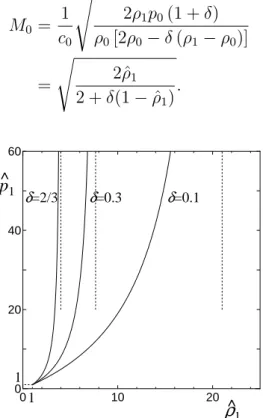
, (1.14)
ˆ
p1 = 1 +c20M02ρ0(ρ1−ρ0) p0ρ1
= 1 + 2 (1 +δ) ( ˆρ1−1)
2−δ(ˆρ1−1) , (1.15)
CHAPTER 1. INTRODUCTION
where ˆρ1 is the ratio between densities in the perturbed and unperturbed state and expressed as follows:
ˆ ρ1 = ρ1
ρ0.
The expression of the unperturbed Mach number can be obtained as follows:
M0 = 1 c0
√
2ρ1p0(1 +δ) ρ0[2ρ0−δ(ρ1−ρ0)]
=
√
2 ˆρ1 2 +δ(1−ρˆ1).
(1.16)
0 10 20
0 20 40 60
ρ^1
1 1
p^1
δ=0.1 δ=0.3
δ=2/3
Figure 1.1: Dependence of the perturbed pressure on the perturbed density for several δ(δ = 2/3,0.3,0.1). Vertical dotted lines are asymptotes, ˆρ1= ˆρ∞1 .
It can be seen from Fig. 1.1 that the perturbed pressure increase monotoni- cally as the increase of the perturbed density (strength of the shock wave). In the strong shock limit the perturbed pressures diverge, however, the perturbed density approach a finite critical value which depend on δ (internal degrees of freedom).
The ratio between densities in the strong shock limit and the unperturbed state is called as ultimate compression ratio, ˆρ∞1 . From the expressions of Rankine-Hugoniot conditions (1.14), (1.15) and (1.16), the value of ˆρ∞1 can be obtained explicitly as follows:
ˆ
ρ∞1 = 1 +2
δ. (1.17)
From Fig. 1.2 and also (1.17), ˆρ∞1 increase as the decrease ofδ (which corresponds to the increase of the internal degrees of freedom). This result can be physically
CHAPTER 1. INTRODUCTION
0 0.2 0.4 0.6
0 10 20
δ ρ^1
3/2
Figure 1.2: The dependence of ˆρ∞1 on δ.
flow into the internal motion becomes larger and therefore the increasing rate of perturbed temperature and perturbed pressure, due to a shock compression, become comparatively smaller.
Admissibility of shock waves
We have derived the Rankine-Hugoniot conditions for an ideal gas. As is pointed out in Sec. 1.2.3, the Rankine-Hugoniot conditions are only necessary conditions for the physically meaningful solution and therefore we need other admissibility conditions.
We discuss the admissibility of a shock wave by using the Lax condition which is obtained in terms of the propagation speed of a shock and the characteristic speed.
The unperturbed Mach numberM0 (1.5) and the dimensionless characteristic speed λˆ (1.7) are the propagation speed of a shock wave Us divided by the unperturbed sound speed and the fastest characteristic speed divided by the unperturbed sound speed. Therefore we can conclude the admissibility from the magnitude relation between M0 and ˆλ based on the Lax condition. From the definitions, the values of M0 and ˆλ at the unperturbed state are always one. The derivative of M0 with respect to the perturbed density ρ1 can be given by
dM02
d ˆρ1 = 4 + 2δ
[2−δ(1−ρˆ1)]2 >0 and therefore we have
M0 =
>1 for ρˆ1 >1 1 for ρˆ1 = 1
<1 for ρˆ1 <1.
(1.18)
We can conclude that λ0 < Us when ˆρ1 >1.
CHAPTER 1. INTRODUCTION
The difference between M0 and ˆλ can be expressed by ˆλ−M0 = ˆv + ˆc−M0
=
√ ˆ
ρ1(2 +δ)−δ ˆ
ρ1[2−δ( ˆρ1−1)] −
√
2 ˆ
ρ1[2−δ( ˆρ1−1)].
The magnitude relation between the unperturbed Mach numberM0 and the dimen- sionless characteristic speed ˆλ is summarized as follows:
λˆ=
> M0 for ρˆ1 >1 M0 for ρˆ1 = 1
< M0 for ρˆ1 <1.
This fact can also be seen from Fig. 1.3. We can conclude thatUs < λ1 when ˆρ1 >1.
0 2 4
0 10 20
ρ1 1
M0
1 ^ 00 5 10
10 20
ρ1 1
M0
1 ^ 00 10 20
10 20
ρ1 1
M0
1 ^
Figure 1.3: The dependence of the unperturbed Mach number M0 (solid line) and the dimensionless characteristic speed ˆλ(dashed line) on the perturbed density ρ1 for several δ (Left: δ = 2/3, center: δ= 0.3, right: δ = 0.1).
From the Lax condition, it is shown that a shock wave is admissible only when the perturbed density is larger than the unperturbed density. We can conclude that all and only compressive shock waves are admissible in an ideal gas based on the Lax condition.
Typical properties of shock waves in an ideal gas
The typical property of shock wave phenomena in an ideal gas are summarized as follows:
• Shock-induced phase transition can not occur.
• All and only compressive shock waves are admissible.
CHAPTER 1. INTRODUCTION
1.4 Typical real-gas effects on shock wave phenomena
The typical properties of wave phenomena in an ideal gas were summarized in the previous sections. As the validity range of the ideal gas model is limited, shock wave in condensed matters are more or less different from the ones in an ideal gas.
However, it is known that there exists shock wave phenomena which are not only quantitatively but also even qualitatively different from shock waves an ideal gas.
In this thesis we will call the effects inducing such differences as the real-gas effects on shock wave phenomena.
Here we list the typical examples of the real-gas effects on shock wave phenomena.
1.4.1 Shock-induced phase transition
Physical quantities can be changed rapidly at a shock front, therefore, the states before and after a shock front can be in different phases, in the other words, shock waves can induce phase transitions.
Several studies of the shock-induced phase transitions were made by experiments.
Experiments of liquefaction shock waves [47] freezing and crystallization of liquid benzene [48], melting of Iron [49], melting of vanadium [50] and structural phase transition between two solid phases in Molybdenum [51] have already been investi- gated.
Several studies were made by computer simulations of microscopic models. Molec- ular dynamics simulations for shock-induced freezing in a hard-sphere system [52], melting of Argon [53], melting of Al [54], melting of Cu, Pd, Pt [55], melting of many metals [56] and structural phase transition between two solid phases [57] have been performed.
Some theoretical studies were also made by using the models with realistic in- teratomic potentials [9, 58–60]. A review article [61] is also available. Material synthesis, for example, sometimes makes use of such dynamic phase transitions [62].
1.4.2 Rarefaction (negative) shock waves
All and only compressive shock waves in an ideal gas are admissible. However, in condensed matters, rarefaction (negative) shock waves can propagate stably. This shock waves are shock waves of which the density in the state after the shock is smaller than the density in the state before the shock.
CHAPTER 1. INTRODUCTION
Figure 1.4: Direct observation of rarefaction shocks by the experiments in the pressure - time plane [67]. It is clearly seen that the pressure decrease rapidly after the shock fronts.
The existence of the negative shock wave and the condition for these shock waves were investigated [63]. More detailed discussions have also been done [64, 65]. The negative shock waves were observed directly by the experiment [66, 67]. A review paper [68] is also available.
1.4.3 Shock splitting phenomena
Shock splitting phenomena are the other typical phenomena due to the real-gas effect. This phenomena are that an unstable shock wave eventually splits into several waves composed of shock waves, rarefaction waves and constant states in the course of its propagation.
Shock splitting phenomena in a gas [69–71] and in a solid [57] have already been studied.
CHAPTER 1. INTRODUCTION
Figure 1.5: Several experimental results of shock wave profile [69] in a vapor-liquid phase are shown in the pressure - time plane. Shock splitting phenomena can be observed.
1.5 Theoretical studies of shock wave phenomena in two models of condensed matters
Here we show theoretical studies which can explain typical real-gas effects on shock wave phenomena by using the framework of models of condensed matters.
1.5.1 Shock wave phenomena in a hard-sphere system
The shock waves in a hard-sphere system without internal degrees of freedom have widely been studied. Especially, in the recent paper [83], shock wave phenomena and shock-induced phase transition from liquid phase to solid phase were studied in detail.
Because we will analyze shock wave phenomena in a hard-sphere system with internal degrees of freedom in Chap. 2 as a direct consequence of this study and we will derive more general relations which include all relations derived in that paper, we here summarize only the typical results briefly.
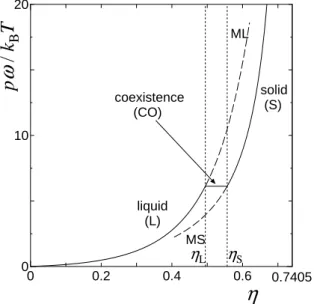
The caloric equation of state for a hard-sphere system has the same form as the one of an ideal gas. Only the thermal equation of state is different. From Fig. 1.6, we can see that there exists the first-order phase transition (Alder transition) which can be regarded as the prototype of the liquid / solid phase transition.