• 検索結果がありません。

Implementing an E-learning Program in a Japanese University Class: A Case of ALC NetAcademy Next in a TOEIC Preparation Course

N/A
N/A
Protected

Academic year: 2021

シェア "Implementing an E-learning Program in a Japanese University Class: A Case of ALC NetAcademy Next in a TOEIC Preparation Course"

Copied!
9
0
0

読み込み中.... (全文を見る)

全文

(1)

事例報告

Implementing an E-learning Program in a Japanese University Class: A Case of ALC NetAcademy

Next in a TOEIC Preparation Course

Introduction

The Test of English for International Com- munication (TOEIC

®

) is a commonly used standardized test in Japan. Many people, in- cluding university students, take the test as a way of measuring their English skills and im- provements, fulfilling the graduation require- ment, and meeting job qualifications (ETS, 2018). Japanese university students perceive TOEIC scores as an essential factor in deter- mining the chance of getting jobs (Caldwell, 2018), and consequently, TOEIC preparation has had a major impact on English teaching and learning in Japanese universities (Taka- hashi, 2012). Though there are criticisms about measuring university studentsʼ English proficiency based on the TOEIC score (Cald- well, 2018), it remains one of the primary sources for determining their English compe- tence. Therefore, it is vital to equip the stu- dents with the skills to achieve a satisfactory TOEIC score.

One way to include TOEIC preparation in

curricula is by using e-learning programs (e.g., Stewart, 2019; Tanaka, 2017; Shimada, 2017). E-learning programs can be utilized in different ways for TOEIC preparation; it could be an effective flipped course material (Tana- ka, 2017) and a primary learning resource for a CALL course (Stewart, 2019). According to Shimada (2017), the majority of the students in a TOEIC preparation course favored the e- learning program over the paper-based text- book. However, some students preferred the paper-based textbook because they liked tak- ing handwritten notes on the textbook and receiving face-to-face explanation, so he sug- gests that the balance of materials is essen- tial. Furthermore, students may not be able to make use of an e-learning program unless it is part of the assessment of the course (Fry- er, Steward, Anderson, Bovee & Gibson, 2011). Hence, e-learning programs need to be utilized with caution.

Technology is useful, but Christison and Murray (2014) make it clear that it should be chosen carefully, taking learnersʼ needs into account. We should not forget “the focus is on

Azusa Yamamoto, SEED

World Language Center Soka University

Keywords: e-learning, university, Japan, TOEIC, teacher development

(2)

the required textbook, Tactics for TOEIC Lis- tening and Reading Test (Trent, 2008). The textbook follows a modular arrangement (Na- tion & Macalister, 2010) in which the chapter stands alone without following a specific pres- entation order. There are 28 units, and each unit focuses on the different parts of the TOEIC listening and speaking test. After studying each unit, the students created their own TOEIC-format exercises with their group members based on the knowledge gained from the unit (e.g., the usage of paraphrasing, the distractors using the similar-sounding words, and the distractors using the same word meaning different things). Through this ac- tivity, the students put their learned knowl- edge into practice.

In addition to textbook-based learning, the students took part in the activities listed be- low throughout the semester.

・ Learning vocabulary from TOEIC Service List (Browne & Culligan, 2016) using word cards.

・ 4/3/2 (see Nation & Newton, 2008) as a warm-up activity at the beginning of les- sons.

・ Extensive reading and book-share: the stu- dents read a minimum of four graded read- ers and wrote a book report for each book.

They had four book-shares in class, where the students introduced the books they read to their group members.

・ Extensive listening and video sharing: The students watched at least two hours of Eng- lish videos from online streaming websites such as YouTube and English Listening Lesson Library Online (Beuckens, 2016) and filled out the extensive listening log sheet at home. They had four video-shares with their group members in class, where teaching and learning, not merely on using

technology because it is there” (Christison &

Murray, 2014, p. 43). Furthermore, when cre- ating a curriculum, not only the studentsʼ needs but also wants should be considered (Nation & Macalister, 2010). It is essential that there is no mismatch between learnersʼ views and teacherʼs view, and interviews and questionnaires can be used to gather this in- formation. The purpose of this study is to in- vestigate studentsʼ perception of the e-learn- ing program, NetAcademy Next (ALC Press Inc., 2017), and its implementation in a Japa- nese university TOEIC preparation course.

Methodology

Participants

The participants of this study were the stu- dents enrolled in a TOEIC preparation course in a Japanese university located in the west of Tokyo in Japan. The study took place in the spring semester of 2019, and there were 23 students (female: 15, male: 8). The distribu- tion of the studentsʼ year grade was: 8 second- year students, 11 third-year students, and 4 fourth to sixth-year students. The studentsʼ initial TOEIC score ranged from 295 to 825, with 414.5 as the mean score.

Course design

The aim of the course was to increase the

studentsʼ TOEIC scores. The course consisted

of thirty 90-minute lessons over 15 weeks,

and the students sat in randomly assigned

groups of four or five, which changed every

two weeks. It was an English-only class, and

various activities to increase the studentsʼ

overall English skills were utilized. The main

component of the course was based around

(3)

When they studied using NetAcademy Next, the students were advised to keep re- cords of learning, such as vocabulary, gram- mar points, tips, and strategies in their note- book. Bringing these notes to class, the students shared and taught each other what they had learned from the program. This group sharing occurred about every two weeks, and it provided the opportunity for the students to output what they had learned. Na- tion (2007) advocates the balance of learning opportunities using the principle called the four strands. It categorizes each learning ac- tivity in four different strands: meaning fo- cused input, meaning focused output, lan- g uage focused lea rning, and f luency development. NetAcademy Next includes all the strands except meaning focused output.

Therefore, the sharing activity was added to compensate for the lack of this strand. This sharing time was also used for the students to ask the teacher questions regarding NetA- cademy Next content.

Data collection

To investigate the studentsʼ perception of NetAcademy Next, and its implementation in class, the students were asked to answer some open-ended questions at the end of the semes- ter, using Google Form (see Appendix A). The original questionnaire was in Japanese to avoid misunderstanding, and the students were free to answer in Japanese or English.

After the semester was over, and the grades had been posted, the studentsʼ responses were analyzed and coded into themes.

they explained the contents of the videos and the quotes from the videos.

・ English Forum: The students attended at least five English conversation practices of- fered at the university self-access center conversation lounge.

・ NetAcademy Next: The students used the TOEIC e-learning program, which is ex- plained in detail in the following section.

NetAcademy Next

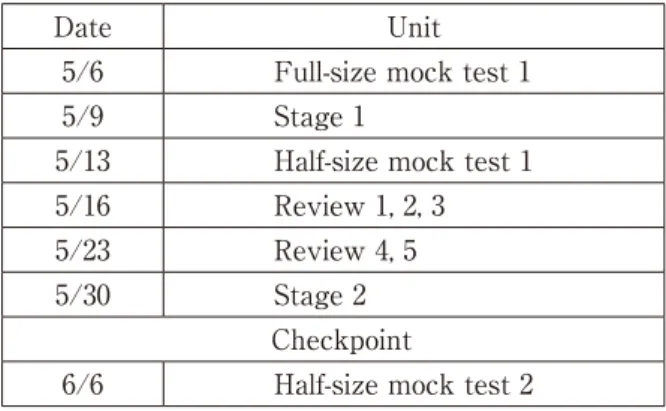
NetAcademy Next (ALC Press Inc., 2019) was used to facilitate the studentsʼ TOEIC practice outside the class. The completion of the TOEIC 730 course in the program was 20 percent of the course assessment. In the be- ginning, the students were instructed on how to access the program from their computer and smartphones. They also received a tenta- tive assignment schedule (Table 1). Because the students in the previous semester had had difficulty following the strict study plan due to their busy schedules, it was decided that the students were to be checked on their pro- gress only every two or three weeks. The stu- dents were left responsible for finishing all the assigned units by the ʻcheckpoint.ʼ For in- stance, instead of checking the progress every class, the teacher checked if the students fin- ished all the units from Full-size mock test 1 to Stage 2 on 5/30.

Table 1. Tentative schedule given to the students

Date Unit

5/6 Full-size mock test 1

5/9 Stage 1

5/13 Half-size mock test 1 5/16 Review 1, 2, 3

5/23 Review 4, 5

5/30 Stage 2

Checkpoint

6/6 Half-size mock test 2

(4)

practice they could receive, and its conveni- ence. The most frequent feedback was the usefulness of the detailed explanations in Japanese on the exercises. For example, six students mentioned that they learned a sig- nificant number of tips and strategies directly useful for taking TOEIC, and three men- tioned a favorable attitude towards the depth of explanations. Secondly, the students were satisfied with the amount of practice in the program. Four students mentioned the practi- cality of the exercises similar to the real TOEIC. They pointed out the effectiveness of familiarizing themselves with the test format and fast listening questions. Lastly, the stu- dents were positive about the accessibility and the segmentations of the units. Because they were able to access the program from their smartphones, and the study units were bro- ken into smaller units, the students were able to study a small portion at a time in different places. Despite this convenience, however, it must be noted that one student thought open- ing and logging into the program by itself was troublesome. Two students did not recom- mend NetAcademy Next. One mentioned that it was easier to concentrate when the materi- als were paper-based, and the other revealed a difficulty accessing the contents without the computer and Wi-Fi connection.

Results and discussion

Students’ use of the online program The responses for Questions 1, 2, and 3 (see Appendix A) were explored to understand the studentsʼ use of NetAcademy Next. It ap- peared that the students used the program in various places and timing (Table 2). The most common places mentioned by the students were at home and the university, and they also made use of commuting time. Some men- tioned that they used the program on day-off and small pockets of time, such as when dry- ing hair. Four students mentioned using the program every day while four other students used it once or twice a week. The rest of the students varied in frequency, such as four times a week, three times a week, on the weekend, and only before the ʻcheckpoint.ʼ Due to the nature of the open-ended ques- tions, the students mentioned more than one place and timing. Likewise, some students did not mention anything about frequency.

Students’ perception of NetAcademy Next The studentsʼ perception of the program was generally positive. Twenty-one students recommended the program because of the usefulness of the answer key with detailed explanations in the program, the amount of

Table 2. The use of the program

When / where # of students Frequency # of students

At home 9 Everyday 4

In-between classes at the university  7 1-2 times a week 4

During the commute 5 4 times a week 1

On day off 3 3 times a week 1

Pocket of time 1 On weekends 1

Only before the ‘checkpoint’ 1

(5)

ferent points, such as different strategies and vocabulary. They could also realize their mis- understandings by sharing and checking in groups. Also, when the students were not able to explain well to others, they noticed that their understanding was not internalized.

The second frequent theme was the impor- tance of output. The students thought that by teaching others and explaining in their own words, their understanding became deeper.

As a result, they remembered the information and were able to apply it during the TOEIC test. Finally, the students, especially the younger students, mentioned that they appre- ciated learning from more advanced or older students. One student wrote: “It was difficult to explain in English, but I learned a lot from my group members. For instance, I under- stood how to use the word ʻstrategyʼ in context when I was listening to my group members.”

Ideas from the students

As a response to Question 6 (see Appendix A), 11 students shared their ideas on how the teacher could implement the program better.

Because the e-learning program was a home assignment, the students did not usually have time to work on it in class; however, four stu- dents suggested otherwise. Two students sug- gested printing out the exercises on paper, es- pecially the reading sections. Another two students suggested acknowledging the hard- working students more explicitly and fre- quently. Lastly, the minor suggestions includ- ed making a paper progress sheet, making ʻallianceʼ groups for accountability, and test- ing the students using the exercises from the NetAcademy Next.

Students’ perception of teacher monitoring The preference of the frequency of the teacher checking their progress was mixed.

Fourteen students showed a positive attitude towards being checked every two to three weeks. “Because the students have different commitments outside of this course, it was good that we had less checkpoints.” The stu- dents appreciated the flexibility of the sched- ule while still having a mandatory deadline that motivated them to complete the NetA- cademy Next course. On the other hand, sev- en students preferred more frequent teacher checks. One student answered: “Without be- ing pushed and forced, I would become lazy. I know it was my fault that I could not keep my motivation to study on my own, but I needed more frequent deadlines.”

On taking notes and group sharing

The students were advised to take notes while reading the answer explanations. They kept records of multiple things, but the most frequently mentioned were: newly learned vo- cabulary and phrases (nine students), and the tips and strategies on TOEIC test (eight stu- dents). Five students also wrote the informa- tion highlighted in the answer key. Two stu- dents mentioned that they did not take any notes because they were not sure of what to write.

As for sharing their learning with group members, the studentsʼ responses mainly in- cluded three themes: the opportunity for no- ticing, the importance of output and learning from others. The most frequent theme in Question 5 (see Appendix A) was that they noticed various things through this activity.

For example, nine students noted that it was

effective because each student focused on dif-

(6)

in and using the program with their smart- phones had a positive attitude towards the program. However, the students who men- tioned the issues of Wi-Fi access and log- ging in were not favorable toward the pro- gram.

・ The simple layout and features to show their progress were motivating to the stu- dents.

Monitor the students effectively

Be mindful that the students have dif- ferent monitoring preferences. The atti- tude towards the teacherʼs monitoring fre- quency varied. Therefore, it is advisable that the teachers adjust the monitoring style to each studentʼs needs. It is important to com- municate with each student and catch the students early if they start to fall behind. If there are students who ask for additional en- couragement and being “pushed ” to work harder, the teacher should give that encour- agement accordingly.

Allow the students to plan their own schedules within the fixed deadlines. Be- cause each university student has a different schedule (e.g., club activities, work, and other class assignments and exams), it is necessary to consider these factors. When doing so, mo- tivated and independent learners can take advantage of this freedom in controlling their schedules. However, others may need more structure. Hence, having a balance of flexibil- ity and control seems essential. While setting the fixed deadlines for all the students, the smaller deadlines can be decided by the indi- vidual student. This balance will be likely to make each student accountable and responsi- ble for their consistency (see Appendix B).

Provide an additional paper progress Suggestions for teachers

The findings described in the previous sec- tion have given me an opportunity to contem- plate how I could better implement the e- learning program from the subsequent semes- ter. In this section, based on the findings mentioned above, I suggest the following ideas for the successful use of e-learning programs in class. Though this study focused on NetA- cademy Next, these suggestions can be ap- plied to many different e-learning programs in various curricula.

Choose the online program that is suitable for the students’ environment and needs

Choosing a suitable program is one of the key factors for the successful technology use in class (Christison & Murray, 2014). The stu- dentsʼ feedback showed that in determining the effectiveness of the program, they focused on the following factors:

・ Each unit was broken into smaller seg- ments, which allowed them to work on the program little by little. This segmentation lets them use the program even in a short time.

・ There were in-depth explanations of the ex- ercises in their native language. The addi- tional support in Japanese was helpful, es- pecially because the medium of instruction in class was English. Nation and Macalis- ter (2010) also claim the effectiveness of L1 support.

・ The program offered a vast amount of prac- tice, similar to the real TOEIC test.

・ The accessibility affected their motivation

towards the use of the program. The stu-

dents who claimed the easiness of logging

(7)

coming a simple receptive practice. One thing to remember, however, is that there were stu- dents who were uncertain about what to write. In the beginning, it is important to give guidance on note-taking with examples or a template.

Share the learning with other class- mates. Though the sharing activity was ini- tially a way of increasing the meaning fo- cused output (Nation, 2007), for the students, it was also the opportunity to notice various things. They learned from each other, and teaching their group members deepened their understanding.

Make time to work on the program in class, even if it is as short as 5 minutes.

By taking the first step in class, the students will likely to continue using the program out- side the class. Furthermore, the students were able to receive help on issues of logging in and accessing certain pages. If the time spent troubleshooting in the class is suffi- cient, the students will be comfortable using it on their own.

Remember that technology is merely one of the choices

Echoing the findings by Shimada (2017), not all students enjoyed e-learning. The stu- dents have d i f ferent lea r n i ng styles (Dörnyei& Ryan, 2015), and for some, paper- based exercises can be more motivating.

Moreover, the actual TOEIC is administered on paper. Therefore, it is better to mix differ- ent types of learning and teaching materials.

Conclusion

This study has explored the studentsʼ per- ception of NetAcademy Next and its imple- sheet. The studentsʼ schedule mentioned

above can be written down on paper (see Ap- pendix B). The benefit of adding the sheet is its tangibility; the students can write, check off the list, and also see the progress anytime without logging in from their smartphone or computer. This progress sheet can also incor- porate the places for writing their goal of the semester, how they plan to achieve it, and their target TOEIC score. It may also be help- ful to visualize the studentsʼ progress using charts and graphs for motivation (Nation &

Macalister, 2010). The teacher can have a quick talk with each student over this pro- gress sheet in class.

Give a brief but frequent encourage- ment in class. As a way of monitoring, the teacher can talk about the program in class.

The students can also share their progress with their classmates (e.g., which section they are working on, and how long they have stud- ied so far). The students seem to enjoy this type of conversation because it creates healthy competition with other classmates. Sharing ideas on when they can use the program (e.g., during the TV commercial, in-between class- es, or time on the bus) can raise awareness of how to efficiently use their time. Lastly, the teacher can acknowledge and praise the stu- dents who have made significant progress in the program.

Make a clear connection between the e- learning program and the class content

Have the students take notes. The stu-

dents were positive about summarizing and

recording the information on the answer ex-

planations because it deepened the learning

process. By requiring the students to take

notes, it avoids the e-learning program be-

(8)

Fryer, L. K., Stewart, J., Anderson, C. J., Bovee, H. N., & Gibson, A. (2011). Coordi- nating a vocabulary curriculum: Explora- tion, pilot, trial and future directions. In A.

Stewart (Ed.), JALT2010 Conference Pro- ceedings. Tokyo: JALT.

Shimada, K. (2017). Textbooks or e-learning?

Learnersʼ preferences and motivations in a Japanese EFL classroom. The Language Teacher, 41(2), 3-8.

Stewart, G. A. (2019). Using ALC Press Inc.ʼs NetAcademy Next as the Main Resource in Lower-Level University English CALL Classes in Japan: A Case Study.  JALT CALL Journal, 15(1), 19-41.

Nation, I.S.P. (2007). The four strands. Inter- national Journal of Innovation in Lan- guage Learning and Teaching, 1(1), 2-13.

Nation, I.S.P., & Newton, J. (2008). Teaching ESL/EFL listening and speaking. New York, NY: Routledge.

Nation, I.S.P., & Macalister, J. (2010). Lan- guage curriculum design. New York, NY:

Routledge.

Takahashi, J. (2012). An overview of the is- sues on incorporating the TOEIC test into the university English curricula in Japan.

Tama University Global Studies Depart- ment Bulletin, 4(3), 127-138. Retrieved from https://ci.nii.ac.jp/naid/120005648811/

Tanaka, H. (2017). Preliminary study of flipped English courses for EFL learners using ALC Net Academy 2 and YouTube.

University of Nagasaki Department of Glob- al and Media Bulletin, 2, 167-175.

Trent, G. (2008). Tactics for TOEIC listening and reading test student book. Oxford, UK:

Oxford University Press.

mentation in a Japanese university TOEIC class. Based on the studentsʼ feedback, multi- ple suggestions have been made regarding e- learning program selection, teacher monitor- ing, and program use in class. While the present study is only based on a small sample size and a simple data collection method, the findings shed light on authentic studentsʼ opinions. Implementing an e-learning pro- gram seems rather straightforward at a glance; however, it is clear that the teacher has to take multiple factors into consideration if they want to use it effectively as part of the curriculum.

References

ALC Press Inc. (2019). ALC NetAcademy Next. Retrieved from https://www.alc-edu- cation.co.jp/nanext/

Beuckens, T. (2016). English Language Lis- tening Library Online. Retrieved from http://www.elllo.org/index.htm

Browne, C., & Culligan, B. (2016). The TOE- IC Service List. Retrieved from http://www.

newgeneralservicelist.org.

Caldwell, M. (2018). Japanese university stu- dentsʼ perspectives on the TOEIC test. Osa- ka JALT Journal, 5, 44-74.

Christison, M. A., & Murray, D. (2014). What English language teachers need to know volume III: designing curriculum. New York, NY: Routledge.

Dörnyei, Z., & Ryan, S. (2015). The psycholo- gy of the language learner revisited. New York: Routledge/Taylor & Francis.

ETS. (2018). Report on Test Takers World- wide. Retrieved from https://www.iibc-glob- al.org/library/default/toeic/official_data/

pdf/Worldwide2018.pdf

(9)

taking notes while reading the answer ex- planations?

・ Q5. What did you think of sharing learn- ing with your group members?

・ Q6. If you were the instructor of this course, how would you improve the imple- mentation of NetAcademy Next? Please ex- plain in detail if you have any suggestions.

Appendix B

An Example of a Paper-based Progress Sheet

Appendix A

List of Survey Questions

・ Q1. When, where, and how often did you use NetAcademy Next?

・ Q2. Do you recommend this e-learning pro- gram to the students who will be taking this course in the future?

・ Q3. What did you think about having a ʻcheckpoint ʼ every two to three weeks, in terms of frequency?

・ Q4. What did you pay attention to when

Table 1. Tentative schedule given to the students
Table 2. The use of the program

参照

関連したドキュメント

This dissertation aimed to develop a method of instructional design (ID) to help Japanese university learners of English attain the basics of internationally

This dissertation aimed to develop a method of instructional design (ID) to help Japanese university learners of English attain the basics of internationally

(2013) Tactics for The TOEIC Test: Listening and Reading Test Introductory Course, Oxford University Press. There is a lamp in the corner of

Design of a radiopharmaceutical for the palliation of painful bone metastases: rhenium-186-labeled bisphosphonate

An example of a database state in the lextensive category of finite sets, for the EA sketch of our school data specification is provided by any database which models the

We show that a discrete fixed point theorem of Eilenberg is equivalent to the restriction of the contraction principle to the class of non-Archimedean bounded metric spaces.. We

Shi, “The essential norm of a composition operator on the Bloch space in polydiscs,” Chinese Journal of Contemporary Mathematics, vol. Chen, “Weighted composition operators from Fp,

One may think that, if matrix subjects can be reactivated due to similarity-based reactivation, the distant NOM and DAKE-NOM conditions should show