The pagurid hermit crab genus Pagurixus Melin, 1939 is widespread in tropical to warm temperate waters in the Indo-Pacific regions.
Presently, 27 species are known in the genus (McLaughlin and Haig, 1984; Gunn and Morgan, 1992; Morgan, 1993; Komai and Asakura, 1995;
de Saint Laurent and McLaughlin, 2000; Komai and Myorin, 2005; Komai, 2006; Komai and Osawa, 2006, 2007; Komai and Takada, 2006;
Osawa et al., 2006; Osawa and Komai, 2007), of which 14 species have been described in the last eight years. Many of the known species inhabit shallow sublittoral reefs where only divers equipped with SCUBA are accessible.
During ongoing studies on the sublittoral her- mit crab fauna in Japan, conducted by us, a num- ber of undescribed species or poorly known species have been found, amongst them two un- described species of Pagurixus. Furthermore, ex- amination of abundant material from various western Pacific localities, kindly made available for study by Dr. Gustav Paulay of the Florida Museum of Natural History, University of Flori- da, has resulted the finding of one of the two un- described species also in Papua New Guinea. In the present paper the two new species are de-
scribed. The first, P. purpureussp. nov., appears closely related to P. boninensis(Melin, 1939), P.
paulayi Komai and Osawa, 2006 and P. ruber Komai and Osawa, 2006, all referred to the P.
boninensisspecies group (cf. Komai and Osawa, 2006). The second, P. acanthocarpussp. nov., be- longing to the P. anceps group (cf. Komai and Osawa, 2006), appears morphologically similar to P. fasciatus Komai and Myorin, 2005, P. han- dreckiGunn and Morgan, 1992, P. nanusKomai and Takada, 2006, and P. dissimilis Osawa and Komai, 2007. Affinities of these two new species are discussed in detail. Descriptions of the col- oration in life, which is known to be species spe- cific in the genus, are also provided for both species.
The type specimens of the new species are de- posited in the National Museum of Nature and Science, Tokyo (NSMT), the Natural History Museum and Institute, Chiba (CBM), Coastal Branch of Natural History Museum and Institute, Chiba, Katsuura (CMNH), and the Florida Muse- um of Natural History, University of Florida, Gainesville (UF). The shield length, abbreviated as SL, is measured from the tip of rostrum to the midpoint of posterior margin of the shield. Ter-
Two New Species of the Hermit Crab Genus Pagurixus (Decapoda:
Anomura: Paguridae) from the Western Pacific
Tomoyuki Komai1and Junji Okuno2
1Natural History Museum and Institute, Chiba, 955–2 Aoba-cho, Chuo-ku, Chiba, 260–8682 Japan e-mail: [email protected]
2Coastal Branch of Natural History Museum and Institute, Chiba, 123 Yoshio, Katsuura, Chiba, 299–5242 Japan e-mail: [email protected]
Abstract Two new species of the pagurid hermit crab genus PagurixusMelin, 1939 are described and illustrated. Pagurixus purpureussp. nov., known from Japan and Papua New Guinea, is mor- phologically similar to P. boninensis (Melin, 1939), P. paulayiKomai and Osawa, 2006, and P.
ruberKomai and Osawa, 2006. Pagurixus acanthocarpussp. nov., so far restricted to Japanese wa- ters, appears close to P. fasciatusKomai and Myorin, 2005, P. handreckiGunn and Morgan, 1992, P. nanusKomai and Takada, 2006, and P. dissimilisOsawa and Komai, 2007. Distinguishing char- acters between respective new species and their allies are discussed.
Key words : Decapoda, Anomura, Paguridae, Pagurixus, new species, Japan, New Guinea.
minology used in the description follows McLaughlin (2003), with the exceptions of num- bered thoracic sternites and pleon for abdomen.
Taxonomy
Genus PagurixusMelin, 1939 Pagurixus boninensisspecies group
Pagurixus purpureussp. nov.
[New Japanese name: Sumire-hime-hon-yadokari]
(Figs. 1–4; 9A, B)
Material examined. Holotype: NSMT-Cr 19740, male (SL 3.4 mm), Issoh, Yakushima Is- land, Ohsumi Islands, 20 m, 11 January 2007, SCUBA diving, coll. Shigeru Harazaki.
Paratypes: Japan. CMNH-ZC 2251, 1 female (SL 2.1 mm), Akino-hama, Izu-Oshima Island, Izu Islands, 4 m, 15 May 2005, SCUBA diving, coll. Hirohito Arima; CMNH-ZC 2252, 1 male (SL 2.1 mm), CMNH-ZC 2253, 1 female (SL 2.3 mm), same locality, 4 m, 2 June 2005, SCUBA diving, coll. H. Arima; NSMT-Cr 19859, 1 fe- male (SL 2.3 mm), Kashiwa-jima Island, Ohtsu- ki, Kochi Prefecture, 3 m, 10 June 2005, SCUBA diving, coll. Naoki Nishimura; CBM-ZC 9560, 2 females (SL 2.0, 2.3 mm), same locality, subtidal, SCUBA diving, coll. Eiji Myorin. Papua New Guinea. UF 5398, 1 male (SL 2.4 mm), 4 oviger- ous females (SL 1.7–2.1 mm), “Brooker Chan- nel” in Calvados Channel, Milne Bay Province, Louisiade Archipalago, 11°03.09S, 152°28.62E, 5–10 m, 1 June 1998, coll. Gustav Paulay.
Non-type. CMNH-ZC 1881, 1 young male (SL 1.2 mm), Akinohama, Izu-Oshima Island, Izu Islands, 13 m, 20 March 2005, SCUBA diving, coll. H. Arima.
Description. Shield (Fig. 1A) 1.00–1.15 times longer than broad; anterior margin between ros- trum and lateral projections concave; anterolater- al margins sloping; dorsal surface weakly con- vex, with few tufts of short setae laterally. Ros- trum triangular, not reaching level of midlength of ocular acicles, moderately broad, terminating acutely. Lateral projections slightly produced,
each with submarginal spinule.
Ocular peduncles (Fig. 1A) moderately long, relatively slender, 0.60–0.70 length of shield, each with row of tufts of short setae on dorsal surface mesially; corneas slightly dilated, corneal width 0.26–0.38 of peduncular length; basal part somewhat inflated, slightly broader than corneal width. Ocular acicles subtriangular or subovate, each with small submarginal spine distally.
Antennular peduncles (Fig. 1A) overreaching distal corneal margins by 0.30–0.50 lengths of ultimate segments. Ultimate segment with tufts of long setae at dorsolateral distal angle; ventral surface with 2 longitudinal rows of setae, con- sisting of mixture of short and long setae in distal half (Fig. 1B). Basal segment with small lateral spine on statocyst lobe. Ventral flagellum with row of numerous long setae on lateral and mesial margins.
Antennal peduncles (Fig. 1A) overreaching distal corneal margins by 0.30 lengths of fifth segments. Second segment with tiny spinule at dorsomesial distal angle; laterodistal projection short, not reaching midlength of fourth segment, terminating in simple or bifid spine. First seg- ment with small laterodistal spine; ventromesial distal margin produced, unarmed or with spinule just lateral to antennal gland opening. Antennal acicle moderately long, arcuate, terminating in slender spine, overreaching base of cornea but not reaching distal corneal margin, mesial margin with row of sparse stiff setae. Flagellum moder- ately long, exceeding 4.00 length of shield.
Third maxilliped moderately stout; ischium with well-developed crista dentata and 1 accesso- ry tooth.
Right cheliped of males (Figs. 2A, B, 3A) not particularly elongate, moderately stout, distinctly longer than left cheliped. Chela subovate in dor- sal view, 1.80–2.10 times longer than broad.
Dactylus distinctly shorter than palm; dorsome- sial margin not delimited; surfaces microscopi- cally finely granular; cutting edge with row of small calcareous teeth in proximal 0.75 and row of small corneous teeth in distal 0.25, terminat- ing in small corneous or calcareous claw. Palm
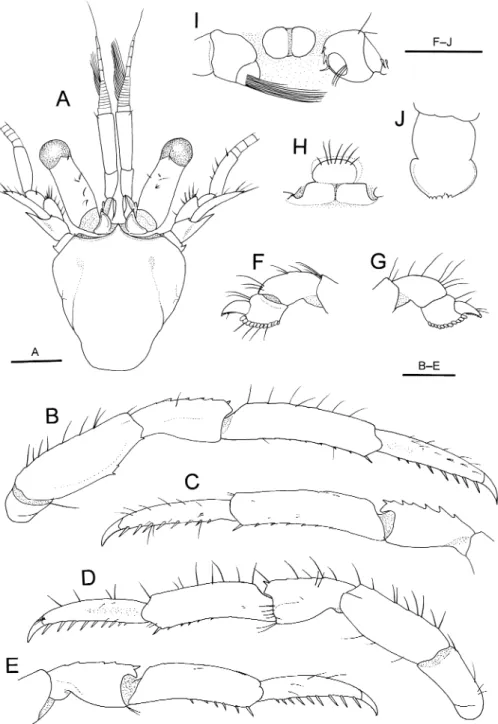
Fig. 1. Pagurixus purpureussp. nov., holotype, male (SL 3.4 mm), NSMT-Cr 19740. A, shield and cephalic ap- pendages, dorsal view; B, ultimate segment and ventral flagellum of left antennular peduncle, ventral view;
C, left fourth pereopod, lateral view; D, right fourth pereopod, lateral view; E, sixth thoracic sternite, ventral view; F, coxae of fifth pereopods and eighth thoracic sternite, ventral view; G, telson, dorsal view. Scale bars:
1 mm for A; 0.5 mm for B–G.
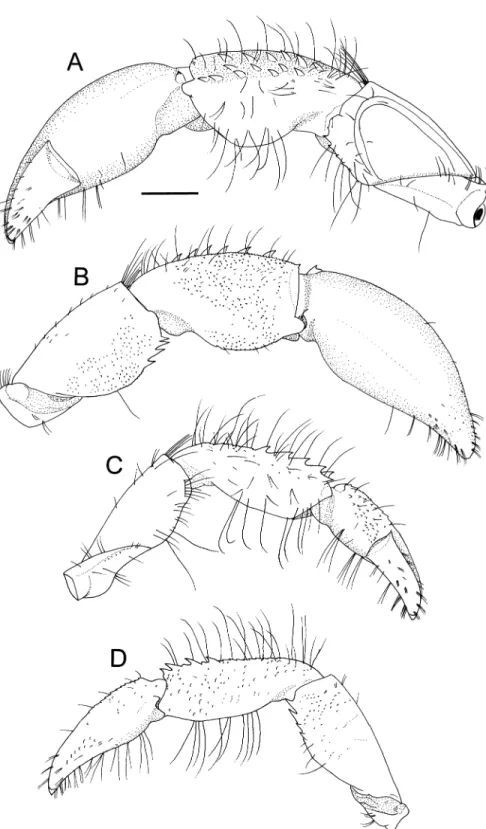
Fig. 2. Pagurixus purpureussp. nov., holotype, male (SL 3.4 mm), NSMT-Cr 19740. A, right cheliped, mesial view; B, same, lateral view; C, left cheliped, mesial view; D, same, lateral view. Scale bar: 1 mm.
slightly longer than carpus; convex dorsal surface microscopically granular, with small but conspic- uous spine at proximomesial angle; dorsolateral and dorsomesial margins not delimited; lateral, mesial and ventral surfaces minutely granular or nearly smooth, and occasionally with some tufts of short setae on ventral surface. Cutting edge of fixed finger with row of tiny calcareous teeth and with 1 moderately large, blunt calcareous tooth proximal to midlength, terminating in small cal- careous claw. Carpus 1.50–1.70 times longer than broad; dorsal surface granular (granules strongest mesially), with few small spines adja- cent to dorsodistal margin and with 2 rows of moderately large spines mesially; dorsolateral margin not delimited, unarmed; lateral, mesial and ventral surfaces also granular, lateral surface without longitudinal median ridge, ventrolateral margin with row of minute granules; mesial face with several short to long setae directed mesially, ventromesial margin smooth, unarmed; ventral surface moderately convex. Meral-carpal articu- lation lacking any pronounced clockwise rota- tion; dorsal surface of merus with trace of trans- verse ridges and row of short setae, dorsodistal margin with row of stiff setae; lateral face nearly smooth in dorsal half and minutely granular in ventral half, ventrolateral margin with row of 5 moderately small spines in distal 0.30; mesial face smooth, with several stiff setae, ventrome- sial margin with row of 5 small spines; ventral surface convex, with scattered granules and long setae. Ischium with smooth ventromesial margin;
surfaces unarmed.
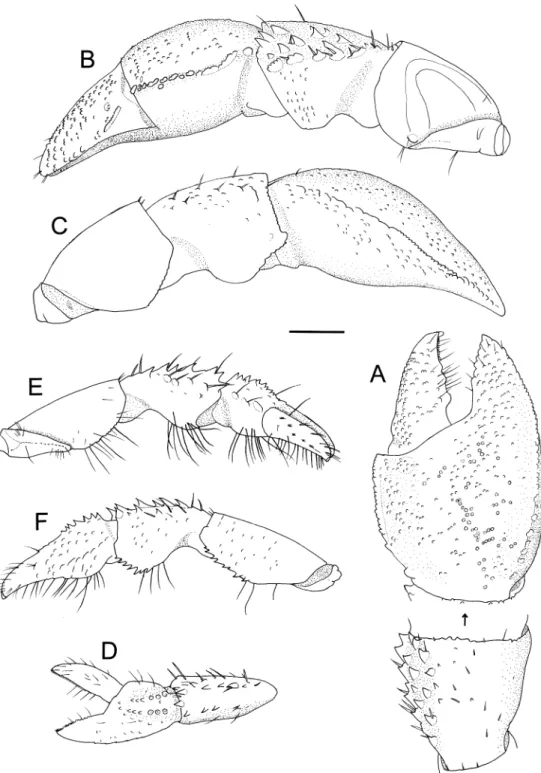
Right cheliped of females (Fig. 3C–E) moder- ately stout for genus, slightly longer than or subequal in length to left cheliped. Chela 1.90–
2.10 times longer than broad. Dactylus longer than palm; cutting edge with row of small, blunt calcareous teeth in proximal 0.60–0.70 and row of small corneous teeth in distal 0.30–0.40, ter- minating in small corneous claw. Palm distinctly shorter than carpus; dorsal surface with scattered minute granules and minute setae, and with 1 conspicuous spine at proximomesial angle; dor- somesial margin not delimited, dorsolateral mar-
gin faintly delimited by low of small, low gran- ules extending onto fixed finger. Cutting edge of fixed finger with row of small blunt calcareous teeth in proximal 0.80 and row of small corneous teeth in distal 0.20, terminating in small corneous claw. Carpus 1.30–1.80 times longer than broad, subequal in length to merus; dorsal surface with 2 rows of moderately large spines mesially and with row of tiny tubercles laterally, dorsodistal margin with few small spines; lateral and mesial surfaces coarsely granular, former nearly perpen- dicular, without longitudinal ridge, latter with several stiff setae directed mesially; ventrolateral and ventromesial margins unarmed; ventral sur- face convex. Merus with row of very low protu- berances on dorsal surface, dorsodistal margin with several stiff setae; lateral surface with nu- merous minute vertical ridges, ventrolateral mar- gin with 2–6 spines in distal one-third, otherwise nearly smooth; ventromesial margin tuberculate or granular, without conspicuous spine. Ischium with row of minute granules on ventromesial margin, surfaces otherwise unarmed.
Left cheliped (Figs. 2C, D, 3B) moderately slender, morphologically similar between male and female. Chela 2.60–2.70 times longer than broad. Dactylus subequal in length to or slightly longer than palm, with sparse tufts of setae on surfaces (setae on ventral surface longest); cut- ting edge with row of small corneous teeth, ter- minating in small corneous claw. Palm about half length of carpus; dorsal surface slightly elevated in midline and bearing scattered tiny tubercles or granules, dorsolateral and dorsomesial margins not delimited; mesial surface with small granules dorsally, smooth ventrally; ventral surface smooth, with some tufts of long stiff setae. Cut- ting edge of fixed finger with row of small, slen- der calcareous teeth in proximal 0.60–0.70 and row of small corneous teeth in distal 0.30–0.40, terminating in small corneous claw. Carpus rela- tively slender, slightly longer than chela or merus; length about 2.80 of distal width and about 2.70 of greatest height; dorsal surface with lateral row of 2–7 moderately small spines and low protuberances, and with mesial row of 4–7
Fig. 3. Pagurixus purpureussp. nov., holotype, male (SL 3.4 mm), NSMT-Cr 19740 (A, B); paratype, female (SL 2.0 mm), CBM-ZC 9560 (C–E). A, C, chela and carpus of right cheliped, dorsal view; B, left cheliped, dorsal view; D, right cheliped, lateral view; E, same, mesial view. Scale bars: 1 mm for A, B; 0.5 mm for C–E.
spines, dorsodistal margin unarmed or armed with 1 small spine; lateral face steeply sloping, covered with coarse granules, without longitudi- nal median ridge, ventrolateral margin unarmed;
mesial surface with granules dorsally and with numerous short to long stiff setae directed mesially, ventromesial margin unarmed. Merus nearly smooth on dorsal surface, dorsodistal mar- gin with stiff setae; lateral surface sparsely gran- ular, ventrolateral margin with 3–6 small spines in distal one-third to half; mesial surface nearly smooth, with several stiff setae ventrally, ventro- lateral margin unarmed; ventral surface weakly convex, with few granules and long stiff setae. Is- chium with row of minute denticles on ventrome- sial margin, otherwise unarmed.
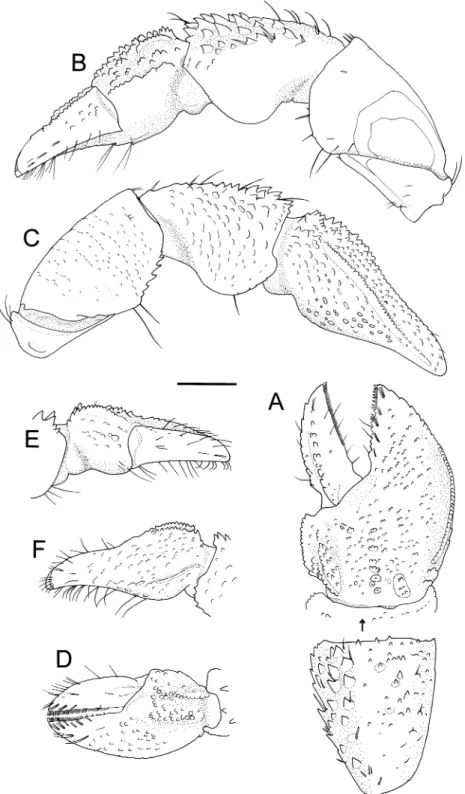
Ambulatory legs (Fig. 4A, B) moderately long and slender, generally similar from right to left in both male and female. Dactyli (Fig. 4C, D) 0.84–
0.92 (second) or 0.99–1.09 (third) length of propodi, 5.30–6.20 times longer than high, termi- nating in large corneous claws; dorsal surfaces each with row of sparse stiff setae; lateral and mesial faces each with few tufts of short setae, mesial faces unarmed (second) or each armed with few corneous spinules adjacent to dorsal margin (third); ventral margins each with 6–10 relatively long corneous spines notably increas- ing in size distally. Propodi slightly tapering dis- tally, 3.90–4.10 (second) or 3.10–3.80 (third) times longer than high; dorsal surfaces nearly smooth or with trace of low, transverse ridges, bearing tufts of short to moderately long stiff setae; lateral faces nearly smooth; ventral mar- gins each with row of 4–9 corneous spinules, ventrodistal margins each with paired corneous spines. Carpi each usually with small dorsodistal spine, dorsal surface smooth, with row of tufts of stiff setae; lateral faces nearly smooth. Meri near- ly smooth on dorsal surfaces, each with single setae or tufts of setae; lateral surfaces smooth;
ventrolateral distal margins each with small sub- distal spine (second) or unarmed (third), ventral surfaces with few spinules at about distal 0.30 (second) or smooth (third), all with few short setae.
Fourth pereopods (Fig. 1C, D) slightly to markedly unequal in both male and female.
Dactyli terminating in very small corneous claws, with numerous, dense long setae on dorsal margins (setae much longer and more numerous in left than in right); left dactylus much broader than right. Propodi with tuft of several setae on mesial face at base of ventrodistal extremity;
propodal rasp consisting of single row of cor- neous scales; mesial faces nearly flat, with sever- al long setae dorsally. Carpi each with tuft of setae on mesial face near ventrodistal angle (setae longer and more numerous in left than in right).
Anterior lobe of sixth thoracic sternite (Fig.
1E) roundly subrectangular, anterior margin with row of short to long setae. Eighth thoracic stern- ite (Fig. 1F) composed of two unequal, rather widely separated, rounded lobes, each with nu- merous short stiff setae.
Males with coxae of fifth pereopods slightly unequal (Fig. 1F). Ventromesial protrusion origi- nating from surface of right coxa well developed, clearly demarcated; setae arising from terminal margin of ventromesial protrusion, extending to left coxa; left coxa with distinct gonopore partial- ly obscured by short setae; numerous setae pre- sent along ventrolateral margin. Female with sin- gle left gonopore.
Telson (Fig. 1G) with terminal margins slight- ly oblique, bearing 4 or 5 prominent, slender spines and several mesial spinules interspersed by spines; dorsal surface adjacent to terminal margins slightly upturned, strongly calcified.
Coloration in life. Shield translucent, with yellowish-brown tint; posterior carapace also translucent. Ocular peduncles pale yellowish- brown, with tinge of purple. Ultimate segment of antennular peduncle violet; penultimate and basal segments purplish. Antennal peduncle gen- erally purple, fifth segment with distinct lateral and mesial stripes; flagellum alternated with pur- ple (5 or 6 articles) and white (1 or 2 articles).
Right cheliped purplish-brown or reddish-brown;
fingers whitish. Left cheliped generally purple, distal part of fingers whitish. Ambulatory legs
Fig. 4. Pagurixus purpureussp. nov., holotype, male (SL 3.4 mm), NSMT-Cr 19740. A, right second pereopod, lateral view; B, left third pereopod, lateral view; C, dactylus of right second pereopod, mesial view; D, dacty- lus of left third pereopod, mesial view. Scale bars: 1 mm for A, B; 0.5 mm for C, D.
striped with purple and white; dorsal and ventral surfaces of dactyli and propodi purple, lateral and mesial faces of these segments each with purple median stripe, otherwise white; meri each with purple dorsal stripe extending onto mesial surface distally and median stripe, ventral surface purple, and otherwise white. Pleon translucent.
See Fig. 9A, B.
Distribution. So far known from Japan (Izu Islands to Yakushima Island) and Papua New Guinea; subtidal to 13 m.
Remarks. Pagurixus purpureus sp. nov. be- longs to the P. boninensis group because of the possession of two setal rows on the ventral sur- face of the ultimate segment of the antennular peduncle. This informal species group includes the following 13 species: P. laevimanus (Ort- mann, 1892), P. maorus(Nobili, 1906), P. boni- nensis (Melin, 1939), P. tweediei (Forest, 1956), P. festinusMcLaughlin and Haig, 1984, P. nomu- raiKomai and Asakura, 1995, P. brachydactylus Komai and Osawa, 2006, P. carinimanus Komai and Osawa, 2006, P. concolorKomai and Osawa, 2006, P. paulayiKomai and Osawa, 2006, P. pse- liophorus Komai and Osawa, 2006, P. pulcher Osawa, Fujita and Okuno, 2006, and P. ruber Komai and Osawa, 2006. Among them, P. boni- nensis, P. paulayi and P. ruber are close to the new species in the lack of a longitudinal ridge on the lateral surface of the carpus of each cheliped and the relatively slender ambulatory dactyli.
Differences among the four species are summa- rized in Table 1. The new species appears unique in having two dorsomesial rows of relatively large spines on the carpus of the right cheliped.
In P. boninensisand P. paulayi, there are one or two rows of small spines on the dorsomesial sur- face of the carpus of the right cheliped; and there is no dorsomesial row of spines in adults of P.
ruber, although a single small dorsomesial spine may be present in females. In the pattern of the ventral setal rows on the ultimate segment of the antennular peduncle, the new species is similar to P. paulayi, but the non-spinulose palm of the right cheliped, the presence of one or more spines on the ventrolateral margin of the merus
Table1.Comparison among four species of Pagurixus, P. purpureussp. nov., P. boninensis, P. paulayiand P. ruber. ItemsP. purpureussp. nov.P. boninensisP. paulayiP. ruber Setal rows of ultimate segment consisting of mixture of short consisting of tufts of short consisting of mixture of shortconsisting of tufts of short setae of antennular peduncleand long setaesetaeand long setae Dorsal surface of right palmnon-spinulosenon-spinulosespinulosenon-spinulose Dorsal surface of carpus of with 2 mesial row ofwith 1 mesial row of few with 1 or 2 mesial rows of non mesial row of spines right chelipedmoderately large spinessmall spinessmall spines Ventrolateral margin of merus with 2–6 small spineswith 1 or 2 subdistal spineswith 1 subdistal spinewith 1 subdistal spine of right cheliped Coxa of right fifth pereopod ofwith prominent ventromesial with prominent ventromesial with prominent ventromesialwithout ventromesial malesprotrusion; setal tuft longprotrusion; setal tuft longprotrusion; setal tuft longprotrusion; setal tuft very short Left gonopore of malespresentpresentabsentabsent Color of ambulatory legsstriped with purple and whitestriped with reddish brown generally light purple in generally red or reddish purple, and whitepreservativewith white distal ring
of the right cheliped, and the possession of the left gonopore in males distinguish the new species from P. paulayi. The new species is readi- ly distinguished from P. ruber by the different pattern of the ventral setal rows on the ultimate segment of the antennular peduncle, the presence of two to six spines on the ventrolateral margin of the merus of the left cheliped, and the posses- sion of a well-developed ventromesial protrusion and tuft of long setae on the coxa of the right fifth pereopod in males. From P. boninensis, P.
purpureus differs in the different pattern of the ventral setal rows on the ultimate segment of the antennular peduncle, and more prominent setal tufts of the dactylus and carpus of the left fourth pereopod. The living coloration of the new species is distinctive in the violet antennular pe- duncle and the ambulatory legs longitudinally striped with purple and white. Pagurixus boni- nensisalso has similarly striped ambulatory legs, but the base color is reddish brown; the antennu- lar peduncle is also reddish brown. Chelipeds and ambulatory legs of P. ruber are almost entirely purplish red occasionally with white distal rings on the propodi of the ambulatory legs. Coloration in life remains unknown in P. paulayi, although the preservative color was described by Komai and Osawa (2006).
Etymology. Named in reference to the vivid purple color in life.
Pagurixus ancepsspecies group
Pagurixus acanthocarpussp. nov.
[New Japanese name: Konpeitou-hime-hon-yadokari]
(Figs. 5–8; 9C)
Material examined. Holotype: NSMT-Cr 19741, male (SL 1.5 mm), Kashiwa-jima Island, Ohtsuki, Kochi Prefecture, subtidal, 30 June 2005, SCUBA diving, coll. Eiji Myorin.
Paratypes: CBM-ZC 9517, 1 male (SL 1.6 mm), same data as holotype; CMNH-ZC 1871, 1 female (SL 1.8 mm), Akino-hama, Izu-Oshima Island, Izu Islands, 8 m, 26 December 2004,
SCUBA diving, coll. Hirohito Arima.
Description. Shield (Fig. 5A) 1.05–1.11 times as long as broad; anterior margin between ros- trum and lateral projections concave; anterolater- al margins sloping; posterior margin roundly truncate; dorsal surface naked. Rostrum triangu- lar, not reaching midlength of ocular acicles, moderately broad, terminating acutely. Lateral projections obtuse, each with submarginal spin- ule.
Ocular peduncles (Fig. 5A) moderately stout, 0.60–0.70 length of shield, each with few tufts of short setae on dorsomesial surface; middle part slightly inflated, subequal to corneal width;
corneas slightly dilated, corneal width 0.30–0.36 of peduncular length. Ocular acicles subtriangu- lar, each with submarginal spinule.
Antennular peduncles (Fig. 5A) overreaching distal corneal margins by 0.20–0.40 lengths of ultimate segments. Ultimate segment with 1 short seta at dorsolateral distal angle; ventral sur- face lacking longitudinal rows of setae. Basal segment with small spine on distal margin of sta- tocyst lobe. Ventral flagellum with few short setae on lateral and mesial margins.
Antennal peduncles (Fig. 5A) slightly reaching beyond distal corneal margins. Third segment with small spine at distomesial angle. Second segment with spinule at dorsomesial distal angle;
laterodistal projection reaching midlength of fourth segment, terminating in simple spine. First segment unarmed on lateral face; ventromesial distal margin strongly produced, but unarmed.
Antennal acicle arcuate, terminating in slender spine, overreaching base of cornea but not reach- ing distal margin; mesial margin with few stiff setae. Flagellum relatively short, about 2.5 times longer than shield.
Third maxilliped moderately stout; ischium with well-developed crista dentata and 1 accesso- ry tooth.
Male right cheliped (Fig. 6A–C) large, not par- ticularly elongate. Chela subovate in dorsal view, about 1.60 times longer than broad. Dactylus slightly shorter than palm, terminating in small corneous claw; dorsomesial margin not delimit-
Fig. 5. Pagurixus acanthocarpussp. nov., holotype, male (SL 1.5 mm), NSMT-Cr 19741. A, shield and cephalic appendages, dorsal view; B, right second pereopod, lateral view; C, dactylus to carpus of right second pereo- pod, mesial view; D, left third pereopod, lateral view; E, dactylus to carpus of left third pereopod, mesial view; F, dactylus to carpus of left fourth pereopod, lateral view; G, same of right fourth pereopod, lateral view; H, sixth thoracic sternite, ventral view; I, coxae of fifth pereopods and eighth thoracic sternite, ventral view; J, telson, dorsal view. Scale bars: 0.5 mm.
Fig. 6. Pagurixus acanthocarpussp. nov., holotype, male (SL 1.5 mm), NSMT-Cr 19741. A, chela and carpus of right cheliped, dorsal view; B, right cheliped, mesial view; C, same, lateral view; D, chela and carpus of left cheliped, dorsal view; E, left cheliped, mesial view; F, same, lateral view. Scale bar: 0.5 mm.
ed; dorsal and mesial surfaces with numerous small granules, latter with short oblique ridge proximally; cutting edge with 3 low calcareous teeth in proximal 0.70 and row of small corneous teeth in distal 0.30. Palm subequal in length to carpus; convex dorsal surface covered with small granules; dorsolateral margin distinctly delimited by tuberculate or granular ridge extending onto fixed finger; dorsomesial margin also delimited by sharp, granular ridge; lateral surface with scattered, coarse granules, mesial and ventral sur- faces nearly smooth. Fixed finger terminating in calcareous claw; cutting edge with row of low, blunt calcareous teeth. Carpus nearly as long as broad and subequal in length to merus; dorsal surface nearly smooth, but with some scattered short spiniform setae, bearing 2 rows of small to moderately large spines adjacent to dorsomesial margin, dorsolateral surface rounded; dorsome- sial margin weakly delimited by row of small spines or spinulose tubercles occasionally bear- ing spiniform setae; dorsodistal margin with row of small tubercles or granules; lateral surface nearly smooth, ventrodistal margin with subdistal spinule followed by row of low tubercles; mesial surface with scattered granules distally, distal margin unarmed; ventral surface strongly convex, naked. Meral-carpal articulation lacking any pro- nounced clockwise rotation; dorsal surface of merus smooth, dorsodistal margin with few short setae; lateral face smooth, ventrodistal margin slightly tuberculate; mesial face smooth, convex ventromesial margin smooth; ventral surface also smooth, with only few short setae. Ischium with smooth ventromesial margin; surfaces unarmed.
Female right cheliped (Fig. 7A–C) moderately large, distinctly longer than left. Chela about 1.40 times longer than broad, with markedly arched lateral margin. Dactylus longer than palm, termi- nating in small corneous claw; dorsal surface with tuberculate median ridge extending beyond midlength; dorsomesial margin delimited by row of tiny tubercles or granules; mesial surface with scattered tiny tubercles or granules proximally;
cutting edge with row of small corneous teeth on distal 0.75. Palm distinctly shorter than carpus;
weakly convex dorsal surface covered with coarse granules, row of larger, occasionally mul- tifid granules on midline, and short, distinct granular ridge proximomesially; dorsolateral margin delimited by sharp, granular ridge ex- tending to tip of fixed finger; dorsomesial margin also delimited by sharp, faintly granular ridge;
lateral surface with scattered low protuberances, mesial surface nearly smooth, and ventral surface with few low protuberances and tufts of setae.
Fixed finger terminating in small corneous claw;
cutting edge with row of small, subacute calcare- ous teeth in proximal half and row of small cor- neous teeth in distal half. Carpus slightly longer than broad and subequal in length to merus; dor- sal surface with scattered small spines and gran- ules laterally and with 2 rows of moderately large spines mesially, dorsodistal margin with 3 small spines; lateral surface with scattered small, low protuberances, ventrolateral margin with few small granules; mesial surface with row of small spines dorsally, but otherwise nearly smooth, ventromesial margin granular in distal part; ven- tral surface strongly convex, naked. Meral-carpal articulation lacking any pronounced clockwise rotation; dorsal surface of merus with very low transverse ridges, dorsodistal margin with few short setae; lateral face with scattered granules, ventrolateral margin with row of small spines or tubercles; mesial face smooth, convex ventrome- sial margin nearly smooth; ventral surface also smooth, with only few setae. Ischium with smooth ventromesial margin; surfaces unarmed.
Male left cheliped (Fig. 6D–F) moderately short and stout. Chela about 2.10 times longer than wide, distinctly longer than carpus. Dactylus distinctly longer than palm, terminating in small corneous claw; surfaces smooth, rounded dor- somesially, with scattered short setae; cutting edge with row of small corneous teeth. Palm about half length of carpus; dorsal surface con- vex, with 2 rows of small spines medially and scattered granules on dorsolateral face; trace of delineation of lateral margin formed by low pro- tuberances; ventrolateral face with low protuber- ances; mesial surface with 3 low, short ridges
dorsally, otherwise nearly smooth; ventral sur- face weakly convex, with several tufts of moder- ately long setae. Fixed finger terminating in small corneous claw, cutting edge with row of small tiny calcareous teeth and interspersed with minute corneous teeth. Carpus somewhat com- pressed laterally, shorter than merus; length about 2.0 times distal width and 1.5 times height;
dorsal surface with 3 lateral spines and 6 mesial spines, dorsodistal margin with 1 spine medially;
lateral face nearly perpendicular, with scattered granules and few spiniform setae dorsally, ven- trolateral margin with row of small spines;
mesial face dorsally with low protuberances bearing spiniform setae, ventrodistal margin un- armed; ventral surface convex, with several long setae. Merus smooth on dorsal surface, dorsodis- tal margin unarmed; lateral surface with sparse granules, ventrolateral margin with row of small spines in distal half; mesial face smooth, ven- tromesial margin minutely tuberculate; ventral surface weakly convex, smooth, with some long setae. Ischium with row of minute granules on ventromesial margin, otherwise unarmed.
Female left cheliped generally similar to that of male, but granulation and sculpture of chela more pronounced. Chela (Fig. 7D–F) 1.70 times longer than wide with noticeably arched lateral margin. Dactylus with few granules proximodor- sally. Dorsal surface of palm notably elevated medially, with prominent, granular ridge mesial to midline, and lower, but similarly granular ridge slightly lateral to midline, sloping dorsolat- eral surface with scattered granules, dorsomesial to mesial faces with sparse granules; lateral mar- gin delimited by sharp, weakly granular ridge ex- tending onto fixed finger as interrupted ridge.
Male ambulatory legs (Fig. 5B–E) moderately slender, generally similar on right and left in sec- ond, left third slightly stouter than right. Dactyli 0.90–1.00 length of propodi, 5.30–6.20 times longer than high, terminating in large corneous claws; dorsal surfaces each with few short setae;
lateral and mesial faces smooth; ventral margins each with 8 or 9 long corneous spines increasing in size distally. Propodi weakly curved, not taper-
ing distally, about 4.20 times longer than high (second and right third) or 3.50 times (left third);
dorsal surfaces smooth, with sparse short setae;
lateral faces smooth; ventral margins each with 5 or 6 corneous spinules (spinules on left third longer than those on other legs), ventrodistal margins each with paired corneous spines. Carpi each with small dorsodistal spine; dorsal surface of right second with 1 (paratype) or 5 (holotype) small spines, that of left second with 1 small spine arising proximal to midlength, and those of third pereopods each with low, tiny protuber- ances; row of sparse setae present on each dorsal surface; laterodistal margin of left third with row of stiff setae, those on other legs naked. Meri with smooth dorsal margins bearing sparse setae;
lateral surfaces nearly smooth; ventrolateral dis- tal margins each with small subdistal spine (sec- ond pereopod) or unarmed (third), ventral sur- faces armed with few spinules (second pere- opods) or unarmed (third pereopods).
Female ambulatory legs (Fig. 8A–E) generally stouter than those of males, third pereopods ap- preciably dissimilar, left distinctly stouter than right. Number of ventral spines on dactyli 7 in second, 10 in right third, and 8 in left third.
Propodi each with 4–7 ventral spines and 1 or 2 ventrodistal spines. Carpus of left third pereopod with row of stiff setae on laterodistal margin;
dorsal surfaces without conspicuous spines ex- cept for dorsodistal spines, but with tiny, low protuberances in right second pereopod.
Fourth pereopods (Fig. 5F, G) subequal and similar on right and left. Dactyli moderately broad, slightly curved, terminating in small cor- neous claws; dorsal margins with few short setae.
Propodi each with 1 tuft of setae on dorsal mar- gins; mesial face nearly flat or slightly convex, with few short setae; propodal rasp of single row of corneous scales. Carpus without prominent tufts of setae on mesial face.
Anterior lobe of sixth thoracic sternite (Fig.
5H) roundly subrectangular, with row of short to long setae on anterior margin. Eighth thoracic sternite (Fig. 5I) composed of 2 subequal, close- ly-set, rounded lobes; ventral surface of each
Fig. 7. Pagurixus acanthocarpussp. nov., paratype, female (SL 1.8 mm), CMNH-ZC 1871. A, chela and carpus of right cheliped, dorsal view; B, right cheliped, mesial view; C, same, lateral view; D, chela of left cheliped, dorsal view; E, same, mesial view; F, same, lateral view. Scale bar: 0.5 mm.
Fig. 8. Pagurixus acanthocarpus sp. nov., paratype, female (SL 1.8 mm), CMNH-ZC 1871. A, right second pereopod, lateral view; B, dactylus to carpus of right second pereopod, mesial view; C, left third pereopod, lateral view; D, dactylus to carpus of left third pereopod, mesial view; E, right third pereopod, lateral view.
Scale bars: 0.5 mm.
lobe flattened, naked.
Coxae of male fifth pereopods (Fig. 5I) slight- ly unequal; weak ventromesial protrusion arising from surface of right coxa, bearing prominent tuft of setae arising at midlength and reaching to left coxa. Left coxa with gonopore. Female with left gonopore.
Telson (Fig. 5J) with terminal margins nearly
horizontal, bearing 4 (left) or 2 (right) spinules;
lateral margins of posterior lobes not calcified.
Coloration in life. Carapace translucent;
shield with tinge of brown posterior to base of ocular peduncles and pair of brown spots lateral- ly. Ocular peduncles translucent, with tinge of brown basally. Antennular peduncles with broad brown band on penultimate segment; ultimate
Fig. 9. Entire animal in dorsal view. A, Pagurixus purpureussp. nov., holotype, male (SL 3.4 mm), NSMT-Cr 19741, photo by J. Okuno; B, Pagurixus purpureussp. nov., paratype, female (SL 2.3 mm), NSMT-Cr 19859, photo by J. Okuno; C, Pagurixus acanthocarpussp. nov., holotype, male (SL 1.5 mm), NSMT-Cr 19741, photo by T. Komai.
segment generally brown, proximal and distal portions colorless; flagella yellowish brown. An- tennal peduncle generally translucent, second segment with tinge of brown basally; fifth seg- ment marginally brown; flagellum entirely light brown. Right cheliped generally white, merus with dark brown blotches dorsally. Left cheliped also white, with dark brown transverse band on merus. Ambulatory legs banded with white and dark brown; dactyli dark brown in proximal one- third, becoming paler distally; propodi each with band occupying about proximal one-third; carpi with tinge of brown proximally; meri each with 2 transverse bands subdistally and proximally; is- chia each with brown patch laterally. See Fig. 9C.
Distribution. Kashiwa-jima Island, Ohtsuki, Kochi Prefecture, and Izu-Oshima Island, Izu Is- lands; subtidal to 8 m.
Remarks. The single female specimen is dif- ferent from the two males in many respects, for example, the armature of the chelipeds and of the carpus of the second pereopods, although the coloration in life agrees well for each other. In general, the armature of the chelipeds is more pronounced in the female specimen than in the two males, whereas the armature of the carpus of the right second pereopod is greatly reduced in the female specimen. Similar variation in the ar- mature of the chelipeds between different sexes has been reported in other congeneric species (e.g., McLaughlin and Haig, 1984; Gunn and Morgan, 1992; Komai and Myorin, 2005; Komai and Osawa, 2006).
Pagurixus acanthocarpussp. nov. is referred to the P. anceps species group because of the lack of setal rows on the ventral surface of the ulti- mate segment of the antennular peduncle. This informal species group is represented by the fol- lowing 14 described species: P. hectori (Filhol, 1883), P. anceps (Forest, 1954), P. jerviensis McLaughlin and Haig, 1984, P. handreckiGunn and Morgan, 1992, P. amsa Morgan, 1993, P.
granulimanusMorgan, 1993, P. stenopsMorgan, 1993, P. kermadecensis de Saint Laurent and McLaughlin, 2000, P. fasciatus Komai and My- orin, 2005, P. longipesOsawa, Fujita and Okuno,
2006, P. patiaeKomai, 2006, P. nanusKomai and Takada, 2006, P. haigaeKomai and Osawa, 2007 and P. dissimilis Osawa and Komai, 2007. The distinctly ridged dorsomesial margin of the right palm links the new species to P. fasciatus and P.
handrecki. In the other 12 species, the dorsome- sial surface of the right palm is rounded or faint- ly ridged. Differences among the three species are summarized in Table 2. The new species is characteristic in having conspicuous spine(s) on the dorsal surface of the carpus of the right sec- ond pereopod in addition to a dorsodistal spine, at least in the male. In the other two species, the carpus of the second pereopod does not have spines on the dorsal surface, except for the dor- sodistal spine. With regard to the female, it is dif- ficult to fully assess intraspecific variation. Nev- ertheless, P. acanthocarpusdiffers from the latter two species in the dissimilar third pereopods, of which the left is appreciably shorter and stouter.
Furthermore, as summarized in Table 2, the gen- eral armature and ornamentation of the chelipeds seems to be more pronounced in P. acanthocar- pussp. nov. and P. handreckithan in P. fasciatus.
Differences between the new species and P. han- dreckiare seen in details of the armature and or- namentation of the chelipeds (see Table 2). Col- oration in life is quite different among the three species. For example, P. handrecki has reddish brown longitudinal stripes on the ocular pedun- cles, chelipeds and ambulatory legs (Gunn and Morgan, 1992; Poore, 2004), whereas no stripes are seen on those appendages in the other two species. The coloration of P. acanthocarpus dif- fers from that of P. fasciatus as follows. In the new species, the dactyli are dark brown in the proximal one-third, becoming paler distally; each propodus bears a dark brown band occupying about proximal one-third, the remainder is white;
the carpi have brown tinge proximally. In P. fas- ciatus, the dactyli are entirely dark brown; each propodus has a white ring occupying the distal one-fourth, and the remainder is generally dark brown with a white patch proximally; the carpi are generally dark brown, but distal parts are white (see Komai and Myorin, 2005).
Table2.Comparison among three species of Pagurixus, P. acanthocarpussp. nov., P. fasciatus, and P. handrecki. ItemsP. acanthocarpussp. nov.P. fasciatusP. handrecki Male right cheliped Dorsal surface of palmcoarsely granularapparently smooth, but micro-minutely granular scopically granular Dorsolateral margin of palmcrenulate, extending onto fixed finger delimited by weak ridgecrenulate as granular ridge Dorsomesial margin of palmdistinctly ridged over entire lengthdistinctly ridged over entire lengthdistal one-third to one-fourth obsoletely ridged Dorsal surface of carpuswith moderately large spinesdorsomesially with some small spines dorsomesial margin with irregular arranged in 2 or 3 rows adjacent to arranged in 1 or 2 rowsrows of large spines dorsomesial margin delimited by spinulose protuberances Female right cheliped Dorsal surface of palmwith small spines on midline andnearly smoothwith spinulose tubercles or small coarse granules spines on elevated midline Dorsolateral margin of palmsharply delimited by granular ridge sharply delimited by smooth ridge sharply delimited by row of small extending onto fixed fingerextending onto fixed fingerspines extending onto fixed finger Dorsomesial margin of palmdelimited by irregularly granular ridgedelimited by granular ridgedelimited by row of small spines Dorsal surface of carpuswith 2 rows of large spines adjacent to with 1 dorsomesial row of small spineswith 1 or 2 dorsomesial rows of dorsomesial margin delimited bylarge spines single row of smaller spines Left cheliped Dorsal surface of palmwith 2 rows of small spines (male) orwith scattered small tubercles orwith row of spines or tubercles on 2 rows of spinulose tubercles granules on elevated midlineelevated midline (female) on elevated midline Lateral margin of palmdelimited by distinct ridgenot delimitedwith irregular row of small tubercles Male ambulatory legs Second pereopod carpusdorsally with 1–5 spines no spineno spine Female ambulatory legs Third pereopodsleft appreciably shorter and stouter generally similargenerally similar than right Female gonoporesunpaired, only left presentunpaired, only left presentpaired Color of propodi of ambulatory legswith reddish brown stripes on white white in distal two-thirds, dark brown white in distal one-fourth, back groundin proximal one-thirdremainder generally dark brown
The presence of at least one dorsal spine on the carpus of the right second pereopod links the new species to Pagurixus nanusand P. dissimilis, but the poorly developed general armature of the chelipeds and the non-delineated dorsolateral and dorsomesial margins of both chelae, as well as the quite different coloration in life immediately distinguish P. nanus and P. dissimilis from P.
acanthocarpus (cf. Komai and Takada, 2006;
Osawa and Komai, 2007).
Etymology. Named in reference to the pres- ence of spines on the dorsomesial surface of the carpus of the right cheliped and the dorsal sur- face of the carpus of the right second pereopod in males.
Acknowledgments
We thank Hirohito Arima (Izu-Oshima Island), Shigeru Harazaki (Yakushima Island), Eiji My- orin (Kanazawa City), and Naoki Nishimura (Kashiwa-jima Island, Ohtsuki Town) for donat- ing the valuable specimens to us for study. Sin- cere thanks are also extended to Patsy A.
McLaughlin (Shannon Point Marine Center, Western Washington University) and Masayuki Osawa (Department of Marine and Environmen- tal Sciences, University of the Ryukyus) for re- viewing the manuscript and for offering valuable suggestions for improvements.
References
Gunn, S. and G. J. Morgan, 1992. A new species of Pagurixus (Crustacea: Decapoda: Paguridae) from southern Australia. Memoirs of Museum Victoria, 53:
31–41.
Komai, T., 2006. A new species of PagurixusMelin, 1939 (Crustacea: Decapoda: Anomura: Paguridae) from the Ryukyu Islands, Japan. Zoosystema, 28: 507–516.
Komai, T. and A. Asakura, 1995. Pagurixus nomurai, new species, and additional record of Pagurixus maorus (Nobili, 1906), hermit crabs from Kume-jima Island, the Ryukyus, Japan (Decapoda: Anomura: Paguridae).
Journal of Crustacean Biology, 15: 341–154.
Komai, T. and E. Myorin, 2005. A new species of Pagurixus(Crustacea: Decapoda: Anomura: Paguridae) from southern Japan. Zootaxa, (876): 1–12.
Komai, T. and M. Osawa, 2006. A review of the Pagurixus boninensisspecies group, with descriptions of six new species (Crustacea: Decapoda: Anomura:
Paguridae). Zootaxa, (1214): 1–107.
Komai, T. and M. Osawa, 2007. A new species of the her- mit crab genus PagurixusMelin (Crustacea: Decapoda:
Anomura: Paguridae) from the Indo-West Pacific. Raf- fles Bulletin of Zoology, 55: 97–105.
Komai, T. and Y. Takada, 2006. A new species of the her- mit crab genus Pagurixus (Crustacea: Decapoda:
Anomura: Paguridae) from shallow coral reefs in Ishi- gaki Island, Ryukyu Islands. Species Diversity, 11:
327–337.
McLaughlin, P. A., 2003. Illustrated keys to families and genera of the superfamily Paguroidea (Crustacea: De- capoda: Anomura), with diagnoses of genera of Paguri- dae. Memoirs of Museum Victoria, 60: 111–144.
McLaughlin, P. A. and J. Haig, 1984. A review of Pagurixus (Decapoda, Anomura, Paguridae) and de- scriptions of new species. Crustaceana, 47: 121–148.
Melin, G., 1939. Paguriden und Galatheiden von Prof. Dr.
Sixten Bocks Expedition nach den Bonin-Inseln 1914.
Kongliga Svenska Vetenskapsakademiens Handlinger, Serien 3, 18: 1–119.
Morgan, G. J., 1993. Three new species of Pagurixus (Crustacea, Decapoda, Paguridae) from Western Aus- tralia, with notes on other Australian species. In: Wells, F. E., D. I. Walker, H. Kirkman and R. Lethbridge (eds.), Proceedings of the Fifth International Marine Biological Workshop: The Marine Flora and Fauna of Rottnest Island, Western Australia.Pp. 163–181. West- ern Australian Museum, Perth.
Osawa, M., Y. Fujita, and J. Okuno, 2006. Two new species of Pagurixus(Crustacea: Decapoda: Anomura:
Paguridae) from submarine caves of the Ryukyu Is- lands, southwestern Japan. Zootaxa, (1148): 27–45.
Osawa, M. and T. Komai, 2007. A new hermit crab species of the Pagurixus anceps group (Crustacea: De- capoda: Anomura: Paguridae) from southern Japan, and supplemental note on P. patiae Komai, 2006.
Zootaxa, (1627): 41–51.
Poore, G., 2004. Marine Decapod Crustacea of Southern Australia.ix574 pp. CSIRO Publishing, Victoria.
Manuscript received 8 May 2008; revised 30 September 2008; accepted 15 October 2008.
Associate editor: T. Komai