2019 Cultural Administration Research Survey
A Quantitative Evaluation:
The Economic and Social Effects of Culture (3)
March 2020
Agency for Cultural Affairs, Japan
Published in 2020
Agency for Cultural Affairs, Japan
Headquarters for Vitalizing Regional Cultures 43-3 Bishamoncho, Higashiyama-ku, Kyoto 605-8505, Japan
Tel; +81-75-330-6720 Fax; +81-75-561-3512
Email; [email protected] https://www.bunka.go.jp/
©2020 Agency for Cultural Affairs-Japan
Research: Communication Design Institute
83 Tomoecho, Karasuma-dori Muromachi Higashiiru, Nakagyo-ku, Kyoto
604-0863, Jap
i
Table of contents
Introduction ... 1
1. Social vision and economic statistics ... 1
2. Outline of the survey ... 3
3. Survey content and method ... 4
Chapter 1: Basic the UIS Policy ... 9
1. The UIS policy on Compliance with International ... 9
1.1 Outline of issue 1 ... 9
1.2 Issues regarding frameworks and methods ... 10
1.3 The UIS's view on frameworks ... 11
1.4 The UIS Opinion on the CSA Framework and Methodology in Japan ... 13
2. UIS policy on establishing specific and domestic domains ... 15
2.1 Why are specific and domestic domains necessary? ... 15
2.2 Establishing specific domains in domestic versions of the CSA ... 16
2.3 Specific domain estimation methods ... 19
Chapter 2: Developing the CSA in Japan ... 23
1. Compilation of international standard CSA ... 23
2. Addition of unique Japanese sections to the CSA... 26
3. Future of the CSA outlook ... 27
3.1 The final goal as account ... 27
3.2 Approach from demand side ... 30
3.3 Linking CSA with economic ripple effects ... 30
3.4 Developing the CSA: Japan’s role in the global community ... 31
3.5 Dissemination for CSA sharing ... 32
Column 1 World the CSA compilation status ... 6
Column 2 Cultural GDP in the world ... 7
Column 3 Domain establishment in the world ... 17
Column 4 2009 FCS ... 22
Column 5 The CSA of the USA ... 29
Column 6 The CSA as a tool for constructing a cultural logic model from a macro perspective ... 33
ii
Figures and Tables
Figure 1 Conceptual diagram of the issues in this survey ... 3
Figure 2 World the CSA compilation status ... 6
Figure 3 Cultural GDP of each country ... 7
Figure 4 Cultural GDP as a percentage of national GDP in each country ... 7
Figure 5 Estimated status of cultural GDP in 2018 survey ... 9
Figure 6 Domain comparison of the CSA in preceding countries ② ... 18
Figure 7 Cultural framework of 2009FCS ... 22
Figure 8 Overall concept of the CSA ... 27
Figure 9 Economic ripple effect calculation concept ... 31
Figure 10 Infographic from the Canadian Bureau of Statistics website (import and export of culture) ... 32
Figure 11 Amount and ratio of each country's cultural GDP ... 33
Figure 12 Comparison of adjusted US and Japanese cultural GDP domain structure .... 37
Figure 13 Top US exported cultural products (2015) ... 36
Figure 14 Finnish international trade balance of culture (2005) ... 37
Tables
Table 1 Background of studies for “A Quantitative Evaluation: The Economic and Social Effects of Culture” ... 2Table 2 Survey targets and content ... 4
Table 3 Overview of surveys ... 5
Table 4 Ratio of cultural GDP to total national GDP in each country ... 8
Table 5 Unestimated domains and reasons ... 10
Table 6 Domain comparison of the CSA in preceding countries ... 17
Table 7 Correspondence policies of each domain and subdomain ... 23
Table 8 Indicators of the CSA in other countries ... 28
Table 9 The composition of US cultural GDP ... 34
Table 10 Comparison of adjusted US and Japanese cultural GDP ... 35
iii
Note 1: This survey was conducted under the advice, cooperation, and supervision of the "Research Council for “A Quantitative Evaluation: The Economic and Social Effects of Culture” organized by the trustee CDI. (The members of the research council were commissioned by the Agency for Cultural Affairs.) “This survey” or “we” in this report refers to this research council.
Note 2: Monetary amounts converted into Japanese yen or US dollars in this report use the IMF (International Monetary Fund) exchange rate (annual average).
Note 3: Figures and tables in the text for which references are not shown are created by CDI and are primarily based on the sources listed at the end of this document.
iv
Abbreviations
CAB Convenio de Andrés Ballo
CPC Central Product Classification
CSA Culture Satellite Account
DANE Departamento Administrativo Nacional de Estadística
EBPM Evidence-Based Policy Making
FCS Framework for Cultural Statistics GDP Gross Domestic Product
ILO International Labour Organization
ISIC International Standard Industrial Classification NAICS North American Industry Classification System SNA System of National Accounts
STATCAN Statistics Canada
TAG Technical Advisory Group, the UIS
TSA Tourism Satellite Account
UIS UNESCO Institute for Statistics
VA Value Added
1
Introduction
1. Social vision and economic statistics
In 2003, the Japanese government made an official declaration of its intention to significantly increase tourism.
In 2006, it enacted its “Basic Law on Promotion of Tourism” and in 2008, established the Japan Tourism Agency. In parallel with these developments, Japan’s Tourism Satellite Account (TSA) was being compiled.
When a national vision such as a TSA is launched, economic statistics are required as evidence for the formulation and promotion of policies aimed at its realization. This was true of the declaration of “2007 Strategies for an Environmentally Aware Nation” in 2007 and the environmental satellite account. The same applies to the current “growth strategy” priorities, namely medical and health, and the National Governor's Council's “Healthy Nation Declaration” and the creation of medical and health satellite accounts. Regarding medical and health satellite accounts, the United States has already compiled a Health Care Satellite Account (HCSA). In this way, economic statistics are almost always required when proposing a future vision for a social issue.
In the field of culture and the arts in Japan, the "Basic Policy on Promotion of Culture and Art-Creating a Future with Culture and Art Sources-(Fourth Basic Policy)" (May 22, 2015 Cabinet decision) proposes a social future of culture and art, "Creating the future with cultural and artistic sources and becoming a cultural and artistic nation."
To realize this vision, both economic and cultural statistics are essential in providing a foundation and evidence for policies. This study, "A Quantitative Evaluation: The Economic and Social Effects of Culture", provides these vital statistics.
Cultural fields, however, are difficult to quantify compared to fields for which satellite accounts have already been compiled. The leader in this difficult challenge is the UNESCO Institute for Statistics (the UIS). Many countries in the UIS network are working on a “Quantitative Evaluation of the economic and social effects of culture” in the framework of compilation of the Cultural Satellite Account (the CSA).
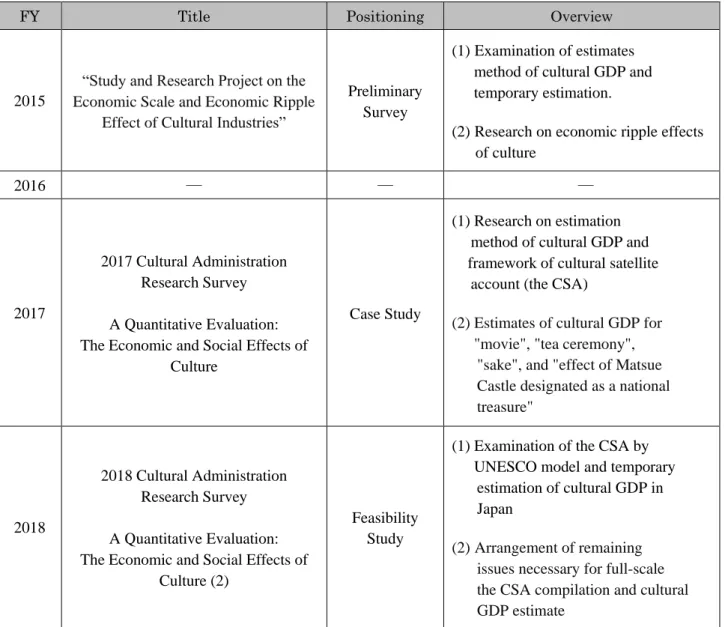
In Japan, beginning with the “Study and Research Project on the Economic Scale and Economic Ripple Effect of Cultural Industries” conducted in 2015, this approach has been implemented in stages as a series of research projects and studies. (Table 1) The approximate size of the cultural industry in Japan was estimated through survey research in FY2015. In the research studies in FY2017 and FY2018, we constructed the CSA framework encompassing the realities of cultural and economic statistics in Japan, adapting it to the CSA model presented by UNESCO. We then conducted case studies and feasibility studies using more detailed estimates of cultural GDP.
These studies were conducted with the advice and supervision of experts in culture, economy, statistics and other relevant areas.
Through these efforts, a Cultural Satellite Account (the CSA) employing quantitative evaluation methods for the economic and social efforts of culture in Japan has achieved results that conform to international standards. The future challenge lies in determining ways to promote a "cultural and artistic nation" by further developing, and measuring wide-ranging ripple effects on tourism promotion, regional revitalization, and cultural and educational industry development. To that end, it is necessary to develop a foundation for cultural and economic statistics centered on the CSA. The CSA is a fundamental source for such cultural policies.
2
Table 1 Background of studies for “A Quantitative Evaluation: The Economic and Social Effects of Culture”
FY Title Positioning Overview
2015
“Study and Research Project on the Economic Scale and Economic Ripple
Effect of Cultural Industries”
Preliminary Survey
(1) Examination of estimates method of cultural GDP and temporary estimation.
(2) Research on economic ripple effects of culture
2016 ― ― ―
2017
2017 Cultural Administration Research Survey A Quantitative Evaluation:
The Economic and Social Effects of Culture
Case Study
(1) Research on estimation method of cultural GDP and
framework of cultural satellite account (the CSA)
(2) Estimates of cultural GDP for "movie", "tea ceremony", "sake", and "effect of Matsue Castle designated as a national treasure"
2018
2018 Cultural Administration Research Survey A Quantitative Evaluation:
The Economic and Social Effects of Culture (2)
Feasibility Study
(1) Examination of the CSA by UNESCO model and temporary estimation of cultural GDP in Japan
(2) Arrangement of remaining issues necessary for full-scale the CSA compilation and cultural GDP estimate
*The Japanese versions: 2015, 2017 and 2018; and English versions: 2017 and 2018 of the survey reports can be referenced at the following URL.
https://www.bunka.go.jp/tokei_hakusho_shuppan/tokeichosa/bunka_gyosei/index.html No survey was conducted in 2016.
3
2. Outline of the survey
In this fiscal year,
we engaged in the survey of the following issues. These issues were set based on the results of previous surveys.
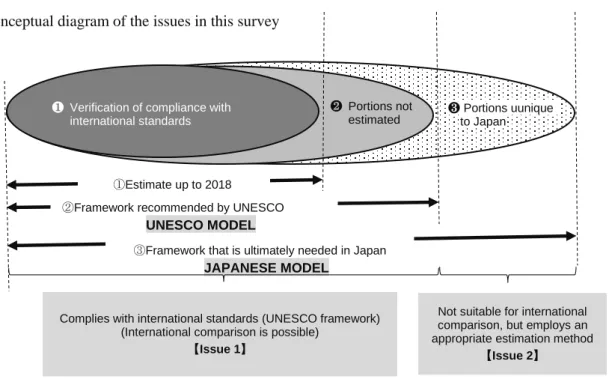
【Issue 1】Monitoring Japan’s provisional estimate in 2018 based on international standards, completion of portions that have not yet been estimated, and improvement of completion.
(1) International monitoring of compliance with international standards
Verification of whether the estimation method of the previously estimated part conforms to the method recommended by UNESCO.
(2) Completion of portions not yet estimated
Confirmation of classifications and methods for estimating portions that cannot be estimated within the cultural framework recommended by UNESCO.
【Issue 2】Global feedback of Japan's approach to the CSA expansion for further enhancement of the CSA.
(3) Establishing (defining) portions unique to Japan and evaluating them
In the quantitative evaluation of culture required by Japan, it is necessary to add portions unique to Japan to the CSA framework presented by UNESCO. Evaluation and monitoring are required to determine whether the concepts and methods of quantification are appropriate for international standards.
By clarifying “Issue 1”, it is possible to estimate cultural GDP that conforms to the international standards recommended by UNESCO (UNESCO model) and enable international comparison. In addition, by clarifying “Issue 2”, it is possible to establish the larger framework of the CSA (Japanese model) required by Japan, and to estimate the unique portions of Japan's cultural GDP.
Figure 1 Conceptual diagram of the issues in this survey
②Framework recommended by UNESCO UNESCO MODEL
①Estimate up to 2018
③Framework that is ultimately needed in Japan JAPANESE MODEL
日本モデル
❶ Verification of compliance with international standards
❸ Portions uunique to Japan
❷ Portions not estimated
Complies with international standards (UNESCO framework) (International comparison is possible)
【Issue 1】
Not suitable for international comparison, but employs an appropriate estimation method
【Issue 2】
4
3. Survey content and method
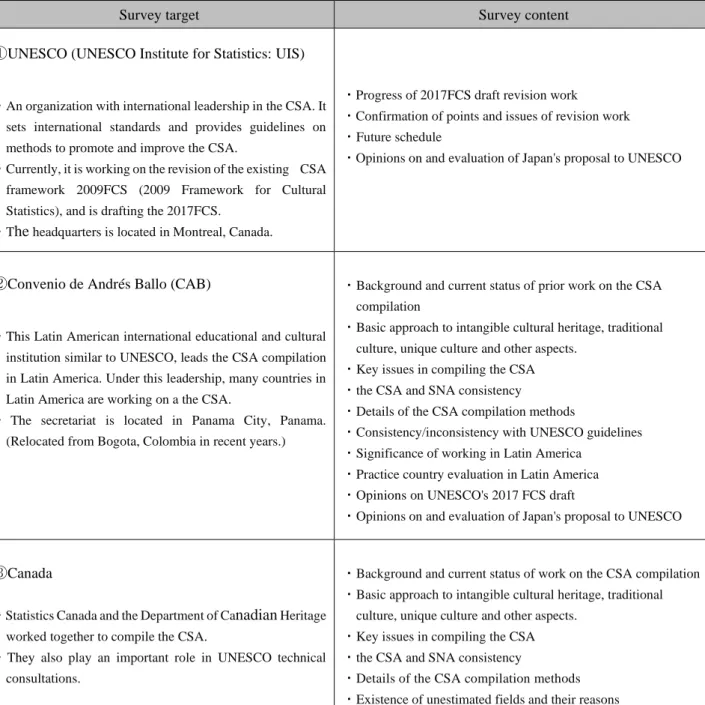
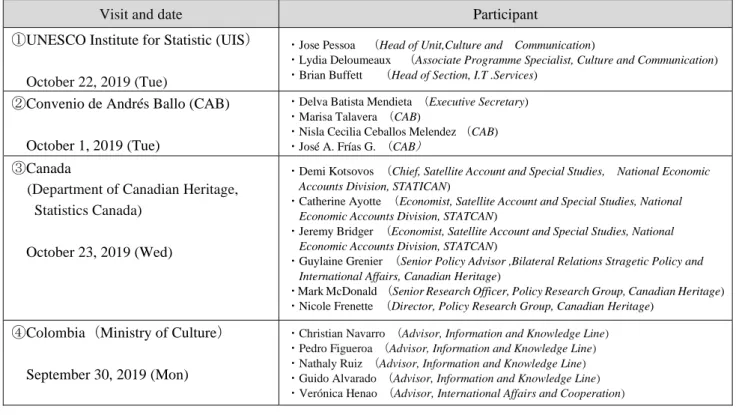
To achieve research objectives, we surveyed the current situation of two international institutions: the UNESCO Institute for Statistics (UIS) and the CAB (Convenio de Andrés Ballo) in Latin America, and two countries:
Canada and Colombia, leading the development of CSA. The contents of the survey are shown in the table below.
Table 2 Survey targets and content
Survey target Survey content
①UNESCO (UNESCO Institute for Statistics: UIS)
・An organization with international leadership in the CSA. It sets international standards and provides guidelines on methods to promote and improve the CSA.
・Currently, it is working on the revision of the existing CSA framework 2009FCS (2009 Framework for Cultural Statistics), and is drafting the 2017FCS.
・The headquarters is located in Montreal, Canada.
・Progress of 2017FCS draft revision work
・Confirmation of points and issues of revision work
・Future schedule
・Opinions on and evaluation of Japan's proposal to UNESCO
②Convenio de Andrés Ballo (CAB)
・This Latin American international educational and cultural institution similar to UNESCO, leads the CSA compilation in Latin America. Under this leadership, many countries in Latin America are working on a the CSA.
・The secretariat is located in Panama City, Panama.
(Relocated from Bogota, Colombia in recent years.)
・Background and current status of prior work on the CSA compilation
・Basic approach to intangible cultural heritage, traditional culture, unique culture and other aspects.
・Key issues in compiling the CSA
・the CSA and SNA consistency
・Details of the CSA compilation methods
・Consistency/inconsistency with UNESCO guidelines
・Significance of working in Latin America
・Practice country evaluation in Latin America
・Opinions on UNESCO's 2017 FCS draft
・Opinions on and evaluation of Japan's proposal to UNESCO
③Canada
・Statistics Canada and the Department of Canadian Heritage worked together to compile the CSA.
・They also play an important role in UNESCO technical consultations.
・Background and current status of work on the CSA compilation
・Basic approach to intangible cultural heritage, traditional culture, unique culture and other aspects.
・Key issues in compiling the CSA
・the CSA and SNA consistency
・Details of the CSA compilation methods
・Existence of unestimated fields and their reasons
・Consistency/inconsistency with UNESCO guidelines
・Future schedule
・Evaluation of other working countries
・Opinions on UNESCO's 2017 FCS draft
・Opinion and evaluation on Japan's proposal to UNESCO
5
④Colombia
・Colombia is one of the first countries in Latin America to actively work on the CSA compilation and played a major role in the CAB.
・Background and current status of work on the CSA compilation
・Basic approach to intangible cultural heritage, traditional culture, unique culture and other aspects.
・Key issues in compiling the CSA
・Regarding consistency between the CSA and SNA
・Details of the CSA compilation methods
・Existence of fields not yet estimated and reasons
・Consistency/inconsistency with UNESCO guidelines
・Future schedule
・Evaluation of other working countries
・Opinions on UNESCO's 2017 FCS draft
・Opinions on and evaluation of Japan's proposal to UNESCO
Table 3 Overview of surveys
Visit and date Participant
①UNESCO Institute for Statistic (UIS)
October 22, 2019 (Tue)
・Jose Pessoa (Head of Unit,Culture and Communication)
・Lydia Deloumeaux (Associate Programme Specialist, Culture and Communication)
・Brian Buffett (Head of Section, I.T .Services)
②Convenio de Andrés Ballo (CAB) October 1, 2019 (Tue)
・Delva Batista Mendieta (Executive Secretary)
・Marisa Talavera (CAB)
・Nisla Cecilia Ceballos Melendez (CAB)
・José A. Frías G. (CAB)
③Canada
(Department of Canadian Heritage, Statistics Canada)
October 23, 2019 (Wed)
・Demi Kotsovos (Chief, Satellite Account and Special Studies, National Economic Accounts Division, STATICAN)
・Catherine Ayotte (Economist, Satellite Account and Special Studies, National Economic Accounts Division, STATCAN)
・Jeremy Bridger (Economist, Satellite Account and Special Studies, National Economic Accounts Division, STATCAN)
・Guylaine Grenier (Senior Policy Advisor ,Bilateral Relations Stragetic Policy and International Affairs, Canadian Heritage)
・Mark McDonald (Senior Research Officer, Policy Research Group, Canadian Heritage)
・Nicole Frenette (Director, Policy Research Group, Canadian Heritage)
④Colombia(Ministry of Culture)
September 30, 2019 (Mon)
・Christian Navarro (Advisor, Information and Knowledge Line)
・Pedro Figueroa (Advisor, Information and Knowledge Line)
・Nathaly Ruiz (Advisor, Information and Knowledge Line)
・Guido Alvarado (Advisor, Information and Knowledge Line)
・Verónica Henao (Advisor, International Affairs and Cooperation)
<Researchers of international aspects> (Alphabetical order)
Person in charge (affiliation) Target
AOSHIBA, Masaru (Policy Coordination and Policy Research Group
Headquarters for Vitalizing Regional Cultures, Agency for Cultural Affairs) CAB, Colombia FUJIKAWA, Kiyoshi (Member of survey committee, (Professor, Nagoya
University Organization for Asian Creative Education: Economic Statistics)
UIS, CAB, Canada, Colombia KAWAI, Mitsuo (Communication Design Institute) UIS, CAB, Canada, Colombia OKUDA, Akimi (Policy Coordination and Policy Research Group
Headquarters for Vitalizing Regional Cultures, Agency for Cultural Affairs) UIS, Canada
6
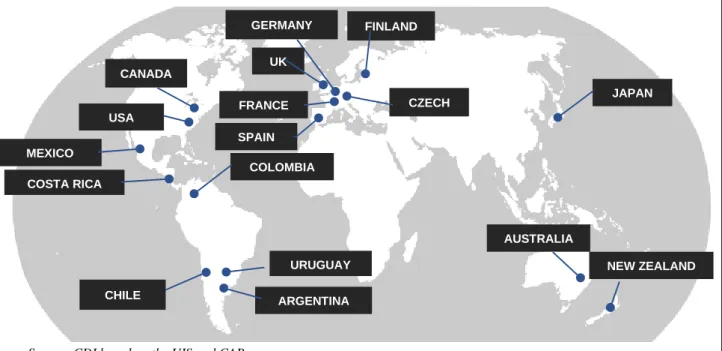
Countries that have already compiled the CSA include North, Central and South American countries, some European countries, and Australia and New Zealand. The USA, Canada, Finland, Spain, Australia and New Zealand are based on the experience of compiling tourism satellite accounts (TSA), while the UK and France are based on creative industry theory. In Latin America (including Spain), the CSA was compiled under the leadership of CAB in collaboration with UNESCO.
Figure 2 World the CSA compilation status
Source: CDI based on the UIS and CAB sources
Of these compiled countries, some are continuously being estimated or revised, while others are stopped at some point. Some countries are also starting to compile. South America, such as Bolivia, Brazil, and Paraguay, and Portugal are in the process of being compiled.
Compiling the CSA is said to take at least 1-2 years. However, many countries take more than three years depending on their statistical environment, financial situation, and political situation. In some cases, efforts may not be continued.
As shown in the map above, no Asian country is working on the CSA compilation. Japan is the first country.
Some Asian countries have begun to consider developing cultural statistics, but are still far from compiling the CSA.1
1 Information provided by the UIS. In this consultation with the UIS, the UIS evaluated that it was desirable and meaningful that Japan support the compilation of the CSA in other Asian countries and areas.
Column 1 World CSA compilation status
SPAIN
URUGUAY ARGENTINA CHILE
COLOMBIA COSTA RICA
USA
AUSTRALIA CANADA
GERMANY
MEXICO
FRANCE
JAPAN
NEW ZEALAND CZECH
UK
FINLAND
7
The figure below compares the cultural GDP of each country based on the data published by each country.
However, it is important to keep in mind that the composition of the CSA domains (areas) varies from country to country, as shown in “Column 3: Domain establishing in the world” (p.17-18).
The USA, the UK, and Australia use the concept of "creative industries" to broaden the scope of cultural industries. These countries also include manufactured goods such as clothing and furniture. For this reason, the service and manufacturing industries are more widely incorporated as cultural industries than other countries. In Finland, recreation departments such as amusement parks are incorporated, and the range is wider than the UNESCO model.
In addition to these differences in concept and scope, it should also be noted that countries have different estimated years. With these in mind, the chart below can be viewed as a rough overview.
Figure 3 Cultural GDP of each country (Unit: 100 million USD)
Source: Created by CDI based on reports from the UIS, CAB, and countries
Figure 4 Cultural GDP as a percentage of national GDP in each country
Source: Created by CDI based on reports from the UIS, CAB, and countries 0.6
8.6 8.6 17.9 20.0 32.4 33.4 40.0
52.8 81.7
91.7 92.3
157.9
763.6
0 100 200 300 400 500 600 700 800 900
Uruguay Finland Colombia Argentina Costa Rica Mexico Spain Australia Canada Germany France Japan UK USA
Column 2 Cultural GDP in the world
1.9%
1.9%
2.0%
2.4%
2.5%
2.7%
3.2%
3.2%
3.2%
3.4%
3.4%
4.0%
4.2%
5.2%
0% 1% 2% 3% 4% 5% 6%
Japan Uruguay Costa Rica Germany Spain Mexico France Canada Colombia Argentina Finland Australia USA UK
8
Table 4 Ratio of cultural GDP to total national GDP in each country
Country Ratio of cultural GDP to national GDP (%) Year of estimate
UK 5.2 2014
USA 4.2 2015
Australia 4.0 2009
Argentina 3.4 2011
Finland 3.2 2017
France 3.2 2011
Colombia 3.2 2018
Canada 3.2 2017
Mexico 2.7 2012
Spain 2.5 2012
Germany 2.4 2010
Costa Rica 2.0 2014
Uruguay 1.9 2008
Japan 1.9 2016
Source: Created by CDI based on reports from the UIS, CAB, and countries
As described below, the estimated value of Japan's cultural GDP is a "temporary estimate" because it does not estimate all constituent domains of the UNESCO model. However, estimates for major fields have already been made. Therefore, by estimating cultural GDP as shown in these charts, the relationship between culture and economy can be quantified and understood, and further compared internationally.
It can be seen that the characteristic of Japan is that, compared to other countries, the value of cultural GDP is high, but the ratio to GDP is low. Furthermore, by inferring from these figures the reason why Japan's figures are like this and why they have such characteristics, the relationship between culture and economy can be seen more deeply.
The various results that can be obtained from such international comparisons are based on the relationship between culture and economy, or the social positioning of culture. This will be the basis for the planning and evaluation of Japan's cultural policy in the future. Since this base is quantified, it serves as a concrete and easy-to- share index. This is the significance of the CSA compilation.
9
Chapter 1: Basic the UIS Policy
1. The UIS policy on compliance with international standards
1.1 Outline of issue 1
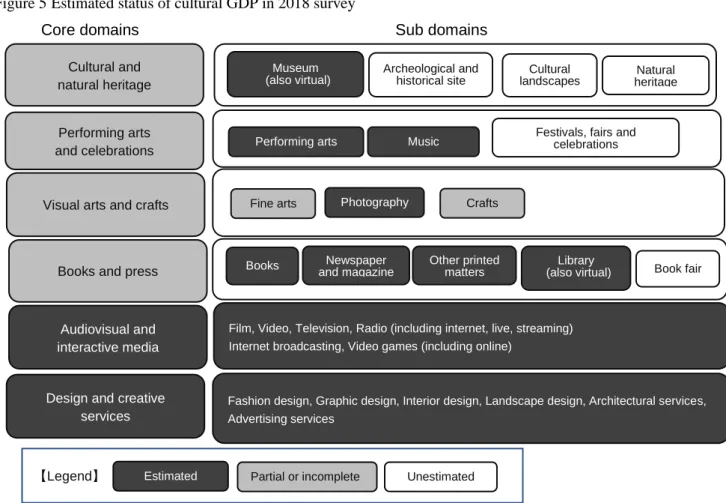
Figure 5 shows the estimated situation of Japan's cultural GDP in 2018 survey according to the cultural framework shown by UNESCO. At present, the estimate of Japan's cultural GDP does not completely cover the UNESCO cultural framework as shown in this figure. It is necessary to continue estimating the unestimated portions and the incomplete sectors so that the estimates of Japan's cultural GDP can be internationally compared with higher accuracy.
Figure 5 Estimated status of cultural GDP in 2018 survey
Core domains Sub domains
Source: 2018 Cultural Administration Research Survey “A Quantitative Evaluation: The Economic and Social Effects of Culture (2)”
(CDI) Cultural and natural heritage
Performing arts and celebrations
Visual arts and crafts
Books and press
Audiovisual and interactive media
Design and creative services
Film, Video, Television, Radio (including internet, live, streaming) Internet broadcasting, Video games (including online)
Fashion design, Graphic design, Interior design, Landscape design, Architectural services, Advertising services
Archeological and historical site Museum
(also virtual) Cultural
landscapes Natural heritage
Performing arts Music Festivals, fairs and
celebrations
Fine arts Photography Crafts
Books Newspaper
and magazine
Other printed matters
Library
(also virtual) Book fair
Estimated Partial or incomplete Unestimated
【Legend】
10
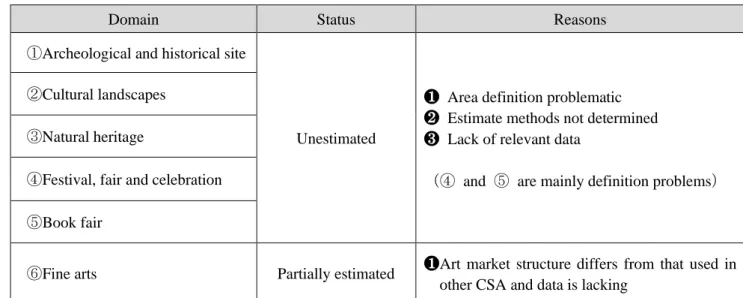
The reasons for unestimated portions in the estimate of cultural GDP in 2018 survey are as follows.
Table 5 Unestimated domains and reasons
Domain Status Reasons
①Archeological and historical site
Unestimated
❶ Area definition problematic
❷ Estimate methods not determined
❸ Lack of relevant data
(④ and ⑤ are mainly definition problems)
②Cultural landscapes
③Natural heritage
④Festival, fair and celebration
⑤Book fair
⑥Fine arts Partially estimated ❶Art market structure differs from that used in other CSA and data is lacking
Source: 2018 Cultural Administration Research Survey “A Quantitative Evaluation: The Economic and Social Effects of Culture(2)”
(CDI)
1.2
Issues regarding frameworks and methods
The problems related to the unestimated portions can be broadly divided into cultural framework and estimate method issues.
A. Examples of cultural framework issues
(1) To what extent do UNESCO's “festivals, fairs, and celebrations” specifically include?
(2) The "book fair" subdomain is a less common area in Japan. How is this domain processed?
(3) What is the classification/range of “Archeological and historic sites”, “Cultural landscapes”, and “Natural heritage”?
(4) To what extent does the "crafts" domain include products?
B. Examples of estimate method issues
(1) How can we clarify methods for estimating the cultural GDP of “Archeological and historic sites”, “Cultural landscapes”, and “Natural heritage” that are not goods traded in the market?
(2) How can we refigure the processing method for fine arts detailed in the UNESCO model to suit the product data of Japan? How can we apply the UNESCO methods to the Japanese art trading system.
11 1.3 The UIS's view on the framework
It is the UIS that presents international rules and standards regarding international frameworks and methods for the issues mentioned above. Through discussions with the UIS, the following points became clear.
(1) The UIS’s FCS is a flexible framework
The positioning of the cultural framework presented by the UIS is shown in 2009FCS. The 2009FCS is designed to be adaptable to the situation of each country, and can correspond to the country to country variation in statistical availability. The flexibility of FCS presented by UNESCO remains unchanged after the revision.
The cultural framework presented by the UIS, which is the standard for the CSA in many countries around the world, is not a “rule” that must be observed, but a “guideline” that should be kept in mind. Although the UIS recommends that each country compile the CSA according to the guidelines, in actual CSA compilation, each country can compile the CSA in conjunction with situations and conditions presenting in their cultural environments.
With regard to the above, the supplementary perspective of the UIS is as follows.
The ability to collect and enhance cultural statistics varies greatly depending on the policy priorities of each country, the level of statistical expertise, and the extent and level of human and financial sources involved.
Therefore, UNESCO's FCS is designed to flexibly adapt to the various situations of each country.
In a country that does not have a sufficient cultural framework in domestic statistics, the basic structure of FCS may not be traced strictly, so it should be incorporated as appropriate. On the other hand, in countries with high statistical capacity and well-established statistical environments, more detailed statistics are collected using more finely tuned or specialized statistical tools to reflect policy priorities in culture. By doing so, a more accurate CSA can be created.
UNESCO's FCS seeks to be a flexible framework and enhances comparability within certain criteria. At the same time, it aims to help countries build their own cultural frameworks. Therefore, it does not prevent the adoption of FCS's own definition related to each domain of each country or the estimate based on data from each country's own surveys. The estimates of each domain may be used as internationally comparable ones.
The UIS Perspective
12 (2) Basics for international comparison
The 2009FCS has a flexible framework that makes it easier for each country to compile a CSA. However, if it is too flexible and each country creates its own CSA, international comparison will not be possible. Flexibility and international comparability are contradictory factors.
In this regard, the UIS seeks to ensure international standards by linking the CSA to existing international statistical classification systems. In other words, the UIS seeks to ensure comparability and standardization of levels in industries and products that connect with cultural domains, rather than the interpretation of cultural domains.
(3) The 2009FCS is not the final version
From the UIS's perspective, the 2009FCS is not the final version and should continue to be improved.
Therefore, it is necessary to continue to promote the development of FCS through international cooperation and the efforts of each country.
The 2009FCS includes all existing relevant international statistical classification systems and standards.
Therefore, it is possible to compare data between countries and make the best use of existing research to measure culture. These classification systems provide a comprehensive framework for collecting and disseminating cultural data in each country. It can also serve as a guideline for measuring cultural activities, goods and services using standard economic statistics and labor force surveys, censuses and household surveys.
The 2009FCS does not define or propose any particular fixed indicator. The development of indicators relevant to the framework of cultural indicators is the next important step at national and international levels.
The current 2009FCS provides a conceptual basis for evaluating the economic and social contribution of culture. It also serves as a tool to help UNESCO member countries promote the collection and dissemination of cultural statistics. The 2009FCS will also enable the creation of national and international data for use by a global community of cultural data users such as UNESCO and many international organizations.
The UIS Perspective
The UIS Perspective
13
1.4 The UIS opinions on the CSA framework and methodology in Japan
(1) Archeological and historical sites, cultural landscapes, cultural and natural heritage
Classifications and definitions differ depending on the legal system and concept of each country. Each country can set the framework depending on its legal system or concept. The estimation method for this domain is still under discussion at the UIS, and it is necessary to observe the progress and respond accordingly. However, since the input method assumed in the UIS is the estimation method used for public services such as museums and libraries, it is appropriate to use this method for estimates at this stage. In countries around the world, this input method is used in cultural heritage domains as well as museums and libraries.
(2) Festival, fair and celebration
The specific content of this domain varies from country to country. Each country should define and code this subdomain to determine whether it should be included in the international or domestic version of the CSA.
(3) Book fairs
This subdomain may be deleted if it does not fit the actual situation of the country.
(4) Fine arts
It was suggested that the estimation method may be adapted to the actual situation in each country. In Japan, the applicable economic statistics in this field are insufficient, and the estimate in FY2018 was treated as a provisional one. For the time being, it is necessary to study more elaborate estimation methods while responding to the estimation methods of FY2018.
(5) "Architectural services (architectural design)" and "textile design" in the design domain
In Japan, the architectural design industry is integrated in the form of a so-called “general contractor”, which is a major building industry. In addition, fashion design and textile design are often internal tasks of apparel manufacturers, and it is difficult to separate them. However, for these subdomains as well, there was a suggestion that a method may be developed according to the actual situation and statistical environment of each country, or that each country may use a method suited to the actual situation.
(6) Crafts
The production data of various products (commodities) exemplified in the “Crafts” domain of the UNESCO framework cannot be extracted from industrial statistics in Japan. The only item that can be extracted from this domain is "jewelry". However, it is clear that in Japan there is a wide variety of "crafts" including traditional ones.
In the FY2018 estimate, pottery painting, cloisonné, Japanese paper and many other example of applied art, which are considered to be important as crafts in Japan for which data can be extracted, have also been added to the estimate. If concrete products that differ from country to country are put into or taken out of the framework, problems may arise in international comparison. However, in this regard, the UIS's view was that it was inevitable.
14
In addition, as mentioned above, this did not cause the results to change significantly, and the view was that it would function within the “flexibility” of the framework.
Regarding crafts, the 2009FCS reference materials list a large number of metal crafts, pottery, textiles, wood crafts, basket weavers, etc. These are based on internationally traded items. However, in the current revision work, there is a tendency to limit these items. However, rather than products, manufacturing methods (hand- crafting, mechanical production, mass production, etc.) are being discussed.
The background of this discussion may be related to the International Labour Organization (ILO). There are many people who are engaged in handicrafts in the world, and this cannot be ignored from the viewpoint of employment in developing countries. In Mexico, where crafts make up a large proportion, crafts are very important, and in Colombia, a subdomain called "toys" is used. Conversely, many European countries do not put craft into the cultural realm. In France, there is a category called “art craft”, but this is limited to products that are purely art-related. In Japan, there is no appropriate product classification equivalent to CPC. Also, when using trade-related product categories, work is required to adapt them to the product categories.
Due to these factors, discussion on craft is ongoing, and it is necessary to make an estimate while paying attention to future trends and keeping in line with Japan's statistical realities.
(7)Supplementary explanation
In this study, the UIS pointed out that the issues noted by Japan involve domains that were challenging during CSA development (traditional festivals, traditional crafts and other “non-market” indicators). Discussions on these issues are ongoing. According to UIS comments, these findings and issues Japan raised, mainly regarding the framework, will be included in their revision discussions.
The input method is also used for estimating intangible cultural heritage and various public sectors. Japan's estimates also use this method for public sector museums and libraries.
The method for estimating intangible heritage suggested by Japan is still being tested. As for other satellite accounts, such as environmental satellite accounts, TSA, health care satellite accounts and NPO satellite accounts, it is thought necessary to first verify this method by using it as a reference. The UIS also states that accurate estimation of “non-market inputs” is one of the challenges they have identified in taking the CSA to the next level of development.
15
2. UIS policy on establishing specific and domestic domains
2.1 Why is the specific and domestic domain necessary?
(1) View of this survey
In the previous section, we examined how to adjust concrete content while maintaining the cultural framework recommended by UNESCO. This section looks at attempts to further expand the cultural framework recommended by UNESCO. In order for the CSA to function as a more effective tool for numerically evaluating the economic and social impacts of culture in line with the overall conditions and realities of Japan's culture, it is necessary to expand the cultural framework. This is one of the main views of this survey.
In particular, areas related to "intangible culture" should be emphasized as new areas. One example of this is
"Japanese cuisine (Washoku) " (Japanese cuisine as living traditional Japanese culture). “Washoku” is registered as an intangible cultural heritage by UNESCO. In addition to the above, the world's registered intangible cultural heritage includes French gastronomy, the Mediterranean diet, Mexican, Malawi and Tajikistani traditional dishes, Turkish coffee culture and traditions. These target intangible traditions and customs, and do not recognize ingredients, or resulting foods, as culture.
An example of intangible cultural heritage other than food culture, is festivals and fairs. In Japan, many festivals such as Gion Festival in Kyoto and the Hakata Gion Yamakasa event are registered as UNESCO Intangible Cultural Heritage. Various traditional performing arts and customs/folklore are going to be added to the list. In addition, Japan has areas of "lifestyle culture" such as tea ceremony, flower arrangement, kimono and much more.
In order to adapt the CSA to the actual situation in Japan, it is necessary to consider these areas as culture, quantify them and add them to the framework of culture. In fact, Latin American actors such as CAB and Colombia are trying to incorporate food as a culture into the CSA. This survey recommends quantifying the value of intangible culture such as food culture and estimating the cultural GDP as a part of the CSA.
(2) View of the UIS
The UIS recognizes that in many developing countries, culture is mainly intangible. In order for the CSA to cope with cultural diversity, the UIS recognizes that it is necessary to appropriately incorporate such intangible culture into the CSA, and the UIS is sympathetic to the view of this survey.
Behind such UIS recognition is the process that resulted in the 2009FCS. Originally, prior to the 2009FCS, there was the 1986FCS2, but because the review of the 1986FCS was devised mainly by developed UNESCO member countries, the intentions of developing countries were not well reflected. The 2009FCS, an updated version of the 1986FCS, corrects this point and takes into account the needs of developing countries. A specific feature of the 2009FCS is the recognition that it is appropriate to incorporate elements such as intangible cultural heritage and non- market economies. At the same time, it is also characterized by its thorough consideration of feasibility and cultural diversity.
2 For the differences between 1986FCS and 2009FCS, see, for example, Nagasawa (2014).
16
However, regarding intangible cultural heritage, there is no suitable economic product or activity that can be targeted/quantified by the CSA, so it tends to be excluded from the CSA estimate at the stage of methodological study. It is because of this background that the UIS is attentive to the positive approach to intangible culture and lifestyle culture that is reemphasized in this survey.
Discussions on intangible culture continued at the 2018UIS/TAG Kamakura Meeting in Tokyo. In addition, at this meeting, a study (2017 Survey) on methods from Japan was presented. This process has revived the debate about intangible culture.
2.2 Establishing specific domains in domestic versions of the CSA
If, however, each country adds its own domain using its own framework and standards, international comparison becomes impossible. In fact, such a situation occurred with the environmental satellite account when the estimation standards differed from country to country, making it impossible to make international comparisons.
Eventually, from the perspective of the global community, its utility was lost.
In order to avoid such a case, it is possible to establish two versions, one for international comparison and a second for domestic policy. In fact, the UIS already recognizes these two versions. For the domestic version, the classification and methods may be more flexible, but for the international version, it is necessary for estimates to adhere to some standards or guidelines. In addition, in the international comparison, it is necessary to clearly describe how each country applied the framework recommended by UNESCO.
The UNESCO framework is designed to enable international comparisons. At the same time, this framework aims to function as a flexible model that attempts to integrate the different cultural perspectives of each country. The framework can be used flexibly with modifications in ways that reflect the circumstances and perspectives of each country provided caution is used when making international comparisons.
Also, when adding a new domain to the domestic policy version of the CSA, strict coding must be used to organize data in a specific way. This is important to avoid double counting and overestimations.
17
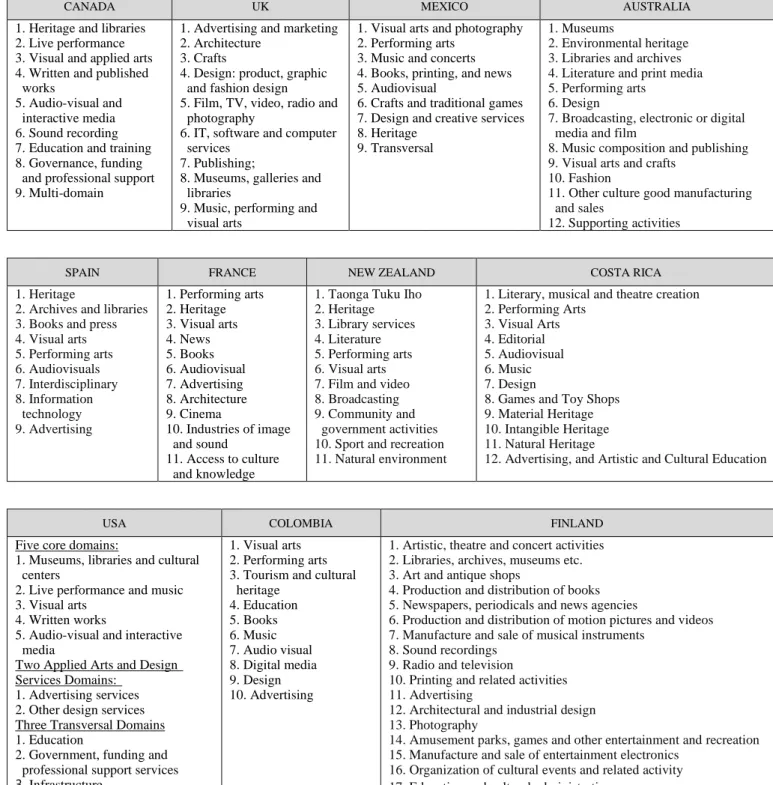
The establishment of a cultural framework (FCS) by and for the CSA precedent countries are based on UNESCO FCS in many cases. However, there are countries that are not so. The diverse is as shown below.
Table 6 Domain comparison of the CSA in preceding countries ①
CANADA UK MEXICO AUSTRALIA
1. Heritage and libraries 2. Live performance 3. Visual and applied arts 4. Written and published
works
5. Audio-visual and interactive media 6. Sound recording 7. Education and training 8. Governance, funding
and professional support 9. Multi-domain
1. Advertising and marketing 2. Architecture
3. Crafts
4. Design: product, graphic and fashion design 5. Film, TV, video, radio and
photography
6. IT, software and computer services
7. Publishing;
8. Museums, galleries and libraries
9. Music, performing and visual arts
1. Visual arts and photography 2. Performing arts
3. Music and concerts 4. Books, printing, and news 5. Audiovisual
6. Crafts and traditional games 7. Design and creative services 8. Heritage
9. Transversal
1. Museums
2. Environmental heritage 3. Libraries and archives 4. Literature and print media 5. Performing arts
6. Design
7. Broadcasting, electronic or digital media and film
8. Music composition and publishing 9. Visual arts and crafts
10. Fashion
11. Other culture good manufacturing and sales
12. Supporting activities
SPAIN FRANCE NEW ZEALAND COSTA RICA
1. Heritage
2. Archives and libraries 3. Books and press 4. Visual arts 5. Performing arts 6. Audiovisuals 7. Interdisciplinary 8. Information
technology 9. Advertising
1. Performing arts 2. Heritage 3. Visual arts 4. News 5. Books 6. Audiovisual 7. Advertising 8. Architecture 9. Cinema
10. Industries of image and sound
11. Access to culture and knowledge
1. Taonga Tuku Iho 2. Heritage 3. Library services 4. Literature 5. Performing arts 6. Visual arts 7. Film and video 8. Broadcasting 9. Community and
government activities 10. Sport and recreation 11. Natural environment
1. Literary, musical and theatre creation 2. Performing Arts
3. Visual Arts 4. Editorial 5. Audiovisual 6. Music 7. Design
8. Games and Toy Shops 9. Material Heritage 10. Intangible Heritage 11. Natural Heritage
12. Advertising, and Artistic and Cultural Education
USA COLOMBIA FINLAND
Five core domains:
1. Museums, libraries and cultural centers
2. Live performance and music 3. Visual arts
4. Written works
5. Audio-visual and interactive media
Two Applied Arts and Design Services Domains:
1. Advertising services 2. Other design services Three Transversal Domains 1. Education
2. Government, funding and professional support services 3. Infrastructure
1. Visual arts 2. Performing arts 3. Tourism and cultural
heritage 4. Education 5. Books 6. Music 7. Audio visual 8. Digital media 9. Design 10. Advertising
1. Artistic, theatre and concert activities 2. Libraries, archives, museums etc.
3. Art and antique shops
4. Production and distribution of books 5. Newspapers, periodicals and news agencies
6. Production and distribution of motion pictures and videos 7. Manufacture and sale of musical instruments
8. Sound recordings 9. Radio and television
10. Printing and related activities 11. Advertising
12. Architectural and industrial design 13. Photography
14. Amusement parks, games and other entertainment and recreation 15. Manufacture and sale of entertainment electronics
16. Organization of cultural events and related activity 17. Education and cultural administration
Source: “Measuring the Economic Importance of Culture: An Examination of International Methodologies”
(Department of Canadian Heritage 2016) Column 3 Domain establishing in the world
18
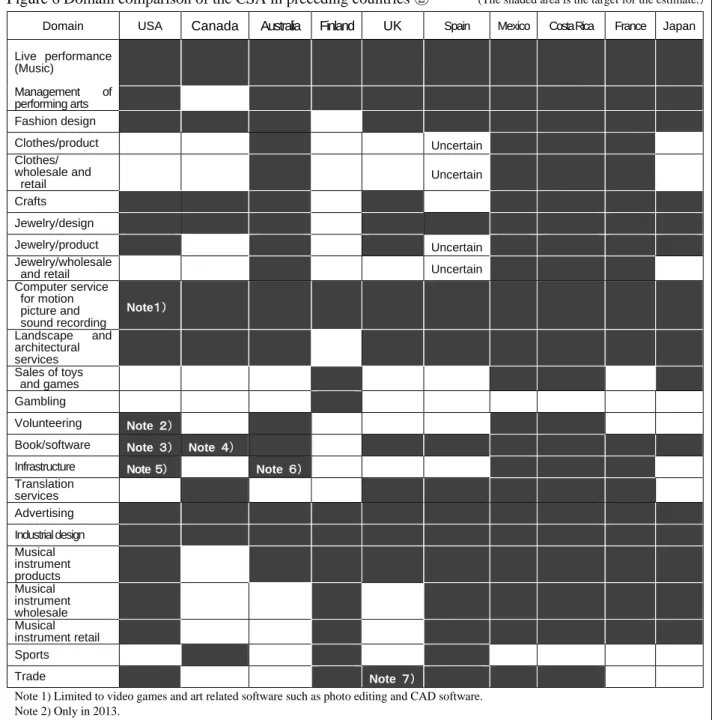
The table below shows a comparison of these. The years they were created are not consistent.
Figure 6 Domain comparison of the CSA in preceding countries ②
Domain USA Canada Australia Finland UK Spain Mexico Costa Rica France Japan
Live performance (Music)
Management of
performing arts
Fashion design
Clothes/product Uncertain
Clothes/
wholesale and
retail Uncertain
Crafts
Jewelry/design
Jewelry/product Uncertain
Jewelry/wholesale
and retail Uncertain
Computer service for motion picture and sound recording
Note1)
Landscape and architectural
services
Sales of toys
and games
Gambling
Volunteering Note 2)
Book/software Note 3) Note 4)
Infrastructure Note 5) Note 6)
Translation
services
Advertising
Industrial design
Musical instrument
products
Musical instrument
wholesale
Musical
instrument retail
Sports
Trade Note 7)
Note 1) Limited to video games and art related software such as photo editing and CAD software.
Note 2) Only in 2013.
Note 3) Limited to games and art related software such as photo processing software.
Note 4) Limited.
Note 5) Limited to art and cultural facility construction.
Note 6) Only the cultural/creative part.
Note 7) Service export only. It does not include the export of goods.
* "Uncertain" No response to the inquiry from the Canadian Department of Cultural Heritage.
Source: Made by CDI based on “Measuring the Economic Importance of Culture: An Examination of International Methodologies”(Department of Canadian Heritage 2016)
(The shaded area is the target for the estimate.)
)
19 2.3 Specific domain estimation methods
Lifestyle culture, such as food culture, is often intangible culture, so it is difficult to quantify using the conventional the CSA method recommended by the UIS. UNESCO's 2009FCS incorporates the area of intangible culture as “Transversal domains”. However, the specific estimation method is recognized as being in a shelved state or already incorporated into another domain as a tangible cultural product, in advance or automatically. The ideas that traditional techniques are included in crafts, and traditional performing arts and music performed at festivals are included in performing arts are examples of this. Even in leading countries, this domain is not emphasized.
For this reason, we find the estimation of intangible culture is not being actively promoted by the UIS. This is because conventional methods cannot be used and attempting to estimate from the production side is difficult,.
In the 2017 survey, an attempt was made to estimate the cultural GDP of tea ceremony, which is a “lifestyle culture” close to intangible culture. The process of this estimation was as follows.3
(1) A survey of the consumption by people who engage in tea ceremony activities. (Sample survey) (2) Extraction of tea ceremony activity population and activity frequency. (Social life general survey, etc.) (3) Estimating final consumption by tea ceremony activities. ( (1) x (2) )
(4) Conversion of consumption to production using the Leontief inverse matrix.
(5) Estimated value added from production value.
The UIS's views and evaluations on this method were as follows.
(1) This consultation has just begun and requires further discussion in the future. Depending on the results of the consultation, there may be an approach from the demand side as well as the production side for certain domains.
Currently, the UIS recognizes the problem and that there is no definite answer regarding a method to deal with it.
(2) Ideally, UNESCO could include this issue in its recommendations if it is discussed in the future and international standards are established. It may be necessary to provide guidance for each country.
(3) There are costs in maintaining and implementing festivals which can be used for production side estimate. On the other hand, at a festival, people consume food, providing consumption side data. The festival has both aspects. At this stage, there is no conclusion as to whether to estimate the festival production value alone, or both production and consumption. At least for the time being, Japan is the only country capturing festivals and
3 For details, refer to the "2017 Cultural Administration Research Survey A Quantitative Evaluation: The Economic and Social Effects of Culture” (2018 CDI)
The UIS Perspective
20
other intangible cultural heritage data from the demand side. However, we acknowledge the importance of this issue and the possibilities of such an approach. This Japanese proposal is innovative and, if successful, will be the first to be implemented in the world.
(4) The major challenge of this theme is that the CSA needs to stay within the scope of the SNA. Therefore, the CSA approach has to be more rigorous. The CSAs outside SNA are not so important for the very reason that they fall outside the mainstream of the CSA. This limits their function to use in planning cultural policy.
(5) Among the CSA's review groups, there is an opinion that the CSA is biased toward a production side approach.
A demand side approach is also necessary, but its development is not sufficient at this stage, and in that sense, the current CSA is “incomplete”. In this respect as well, the approach from the demand side, which was proposed this time, is a problem for UNESCO and must be solved.
Furthermore, when applying these issues to the intangible culture of “food culture”, the specific issues are as follows. First, in addition to the aspect that "food culture" is an intangible culture that is difficult to estimate, there is also the issue of whether it is appropriate to set the "food culture" category as a cultural domain or subdomain. This is not a discussion of methods, but a discussion of cultural divisions and concepts. The UIS's view on this point was as follows.
(1) “Food culture”, is included in intangible cultural heritage if it is included in the category of traditional culture.
However, the concept of food, in general, is too broad, and not all of it is cultural. It is only considered a part of culture when there is a particular activity associated with a particular food. This is one of the challenges of the current cultural framework revision work. We must discuss this more fully and clarify the categories in the future.
(2) Regarding food, for example, in the case of an occupational approach, if there is an employment list that includes “chef” in the statistics, it can be clarified. The activity of many chefs is a kind of art and can be regarded as a creative activity, comparable to that of any other artist.
(3) On the other hand, within the food category, many traditional foods are also mass produced. Whether to include traditional food mass production is a question. This also applies to craft. There are cases in which crafts are industrialized and mass-produced. To distinguish between them, for example, a qualifying condition of
"handmade" can be added. However, some people and some countries, may want to categorize a wider range of crafts as handicrafts. So is traditional food.
The UIS Perspective
21
(4) Ethiopia said that it once produced a special beer that was used for traditional events and wanted to include that culture as well. There are also special spices in these traditional food categories. If you have a local brewery and have been brewing for many years, you may say that the beer is a traditional food. But if a big company buys the brewery and then mass-produces local beer, it's questionable whether it's included in traditional food. The issue is where to set the boundaries of these things. This argument leads to a more rigorous definition of the production process, not just the product categories. This is a completely different approach than the 1986 FCS discussion. The new framework may change in these respects.
22
The cultural framework in the “2009 Framework for Cultural Statistics” (2009FCS) is shown in Figure 7. The UIS is currently working on a revision of this framework, but the countries that completed CSA development prior to 2009FCS based their estimates on this framework.4
Figure 7 Cultural framework of 2009FCS
Source; UNESCO Institute for Statistics (2009)
The six domains from A (cultural and natural heritage) to F (design and creative services) in this framework are core domains. Many countries that are compiling the CSA have these 6 domains as their core. Related domains consist of other economic and social activities that are often considered "partly cultural" or "recreational or leisure"
rather than "purely cultural."
In addition, the framework sets up three “transverse” domains that are measured across domains in different disciplines. Classified into this domain are intangible cultural heritage, education and training, archiving and preservation.
4 However, as shown in Figure 5 (p.9), the estimate of Japan's cultural GDP in 2018 was completed prior to this revision work.
Cultural Domains
A. Cultural and Natural Heritage
・Museums (also virtual) ・Archeological and Historical Places
・Cultural Landscapes ・Natural Heritage
Related Domains
C. Visual Arts and Crafts
・Fine Arts ・Photography ・Crafts B. Performance and Celebration
・Performing Arts ・Music
・Festival, Fairs and Feasts
D. Books and Press
・Books ・Newspaper and Magazine ・Other printed matters
・Library (also virtual) ・Book Fairs
E. Audio-Visual and Interactive Media
・Film and Video ・TV and Radio (also internet live streaming)
・Internet Podcasting ・Video Games (also online)
F. Design and Creative Services
・Fashion Design ・Graphic Design ・Interior Design
・Landscape Design ・Architectural Services ・Advertising Services
Intangible Cultural Heritage (Oral Tradition andExpressions, rituals, Languages, Social Practices) Education and Training Archiving and Preserving Equipment and Supporting Materials
G. Tourism
・Charter Travel and Tourist Services
・Hospitality and Accommodation
H. Sports and Recreation
・Sports ・Physical Fitness and Well Being
・Amusement and Theme Park ・Gambling
Intangible Cultural Heritage Education and Training Archiving andPreserving Equipment andSupporting Materials
Column 4 2009FCS