ATTA: AUTOMATIC TIME-SPAN TREE ANALYZER BASED ON EXTENDED GTTM
Masatoshi Hamanaka Keiji Hirata Satoshi Tojo PRESTO, Japan Science and
Technology Agency A.I.S.T. 1-1-1 Umezono,
Tsukuba, Ibaraki, Japan
[email protected]NTT Communication Science Laboratories
2-4, Hikaridai, Seikacho, Kei- hanna Science City, Kyoto, Japan
Japan Advanced Institute of Science and Technoloty
1-1, Asahidai, Nomi, Ishikawa, Japan
[email protected]ABSTRACT
This paper describes a music analyzing system called the automatic time-span tree analyzer (ATTA), which we have developed. The ATTA derives a time-span tree that assigns a hierarchy of 'structural importance' to the notes of a piece of music based on the generative theory of tonal music (GTTM). Although the time-span tree has been applied with music summarization and collabora- tive music creation systems, these systems use time-span trees manually analyzed by experts in musicology. Pre- vious systems based on GTTM cannot acquire a time- span tree without manual application of most of the rules, because GTTM does not resolve much of the ambiguity that exists with the application of the rules. To solve this problem, we propose a novel computational model of the GTTM that re-formalizes the rules with computer im- plementation. The main advantage of our approach is that we can introduce adjustable parameters, which en- ables us to assign priority to the rules. Our analyzer automatically acquires time-span trees by configuring the parameters that cover 26 rules out of 36 GTTM rules for constructing a time-span tree. Experimental results showed that after these parameters were tuned, our method outperformed a baseline performance. We hope to distribute the time-span tree as the content for various musical tasks, such as searching and arranging music.
Keywords: ATTA, Generative Theory of Tonal Music (GTTM), time-span tree, grouping structure, metrical structure, musical knowledge, knowledge acquisition.
1 INTRODUCTION
We propose a method for implementing a music theory called Generative Theory of Tonal Music (GTTM) [1].
It is difficult for those who are not musical experts to manipulate music, because commercial music se- quence software today only operates on the surface structure of music, such as the notes, rests, and chords.
Our goal is to create a system that will enable a musical novice to manipulate a piece of music, which is an am- biguous and subjective media, according to the user's in- tentions, by implementing the musical knowledge of mu- sicians. Our first step was to attempt to implement the GTTM, which analyses the meaning of a piece of music and interprets the implicit intentions of the composer.
Musical theory provides us with the methodologies for analyzing and transcribing musical knowledge, ex- periences, and skills from a musician's way of thinking.
Our concern is whether or not the concepts necessary for music analysis are sufficiently externalized in musical theory. We consider the GTTM to be the most promis- ing theory among the many that have been proposed [2–4], in terms of its ability to formalize musical knowledge, because the GTTM captures the aspects of the musical phenomena based on the Gestalt occurring in music and is presented with relatively rigid rules.
The time-span tree provides a summarization of a piece of music, which can be used as the representation of a search, by analyzing the results from the GTTM, re- sulting in a music retrieval system [5]. It can also be used for performance rendering [6-8] and reproducing music [9]. These systems enable users to manipulate music us- ing a time-span tree, disregarding the surface structure of the music. However, the time-span trees in these systems need to be manually analyzed by experts in musicology.
The biggest problem with computer implementation of the GTTM is that musical theories, including GTTM, are ambiguous, because music interpretation is tacit and subjective. Beside that most of the musical theories are presented for humans, without taking into consideration computer logic. Attempts have been made to implement several rules of the GTTM, but when these rules conflict we could not adequately resolve the priority in multiple rules [10, 11]. On the other hand, the computer model of the GTTM [12] could produce a time-span tree, but it re- quired manual application of most of the rules.
To overcome the ambiguity of the GTTM rules, we propose an extended GTTM that re-formalizes the rules and establishes an algorithm for acquiring a time- span tree by numerical expressions. In the expressions, we introduce adjustable parameters for controlling tacitness, ambiguity, and subjectiveness. The extended GTTM now covers 26 rules out of 36 GTTM rules for constructing a time-span tree. We implemented a time- span analyzer, called ATTA, based on the extended GTTM in Perl. User can acquire the time-span tree by Permission to make digital or hard copies of all or part of this
work for personal or classroom use is granted without fee pro- vided that copies are not made or distributed for profit or com- mercial advantage and that copies bear this notice and the full citation on the first page.
…
3a^ 6 3a6 3a,6 This paper is organized in the following way. We
present the problem of applying GTTM rules in Sec- tion 2, propose extended GTTM in Section 3, describe the time-span analyzer and it’s examples in Section 4 and 5, and present experimental results and conclusion in Sections 6 and 7. Lastly, we provide in the appendix all the expressions to implement the GTTM analyzer.
2 INTRODUCTION OF GTTM AND ITS PROBLEMS
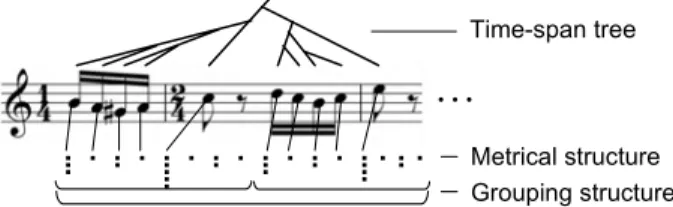
The GTTM is composed of four modules, each of which assigns a separate structural description to a listener’s un- derstanding of a piece of music. These four modules out- put a grouping structure, a metrical structure, a time-span tree, and a prolongational tree, respectively (Figure 1).
…
・ ・ ・ ・ ・ ・ ・ ・ ・ ・ ・ ・ ・ ・ ・ ・
・ ・ ・ ・ ・ ・ ・ ・
・ ・・・ ・ ・・
Time-span tree
Metrical structure Grouping structure
Figure 1. Grouping structure, Metrical structure, and Time-span tree.
1 2 3 4 5 6 7 8 9 10 11 12 13 14
^
^ ^ ^
The grouping structure is intended to formalize the intuitive belief that tonal music is organized into groups that are in turn composed of subgroups. These groups are graphically presented as several levels of arcs below a music staff. The metrical structure describes the rhythmical hierarchy of the piece by identifying the po- sition of strong beats at the levels of a quarter note, half note, a measure, two measures, four measures, and so on. Strong beats are illustrated as several levels of dots below the musical staff. The time-span tree is a binary tree, which is a hierarchical structure describing the relative structural importance of notes that differentiate the essential parts of the melody from the ornamentation.
For example the left-hand side of Figure 2 depicts a simple melody and its tree. The time-span (designated as <--->) is represented by a single note, called a head, which is designated here as “C4”.
Abstracting Instantiating
C4 head C4
⊂ −
Figure 2. Subsumption relation of melodies.
There are two types of rules in GTTM, i.e., “well- formedness rules” and “preference rules”. Well- formedness rules are the necessary conditions for the assignment of a structure and the restrictions on the structures. When more than one structure satisfies the well-formedness rules, the preference rules indicate the superiority of one structure over another.
In this section, we specify the problems with the GTTM rules in terms of computer implementation.
2.1 Ambiguous concepts defining preference rules The GTTM uses some undefined words, causing ambi- guities in the analysis. For example, the GTTM has rules for selecting proper structures when discovering similar melodies (called parallelism), but does not have the defi- nition of similarity itself.
To solve this problem we attempted to formalize the cri- teria for deciding whether each rule is applicable or not.
2.2 Conflict between preference rules
The conflict between rules often occurs when applying the rules and results in ambiguities in the analysis be- cause there is no strict order for applying the preference rules. Figure 3 shows a simple example of the conflict between the grouping preference rules (GPR). GPR3a (Register) is applied between notes 3 and 4 and GPR6 (Parallelism) is applied between notes 4 and 5. A boundary cannot be perceived at both 3-4 and 4-5, be- cause GPR1 (alternative form) strongly prefers that note 4, by itself, cannot form a group.
To solve this problem we introduced adjustable pa- rameters that enable us to control the strength of each rule.
Figure 3. Simple example of conflict between rules.
2.3 Few mentions to how to calculate hierarchical structures
The GTTM does not define a valid procedure for acquir- ing the hierarchical structure. It is not realistic to first make every structure satisfy the well-formedness rules and then select the optimal structure. For example, only a ten note score provides 185794560 (=9 !) kinds of time-span trees.
9
2×
To solve this problem we developed an algorithm for acquiring the hierarchical structure, taking into consid- eration some of the examples in the GTTM.
2.4 Less precise explanation of feedback link
The GTTM has some feedback links from higher level structures to lower level ones, e.g. GPR7 (time-span and prolongational stability) prefers a grouping structure that results in a more stable time-span and/or prolonga- tion reductions. However, no detailed description and only a few examples are given.
3 EXTENDED GTTM
To overcome the problems with computer implementa- tion of the GTTM, we propose a computational model of the GTTM called the extended GTTM, which covers 26 rules out of 36 GTTM rules for constructing time-span tree. The remaining 4 rules are for feedback links and another 6 rules are for homophony. In the current stage, we restrict the music structure to monophony to cor- rectly evaluate the performance of each rule.
In this section we particularize our proposed exten- sion of the GTTM for computer implementation. The policies are equally applied to the three analyses, which are the grouping structure, metrical structure, and Time- span reduction analyses.
3.1 Re-formalization of rules
In order to deal with the preference rules on a computer, we have expressed the rules into numerical styles. Nu- meric descriptions of the rules allow to quantitatively combine the result of each rule application.
We expressed the degree of application of the rule as a numerical function Dirule which output 1 (applicable) or 0 (not applicable) if the rule is clearly applicable or not. For example, GPR2b (Attack-Point) states that a relatively greater interval of time between attack points initiates a grouping boundary that can be expressed as follows:
⎩⎨
⎧ < >
= − +
lse e
ioi oi i and ioi oi i
DiGPR2b i i i i
0
1 1 1
, (1) i : transition of note
ioi i : inter onset intervals.
A numerical function Dirule outputs between 1 (applica- ble) and 0 (not applicable) if the rule is not clearly ap- plicable or not. For example, time-span reduction pref- erence rule 3a (TSRPR3a) that prefers that a higher me- lodic pitch is used as the head of a time-span can be expressed as follow:
j j TSRPR3 i
i pitch pitch
D = max , (2) i : head
pitch i : pitch (note number of MIDI).
3.2 Refinement of ambiguous concepts
As described above, the GTTM uses some undefined concepts that provide ambiguousness in analysis. The concepts are ambiguous, with no unique definition. For example, the concept of a similar melody has a lot of plausible definitions [13], but no best one.
Here, we attempted to formalize concepts based on the following two policies, which we esteem.
1) To define intuitionally and comprehensively.
2) Equipment adjustable parameters for control of the ambiguity.
3.2.1 Concept for symmetry
GPR5 is the rule for symmetry in a grouping structure. It prefers grouping analyses that most closely approach the ideal subdivision of groups into two parts of equal length.
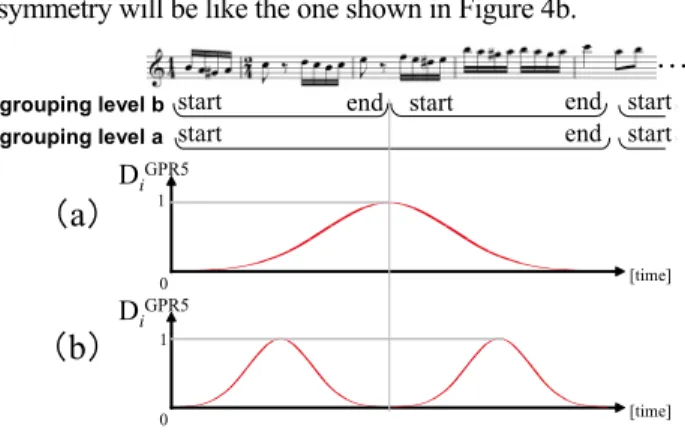
We define the degree of symmetry DiGPR5 so that there is a preference to subdivide a group into two parts of equal length. Here, we use a normal distribution with the stan- dard deviation σ as the degree of symmetry, as follows.
(3) where
start : start transition of group.
end : end transition of a group.
The σ is an adjustable parameter for a user to control the degree of symmetry. In Figure 4a is the degree of symme- try corresponding to grouping level a. If the next level boundary is found in the middle of the group by applying all grouping rules, the next grouping level’s the degree of symmetry will be like the one shown in Figure 4b.
start end start
grouping level a
start end start
grouping level b end start
DiGPR5
[time]
0
DiGPR5
[time]
0
(a)
(b)
…
1 1
Figure 4. Examples of symmetry level.
3.2.2 Concept for parallelism where
GPR6, MPR1, and TSRPR4 rules for parallelism are as follows.
GPR6: Where two or more segments of the music can be construed as parallel, they preferably form parallel parts of groups.
MPR1: Where two or more groups or parts of groups can be construed as parallel, they preferably form paral- lel metrical structures.
TSRPR4: If two of more time-spans can be construed as motivically and/or rhythmically parallel, preferably assign them parallel heads.
where
We formalized the concept of parallelism and defined the degree of parallel in each rule, because the target structures of the rules are different.
In GPR6, we focused on the parallelism of the seg- ments. We introduced the degree of parallel for GPR6 DiGPR6, which indicates a high value at the start and end of the parallel part (Figure 5). The degree of parallel DiGPR6 was calculated by searching all the segments throughout the score. The length of the segments is from a beat to a half of the score by every beat.
GPR6 has three adjustable parameters for controlling the degree of parallel: Wr (priority to the same rhythm compared with the same register in parallel segments), Ws (priority to one end of a parallel segment compared with the start of the parallel segment), and Wl (priority to large parallel segments) (0≦Wr, Ws , Wl ≦1). By using these parameters, a user can easily find and con- figure the parallel segment.
DiGPR6
0 i
…
⎭
Figure 5. Example of the degree of parallel.
⎬⎫ σ2
⎩⎨
⎧ ⎟
⎠
⎜ ⎞
⎝
⎛ ∑ − ∑
−
= = =
GPR5 exp end 2 2
start
j j
i start
j j
i ioi ioi
D
In MPR1, we focused on the parallelism of beat in groups. We introduced the degree of parallel for MPR1 Di kMPR1, which is calculated by searching all the groups.
MPR1 has two adjustable parameters for controlling the degree of parallel: Wr (weight of priority of the same rhythm compared with the same register in parallel groups), and TMPR1 (threshold that decides whether beat i and beat k are parallel (Di kMPR1= 1) or not (Di kMPR1= 0)).
In TSRPR4, we focused on the parallelism of time- spans, which are generated by grouping structure and metrical structure. We introduced the degree of parallel for TSRPR4 Di kTSRPR4, which is calculated by searching all the time-spans. TSRPR1 has no adjustable parame- ters for controlling the degree of parallel.
3.3 Resolving the preference rule confliction by pri- oritizing rules
We introduced adjustable parameters, Srule, for controlling the strength of the GTTM rules. By using these parameters, we can acquire the local-level strength of bound- ary/beat/head. For example, as a result of applying the lo- cal-level grouping rules, we can acquire low-level grouping boundaries as weighted summations on the grouping rules results DiGPR and adjustable parameter SGPR as follows:
⎟⎟⎠
⎜⎜ ⎞
⎝
⎛ ×
×
=
∑ ∑
= ′
=(2,2,3,3,3,3,6 ) ′ (2,2,3,3,3,3,6 )
max
d c b a b a j
j GPR j GPR i i
d c b a b a j
j GPR j GPR i
i D S D S
B .(4)
3.4 Top-down algorithm for calculating hierarchical structures
We introduced the top-down process for acquiring the structures. The hierarchal structure is constructed by calculating the local strength and choosing the next level structure.
- Acquisition of grouping structure
The grouping structure is constructed in the following way.
(1) First, consider the whole piece of music as a group.
(2) Then, calculate local-level boundary strengths and detect low-level boundaries.
(3) Next, select the strongest boundary and divide the group at the boundary.
(4) Finally, iterate (3) while the local boundaries are found at the group.
- Acquisition of metrical structure
The metrical structure is constructed in the following way.
(1) First, consider all the beats as a lowest (global) level metrical structure.
(2) Then, calculate the local-level metrical strength.
(3) Next, select the strongest metrical structure from possible structures.
(4) Finally, iterate (2) and (3) while the current struc- tures have more than one beat.
- Acquisition of time-span tree
The time-span tree is constructed in the following way.
(1) First, consider all the notes as a head.
(2) Then, calculate the local-level head strength.
(3) Next, select the next level head from each time-span.
(4) Finally, iterate (2) and (3) while the time-span con- tains more than one head.
4 STRUCTURE OF ATTA
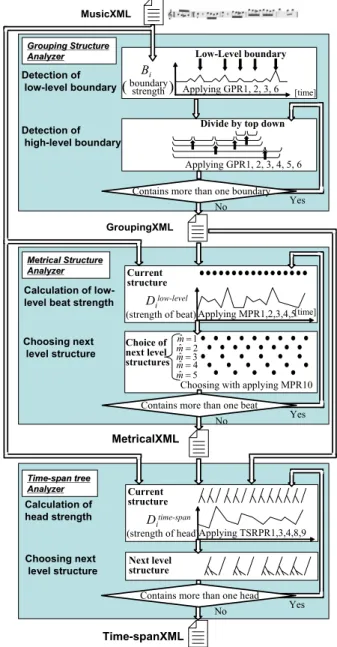
We implemented the extended GTTM described above on the computer that we call ATTA. Figure 6 is the over- view of the ATTA which consists of a grouping struc- ture analyzer, a metrical structure analyzer, and a time- span tree analyzer. ATTA has three distinctive features, an XML-based data structure, its implemented in Perl, and has a Java-based GUI.
MusicXML
Low-Level boundary
[time]
boundary strength Detection of
low-level boundary
Detection of high-level boundary
GroupingXML
Divide by top down Applying GPR1, 2, 3, 6
Applying GPR1, 2, 3, 4, 5, 6
( )
Bi
Calculation of low- level beat strength
Choosing next level structure
MetricalXML
[time]
Dilow-level
(strength of beat) Applying MPR1,2,3,4,5 Current
structure
Choice of next level structures
Choosing with applying MPR10 ˆ=1
mˆ=2 mˆ=3 mˆ=4 mˆ=5 m
No Yes Contains more than one beat
Calculation of head strength
Choosing next level structure
Ditime-span
(strength of head)Applying TSRPR1,3,4,8,9 Current
structure
Next level structure
Time-spanXML No Yes Contains more than one head
No Yes Contains more than one boundary Grouping Structure
Grouping Structure Analyzer Analyzer
Metrical Structure Metrical Structure Analyzer Analyzer
Time Time--span tree span tree Analyzer Analyzer
Figure 6. Processing flow of ATTA.
4.1 XML based data structure
We use an XML format for all the input and output data structures of the ATTA. Each analyzer of the ATTA works independently but are integrated by the XML- based data structure.
As a primary input format, we chose MusicXML [14]
because it provides a common ‘interlingua’ for music no- tation, analysis, retrieval, and other applications. We de- signed GroupingXML, MetricalXML, and Time- spanXML as the export formats for our analyzer. The XML format is extremely qualified to express the hierar-
chical grouping structures, metrical structures, and time- span trees. Note that note elements in GroupingXML, Met- ricalXML, and Time-spanXML are connected to note ele- ments in MusicXML, using Xpointer [15] and Xlink [16].
We expect that the distribution of a MusicXML or a SMF, together with a grouping structure, metrical struc- ture, and time-span tree, is useful for various musical tasks such as searching and arranging.
4.2 Implementation in Perl
We implemented the ATTA in Perl so that using CGI allows it to be used through the internet (available at http://staff.aist.go.jp/m.hamanaka/atta/). We believe that the exhibition of this kind of resource is very important for the music researching community. ATTA is the first application for automatically acquiring time-span tree.
We hope to benchmark the ATTA to other systems, which hereafter will be constructed.
4.3 Java based GUI
Although our analyzer implemented in Perl has a simple user interface, we also developed a graphical user inter- face in Java called GTTM editor (Figure 7). The GTTM editor has two modes, the automatic analysis and man- ual-edit modes. The automatic-analysis mode analyzes using our analyzer and displays the results. The structures change depending on the configured parameters. The manual-edit mode assists in editing the grouping structure, metrical structure, and time-span tree. It can be used to edit the results of the automatic-analysis mode.
Figure 7. GTTM editor (automatic-analysis mode).
5 EXAMPLES OF ANALYSIS USING ATTA
We provide in the appendix all the expressions to implement the ATTA, so that they may be helpful for those users who intend to develop other systems. In this section we expati- ate how to acquire the grouping structure by using ATTA.
5.1 Detection of low-level boundaries
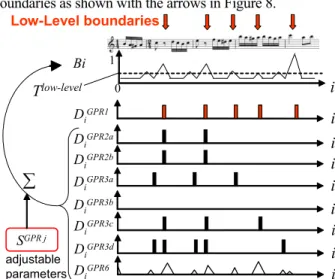
Figure 8 is the result of applying the local-level grouping rules, such as GPR1, 2a, 2b, 3a, 3d and 61. We calculate the degree of low-level boundary Bi as the weighted sum- mation on the local-level grouping rules results DiGPR and adjustable parameter SGPR j. The threshold Tlow-level decides
1The GTTM define the GPR6 for large-level grouping rules. However, we also include it for low-level grouping rules, as manual analyzing results based on GTTM by musicology experts.
if there is a low-level boundary or not. In this case, seven positions are over the threshold and five positions are ap- plied to GPR1. Therefore, we can acquire five low-level boundaries as shown with the arrows in Figure 8.
Tlow-level 0 i
1
DiGPR1 i DiGPR2a i DiGPR2b i DiGPR3a i DiGPR3b i Bi
DiGPR3c i DiGPR3d i DiGPR6 i
Low-Level boundaries
adjustable parameters
SGPR j
∑
Figure 8. Detection of low-level boundaries.
5.2 Detection of high-level boundaries
The hierarchical grouping structure is constructed in the top-down method (Figure 9). First of all, consider a whole score as a group and calculate the degree of high- level boundary Di high-level boundary. Then select the strong- est boundary for the next level grouping boundary as shown with the upward arrows in Figure 9. Finally iter- ate while the group contains low-level boundaries.
… Low-level boundaries
Calculate this way the degree of high-level boundary iteratively i
0
i i
0 0 boundary level high
Di −
boundary level high
Di −
boundary level high
Di −
Time-span tree
adjustable parameters Grouping structure
Metrical Structure
Figure 9. Construction of hierarchical grouping structure .
6 EXPERIMENTAL RESULTS
We evaluated the performance of the music analyzer using an F-measure, which is given by the weighted harmonic mean of Precision P and Recall R,
R P
R Fmeasure P
+
× ×
=2 . (5) This evaluation required us to prepare correct data of a grouping structure, metrical structure, and time-span tree. We collected a hundred pieces of 8-bar length, monophonic, classical music pieces, and asked musicol- ogy experts to manually analyze them faithfully with regard to the GTTM, using the manual-edit mode of Java GUI to assist in editing the grouping structure,
metrical structure, and time-span tree. Three other ex- perts crosschecked these manually produced results.
To evaluate the baseline performance of our system, we used the following default parameters: S rules=0.5, Trules=0.5, Ws,=0.5 Wr =0.5, Wl=0.5, and σ=0.05.
In the current stage, the parameters are configured by humans, because the optimal values of the parameters depend on a piece of music. When a user changes the parameters, the hierarchical structures change as a result of the new analysis.
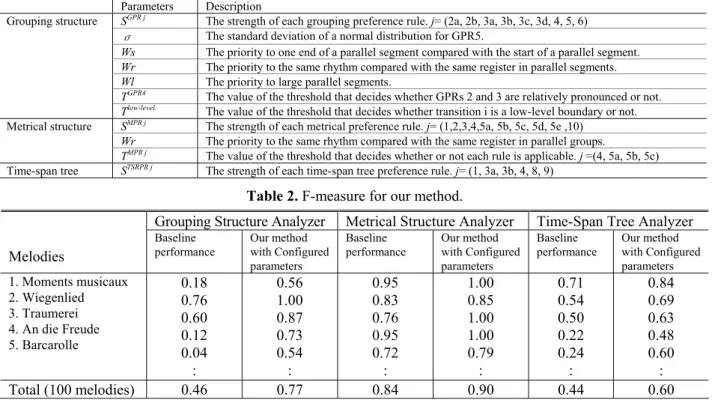
It took us an average of about 10 minutes per piece to find the plausible tuning for the set of parameters (Table 1).
As a result of configuring the parameters, each F-measure of our analyzer outperformed the baseline (Table 2).
7 CONCLUSION
We developed a music analyzing system called ATTA, which derives the time-span tree of the GTTM. The fol- lowing three points are the main results of this study.
- Proposed extended GTTM
We propose an extended GTTM for computer im- plementation. The difficulty with the computer im- plementation of GTTM has been designated, how- ever no radical solutions have been proposed [17].
We re-formalized the rules using a numerical ex- pression with adjustable parameters, so that it can separate the definition and ambiguity from the ana- lyzed material.
- Implemented ATTA on computer
We implemented an actual working system to ac- quire the hierarchical grouping structure, metrical structure, and time-span tree of music, based on the GTTM. The ATTA automatically acquirers the time- span tree by configuring the parameters without manually analyzing by experts in musicology.
- Constructed a set of correct data
We made a set of one hundred correct data, which is the greatest database of analyzed results from the GTTM to date. We plan to exhibit this database in the near future.
- Evaluated the performance of ATTA
Our experimental results showed that, as a result of configuring the parameters, our music analyzer out- performed the baseline F-measure. The set of pa- rameters that was tuned for a certain family of music pieces would possibly reflect the common features of the family. Thus, the idealized parameter set for a music family, if any, would expectedly analyze a new piece correctly, priort to human analysis.
We plan to develop further systems, using time-span trees and the results of the music analyzer, for other musical tasks, such as searching, harmonizing, voicing, and ad-lib to indicate the effectiveness of implementing the GTTM to provide music knowledge.
REFERENCES
[1] Lerdahl, F., and Jackendoff, R. A Generative Theory of Tonal Music. MIT Press, Cambridge, 1983.
[2] Cooper, G., and Meyer, L. B. The Rhythmic Structure of Music. The University of Chicago Press, 1960.
[3] Narmour, E. The Analysis and Cognition of Basic Melodic Structure. The University of Chicago Press, 1990.
[4] Temperley, D. The Congnition of Basic Musical Structures. MIT press, Cambridge, 2001.
[5] Hirata, K., and Matsuda, S. Interactive Music Summarization based on Generative Theory of Tonal Music. Journal of New Music Research, 32:2,
Table 2.F-measure for our method.
Grouping Structure Analyzer Metrical Structure Analyzer Time-Span Tree Analyzer Melodies
Baseline performance
Our method with Configured parameters
Baseline performance
Our method with Configured parameters
Baseline performance
Our method with Configured parameters 1. Moments musicaux
2. Wiegenlied 3. Traumerei 4. An die Freude 5. Barcarolle
0.18 0.76 0.60 0.12 0.04 :
0.56 1.00 0.87 0.73 0.54 :
0.95 0.83 0.76 0.95 0.72 :
1.00 0.85 1.00 1.00 0.79 :
0.71 0.54 0.50 0.22 0.24 :
0.84 0.69 0.63 0.48 0.60 :
Total (100 melodies) 0.46 0.77 0.84 0.90 0.44 0.60
Parameters Description
SGPR j The strength of each grouping preference rule. j= (2a, 2b, 3a, 3b, 3c, 3d, 4, 5, 6)
σ The standard deviation of a normal distribution for GPR5.
Ws The priority to one end of a parallel segment compared with the start of a parallel segment.
Wr The priority to the same rhythm compared with the same register in parallel segments.
Wl The priority to large parallel segments.
TGPR4 The value of the threshold that decides whether GPRs 2 and 3 are relatively pronounced or not.
Grouping structure
Tlow-level The value of the threshold that decides whether transition i is a low-level boundary or not.
SMPR j The strength of each metrical preference rule. j= (1,2,3,4,5a, 5b, 5c, 5d, 5e ,10)
Wr The priority to the same rhythm compared with the same register in parallel groups.
Metrical structure
TMPR j The value of the threshold that decides whether or not each rule is applicable. j =(4, 5a, 5b, 5c)
Time-span tree STSRPR j The strength of each time-span tree preference rule. j= (1, 3a, 3b, 4, 8, 9)
Table 1.Adjustable parameters.
165-177, 2003.
[6] Todd, N. A Model of Expressive Timing in Tonal Music. Musical Perception, 3:1, 33-58, 1985.
[7] Widmer, G. ''Understanding and Learning Musical Expression'', Proceedings of International Computer Music Conference, pp. 268-275, 1993.
[8] Hirata, K., and Hiraga, R. ''Ha-Hi-Hun plays Chopin’s Etude'', Working Notes of IJCAI-03 Workshop on Methods for Automatic Music Performance and their Applications in a Public Rendering Contest, pp. 72-73, 2003.
[9] Hirata, K., and Matsuda, S. ''Annotated Music for Retrieval, Reproduction, and Sharing'', Proceedings of International Computer Music Conference, pp.
584-587, 2004.
[10] Ida, K., Hirata, K., and Tojo, S. '' The Attempt of the Automatic Analysis of the Grouping Structure and Metrical Structure based on GTTM'', Proceedings of International Computer Music Conference, SIG Technical Report, 2001(42):49-54, 2001 (in Japanese).
[11] Touyou, T., Hirata, K., Tojo, S., and Satoh, K. '' Improvement of Grouping Rule Application in Implementing GTTM'', Proceedings of International Computer Music Conference, SIG Technical Report, 2002(47):121-126, 2002 (in Japanese).
[12] Nord, T. A. Toward Theoretical Verification:
Developing a Computer Model of Lerdahl and Jackendoff’s Generative Theory of Tonal Music.
Ph.D. Thesis, The University of Wisconsin, Madison, 1992.
[13] Hewlett, W. B. ed. Melodic Similarity Concepts, Procedures, and Applications, Computing in Musicology 11, The MIT press, Cambridge, 1998.
[14] Recordare LLC. MusicXML 1.0 Tutorial.
http://www. recordare.com/xml/musicxml- tutorial.pdf., 2004.
[15] W3C. XML Pointer Language (XPointer).
http://www.w3.org/TR/xptr/, 2002.
[16] W3C. XML Linking Language (XLink) Version 1.0. http://www.w3.org/TR/xlink/, 2001.
[17] Heikki, V. Lerdahl and Jackendoff Revisited.
http://www.cc.jyu.fi/~heivalko/articles/lehr_jack.htm.
Appendix 1: Grouping Structure analyzer
Step 1: Calculation of basic parameters
Six basic parameters for note transition i are calculated from MusicXML: resti (interval between current offset and next onset), ioii (inter-onset intervals), regii (pitch intervals), leni (subtraction of duration), dyni (subtraction of dynamics), and arti (subtraction of ratio between dura- tion of performed note and proper duration of the note).
Step2: Application of GPR GPR1 (Alternative form)
⎩⎨
⎧ ≤ ≥
= +
lse 0
B B
1 i-1 i 1
GPR1
e
B B
Di and i i ,
(6)
⎟⎠
⎟⎞
⎜⎜⎝
⎛ ×
×
=
∑ ∑
= ′
=(2,2,3,3,3,3,6) ′ (2,2,3,3,3,3,6)
max
d c b a b a j
j GPR j GPR i i
d c b a b a j
j GPR j GPR i
i D S D S
Bwhere
. GPR2a (Slur/Rest)
⎩⎨
⎧ < >
= − +
lse e
rest rest and rest rest
DiGPR2a i i i i
0
1 1 1
(7) GPR2b (Attack-Point)
⎩⎨
⎧ < >
= − +
lse e
ioi oi i and ioi oi i
DiGPR2b i i i i
0
1 1 1
(8) GPR3a (Register)
⎩⎨
⎧ < >
= − +
lse e
regi regi and regi regi
DiGPR3a i i i i
0
1 1 1
(9) GPR3b (Dynamics)
⎩⎨
⎧ = ≠ =
= − +
lse e
dyn and 0 dyn and dyn
DiGPR3b i i i
0
0 0
1 1 1
(10) GPR3c (Articulation)
⎩⎨
⎧ = ≠ =
= − +
lse e
and arti and arti
Di artii i i
0
0 0
0
1 1 1
GPR3c (11)
GPR3d (Length)
⎩⎨
⎧ = ≠ =
= − +
lse 0
0 len and 0 len and 0 len
1 1 1
GPR3d
Di e i i i (12)
GPR4 (Intensification)
( )
⎩⎨
⎧ >
= 0 lse
P , P , P , P , P max 1
4 arti
i dyn i regist i ioi i rest i GPR4
e D T
GPR i
(13)
arti arti P , lse 0
0 regi regi P regi
, dyn dyn P ,
P , rest rest P
1 1 i arti i 1
1 1
1 regist i
i
1 1 i dyn i 1
1 i ioi i 1
1 i rest i
∑ ∑
∑
∑
∑
∑
+
−
= +
−
= +
−
=
+
−
= +
−
= +
−
=
⎪ =
⎩
⎪⎨
⎧
⎟⎟⎠
⎜⎜ ⎞
⎝
⎛ >
=
=
=
=
i i j
j i
i j
j i
i j
j
i i
j j
i i
j j
i i
j j
e ioi ioi
GPR5 (Symmetry) where
.
⎪⎭
⎪⎬
⎫
⎪⎩
⎪⎨
⎧ ⎟
⎠
⎜ ⎞
⎝
⎛ ∑ − ∑
−
= = =
2 2
GPR5 exp end 2 2σ
start
j j
i start
j j
i ioi ioi
D , (14)
start : start transiton of a group.
where
end : end transition of a group.
GPR6 (Parallelism)
( )
( )
∑ ∑
⎪⎪
⎪
⎩
⎪⎪
⎪
⎨
⎧
=
=
× +
−
×
=
×
=
−
×
=
j r
j i j i end s
r j i start s
r j i
j i end s
r j i
j i start s
r j i iGPR6
m
m W G W G
m W G
m W G
D
s 0
t 1
e b 1
, (15)
where
division : duration of a quarter note.
r : length of parallel segments based on the division of a quarter note.
Wl r r r j- q r i- q
r r j- q r i- l q r W r r j- q r i- q
r r j- q r i- end q
j i
Wl r r j q i q
r j q i l q r W r j q i q
r j q i start q
j i
r z W
r y y W
G z
r z W
r y y W
G z
+ +
+ +
×
× +
×
−
×
=
×
× +
×
−
×
=
1 1
1 1
) 1 (
) 1 (
( Gausian integer)
division ioi
q i
k k
i []:
1 ⎥⎦
⎢ ⎤
⎣
=⎡∑
=
⎪⎪
⎩
⎪⎪
⎨
⎧
≠
≠
≠
≠
≠
≠
=
=
=
=
≠
≠
=
+ +
+ +
+ +
lse e s
q q and q q and q q and q q t
q q and q q and q q and q q e
q q and q q and q q and q q m
1 j j 1 i i 1 - j j 1 - i i
1 j j 1 i i 1 - j j 1 - i i
1 j j 1 i i 1 - j j 1 - i i
j i
b
∑⎩⎨⎧ ≤ ≤ +
=
j
i j j i ir
q 0 else
r q q and q q
x 1