Ⅰ Introduction
Mountaineering accidents are becoming increas
ingly frequent in Japan. In 2015, a record high of 2508 persons across Japan were involved in moun
taineering accidents. One prominent trend is the increase in middle-aged and elderly adults in this group. Adults aged≥40 years accounted for 76.7% of persons involved in all mountaineering accidents, 91.6% of those died or went missing. Causes of mountaineering accidents include not only factors specific to mountain climbing, for example, changes
in weather and getting lost, but also injuries and illness. Illness was the fourth most common cause at 7.6% (232 persons). The prefecture with the most accidents was Nagano
1). According to Nagano Pre
fectural Police statistics in 2015, 32 persons (11.7%) had accidents caused by illness
2).
There are few reports of stroke during mountain climbing in the medical literature
3)-6). Noguchi et al.
reported 3 cases of cerebral ischemia. One case was diagnosed as having cerebral infarction by autopsy, and the others were considered transient ischemic attacks. However, we were unable to find any re
ports of treatment in patients with stroke occurring during mountain climbing.
The prognosis of patients with cerebral infarction has improved in recent years due to the introduction of thrombolysis and endovascular therapy. However,
A Case of Cerebral Infarction with Favorable Outcome that Occurred while Climbing a 2400m Mountain
―Successful Prehospital Emergency Medical Service of Mountain Rescue―
Hiroshi T akayama
Department of Emergency and Critical Care Medicine, Shinshu University School of Medicine
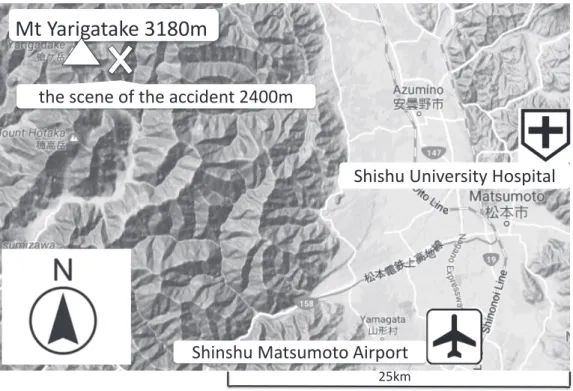
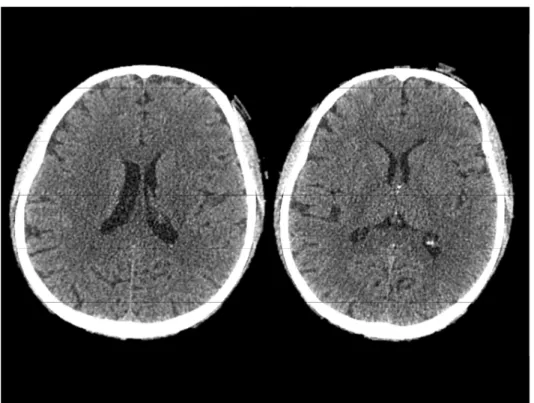
Here we report a case of ischemic stroke in a 55-year-old man climbing a mountain 2400m above see level alone who successfully recovered after treatment with reperfusion therapy. He experienced an ischemic stroke on a snowfield at an altitude of 2400m while climbing the 3180m Mt. Yarigatake in May. A nearby climber reported the incident by cellular phone. The patient was rescued by a Nagano Prefecture Emergency Management Air Corps helicopter and transported to our hospital 1 h after stroke onset. On arrival, his National Institutes of Health Stroke Scale (NIHSS) score was 25. At 2 h 9 min after onset, the recombinant tissue plasminogen activator alteplase was administered intravenously and his NIHSS score improved to 2. The patient was transferred to another hospital on day 19 after onset with a modified Rankin Scale score of 2 and a Barthel Index score of 100. He returned to work 78 days after onset. This is the first case report in Japan about the successful treatment of cerebral infarction that occurred on a mountain at 2400m. While good weather and various other favorable conditions helped to improve the patient’s prognosis, other factors, such as the good communication infrastructure and the coordination between the aeromedical service system and hospital, played a major role in mountain rescue of this patient. Shinshu Med J 65 : 259―265, 2017
(Received for publication November 22, 2016 ; accepted in revised form June 23, 2017) Key words : mountain rescue helicopter, stroke, rt-PA
*