28-1
SOCIAL PARTICIPATION IN ENVIRONMENTAL DEVELOPMENT OF KAMPONG MASPATI IN
SURABAYA CITY
‘A Study on How Social Participation Might Results to Sustainable Development’
ANNISA PUTRI PRASAMANTIAJI 1. INTRODUCTION
1.1 Background
Kampong is an Indonesian term to describe a settlement situated in city with high density of population. The majority of its people still upholds traditional cultures as a part of their lifestyle, thus can’t be equated with slum or squatter settlement. Kampong also has been an integral part of city.
But due to the low level of sanitation and insufficient public infrastructure, as response, government established several kinds of Kampong development program.
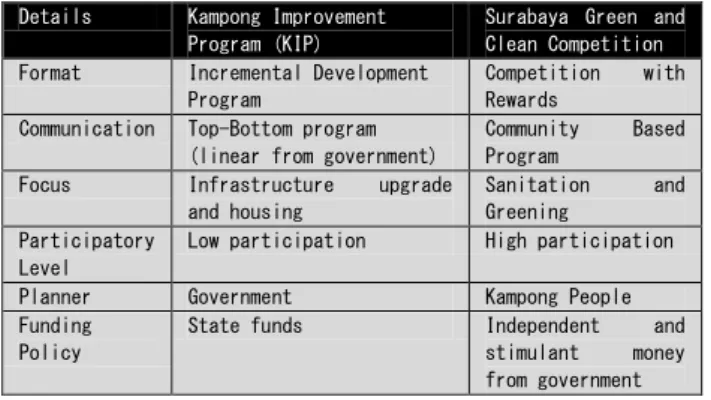
Details Kampong Improvement
Program (KIP)
Surabaya Green and Clean Competition
Format Incremental Development Program
Competition with Rewards
Communication Top-Bottom program (linear from government)
Community Based Program
Focus Infrastructure upgrade and housing
Sanitation and Greening
Participatory Level
Low participation High participation
Planner Government Kampong People Funding
Policy
State funds Independent and stimulant money from government
History recorded that Kampong Improvement
Program had successfully improved the
infrastructure of kampongs in Surabaya, but in general, the environmental development stayed stagnant or passive without having any renewals. While in Surabaya Green and Clean competition, kampong people are given the opportunity to expand their ideas or innovations in environmental development since it is a community based program.
Both programs indeed have different focus and direction, but since the main theme of this research is on the participatory level of kampong people, kampong improvement program here is used as comparison whether or not a community based program would help kampong to achieve sustainable environmental development.
Kampong Maspati, an old historical kampong in Surabaya has been participating Surabaya Green and
Clean competition every year since 2011 until 2017 consecutively.
The reason why Kampong Maspati is chosen as the case study of this research because they have been conducting environmental development for roughly 7 years and has been aggressively promoting their kampong as tourism destination bringing their historical value as their selling point.
1.2 Research Purpose
There are four research purposes of this research: 1) To investigate what is Kampong Maspati’s strategy to keep their environmental development sustainable 2) To investigate the social participation; forms of participation, process of participation 3) To clarify all of the supportive factors such as; involving individual
or institutions that contributes in the
environmental development of Kampong Maspati.
2. CONCEPTUAL FRAMEWORK
The conceptual framework diagram will help to gain understanding about ongoing story of the environmental development of Kampong Maspati.
Thus, based on the explanation above, this research would focus in how social participation
might affect a sustainable environmental
development and their strategy upon making
Fig. 3 Kampong Maspati
Fig. 4 Concept Diagram
Needs to be Investigated Sustainable Environmental Development Participates in 2017 Kampong Maspati
Surabaya Green and Clean Competition Environmental Development Output 2011 Kampong Social Participation Strategy to sustain the developme nt Green and Clean Competitio n Government Environmental Development Fixed Fig. 1 Comparison between KIP and SGC
28-2
sustainable environmental development will be revealed.3. RESEARCH METHODOLOGY
A Qualitative Method is chosen by conducting interviews, observations, and taking field notes.
Sampling Technique
Researcher would use two different sampling method, those are purposive sampling technique and snowball sampling. Purposive sampling technique will focus on the selection of the information. And snowball sampling where an informant helps researcher to find another potential informant who is expected to provide the needed information. 4. FINDINGS
4.1 Motivation to Start New Movement
1.) To join the Surabaya Green and Clean competition and acknowledged by government and people in general that they exist and has historical value.
2.) Motivated by other kampongs that are attractive, clean and lush of greenings. 3.) They witnessed the benefits of conducting
environmental development such as the potency to develop economy, health benefits, etc. 4.2 Role of Women Organization for Socializing Environmental Awareness
The women organization of kampong Maspati carries both tasks of learning about managing environment issues through facilitator provided by government and also to spread environmental awareness to people of Kampong Maspati in general. There are several methods used for spreading the environmental awareness to people. First, by holding weekly Women Organization Meeting.
Each meeting will discuss different topics related to health, welfare, and environmental issues. They also applied different ways upon convincing people to take environmental awareness
seriously by making personal approach,
distributing plants by free to each houses, and showcasing kinship in order to encourage more people to join in.
4.3 Environmental Development by Kampong Maspati A. Greening Strategy
In the favor of carrying out an effective way of greening the kampong, Kampong Maspati has two greening strategies, those are:
By making a cluster of 10 houses, an organized greening plan can be achieved and people can share their thoughts evenly.
The second strategies, that is by placing plants along the road perimeter and parallel to opposite side so that the greens would look dense and lush like in the picture below.
B. Greening Policies
Despite that it is not on the requirements list of‘Surabaya Green and Clean competition’, Kampong Maspati established a policy that each Learn Environmental Knowledge Women Organization of Kampong Maspati Learning Center at District Office provided by Government Women Organization of Kampong Maspati People of Kampong Maspati Teach Environmental Knowledge 2 1 1 2
Fig. 5 Role of Women organization
Fig. 6 Women Organization Meeting
Fig. 7 Approaches for convincing people
Fig. 8 Greening Strategy 1
Fig. 9 Greening Strategy 2
28-3
house should have at least 3 kinds of herbal plants, 2 decorative plants, and 1 shading plant.Each people has the record book of the owner and also the species of plants, thus they can share plants with each other.
They also has another policy of having one thematic edible plants that later be used as materials to make homemade food or drinks products. This act is a manifestation of economic empowerment of Kampong Maspati.
The products usually will be sold on street or online market. Earned money will be partially used for environmental development.
C. Waste Management
Bank of waste, is a program that emphasize on filtering non organic waste and making money out of it. By collecting plastic bottles, newspaper that later will be weigh-measured and sold, the money earned will be recorded in a bank book. The whole earned money will be deposited as environmental savings.
D. Mutual Cooperation in Developing Environment
People has a strong attachment to their plants, they don’t need to be told to maintain and water them. Whenever they see people working, people would involuntarily join the activities. 4.4 Money Circulation
Kampong Maspati has several different methods on collecting money from people. Those are:
a. Monthly Money Subscription
People ought to pay around Rp. 2000-5000 (20-50 yen) per month. Half will be used as social funding (death compensation) and other half will be used to manage waste.
b. Money from Bank of Waste and Homemade Products
The output of environmental development, as mentioned before, ‘Bank of Waste’ and Homemade Products have generated money in order to be used for environmental development, that is buying plant, maintenance for environmental equipment, etc. The money circulates around the cycle of buying plants-Homemade products and bank of waste-earn money-buying plants again.
4.5 Contributions from Local Government Local government also made contribution to Kampong Maspati in different aspects, such as providing facilitation for Kampong People to learn environmental management and for infrastructure development, they sent in some plants seeds, renewed the pavement and renovated some historical houses to welcome the event of UN Habitat prepcom III in Surabaya on July 2016.
Environmental Development
‘Bank of Waste’
Homemade Products
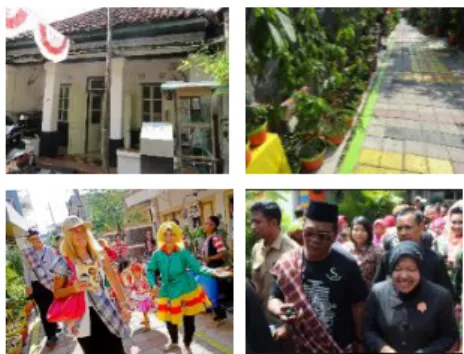
Fig. 18 Contribution from Government Fig. 17 Historical houses and Kampong festival
Output Input Contributions from Local Government Environmental Knowledge Plants Seeds Infrastructure Development Kampong Maspati Greening Activity Tourism Potential Diagram
Fig. 11 Greening Policy 1
Fig. 12 Greening Policy 2
Fig. 13 Bank of waste
Fig. 14 Mutual cooperation
Fig. 15 Output from Environmental Development
28-4
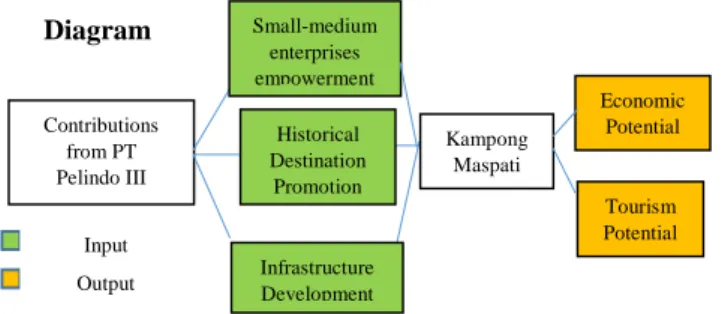
4.6 Contributions from CSR PT Pelindo IIIPT Pelindo III, a CSR (Corporate Social Responsibility) company, agreed to become sponsorship partner of Kampong Maspati. Through the submittance of the proposal made by Kampong Maspati to build their first meeting hall for infrastructure development.
Programs established for Kampong Maspati: - Infrastructure development;
- Tourism promotions; provision of promotional facilities, training for tourist guide, holding‘Kampong Festivals’
- Economic empowerment; entrepreneurship
training, marketing
5. Conclusion
A stimulant program with competition format might motivates Kampong people more than the (linear) top-bottom program by Government.
Social Participation is very crucial, Since Kampong people hold the authority to direct the development, they will grow an emotional attachment to their development.
By taking advantage of the development, such as producing homemade products that generates money, this activity will sustain the environmental development. CSR -company as the economical backup also necessary to help Kampong Maspati improved.
References
1. Slamet, Y. 1993. Pembangunan Masyarakat Berwawasan Partisipasi. Sebelas Maret University Press.
2. Saldana, J. 2003 The Coding Manual for Qualitative Researches. Sage Publications
3. Turner, JFC. 1976. Housing by People, Towards Autonomy in Building Evironments. Pantheon
Fig.21 Facilities by Pelindo III and Kampong Festival
1
2
3
Fig. 19 Diagram of Contributions in Maspati VI Street
Fig. 20 Diagram of Contributions in Maspati V Street
Contributions from PT Pelindo III Historical Destination Promotion Infrastructure Development Kampong Maspati Economic Potential Tourism Potential Input Output Small-medium enterprises empowerment Diagram
Fig. 22 Contribution from Pelindo III
Fig. 23 Conclusion 1
Fig. 24 Conclusion 2