Introduction
Firms are creating their corporate value through their activities. Financial performance increases due to firms’ ability to meet customer needs for products and servic-es. Firms could get the reliance from investors, but this depends on the engagement on financial performance and value creation. It is important to develop organiza-tional system and incentive systems to meet employee satisfaction as well. Managers also need to execute effi-cient and effective management via innovation to attain top managers’ vision. In addition, firms need to accom-plish environmental responsibility and social respon-siveness. It is a corporate objective to create stakeholder oriented corporate value. To create corpo-rate value it is necessary to the firms’ intangibles with the firms’ strategies. That is why firms create corporate value mediated intangibles through their activities.
There has been a lot of research done on intangibles and corporate value. Many of these focus on corporate reputation instead of intangibles, and corporate objec-tive has not been related to corporate value, but corpo-rate financial performance (Fombrun and Shanley, 1991; Preston and Sapienza, 1990; Riahi-Belkaoui and Paclik, 1991; Shulz et al., 2001; Sabate et al., 2002; Rob-erts and Dowling, 2002; Lee and Roh, 2012, Kim and Yang, 2013). This research insisted on the evidence that corporate financial performance has an influence of corporate reputation (Fombrun and Shanley, 1990; Preston and Sapienza, 1990; Riahi-Belkaoi and Paclik,
1991) and how corporate reputation affects future cor-porate financial performance as well (Roberts and Dowling, 2002).
Recently we could see research the shed light on the relationship between the corporate reputation and cor-porate financial per formance. First of all, some researchers suggested that corporate reputation is mediate variables, and activities effect corporate reputa-tion (Kim and Yang, 2013; Stacks et al., 2013), and some researches extended corporate reputation to intangi-bles (Suroca et al., 2010; Stacks et al., 2013). In addition, some researchers extended corporate financial perfor-mance to corporate value (Surroca et al., 2010; Stacks et al., 2013). We could not find out any extended research survey on the relationship between intangi-bles and corporate value. Our research question is to find the issues of theoretical framework involved and to propose a new theoretical framework.
We research on the value creation mechanism which is the relationship between activities, intangibles, and corporate value. In section 1 we define the intangibles. In section 2, we deal with the empirical research on the relationship between corporate reputation and corpo-rate financial performance. In section 3 we discuss the extended researches on the relationship between cor-porate reputation and corcor-porate financial performance. In section 4 we develop a new theoretical model on the relationship between intangibles and corporate value. Lastly, we point out our findings in this paper.
1. What are Intangibles?
Firms develop their strategy for creating corporate
val-New Theoretical Model on Value Creation
Kazunori Ito
*ue. The strategy is not only to seek external competitive advantage, but also to seek internal core competence. Barney (1991) proposed resource-based view (RBV). According to Barney, “a firm is said to have sustained competitive advantage when it is implementing a value creating strategy not simultaneously being implement-ed by any current or potential competitors and when these other firms are unable to duplicate the benefits of this strategy”. To have Barney’s competitive advantage, a firm must has four attributes: valuable resources, rare resources, imperfectly imitable resources, and substi-tutability. In summary, the firm must be valuable, in the sense that its exploit opportunities and neutralizes threats in it environment, it must be rare among its cur-rent and potential competition, it must be imperfectly imitable, and there cannot be strategically equivalent substitutes for source of the strategy that are valuable but neither rare or imperfectly imitable. Internal resources which have these four attributes are defined as intangibles.
Intangible Assets, or Intellectual Capital, are defined by Lev (2001) as “non-physical sources of value (claims to future benefits) generated by innovation (discovery), unique organizational designs, or human resource prac-tices”. According to the opinion of Lev, the terms Intan-gible Assets, Knowledge Assets and Intellectual Capital are interchangeable owing to the fact that all three terms are widely used. The feature of this definition is a stock of non-physical sources of value.
On the other hand, Ittner (2008, p.262) defines them as “Intangible assets represent expenditures on and development of non-physical assets that are drivers of future economic performance and firm value”. Accord-ing to Ittner’s definition, intangible assets have almost the same definition as value drivers. The feature of this definition is not stock, but flow of activity expenditures.
I addition, Kaplan and Norton (2004, p.55) defined it as follows: ”we identified, in its Learning and Growth Perspective, three categories of intangible assets essen-tial for implementing any strategy:
• Human Capital: the skills, talent, and knowledge that a company’s employees possess.
• Information Capital: the company’s databases, information systems, networks, and technology infrastructure.
• Organization Capital; the company’s culture, its leadership, how aligned its people are with its strategic goals, and employees’ ability to share knowledge.
Kaplan and Norton insisted that the strategy connects three categories of intangible assets. On embedding the readiness concept which is a degree of readiness
for creating corporate value, they proposed to measure the outcome of value creation activities. The feature of this definition is not only stock, but also flow.
Blair and Wallman (2001, pp.51-56) divided intangible assets into three subcategories based on the degree to which they can be controlled and/or sold by the firm. • Assets that can be controlled and owned by the firm
and can be separated out and sold, for example, patents and databases.
• Assets that can be controlled and owned by the firm but not separated out and sold, for example, R&D and organizational processes.
• Assets that may not be wholly controlled by the firm and are therefore not owned by the firm, for example, knowledge and skills of labor force.
Based on this classification by Blair and Wallman, Sakurai (2008) insisted on named intellectual proper-ties for first level, off balanced intangible assets for sec-ond level, and intangibles for third level.
In summar y, we can classify the intangibles as; non-physical source of value, the intellectual properties as goodwill, the off balanced intangible assets as corpo-rate reputation and corpocorpo-rate bland, and the limited intangibles as innovation, human assets information assets, and organizational assets. In this paper, we look at the intangibles corporate reputation, innovation, human assets, information assets, and organization assets except for intellectual properties. We limit intan-gibles not flow, but stock.
2. The Relationship between Corporate Reputation and Corporate Financial Performance
In this section, we review the literatures on the relation-ship between Corporate Reputation and Corporate Financial Performance. First, we introduce several defi-nitions by some literatures then we declare our position of corporate reputation in this paper. Second, we review the research of Schultz et al. (2001) which found evi-dence of positive relationship between corporate repu-tation and perceived financial performance. Third, we introduce the research of Fombrun and Shanley (1990) which defined the theoretical model of the relationship between corporate reputation and corporate financial performance.
2.1 Definition of Corporate Reputation
to deliver valued outcomes to multiple stakeholders. It gauges a frm’s relative standing both internally with employees and externally with its stakeholders, in both its competitive and institutional environments”. That is, a representation was made as the corporate reputation by a firm’s past actions, then firm develops the outcome to firm’s stakeholders. Herein, corporate reputation is a perception of external stakeholders, is not included future prospects.
On the other hand, Fombrun (1996, p.72) defines a corporate reputation as “a perceptual representation of a company’s past actions and future prospects that describes the firm’s overall appeal to all of its key con-stituents when compared with other leading rivals”. In this definition, we understand that a perception of external stakeholders and activities of internal manag-ers and employees are included. As the same opinion, Sakurai (2008, p.23) defined corporate reputation as “a sustainable competitive advantage that is lead from def-erent stakeholders related with a firm under the results of past actions of managers and employees and the present and future expected information”. While this definition puts emphasis on the point of view that man-agers and employees develop a corporate reputation, Sakurai (2011, pp.201-231) insists on a communication that effects a perception of external stakeholders as well. In summary, corporate reputation is a one of intan-gibles that are lead from the results of internal activities and the present and future information. In this paper, we progress our research under Sakurai’s definition. 2.2 The Relationship between Corporate Reputation and Perceived Financial Performance
Schultz et al. (2001) is an empirical study of the rela-tionship between corporate reputation and corporate financial performance in Denmark. They “study the construction of reputation as it is formed by the meth-ods used to collect and aggregate survey-based judg-ments about firms held by individual respondents”. Their research used Danish ranking data for 14 years, from 1986 to 1999, in a leading Danish business maga-zine, Børsens Nyhedsmagasin. The dimensions of this corporate reputation’s ranking are 9 criteria which con-sists of quality of product, management, price com-pared with quality, marketing (included PR, design and ser vice), human resource management, financial strength, responsibility environment, product develop-ment, and importance to society. This ranking system is focusing on judgment of corporate reputation, 5-point Likert scale, held by managers and analysts from the financial community. While the ranking system changed some dimensions during 14 years, they
con-cluded that 64 out of 200 firms keep top 20 ranks. To this 64 firms, they studied the relation corporate reputation with average ROA, age (yea), average employees, and average revenues, and found evidence of relationship between average employees as size and corporate reputation. They also found that “perceived financial performance has the strongest impact of all the criteria of reputation” except for management crite-ria.
The result suggests that there is no evidence of the relationship between corporate reputation and corpo-rate financial performance. It is a kind of “halo effect” that the perceived financial performance just relates with almost (eight of nine) dimensions of corporate rep-utation. Because it is a possible to effect reputation’s ranking on perceived financial performance. The cause of fail in empirical research by Schultz et al. (2001) is “the lack of theoretical framework that would link empirical literature within the area of the theory of the firm” (Sabate and Puente, 2002). This is the biggest problem in Schultz et al. (2001). We can know the hypothesis of the relationship between corporate repu-tation and financial performance, but it is necessary to identify the theoretical framework of the reason why they develop their own hypothesis.
2.3 Theoretical Framework of the Relationship between Corporate Reputation and Corporate Financial Perfor-mance
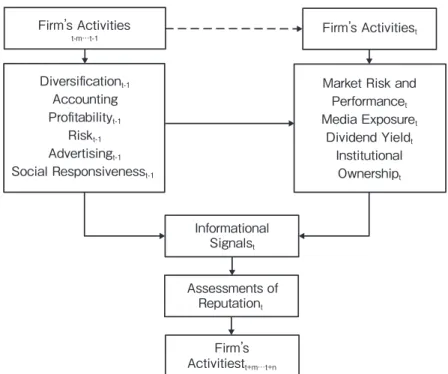
Fombrun and Shanley (1990) studied the relationship between corporate reputation and financial perfor-mance under the theoretical framework about develop-ing corporate reputation. We draw on their theoretical model of reputation building in Figure 1. This theoreti-cal framework is assumed that corporate audiences attend to market, accounting, institutional, and strategy signals about firms.
The 292 firms included in Fortune’s 1985 study of the
America’s Most Admires Corporations constituted the
set of firms for their analysis. The Fortune survey, which solicited ratings of corporate excellence from 8,000 executives, outside directors, and securities ana-lysts, had 50 percent response rate. The dependent var-iable was reputation, an index formed from ratings respondents provided on eight 11-point scales to the Fortune survey. The survey began by asking respond-ents to name the leading firms in an economic sector and continued: “How would you rate these companies on each of following attributes; quality of management; quality of products or services; long-term investment value; innovativeness; financial soundness; ability to attract, develop, and keep talented people; community and environmental responsibility; and use of corporate assets?”
Size was computed as a logarithmic transformation of total sales in 1984. Economic performance was gauged in three ways: the return on invested capital (ROIC) at end of fiscal year (1984), the ratio of market to book val-ue (on September 27, 1985), and the ratio of prior four quarters’ dividends divided by share price (on Septem-ber 27, 1985). On riskiness, the level of accounting risk in 1984 was estimated by the coefficient of variation of ROIC in the previous nine years. And market measure of risk was gauged by firms’ beta coefficients on Sep-tember 27, 1985. Institutional ownership was estimated the percentage of all outstanding shares held on
Sep-tember 27, 1985, by banks, insurance companies, and mutual funds. Media exposure was estimated as the total number of articles written about a firm in 1985. Differentiation as the measure of advertising intensity was estimated a firm’s total advertising expenditures in 1984, adjusted for firm size. Diversification at the end of fiscal year 1985, was estimated as 1-(ΣSalesj2)/
(ΣSalesj)2, where j= the number of segments, on using
COMPUSTAT data.
The cross-sectional time series analysis on 557 firm-years indicates that the assessments of corporate repu-tation appear to be positively related to ROIC, differentiation, and size and negatively related to prior risk. Based on the regression analysis, ROIC, differenti-ation, size, institutional ownership, and ratio of market to book value positively influence assessments of corpo-rate reputation. On the other hand, market measure of risk, ratio of dividends divided by share price, and media exposure related negatively to corporate reputa-tion. They found out the evidence of the relationship between corporate reputation and corporate financial performance which consists of accounting measures and market measures.
Fombrun and Shanley (1990) research is valuable not only on the relationship between corporate reputa-tion and corporate financial performance, but also on the theoretical model of developing corporate reputa-tion. It is an important contribution that their model identified activities effect on corporate reputation.. Figure 1. Model of Reputation Building under Conditions of Incomplete Information
Source: Fombrun and Shanley(1990) Firm’s Activities t-m…t-1 Firm’s Activitiest Diversificationt-1 Accounting Profitabilityt-1 Riskt-1 Advertisingt-1 Social Responsivenesst-1
Their paper, however, has some limitations which is in the relationship between corporate reputation and corporate financial performance. We don’t know wheth-er past corporate financial pwheth-erformance influences cor-porate reputation or corcor-porate reputation influences future corporate financial performance. Thus, nobody could get any information about how firms should do, from the evidence of Fombrun and Shanley(1990). 3. Some Theoretical Frameworks and their Issues In this section, we organize the researches about some extended theoretical frameworks. First, Stacks et al. (2013) insisted corporate reputation as mediate varia-bles between activities and corporate value. Second Roberts and Dowling (2002) found out that a good rep-utation will enhance a firm’s ability to sustain superior financial performance over time. Third, Surroca et al. (2010) studied empirically the theoretical framework of the virtuous circle.
3.1 Corporate Reputation as Mediate Variables
Stacks et al.(2013) proposed interesting measurement types of corporate reputation. Based on Fombrun and van Riel (1997)’s definition of corporate reputation, they classify corporate reputation into three types of meas-urements. They referred to antecedents (i.e. reputation
driver) as outputs, indicators of reputation (i.e. mediate variables) as outtakes, and reputation (i.e. corporate value) as outcomes. Their theoretical framework is drawn in Figure 2.
Figure 2 suggested that outputs are antecedents such as reputation driver, outtakes are indicators of rep-utation such as corporate reprep-utation, and outcomes are reputation such as corporate value. Next, we review three types of measurements.
Outputs are three main domains: corporate capabili-ty, communication, and social responsibility. Corporate capability is to provide quality product, to develop inno-vation, and to maintain corporate advantage. Communi-cation is to communicate among stakeholders to increase the probability that firm is perceived as genu-ine and credible. Social responsibility is to play a key role demonstrating to general public that a firm is an accountable citizen. In summary, we could translate from outputs to reputation drivers which are outputted by activities.
Indicators of reputation include 7 key indicators: visi-bility, credivisi-bility, authenticity, transparency, trust, rela-tionship, confidence. Visibility is a clear and visible image which stakeholders have. Credibility is defined as the extent to which consumers, investors, or other stakeholders believe in a firm’s trustworthiness and expertise. Corporate credibility has been recognized as Figure 2. A process of reputation
Source: Stacks et al. (2013) ・Effective com- munication(two- way communication) ・Corporate capability ・Product and services ・Leadership and management competence ・CEO image, reputation, credibility ・Financial performance ・Social responsibility ・Visibility ・Creditability ・Authenticity ・Transparency ・Trust ・Relationship ・Confidence ・Public supportive behavior
・Beneficial outcome from different publics: ・Internal : employee commitment, retention, engagement → work performance
・external : customer loyalty, investor investment, positive media coverage, community support → ,ore sales and revenue ・ROE
・ROI(bottom line) ・Competitive advantage Antecedents
a key determinant of corporate reputation. Authenticity is defined as real, genuine, accurate, reliable, and trust-worthy.
Transparency is defined to encompass integrity, respect, and openness. Trust is defined as stakeholder expectations that the business of the firm will be relia-ble, dependarelia-ble, and continue to act in their interest even in an uncertain future. Relationship is defined as stakeholders’ perception of association with the firm. Confidence is defined as the combination of the admira-tion, respect, trust, confidence in a firm’s actions.
We could classify outcomes into internal outcomes and external outcomes. Externally, a good corporate reputation attracts customers to its products, investors to new investment, and media journalists to favorable press coverage. Internally, a good corporate reputation helps employees internalize corporate values, commit-ment to their work and the firm, and engage in dialogs, cooperation and citizenship behaviors (Fombrun and van Riel, 2004).
As a result, according to Stacks et al. (2013), effective corporate activities improve indicators of reputation, and the improving of indicators of reputation support to increase corporate financial performance and to con-tribute social responsibility, and to develop competitive advantage of the firm. This theoretical framework by Stacks et al. (2013) is the same models which Kim and Yang (2013) proposed.
In conclusion, Stacks et al. (2013) criticized that lots of empirical research has a lack of theoretical frame-work. That is “although there have been attempts through structural equation modeling to imply some sort of causal modeling, there have been too few under-lying theoretical models from which to base the hypoth-esized model”. In Stacks et al. (2013), there are some
valuable ideas that corporate reputation is mediate vari-ables, that outcomes include not only corporate finan-cial performance, but also internal outcomes like employee commitment, external outputs like customer loyalty, social responsibility like public supportive behavior, and competitive advantage.
The limitation of Stacks et al. (2013) is that they did not study empirically their theoretical framework. Also, Stacks et al. (2013) identified outputs as reputation driv-ers in their theoretical framework, but we believe that activities drive indicators of reputation.
3.2 Impact on Profit Persistence of Corporate Reputa-tion
Sabate and Puente (2002) is meta-analysis on the rela-tionship between corporate reputation and corporate financial performance. According to Sabate and Puente (2002), McGuire et al. (1990) studied empirically that past financial performance (return on assets and debt/ asset ratio from 1982 to 1984) effects on current corpo-rate reputation (average of the rating obtained in the eight dimensions of Fortune’s 1983 survey). Also Dun-ber and Schwalbach (1998) found out that the stability of corporate reputation asset two years ago was the fac-tor most determinative of current reputation. On the other hand, Chung et al. (1999) using an event study, found the proof that previous economic events influ-enced reputation ranking, while they refuted the hypothesis that these valuations signal future perfor-mance. As a result of meta-analysis, Sabate and Puente (2002) concluded that these inconsistent results were derived from the lack of theoretical framework and the inappropriateness of the methodological tools employed.
Roberts and Dowling (2002) is one of good solutions Figure 3. Model of Reputation – Financial Performance Dynamics
Source: Roberts and Dowling (2002)
Reputation (Residual) (Financial)
Financial
Performance Performance Financial Performance Financial Reputation
Building
time
to the theoretical framework on the cause and effect relationship. After introducing Fombrun and Shanley (1990), McGuire et al. (1990), and others as previous study, Roberts and Dowling (2002) pointed out that sev-eral studies confirm the expected benefits associated with good reputation. However, they said that no research to data has looked as the extent to which a good reputation at a point in time allows superior finan-cial performance to persist over time. The research question of Roberts and Dowling (2002) is an empirical study on persistence of corporate reputation (showed in Figure 3). In Figure 3, we see that the theoretical framework is a building model among past financial performance, current corporate reputation, and future financial performance, while they decompose each rep-utation score into that which is predicted by previous profitability, and that which is independent of the firm’s history of financial performance.
The data using empirical study related to corporate reputation and financial performance. The data of cor-porate reputation is the ranking of Fortune survey from 1984 to 1998. The dimension of corporate reputation is 8 scales, as we described in Fombrun and Shanley’s study (1990). The data of financial per formance matched with corresponding Fortune 1000 data is after-tax return on total assets (ROA), market-to-book value and firm size (total sales).
Roberts and Dowling (2002) found that a good repu-tation will enhance a firm’s ability to sustain superior financial performance over time. Financial reputation significantly effects the persistence of ROA, and residu-al reputation residu-also significantly effects the persistence of ROA. A relative ROA in year one erodes more slowly if the firm in question has the better residual reputation. And below-normal returns converge quickly toward a negative long run level.
Roberts and Dowling (2002) has two merits. First, they found out that past financial performance effects on current corporate reputation. Second, they also found out that current corporate reputation effects on future financial performance. The latter is Roberts and Dowling’s contribution to the cause and effect relation-ship between corporate reputation and financial perfor-mance.
On the other hand, Roberts and Dowling (2002) has some limitations in the persistence of corporate reputa-tion involved. One of their hypotheses is that past finan-cial per for mance ef fects on futur e finanfinan-cial performance through corporate reputation. However, the corporate reputation has an effect not only on past financial performance but also corporate activities. Also their other hypothesis, which states that corporate
rep-utation effects future financial performance, is not cor-rect because the influence of intangibles included reputation is not taken account. In addition, it is a prob-lem that they assume profit maximization or wealth maximization theory, not stakeholder theory for corpo-rate value.
3.3 Theoretical Framework of Virtuous Circle
Surroca et al. (2013) proposed the theoretical frame-work of the virtuous circle. This is an interesting model in combination Stacks et al. (2013) which insisted that corporate reputation is mediate variables with Roberts and Dowling (2002) which found out the persistence of corporate reputation. We have drawn their virtuous cir-cle model in Figure 4.
Surroca et al. (2013) not only unifies the previous studies, but also the extended framework from corpo-rate reputation to intangibles. The framework is also a combination the instrumental approach which corpo-rate responsible performance increases corpocorpo-rate financial performance by using intangibles (Donaldson and Preston, 1995) with the slack resources approach in which slack resources of corporate financial perfor-mance invest to the area to improve corporate responsi-ble performance (Waddock and Graves).
According to Surroca et al. (2013), intangible resources consist of innovation, human capital, corpo-rate reputation, and culture. On the instrumental approach, the capacity to innovate new products, tech-nologies, and market ideas is strongly influenced by the quality of the firm’s relational capital, which in turn can be enhanced through a proactive social and environ-mental strategy. Also firms that are perceived to be committed to corporate responsibility performance tend to attract better job applicants and retain them once hired, thereby reducing turnover, recruitment, and training cost. Improved reputations also allow firms to attract better employees, augment labor commit-ment, negotiate better terms with capital supplier, and build customer loyalty, all of which results in corporate financial performance improvements. The adoption of a socially responsible strategy can be a source of funda-mental changes in business philosophy, decision-mak-ing criteria, and ways of workdecision-mak-ing together. In summary, corporate responsible performance will have a positive impact on the development of intangibles, which in turn will positively affect corporate financial performance. That is instrumental approach.
expected to favor innovation. Product innovation allows a firm to incorporate responsible attributes into its goods and services. Process innovation enables firms to implement such responsible product practices. High-performance firms may share profits with employ-ees by developing commitment-based HR practices. Commitment-based HR practices are an integral part of a firm’s social responsiveness toward employees, employee empowerment, training and team collabora-tion and well-designed reward systems. Success in the competitive arena signals an effective corporate strate-gy, good management, and good resource allocations. Financial success allows a firm to focus all its efforts on development of its internal processes, thereby creating a humanistic culture of high involvement, commitment, coordination, and identification with core values. In summary, corporate financial performance will be posi-tively related to the development of intangibles, which in turn will affect corporate responsible performance. That is the slack resources approach.
Using the instrumental approach and the slack resources approach, a firm can formulate the virtuous circle. Surroca et al. (2013) studied empirically these hypotheses. The data of corporate responsibility perfor-mance are compiled Sustainalystics Platform database by the Sustainalystics Responsible Investment Services. And they use Tobin’s q to measure corporate financial
performance. They measure the intangible of innova-tion using the ratio of R&D expenses to a firm’s total number of employees, human capital and culture using seven items provided by Sustainalytics, and reputation using Fortune’s World’s Most Admired Companies’ sur-vey. They also measure physical resources as capital intensity which is the ratio of total assets minus current assets divided by total assets, leverage which is defined as the accounting value of debt to the accounting value of equity, and financial resources as cash-flow-to-reve-nue ratio. In addition, control variables are measured size (the logarithm of the number of employees), risk (firm’s beta), industry, country, and year.
Surroca et al. (2013) used two-stage model for tack-ling problems of multicolinearity and endogeneity which are the issues of reverse causality and the possi-ble correlation between time-invariant unobservapossi-ble heterogeneity and explanatory variables of perfor-mance. In the first stage, they construct instruments for corporate responsibility performance and corporate financial performance by regressing each performance variables on intangibles and control, and then comput-ing the residual of each measure of performance by subtracting the predicted effect of intangibles from the dependent variables. In the second stage, they estimate the complete models using such residuals as instru-ments in order to test the existence of direct effects Figure 4. Theoretical Framework of Virtuous Circle
Source: Surroca et al. (2013)
Corporate responsibility performance Mediation of intangibles in the
instrumental stakeholder approach
Mediation of intangibles in the slack resources stakholder approach
between the performance variables.
By their analysis, they have found no multicolinearity problems in the data. They found out that corporate responsibility performance positively influences innova-tion, human capital, reputainnova-tion, and culture, which lead in turn to improved corporate financial performance, and corporate responsibility performance is positively and significantly related to corporate financial perfor-mance. This relationship vanishes, however, when they include intangibles as regressors and use the residual of corporate responsibility performance as an instru-ment. That is, the results support the instrumental approach which intangibles mediate the relationship between corporate responsibility performance and cor-porate financial performance.
As the same, they found out that corporate financial performance has a positive effect on innovation, human capital, reputation, and culture, and corporate financial performance has a positive impact on corporate respon-sibility performance. When intangibles are included in the regression equation, they found out that corporate financial performance has no effect on corporate responsibility performance. Thus, the results support the slack resources approach which intangibles medi-ate the relationship between corpormedi-ate financial perfor-mance and corporate responsibility perforperfor-mance. These results yield support for the existence of a virtu-ous circle connecting both performance measures through intangibles.
Surroca et al. (2010) developed the theoretical frame-work of the virtuous circle and verified this frameframe-work. These are valuable contribution to the area of this study, and it is important to extend from the relation-ship between corporate reputation and corporate finan-cial per for mance to the relationship between intangibles and corporate values. The concept of their corporate value is to increase corporate financial perfor-mance and corporate responsibility perforperfor-mance, in other words, economic value and social value.
In their framework, there are three limitations. First, a concept of corporate value focused on economic value and social value. Adopting stakeholder theory, they should consider stockholders, employees and manag-ers, clients and custommanag-ers, and community. In other words, their framework has a problem ignoring the sig-nificance of stakeholders. Second, it is not clear what the relationship between the intangibles as mediation and corporate responsibility performance on slack resources approach is. Firms could not invest slack resources in corporate responsibility performance, but activities. It is a problem to ignore activities in their framework. Third, on the instrumental approach, it is a
problem that the cause of corporate financial perfor-mance is corporate responsibility perforperfor-mance. We pro-pose that corporate responsibility performance and corporate financial performance are the effect, and the cause of both performances is activities.
4. Discussion for new Theoretical Framework Up to this point, we reviewed several theoretical frame-works on value creation by research survey. In this sec-tion, we discuss two things. First, we discuss these frameworks’ features, especially Surroca et al.’s merit and demerit. Second, we propose new theoretical framework for solution of these issues.
4.1 Features of Previous Literatures
The relationship between corporate reputation and cor-porate financial performance was studied on the mutual relation of each other. Then, on recognizing halo effect, we could understand that corporate financial perfor-mance influences corporate reputation. After that, under resource-based view, it was studied that corpo-rate reputation has an impact on corpocorpo-rate financial performance. However lots of researches concluded inconsistent findings because of their correlation analy-sis and regression analyanaly-sis without theoretical frame-work.
On the theoretical framework, Fombrun and Shanley (1990) developed the model that signals of activities’ results are sent to stakeholder and the stakeholder assesses these signals as reputation, and the reputation is inputted to activities. In their model, it is the most important comment that activities’ result effects reputa-tion.
Next, Stacks et al. (2013) proposed the theoretical framework that corporate reputation is mediate varia-bles of between outputs and outcomes. In other words, this model states that corporate reputation is the media-tion of between outputs which are derived from activi-ties’ result and outcomes which are driven by corporate reputation.
ability to sustain superior financial performance over time. As a result, they have the evidence that past finan-cial performance effects on current corporate reputa-tion and the current corporate reputareputa-tion effects on the future financial performance. It is a turning point in this area that they concluded the persistence of corporate reputation.
Lastly, Surroca et al. (2010) developed the theoretical framework of the virtuous circle. This model is the combination the Stacks et al.’s result of which the cor-porate reputation is the mediation and the Roberts and Dowling’s result of which past financial performance effects on current corporate reputation and the current corporate reputation effects on future financial perfor-mance. Surroca et al. (2010) extended from the tradi-tional issue of the relationship between corporate reputation and corporate financial performance to the new mechanism of the relationship among corporate responsibility performance, intangibles, and corporate financial performance. They proved the instrument approach of which corporate responsibility perfor-mance as activities’ result mediates intangibles included corporate reputation and the intangibles as instrument effect on corporate financial performance. This proves the hypothesis that corporate competitive advantage leads to sustainable financial performance under resource-based view. At the same time, they proved the slack resources approach of which slack resources of financial performance invest in the activities of improv-ing corporate responsibility performance.
Surroca et al. (2010) is the most extended theoretical framework in the value creation models. However their research has also several demerits.
First, we suspect for what are the mediate variables of slack resources approach. Surroca et al. (2010) refer to what firms invest the slack resources in intangibles under the slack resources approach. But they did not refer to the mediation between corporate financial per-formance and corporate responsible perper-formance. We should develop the model that firms invest slack resources in activities for creating intangibles, not directly in intangibles.
Second, it is a problem that Surroca et al. (2010) ignores corporate activities for creating intangibles in their model. Fombrun and Shanley (1990) developed the model that activities are a fundamental intangibles (reputation) driver. Surroca et al. (2010) pointed out the relationship between corporate financial performance and corporate responsibility performance, but they ignoreed activities in their theoretical framework. Also under slack resources approach, firms invest slack resources in activities for improving not only corporate
responsibility performance, but also corporate financial performance.
Third, Surroca et al. (2010) has a limited corporate values concept. The corporate objective of Kim and Yang (2013) and Lee and Roh (2012) is to increase cor-porate financial performance as corcor-porate value. Rob-erts and Dowling (2002) also has a prerequisite that firms increase future financial performance by improv-ing current corporate reputation. On the other hand, Surroca et al. (2010) suggested the maximization of corporate responsibility performance and corporate financial performance under the virtuous circle. The concept of corporate value by Surroca et al. (2010) is the similar concept of shared value by Porter and Kramer (2002, 2006, 2011). On the concept of corporate value, Stacks et al. (2013) insisted stakeholder’s theory that includes not only financial performance and social performance, but also employee and customer satisfac-tion. It is a problem that Srroca et al.’s concept of corpo-rate value ignores employee and customer satisfaction, or organization value and customer value. We should develop the model that includes corporate values among organizational value, social value, customer val-ue, and economic value.
4.2 New Theoretical Framework
Our outcome from previous literature is new theoretical framework showed in Figure 5. Figure 5 is our theoreti-cal framework improved.
This model shows that corporate values are created through intangibles by activities. The features of this model are that activities are intangibles driver, intangi-bles are mediate variaintangi-bles, and that corporate value consists of economic value, customer value, social val-ue, and organization value.
First, it is necessary for companies to provide a work-place in which employees can be satisfied. Specifically, companies are required to offer fair remuneration sys-tem, enhanced welfare, and equal opportunities like promotion system. In addition, information system improves corporate value by combining with strategy. Being well organized and having an appealing leader, excellent management, and a clear vision for the future are necessary for good leadership. All of these factors improve organizational value.
It is also necessary for companies to provide prod-ucts and services which satisfy their customers. Of course the products and services should be high quali-ty, but it is also important for the company to provide products and services that offer a complete value prop-osition for customers, to work hard to stand behind the products, and to satisfy customer needs. Moreover, innovative products/services, being first to market, and appropriate responses to environmental change are required. All of these factors improve customer value, and therefore improve social value and economic value.
In Figure 5, how should we think the relationship among organization value, social value, customer value, and economic value? We set up the hypothesis that social value is influenced by organization value, custom-er value is affected by the social value, and economic value is increased by the customer value.
In the test of this theoretical framework, we have three steps of test. First step is to measure intangibles. Second step is to measure corporate value. Third step is to analyze the impact on corporate value of intangi-bles.
First, in Japan, we can use the data of NICES survey, which is Nikkei Inc.’s comprehensive annual ranking of Japanese companies, for corporate reputation. The NIC-ES survey assesses firms in five areas: investors, cus-tomers, employees, society and growth potential. Some of the specific factors examined include changes in a
company’s capital market, name recognition, environ-mental measures and working conditions. Each is then awarded an overall score. We can measure the innova-tion using the ratio of R&D expenses to a firm’s total number of employees or the ration of R&D expenses to total sales like Surroca et al. (2013), or a firm’s score point of the growth potential of NICES. We can also measure the human assets using a firm’s total number of employees like Surroca et al. (2013), or a firm’s score point of the employees of NICES. We could not find out the measure of the information assets in previous litera-tures, but need to device some measures of the infor-mation assets in the future. Lastly, we can measure the organization assets using firm’s score point of the growth potential of NICES.
Second step is to measure the corporate value which consists of organizational value, social value, customer value, and economic value. We can measure the corpo-rate value using 23 attributes of RepTrakTM Pulse which
is a global standard of corporate reputation. Specifically, these attributes are of high quality, value for money, stands behind, meets customer needs, innovative, first to market, adapts quickly to change, profitable, high-performing, strong growth prospects, well organ-ized, appealing leader, excellent management, clear vision for its future, open and transparent, behaves ethi-cally, fair in the way it does business, environmentally responsible, supports good causes, positive influence Figure 5: New Theoretical Framework
Reputation Innovation Human Assets Information Assets Organization Assets Mediation
(Intangibles) Corporate Value Activities
Remuneration System Welfare Promotion SystemI nformation
Technology
Organization System Leadership Management Vision Economic Value Customer Value Social Value Organization Value Slack Resources
Quality Improvement Price-Reducing Customer Satisfaction After Sales
Innovation time‒to-market Adaptive change
on society, rewards employees fairly, employee well-be-ing, and offers equal opportunities. We can get the score points of these attributes surveying the percep-tions of the business managers of major companies in Japan. While these attributes of RepTrakTM Pulse are
for the survey of corporate reputation, we are thinking to measure a firm’s corporate reputation using the same attributes. On the other hand, we can measure the corporate reputation of intangibles using ranking data of NICES.
Third step is to analyze that the intangibles effect on the corporate value. If we can use the corresponded companies between first step and second step, we can analyze our hypothesis. In practice, it is a problem that NICES survey is a limited number of 500 companies. There is a possibility that we could not analyze the test because of low rate of response.
Conclusion
In this paper, we studied previous literatures of the rela-tionship among corporate activities, intangibles, and corporate value. Surveyed literatures were included theoretical study, empirical study, and meta-analysis. Based on the research survey, we specified that the studies questioned were leaded to inconsistent results because of the lack of theoretical framework. We intro-duced the theoretical framework of the reputation building, the mediation model of reputation, and the persistence model and so on. We reviewed that the vir-tuous circle is the most excellent model in our previous literatures.
The virtuous circle model is the hypothesis that intangibles mediate between corporate responsibility performance and corporate financial performance. We found out that there are three demerits in this model. That is, how does corporate financial performance relate with intangibles under slack resources approach, what is the lack of activities in this model for, and why do they ignore the organizational value and the custom-er value in their concept of corporate value.
We proposed the new theoretical framework for over-coming these demerits. Firms should be focused their activities on intangibles as sustainable advantage, and it is important to develop the intangibles as mediation between activities and corporate value in the model. This corporate value is stakeholders’ perspective included not only financial measures, but also shared value, and organizational and customer value.
We have to point out the limitation of this paper. This paper is a research survey, thus its aim is to propose new theoretical framework. Our model adopted several
excellent features of previous literatures, and overcame several demerits. But nobody knows whether our mod-el is correct or not, because we did not study empirical-ly our theoretical framework. Our next study is to proof our model in the future.
References
Barney, J. (1991) Firm Resources and Sustained Competitive Advantage, Journal of Management, Vol.17, No.1, pp.99-120.
Blair, Margaret M. and Steven M. H. Wallman (2001), Unseen
Wealth, Brookings Institution Press, Washington, D. C..
Chung, S. Y., T. Schneeweis, and K. Eneroth (1999) Corporate Reputation and Investment Performance: The UK and US Expertise’, SSRN Electronic Paper Collection.
Donaldson, T. and L. Preston (1995) The Stakeholder Theoty of The Corporation: Concepts, Evidence, and Implications,
Academy of Management Review, Vo. 20, No. 1, pp.65-91.
Dunbar, R. L. M. and J. Schwalbach (2000) Corporate Reputa-tion and Performance in Germany, Corporate ReputaReputa-tion
Review, Vol.3, No. 2, pp.115-123.
Fombrun, C. J. (1996) Reputation: Realizing Value from the
Corporate Image, Harvard Business School Press.
Fombrun, C. and M. Shanley (1990) What’s in a Name? Repu-tation Building and Corporate Strategy, Academy of
Man-agement Journal, Vol.33, No.2, pp.233-258.
Fombrun, C. J. and C. van Riel (1997) The Reputation Land-scape, Corporate Reputation Review, Vol. 1, No.1, pp.5-13. Fombrun, C. J. and C. B. M. van Riel (2004) Fame and
For-tune, How Successful Companies Build Winning Reputa-tion, Pearson EducaReputa-tion, Inc.
Ittner, Christopher D.(2008), Does measuring intangibles for management purposes improve performance? A review of the evidence, Accounting and Business Research, Vol.38, No.3, pp.261-272.
Kaplan, R. S. and D. P. Norton(2004), Strategy Maps :
Convert-ing Intangible Assets into Tangible Outcomes, Harvard
Business School Press.
Kim, Y. (2001) The Economic Value of Public Relations,
Jour-nal of Public Relations Research, No.13, pp.3-26.
Kim, Y. and J. Yang (2013) Cooperate Reputation and Return in Investment (ROI): Measuring the Bottom-Line Impact of Reputation, in The Handbook of Communication and
Corporate Reputation, First Edition, edited by Craig E.
Carroll, John Wiley & Sons, pp.574-589.
Lee, J. and J.J. Roh (2012) Revisiting Corporate Reputation and
Firm Performance Link, Benchmarking : An International Journal, Vol. 19, No. 4/5, pp.649-664.Lev, B.(2001),
Intan-gibles: Management Measurement, and Repor ting, Brookings Institution Press, Washington, D. C..
Lev, B.(2001), Intangibles: Management Measurement, and Reporting, Brookings Institution Press, Washington, D. C..
McGuire, J. B., T. Schneeweis, and B. Branch (1990) Percep-tions of Firm Quality: A Cause or Result of Firm Perfor-mance?, Journal of Management, Vol.16, No. 1, pp.167-180. Ponzi, L. J.,C. J. Fombrun, N. A. Gardberg (2011) RepTrakTM
Meas-ure of Corporate Reputation, Corporate Reputation Review, Vol.14, No.1, pp.15-35.
Porter, M. E. and M. R. Kramer (2002), The Competitive Advantage of Corporate Philanthropy, Harvard Business
Review, Dec., pp.56-68.
Porter, M. E. and M. R. Kramer (2006) Strategy and Society: The Link Between Competitive Advantage and Corporate Social Responsibility, Harvard Business Review, Dec., pp.78-92.
Porter, M. E. and M. R. Kramer (2011) Created Shared Value,
Harvard Business Review, Jan.-Feb., pp.62-77.
Preston, L. E. and A. L. Sapienza (1990) Stakeholder Manage-ment and Corporate Performance, The Journal of
Behavio-ral Economics, Vol. 19, No. 4, pp. 361-375.
Riahi-Belkaoui, A. and E. Pavlik (1991) Asset Management Performance and Reputation Building for Large US Firms, British Journal of Management, Vol. 2, pp.231-238. Roberts, P. W. and G. R. Dowling (2002) Corporate Reputation
and sustained superior Financial Performance, Strategic
Management Journal, Vol. 23, pp,1077-1093.
Sabate, J. M. F. and E. Q. Puente(2002) Empirical Analysis of the Relationship between Corporate Reputation and Financial Performance : A Survey of the Literature,
Corpo-rate Reputation Review, Vol.6, No. 2, pp.161-177.
Schultz, M. J. Mouritsen and G. Gabrielsen (2001) Sticky Rep-utation: Analyzing a Ranking System, Corporate
Reputa-tion Review, Vol.6, No. 1, pp.24-41.
Stacks, D. W., M. D. Dodd, and L. R. Men (2013) Corporate Reputation Measurement and Evaluation, in Handbook of
Communication and Corporate Reputation, First ed. Edited
by Crig E. Carroll, pp. 561-573.
Surroca, J., J. A. Tribo, and S. Waddock (2010) Corporate Responsibility and Financial Performance: The Role of Intangible Resources, Strategic Management Journal, Vol. 31, pp. 463-490.
Waddock, S. A. and S. B. Graves (1997) The Corporate Social Performance Financial Performance Link, Strategic
Man-agement Journal, Vol.18, Issue 4, 303-319.
Weiss, A. M., E. Anderson, and D. J. MacInnis (1999) Reputa-tion Management as a MotivaReputa-tion for sales Structure Decisions, Journal of Marketing, Vol. 63, pp.74-89.
Ito, K. H. Sekiya and M. Sakurai (2014) The Impact of Corpo-rate Reputation on Financial Performance, Accounting
Progress, Vol.15, pp.1-12.
Sakurai, M. (2008) Corporate Reputation, Chuo-Keizaishya. Sakurai, M. (2011) Measurement and Management of