【論 説】
Effect of Cultural Influence on Expansion of Market *
―Empirical evaluation of economic benefits of cultural social infrastructure―
Tadashi Yagi**
Introduction
The economic slump of the Japanese economy is getting more serious because of the emergence of the Chinese economy. Until the 1980s, Japanese companies expanded their markets by producing cheap and high quality products. In the 1990s, Chinese companies have been improving the quality of their products through the rapid accumulation of both physical and human capital. Using cheap and rich labor resources, and high quality equipments, Chinese companies have increased their competitive power in the global market. Responding to worsening market conditions, Japanese companies have been shifting factories from Japan to China, and the de-industrialization of the Japanese economy has brought about serious unemployment issues.
Confronted with this drastic change in economic environment, Japanese compa- nies and Japanese government are forced to seek a new industry model. When we consider such a new industry model, the experiences of France and Italy are high- ly suggestive. France increased her cultural influence through strategic cultural
*The research for this paper was supported by the Aid of Doshisha University's Research Promotion Fund (2003-2004,chief researcher :Tadashi Yagi).
**Professor of Doshisha University, Faculty of Economics,. Correspondance address: Kamigyo-ku, Kyoto, Japan, 602-8580. Tel./Fax. 81-75-251-3629, E-mail: [email protected]
policy, and increased the brand value of her products. The amount of central gov- ernment's expenditure in the field of cultural policy is around three times of that of Japan, and the ratio of the expenditure to GDP is around ten times of that of Japan1). It is believed that the brand value of France increased the competitive power of some French products such as apparel, bags, perfume and wine.
The experience of Italy is different from that of France. Italy succeeded in pro- ducing sophisticated and differentiated products, and expanding their market shares in OECD countries despite the emergence of China (Kobayashi [2002]). What makes Italian companies successful in producing sophisticated products is an important question. One possible conjecture is that the cultural basis and the accumulation of skills of craftsman in the country are working together as a source of creativity. Kobayashi [2002] documents some examples which illustrate this conjecture. One example is the difference in the number of print screen pre- pared for fabrics. A certain Italian apparel producer prepare 3 million number of print screen for a particular fabric, and produce clothes with using very delicate colors.
In addition to cultural resources and the accumulation of skills of craftsman, Italian cultural influence in global markets plays an important role for the creation or expansion of markets for Italian products. One example is a collaboration proj- ect between the Italian government and the Japanese government called the Italian Year in Japan, 2001 . Utilizing this kind of event, Italy succeeded in gen- erating a sophisticated brand image in the Japanese market. An important part of this event is the generation of a network system through the internet. Through this network, both information about Italian products (e.g. motor cars, and cultural products such as paintings) are distributed to members of the network. This is a typi-
1)According to the website of Japanese Agency of Cultural Affair, the ratio of budget for cultural policy in the total government budget is around 0.1%, while it is around 0.94% in France.
cal example of a strategy for creating and expanding markets for Italian products through the expansion of cultural influence2).
In this paper, we estimate the effects of the expansion of cultural influence on the demand for products empirically, and examine an effective method for expand- ing cultural influence. This analysis provides us with some evidence for how cul- tural resources work as a source of economic growth.
The composition of this paper is as follows. Section 2 discusses the shift in mar- ket preference from function and price to sensitivity and quality. Section 3 focuses on market creation through the expansion of cultural influence. Sections 4, 5 and 6 compare the methods of expanding cultural influence in the public and private sec- tors. Section 7 estimates the effect of the expansion of cultural influence on demand for products empirically. Section 8 concludes the paper.
2 Shift of Market Preference to Sensitive Products.
In an economy where the average income level is low and the demand for prod- ucts is directed to low price and good function products, products produced through mass production with low cost dominates the market. Consumers demand products because they need them to make their life more convenient and enjoyable in their immature stage of life. When income level increases and the needs for function are fulfilled, however, consumer preference shifts from func- tion to design. One example is a kettle pot produced by ALLESI Company in Italy.
This product is priced as much as several times that of a standard kettle pot, but is very popular among people who are sensitive to design.
As the average income level increases and the market gets to be mature, demand for mass-produced products decreases, and the profits of mass-production
2)Santagata (2002) and Altman (2001) argue that cultural resource plays a important role in economic growth and material welfare.
companies decrease. In such a case, it is common for such companies to decrease costs as possible, and to try to keep their competitive advantage. This, however, leads to further declines in profits in the long-run, because the company cannot increase market share through price competition. The strategy of Italian compa- nies is different from this. The strategy of Italian companies is to improve the quality of products, differentiate the products from other products in the market, and to avoid price competition. It is worthwhile noting that this kind of strategy is taken not only by fashion-oriented industries(i.e. apparel), but also by the machin- ery industry (See Kobayashi [2002]). The high profit rate of Italian medium-size companies shows that this strategy is successful, and effective for avoiding price competition.
The question is whether it is possible for all companies to follow the same strat- egy. To answer this question, it is necessary to consider the reason why Italian medium-size firms are successful in producing differentiated products. Sforz [2002] suggests the importance of the accumulation of cultural heritage and crafts- man skill in Italy. To create demand, consumers should be impressed by the prod- uct. Without a sense of beauty, it is difficult to impress consumers. Craftsman's skill plays a critical role in differentiation of the product, and making the product sophisticated. This point is important in considering a government's industrial pol- icy and cultural policy.
3 Importance of Market Creation
As the economy gets mature and the profit rates of companies decrease, employment absorbing power declines. The economic slump during the 1990s in Japan was not only caused by the failure of economic policy but also from the rapid emergence of China. China is now replacing Japan in the role of world factory for cheap and good quality manufactured products. Under this circumstance, market
creation is gaining in importance for promoting economic growth. There are sev- eral methods for market creation. Developing an innovative technology would be the most promising candidate for market creation. Promoting venture enterprises may be effective and necessary for creating new technology, as is illustrated by Microsoft, and some policies are actually being implemented for raising venture capitals. The policies are, however, mainly directed to leading industries (i.e. the IT industries or bio-industry), and less attention has been paid to traditional indus- tries. The importance of market creation in traditional industries is not small, although it would be more difficult to create new markets for traditional indus- tries.
When we think about market creation in traditional industries, the experience of Italian medium-sized companies is valuable. The third Italian model pres- ents a new style of market creation in traditional industries (See Piore and Sabel [1984] and Swank [1996]). The creation of new markets in traditional industries is based on the discovery of new consumer needs generated through the advance of life style and maturity. But, it is not easy to discover the new needs which the advance of life style and maturity bring. Discovering such new needs is possible only through the accumulation of producer's cultural knowledge, and advances in a producer's life style. Kobayashi [2002] suggests the importance of their Renaissance spirit( Beauty as a supreme value )for the success of Italian medi- um-sized firms. That is, Italian producers are creating the beauty by producing products.
We should pay attention not only to the supply side but also to the demand side.
Especially, the distribution of consumers' preferences to the products affects the size of the market for such sophisticated and knowledge-intensive products. As a society matures, markets for such products become large enough to absorb large employments. Thus, it is necessary to think about public policies that help mature
consumers' preferences. Public investment to cultural social infrastructure is one of the policies needed. For example, museums and theater performances stimu- late consumers' sensitivity toward beauty. A government subsidy for such cultural social infrastructure will be effective to provide people with opportunities for enjoying cultural life at low cost.
In addition, other policies such as international cultural exchange programs are necessary for the creation of new global markets. Expanding cultural influence at the global level enhances the demand for such products of one's own country. For this purpose, it is necessary to organize cultural exchange programs strategically and optimally. The next section reviews the current state of the Japanese govern- ment's cultural exchange programs.
4 The Current State of International Cultural Exchange in Japan
In this section, we survey the current state of international cultural exchange in Japan to give basic information of Japanese cultural exchange policy. There are the following methods of conducting international cultural exchange.
(1) Dispatch by the Japan Foundation of the Ministry of Foreign Affairs. (Actual results in 1998.)
a. The dispatch person,
a-1. Specialist short-term dispatch
(i) Dispatch for introducing Japanese culture (13 groups, 70 persons, 163,570,000 yen)
(ii) Dispatch aids for introducing Japanese culture (39 groups, 147 persons, 22,920,000 yen)
a-2. Japan-Europe special exchange program
(i) The intellectual leader dispatch (1 group, 10 persons, 25,150,000 yen) (ii) Grass roots exchange dispatch (auspices) (1 group, 25,890,000 yen)
(iii) Grass roots exchange dispatch(aid) (12 groups, 252 persons, 25,220,000 yen) (iv) The intellectual leader dispatch aid (Japanese culture introduction) (7 groups,
30 persons, 53,020,000 yen)
(2) Person dispatch and invitation by the Agency for Cultural Affairs a. Person dispatch and invitation in the field of art and culture.
a-1. Art fellowship
(i) Artist training abroad program (In 2000, 587,000,000 yen. 74 persons for one year dispatch, 13 persons for 2 years dispatch, 2 persons for 3 years dispatch, 47persons for special dispatch)
(ii) Overseas invited artist training program (In 2000, 90,000,000 yen, 33 per- sons)
a-2. Invitation program of overseas excellent artists (In 1999, 28,000,000 yen, 31 persons)
b. International exchange program
b-1 Promotion of international art exchange(Art Plan 21) (1,363,000,000 yen) b-2 Asia art festival (48,000,000 yen)
b-3 National cultural exchange project (111,530,000 yen) (i) Asian cultural exchange project (38,000,000 yen)
(ii) Internationalization project for traditional cultural activities(10,000,000 yen)
(iii) International exchange project for local culture (27,000,000 yen)
(iv) Japan-China high school student cultural exchange project (22,000,000 yen)
(v) Japan-South Korean high school student cultural exchange project (14,000,000 yen)
b-4 International exchange project for movie culture (6 works, 24,000,000 yen) (3) Cultural exchange by local governments
Mainly, subsidies are directed to overseas sister city exchange programs. In addition, subsidies are paid to excellent local artists to appear in prominent art festivals.
(4) Cultural exchange by organizations such as universities.
(5) Cultural exchange by private foundations, and support by private companies (e.g. the Massena activity).
(6) NPO, and international cooperation.
(7) Self-financed performance trips by artists and players
Except for commercial-based tours by record companies or music offices, most trips are organized by travel companies. Travel companies organize local concerts with the help of local travel agencies or local Japanese organizations. These kinds of concerts are, however, planed as a tour good, and the concerts are produced to maximize players' satisfaction.
5 International Cultural Exchange through Workshop
In this section, we discuss the possibilities of various styles of cultural exchange, and evaluate the current method of cultural exchange policy.
Especially, we compare tours, workshops and residence, and discuss merits and demerits of these styles of cultural exchange.
(1) Tour
The main activity of tours is concert. Usually, concerts take place in several places to attract people in those places. It is rare that detailed explanations of con- certs and the philosophies behind them are given to audiences. Without knowl- edge of cultural background, understanding of the concert is limited. In this sense, the degree of cultural influence of tours on foreigners is limited, and the length of impression in audiences' minds is not very long in many cases. That is, transience is one of the important characteristics of tours.
(2) Workshop
The workshop is experience learning. One can deeply absorb cultural knowl- edge through not merely listening and watching a performance, but also touching the instruments or tools. Thus, it is obvious that workshops are superior to con- certs in strengthening the cultural influence on foreigners. For example, Japanese thirteen strings harp Koto , Chinese Old Koto , and Korea Kaya Koto are similar instruments, which have the same origin, but developed in different cul- tural backgrounds. It is difficult for ordinary people to distinguish these three instruments based on their appearance, even though some alert people notice the difference in the way the strings are plucked. These three instruments are cate- gorized in Long titter distributed in East Asia. Once one touches them, how- ever, everyone can realize the differences in the tension of strings, the thickness and the materials of the instruments. Each instrument has been developed through the constant effort to express the beauty and philosophy for hundreds years in each country, and the differences have been generated by selecting vari- ous elements of sound. People can understand the differences through a work- shop, and understand the cultural background of each artistic expression.
Frequently overseas cultural exchange tours, subsidized by the Japan Foundation of International Exchange, contain a workshop program. However, this kind of one-shot workshop program has a limited effect in building bases for prevailing culture because continuous learning is necessary for educating artists who can teach the culture. For the participants of workshop programs, the chance for continuous workshops is limited because various overseas cultural exchange tours present workshops independently and non-systematically, and they merely give an introductory lecture. That is, the government should produce a serial workshop program independently from the concert tour, so that participants can learn culture continuously.
(3) Artist-in-residence ( A-I-R )
Artist-in-residence programs are attracting attention recently. Such programs provide foreign artists with the opportunity to stay in the country for long time, promoting collaboration with domestic and foreign artists, and stimulating the cre- ativity of artists in a cross-cultural atmosphere. A-I-R programs are effective in improving the creativity of the artists, but they have a limited effect on the mutual understanding of culture because the cultural exchange is restricted to a specific field.
A-I-R programs are successful in the fine arts field, in which artists are not restricted by home base. Contrary to the fine arts field, performing arts are restricted by home base. In this field, artists, except for professors in art colleges, face various risks (e.g. income reduction)when they leave their home base for a long time, because the opportunity for having stage performances is restricted outside of their home base.
(4) The systematic organization of workshop programs
As stated above, one-shot workshops are not effective in deepening the mutual understanding of culture. To improve the effectiveness of the workshop program, the program should be organized systematically so that students can learn the art continuously, from introductory level to advanced level. One suc- cessful example is Indian music in the U.S.A. Workshop programs are organized using a network of various Indian music groups. Cultural exchange using the sys- tematically organized workshops has a long-lasting and effective effect for under- standing Indian culture.
As a case study, we introduced a workshop program of Japanese traditional music at the University of Colorado. The workshop is organized by history and Japanese literature classes, and Japanese traditional music players are invited both for concerts and workshops. Professors have to collect funds for paying the play-
ers ($800 per player in average). The success of collecting funds is evaluated as an achievement of the professor in his/her merit system.
It is an efficient and effective way for the Japanese government to construct a network with a university which has a workshop program of Japanese arts, and to subsidize the workshop program for expanding Japanese cultural influence in for- eign countries. This policy would be more efficient and effective than just dis- patching Japanese artists to foreign countries by using large amounts of money.
6 A Private Cultural Exchange: A Case Study in the U.S.
6. 1 Outline of a cultural exchange activity.
In this research, we investigate the merits of private cultural exchange through a case study. We focus on the case of a company ( ABI )in the Detroit (USA) area.
SDM is a President of ABI, and has been working with cultural exchange without any support from public authorities. SDM was an executive of the American Chamber of Commerce in Japan in 1970s, and returned to the U.S. to establish a Japanese-English bilingual business consulting and translation company in the Detroit area. SDM started a cultural exchange project in the end of 1980s to sup- port the bilingual marketing of his clients, and to raise awareness of his own com- pany. In 1990, he supported a tour of a Russian pianist in Japan, and supported a performance tour of a Kyoto traditional music group( SKD ) in 1991. SDM has been introducing rakugo, daikagura to Americans, and introducing ragtime piano in Japan. Through the coordination of SDM, a joint performance of daikagura (Japanese traditional juggling)and ragtime piano was performed in the U.S., and the first Japanese ragtime club was established in Nagoya. SDM also produced a col- laboration project of a Canadian jazz composer and SKD. They produced a power- ful CD. In addition, SDM produced an international jazz festival in Japan, and cre- ated a new style of international cultural exchange. The unique style of his inter-
national cultural exchange is the promotion of mixing different cultures. SDM is quite sensitive to keeping the original essence of original culture in different countries. That is, he is not satisfied with a just new style of cultural mixture, but he endeavors to express the beauty of the original cultures in a new style of cultural and artistic mixture.
ABI established an NPO in 2000, and acquired the status 501(c)(3) from the IRS in 2001. This status establishes that ABI is a tax-exempt organization, and that the activities of this NPO contribute to social interests. Using this NPO, ABI has became eligible for raising funds from various groups for executing a new style of cultural exchange.
6. 2 The merits of private cultural exchange
The case of ABI gives us some insights on the merits of private cultural exchange. The essential part is that the cultural influence increases most effec- tively when it passes through a market. SDM worked to expose Japanese per- forming groups to the mass media and Americans as much as possible. He con- tacted many people in the mass media and business society, and organized a num- ber of performances in diverse places such as an art gallery, an atrium in a large commercial building, a shopping mall, and a university. In the case of cultural exchange organized by a government, it is quite rare that a performance is held in a shopping mall. In contrast to a public authority, a private company tries to maxi- mize the results of cultural exchange. They don't care so much about the method of attaining such results. Increasing the exposure to people is consistent with the incentive of a private company. Public authority has less incentive of exposing the dispatched artists to people in a foreign country, and is not flexible in organizing the tour. In the worst case, a public authority does not care about the result of the tour so much, and is not concerned with whether people are impressed or not.
6. 3 Influence of cultural exchange on business activities
Entertainment and culture-related industries (e.g. movie, fashion, and art indus- tries)are benefited directly from cultural exchange. Even in this kind of industry, the methods of using cultural exchange are crucial for generating benefits from cultural exchange. In introducing a different culture from foreign country, the response varies to some extent among people, and the responses are not easily predictable. Some cannot understand the different culture because of a lack of knowledge. For example, the impression from the pure Japanese traditional music is just boring or difficult for many people in western countries, even though many evaluate the beauty of sounds and show some interest in different cultures. In this case, the mixture of cultures or the localizing of foreign culture is necessary and effective. SDM experienced this response when they invited SKD, a Japanese tra- ditional music group which can play both pure classical Japanese traditional music and western mixed Japanese traditional music. A concert was held at the atrium of a large scale commercial building, and was open to public. The response could be seen from the number of people in the audience. When the group played a true classical Japanese music, the number of audience was small, and some walked away. When the group played the mixed Japanese traditional music, which includ- ed jazz rhythms, many gathered to the concert place, and applauded the music. It was the case where localizing a different culture was more effective for attracting people, who then show some interest in a different culture. Without knowing the preference of consumers in foreign countries, products in which the fashion and design factors are important cannot be sold. In this sense, investigation of the preference regarding foreign culture, and localizing foreign culture, are important for the successful introduction of foreign culture.
The influence of cultural exchange on general business activities arises through
the mutual understanding of different cultures, and the gaining of respect for dif- ferent countries. SDM strongly stresses this influence. Cultural exchange improves the brand image of a country, and this promotes the demand for their imports. For example, many people in the world have images that France is supe- rior in beauty, and Germany is superior in mechanics. These images promote the demand for French fashion products and German motorcars. This example sug- gests to us the importance of building a brand image for the country, to expand world-wide their markets, and gives us some hints on the reason why Japanese motor companies cannot expand markets in Latin countries such as France, Italy, and Spain as much as North America(See Appendix 1). One conjecture is that the Latin people consume motorcars not only as a means of transportation, but also as a possession that expresses some cultural identity. If buyers cannot satisfy the cultural impact of the car, they won't buy it.
More importantly, increasing the cultural influence in foreign markets is neces- sary to give a cultural impact on foreign consumers through the country's prod- ucts. That is, for example, it is necessary to increase cultural influence in France beforehand, if a Japanese motor company tries to give a cultural impact on French consumers by using some essence of Japanese culture. For example, the under- standing of Noh (Japanese classical drama style) is necessary to provide an impact on French consumers by some design that includes the essence of a Noh mask.
As of 2003, the Japanese government is not very serious about expanding Japanese cultural influence in order to expand foreign markets for Japanese prod- ucts. One of the strategies for expanding cultural influence in foreign countries is branding the country as Britain adopted in their branding Britain strategy in 1998 3). Branding the country strategy includes the advertisement of distin-
3)We need to pay attention to the limitation and difficulties of branding the country strategy as well as positive effects. See The Economist [1998] for details.
guished points of the country. This strategy, however, is limited in creating a new market, because a government tends to avoid risks and follow traditional patterns.
For example, most of the Japanese international exchange programs dispatch established artists to foreign countries, and it is not easy to dispatch innovative artists who seek to create new art. The only way for innovative artists to demon- strate their new art is through private activities. However, it is rare that such challenging artists have enough funds to travel to foreign countries to demon- strate their art. Thus, it is quite difficult to create new markets through the new and innovative art. This point is one of the most important difficulties to be over- come in expanding cultural influence in foreign countries, because the possibility of attracting attentions in foreign countries may be higher for new and innovative art than for the conventional one.
To illustrate the above argument, let us discuss the case of a Japanese tradition- al music group SKD. This group mixes western jazz and Japanese instruments through collaboration with Canadian composer IMS. An important part of their collaboration is the existence of coordinator SDM. SDM promotes this collabora- tion because he found it valuable to create a new style of Japanese music to create a new market for Japanese culture in the U.S. The leader of Japanese music group SKD states that the pure Japanese traditional music is limited in attracting foreign listeners because the rhythm part is weak in Japanese traditional music, although the Japanese instruments are superior in expressing natural and delicate sounds.
Mixing jazz and Japanese instruments is a way to remove the weakness of Japanese traditional music in attracting a foreigner's interest. It is important to mention that the collaboration of SKD does not work without the assistance of people like SDM, and SKD is fortunate in finding such a sympathetic coordinator.
7 Monetary Value of Cultural Exchange on Marketing
7. 1 Measuring benefits from cultural infrastructure.
In this section, we measure the benefits of non-physical cultural infrastructure (such as cultural exchange program). Contrary to the measurement of the benefits of physical cultural infrastructure (such as a museum or a library), there exists few researches on measuring the non-physical cultural infrastructure. In the case of measuring the benefits of physical cultural infrastructure, we usually concentrate on the direct benefits from using the infrastructure. Thus, travel costs method is often used to measure such benefits.
Non-physical cultural infrastructure(such as cultural exchange program)produces not only direct user's benefits, but also indirect benefits (such as the promotion of mutual understanding, or enhancing the country's brand image). The direct benefit from the cultural exchange belongs to the audiences of stage performances. It is often the case that the cost is borne by the home country, and the direct benefit belongs to the foreign audiences. The reason why the home government bears the cost of dispatching artists to foreign country is that there exist some indirect benefits that accrue to the home people. One of the benefits is the improvement of the home country's brand image, and the improvement of foreign consumer's prefer- ence of home products, led by the improvement of the home country's brand image. For example, the Japanese government dispatches music groups to the U.S. to perform in concerts. The people in the U.S. are impressed by the beauty of the Japanese music, and change their impression of Japan. The improved impres- sion of Japan leads to the stimulation of interests in Japanese culture, and in prod- ucts that contain the essence of Japanese culture.
It is not meaningless to examine whether the above story really works or not.
Especially, when we need to examine the justification of government expenditure
on cultural exchange programs, it is necessary to measure the value of the indi- rect benefits generated by the program. In addition, empirical examination on the indirect benefits from a cultural exchange program gives us some insight to make cultural policy and strategy to expand cultural influence in foreign countries. In the following section, we explain the method of measuring the indirect benefits of international cultural exchange program for home people, and present the results.
7. 2 Method of measuring the indirect benefits
We can expect that international cultural exchange stimulates interest in for- eign culture, stimulates the preference of foreign design, and increases the WTP (willingness to pay)for products with foreign design. This increase in WTP increas- es the demand for the products with foreign design, and expands the market for such foreign products. To measure the amount of an increase in WTP for products with foreign design through a cultural exchange program, we compared the WTP of respondents who attended the Japanese music concert and the WTP of random- ly selected respondents in the region where the concert was held. In addition to the measurement of an increase in WTP through Japanese music concert, we measured an increase in WTP through a workshop on Japanese music. Thus, the same questionnaire was distributed to the attendants of the workshop.
To measure WTP, the questionnaire asked the ordering of preference of the combinations of three prices and three designs (See Appendix 2). We used Japanese design, European design, and standard American design for lamp and vest, and applied Con-joint analysis in calculating WTP. Con-joint analysis is the technique of measuring the taste of a consumer for a product or attribute of serv- ice, and it has been used as a market research tool to come up with effective prod- uct design (Green and Wind [1973]). An attribute is described by factor such as price, color, the size, and so on. An analysis was done by using SPSS Conjoint in this
research (SPSS [2002]).
The questionnaire was distributed to 800 randomly selected residents in the Detroit and Windsor area, 350 audience members at the Japanese music concert, and 20 attendants at the workshop. Collection rates were around 10%, 48%, and 80%. The questionnaires to residents were sent in a mailing form, and returned by mail, too. The questionnaire to attendants in the concert and the workshop were returned mainly in the same place, and some were returned by mail. The number of returned questionnaires is 254.
7. 3 Descriptive statistics
The total effective number of respondents is 248. Among them, the number of respondents from the randomly selected from residents was 77, and the number of respondents from the attendants at the concert is 155, the number of respondents in the workshop is 16. 44.8% of the respondents are men and 54.4% are women.
Age distribution is shown by
Table 1
, and it is shown that respondents are not concentrated on the specific age class, and are distributed almost uniformly.Table 2
shows that 62.5% of the respondents answer that economic condition is ordinary, and income distribution is not concentrated on neither high income class nor low income class.Table 1 Age distribution Age
Ratio
30-39 17.3%
40-49 23%
50-59 29%
60- 20.2%
-29 8.9%
Table 2 Economic conditions Economic conditions
Ratio
Tight.
11.7%
Ordinary 62.5%
Affluent 21.8%
As is shown in
Table 3
, 11% of the respondents had visited Japan 4 times or more. This frequent visitor is concentrated in concert or workshop attendants (25 among 28 are concert or workshop attendants).Table 4
summarizes the difference in the interest among the different respon- dents' groups. The ratio of respondents who showed their interest in Japan is larg- er among concert goers, and all the respondents in the workshop expressed their interest in Japan.Among the respondents who expressed their interest in Japanese culture, the degrees of their interest by the type of respondents are as follows:
Among the respondents from residents, 31% of them showed a strong interest.
Among the respondents from the concerts, 52% of them showed a strong inter- est.
Among the respondents from workshop, 75% of them revealed their strong interest.
As these figures show us, the portion of respondents who showed a strong interest in Japanese culture differs much among the type of respondents.
The reason why the respondents went to the concert is shown by
Table 5
. This table shows that only 25% of respondents went to the concert by accident, andTable 3 The frequency distribution of visiting Japan Frequency of visiting
Ratio
0 time 72.2%
One time 9.7%
Two times 2.8%
Three times 1.6%
More than four times 11.3%
Table 4
Residents Concert Workshop
Interest 44 101 16
No interest 33 43 0
42% went to the concert from an interest in Japanese music or culture.
A change in the concern for Japanese music or Japanese culture after the con- cert is shown by
Table 6
. This table shows that 72% of respondents increased their interest in Japanese music or culture through the concert. This result is important in evaluating the effect of cultural exchange.In question 8, we asked the willingness to pay (WTP)for Japanese design parti- tion. The distribution of WTP is shown by the
table 7
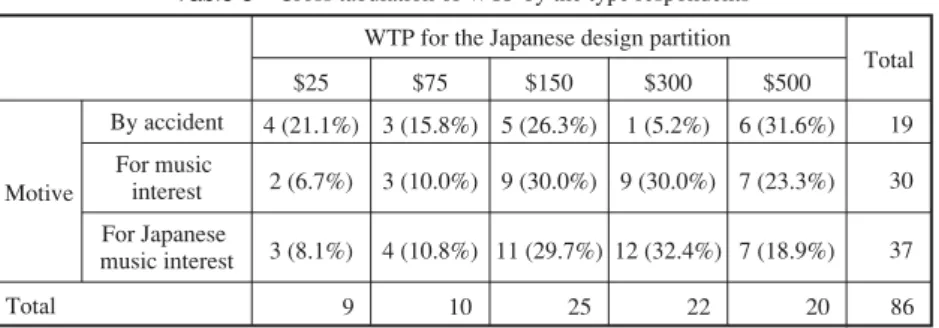
.WTP for Japanese design partition differs among the type of respondents, as is shown in
Table 8
. This table shows that the portion of respondents who reveal a low amount of WTP is larger in the group who went to the concert by accident, and there is no distinct difference between the group who went to the concert for their interest in music and in Japanese music. It is shown that not a small portion of respondent who went to the concert by accident shows the highest amount of WTP for Japanese design partition. These results suggest the possibility that theTable 5 The reason why the respondents went to the concert Reason
Ratio
By accident 24.4%
Because I was interested in music.
33.6%
Because I was interested in Japanese music or Japanese culture.
42.0%
Table 6 A change in the concern for Japanese music or Japanese culture A change in the concern
Ratio
There is no change.
27.8%
Concern rose a little.
37.8%
Concern rose greatly.
34.4%
Table 7 The distribution of WTP for Japanese design partition WTP
Ratio
$25 15.3%
$75 13.7%
$150 20.2%
$300 18.5%
$500 13.3%
Non-response 19.0%
person who is impressed by the concert may show a high amount of WTP irre- spective of the motivation.
This intuition is supported by
Table 9
. This shows that the person who increased their interest shows a high amount of WTP.7. 4 Results of the Con-Joint analysis
In this subsection, we summarize the results of Con-Joint analysis.
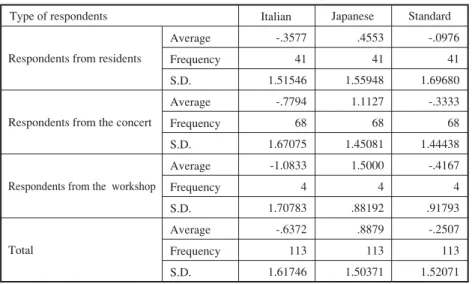
Table 10
shows the marginal utility from lamp by each type of design and respondents. This shows that the marginal utility from Japanese design is larger for the respondents from concert and workshop than that from residents. This result shows that expansion of Japanese cultural influence increases the marginal utility from theTable 8 Cross tabulation of WTP by the type respondents
4 (21.1%) 2 (6.7%)
3 (8.1%)
$25
3 (15.8%) 3 (10.0%)
4 (10.8%)
5 (26.3%) 9 (30.0%)
11 (29.7%)
1 (5.2%) 9 (30.0%)
12 (32.4%)
6 (31.6%) 7 (23.3%)
7 (18.9%)
$75 $150 $300 $500
WTP for the Japanese design partition
Total By accident
For music interest For Japanese music interest
19 30 37 Motive
Total 9 10 25 22 20 86
Note: The inside of the parenthesis is a row ratio.
Table 9 WTP to Japanese design partition by changes in interest
4 (18.2%) 3 (10.7%) 2 (9.1%)
$25
2 (9.1%) 4 (14.3%) 2 (9.1%)
6 (27.3%) 6 (21.4%) 8 (36.4%)
5 (22.7%) 10 (35.7%)
4 (18.2%)
5 (22.7%) 5 (17.9%) 6 (27.2%)
$75 $150 $300 $500
WTP for the Japanese design partition
Total 22 28 22
Total 9 8 20 19 16 72
Note: The inside of the parenthesis is a row ratio.
There is no change.
Concern rose a little.
Concern rose greatly.
lamp with Japanese design, and would increase demand for it. The result that the marginal utility from the Japanese design lamp is largest in the respondents from workshop implies that the deeper understanding of the culture increases the demand for the products with the essence of culture. This gives some foundation for promoting workshop programs on Japanese culture, to increase the competi- tive power of Japanese products in the global market place.
Table 11
shows the result of the Con-joint analysis for vests with three types of design. This result is similar with that of Table 10, strengthens the robustness of the former result, and supports our hypothesis that the deepening cultural influence increases the demand of products with the essence of the culture.Table 10 Marginal utility from lamp Type of respondents
Respondents from residents
Respondents from the concert
Respondents from the workshop
Total
Average Frequency S.D.
Average Frequency S.D.
Average Frequency S.D.
Average Frequency S.D.
-.3577 41 1.51546 -.7794 68 1.67075 -1.0833 4 1.70783 -.6372 113 1.61746
-.0976 41 1.69680 -.3333 68 1.44438 -.4167 4 .91793 -.2507 113 1.52071
.4553 41 1.55948 1.1127 68 1.45081 1.5000 4 .88192 .8879 113 1.50371 Italian Japanese
Standard
8 Concluding comments
This paper empirically examined the hypothesis that the expansion of cultural influence increases the demand for products with the essence of a culture empiri- cally. The result of the analysis shows that the demand for the product increases more as the understanding on the culture deepens more, and supports the hypoth- esis. This result has important implications for strategies to improve competitive power in the global marketplace, and to create new markets. In addition, this result suggests that cultural exchange programs should be designed so that the effectiveness of increasing cultural influence is improved through systematic workshop programs in foreign countries.
Table 11 Marginal utility from lamp Type of respondents
Respondents from residents
Respondents from the concert
Respondents from the workshop
Total
Average Frequency S.D.
Average Frequency S.D.
Average Frequency S.D.
Average Frequency S.D.
.6444 30 1.61870 -.1667 64 1.49308 -.6667 2 1.41421 .0764 96 1.56607 European
-.1422 30 1.91615 -.1948 64 2.11267 .3333 2 .00000 -.1674 96 2.02157 Standard
-.5022 30 1.59796 .3615 64 1.61504 .3333 2 1.41421 .0910 96 1.64071 Japanese
【Reference】
Altman, M., (2001) Culture, Human Agency, and Economic Theory: Culture as a Determinant of Material Welfare, Journal of Socio-Economics 30, 379-391.
The Economist, (1998) Cognitive Dissonance, Economist, 00130613, 04/04/98, Vol. 346, Issue 8062.
Kobayashi, H., (2002) Italian Work Style, (in Japanese), Nikkei Business Bunko.
Green, P.E., and Y. Wind, (1973) Multiattribute Decisions in Marketing: A Measuerment Approach, Hindsdale, Ill.: Dryden Press.
Piore, M.J., and C.F. Sabel, (1984) The Second Industrial Divide: Possibilities for Prosperity, Basic Books.
Santagata, W., (2002) Cultural Districts, Property Rights and Sustainable Economic Growth, Journal of Urban & Regional Research, Mar2002, Vol. 26, Issue 1, p9-23.
Sforzi, F., (2002) The Industrial District and the 'New' Italian Economic Geography, European Planning Studies, Jun2002, Vol. 10, Issue 4, p439-448.
Swank, D., (1996) Culture, Institutions, and economic growth, American Journal of Political Science, Aug96, Vol. 40, Issue 3, p660-679.
SPSS, (2002) SPSS Conjoint 8.0J Manual, SPSS Japan Inc.
Appendix 1 Japanese motor car sales share by country 2001年
Japanese Brand
Portion (%) Cars produced
in Japan
Portion (%) Total
number of sales Japan
U.S.A Canada
4,289,683 8,422,625 868,135 2,458,769 3,341,718 2,254,732 2,425,300 530,287 488,683 96,158 42,833 164,765 280,214 1,436,880 248,529 246,581 109,441 293,873 14,418,763 319,094 91,916
…
…
4,034,597 2,819,262 319,573 343,181 324,789 116,178 218,443 78,296 46,817 18,005 3,144 44,703 52,570 84,267 23,761 34,229 25,424 40,143 1,453,950 59,561 25,571
…
…
94.1 33.5 36.8 14.0 9.7 5.2 9.0 14.8 9.6 18.7 7.3 27.1 18.8 5.9 9.6 13.9 23.2 13.7 10.1 18.7 27.8
…
…
4,020,595 838,925 122,982 135,323 177,522 58,120 132,612 39,407 23,101 7,712 1,850 21,968 31,660 26,519 12,587 16,672 9,543 25,261 719,857 43,496 17,007
…
…
93.7 10.0 14.2 5.5 5.3 2.6 5.5 7.4 4.7 8.0 4.3 13.3 11.3 1.8 5.1 6.8 8.7 8.6 5.0 13.6 18.5
…
… Britain
Germany France
Italy Holland Belgium Denmark Luxemburg
Ireland Greece Spain Portugal Sweden Finland Austria
計 Switzerland
Norway Mexico Australia
E
U
Note: Japanese brand includes Japanese brand cars produced outside of Japan. … means N.A.
Source: Japan Car Manufacturing Association.
Country
Appendix 2 Please imagine a situation where you must select a lamp for a gift to a friend (or yourself). Please rank the following cards according to your preference. This question is for estimating the willingness to pay for each type of design.
Italian design Japanese design Common design
Card 1 Price : $50 Design : Japanese
Card 2 Price : $300 Design : Italian
Card 3 Price : $100 Design : Japanese
Card 4 Price : $100 Design : Common
Card 5 Price : $50 Design : Common
Card 6 Price : $100 Design : Italian
Card 7 Price : $50 Design : Italian
Card 8 Price : $300 Design : Japanese
Card 9 Price : $300 Design : Common
Rank Card Number
1 2 3 4 5 6 7 8 9
The Doshisha University Economic Review Vol.57 No.2 Abstract
Tadashi YAGI, Effect of Cultural Influence on Expansion of Market: Empirical eval- uation of economic benefits of cultural social infrastructure
Confronted with this drastic change in economic environment, companies and governments in developed countries are forced to seek a new industry model.
Price competition is not an effective strategy, and the effective utilization of cul- tural element in creating market is gaining its importance. In this paper, we esti- mate the effects of the expansion of cultural influence on the demand for products empirically, and examine an effective method for expanding cultural influence.
This analysis provides us with some evidence for the way cultural resources work as a source of economic growth.