研究論文 Research Papers
11
Analyzing the Factors that Make Matsunojo’s Makura Captivating: Nurturing Imagination and the Possibility of
Application to Education
Aya SAKAI (Kyushu University)
Keywords
: Koudan, Rakugo, Discourse analysis, Story-telling, Japanese language teaching概 要
本研究は、講談師・神田松之丞のマクラの構造を明らかにする基礎的分析を行うことを目 的とした。まず、話題を検討した結果、構成的特徴として「来場への謝辞」「演ずることの表 明」、内容的特徴として「他の出演者への言及」「講談と落語の比較」「講談師である自分の 価値や評価」が見られた。次に、発話機能を分類した結果、15 種類に大別され、【提示情報 の言いかえ】【提示情報の補足】【沈黙表現】【行為要求】【行動に対する注釈】に強調効果と 梯子外しという強弱二つの使い分けが見られ、観客を惹きつけていることが明らかになった。
1. Introduction
Rakugo (落語) and koudan (講談) are two forms of traditional Japanese story-telling that preserve the element of here-and-now. The performers relate the stories according to the times and share them with the audience in a refined manner (Sakai, 2001).
What the rakugoka (rakugo performer) and koudanshi (koudan performer) have in
common with teachers is that they both address big groups single-handedly. The performers
engage the audience, and the teachers their students. Rakugo and koudan possess tried and
tested oratory techniques that that may be applied to language teacher education. Makura,
which is the component preceding the actual rakugo story, is especially noteworthy. In the
makura, the rakugoka and koudanshi assess the atmosphere of the room, the age range and
background of the audience members, and their reactions to the performer’s utterances. These
set the tempo for the main story that follows.
12
2. Literature Review and Research Objectives
2.1 Verbal Entertainment and Japanese Language Education
Rakugo is a form of entertainment that has been in existence for at least 400 years (Matsumoto, 2010). In rakugo, the rakugoka uses a sensu (Japanese folding fan that opens and closes) and tenugui (Japanese towel) as props. In order to distinguish between characters, they turn their bodies left and right accordingly. Koudan, which is said to have originated in the 15th or 16th century, is similar to rakugo in that it is also a form of verbal entertainment. The difference between the two is that in koudan, the performer sits in front of a low lecture stand, and tells stories with historical themes while keeping rhythm with both a sensu and hari-oogi (special type fan used in koudan that does not open).
According to Ooshima (2006), rakugo contains humor that is universally understood, and consequently, people of various cultural backgrounds can relate to it. Researchers have looked into rakugo as a possible teaching material for Japanese language learners. For instance, Sakai (2001) reported that by explaining the structure of rakugo and the vocabulary to students, followed by listening practice or inviting rakugoka, students were able to understand the characters in the stories and their relationships to each other.
Similarly, Iritono (2009), as well as Hatasa and Kubota (2009), observed that studying rakugo helps improve American university students’ Japanese skills and their understanding of Japanese culture. In recent years, rakugo performances have been incorporated into many language classes, and their dramatic effects are being noted.
In terms of Japanese language teacher training, Sakai and Takahashi (2006) conducted a workshop for Korean Japanese-language teachers, in which they held discussions after watching rakugo. In the study by Kanai, Uenishi, and Enomoto (2014), teacher training sessions that included rakugo lessons and performances were designed. Kanai, Uenishi, and Enomoto (2014) asserted that in Japanese language education, it is necessary for teachers to possess the ability to cultivate a space based on mutual trust between speakers and listeners.
2.2 Structure of Verbal Entertainment and Discourse Analysis
In his series of studies, Nomura (1995; 1996; 2013) approached rakugo through discourse analysis. Nomura (2013) identified five elements in rakugo: maeoki (greeting), makura (the introduction to the story), hondai (main story), ochi (punchline), and musubi (wrap-up). Maeoki was marked as the beginning of the discourse, and upon examining recordings and transcripts of rakugo, Nomura categorized the maeoki into seven parts.
Furthermore, Nomura (1995) observed several points. First, rakugo possessed a duality of speaking to the audience and of speaking between the characters in the story.
Secondly, a character’s speech time was longer than naturally occurring conversations, and
13
there were numerous monologues indicating scene changes and time lapses. Thirdly, the purpose of the pause taken at the start of speech was to gauge the audience’s reaction, as well as to signify scene change, non-verbal action, hesitation, and dramatic presentation.
In contrast, little research has been done on koudan. Since makura appear in koudan as well as rakugo, the makura in the koudan will be the focus of this study. The hondai will hereafter be referred to as the program or story.
2.3 Research Objectives
Several trends emerged when surveying the literature available. First, in the field of Japanese language teaching, studies have been conducted on how rakugo can be used as teaching material. These focus on viewing rakugo and learning about Japanese culture. Second, rakugo has also been studied as material for Japanese language teacher education; however, there has been no investigation into the implementation of rakugo oratory techniques into teaching. Thirdly, there seem not to be many past studies available on koudan in terms of Japanese language teaching. Finally, while the structure analysis for the hondai and the maeoki has been performed, that of makura has not been explored.
This study attempts to better understand the structure of the koudan makura. It investigates topics used in makura and speech functions, focusing on elements which engage the attention of the audience. Koudan makuras were chosen because koudan is difficult to understand even for native speakers of Japanese, and they make full use of the techniques for engaging the audience.
3. Method
3.1 Data for Analysis
In this study, data was taken from the transcripts of four types of Makura (A) to (D) from a DVD on koudan titled Shin-Seiki Koudan Taizen Kanda Matsunojo. It features Matsunojo Kanda, a koudanshi whose strong and dramatic narration is well-received by both critics and the general public in Japan.
Makura is the first contact and place of communication between the performer and the audience. Burke (1969), who advocated dramaturgical theory, proposed that the motivation for communication is the need and desire to understand each other, similar to the interaction of actors in drama series.
In dramaturgical theory, communication is considered to have the following five rhetorical elements: act (action, event; what happened), scene (the setting of the action; when and where), agent (the doer; who did it), agency (the tools and language of the doer; how it was done), and purpose (the goal; why it was done).
This present study approaches the art of speaking as the communication between the
performer and the audience. Its construct is based on dramaturgical theory. The scene from
14
Makura (A) to (C) is Suehirotei in Shinjyuku, and the scene from Makura (D) is Renjyakutei in Kanda. The agent is Matsunojo Kanda. The span of makura is defined as from the moment when the agent is seated to when a sound is made by hari-oogi and sensu, as the signals the beginning of the main story. Agency and purpose is examined in the section titled Results and Discussion.
3.2 Data Transcription
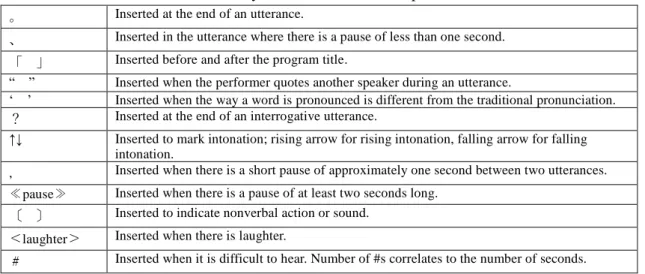
Data transcription was performed according to Basic Principles of Transcription (Usami, 2011). The basic analysis unit is the utterance. The symbols used in the transcription for the present study are presented in Table 1.
Table 1 Symbols used in Transcription
。 Inserted at the end of an utterance.
、 Inserted in the utterance where there is a pause of less than one second.
「 」 Inserted before and after the program title.
“ ” Inserted when the performer quotes another speaker during an utterance.
‘ ’ Inserted when the way a word is pronounced is different from the traditional pronunciation.
? Inserted at the end of an interrogative utterance.
↑↓ Inserted to mark intonation; rising arrow for rising intonation, falling arrow for falling intonation.
, Inserted when there is a short pause of approximately one second between two utterances.
≪pause≫ Inserted when there is a pause of at least two seconds long.
〔 〕 Inserted to indicate nonverbal action or sound.
<laughter> Inserted when there is laughter.
# Inserted when it is difficult to hear. Number of #s correlates to the number of seconds.
4. Results and Discussion
4.1 Topic Analysis
A conversation generally takes place between two or more people, and a shift in topic is indicated by the markers of language, denoting the beginning and end of a topic. Since the makura is not a conversation, the data was divided according to topics Matsunojo spoke on and the audience’s reactions. Simultaneously, the following categorizations by Tsutsui (2012) was used for analyzing the qualitative differences in the topic, and for dividing each item in the topic as sub-topics: (1) referencing a new topic, different from the topic previously spoken about, (2) referencing the same topic, but from a different perspective, (3) referencing the same topic, but in a different time period, (4) referencing the same target and situation, and (5) generalization of references to the same individual target or situation. In the tables appearing in this study, the sub-topics are the descriptions of utterances by Matsunojo.
The categorization of topics for Makura (A) is presented in Table 2. The DVD used
to gather data for this study did not include a story after Makura (A), while it did have stories
15 for the other three Makuras (B), (C), and (D).
Table 2 Makura (A) April 13, 2013 Shinjyuku Suehirotei “Shinyayose” 2 min 18 sec
Topic Sub-Topic
state of the venue
The venue is full.
There are two TV cameras.
The koudan is about to begin.
situation surrounding the field of story telling
The number of rakugoka is increasing.
The number of koudanshi is small.
The ratio between male and female for rakugoka and koudanshi is different.
value as a koudanshi
Matsunojo is the only person who is a male koudanshi in his twenties.
As he is the only male koudanshi in his twenties, he is special.
Even if his koudan is not funny, he wants audiences to think that he is special.
In general, if people see something rare or special, they think it’s also something good.
He wants audiences to think that his koudan is funny.
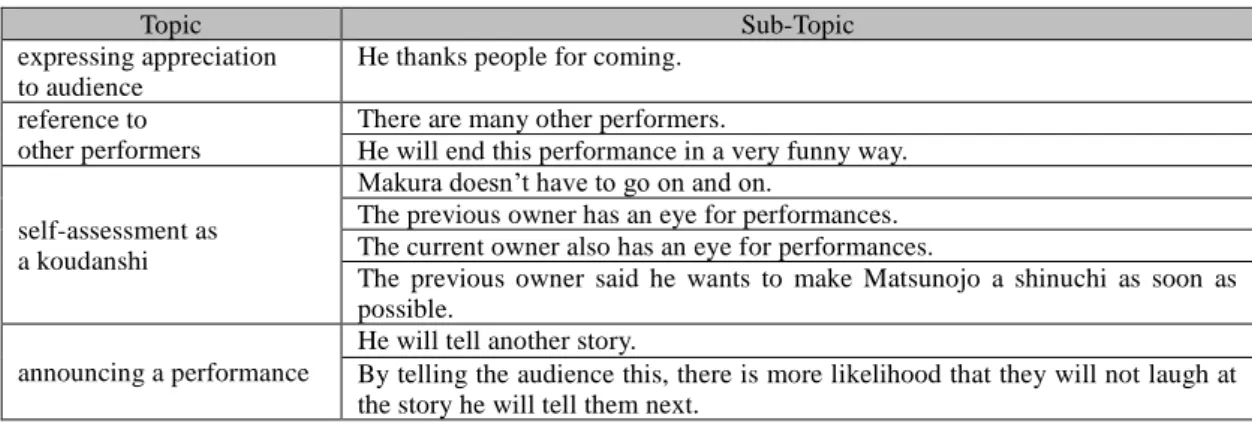
The categorization of topics for Makura (B) is presented in Table 3. The program that follows the makura is titled Tagasode no Otokichi. The story, also known as Naniwa Sankyo Kyaku, depicts Otokichi’s boyhood. A glib Otokichi bumps into a professional gambler at a bridge and angers him with his words. The topics used in makura are generally related to the main story that follows, and they sometimes foreshadow the punchline. In this case, Matsunojo first discusses a topic from his daily life (i.e., about how he had met the previous Suehirotei owner). Next in the performance, Matsunojo discusses the hardships he himself faced in his early career while he is playing the character of Otokichi; it appears that Matsunojo projects himself onto Otokichi, who was later to become famous.
Table 3 Makura (B) May 10, 2014 Shinjyuku Suehirotei “Shinyayose” 2 min 5 sec
Topic Sub-Topic
expressing appreciation to audience
He thanks people for coming.
reference to other performers
There are many other performers.
He will end this performance in a very funny way.
self-assessment as a koudanshi
Makura doesn’t have to go on and on.
The previous owner has an eye for performances.
The current owner also has an eye for performances.
The previous owner said he wants to make Matsunojo a shinuchi as soon as possible.
announcing a performance
He will tell another story.
By telling the audience this, there is more likelihood that they will not laugh at the story he will tell them next.
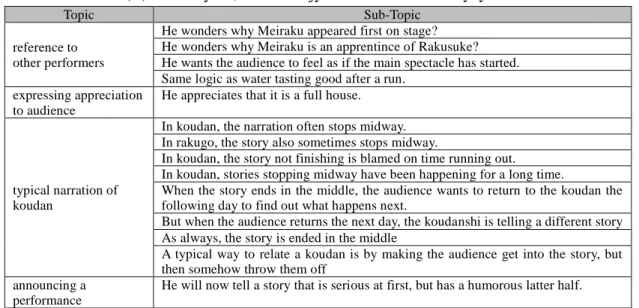
The categorizations of topics for Makura (C) is presented in Table 4. The program
that follows this is Kashima no Bo-matsuri. It is an excerpt from Tenpo Suikoden, which
depicts the fight between Hanzo Sasagawa and Sukegoro Iioka. In the story, a drunk Hirate
has a quarrel with a subordinate of his enemy Sukegoro. Suddenly, the old lady of Kashima
and her white shaggy dog appear, adding a humorous touch. Matsunojo ends the story in the
middle at the most exciting part, just as he warns beforehand. By informing the audience of
the “typical narration of koudan”, he gives them a clue about the following program.
16
Table 4 Makura (C) February 14, 2015 Shinjyuku Suehirotei “Shinyayose” 3 min 22 sec
Topic Sub-Topic
reference to other performers
He wonders why Meiraku appeared first on stage?
He wonders why Meiraku is an apprentince of Rakusuke?
He wants the audience to feel as if the main spectacle has started.
Same logic as water tasting good after a run.
expressing appreciation to audience
He appreciates that it is a full house.
typical narration of koudan
In koudan, the narration often stops midway.
In rakugo, the story also sometimes stops midway.
In koudan, the story not finishing is blamed on time running out.
In koudan, stories stopping midway have been happening for a long time.
When the story ends in the middle, the audience wants to return to the koudan the following day to find out what happens next.
But when the audience returns the next day, the koudanshi is telling a different story As always, the story is ended in the middle
A typical way to relate a koudan is by making the audience get into the story, but then somehow throw them off
announcing a performance
He will now tell a story that is serious at first, but has a humorous latter half.
Finally, the categorizations of topic for Makura (D) are shown in Table 5. The
program title for (D) is Grey Zone. It is an original koudan created by Matsunojo. In it, a
young boy named Yoshida becomes disillusioned upon learning in a pro-wrestling magazine
that the games are scripted. He idolizes Oonokuni, a sumo wrestler who denounced fixed
matches. Yoshida moves to Tokyo and becomes a rakugoka, even starring in the supposedly
non-scripted TV program Shoten. In (D), Matsunojo announces the release of his DVD, and
suggests that it would not be so bad if his DVD serves as an inspiration for youngsters to
become koudanshi and experience the ups and down of the koudan world.
17
Table 5 Makura (D) December 26, 2014 Kanda Renjyakutei “Hitori Dainarikin Zenyasai”
5 min 26 sec
Topic Sub-Topic
value of his DVD Master Shinsuke wants his DVD.
Not sure if topic-wise, it is right to give Master Shinsuke the DVD.
filming at Renjyakutei It’s the first time to be filming at Renjyakutei.
He spoke with the staff, and the makura will be cut later.
expressing appreciation to audience
He thanks the audience for coming.
He should have given thanks to the audience first thing.
value of his DVD
He is always very sorry.
No intention of giving a splendid performance.
He asks if there is value in buying the DVD?
effect of his DVD
In rakugo study circles, there are some foolish people.
He ponders what would happen if his DVD were in a room where a rakugo study circle was taking place.
There may be people in rakugo study circles that would make good koudanshi.
He wants people to know in his DVD that one can perform freely in a koudan.
There is a possibility that viewers of this DVD may want to become koudanshi.
announcing a performance Finally, he will tell another story.
effect of his DVD It is worth it if there are people who become fans of koudan after watching this DVD.
announcing a performance Finally, he will perform Grey Zone.
explanation for performing again
He performed Grey Zone at Shinyayose, and it turned out well.
But the staff wanted him to do Grey Zone again.
He went overboard when he did Grey Zone at Shinyayose.
He wants to record Grey Zone at the studio, as the rakugoka Ensho-hyakuseki did.
He wants Kishin Shinoyama to photograph him.
Due to some circumstance, they can’t record the performances in the studio.
announcing a performance He has said this many times, but he will perform Grey Zone.
Matsunojo’s makura has the following four characteristics: First, as seen in (C) and (D), in the middle of the performance he realizes he has not thanked the audience for coming, and starts doing so. Nomura (2013) has observed that the performer generally thanks the audience at the beginning of the makura, as seen in (B). Therefore, the audience does not expect to hear this in the middle, which induces laughter from them.
Secondly, he refers to other presenters, as seen in (B) and (C). In both cases, he pokes fun at the others, inviting laughter, and thereby setting the mood.
Thirdly, while the topics differ somewhat, as seen in “situation surrounding the field of story-telling” in (A) and “typical narration of koudan” in (C), he is able to explain koudan, which may be unfamiliar to the audience, by comparing it with the more famous rakugo.
While explaining rakugo light-heartedly, his effort and desire to help the audience enjoy the koudan performance is apparent.
Finally, as seen in “value as a koudanshi” in (A), “self-assessment as a koudanshi” in
(B), and “the value of his DVD” in (D), he is continuously interested in his own worth and
evaluation. These types of topics, along with koudan and Matsunojo’s self-introductions, often
emerge in his talks at the Shinyayose at Suehirotei in Shinjyuku where there are many first
time viewers.
18 4.2 Classification and Structure Analysis of Speech Acts
Next, speech acts and the factors for engaging the audience were analyzed in order to understand the structure of the makura. Speech acts are defined as utterances that accomplish certain goals in a communication (Szatrowski, 1993).
4.2.1 Classification and Frequency of Speech Acts
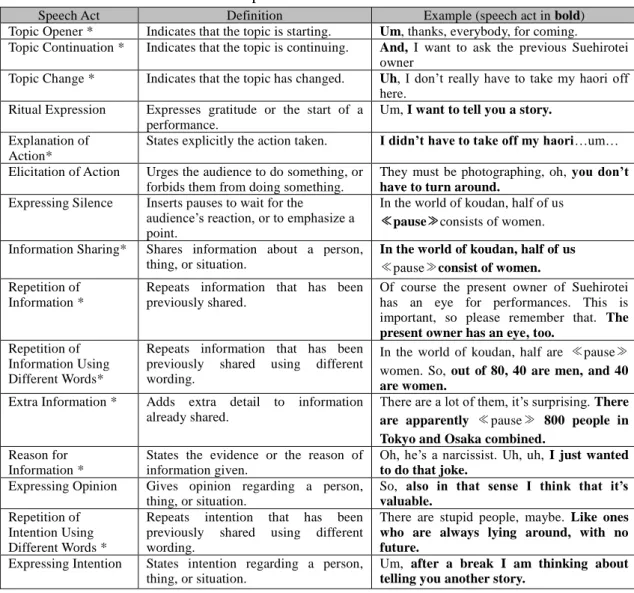
Fifteen types of speech functions were identified in this data using the framework by Szatrowski (1993). Definitions and examples of these speech functions are presented in Table 6. An asterisk (
*) signifies new speech functions identified in the current research.
Table 6 Speech Acts in this Research
Speech Act Definition Example (speech act in bold)
Topic Opener * Indicates that the topic is starting. Um, thanks, everybody, for coming.
Topic Continuation * Indicates that the topic is continuing. And, I want to ask the previous Suehirotei owner
Topic Change * Indicates that the topic has changed. Uh, I don’t really have to take my haori off here.
Ritual Expression Expresses gratitude or the start of a performance.
Um, I want to tell you a story.
Explanation of Action*
States explicitly the action taken. I didn’t have to take off my haori…um…
Elicitation of Action Urges the audience to do something, or forbids them from doing something.
They must be photographing, oh, you don’t have to turn around.
Expressing Silence Inserts pauses to wait for the
audience’s reaction, or to emphasize a point.
In the world of koudan, half of us
≪pause≫consists of women.
Information Sharing* Shares information about a person, thing, or situation.
In the world of koudan, half of us
≪pause≫consist of women.
Repetition of Information *
Repeats information that has been previously shared.
Of course the present owner of Suehirotei has an eye for performances. This is important, so please remember that. The present owner has an eye, too.
Repetition of Information Using Different Words*
Repeats information that has been previously shared using different wording.
In the world of koudan, half are ≪pause≫
women. So, out of 80, 40 are men, and 40 are women.
Extra Information * Adds extra detail to information already shared.
There are a lot of them, it’s surprising. There are apparently ≪pause≫ 800 people in Tokyo and Osaka combined.
Reason for Information *
States the evidence or the reason of information given.
Oh, he’s a narcissist. Uh, uh, I just wanted to do that joke.
Expressing Opinion Gives opinion regarding a person, thing, or situation.
So, also in that sense I think that it’s valuable.
Repetition of Intention Using Different Words *
Repeats intention that has been previously shared using different wording.
There are stupid people, maybe. Like ones who are always lying around, with no future.
Expressing Intention States intention regarding a person, thing, or situation.
Um, after a break I am thinking about telling you another story.
19 Diagram 1 Frequencies of Speech Acts
Next, the frequencies of speech acts were analyzed for each makura. The findings are summarized in Table 1. The speech acts occurring the most frequently were Information Sharing (58), Topic Continuation (33), and Expressing opinion (31). In addition, the topic direction became apparent through Topic Opener, Topic Continuation, and Topic Change.
Finally, Repetition of Information, Repetition of Information Using Different Words, Extra Information, and Reason for Information characteristically appeared after Information Sharing.
4.2.2 Factors for Engaging the Audience
When there is a reaction or laughter from the audience after a speech act, it signifies that the speech act contains factors for engaging the audience. In analyzing Matsunojo’s speech acts, close attention was paid to Repetition of Information Using Different Words, Extra Information, Expressing Silence, Elicitation of Action, and Explanation of Action. From here on, the utterance numbers, utterance topics, and speech acts are labeled. M in utterance number stands for Matsunojo and A for the audience.
4.2.2.1. Repetition of Information Using New Words: Emphasis on Information and Rhythm
In a discourse, it is rare for the speaker to add extra information or provide evidence
for the information unless the interlocutor fails to comprehend or asks questions about it.
20
However, Repetition of Information Using Different Words occurs frequently in the present data, excepting (B).
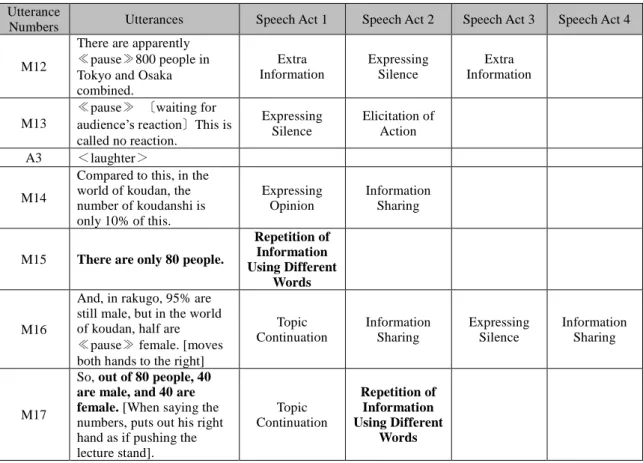
In Example 1, two pieces of information in M12 and M14 (i.e., there are 800 rakugoka, and the number of koudanshi is only 10% of this) are rephrased in M15. Moreover, M16 (i.e., in the world of koudan, there are an equal number of females and males) is rephrased in M17. Both numerical pieces of information are easy to understand; by rephrasing
“1 out of 10” to “80 people”, and “half are females” to “40 females”, it accentuates the information given previously.
Table 7 Example 1 Makura (A)
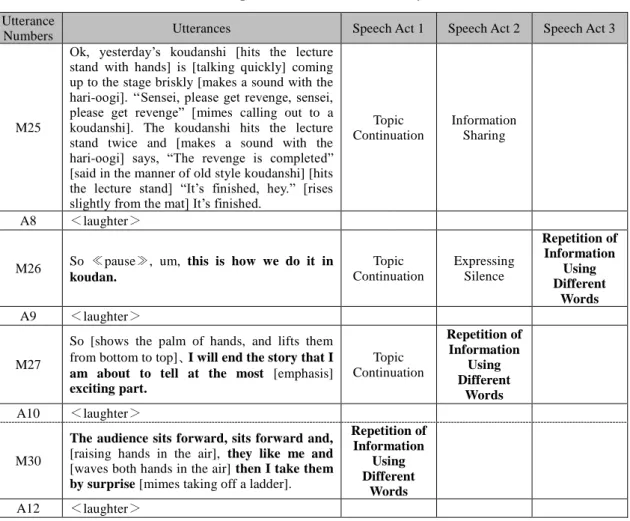
In the telling of a koudan, the story often ends abruptly at the climax. In M 26, M 27, and M30 in Example 2, Matsunojo touches on this, using both straightforward and metaphorical language. In M25, the audience members are already laughing, but by repeating the same topic in different words, he further engages the audience and causes more laughter.
Moreover, by saying this three times, he creates a rhythm like that of a hari-oogi drawing in the audience.
Utterance
Numbers Utterances Speech Act 1 Speech Act 2 Speech Act 3 Speech Act 4 M12
There are apparently
≪pause≫800 people in Tokyo and Osaka combined.
Extra Information
Expressing Silence
Extra Information
M13
≪pause≫ 〔waiting for audience’s reaction〕This is called no reaction.
Expressing Silence
Elicitation of Action A3 <laughter>
M14
Compared to this, in the world of koudan, the number of koudanshi is only 10% of this.
Expressing Opinion
Information Sharing
M15 There are only 80 people.
Repetition of Information Using Different
Words
M16
And, in rakugo, 95% are still male, but in the world of koudan, half are
≪pause≫ female. [moves both hands to the right]
Topic Continuation
Information Sharing
Expressing Silence
Information Sharing
M17
So, out of 80 people, 40 are male, and 40 are female. [When saying the numbers, puts out his right hand as if pushing the lecture stand].
Topic Continuation
Repetition of Information Using Different
Words
21
Table 8 Example 2 Makura (C)(Partly Omitted)
4.2.2.2. Extra Information: Causing Laughter, or Betraying Expectations
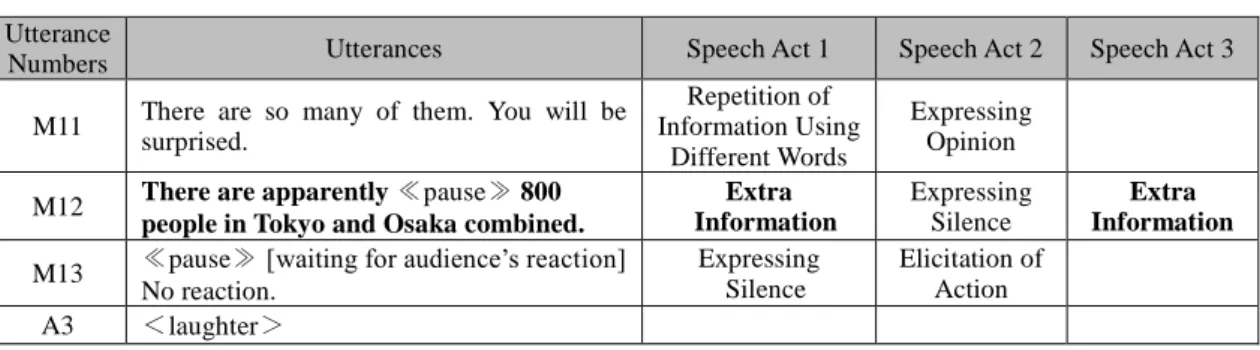
Unique approaches to engaging the audience were observed in the Extra Information occurring after Information Sharing. In Example 3, in which the topic of the number of rakugoka continue, Matsunojo waits for the audience’s reaction after saying exactly how many people it comprises (M12). Furthermore, referring to the news that the previous owner of Suehirotei wants to give Matsunojo the title of shinuchi (the highest rank in koudan) in Example 4, Matsunojo creates suspense by first saying, “And, so that I can hear it, he said clearly,” then “Oh, how I want to make him a shinuchi as soon as possible.” Supplying further information leads to the next utterance, and this holds the audience’s attention and makes them laugh even more.
Utterance
Numbers Utterances Speech Act 1 Speech Act 2 Speech Act 3
M25
Ok, yesterday’s koudanshi [hits the lecture stand with hands] is [talking quickly] coming up to the stage briskly [makes a sound with the hari-oogi]. ‘‘Sensei, please get revenge, sensei, please get revenge” [mimes calling out to a koudanshi]. The koudanshi hits the lecture stand twice and [makes a sound with the hari-oogi] says, “The revenge is completed”
[said in the manner of old style koudanshi] [hits the lecture stand] “It’s finished, hey.” [rises slightly from the mat] It’s finished.
Topic Continuation
Information Sharing
A8 <laughter>
M26 So ≪pause≫, um, this is how we do it in koudan.
Topic Continuation
Expressing Silence
Repetition of Information
Using Different
Words A9 <laughter>
M27
So [shows the palm of hands, and lifts them from bottom to top]、I will end the story that I am about to tell at the most [emphasis]
exciting part.
Topic Continuation
Repetition of Information
Using Different
Words A10 <laughter>
M30
The audience sits forward, sits forward and, [raising hands in the air], they like me and [waves both hands in the air] then I take them by surprise [mimes taking off a ladder].
Repetition of Information
Using Different
Words A12 <laughter>
22
Table 9 Example 3 Makura (A)
Table 10 Example 4 Makura (B)
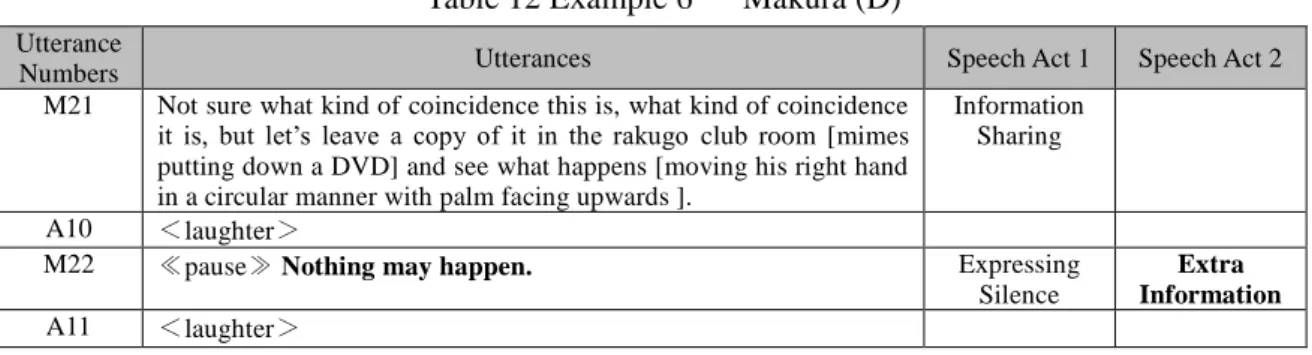
On the other hand, after explaining how a rakugoka typically ends his story in Example 5, he makes fun of himself, as M18 exemplifies. In Example 6, he contemplates the reaction to the sale of his own DVD, then adds in M22, “Nothing may happen.” In both instances, the audience’s interest in what Matsunojo says is at a peak; however, Matsunojo betrays their expectation in finding out what happens next, which makes causes laughter.
Table 11 Example 5 Makura (C)
Utterance
Numbers Utterances Speech Act 1 Speech Act 2 Speech Act 3
M11 There are so many of them. You will be surprised.
Repetition of Information Using
Different Words
Expressing Opinion M12 There are apparently ≪pause≫ 800
people in Tokyo and Osaka combined.
Extra Information
Expressing Silence
Extra Information M13 ≪pause≫ [waiting for audience’s reaction]
No reaction.
Expressing Silence
Elicitation of Action A3 <laughter>
Utterance
Number Utterances Speech Act 1 Speech Act 2 Speech Act 3 Speech Act 4 M14
It was definitely ≪pause≫ in a small voice [moving both hands].
Information Sharing
Expressing Silence
Information Sharing
M15
And, to me [raising his right hand] he said clearly [makes noise with his hari-oogi] “Oh, how I want to make him
≪pause≫a shinuchi as soon as possible” [whispering].
Extra Information
Information Sharing
Expressing Silence
Information Sharing
A4 [commotion・applause]
<laughter>
Utterance
Numbers Utterances Speech Act 1 Speech Act 2 Speech Act 3
M16
Um, by the way, when rakugoka-sans [waves his right hand quickly] want to cut the story in the middle, the way they do it is [makes a sound with his hari-oogi]
Topic Continuation
Extra Information
M17
You say, ‘‘You’re kidding’’ [sweeping haori towards the back with his left hand], like this [licking lips].
Information Sharing M18 I haven’t really told a ≪pause≫ joke. Extra
Information
Expressing Silence
Extra Information A7 <laughter>
23
Table 12 Example 6 Makura (D)
4.2.2.3. Expressing Silence: Heightening Dramatic Effect
The purpose of Expressing Silence is to wait for the audience’s reaction, or to emphasize a point. In the case of conversations, it is used when one is not sure how to respond, or to ponder a subject. On the other hand, in Matsunojo’s makura, silence has a tangible quality and it is used deliberately as something he wants the audience hear.
For example, instances of Expressing Silence appear in the following (i.e., “There are apparently
≪pause≫800 people in Tokyo and Osaka combined,” (Example 1, M12); “And, in rakugo, 95% are still men, but in the world of koudan, half are
≪pause≫ female.”(Example 1, M16)). By remaining silent for a few seconds before saying “800 people” and
“female”, Matsunojo has the audience’s attention and creates emphasis for what follows next.
Expressing Silence also appears when other performers are referenced (i.e., “≪pause
≫, I am watching something valuable,” (Example 7, M24); and “≪pause≫ I’m talking
about you.” (Example 8, M21). These pauses have a dramatic effect. As these instances of Expressing Silence occur before Matsunojo’s signature phrases, they increase the dramatic effect and elicit laughter.
Table 13 Example 7 Makura (A)
Table 14 Example 8 Makura (B)
Utterance
Number Utterances Speech Act 1 Speech Act 2 Speech Act 3
M21
“Um,” [while thrusting out the right index finger] I asked, “Do you mean Brother Koihachi?”, then he shook his head for about two seconds [his right hand still outstretched]
and like this [shaking his head], he shook his head sideways ≪pause≫ “I’m talking about you.”
Information Sharing
Expressing Silence
Information Sharing
A5 [commotion and applause]
Utterance
Numbers Utterances Speech Act 1 Speech Act 2
M21 Not sure what kind of coincidence this is, what kind of coincidence it is, but let’s leave a copy of it in the rakugo club room [mimes putting down a DVD] and see what happens [moving his right hand in a circular manner with palm facing upwards ].
Information Sharing
A10 <laughter>
M22 ≪pause≫ Nothing may happen. Expressing Silence
Extra Information A11 <laughter>
Utterance
Number Utterances Speech Act 1 Speech Act 2 Speech Act 3
M23 So, please think like this. Topic
Continuation
Elicitation of Action
M24
So even if my koudan is not [puts both hands forward] funny ≪pause≫ ‘‘Oh [placing right hand on chest and facing right]≪pause≫、I am watching something valuable’’[placing right hand on chest and face left].
Information Sharing
Expressing Silence
Elicitation of Action
24 4.2.2.4 Elicitation of Action: Creating New Laughter
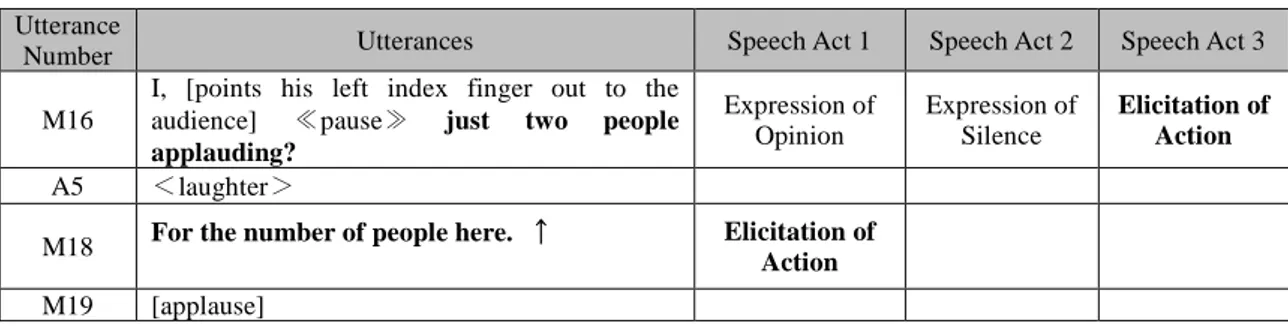
Elicitation of Action is utilized when some type of action is elicited explicitly or implicitly from the audience. In Example 9 M16 and Example M18, Matsunojo asks the audience to applaud. In Example 3, he does not get a desired reaction after remarking that the number of rakugoka in east and west Japan combined is 800. Therefore, he says, “No reaction” in order to get a reaction. Owing to the physical distance between the stage and spectator seats, natural conversation cannot be established. However, laughter is caused through the elicitation of action by the performer.
Table 15 Example 9 Makura (B)
4.2.2.5 Explanation of Action: Taking Off the Haori
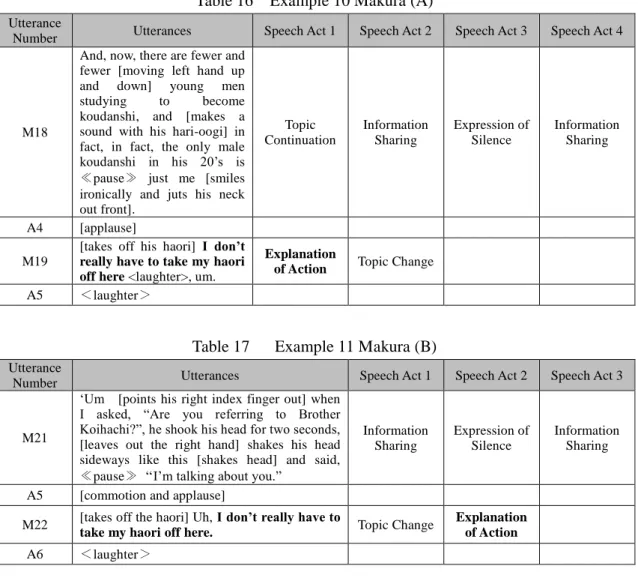
Explanation of Action refers to an explicit explanation of the action taken. For instance, the performer may exclaim, “Oh, I dropped it” when he drops something. In the data used, Explanation of Action occurs infrequently, once in Makura A and B. In both cases, it is used when Matsunojo takes off his haori (short traditional Japanese kimono-style jacket).
In Example 10, after speaking about how valuable he is as a koudanshi because he is the only male koudanshi in his twenties, he embarks on the next topic by saying, “I don’t really have to take my haori off here”. Furthermore, in Example 11, after he tells the audience about how the previous owner of Suehirotei wants to make him a shinuchi, he states, “I don’t really have to take my haori off here,” before changing topics.
In both cases, since Matsunojo takes his haori off after he discusses his self-worth, he may be portraying himself as being embarrassed or humble. Also, the Explanation of Action invites the audience’s laughter. In koudan, taking off the haori typically signals a change in topic or story. In Matsunojo’s performance, he tells jokes while doing so; this has become his signature move.
Utterance
Number Utterances Speech Act 1 Speech Act 2 Speech Act 3
M16
I, [points his left index finger out to the audience] ≪pause≫ just two people applauding?
Expression of Opinion
Expression of Silence
Elicitation of Action A5 <laughter>
M18 For the number of people here. ↑ Elicitation of Action M19 [applause]
25
Table 16 Example 10 Makura (A)
Utterance
Number Utterances Speech Act 1 Speech Act 2 Speech Act 3 Speech Act 4
M18
And, now, there are fewer and fewer [moving left hand up and down] young men studying to become koudanshi, and [makes a sound with his hari-oogi] in fact, in fact, the only male koudanshi in his 20’s is
≪pause≫ just me [smiles ironically and juts his neck out front].
Topic Continuation
Information Sharing
Expression of Silence
Information Sharing
A4 [applause]
M19
[takes off his haori] I don’t really have to take my haori off here <laughter>, um.
Explanation
of Action Topic Change A5 <laughter>
Table 17 Example 11 Makura (B)
Utterance
Number Utterances Speech Act 1 Speech Act 2 Speech Act 3
M21
‘Um [points his right index finger out] when I asked, “Are you referring to Brother Koihachi?”, he shook his head for two seconds, [leaves out the right hand] shakes his head sideways like this [shakes head] and said,
≪pause≫ ‘‘I’m talking about you.”
Information Sharing
Expression of Silence
Information Sharing
A5 [commotion and applause]
M22 [takes off the haori] Uh, I don’t really have to
take my haori off here. Topic Change Explanation of Action A6 <laughter>
5. Limitations
The limitations to this study will be discussed in this section. First, for the present study, data was solely collected from Matsunojo’s DVD, and as a result it has limited reliability. In order to apply the techniques learned through makura to language teaching, more investigation amassing data and comparing with other makura to classify patterns is in order.
Secondly, more investigation amassing data and comparing with makura by other
performers to classify patterns is in order. Quantitative research examining the audience
demographics and the optimal environment for listening to the koudan is necessary. It would
be of use in future research to explore ways in which oratory techniques used in koudan can be
effectively implemented by language instructors to draw students’ attention and to carry out
their lectures.
26 6. Conclusion
Several characteristics were observed in Matsunojo’s makura. Expressing appreciation to audience was uttered in the middle of the makura, and announcing a performance also appeared either part way or at the end. Topic-wise, there were many references to other performers, comparisons between koudan and rakugo, and self-evaluation as a koudanshi.
The speech acts were categorized into 15 types and analyzed. The following 5 speech acts were the most prominent in Matsunojo’s makura.
(1)Repetition of Information Using Different Words: By repeating information, the information is emphasized, causing laughter and creating a comfortable rhythm.
(2)Extra Information: Brings about laughter in the audience and betrays expectation.
(3)Expressing Silence: Pausing allows for dramatic effect, inducing laughter.
(4)Elicitation of Action: Eliciting action that did not originally exist.
(5)Explanation of Action: This occurs just as Matsunojo is taking off his haori. Laughter