– Mondegreen Phenomena by Nonnative Listeners
Hitomi Nakata
成蹊大学一般研究報告 第 50 巻第 2 分冊
平成 28 年 11 月
BULLETIN OF SEIKEI UNIVERSITY, Vol. 50 No. 2
Hearing Japanese Words in English Songs – Mondegreen Phenomena by Nonnative Listeners
Hitomi NAKATA
Abstract
This study investigates the mondegreen phenomenon – Japanese speakers, who are not proficient in English, mishear certain English lyrics as Japanese rather than just as nonsense – which occurs when Japanese speakers listen to English songs. The dataset was adopted from a website and a magazine that contained the songs of the well-known band, Queen. This dataset was presented to participants to test if they could aurally detect any Japanese words from the data. The results are comparable to those of a previous study of native speakers of English, showing that phonetically similar segments cause perceptual reinterpretations. The results also suggest a particular feature of nonnative listeners. They tend to interpret what they hear at face value because they cannot compensate for phonological reduction(s): speaking/listening strategies of native speakers such as coarticulation and deletion. From an experiment, we also obtained the results that Japanese listeners tend to isolate Japanese words from English songs where the same vowels are shared in both languages and where the structure of a syllable and a mora are matched. In EFL contexts, listening learning usually focuses on differences between sound features, but the results of this study suggest that common phonetic features also deserve attention.
Keywords: English songs, Japanese listeners, lyrics, phonetic factors, compensation
1. Introduction
Listening to songs occasionally causes mondegreen which can be defined as mishearing some parts of lyrics as different words and/or phrases often in an amusing way. For example, the lyrics: Are you going to Scarborough Fair? in Scarborough Fair by Simon & Garfunkel might be heard as Are you going to starve an old friend? Similar examples can be found in websites such as A Collection of Humorous Mondegreens (Barber, 2000).
中田ひとみ「英語の歌詞が日本語に聞こえる-非母語話者の空耳現象」
Bond (1999) examined the phenomenon, as titled in her book Slips of the Ear with 900 samples, although her analyses are not from songs but from normal speech. The samples are mostly exemplified by native speakers of English in their first language (hereafter, L1) contexts.
Japanese mondegreen, however, often takes place in listening to English songs containing lyrics of their second language (hereafter, L2). That is, when Japanese speakers listen to English songs, they sometimes hear a part of the lyrics as Japanese words. The phenomenon is well known due to the popular section, “Soramimi awaa” of a TV program (meaning slips of the ear hour: hereafter, soramimi hour), where viewers of the section submit samples of lyrics heard as Japanese, and the producer of soramimi hour broadcasts them with some entertaining visual images.
Otake (2009) reports the misperception events using the mondegreen examples as a dataset. He collected 833 cases which had been introduced in 10 years and concluded that listeners’ mental lexicon of L1 may be activated by input of L2 speech which is irrelevant to their L1. The event is least likely relevant to lexical and/or semantic connotations of original English words due to the listeners’ partial/random detection. Therefore it is suggested that the phenomenon is derived from the interaction of phonological domains that leads to the activation of listeners’ first language. In addition to his claim, we need to consider that the set of data is based on a musical environment, i.e. speakers (or, singers) produce their speech (lyrics) in musical constraints such as rhythm or accent patterns within a regularity of bars. The representation of utterances is different from those that are heard in conversations and mapping lyrics to notes may change prosodic features in normal speech. Specifically, we should consider the mapping between the note type and syllables.
Additionally, acoustically accompanied instrumental sounds are not to be ignored as overlapping noise. In fact, Cutler & Carter (1987) (cited in Vitevitch, 2002:409) argue that using lyrics in music is not appropriate to analyze auditory misperception because “it is unclear whether other factors in a song, such as the musical instruments in the background or the temporal characteristics of the music, influence perception in some way.” However, if we consider background sounds as accompanied noise in speech, this would create a more realistic environment in L2 listening, rather than a textbook speech recorded in a noise-free studio. Thus, it is worthwhile to investigate if phonetic segments are influential at all in singing contexts.
Considering these issues, the present study came up with a hypothesis that phonetic features such as vowel and consonant segments trigger the mondegreen phenomenon on the basis that prosodic features (e.g., linguistic stress patterns) are not as robust in
singing as in normal speech. We will see to what extent the mondegreen phenomena can be explained by analyzing segmental units mapped onto notes, and by an experiment of auditory tests administered to learners of English.
2. Dataset
Samples were adopted from Queen’s songs introduced for soramimi hour: 21 songs and 29 phrases. The collection of the program is retrievable from a website Queen Soramimi Hour (Retrieved, March 2012). In phonemic counting, there were 121 tokens altogether. Music sheets were available for four songs, and the author transcribed by listening for the rest of the 17 songs. The band was targeted because they have been popular in Japan for over 40 years and some of their songs are even used in commercials. This familiarity leads to the high frequency of submission of Queen’s music to soramimi hour. Another reason is the variety of their music style. It extends from rock music, pop, classical music, opera, jazz, musical, and even vaudevillian. As one band, the members develop extensive variations in the motif, temporal range from rapid rock to slow ballad. All members have written songs and three of them were in charge of vocals, on which a variation of notes could be obtained.
3. Methods
3.1 Counting methods of the dataset
Figure 1. The two bars above compare the original lyrics and misheard Japanese: ‘gunpowder gelatine’ from Killer Queen.
As shown in the music of Figure 1, both an English original syllable and a Japanese misheard syllable (or, more precisely, mora) are written in parallel to each mapped note. The mondegreen occurred in the second bar, where the line above indicates the English phrase: gunpowder gelatine (/gVn pa dɚ/ /dZe l@ tIn/) that was misheard as ganbare tabuchi ([gan ba 4e] [ta b ʧI])(meaning, “Go for it, Tabuchi.”; Tabuchi is the name of a popular baseball player of the 70s). The details are shown in Appendix 1, where how each
3
phenomenon on the basis that prosodic features (e.g., linguistic stress patterns) are not as robust in singing as in normal speech. We will see to what extent the mondegreen phenomena can be explained by analyzing segmental units mapped onto notes, and by an experiment of auditory tests administered to learners of English.
2. Dataset
Samples were adopted from Queen’s songs introduced for soramimi hour: 21 songs and 29 phrases. The collection of the program is retrievable from a website
Queen Soramimi Hour (Retrieved, March 2012). In phonemic counting, there were
124 tokens altogether. Music sheets were available for four songs, and the author transcribed by listening for the rest of the 17 songs. The band was targeted because they have been popular in Japan for over 40 years and some of their songs are even used in commercials. This familiarity leads to the high frequency of submission of Queen's music to soramimi hour. Another reason is the variety of their music style. It extends from rock music, pop, classical, opera, jazz, musical, and even vaudevillian. As one band, the members develop extensive variations in the motif, temporal range from rapid rock to slow ballad. All members have written songs and three of them were in charge of vocals, on which a variation of notes could be obtained.
3. Methods
3.1 Counting methods of the dataset
Figure 1. The two bars above compare the original lyrics and misheard Japanese:
‘gunpowder gelatine’ from Killer Queen
As shown in the music of Figure 1, both an English original syllable and a Japanese misheard syllable (or, more precisely, mora) are written in parallel to each mapped note. The mondegreen occurred in the second bar, where the line above indicates the English phrase: gunpowder gelatine (/fUm o`T cɚ / /cYd k? sHm/) that was misheard as ganbare tabuchi (/f`m a`3d/ /s` aT ʧH/ (meaning, “Go for it, Tabuchi.”;
soramimi part is segmentally analyzed with two more song examples.
The counting criteria are set out as follows: 1) if a syllable is a combination of a consonant (C) and a vowel (V) (hereafter, CV) and the C is altered, only the C part is listed because it was often observed that the first element of the diphthong was identical to its corresponding mondegreen vowel, and a schwa /@/ is an ambiguous vowel so it has a potential to sound like any vowel; 2) if a syllable is a CV and only the V is altered, the V part is counted. For example, pow /pa/ was heard as [ba] on the quarter note where both consonantal and vocalic errors occurred, but this part goes to the consonant group. All misheard tokens were, therefore, categorized into three groups: consonants, vowels, and others (or unclear reasons). Each group was further distributed into note types: a sixteenth note, an eighth note, a quarter note, and a half note. All types include their dotted versions (e.g. ‘
’) based on the concept that a dotted version is a rhythmic variation of its original (e.g. ‘
’). The two syllables, /pa/ and /dɚ/ in Figure 1 and the corresponding sounds in Japanese moras are presented in Table 1.Table 1
Targeted misheard syllables and the corresponding moras from ‘powder’
Original syllable pow /pa/ der /dɚ/
Misheard sound as mora ba /ba/ re /4e/
Alternation /p//b/ /a//a/ /d//4/ /ɚ//e/
Group consonant consonant
Corresponding note
Some items were excluded for analysis. For example, if parts of lyrics are sung in non-English words such as Arabic and French, they were not counted. Also, for phonetically specific reasons, two factors were removed from counting. First, alternations of /r/ and /l/, and /s/ and /T/ were not considered as misperception because these two sets are extremely difficult for Japanese speakers to discriminate and commonly misused both in perception and production (Kondo, Tsubaki & Sagisaka, 2015). Second, changes by epenthesis (extra vowel insertion) were excluded as the phenomena often take place for speakers of Japanese when they speak English, e.g. they tend to pronounce [tekIsto] for /tekst/ ‘text’ (Kubozono, 1995).
3.2 Participants and methods of experiments
To reinforce and support the obtained data from the music sheets analysis, we conducted an aural experiment using smaller size materials. Seventeen university students in Yokoyama, Japan, majoring in various subjects and taking an intermediate-level listening class as an elective participated in the experiment. First, they listened to 15 randomly selected music phrases of 10 songs from the materials in which mondegreen parts were embedded, then wrote down any Japanese words as they heard them. The participants used only their ears for the extraction task at this stage. Next, they were given the written (text) information of the identical phrases of the material, in which the reported mondegreen parts were visible. The participants listened to the music phrases once again and made a second judgment of whether they could hear the targeted words as those words had been stated.
4. Results
4.1 Consonants, vowels, and other factors
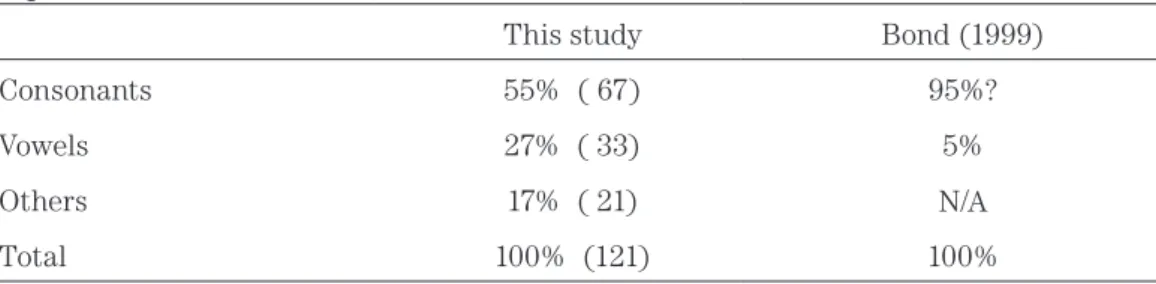
Table 2 presents overall ratios of segmental factors (consonants and vowels) and other elements to cause misperceptions. The ratios are compared to analyses of L1 conversation by Bond (1999) in percentages. The row figures of this study are indicated in parenthesis as a reference.
Table 2
Segmental factors as a whole
This study Bond (1999)
Consonants 55% ( 67) 95%?
Vowels 27% ( 33) 5%
Others 17% ( 21) N/A
Total 100% (121) 100%
It is immediately noticeable that, in the study of Bond, errors of vowels are reported as just 5% (about 50 cases out of 900 samples), although she did not give figures for other factors which obscure the rate (95%) for consonants. In contrast, vocalic factors reached as high as 27% in this study. We speculate that the great number of vocalic misperceptions is from the phonetic inventory in Japanese. Japanese has a fewer number of vowels than English – only five (/a/, /I/, //, /e/, and /o/) in total (Tsujimura, 1996) compared to around 15 in English – which may have allowed two or more similar vowels to be heard as one
integrated vowel. The ambiguous vowel schwa /@/ may also have played a role to obscure the vocalic feature. As a result, the number of perceptual reinterpretations of vowels may have increased in the singing environment in comparison with the study of L1 speech.
4.1.1 Subcategories of consonants
Figure 2 shows a breakdown of the consonantal features. The list consists of five subcategories: the closeness of sonority, the voicing switch, aspirated stops, word-final consonant elisions, and switching of English stops /t/ and /d/ into the Japanese flap /4/. Sonority is a notion of phonetic hierarchy in which the vowels are most sonorant, followed by glides (/w/ and //), liquids (/l/ and /r/), nasals (//, /n/, and //), and finally groups of obstruent (affricates /ʧ/, /ʤ/; fricatives //, //, /T/, //, /s/, //, //, //, and /Z/; and stops /p/, /b/, /t/, /d/, /k/, and /g/). The voicing switch here means that an unvoiced stop is misheard as a voiced counterpart and vice versa, e.g. /p/ is heard as /b/. Also, it occasionally took place that a consonant placed at the end of a word was not pronounced clearly or not pronounced at all, and categorized as an elision. In some cases, a stop was aspirated and heard as another consonant, e.g. /t/ is aspirated ([t]) and perceived as an affricate /ʧ/ or /ʦ/. Finally there were some cases that English stops /t/ and /d/ are confused as /4/ as both can be a Japanese phoneme /4/ which is called flap.
Figure 2. This pie chart shows the subcategories of consonantal reinterpretations. From the chart above, it is observable that consonants of a similar sonority group tend to be misheard (48%). Segments within the obstruent group (narrow closure
Voicing
18%
Closeness
of sonority
48%
Elision
16%
Aspiration
9%
Flaps
9%
of cavity such as /s/ and /t/) are frequently mixed-up, and likewise, sounds within the nearby sonorant group (wide closure of cavity such as /l/ and /n/) are mistaken. All this confusion among consonants occurred at either the same or adjacent places of articulation. Reinterpretations by the voicing switching and elisions reached almost the same ratios, 18% and 16% respectively. In Bond’s analyses (1999), errors between /t/ and /d/ took place most often in the category of consonants. This /t/-/d/ switching in L1 speech also appeared here but in a different form as a similar segment, flap /4/.
4.1.2 Subcategories of Vowels
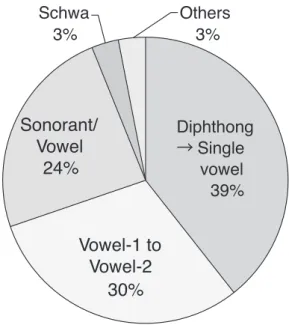
The next subcategory is about vowels in Figure 3. A diphthong is a long vowel consisting of two different vocalic features such as /eI/ and //. Vowel-1 to vowel-2 indicates confusion among two different vowels. Sonorant/vowel means a switching between a sonorant segment (/w/, //, /l/, /r/, //, or /n/) and a vowel. A schwa is defined as an ambiguous and/ or weak vowel.
Figure 3. This pie chart represents the subcategories of vocalic reinterpretations. As shown above, the typical reinterpretation type is switching a diphthong to a single short vowel; the ratio reached more than one thirds of the vocalic factors (39%). It should be noted that the data were taken from singing contexts, where the mapping of syllables has musical constrains (such as bars) and the timing of rhythm is different from normal speech. When a diphthong is mapped on a short note, almost always only the first vowel is heard. For example, in Melancholy Blues, the word over from the phrase another party
30%
Vowel-1 to
Vowel-2
Sonorant/
Vowel
24%
Schwa
3%
Others
3%
Diphthong
→ Single
vowel
39%
is over was sung like [oɚ] and misperceived as [oba] for speakers of Japanese. Here only the first vowel [o] was heard rather than the whole [o]. In Bond’s data, however, this type of diphthong to monophthong alternation did not occur. Thus, the high ratio of misperception of vowels in our data may tell us the different sensitivity to diphthongs between native speakers of English and non-natives. The next vocalic factor concerns the vowel-1 to vowel-2 alteration (30%), followed by the sonorant/vowel switching (24%). And finally, reinterpretations by schwa and other factors reached the same ratios (3%). The alteration from a schwa to another vowel occurred probably because the weak vowel is ambiguous even in normal speech, so it may have been heard as any vowel especially in a fast tempo.
4.1.3 Subcategories of other factors
We will attempt to probe other non-segmental factors which consisted of 17% of all tokens. One possible reason is that it is likely some instrumental noise and/or background chorus made the lead vocal sound unclear. More specifically, it is possible that some acoustic effects occurred at certain points such as masking (an auditory condition where the spectrum of instruments masks a concurrent spectrum of vocals or produces another sound from two combined spectrums). However, this acoustic influence is only effective when the duration is long enough, around 100-300 ms. (Kashino, personal communication, 14 Mar, 2012). Our equivalent 10 data are either from a cappella parts or shorter than 50 ms, so the effect of acoustic clash is not applicable here. The other possibility can be derived from listeners’ use of a top-down processing strategy; they compensate a missing or an ambiguous segment if the flanked parts are meaningfully rich enough to establish a word (Kashino, 2012). Below is an example for the event from My Melancholy Blues.
Table 3
An example of a possible top-down processing from My Melancholy Blues
English lyrics and I’m left cold sober
Phonetic notation /’n aI let kold sob@/
Japanese mondegreen naeko soba
(nameko soba means nameko-mushroom noodle). The last part where /sob@/ changed to [soba] is probably due to a phonetic proximate, but the alternations from and I’m left cold to nameko is hardly explicable. If one speculates that /‘n aI/ was replaced with [nae] and /kold/ was replaced with [ko], the middle /let/ was missing and not reflected in the resulting outcome.
4.2 Mapping by length of notes
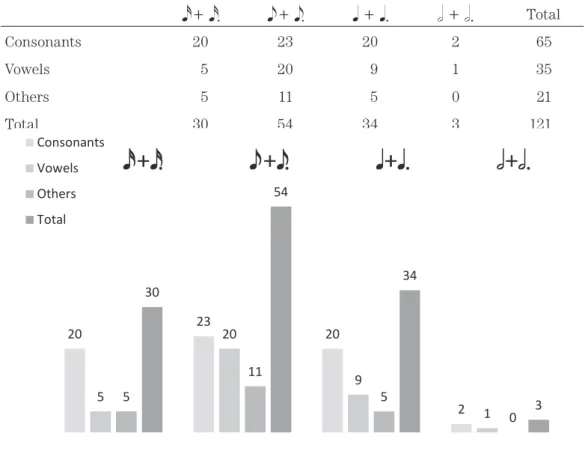
Table 4 exhibits a list of counted numbers of segments, indicating how three groups (consonants, vowels, and others) are mapped onto musical notes. Each note type is, as stated in the Method, conjoined with its dotted version and categorized into one type. The following graph, Figure 4, shows what note types attracted misheard items. The values shown above each bar indicate raw figures of items counted.
Table 4
A list of counted tokens mapped onto notes
TotalConsonants 20 23 20 2 65
Vowels 5 20 9 1 35
Others 5 11 5 0 21
Total 30 54 34 3 121
Figure 4. Misheard items mapped onto musical notes; for each note, values for consonants are represented by the leftmost bar, followed by values for vowels, other elements and total values to the right.
Both the table and the graph above tell us that the eighth notes attracted most of mondegreen events, followed by quarter notes, then sixteenth notes. Secondly it is noticeable that other (unclear) factors are infrequent compared to phonetic groups. The
9
4.2 Mapping by length of notes
Table 4 exhibits a list of counted numbers of segments, indicating how three
groups (vowels, consonants, and others) are mapped onto musical notes. Each note
type is, as stated in the Method, conjoined with its dotted version and categorized into
one type. The following graph, Figure 4, shows what note types attracted misheard
items. The values shown above each bar indicate raw figures of items counted.
Table 4
A list of counted tokens mapped onto notes
£ + £.
¢ + ¢.
+ .
+ .
Total
Consonants
21
23
18
1
63
Vowels
7
17
16
1
41
Others
3
10
7
0
20
Total
31
50
41
2
124
Figure 4. Misheard items mapped onto musical notes; for each note, overall values are
represented by the leftmost bar, followed by values for consonants, vowels
and other elements to the right.
Both the table and the graph above tell us that the eighth notes attracted most of
mondegreen events, followed by quarter notes, then sixteenth notes. Secondly it is
noticeable that other (unclear) factors
are infrequent compared to phonetic groups.
31 50 41 2 21 23 18 1 7 17 16 1 3 10 7 0 Overall Consonants Vowels Others 20 23 20 2 5 20 9 1 5 11 5 0 30 54 34 3
・ ・ ・ ・
・ ・・・
・・・・
・・・・
Consonants Vowels Others Total 20 23 20 2 5 20 9 1 5 11 5 0 30 54 34 3
Consonants Vowels Others Totalsum of consonantal and vocalic factors is about five times more than other factors. Thus, at this point we could probably say that phonetic factors outweigh other factors which include unaccountable ones, regardless of phonetic features or note types. It is also observable that vocalic reinterpretations tend to occur on longer notes, and this is clear if we compare the frequency of the consonantal and other cases.
4.3 Results of an aural experiment
The results of the detection test are shown in Table 5.
Table 5
Perception of mondegreen words by 17 participants (raw figures in parentheses)
Average Min. – Max.
Detection by listening only ≒25% (2.9) 0 – 50%
(0 – 6.0) 15 targeted phrases
Detection by listening with texts 80% (12.0) 0 – 80% (0 – 12.0)
As can be seen from the table, the ratio of detection greatly increased after the “Japanese-sounding” English words were presented, from approximately 25% before participants were informed of the targeted words to 80% after they were informed. Among others, two words attracted listeners’ attention most: ‘sober’ /sobɚ/ and ‘adorable’ /@dɚr@bl/. Five listeners detected ‘soba’ /soba/ (noodle) from ‘sober’ even before the presentation of texts, and the number increased to 17 (all listeners) after the text were given. Likewise, ‘adorable’ was heard as ‘doroboo’ /doroboo/ (theft) for six times only in listening and 13 times after listening again with texts. These words have not only segmental proximity but also identical structures both in syllables and moras, such as /so/ (one syllable) and /so/ (one mora). We can speculate that those words having common phonetic information and the identical phonological structure allowed the listeners to reinterpret an L2 word to the equivalence in L1.
5. Discussion and Summary
We obtained results of perceptual reinterpretations by mapping the relationships between segments and notes to subcategorized phonetic factors, and through a small experiment conducted with 17 L2 learners of English. We hypothesized that musical
constraints such as timing the regularity of bars may reduce prosodic features, and that phonetic factors can be the main reason for triggering the misperception. Our results support the hypothesis because segmental analyses could be applied to many cases; that is, a combination of consonantal factors and vocalic factors took up 83% of all events from the data analysis.
As for consonantal factors, the positional closeness of articulation and sonority was relevant. The phenomenon of switching between similar sonority groups was parallel to Bond’s (1999) findings in her study of normal speech. Mondegreen events in L2 in this study can be shared with events in conversation in terms of consonants. However, differences were also observed in reinterpretations of vowels. We observed numerous vocalic reinterpretations: 27%, which can be considered to be large if we compare the figure to that of the research of Bond: 5%. The existence of a greater number of vowel factors than that of normal speech in L1 in English can be attributed to the difference in vowel inventory between Japanese and English, and the tendency of vowels to be mapped onto longer notes.
We also took the other factors into consideration, i.e., unclear articulation in singing, background noise from instruments and/or chorus might alter the normal perception of speech. These acoustic attributes were, however, not influential enough to cause misperception due to short durations of the spectrum concurrence of noise and vocals. In relation to the inexplicable items, Shockey & Bond (2007) argue that nonsense and unfamiliar words including foreign words cannot be compensated. That is, L2 (incompetent) speakers/listeners cannot use a strategy of phonological reduction (or, changes), so they listen to what they hear at face value, without compensating for missing information such as elision, assimilation, or coarticulation. Instead, we would like to address the difference that L2 listeners tend to access familiar words in their L1 mental lexicon, using their L1 phonology. For example, when they missed out hearing /l@/ in /ʤel@tIn/, they filled the gap with /b/ in order to get it to make sense, turning it into a person’s name. There are no particular phonological similarities between /l@/ and /b/.
Japanese mondegreen events in L2 settings, thus, would most likely take place under the conditions where articulations of consonants are proximate, vowels are either diphthongal or ambiguous between L1 (Japanese) and L2 (English), or language units of syllables and moras are identical. This suggests that we need to reinforce tasks for listening in common features of English and Japanese sounds, as well as unfamiliar syllabic structures (e.g., CCVC) to Japanese learners (Nakata & Shockey, 2011).
The present study has limitations in that the scarcity of the number of data should be reinforced and the study does not cover the possible correlations between accent
patterns in language and melody movements in music. In the future, accordingly, it will be interesting to measure pitch varieties of notes and investigate melodic effects that may exert the events.
Acknowledgements
I thank Makio Kashino for his interpretation of the unclear factors found in the data from a perspective of psychophysics. My appreciation also goes to Peter Cimino who took his time to look over the earlier manuscript and gave me his insightful comments on the data.
About the author
The author, Dr. Hitomi Nakata, is a part-time instructor of English for Seikei Liberal Arts Curriculum. The first manuscript of this paper was submitted on May 20, 2016 and approved on a recommendation from Dr. Hinako Masuda.
References
Barber, M. (2000). A Collection of Humorous Mondegreens. Retrieved from http://www.uh.edu/~mbarber/mondegreens.html.
Bond, Z. S. (1999). Slips of the Ear – Errors in the Perception of Casual Conversation. Academic Press.
Cutler, A. & Carter, D. M. (1987). The predominance of strong initial syllables in the English vocabulary. Computer Speech and Language. 2. 133–142.
Ito, M. (2002). Shuukan Soramimist (Weekly soramimi person). Retrieved from http://fdls.net/mimi.php.
Kashino, M. (2012). Soramimi no kagaku – Damasareru mimi, kikiwakeru noo (The Science of Slips of the Ear – Ears have illusions and the brain has audition). YAMAHA MUSIC MEDIA CORPORATION.
Kondo, M., Tsubaki, H. & Sagisaka, Y. (2015). Segmental Variation of Japanese Speakers’s English: Analysis of “the North Wind and the Sun” in AESOP Corpus. Journal of the Phonetic Society of Japan. Vol. 19 No.1. 3-17.
Kubozono, H. (1995). Go-keisei to Onin-koozoo (Word Formation and Phonological Structure). Tokyo: Kuroshio Publishers.
Nakata, H. & Shockey, L. (2011). The effect of singing on improving syllabic pronunciation – Vowel epenthesis in Japanese. Proceedings of The 17th International Congress of Phonetic Sciences. 1442–1445.
Otake, T. (2009). Soramimi awaa’ no mekanizumu to goi nin’shiki. (Mechanism of ‘Soramimi Hour’ and Lexical knowledge). On’in Kenkyuu. 12. 27–34.
Queen Soramimi Hour. (2012). Retrieved from
http://www.geocities.jp/oneinnuendo/ melancholyblues/soramimi.html
Shockey, L. & Bond, Z. S. (2007). Slips of the Ear Demonstrate Phonology in Action. Proceedings of The 16th International Congress of Phonetics Science. 1385–1388. Tsujimura, N. (1996). An introduction to Japanese Linguistics. Blackwell.
Vitevitch, M. S. (2002). Naturalistic and Experimental Analyses of Word Frequency and Neighborhood Density Effects in Slips of the Ear. Language and Speech. 45(4). 407–434.
Appendix 2. < Compilation of all soramimi data >
# Song titles Soramimiparts Soramimiwords in Japanese Reinterpretation (‘’ = schwa/@/) Grouping of segments (Consonants; Vowels; Others)
Mapping onto Notes (Dotted versions are included in regular notes.)
C V O
1 We are the Champion-① champion チャンポン pin→ pon 1 1
2 We are the Champion-② Let はなみずが let → ha 1 1 the th → na 1 1 music go m-z-g 3 3 on おおい on → ooi 1 1 3 Killer Queen gunpowder がんばれ pau → ba 1 1 がんばれ d → re 1 1 gelatine たぶち ge → ta 1 1 たぶち l → bu 1 1 4 Somebody to Love wants to わしゃ t → ʃa 1 1 put こ put → ko 1 1 me け me → ke 1 1 down た down → ta 1 1 5 Bohemian Rhapsody-① aching all いきの ai → i 1 1 the び → b 1 1
time たい taim → tai 1 1
6 Bohemian Rhapsody-②
Too late しつれい tu → shitsu 1 1
my まっ mai → ma(t) 1 1
time ちゃん taim → (t)tyan 1 1
has です has → des 1 1
come か kVm → ka 1 1
7 Bohemian Rhapsody-③
thunder そんな dr → na 1 1
bol(t) もん boul → mon 1 1
(bol)t and じゃ t an’ → ja 1 1
light(ning) ない lait → nai 1 1
8 I'm in Love w/my car-①
the た th → ta 1 1
ma の ma → no 1 1
chine of a しいな nov → no 1 1
dream つり dr → tsuri 1 1
such そっち sV → so 1 1
clean きん kli:n → kin 1 1
machine し maʃi → shi 1 1
9 I'm in Love w/my car-②
It's ヅ tsu → dzu 1 1
like a らか laik → raka 1 1
di て di → te 1 1
10 We will Rock You singing すげえ singin → sugee 2 2
(singin)g all なあ gol → naa 1 1
11 Ogre Battle-①
o よ ou → yo 1 1
gre こ g → ko 1 1
men are めが menr → mega 1 1
still in(side) すけべく(さい) t→k, l→b 1 1 1 1
12 Ogre Battle-②
can げ kn → ge 1 1
co(me) た kV → ta 1 1
long らん lon(g) → ran 1 1
13 The Invisible man
meanest みぎの n → g 1 1
thought ひと T → h, etc. 1 1
(dar)kest (どう)かして kest → kashite 2 2
fear る fi → ru 1 1
14 Another One Bites …
Oh take it おおたけ teikit → take 2 2
bite the はら bait → ha 1 1
th → ra 1 1
dust it たつ dust → ta 1 1
bite the だれ ba → da 1 1
th → re 1 1
dust hey だって dVst → da(t) 1 1
hei → te 1 1
15 Seaside Rendezvous adorable どろぼう r* → ro 1 1
ble → boo 1 1
# Song titles Soramimiparts Soramimiwords in Japanese Reinterpretation (‘’ = schwa/@/) Grouping of segments (Consonants; Vowels; Others)
Mapping onto Notes (Dotted versions are included in regular notes.) C V O 16 Save me soul for そうぶ sou → soo 1 1 l → none 1 1 for → bu 1 1
sale or せんの sai → sen 1 1
l → n(o) 1 1
rent レール rent → reeru 1 1
17 Hammer to Fall
till ズ till → zu 1 1
one ボン wan → bon 1 1
day ぬい dei → nui 1 1
they で thei → de 1 1
call ほう kl → hoo 1 1
your にょう jua → njo 1 1
name ねえ neim → nee 1 1
18 Fat Bottomed Girls
such a さっちゃん such a → sattyan 1 1
naughty のみに no:ti → nomini 1 1
nanny なれ nani → nare 1 1
19 Flash-②
He'll いっ hil → i? 1 1
save せー save → see 1 1
every ので vvri → node 1 1
one o(f) わら wan → wara 1 1
(f) us わす vs → was 1 1
20 Flash-③ Gordon ゴール gdn → gooru 1 1
(a)live ない lai → nai 1 1
21 Flash-①
savior せび seivj→ sebi 1 1
(r) of a ろで rov → rode 1 1
univer(se) ユニット(バス) juni → yunitto 1 1
22 Breakthru (touchin)g (たち)の → no 1 1 23 Headlong ou(t) あ au(t) → a 1 1 t of ら rv → ra 1 1 con ぐん kn → gun 1 1 trol そう tr → s 1 1 24 Body Language I あ~ ai → a 1 1
wan(t your) おわ(っちゃ) wan → owa 1 1
body た(で)~ bodi → to(de) 1 1
25 My melancholy Blues
A(no) はな a(na) → ha(na) 1 1
ther の th → no 1 1
(par)ty (パ)リ ti → ri 1 1
('s) over そば zo → so 1 1
(I')m left cold なめこ
n aim → name 1 1
left → ? (nil) 1 1
kold → ko 1 1
26 Now I'm here
Don't た doun(t) → ta 1 1
I ま nai → ma 1 1
love が lav → ga 1 1
her わ hr → wa 1 1
27 Don't stop me now-③
Cos I'm かあさん kozaim → kaasan 1 1
havin 'a はぶな havina → habuna 1 1
time たー taim → taa 1 1
28 Don't stop me now-①
turn it とり trnit → tori 1 1
inside みたい in → mi 1 1
said → tai 2 1 1
(d)out だー daut → daa 1 1
yeah ね jir → ne 1 1
29 Don't stop me now-② Ecsta
なつ eks → natsu 1 1
か t → ka 1 1
So ぞ so → zo 1 1
67 33 21 30 54 34 3
PRINTED BY SEIKO-SHA CO. LTD.