The Japanese Psychonomic Society
NII-Electronic Library Service
The JapanesePsychonomic Society
The JdPaneseJou・matofIls3,chonomic'Science
2005,Vol,24,No,1,129-130
Summary
ofAwardedPresentation2P24
Perception
of
aframed
solid
figurereplicating
afanfold
"Mach'sbook"
Hisae
ITo
Uitiversity
of
the SacredHigart*
We
used aframed
solidfigure
in
our experirnentMost
ef the participantswho observed itperceived
differences
inbrightnesson itsthreeplanes. We movedthe
figurein
two ways,back
andforth,under thesame lightingconditions. The perception of the
differences
inbrightness was changed, depending on the figurelocation.These
perccptions of aframed
figure
without physi-callydefined
surface$ show the same relationships as the perceptions of a fanfold paper with surfaces. Therefore,itisplausible
toassume thata perceptivescheme of afanfoldpaper(schematic
mediating variables} givesa model to assirnilate a framed
figure
{perceptual
local
variables). Itcanthen
be
statedthat
the
perception ofdifferences
in
brightness
is
possib]y actualized when perceptual localvarjables are subsumedinto
schematic mediating variables.Key words: localvariables, mediating variablcs, brightness
differences
Demoustration
andExplanation
Itis very interesting to watch a Mach's book, which isa sheet of paper
folded
in
two and placed ona
desk.
In
the rightdirection
oflighting,
theright-hand
plane of the paper isbright and the left-handplane isdark. Ifitisviewed with one eye a reversal of itsdepth can be perceived,and thepaper appears
to
lift.
The
right plane should thenbe
dark and theleftshould be bright because the lightingdirection
remains fixed,and
the
lightsensation remains con-stant.But
surprisingly, the right plane appears tobe
bright
and theleft
appears to be dark because thebrightness constancy isnot maintained This phe-nomenon isnot explained ifwe assume that
percep-tion
is
directlydeterminedby
thestimuli.The
book,
"Atleinson
and
Hi(gard's
introduction
toPsychotogy"
(Smith
et al. 2003, 14th ed,) states that`'perception isthe
use of such assumptions tointegrate
incoming
sensory information
into
a model ofthe world, basedupon which we make decisionsand take action."
(p.
149)We may follow this
definition
of perception andtranslate"sensory information"
into
local
variables
(LVs},
and "amodel of the world"
into
mediatlng variables(MVsL
We could then assume thatpercep-tionispossiblyactualized when LVs are subsumed
intoa $et of
MVs.
* school of Human scieiEe, university of
't'he
sac'rrreLt
Heart,4L3-] Hiro,Sibuyaku, Tokyo 15e-8938
Copyright 2005, The JapanesePsychenomic Society,Allrights reserved.
The
phenomenon of Mach's book showsthat
a set ef MVs has the power toleadus toperceive as ifthe physical propertiesofLVs
are changed. Itis
thenpossibie to assume that this subsuming function works effective!y to make up the
deficit
of theLVs.
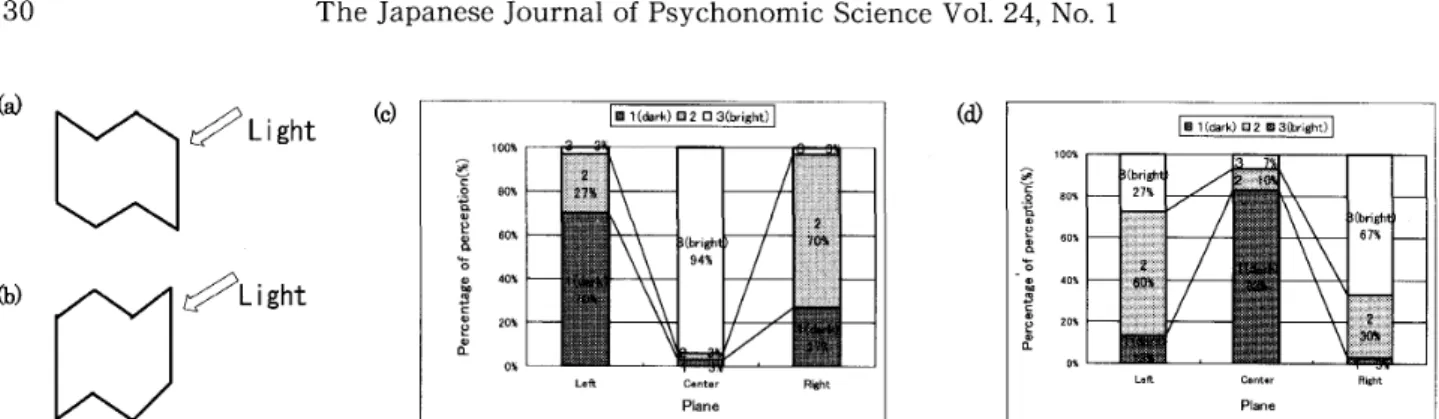
Figure
1a
and1b
arefanfold
solidfigures
usedin
ourexperiments. They copy "Mach's
book" but theLVs
have
adeficit.
They
are made with wooden iramesand so do not have physical surfaces and edges.
Most of the participantsperceived
planes
and white edges whichcornposedtheframedareasandanevenbrightness difference on each plane.
We
haveas-sumed thatthese demonstrate thefunction of
MVs.
The
set ofMVs
in
our experiment act as a hypotheti-calmode! appearing as ifitwere a substantial fanfoid paper with surfaces and edges. The participantswhoperceived a
brightness
difference
en each plane probably applied themodel totheframed figure with-out physical surfaces and edges. This dernonstration and explanation gives us more information forotherquestions. For example, when the
figure
is
movedback
andforth
reversib]y, under the same lightingconditions, the perception of a differencein bright-ness might change frernrtght
to
left,This prediction was made forour presentinvestigation,
Method
Participants The participants were
30
female undergraduate students.The Japanese Psychonomic Society
NII-Electronic Library Service
The JapanesePsychonomic Society
130
(a)
(b>
!Light
elP/Light
The
Japanese
Journal
o(c)
fPsychonomic
Science
Vol.
Figure
1.
<a}
Normal position{NP;
of brightness differenceinthe NP
(d)
24,
No.
1IV==30}.
(b)
Revcrse position(RP;
IV,-30),
(c)
.
(d)
Perception of the order ofbrighrness
diffPerception
of the order erence
in
the RP.height,width, and
depth,
allof60
centimeters were used.The
inside
walls of theboxes
were covered withgrey
sheets ofpaper.
(b)
Twofixing
pillars,oneineach box, supported the figurewith a clip.
{c}
Alightsource on the upper right side ef each box i]luminated equalLy the background within thc
fi-gure.Materials The 2 solid-framed figuresillustrated
in
figures
la
and1b
were used asthe
viewing object.The frame of each figurewas 7centimeters inlength and painted white.
Procedure
(a)
The
figures
were positionedin
2ways, so that 2 conditions were provided.
In
the nermal position(NP>
the leftedge was nearer thanthe right edge. In the reversc positien
(RP}
the Ieftedge was more
distant
than the edge on theright.
(b>
We
randomly presented afigure
in
either the normal position(NP)
or reverse position(RP}.
(c)
The
participantwas requestedto
compare thedifference
in
brightness of the 3 planes and tode-scribe them inan order with thedarkest plane first, and the brightestlasL
Results
andDiseussion
The perception of the erder of brightness differ-ence with the figureina normal position isshown in
Figure
lc.
The
va]ue of the erder ofbrightness
wasanalyzed with a Friedman test. This analysis
re-vealed that
the
average value ofthe order ofbright-ness was:
first,
theleit
plane(1,33);
second, the rightplane
(1.77);
and thirdthecenter{2.90).
These
differ-ences were shown tobe statistically significant by aFriedman
test(x2
=:39.27,
P<
.O1).
The
perception of the order of differencein bright-ness with the figureinthereversed positionis
showninFigure ld. The average value of the order of
brightness
difference
was shown tobe:
first
thecen-ter
plane
(1.23);
second, theleftplane(2,13);
and third,the right plane
(2.63}.
Thesedifference$
were also statistically significantby
a Friedman test(x2=
27.75,P<.Ol),
Perception
by
theparticipantsof theordinaldiffer-ence of brightness was statistically significant both
in
theNP
(normal
position)andin
the RP(reverse
position). These results have demonstrated that, even though the lightingcondition isconstant, the perception of
brightness
difference
can changede-pending on thepositionof the
framed
figure.IntheNP, the leftplane was perceived darkest, and the
center was brightest.Inthe RP.the center plane was
perceived
darkest
and theright wasbrightest.
Theseperceptions of a
framed
figure
without physicalsur-faces
show the same relationships as the perceptjonsof a fanfoldpaper with physical surfaces.
Thcrefore,
itisp]ausibletoassume thata perceptive scheme of a fanfo]dpaper givesa model toassimi]ate a framed
figure.Itcan then
be
statedthat
LVs
(local
variables) of a framedfigure
havebeen
subsumed into MVs(mediating
variables) as aperceptual model, andthat
deficits
of the LV surfaces have been supplied, sothat subjective surfaces and brightness
differences
are perceived,
Referenee
Smith,E.E.,Nolen-Hoeksema, S.,Fredrickson,
B.
L.,
&
Loftus,G.R,2OO3