303
労災疾病等医学研究・両立支援報告 R2―2
膀胱癌における遺伝的素因と環境因子
武内
巧
独立行政法人労働者健康安全機構関東労災病院 (2019 年 3 月 25 日受付) 要旨:膀胱癌はこれまで職業歴を含む環境因子が重要とされてきた.職業因子としては歴史的に は産業に使用される発がん性の芳香族アミンによる職業性膀胱癌が有名である.その他の環境因 子としては喫煙やアルコール摂取と膀胱癌の関連が知られている. ある生物種集団のゲノム塩基配列中に一塩基が変異した多様性が見られ,その変異が集団内で 1% 以上の頻度で観察される場合に一塩基多型(SNP)という.膀胱癌患者の一塩基多型をゲノム ワイドに解析した研究(GWAS)において検出された膀胱癌に易罹患性のある SNP のほとんどは 欧米白人でのデータであり,日本人への直接的な適用は慎重である必要がある.また一つの SNP の膀胱癌易罹患性への寄与は比較的小さい.今後の GWAS は遺伝子間の相互作用や環境因子と の相互作用を検討する必要性が益々高まるものと思われる.他の GWAS 解析の方向性に neural network に代表される人工知能の利用がある.この手法は従来の手法よりも優れた結果を示しう る. 近年,本邦においてはハイテク産業の割合が増大するなど産業構造の変化も見られ,これまで 膀胱癌の発生と関連しているとは考えられていなかった職業,生活習慣,作業環境が膀胱癌の危 険因子となっている可能性がある.今後,膀胱癌を遺伝的素因と環境・職業因子の双方から検討 することが重要であろう. (日職災医誌,67:303─306,2019) ―キーワード― 膀胱癌,職業・環境因子,遺伝的素因 膀胱癌とは 膀胱癌は膀胱尿路上皮から発生する悪性腫瘍である. 本邦において膀胱癌は部位別の罹患率は男性で 12 位,女 性で 19 位,死亡率は男性,女性でそれぞれ 12 位,16 位で,女性よりも男性に多い.筋層浸潤性膀胱癌では尿 路変更を行う膀胱摘出術や化学放射線療法といった侵襲 性の高い治療が必要となる.更にリンパ節や他臓器に転 移が生じれば治療が極めて困難となる(図 1).また,非 筋層浸潤膀胱癌であっても膀胱内に再発しやすく(図 2),頻回の経尿道的手術や牛結核菌(Bacillus Calmette-Guerin;BCG)膀胱注入療法が必要となりうる.従って 膀胱癌の診療には多大な時間と医療費が要求される. 職業・環境因子と膀胱癌 多くの疾患において遺伝的因子と環境因子が関与して いるが,膀胱癌はこれまで職業歴を含む環境因子が重要 とされてきた.職業因子として歴史的には産業に使用さ れる発がん性の芳香族アミンによる職業性膀胱癌が欧 米,本邦において初めて報告された1)2) .本邦における職 業性膀胱癌の歴史と現状,及び膀胱癌の化学発癌研究歴 と現状については松島らによって詳細に報告されてい る3) .最近の代表的な職業性膀胱癌の報告は,北欧諸国に おいて約 1,500 万人を最長 45 年間に渡って経過観察し たものがある.これによれば職業別膀胱癌罹患率比が 1.20 以上の職業としては,罹患率比が高い順にウェイ ター,煙突掃除人,ヘアドレッサー,アシスタントナー ス,船員,飲料水工場従事者が挙げられている4) .近年は 作業環境の改善に伴って職業性膀胱癌発生はなくなるの ではという意見も強くあるが,2016 年に福井市の染料工 場において化学物質であるオルト―トルイジンによると 思われる膀胱癌の集団発生が見られた5) .Zaitsu らは職 業を大まかに分類し,日本人男性においてブルーカラー 企業の労働者に比べホワイトカラー企業の上位の職種に おいて膀胱癌の発生が少ないことを報告した6) . その他の環境因子としては喫煙と膀胱癌の関連が知ら304 日本職業・災害医学会会誌 JJOMT Vol. 67, No. 4 図 1 膀胱全摘術後の全生存率(関東労災病院 2019 年作成) a:膀胱癌深達度で分類 b:骨盤内リンパ節転移の有無で分類 0.00 0.20 0.40 0.60 0.80 1.00 㻜 㻞㻜 㻠㻜 㻢㻜 㻤㻜 㻝㻜㻜 㻝㻞㻜 O ve ra ll su rv iv al Months
Overall survival after cystoprostatectomy
pN0 pN+ 0.00 0.20 0.40 0.60 0.80 1.00 㻜 㻞㻜 㻠㻜 㻢㻜 㻤㻜 㻝㻜㻜 㻝㻞㻜 O ve ra ll su rv iv al Months
Overall survival after cystoprostatectomy
pT0, pTis, pT1, pT2 pT3, pT4 a a bb 図 2 膀胱腫瘍に対する経尿道的膀胱腫瘍切除術後の再発率 ■再発あり,□再発なし (関東労災病院 2018 年作成) 0% 20% 40% 60% 80% 100% ึⓎ⭤⬔⭘⒆ Ⓨ⭤⬔⭘⒆ れている7) .またアルコールの代謝産物であるアセトアル デヒドは発がん性物質の一つであるが,近年,Zaitsu らは日本人において一日当たり 15g 以上のアルコール 摂取と膀胱癌発生の関連を示した8) . 遺伝的素因と膀胱癌 ある生物種集団のゲノム塩基配列中に一塩基が変異し た多様性が見られ,その変異が集団内で 1% 以上の頻度 で観察される場合に一塩基多型(SNP:Single Nucleo-tide Polymorphism)という.ヒトゲノム 30 億塩基対のう ち,一塩基多型はおよそ 1,000 塩基対に 1 個の割合で存 在し,個人差,人種差,疾患に対する感受性,薬物への 応答性等などの違いをもたらしうる. 膀胱癌患者の SNP をゲノムワイドに解析した研究 (GWAS;Genome Wide Association Study)において検
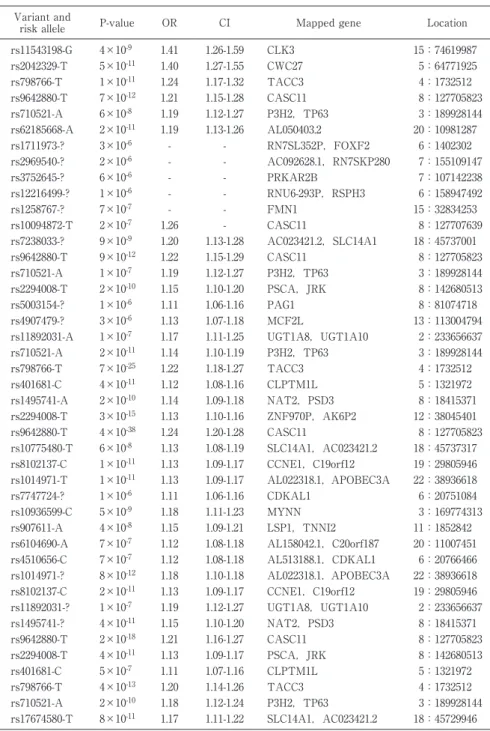
出 さ れ た 膀 胱 癌 に 易 罹 患 性 の あ る SNP は GWAS-Catalog によれば現在まで 43 個の報告がある(表 1)9) .し かしこれらのほとんどは欧米白人でのデータであり,日 本人への直接的な適用は慎重さが必要である.また一つ の SNP の膀胱癌易罹患性への寄与は表 1 からもわかる ように比較的小さく,オッズ比でせいぜい 1.4 程度でし かない.この失われた遺伝率(missing heritability)は例 えば 1.SNP-SNP 相互作用,2.SNP―環境因子相互作用, 3.マイナーアレル頻度<0.5% のレアバリアントの解析 によって見いだせる可能性がある10) .SNP-SNP 相互作用 が GWAS で 発 見 さ れ た 例 と し て は,乾 癬 に お け る ERAP1 と HLA-C の 関 連11) や 強 直 性 脊 椎 炎 に お け る ERAP1 と HLA-B27 の関連12) が挙げられる.また,SNP― 環境因子相互作用の 1 例としては血清脂質濃度に対する SNP と運動強度の影響を解析したものがある13) .今後の GWAS は遺伝子間の相互作用や環境因子との相互作用 を検討する必要性が益々高まるものと思われる.
他の GWAS 解析の方向性に neural network に代表さ れる人工知能の利用がある.単一の SNP では疾患への寄 与は前述のように小さなものであるが,数十あるいはそ れ以上の SNP(および環境因子)の相互作用を人工知能 の膨大な計算力を用いて解析しようというものである. この手法は従来の手法よりも優れた結果を示しうる14)15) . 最 後 に 近年,本邦においてはハイテク産業の割合が増大する など産業構造の変化も見られ,これまで膀胱癌の発生と 関連するとは考えられていなかった職業,生活習慣,作 業環境が膀胱癌の危険因子となっている可能性がある.
武内:膀胱癌における遺伝的素因と環境因子 305
表 1 膀胱癌感受性が指摘された一塩基多型(GWAS Catalog より改変)
Variant and
risk allele P-value OR CI Mapped gene Location
rs11543198-G 4×10⁻⁹ 1.41 1.26-1.59 CLK3 15:74619987 rs2042329-T 5×10-11 1.40 1.27-1.55 CWC27 5:64771925 rs798766-T 1×10-11 1.24 1.17-1.32 TACC3 4:1732512 rs9642880-T 7×10-12 1.21 1.15-1.28 CASC11 8:127705823 rs710521-A 6×10⁻⁸ 1.19 1.12-1.27 P3H2,TP63 3:189928144 rs62185668-A 2×10-11 1.19 1.13-1.26 AL050403.2 20:10981287 rs1711973-? 3×10⁻⁶ - - RN7SL352P,FOXF2 6:1402302 rs2969540-? 2×10⁻⁶ - - AC092628.1,RN7SKP280 7:155109147 rs3752645-? 6×10⁻⁶ - - PRKAR2B 7:107142238 rs12216499-? 1×10⁻⁶ - - RNU6-293P,RSPH3 6:158947492 rs1258767-? 7×10⁻⁷ - - FMN1 15:32834253 rs10094872-T 2×10⁻⁷ 1.26 - CASC11 8:127707639 rs7238033-? 9×10⁻⁹ 1.20 1.13-1.28 AC023421.2,SLC14A1 18:45737001 rs9642880-T 9×10-12 1.22 1.15-1.29 CASC11 8:127705823 rs710521-A 1×10⁻⁷ 1.19 1.12-1.27 P3H2,TP63 3:189928144 rs2294008-T 2×10⁻¹⁰ 1.15 1.10-1.20 PSCA,JRK 8:142680513 rs5003154-? 1×10⁻⁶ 1.11 1.06-1.16 PAG1 8:81074718 rs4907479-? 3×10⁻⁶ 1.13 1.07-1.18 MCF2L 13:113004794 rs11892031-A 1×10⁻⁷ 1.17 1.11-1.25 UGT1A8,UGT1A10 2:233656637 rs710521-A 2×10-11 1.14 1.10-1.19 P3H2,TP63 3:189928144 rs798766-T 7×10-25 1.22 1.18-1.27 TACC3 4:1732512 rs401681-C 4×10-11 1.12 1.08-1.16 CLPTM1L 5:1321972 rs1495741-A 2×10⁻¹⁰ 1.14 1.09-1.18 NAT2,PSD3 8:18415371 rs2294008-T 3×10-15 1.13 1.10-1.16 ZNF970P,AK6P2 12:38045401 rs9642880-T 4×10-38 1.24 1.20-1.28 CASC11 8:127705823 rs10775480-T 6×10⁻⁸ 1.13 1.08-1.19 SLC14A1,AC023421.2 18:45737317 rs8102137-C 1×10-11 1.13 1.09-1.17 CCNE1,C19orf12 19:29805946 rs1014971-T 1×10-11 1.13 1.09-1.17 AL022318.1,APOBEC3A 22:38936618 rs7747724-? 1×10⁻⁶ 1.11 1.06-1.16 CDKAL1 6:20751084 rs10936599-C 5×10⁻⁹ 1.18 1.11-1.23 MYNN 3:169774313 rs907611-A 4×10⁻⁸ 1.15 1.09-1.21 LSP1,TNNI2 11:1852842 rs6104690-A 7×10⁻⁷ 1.12 1.08-1.18 AL158042.1,C20orf187 20:11007451 rs4510656-C 7×10⁻⁷ 1.12 1.08-1.18 AL513188.1,CDKAL1 6:20766466 rs1014971-? 8×10-12 1.18 1.10-1.18 AL022318.1,APOBEC3A 22:38936618 rs8102137-C 2×10-11 1.13 1.09-1.17 CCNE1,C19orf12 19:29805946 rs11892031-? 1×10⁻⁷ 1.19 1.12-1.27 UGT1A8,UGT1A10 2:233656637 rs1495741-? 4×10-11 1.15 1.10-1.20 NAT2,PSD3 8:18415371 rs9642880-T 2×10-18 1.21 1.16-1.27 CASC11 8:127705823 rs2294008-T 4×10-11 1.13 1.09-1.17 PSCA,JRK 8:142680513 rs401681-C 5×10⁻⁷ 1.11 1.07-1.16 CLPTM1L 5:1321972 rs798766-T 4×10-13 1.20 1.14-1.26 TACC3 4:1732512 rs710521-A 2×10⁻¹⁰ 1.18 1.12-1.24 P3H2,TP63 3:189928144 rs17674580-T 8×10-11 1.17 1.11-1.22 SLC14A1,AC023421.2 18:45729946
OR:Odds ratio,CI:Confidence interval
更には遺伝的素因,職業・環境の相互作用と膀胱癌発生 の関連も再検討する必要もある.もし膀胱癌に感受性の ある遺伝的素因を持つ勤労者が膀胱癌を発生しやすい職 業・環境に置かれる場合には,尿細胞診や膀胱超音波検 査等を特殊健診に導入する必要性も考えられる.あるい は環境因子としての労働作業環境を検討,改善すると いったことに繋がる可能性もある.今後は膀胱癌を遺伝 的素因と環境・職業因子の双方から検討することが重要 であろう. 利益相反:利益相反基準に該当無し 文 献
1)Rehn L: Blasengeschwülste bei Anilinarbeitern. Arch Klin Chir 50: 588―600, 1895. 2)西村幾夫:「アニリン色素」ニヨル膀胱腫瘍ノ発生ニ就テ (本邦ニ於ケル最初ノ症例報告).日泌尿会誌 29:733― 749, 1940. 3)松島正浩,桑原 孝:我が国における職業性膀胱癌の歴 史と現状.日泌尿会誌 104:569―578, 2013.
4)Pukkala E, Martinsen JI, Lynge E, et al: Occupation and cancer ― follow-up of 15 million people in five Nordic coun-tries. Acta Oncol 48: 646―790, 2009.
5)福井県の事業場における膀胱がん発症に係る調査結果に ついて.https://www.mhlw.go.jp/stf/houdou/0000126109.
306 日本職業・災害医学会会誌 JJOMT Vol. 67, No. 4
html(参照 2019-3-21).
6)Zaitsu M, Kaneko R, Takeuchi T, et al: Occupational class and male cancer incidence: nationwide, multicenter, hospital-based case-control study in Japan. Cancer Med 8: 795―813.
7)Freedman ND, Silverman DT, Hollenbeck AR, et al: As-sociation between smoking and risk of bladder cancer among men and women. JAMA 306: 737―745, 2011. 8)Zaitsu M, Nakamura F, Toyokawa S, et al: Risk of alcohol
consumption in bladder cancer: Case-control study from a nationwide inpatient database in Japan. Tohoku J Exp Med 239: 9―15, 2016.
9)GWAS Catalog: https://www.ebi.ac.uk/gwas/ (accessed 2019-3-21).
10)Manolio TA, Collins FS, Cox NJ, et al: Finding the miss-ing heritability of complex diseases. Nature 461: 747―753, 2009.
11)Strange A, Capon F, Spencer CC, et al: Genome-wide as-sociation study identifies new psoriasis susceptibility loci and an interaction between HLA-C and ERAP1. Nat Genet 42: 985―990, 2010. doi: 10.1038/ng.694.
12)Evans DM, Spencer CC, Pointon JJ, et al: Interaction be-tween ERAP1 and HLA-B27 in ankylosing spondylitis im-plicates peptide handling in the mechanism for HLA-B27
in disease susceptibility. Nat Genet 43: 761―767. doi: 10.1038/ng.873.
13)Kilpeläinen TO, Bentley AR, Noordam R, et al: Multi-ancestry study of blood lipid levels identifies four loci inter-acting with physical activity. Nat Commun 10: 376, 2019. doi: 10.1038/s41467-018-08008-w.
14)Uppu S, Krishna A, Gopalan RP: A Deep Learning Ap-proach to Detect SNP Interactions. Journal of Software 11: 960―975, 2016. doi: 10.17706/jsw.
15)Long N, Gianola D, Guilherme JMR, et al: Comparison of classification methods for detecting associations between SNPs and chick mortality. Genetics Selection Evolution 41: 18, 2009. doi: 10.1186/1297-9686-41-18. 別刷請求先 〒211―8510 神奈川県川崎市中原区木月住吉町 1―1 関東労災病院泌尿器科 武内 巧 Reprint request: Takumi Takeuchi
Department of Urology, Kanto Rosai Hospital, 1-1, Kizukisumiyoshi-cho, Nakahara-ku, Kawasaki, 211-8510, Ja-pan
Genetic Predisposition and Environmental Factors in Bladder Cancer Takumi Takeuchi
Department of Urology, Kanto Rosai Hospital
Environmental factors including work history have been considered important for bladder cancer. Occu-pational bladder cancer with carcinogenic aromatic amines, which are used industrially in the industry, is re-markable. Other well-known environmental factors for bladder cancer are smoking and alcohol consumption.
When a single nucleotide variation is observed in the genome of a certain biological species at a frequency of 1% or more in the population, it is referred to as single nucleotide polymorphism (SNP). Most of the SNPs sus-ceptible to bladder cancer detected by genome-wide analyses of single nucleotide polymorphisms of bladder cancer patients (GWAS) are from Western Europeans and their direct application to Japanese needs to be care-ful. The contribution of one SNP to bladder cancer susceptibility is relatively small. In the future, GWAS will be increasingly required to examine interactions between genes and interactions with environmental factors. An-other direction of GWAS analysis is the use of artificial intelligence represented by a neural network. This ap-proach may show better results than the conventional apap-proach.
In recent years, there has been a change in the industrial structure such as an increase in the proportion of high-tech industries in Japan, and the occupation, lifestyle, and working environment that were not considered to be related to bladder cancer can be risk factors for bladder cancer. It will be important to study bladder can-cer in the view of both genetic predisposition as well as environmental and occupational factors.
(JJOMT, 67: 303―306, 2019)
―Key words―
bladder cancer, occupation, environment, genetics