Hironori Sasaki
The faculty student teacher training course, which the author of this article belongs to, was looking for a model of a “teacher as a professional”. After discussion among faculty staff members, of a “reflective practitioner” model was introduced in 2014. Consequently, the faculty staff members developed a faculty student teacher training program which consisted of 15 lessons for 3rd and 4th grade student teachers. The staff members examined whether the program could facilitate their practical instructional competence. As a result, it became clear that the training program should be modified to help the student teachers to reflect on their practice more deeply and to explore their own solutions. Therefore in 2015, the faculty staff members renewed the training program. First of all, subject teaching competence, the student guidance competence and the management competence, which formed practical instructional competence, were broken down to concrete abilities. Secondly, the lesson contents of the training program were changed. Thirdly, the format of the journal was modified. The training program and the teaching practice of twenty-nine student teachers were carried out from April to July 2015. The effectiveness of the training program renewal was evaluated from a questionnaire about practical instructional competence and analysis of their journal notes. As a result of the questionnaire, all of the average scores concerning subject teaching competence and student guidance competence increased significantly. As a result of analyzing their journal notes, it was revealed that student teachers became able to reflect on their practice more deeply. Finally, it was suggested that the renewal of the training program could help the student teachers to reflect more effectively and was effective for improving practical instructional competence.
Key Words : Teaching Practice, Practical Instructional Competence, Student Teacher, Reflective Practitioner
Introduction
In 2009, the Central Council of Education in the Ministry of Education in Japan released
“Future teacher training and the license system as
they ought to be”. The establishment of “on going learning professional teacher” model was required in Japan ﹇1﹈. The faculty student teacher training course, which the author of this article belongs to, was looking for a model of “a teacher as a professional”. The model was discussed based on the previous studies below. Schön (1983) originally proposed the concept of a “reflective practitioner” as a brand new professional model. He insisted that a technical expert tended to apply rational
, , , - ,
A Student Teacher Training Program Renewal and
an Analysis of Practical Instructional Competence of
the Student Teachers
Copyright© 2016 by Chugokugakuenhttp://www.cjc.ac.jp/
Corresponding author. Hironori Sasaki
Department of Children Studies, Faculty of Children Studies, Chugokugakuen University, 83, Niwase, Kitaku, Okayama 701︲0197, Japan
rules to everyday situations, whereas a reflective practitioner tended to use situational learning and to adapt to various situations through reflective thinking
﹇2﹈. Sato (1996) pointed out the future need for
teacher education to model based on the reflective practitioner in order to pursue individualistic and creative education instead of the technical expert model which teacher education had previously relied upon. He proclaimed that teachers’ professional competence meant practical wisdom. In the student teacher training university, the professional competence of the student teachers should be raised as well as that of teachers ﹇3﹈. Consequently, the
“reflective practitioner” model was introduced to the
faculty student teacher training course in 2014 ﹇4﹈. Therefore, the faculty staff members developed a student teacher training program which consisted of 15 lessons for 3rd and 4th grade student teachers. They examined whether the training program could facilitate their competence from the reflective practitioners’ perspectives. Their journal notes of 28 student teachers from May to June 2014 were analyzed. The notes were assumed to express the reflective thinking of the student teachers during teaching practice. The notes were sorted based on a preliminarily set classification category criteria. They were time and place, method of reflection, and level of reflection. As a result, it was revealed that there were a lot of abstract and general reflections in the journals and many notes had not reached the level of “critical reflection”. As a result, it became clear that the training program should be modified to help the student teachers to reflect on their practice more deeply and to explore their own solutions. Therefore, in this study the training program was renewed and evaluated to determine whether the training program renewal was effective.
Purpose
The training program should be modified based on the reflection of past conduct. The mapping out of the renewal was as follows. First of all, the concrete abilities should be established. Until last training program, it was only shown that practical instructional competence was formed with subject teaching competence, student guidance competence and management competence. In this study, concrete
abilities of each practical instructional competence were clarified. Secondly, the lesson contents of the training program should be changed. Once the concrete abilities were shown, the objectives of each lesson became obvious. The lessons were changed to achieve the objectives to improve the concrete abilities. Thirdly, the journal format was modified. In the last training program, a lot of notes had not reached to the level of “critical reflection”. The journal format was devised to help the student teachers to reflect on their practice more deeply. Fourthly, the evaluation method was enriched to assess the competence growth. Until last training program, analysis of the journal notes was only used to evaluate the effectiveness of the program. In this study, a questionnaire was introduced as a new method in addition to analyzing the journals. Thus far, the training program has been changed and was pursued from April to July 2015 in this study.
Therefore the purpose of this study was to change the faculty student teacher training program and to examine whether the training program renewal could facilitate the competence of student teachers.
Program Renewal
In the faculty student teacher training course, the objectives of the teaching practice was to improve practical instructional competence, which consisted of subject teaching competence, student guidance competence and management competence ﹇5﹈. The concrete abilities were established as shown in table 1. Subject teaching competence included the broad knowledge and skills about subjects, making a teaching plan and teaching materials, and responding to students flexibly. Student guidance competence included the knowledge about the developmental background and communication skills with students. Management competence included the ability of reflection and consciousness of administration.
In the last study, the training program consisted of the subject “A Study for Teaching Practice” and teaching practice of 4 weeks in the elementary schools. The training program consisted of 15 lessons and between the lessons there was the teaching practice. In this study, the lessons have been changed
as shown in table 2. At a glance, the training program looks ordinary and inevitable. However the contents were changed, for example, in the second lesson, the staff member taught what a reflective practitioner was and how a student teacher wrote journal note. In the mock lessons, the staff member explained how to reflect on their practice of mock lessons.
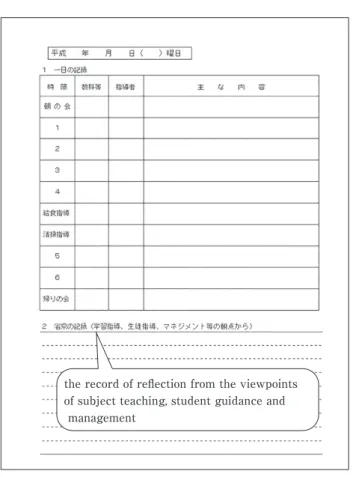
At first, a journal header was changed as shown in Fig. 1. That is, “the record of the lessons, Table 2 Training Program
Table 1 Practical Instructional Competence
the record of reflection from the viewpoints of subject teaching, student guidance and management
describe what you became aware of, what you were impressed with, and any questions you may have had” was changed to “the record of reflection from the viewpoints of subject teaching, student guidance and management”. Secondly, what made a reflective practitioner was emphasized even more in the lessons. Thirdly, learning how to describe the reflection in the journal was stressed in the lessons.
Evaluation Method
Two evaluation methods were used to evaluate whether the training program was effective. One was a questionnaire and the other was analysis of the journals which was the same as in the last study. Targets were twenty-nine 3rd and 4th grade undergraduate student teachers who experienced four weeks of student teaching at elementary schools from May to June 2015. Twenty-three were 3rd graders and six 4th graders.
・Purpose: Comparison of the answers of the
questionnaire between before and after the training program.
・Date of questionnaire: Pre-questionnaire in
April: Post-questionnaire in June 2015
・Questions: Questions were made according to
three kind of competence: subject teaching, student guidance, management.
・Purpose: Classification of the notes into
categories and comparison with the last study in 2014
・Period of analysis: August 2015 to March 2015 ・Method: At first, the episode which included
reflection was chosen from all journal notes of 29 student teachers. Secondly, the episodes were sorted based on three categories that were also used in 2014. The numbers of each classification were compared.
Practice of the Training Program
Practice: In the lesson to teach teaching skills, the staff member taught from the first step. For example, how to grip the chalk, where to stand in front of the blackboard, and what the stroke order of Japanese characters was. Of course, the staff member taught about “a teacher as a reflective practitioner” in detail and how to write reflection in the journal. Picture 1 shows a science mock lesson, Picture 1 Mock Lesson
in which this student teacher is teaching a chemistry experiment. The student teachers went to each elementary school for teaching practice in the middle of May. Picture 2 shows the physical education lesson, and Picture 3 shows the mathematics lesson. During 4 weeks of teaching practice, student teachers had to write in the journal every day. After the teaching practice, they came back to the university and reflected on the teaching practice in the lesson.
Results and Discussion
The results of the questionnaire are shown in table 3.
The average scores of all questions except
questions No. 10 and 11 were significantly different. For question No. 10, the average score was 4.0, which was the highest in the pre-questionnaire. This meant student teachers already had the competence to control their emotions and behavior before the teaching practice. Therefore it was considered that a significant difference hadn’t been observed in the post-questionnaire. However, almost all the answers had increased significantly.
The procedure of analyzing the journal was same as in 2014. At first, the episode which included reflection was chosen from all journal notes. All the notes were read in detail and the episode was chosen. It didn’t mean one sentence. If a series of sentences of the note showed one story, it was regarded as one Table 3 Questonnaire results
4.16 4.51 4.77 2.77 2.59 2.23 5.87 3.71 2.63 1.42 1.69 3.96
episode.
Here is an example “episode 1” as shown in Table 4. In this case, the student described only what he/ she observed in the lesson. There were no reflections there but fact only. Therefore the episode was thrown away. Only the episode which included reflection was chosen. On the other hand, in the case of “episode 2” as shown in Table 4, the first half was what the student teacher observed. In the second half he/she reflected how his/her instruction was and he/she thought how he/she should pay attention to children’s behavior. Therefore the episode 2 was chosen because reflection was included. The episode which included reflection was called “a reflection episode”. A lot of reflection episodes were chose and typed in the spreadsheet software.
Next, the reflection episodes were classified from the viewpoints of three categories. Category 1 was time and place as shown in Table 5, which showed when and where the reflection episode happened. If the reflection episode happened in the lesson, we classified it into the group named “lesson”, and
counted 1.
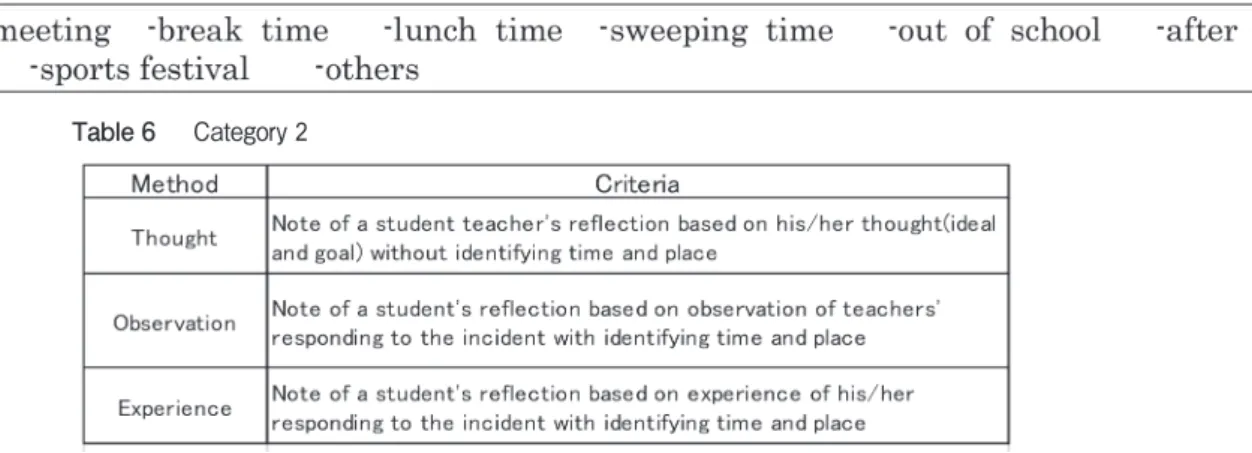
Next, Category 2 was method of reflection as shown in Table 6. The first group named “thought” meant the notes of a student teacher’s reflection based on his/her thought (ideal and goal) without identifying time and place. The second group named
“observation” meant the note of a student’s reflection
based on observation of teachers’ response to the incident with identifying time and place. The third group named “experience” meant note of a student’s reflection based on experience of his/her response to the incident with identifying time and place.
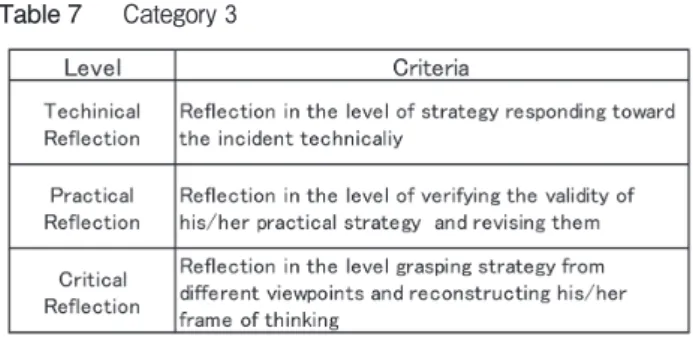
Next, Category 3 was the level of reflection as shown in Table 7. Three levels were introduced. The terms were quoted from those of Van Manen (1977), therefore the meaning was different form them ﹇6﹈. At first, the group named “technical reflection” meant reflection in the level of strategy responding toward the incident technically. Secondly, the group named “practical reflection” meant reflection in the level of verifying the validity of his/ her practical strategy and revising them. Thirdly, the Table 5 Category 1
Table 6 Category 2 Table 4 Examples of Episodes
group named “critical reflection” meant reflection in the level grasping strategy from different viewpoints and reconstructing his/her frame of thinking.
Next, here is an example of classification as shown in Table 8. It explained how to classify and count the reflection episode using the example. At first, according to the category 1, episode A was classified into “lessons”. For category 2, this episode was based on his/her observation, so it was classified into
“observation”. Concerning category 3, this was only
the technical level reflection, so it was classified into
“technical reflection”. In the same way, the reflection
episodes were classified using three categories. The results are shown in Table 9. Table 9 shows the comparison of the cross totaling between category 1(time and place) and category 2 (method) in this study
(left) and the last study (right). At first, there were 617 reflection episodes in total (21.3 episodes per student). The number per student increased compared to the last study. As the period of teaching practice was 20 days, a student teacher faced approximately
Table 7 Category 3
Table 8 Example of Classification
1 Time & Place 2 Method 3 Level
Table 9 Cross Totaling between Category 1 (Time&Place) and Category 2 (Method)
10 23 19 10 8 8 3 15 34 280 9.7 5 3 4 2 0 12 7 151 5.2 21.3 (2015) (2014)
more than one reflection episode per day. It was suggested that the student teachers reflected on their practice more frequently than last year. Secondly for category 1, the group named “lessons” was 290 which were the highest, because they reflected most frequently on the lessons. It was natural because almost of the school life was lesson. The journal header was changed, however, about half of the reflection episodes were written about lessons same as the last study. Thirdly for category 2, the notes based on thought were 186 (6.4 per student), and observation was 280 (9.7 per student), experience was 151 (5.2 per student). The number per student of thought decreased, and the numbers per student of observation and experience increased compared to those of 2014. One of the program goals was to help student teachers to reflect deeply based on their experience. Therefore it was suggested that the student teachers reflected on their practice more deeply than last year.
Table 10 shows the comparison of the cross totaling between category 3 (level) and category 2 (method) in this study (left) and the last study (right). The episodes of practical reflection were 276 (9.5 per student), which was the highest number. Technical reflections were 223 (7.7 per student) and critical reflections were 118 (4.1 per student). The numbers per student of practical reflection and critical reflection increased especially compared to those of 2014. One of the program goals was to help student teachers to reflect critically based on his/her concrete experience. Therefore it was suggested that the student teachers reflected on their practice more
critically than last year.
Conclusion
As a result of the questionnaire, all of the average scores concerning subject teaching competence and student guidance competence had been increased significantly. As a result of analysis of the journal notes, it was revealed that student teachers became to reflect on their practice more deeply and more critically based on their experience. Finally, it was suggested that the training program renewal helped the student teachers to reflect more effectively and was effective to improve practical instructional competence of the student teachers.
References
1. MEXT, the Central Council of Education “The future teacher training and the license system as they ought to be(report)”, 2009 (in Japanese)
http: //www. mext. go. jp/b_menu/shingi/chukyo/chukyo0/ toushin/1212707. htm (2015/7/1 accessed)
2. Schön, D. A. ,
New York: Basic books, 1983, p. 21.
3. Sato, M. , Tokyo: Iwanami Shoten, 1996, p 75 (in Japanese).
4. Sasaki, H., A Discussion on Concrete Image of “Teacher as a Professional” and Problems of Student Teaching.
, 14, 2015
5. Faculty of Children Studies, Chugokugakuen University, teaching practice journal, pp. 2︲3, 2015 (in Japanese)
6. Van Manen, M. (1977). Linking ways of knowing with ways of being practical. 6, pp. 205︲228.
Table 10 Cross Totaling between category 3 (Level) and Category 2 (Method)
5.2 21.3
2 2
3 3
Accepted March 31, 2016.
(2015) (2014)