Report on 2016 Okayama Prefectural University Students’ Beliefs
in Learning English
Sachiko Takahashi
Faculty of Health and Welfare Science Ai Sugimura
Faculty of Computer Science and Systems Engineering
Yoshihiro Minamitsu
Faculty of Health and Welfare Science Yuka Kazahaya
Faculty of Design
Keywords:
Japanese university students, English,
Learner’s belief
The Japanese Ministry of Education, Culture, Sports, Science, and Technology (MEXT) has started a thoroughgoing reform of the whole education system, from elementary level through higher education in 2014. The intention is to reform English education corresponding to the rapid globalization. One critical element of globalization is international communication, which broadly means communication in English. However, the precise English and the language skills needed to meet the requirements of globalization are not necessarily clear— for instance, whether Japanese students are aiming to acquire English as a lingua
franca for business and trade, or whether
they need English because of an increase in the use and importance information and communication technology.
In this context, the Ministry’s efforts to foster English education would be aided by more knowledge about how Japanese university students feel about English, English speakers, and their countries. Many university students lose their original desire to study abroad or make efforts to learn English after entering university, which is a concern because motivation, along with environment, ability, task orientation, and effort is a critical factor influencing second language learners’ success. However, most Japanese students give up making efforts when they encounter difficulty communicating in their second language. To improve students’ English-language communication skills, and to provide them with a better learning environment, Okayama Prefectural University (OPU) implemented a new English Language Program (ELP) in the 2016 academic year. With the university’s adoption of a quarter system in the 2017 academic year, the ELP is expected to enter a new stage in 2017.
This study aims to clarify the beliefs that OPU first-year students had regarding English language education at the beginning of the 2016 academic year.
Literature Review
to do many kinds of cognitive work: planning lessons and courses, understanding learners, managing lessons, assessing the subject, assessing learning, integrating ICT, understanding educational policies and practices, and others. Since the paradigm shift in language learning in recent years from teacher- to learner-centered education, learners’ beliefs have been a major focus. It is useful to investigate learners’ beliefs to understand their cognitive or perceptual learning styles, as their beliefs might be based on their previous learning experiences or on their assumption that a teaching is the best way for them to learn. Put differently, as Lightbown and Spada (2006) state, learners can choose the kinds of strategies they use in learning.
Systematic study of learners’ beliefs started with Horwitz’ (1988) self-report questionnaire, the Beliefs About Language Learning Inventory (BALLI), which covered factors including difficulty of language learning, foreign language aptitude, the nature of language learning, learning and communication strategies, and motivation and expectations. Takahashi (2003) conducted a questionnaire-based study of Japanese university students’ attribution of reasons for their own failure in L2 reading in order to identify their beliefs related to second language learning and to develop their meta-cognitive strategies.
To further improve the current English
Language Program, the present study explores beliefs about learning English, attitudes toward English speakers and their countries among first-year students at OPU. The research question is as follows:
What do OPU first-year students feel about learning English?
Study Participants
A total of 392 students (aged 18 to 19), studying at OPU (a four-year public Japanese university, located in a midsized city in Okayama Prefecture) participated in the study. The university is academically ranked around average for all public universities in Japan (T = 45.0-52.5) by one of the biggest coaching schools for students who wish to enter university (Kawai-juku, 2016). The participants were majoring in any of Health and Welfare Science, Design, or Information Technology. All students were enrolled in English classes and had had at least 6 years of active English. In most cases, they did not learn English at elementary school, but through supplementary lessons at coaching school.
Instrument
The participants were enrolled in a required English course focusing on the four language skills (listening, reading, speaking, and writing). This course involved both in- and out-of-class
activities.
A questionnaire-based survey was conducted at the beginning of the semester. Questionnaire items were created based on the results of previous studies (Clément et al., 1994; Dörnyei et al, 2006; Horwitz, 1988). The questionnaire had been repeatedly scrutinized using principal component analysis over more than ten years and had been reduced to 29 items (Takahashi, 2011, 2012). Two new items composed based on students’ collective voice in the classroom were added to the questionnaire for a total of 31. Questionnaire items appear in Table 1. Four-point Likert-scale items were used to allow the students to express how much they agreed or disagreed (1 = strongly
disagree to 4 = strongly agree) with the
statements.
Table 1. Questionnaire items
1. Studying English enables me to get to know the lifestyle of English-speaking nations.
2. Studying English enables me to learn more about the culture of a language.
3. I sometimes feel uneasy when I have to study English.
4. I get nervous and confused when I am speaking English in my English class.
5. I would like English more if I were in an English-speaking country.
6. Studying English allows me to know what is happening in the world.
7. Most of my favorite musical artists are English speakers.
8. Studying English gives me a sense of achievement.
9. I’m studying English so that I can understand English lectures and write academic papers.
10. Studying English gives me a new, challenging goal.
11. I study English so that I can understand English-language films, videos, TV or radio.
12. I study English so that I can read English poems and novels.
13. I have had a bad experience learning English.
14. I really like learning English. 15. I always feel that the other students
speak English better than I do. 16. I want to join a group that has the
same goal (improving English). 17. Studying English enables me to
succeed in any field.
18. English speakers are sociable and hospitable.
19. I want to spend my life in an English-speaking country.
20. English-speaking cultures appeal to me.
21. I’m studying English so that I can read English articles and books in my field.
write English articles in my field. 23. I’m studying English so that I can
listen to English lectures in my field and comprehend them. 24. I’m studying English so that I can
give an English presentation in my field.
25. With better English proficiency, I can succeed in my future work. 26. With better English proficiency, I
can get any job I wish.
27. I’m studying English just because it’s a required subject.
28. I would like to get better marks in English.
29. I spend more time on English than other subjects.
30. I don’t like English because there is more than one answer in English. 31. I can handle English if I have
enough vocabulary.
Results
Data from all 392 participants were retained for analysis.
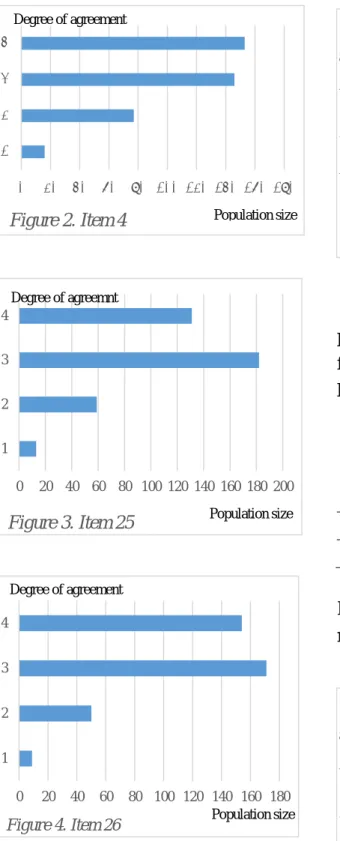
After conducting the analysis, the findings can be summarized as follows. The participants are presumed to have agreed with the following items because their means were above 3.0 (agree):
2. Studying English enables me to learn more about the culture of English as a language,
4. I get nervous and confused when I am speaking English in my English class, 25. With better English proficiency, I can
succeed in my future work,
26. With better English proficiency, I can get any job I wish, and
28. I would like to get better marks in English.
A descriptive analysis of the results for these items appears in Table 2.
Table 2. Descriptive analysis for Items 2, 4, 25, 26, and 28 Item n M SD 2 392 3.01 .74 4 392 3.11 .86 25 385 3.12 .78 26 384 3.22 .75 28 385 3.37 .70
The following figures (Figures 1-5) show their distribution of the surveyed population for Items 2, 4, 25, 26, and 28, respectively. The students’ responses range between 1 (strongly disagree) and 4 (strongly agree). 0 20 40 60 80 100 120 140 160 180 200 220 1 2 3 4
Figure 1. Item 2 Population size Degree of agreement
In contrast, the participants are presumed to have disagreed with the following items because the means were below 2.0 (disagree):
7. Most of my favorite musical artists are English speakers.
Table 3. Descriptive analyses for Items 7
Item n M SD
7 392 1.81 .84
Figure 6 shows the distribution of the responses for this item.
0 20 40 60 80 100 120 140 160 180 1 2 3 4 Figure 2. Item 4 Degree of agreement Population size 0 20 40 60 80 100 120 140 160 180 200 1 2 3 4
Figure 3. Item 25 Population size
Degree of agreemnt 0 20 40 60 80 100 120 140 160 180 1 2 3 4
Figure 4. Item 26 Population size
Degree of agreement 0 20 40 60 80 100 120 140 160 180 200 1 2 3 4
Figure 5. Item 28 Population size
Degree of agreement 0 20 40 60 80 100 120 140 160 180 1 2 3 4
Figure 6. Item 7 Population size Degree of agreement
Discussion
In this section, the research question is answered based on the above results and the implications then discussed. It was:
What do OPU students feel about learning English?
First, many students felt that “Studying English enables them to learn more about the culture of a language.” This shows that the students have an integrative motivational orientation toward English cultures. As Dörnyei (2001) states, integrativeness involves a composite of various L2-related attitudes (social, cultural, ethnolinguistic, etc.), as well as a general interest in “foreignness” and foreign languages.
Second, the item “I get nervous and confused when I am speaking English in my English class,” shows an anxiety about learning English and, in particular, speaking English.
Third, the items “With better English proficiency, I can succeed in my future work,” “With better English proficiency, I can get any job I wish,” and “I would like to get better marks in English” show instrumental motivation, that is, a desire to gain the consequences expected to result from making efforts to learn a second language.
On the other hand, the target students did not feel that most of their favorite musical artists were English speakers. This might be because Japanese or other Asian songs are more popular than
English songs among Japanese university students. It may show that Western music is not attractive enough to motivate them to learn English.
What can be inferred from the results?
Although qualitative research may be more sensitive than quantitative research to the learner’s voice, the present study was able to identify certain important beliefs of the participating English learners using a quantitative method. The results show by the relative importance of particular goals and incentives that the target students had both integrative and instrumental motivation, which is an ideal learning condition. The target students seemed to have a clear idea of how to use English. They also wish to integrate with English culture. Both integrativeness and instrumentality on their own can initiate and maintain students’ motivation to learn English.
At the same time, the target students were found to feel anxiety about speaking in English. They had received their English education under a course of study that was in the process of being tested and improved. Some students might have started learning English very early, but not all of them had had an English program in the early stage of their elementary school days. Although MEXT is planning to start English education early in the elementary school stage, the target students had not gained the benefit
of it; this change might help address the anxiety issue.
What pedagogical implications can be Derived?
The results of the present study imply that teachers teaching English to university students should be aware that a large percentage of these students initially had strong motivation to learn English and desire to acquire English skills and English culture by learning English. Teachers should be careful not to discourage students from wanting to learn. To do so, they should look at their students’ needs and prepare an environment that encourages them to construct their own language learning in the most effective way. Because “learning never takes place in a vacuum” (William & Burden, 1997, p.84), teachers must be more conscious of factors perceived by students to be important.
Conclusion
This study looked at the beliefs of OPU first-year students related to their learning of English at the beginning of the 2016 academic year. The students showed both integrative and instrumental motivation, but also an anxiety about speaking English. The finding suggests that students may need considerate teaching and encouragement.
This work was approved by Okayama Prefectural University Ethics Committee: No.16-05.
References
Dörnyei, Z., & Ushioda, E. (2010).
Teaching and researching Motivation.
London: Routledge.
Horwitz, E. K. (1988). The beliefs about language learning of beginning university foreign language students.
Modern Language Journal, 72,
283-294.
Kawai-juku, Kei-net, (2016). Nyushi nani yoso ranking (Difficulty ranking of universities in Japan). Retrieved from
http://www.keinet.ne.jp/rank/17/dk06. pdf/ 2016 .12. 09.
Lightbown, P. M, & Spada, N. (2005). Individual differences in second language learning. How languages are
learned. Oxford, Oxford University
Press.
Ministry of Education, Culture, Sports, Science and Technology. (2014). English education reform plan corresponding to globalization. Retrieved from
http://www.mext.go.jp/en/news/topics /detail/__icsFiles/afieldfile/2014/01/2 3/1343591_1.pdf
Takahashi, S. (2003). The role of
attribution for success and failure in second language reading by Japanese university students (Doctoral
dissertation, Temple University). Retrieved from ProQuest
Dissertations and Theses database. (UMI No. 3097731)
Takahashi, S. (2011). Attribution theory, self-efficacy theory, and their role in metacognitive strategy training in L2 reading. Notre Dame Seishin
University Kiyo, 35, 108-116.
Takahashi, S. (2012). The effects of metacognitive monitoring training on L2 reading. Notre Dame Seishin
University Kiyo, 36, 111-119.
Williams, M., & Burden, R. L. (1997). Psychology for language teachers. Cambridge, Cambridge University Press. 高橋幸子・保健福祉学部 杉村藍 ・情報工学部 南津佳広・保健福祉学部 風早由佳・デザイン学部 本稿は、岡山県立大学 1 年生を対象とし て、大学入学当初の 5 月に学習者ビリー フを実施した報告である。平成 27 年度か ら新しい英語プログラムである English Language Program (ELP) が始まった。この 報告は、ELP を始めるにあたって、岡山 県立大学に入学した 1 年生が、英語学習 に対して、どのような学習者ビリーフを 持っているのかを量的に調査したもので ある。主な結果として、大半の学生が、 統合的および道具的動機を持っていた。 また、入学当初には、スピーキングに対 して、不安を抱えていたことも明らかに された。 キーワード: 大学生 英語 学習者ビリーフ