A Study on the Current State and Issues of Offshore
Development Involving International Collaboration
with Japan: Business Model of Trilateral
Cooperation Between Japan, Nepal, and South
Korea
Tetsuro Saisho
Kokushikan University [email protected]Abstract - In the Japanese IT industry, there is a marked shortage of IT human resources due to the expansion of IT utilization and e-business, the aging of system engineers, deteriorating working conditions, difficulties in technology succession, and the diversification and sophistication of technology acquisition. The supply of IT human resources is continually unable to keep up with the ever-increasing demand, it is becoming difficult to secure IT human resources year by year, and the shortage is expected to continue in the future.
In Japanese information system development, overseas IT human resources, such as those obtained through offshore development, are actively utilized to make up for the IT human resource shortage. Recently, a new offshore development business model has been developed, in which foreign engineers who wish to work for Japanese IT companies come to Japan to develop information systems, through international cooperation between Japan and developing countries; and a win-win relationship has been established in offshore development involving international cooperation, between Japan and neighboring South Korea and Least Developed Countries (LDCs).
In this study, offshore development involving international cooperation is defined as a development method involving on-site service in offshore development outsourced to overseas, or offshore development utilizing foreigners. After a general examination of the concept, we consider the current state and issues regarding offshore development involving international cooperation between Japan, Nepal, and South Korea.
1. INTRODUCTION
In the modern global information society, offshoring that involves the outsourcing of Japanese business overseas is becoming increasingly common. A typical offshored business is information system development; however, the practice is now found in a wide range of industries, such as the overseas transfer of manufacturing departments in the manufacturing industry, overseas parts procurement, and the establishment of overseas customer service call centers. Today, offshore information system development, which is an outsourcing of information system development to overseas, is a general, non-specialized form of business, though it involves the consignment of business to an overseas third party or a company's overseas base.
On-site offshore development services are also attracting increasing attention. Engineers from overseas companies with outsourced operations are frequently dispatched to Japanese IT (information technology) companies, and in one business variant, such companies are themselves responsible for system development. In the Japanese IT business, there are, in addition, cases of offshore development involving international collaboration. In this case, foreign engineers who wish to work at a Japanese IT company are educated locally in Japanese and IT. When this education is completed, such engineers are hired by Japanese IT companies to develop their information systems, in a new business form variant. Offshore development through international collaboration is an offshore development model that has enabled the formation of a win-win relationship between Japan, which has a marked shortage of IT human resources, and developing countries that are trying to increase employment. In the Japanese IT industry, the IT human resource supply cannot keep up with the growth in demand, and it is becoming more difficult to secure IT human resources year
by year. In contrast, in developing countries, where the domestic industry is not well developed, even domestic human resources that graduate from university often cannot find employment that calls for their specialized skills, such as in the IT field. Thus, the Japanese IT industry is actively utilizing overseas IT human resources through offshore development, in order to make up for the increasingly acute shortage of IT human resources.
From the early 2000s to the early 2010s, a considerable amount of research was conducted on Japanese offshore development, mainly targeting China. However, since then (as of 2020), the number of such studies has gradually decreased, with markedly few studies, either in English or Japanese, on on-site offshore development services, including nearshore development (outsourcing to local cities in Japan).
In Japan's IT industry, Asian countries are the main
recipients (business target countries) of offshore
development contracts. Currently, Japan's offshore development target countries are expanding, from the initial targets of China and India, to ASEAN (Association of Southeast Asian Nations) countries such as Vietnam, Philippines, and Indonesia, and LDCs (Least Developed Countries) such as Bangladesh and Nepal (Federal Democratic Republic of Nepal).
In this study, offshore development involving international cooperation is defined as a development method involving on-site service in offshore development outsourced to overseas, or offshore development utilizing foreigners. Nepal will be discussed as an example of a country targeted for offshore development involving international cooperation between Japan and LDCs.
Until now, most of the research on Nepal has focused on its culture, poverty, education, and social issues. There has been very little research, either in English or Japanese, on Nepal's industries, companies, or business models; and though there are a few recent studies on Japanese offshore development, the practice has been most active in Asia. In general, however, offshore development is a valuable research field, as the practice is utilized by many companies and continues to develop in various business forms.
The future development of offshore development in Nepal, then, is an instructive and useful business model for promoting IT industrial policy in the Asian region and among LDCs. Therefore, in this paper (1), we will focus on offshore development involving trilateral cooperation between Japan, Nepal, and South Korea. South Korea is participating in international collaboration in Japanese employment education in Nepal. Then, focusing on a recent field survey in Nepal (2), we will consider the current state and issues involved in a new offshore development model that involves the active utilization of overseas IT human resources to make up for the shortage of such resources in Japan.
2. OVERVIEW OF NEPAL AND ITS IT INDUSTRY
Nepal borders India on the east, west, and south, and the Tibet Autonomous Region of China on the north. It a long and narrow landlocked country running from northwest to southeast, and is primarily defined by the Himalayas, including the world's highest peak (Mt. Everest, in the Sagarmata Zone), the central hills, and the Tarai Plain in the south.
The area of Nepal, 147,181 km2 (93th in the world), is about 40% that of Japan. It has a population of 28.7 million (2018) and population growth rate of 1.1% (2017). Though it is a multi-ethnic nation, 80% of its people follow the Hindu religion. Its capital and largest city is Kathmandu, with an area of 50.67 km2 and a population of roughly 1.4 million (2020) (EJN, 2019).
Nepal's economy has a nominal GDP (Gross Domestic Product) of approximately USD 30.69 billion (102th / 192 countries), a per capita GDP of approximately USD 1,078.56 (165th / 191 countries), and a real GDP growth rate 7.05% (9th / 192 countries). It is one of the LDCs (IMF, 2020) (MOFA, 2020). The percentage GDP by industry in Nepal is 26.5% for agriculture and forestry, followed by 14.4% for wholesale, 11.5% for real estate, 7.8% for construction, and 7.2% for transportation.
The working population of Nepal by domestic industry is 64.0% for agriculture, forestry and fisheries, 7.0% for wholesale, 5.9% for manufacturing, and 5.7% for social services (public servants) (EJN, 2019). Nepal's main industry, in terms of GDP and working population, is agriculture and forestry, and the IT industry forms only a small part of the emerging industry sector.
The Nepalese government has listed IT and BPO (Business Process Outsourcing)(3) as one of five priority export service sectors in the 2010 NTIS (Nepal Trade Integration Strategy) (FNCCI, 2020). IT outsourcing (offshore development, etc.) in IT/BPO is also called ITS-BPO (Informational Technology Enable Services-Business Process Outsourcing) of Nepal.
Nepal provides BPO services for both domestic and international markets. In Nepal, the labor cost of IT engineers is very low compared (4) to IT-oriented countries such as India and China. In addition, though more than 100 languages are spoken in Nepal, the population is large enough to communicate in English, especially in urban areas, so the country can function as an outsource for offshore development from Western countries.
The Nepalese government is implementing an IT industry policy with emphasis on development of the IT industry, which is an environmentally friendly industrial sector; and the IT industry is growing (developing) rapidly because it is focusing on developing IT human resources who support the industry. Since 2010, Nepal's IT industry has seen high growth and investment, and is expected to show great profit potential in the future, eventually becoming one of the most important growth areas of the domestic economy.
In Nepal, Japan is promoting an IT industry policy modeled on that of neighboring India, aiming at
development of the country through the establishment of IT training institutions and the development of IT parks. Overall, Nepal's IT industry is attracting attention as a new offshore development contractor (business target country), to replace India, China, and other ASEANs, where labor costs are soaring.
The country has developed dynamic economic activities and corporate behavior not found in Japan, and has shown a high GDP growth rate of 7.05% (2019), with a total GDP of USD 30.69 billion (2019) (IMF, 2020). One of the engines of economic growth in Nepal is its commitment to the IT industry, but its IT industry has only a brief history.
All private elementary school classes in Nepal are conducted in English, not in the national language, Nepali; and the percentage of English-speaking people is high, especially in the metropolitan and other urban areas. Since most private Nepalese companies (including IT companies) use English in business, Nepal has been selected as a target country for offshore development by Western companies.
However, because the progress of industrialization in Nepal is slow, the employment is largely limited to agriculture, forestry, and tourism, and many Nepalese go to work abroad. Therefore, even human resources graduating from university often cannot find employment as professionals; the overall unemployment rate in Nepal is 11.2% (2019), and the unemployment rate for those with advanced education is also very high at 8.46% (2017) (EJN, 2019) (World Bank, 2020).
In other words, in Nepal, there are very few opportunities to work in the IT industry, even for those who receive higher education as IT engineers. For this reason, many Nepalese university students wish to work in the Japanese IT industry, in order to utilize the expertise they have learned at university or to access professional employment opportunities.
As a result, young Nepalese IT engineers are expected to improve their skills and careers by gaining practical experience as white-collar workers, instead of unskilled labor (migrant workers), in Japan; and when they later return to Nepal, they are expected to contribute to the economic development of their own country, based on their experience working in Japan.
Nepal established diplomatic relations with Japan in 1956. Since then, it has been one of the world's most pro-Japanese countries, and has established friendly and constructive relations through reciprocal activities such as tourism.
As of the end of October 2019, the number of foreign workers in Japan was 1,658,804, 198,341 more than at the same period of the previous year (for an increase of 13.6%) and a record high since the Japanese mandatory foreign worker notification policy was implemented in 2007. During the same period, the top three countries with the highest growth rates of foreign workers in Japan were Vietnam with a 26.7% increase (401,326 workers), Indonesia with a 23.4% increase (51,337 workers), and
Nepal with a 12.5% increase (91,770 workers) (MHLW, 2020a).
As aforementioned, the number of Nepalese workers in Japan is growing rapidly; in fact, there are 10 times more now than there were 10 years ago. In Okinawa Prefecture, for example, the largest number of foreign workers are Nepalese, accounting for 25% of the foreign workers. And as of May 1, 2019, the number of Nepalese students in Japan was 26,308 (up 1,977 from the previous year), the greatest number of international students after China and Vietnam (MEXT, 2020).
The friendly relationship between Japan and Nepal has now spread to the business side, with Nepal attracting Japanese attention as a target country for active offshore development.
3. THE JAPANESE IT INDUSTRY AND OFFSHORE DEVELOPMENT
The market size of the Japanese IT industry is expanding year by year due to the construction of new systems, the expansion of IT utilization in business, and the creation of new e-businesses. On the other hand, the shortage of IT human resources in Japan has become acute due to the aging of IT engineers, worsening working conditions, difficulties in passing on technology, and diversification and sophistication in technology acquisition (Saisho, 2020b).
According to a survey by Japan’s Ministry of Economy, Trade and Industry (METI), the supply of IT human resources in Japan peaked in 2019 and is now in a state of continual decline. The content of the survey, in 2020, the shortage in human resources in the information security field is expected to increase to just under 200,000, and the human resource shortage in the advanced IT field will increase to 48,000 (METI, 2016).
According to a survey by Mizuho Information Research Institute (consigned by METI), by 2018, there will be a supply-demand gap in IT human resources in Japan, and the human resource shortage will increase from 164,000 to 787,000 in 2030. It is expected to expand to (based on an output gap of IT human resources 0.7%) (MIRI, 2019).
Unsurprisingly, then, the effective job openings-to-applicants ratio (excluding part-time positions) by occupation in Japan, as announced by the Ministry of Health, Labor and Welfare in October 2020, was 1.20 for information processing and communication engineers, compared to 0.97 for all occupations, suggesting a critical labor shortage in the IT field (MHLW, 2020b).
In the Japanese IT industry, then, the supply of IT human resources continues to be unable to keep up with the ever-growing demand, and it is becoming difficult to secure IT human resources year by year, with even greater shortages projected for the future. Thus, in recent years, in order to address this shortage, offshore development that actively utilizes overseas IT human resources in information system development has been promoted in Japan.
Japanese IT offshore development (5) can be roughly divided into three main business variants: (1) basic overseas outsourcing for information system development, (2) on-site offshore development service by dispatched foreign engineers (system development at customer locations), and
(3) offshore development involving international
cooperation, depending on the respective IT engineer human resource management method.
(1) Basic offshore development is a business variant in which system development is simply outsourced overseas, with foreign IT engineers (IT human resources) being contracted and system development performed locally. The main strengths of this variant are cost reduction and comparatively easy human resource access; the main weakness is the need for bridge SEs (6), to ensure effective communication regarding requirements, progress, etc.
(2) On-site offshore development service involves foreign IT engineers (IT human resources) being invited to Japan and dispatched to customers for system development. The main strengths of this variant are that important information is kept within the company, and the work can be monitored, informed, and improved by the dispatching company; the main weaknesses are that the dispatched staff handles the assigned work of the company, so the business know-how is accumulated by non-company staff, and again there are communicational challenges.
(3) In offshore development involving international cooperation, foreign IT engineers (IT human resources) actually join Japanese IT companies and perform system development at the companies. The main strengths of this variant are that it is possible to hire human resources with high Japanese proficiency, it is easier to manage the progress of work by hiring in Japan, and there are few or no problems in communicating with the client regarding the system development. The main weaknesses are the time and cost required for hiring, and the relocation expenses, such as the application fee for residence status (visa), airline tickets, and housing (including hotel stay).
Japanese offshore development has thus far been primarily aimed at cost reductions related to overseas (mainly Asian) labor costs, which are generally lower than in Japan. Recently, however, not only cost reduction but high-quality human resource access has been targeted by the practice, due to the aforementioned IT labor shortage in Japan.
Japanese offshore development began with China and India, and then spread to a number of ASEAN countries such as Vietnam and the Philippines, with the recent addition of LDCs such as Bangladesh and Nepal (Saisho, 2020b).
It is expected that the shortage of IT human resources in Japan will continue, and not be easily resolved. Thus, the Japanese IT industry is actively utilizing overseas IT human resources, in offshore system development for example, to address this shortage. Offshore system development involving international collaboration typically also involves
industry-academia-government collaboration,
industry-academia collaboration, industry-industry collaboration, etc., between Japan and other countries. In this business variant, a foreign IT engineer who wishes to work for a Japanese IT company will come to Japan, work as an employee of the Japanese company, and take charge of system development.
In the case of offshore development involving international cooperation between Japan and the LDCs, Nepal and Bangladesh participate based on two different but related models. International cooperation with Bangladesh is based on a simple, two-country model involving Japan and Bangladesh; whereas, international cooperation with Nepal is based not merely on this simpler model, but also on a more complex model involving the three countries of Japan, Nepal, and South Korea (RSIS, 2019). With its more complex profile, Nepal, will here be considered as an example of a target country for offshore development involving international cooperation between Japan and the LDCs.
4. A NEW BUSINESS MODEL FOR OFFSHORE DEVELOPMENT
While the shortage of IT human resources in Japan continues, Japan, South Korea, and Nepal are building a new business model (7) for trilateral cooperation in offshore development. The model consists of (1) Company A in Japan (8), (2) Yeungjin College in South Korea, and (3) Tribhuvan University, (4) Kathmandu University, (5) and Mid-Valley International College (MVIC) in Nepal.
(1) Company A in Japan was established in November 2007 to develop cross-border human resource business matching, and has branch offices in three countries: China, Vietnam, and Myanmar. Company A's business is centered on global recruitment and worker dispatch. Its primary developmental focuses are (a) global recruitment, to acquire excellent human resources for companies; (b) student recruitment and employment support services, for educational institutions seeking to internationalize and receive foreign students; and (c) solving social problems and revitalizing the Japanese economy by welcoming and introducing foreign human resources to Japan, for regional governments and local governments.
The core competence of Company A is the provision of a global online platform, using an in-house developed database (DB), which connects human resources and companies around the world based on artificial intelligence (AI) matching. The DB is used to match the respective criteria desired by recruitment candidates (applicants) and companies, and thereby automatically determine the most suitable matches between human resources and companies. Such AI matching connects human resources and companies across national borders in a form of borderless recruiting, and offers a form of direct recruiting (via the online platform) for foreign job seekers who want to work in Japan and companies who want to hire highly qualified foreign nationals.
(2) Yeungjin University in South Korea provides bachelor's degree certification education (equivalent to that of Japanese junior colleges), sanctioned by the South Korean Ministry of Education (Yeungjin University, 2020). The university was established in March 1977 as Yeungjin College of Technology. Since then, departments with a business focus have been established, the departments have been reorganized, and some names have been changed.
Yeungjin University’s mission is to train mid-career professionals who will form part of an efficient supply and demand balance of professional engineers in South Korea as an industrial society, responding effectively to the rapidly increasing sophistication of technical personnel. In 1994, the university established its own custom-made educational system (on-demand training), South Korea's first business-oriented education system based on the educational requirements of companies. The system accepts advance orders for specific educational content and objectives, such as curriculum and requisite employee numbers, and provides training for specialized engineers that meet the needs of specific companies. Finally, a dedicated company was established to facilitate the employment of the university’s graduates.
Yeungjin University has a university secretariat in Japan (in a private Tokyo company), and more than 100 of its graduates are employed in Japan every year. In South Korea, it has provided custom-made education for 9,123 students, later employed by 775 South Korean companies, including top companies such as Samsung and LG.
Overseas, the university has provided international order-based education for 2,180 students from 173 companies in 11 countries, such as Japan, China, the United States, and Dubai. In addition, Yeungjin University will establish an affiliated organization, the South Korea-Japan
Enterprise Support Center, introduce custom-made
education for Japan, improve the external competitiveness of regional companies through Japan-South Korea technology exchange, and promote industrial and technical cooperation between the two countries.
(3) Established in 1959, Tribhuvan University was the first institute of higher education in Nepal, and is now the largest national university in the country (Tribhuvan University, 2020). Its mission is to develop the human resources needed for the overall development of Nepal, and to provide standardized higher education, preserving the culture and traditions of Nepal, and pursuing the wide-ranging, empirical, and timely acquisition of knowledge and research in the fields of art, science, technology, and the professions.
The university has five institutes (Institute of Medicine, Institute of Forestry, Institute of Agriculture and Animal Science, Institute of Science and Technology, and Institute of Engineering) and four faculties (Faculty of law, Faculty of Humanities and Social Sciences, Faculty of Management, and Faculty of Education). It has 40 central departments, 62 constituent campuses, and 1,062 partner universities in various disciplines.
Tribhuvan University's four research centers, the Center for Economic Development and Administration (CEDA), Center for Nepal and Asian Studies (CNAS), Research Center for Applied Science and Technology (RECAST), and Research Center for Educational Innovation and Development (CERID), are among the world's foremost in terms of size and program diversity. Overall, the university contributes to the development and modernization of Nepal, the development of human resources, and the development of Nepal’s society, culture, and economy.
(4) Kathmandu University, founded in 1991, is Nepal's second national university and boasts seven faculties: the School of Arts (SoA), School of Education (SoEd), School of Engineering (SoE), School of Law (SoL), School of Management (SoM), School of Medical Sciences (SoMs), and School of Science (SoS) ); as well as the Confucius Institute, the KU Technical Training Center (KUTTC), and a number of Affiliated Colleges (Kathmandu University, 2020). The mission of the university is to provide quality education for leadership, with the aim of becoming a world-class university dedicated to bringing advanced knowledge and technology to human services, serving the people by utilizing knowledge and skills to meet the needs of society.
The Confucius Institute of Kathmandu University is a Chinese Language and Culture institution, cooperatively established by Hebei University of Economics and Business in China and Kathmandu University, with the ratification of the Chinese Language Council International. It is the first Confucius Institute in Nepal. The Technical Training Centre of Kathmandu University was established to train a highly skilled workforce for advancing technologies in the manufacturing sectors.
The university’s academic program is notable for having introduced to Nepal most of its research disciplines, and collaborates with more than 160 universities and related organizations, in Japan and overseas, to continuously improve the level of education.
(5) MVIC was established in 2011, and has two faculties, respectively offering a Bachelor of Business Hospitality Management (BBHM) and a Bachelor of Business Finance (BBF); as well as vocational and technical institutions (the Council for Technical Education and Vocational Training (CTEVT) and the Euro Skills Technical & Vocational Academy (ETVA)), an International Masters Degree Program, and an Internship Program (MVIC, 2020). MVIC's mission is to provide a first-class education based on knowledge, skills, and professionalism, leading to the obtainment of an internationally recognized degree. Its aim is to provide advanced human resources to meet the needs of business and industry, equipping its students with valuable knowledge and skills, and contributing to the economic development of Nepal.
As noted above, MVIC's vocational training is provided by two institutions: CTEVT and ETVA. CTEVT offers technical and vocational education and training to develop skilled human resources for the Nepalese nation, with the aim of creating a valuable workforce to meet the needs of
the Nepalese and international markets. ETVA, a EuroSkills Malaysia training center certified by the Ministry of Labor of Malaysia, provides a broad range of education, to produce high-quality human resources with a wide range of skills for a variety of fields.
The three-country collaboration model involving Japan, South Korea, and Nepal is the provision of the Advanced IT Human Resources Japan Employment Program (hereinafter, the Japan Employment Program)(9), which promotes IT human resource development and employment for Nepalese
universities (Newsweekjapan, 2019). The Japan
Employment Program also provides Japanese language and practical IT lessons necessary for Nepalese graduates to work in Japan, offers employment security after graduation, and contributes to filling the shortage of IT human resources in Japan.
In the Japan employment program, based on the Japan-South Korea-Nepal trilateral cooperation model, advanced IT human resources, who will work in Japan in the future, are trained at the top universities in Nepal. Yeungjin University in South Korea and Nepal's top universities, which latter lead the world in the number of graduates employed by Japanese companies, are jointly offering a Japanese employment program known as the "Japanese scholarship course based on the trilateral cooperation model".
The Japan Employment Program provides a business matching service on a global online platform, for highly-skilled Nepalese IT human resources who wish to work in Japan and Japanese companies with a shortage of IT human resources. The selection process for the Japan Employment Program is entirely managed by the global online platform.
In addition, unlike conventional performance-based
recruitment services, the global online platform has a fixed monthly service usage fee, so the more hires a company makes, the lower the hiring cost per person.
Company A provides a Japanese employment program for Nepalese students who have passed the company entrance selection test at one of the top IT universities in Nepal. Nepalese students are granted a scholarship if they have received a job offer from a Japanese company, but students who do not receive such an offer can also enter the program. The program includes a two-year "Japanese language scholarship course based on the three-country collaboration model".
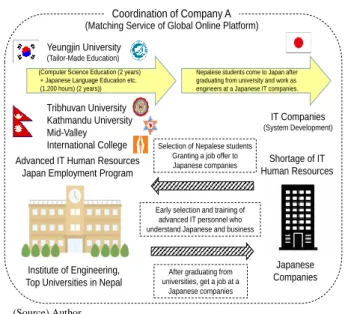
The Japanese Employment Program meets the unique educational needs of companies in Japan. It uses the education curriculum of Yeungjin University in South Korea, which has the highest number of employments receiving custom-made education in Japanese companies (custom-made classes provided by Japanese companies). Japan, South Korea, and Nepal cooperate in offshore development through this program, Selection of Nepalese students, granting a job offer to Japanese companies, and After graduating from universities, get a job at a Japan companies, to create advanced IT human resources to work in Japan (Figure 1).
At the top IT universities in Nepal, computer science education (2 years) and Japanese language education (1,200 hours: 2 years) will be implemented as part of the Japan Employment Program. In addition, the Program will carry out early selection and training of Nepalese university students, to secure advanced IT human resources who understand Japanese and business. Then, the students of the Program will be educated in Japanese business etiquette, in addition to Japanese, in preparation for full-time employment at Japanese IT companies after graduation from university.
In addition, students will receive the education necessary for employment in Japan, such as training tailored to the unique educational needs of the hiring company; for example, training of specialized IT engineers in various fields such as mainframe, mobile, network, website, database, package, game, e-commerce, fund settlement, etc., development.
5. CONCLUSION
Based on the Japan-South Korea-Nepal trilateral cooperation model, the Japan Employment Program is a business model that develops advanced IT human resources in Nepal who will work in Japan in the future. The model enables a win-win relationship that benefits the three parties: Japan, which is in need of IT human resources; South Korea, which wants to provide its own education system; and Nepal’s IT engineers (human resources in developing countries) who want to work in Japan.
However, the model does not depend on industry-academia-government collaboration, in which the ‘public’
(government) participates in industry-academia
collaboration. In other cases of Japanese international cooperation, the resources are provided by the government,
Figure 1. Offshore Development through Trilateral Collaboration (Source) Author. Yeungjin University (Tailor-Made Education) Tribhuvan University Kathmandu University Mid-Valley International College Institute of Engineering, Top Universities in Nepal
Japanese Companies IT Companies
(System Development) Selection of Nepalese students
Granting a job offer to Japanese companies
After graduating from universities, get a job at a
Japanese companies Early selection and training of
advanced IT personnel who understand Japanese and business
Coordination of Company A
(Matching Service of Global Online Platform)
Advanced IT Human Resources Japan Employment Program
Shortage of IT Human Resources
(Computer Science Education (2 years) + Japanese Language Education etc. (1,200 hours) (2 years))
Nepalese students come to Japan after graduating from university and work as engineers at a Japanese IT companies.
JICA (the Japan International Cooperation Agency), and/or local governments, facilitating stable implementation and operation. For stable operation of the Japan Employment Program model, on the other hand, it is necessary to access resources other than private companies and universities.
Further, in Japan, even in the same industry, there are business rules for each individual IT company, with no unified industry rules (coding rules, etc.). Therefore, even if Nepalese IT engineers receive company-focused education, it may take time for them to get used to the Japanese IT companies’ protocols, and thus may not be ready for immediate responsibility. In addition, when Nepalese nationals work in Japan (excluding on-site system development), the salary system is the same as for Japanese workers, so no significant cost reduction can be expected. In general, for all its international strengths, the Japan Employment Program model must be informed by a thorough understanding of system development in Japan, not in Nepal.
Currently, the coronavirus pandemic exerts a great influence on the model’s functionality as well. For example, though not limited to those participating in the model program, the Japanese government has stopped issuing new work visas; so that, even if Japanese IT companies offer employment to advanced IT personnel in Nepal, such personnel cannot come to Japan, and companies cannot resume related recruiting activities until there is a real prospect of them being able to do so.
As aforementioned, Nepal is a multi-ethnic country with many religions, but more than 80% of its population follows the Hindu religion; and while the caste system was officially abolished in 1962, remnants of the system remain. Therefore, it is necessary for the model to be take into consideration the religion, culture, dietary habits, etc., of the Nepalese. Offshore development involving international cooperation among the three countries has just begun; the results of future efforts will determine the success or failure of such business models in developing countries.
ACKNOWLEDGMENTS
This work was supported by the JSPS KAKENHI Grant-in-Aid for Scientific Research (B) Number 19H01532.
NOTES
(1). This paper has been significantly revised, partly based on the author ’ s "New Business Model for Offshore Development in the Federal Democratic Republic of Nepal: The Japan/South Korea/Nepal Trilateral Cooperation Model (APCIM 2020)" (Saisho, 2020a).
(2). Participated in the 14th IFEAMA International Conference held in Nepal, March 29, 2017 (Thursday); visited R&D Bridge Kathmandu Pvt. Ltd. and Tribhuvan University, Institute of Engineering in Kathmandu; and conducted interview surveys.
(3). BPO means that a company outsources (all or partial) business processes, other than core business, to an external specialist. In the IT industry, BPO is being actively utilized because there is no need for new capital investment when outsourcing.
(4). As of 2020, the monthly wages in Asia were about 70,000 yen for mid-level engineers in China, about 50,000 yen for mid-level IT engineers in India and IT engineers in Vietnam and Myanmar, about 40,000 yen for IT engineers in Cambodia, and about 30,000 yen for IT engineers in Nepal.
(5). In the past study, Offshore development can be roughly divided into five forms: (1) Bridge offshoring, (2) Deformed bridge offshoring, (3) Direct offshoring, (4) Deformed direct offshoring, and (5) Global offshoring, based on to the outsourced form of system development (Saisho, 2014). (6). A Bridge SE (Bridge System Engineer) is a system engineer who is familiar with not only IT skills but also bilateral business customs such as language and culture (for example, Japan and China, Japan and India, etc.), and is thereby well-equipped to instruct foreigners in IT system development.
(7). Various companies have started programs to train and hire Nepalese IT human resources who want to work in Japan in the future (Newsweekjapan, 2019).
(8). Company A is engaged in (1) recruitment, acceptance, and retention support for human resources from all over the world, (2) technical test management for IT engineers, (3) cross-border human resource business matching (via its platform), (4) online and overseas Japanese language education, (5) servicing government offices and local governments, (6) study abroad support, (7) global marketing research, etc.
(9). In addition to its focus on the IT industry, there is also a Japanese Employment Program variant for the food and beverage service industry (Kitakata Ramen) in Nepal (PR TIMES, 2020).
REFERENCES
EJN [Embassy of Japan in Nepal] (2019), "Illustrated Nepalese Economy
2019", EJN.
<https://www.np.emb-japan.go.jp/jp/pdf/economy2019.pdf> (Accessed on December 25, 2020)
FNCCI [Federation of Nepalese Chambers of Commerce and Industry] (2020), "Information Technology / ICT", FNCCI.
<Http://www.fncci.org/information-technology-ict-151.html> (Accessed on December 25, 2020)
IMF [International Monetary Fund] (2020), World Economic Outlook Database October 2020, "World Economic Outlook Database", IMF.
<Https://www.imf.org/en/Publications/WEO/weo-database/2020/October> (Accessed on December 25, 2020) IT Human Resources Lab (2019), Started a program to train and hire
Nepalese IT human resources who want to work in Japan in the future, "HRzine", Shoeisha. <https://hrzine.jp/article/detail/1963> (Accessed on December 25, 2020)
Kathmandu University HP (2020) <https://www.ku.edu.np/> (Accessed on December 25, 2020)
Newsweekjapan (2019), "First ever! Japan-Korea-Nepal Trilateral
Collaboration Advanced IT Human Resources Japan Employment Program", November 20, 2019, 10:30, CCC Media House.
<https://www.newsweekjapan.jp/press_release/2019/11/000000016000 040269.php> (Accessed on December 25, 2020)
Mid-Valley International College HP (2020)
<http://www.midvalley.edu.np/> (Accessed on December 25, 2020) METI [Ministry of Economy, Trade and Industry] (2016), "Summary of
survey results on the latest trends and future estimates of IT human resources", METI.
<http://www.meti.go.jp/press/2016/06/20160610002/20160610002.pdf > (Accessed April 1, 2020)
MEXT [Ministry of Education, Culture, Sports, Science and Technology of Japan] (2020), "About 'Survey on the status of enrollment of foreign
students' and 'Number of Japanese students studying abroad' etc.",
MEXT. <https://www.mext.go.jp/content/20200421-mxt_gakushi02-100001342_1.pdf> (Accessed December 25, 2020)
MHLW [Ministry of Health, Labor and Welfare of Japan] (2020a), "Summary of Notification Status of 'Foreign Employment Status' (as of
the end of October 2019)", MHLW.
<https://www.mhlw.go.jp/stf/newpage_09109.html> (Accessed on December 25, 2020)
MHLW [Ministry of Health, Labor and Welfare of Japan] (2020b), General Employment Placement Status by Occupation [Real Number] (Regular (excluding part timer)), "General Employment Placement Status
(October 2020)", MHLW.
<https://www.mhlw.go.jp/content/11602000/000698096.pdf> (Accessed on December 25, 2020)
MIRI [Mizuho Information & Research Institute] (2019), "Survey on IT
Human Resources Supply and Demand", MIRI.
<https://www.meti.go.jp/policy/it_policy/jinzai/houkokusyo.pdf> (Accessed December 25, 2020)
MOFA [Ministry of Foreign Affairs of Japan] (2020), Basic Data of Nepal, "Federal Democratic Republic of Nepal", MOFA.
<https://www.mofa.go.jp/mofaj/area/nepal/data.html> (Accessed December 25, 2020)
PR TIMES (2020), "Service-related human resources specialized type!
Japan Employment Customization Class in Nepal”, February 4, 2020,
12:14, PR TIMES.
<https://prtimes.jp/main/html/rd/p/000000018.000040269.html> (Accessed December 25, 2020)
RSIS [Recruit Staffing Information Services] (2019), launches 'Japan Employment Program for Overseas IT Human Resources' in Nepal, "Press Release", RSIS. <https://www.rs-is.co.jp/news/detail/45> (Accessed December 25, 2020)
Tetsuro Saisho (2014), "Innovation System in China and Vietnam
-Innovation Creation Strategy by Industrial Clusters- [2nd Edition]",
Hakuto Shobo.
Tetsuro Saisho (2020a), New Business Model for Offshore Development in Federal Democratic Republic of Nepal -Japan/Korea/Nepal Trilateral Cooperation Model-, "Proceedings of APCIM 2020", pp.46-49, Asia Pacific Conference on Information Management 2020, Gardenvilla Hotel and Online Kaohsiung City, Taiwan (Proceedings).
Tetsuro Saisho (2020b), New Human Resource Management in IT Industry by Miyazaki-Bangladesh Model, Edited by the Tohoku Subcommittee on Japan Academy of Business Administration, "Regional Companies
in Globalization: Co-creation with the Community by Management Philosophy", Bunshindo.
The World Bank (2020), Unemployment with advanced education (% of total labor force with advanced education), "International Labour
Organization, ILOSTAT database. Data retrieved in September 20, 2020", The World Bank.
<https://data.worldbank.org/indicator/SL.UEM.ADVN.ZS> (Accessed December 25, 2020)
Tribhuvan University HP (2020) <http://www.tribhuvan-university.edu.np/> (Accessed December 25, 2020)
Yeungjin Universally HP (2020) <http://yjc-kr.com/index.html> (Accessed December 25, 2020)